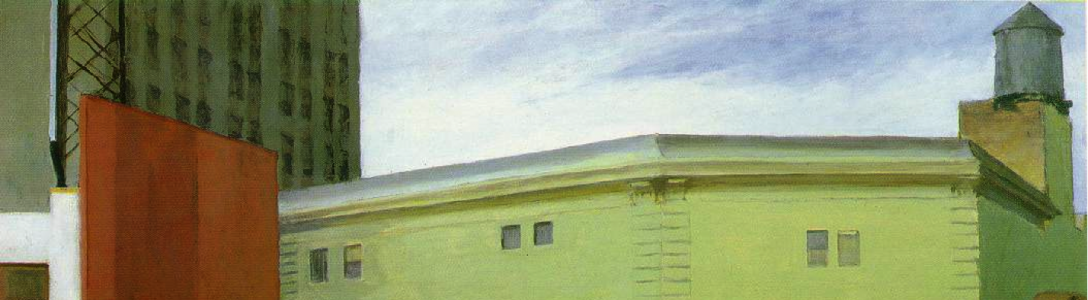
March — Grant Wood

“Martyrdom of Saint Erasmus” (William H. Gass)

week11-0064

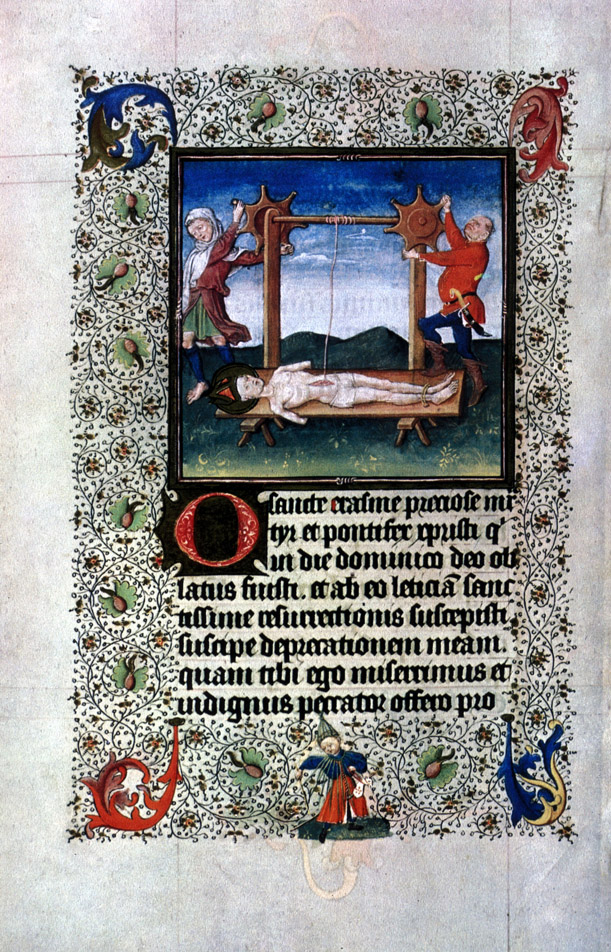
There were images that had nowhere to hang but in his head, images he remembered from books but of which he had no other copy; particularly one, from a strangely beautiful illuminated manuscript called The Hours of Catherine of Cleves, that depicted the martyrdom of Saint Erasmus. The presumptive saint lies on a raised plank, naked except for a loincloth. His abdomen has been opened and his intestines attached to a windlass erected above him. Thereupon, like a length of sausage or a length of rope, his innards are being wound by two figures, one male, one possibly female, each working hard to turn the spokes, their faces, however, averted from the scene. The saint does not appear to have wrists or hands. Eight turns have already been taken. The sky is empty except for a few clouds; the earth is empty except for two hills and some small yellow flowers. Around this painting, framed like a picture, is a delicate thin line made of curlicues and a field of tiny petals stalked by imaginary butterflies. At the bottom a small boy wearing a collar of thin sticks is riding a hobbyhorse.

His curiosity aroused by this calamitous vision, Skizzen sought more bio concerning Saint Erasmus. One source simply said that “although he existed, almost nothing is known about him.” This sentence stayed with Skizzen as stubbornly as the piteous illumination. What a blessed condition Erasmus must have enjoyed! Although he existed, almost nothing was known of him. Although nothing was known of him, as a saint, he existed. He existed, yet he had lived such a saintly life there was nothing of him to be known. Still another authority was not as sanguine. It claimed that the cult of Erasmus spread with such success that twelve hundred years later the martyr was invoked as one of the Fourteen Holy Helpers, whoever they were, and had become patron saint of sailors as well as kids who had colic. What was known, during those hundreds of years, was not known of the saint but of some figure he had thrown about himself as you would a ghostly garment or a costume for the dance. Proudly, Professor Skizzen pasted Erasmus in his memory book. A.d. 300. He was sprayed with tar and set alight. He was jailed, rescued by an angel, disemboweled. On a day in a.d. He died for me.

From William H. Gass’s novel  Middle C.

“To a Poet” — Alexander Pushkin

poet

Rat Evolution — Alexis Rockman

“The feeling of the sublime is a mixed feeling” (Schiller)

The feeling of the sublime is a mixed feeling. It is at once a painful state, which in its paroxysm is manifested by a kind of shudder, and a joyous state, that may rise to rapture, and which, without being properly a pleasure, is greatly preferred to every kind of pleasure by delicate souls. This union of two contrary sensations in one and the same feeling proves in a peremptory manner our moral independence. For as it is absolutely impossible that the same object should be with us in two opposite relations, it follows that it is we ourselves who sustain two different relations with the object. It follows that these two opposed natures should be united in us, which, on the idea of this object, are brought into play in two perfectly opposite ways. Thus we experience by the feeling of the beautiful that the state of our spiritual nature is not necessarily determined by the state of our sensuous nature; that the laws of nature are not necessarily our laws; and that there is in us an autonomous principle independent of all sensuous impressions.

The sublime object may be considered in two lights. We either represent it to our comprehension, and we try in vain to make an image or idea of it, or we refer it to our vital force, and we consider it as a power before which ours is nothing. But though in both cases we experience in connection with this object the painful feeling of our limits, yet we do not seek to avoid it; on the contrary we are attracted to it by an irresistible force. Could this be the case if the limits of our imagination were at the same time those of our comprehension? Should we be willingly called back to the feeling of the omnipotence of the forces of nature if we had not in us something that cannot be a prey of these forces. We are pleased with the spectacle of the sensuous infinite, because we are able to attain by thought what the senses can no longer embrace and what the understanding cannot grasp. The sight of a terrible object transports us with enthusiasm, because we are capable of willing what the instincts reject with horror, and of rejecting what they desire. We willingly allow our imagination to find something in the world of phenomena that passes beyond it; because, after all, it is only one sensuous force that triumphs over another sensuous force, but nature, notwithstanding all her infinity, cannot attain to the absolute grandeur which is in ourselves. We submit willingly to physical necessity both our well-being and our existence. This is because the very power reminds us that there are in us principles that escape its empire. Man is in the hands of nature, but the will of man is in his own hands.

Nature herself has actually used a sensuous means to teach us that we are something more than mere sensuous natures. She has even known how to make use of our sensations to put us on the track of this discovery—that we are by no means subject as slaves to the violence of the sensations. And this is quite a different effect from that which can be produced by the beautiful; I mean the beautiful of the real world, for the sublime itself is surpassed by the ideal. In the presence of beauty, reason and sense are in harmony, and it is only on account of this harmony that the beautiful has attraction for us. Consequently, beauty alone could never teach us that our destination is to act as pure intelligences, and that we are capable of showing ourselves such. In the presence of the sublime, on the contrary, reason and the sensuous are not in harmony, and it is precisely this contradiction between the two which makes the charm of the sublime—its irresistible action on our minds. Here the physical man and the moral man separate in the most marked manner; for it is exactly in the presence of objects that make us feel at once how limited the former is that the other makes the experience of its force. The very thing that lowers one to the earth is precisely that which raises the other to the infinite.

From Frederick Schiller’s essay “On the Sublime.

Silence — Tantiana Deiry

631e6a6db45c6b3232f1561d55cb4258

“Everything has been merely attempted, nothing completed” (Thomas Bernhard)

At the same time I had to tell myself that we invariably made excessive demands of everything and everybody: nothing is done thoroughly enough, everything is imperfect, everything has been merely attempted, nothing completed. My unhealthy craving for perfection had come to the surface again. It actually makes us ill if we always demand the highest standards, the most thorough, the most fundamental, the most extraordinary, when all we find are the lowest, the most superficial, the most ordinary. It doesn’t get us anywhere, except into the grave. We see decline where we expect improvement, we see hopelessness where we still have hope: that’s our mistake, our misfortune. We always demand everything, when in the nature of things we should demand little, and that depresses us. We see somebody on the heights, and he comes to grief while he is still on the low ground. We want to achieve everything, and we achieve nothing. And naturally we make the highest, the very highest demands of ourselves, completely leaving out of account human nature, which is after all not made to meet the highest demands. The world spirit, as it were, overestimates the human spirit. We are always bound to fail because we set our sights a few hundred per cent higher than is appropriate. And if we look, wherever we look, we see only people who have failed because they set their sights too high. But on the other hand, I reflect, where should we be if we constantly set our sights too low?

From Thomas Bernhard’s novel Concrete.

Nostalgia — Luke Pearson

“All art constantly aspires towards the condition of music”

Avian Flower Serpent — Fred Tomaselli

“Good Old Neon” — David Foster Wallace

“Good Old Neon”

by

David Foster Wallace

My whole life I’ve been a fraud. I’m not exaggerating. Pretty much all I’ve ever done all the time is try to create a certain impression of me in other people. Mostly to be liked or admired. It’s a little more complicated than that, maybe. But when you come right down to it it’s to be liked, loved. Admired, approved of, applauded, whatever. You get the idea. I did well in school, but deep down the whole thing’s motive wasn’t to learn or improve myself but just to do well, to get good grades and make sports teams and perform well. To have a good transcript or varsity letters to show people. I didn’t enjoy it much because I was always scared I wouldn’t do well enough. The fear made me work really hard, so I’d always do well and end up getting what I wanted. But then, once I got the best grade or made All City or got Angela Mead to let me put my hand on her breast, I wouldn’t feel much of anything except maybe fear that I wouldn’t be able to get it again. The next time or next thing I wanted. I remember being down in the rec room in Angela Mead’s basement on the couch and having her let me get my hand up under her blouse and not even really feeling the soft aliveness or whatever of her breast because all I was doing was thinking, ‘Now I’m the guy that Mead let get to second with her.’ Later that seemed so sad. This was in middle school. She was a very big-hearted, quiet, self-contained, thoughtful girl — she’s a veterinarian now, with her own practice — and I never even really saw her, I couldn’t see anything except who I might be in her eyes, this cheerleader and probably number two or three among the most desirable girls in middle school that year. She was much more than that, she was beyond all that adolescent ranking and popularity crap, but I never really let her be or saw her as more, although I put up a very good front as somebody who could have deep conversations and really wanted to know and understand who she was inside. Continue reading ““Good Old Neon” — David Foster Wallace”

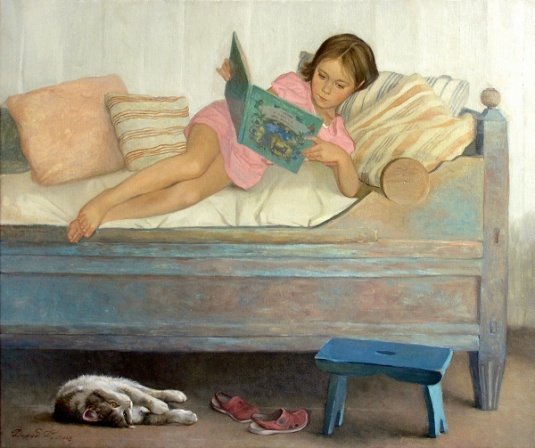
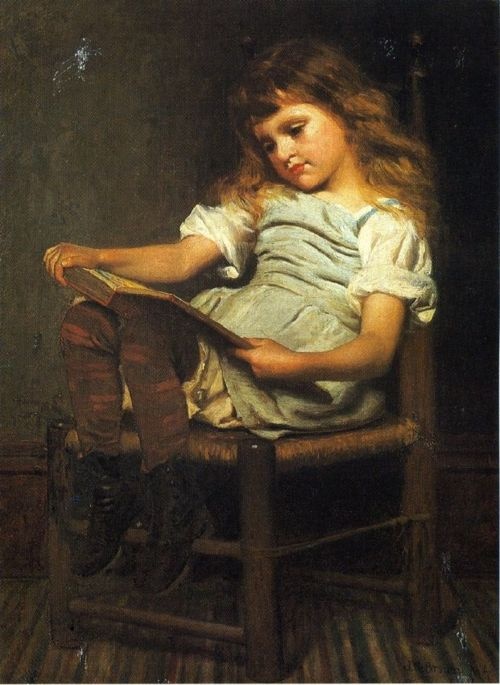
First Reader — John George Brown

f0a8c1518203e6e58749f42315129a4f

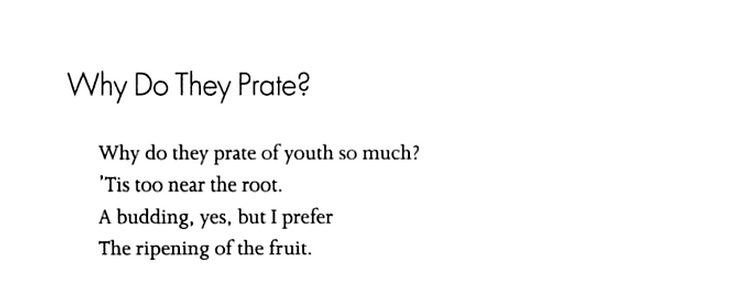
“Why Do They Prate?” — Helene Johnson

root

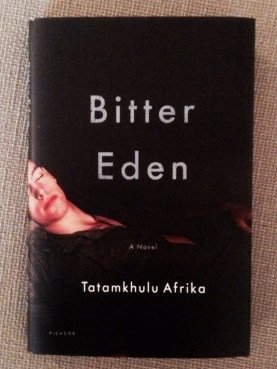
Bitter Eden (Book Acquired, 2.12.2014)

20140223-181957.jpg

This one looks pretty good. Blurb from publisher Picador:

Bitter Eden is based on Tatamkhulu Afrika’s own capture in North Africa and his experiences as a prisoner of war during World War II in Italy and Germany. This frank and beautifully wrought novel deals with three men who must negotiate the emotions that are brought to the surface by the physical closeness of survival in the male-only camps. The complex rituals of camp life and the strange loyalties and deep bonds among the men are heartbreakingly depicted. Bitter Eden is a tender, bitter, deeply felt book of lives inexorably changed, and of a war whose ending does not bring peace.

Read an excerpt here.

Karlheinz Stockausen on Human Evolution

“The Breathing Author” by Gerald Murnane

From Delphic Intimations: Dialogues with Australian Writers and Critics, ed. Pradeep Trikha. 2007: Sarup & Sons, New Delhi.

I have preserved Australian spelling and style.

***

“The Breathing Author” — Gerald Murnane

This essay is the edited version of a talk given at the final session of the Gerald Murnane Research Seminar, held at the University of Newcastle on 20-21 September 2001.

I cannot conceive of myself reading a text and being unmindful that the object before my eyes is a product of human effort.

Much of my engagement with a text consists of my speculating about the methods used by the writer in the putting together of the text, or about the feelings and beliefs that drove the writer to write the text, or even about the life story of the writer.

What I am about to tell you today is the sort of detail that I would have been eager to know if it had been my fate to be a person who was drawn to read these books (points to the stack of his books near by) rather than the person who was drawn to write them.

I have for long believed that a person reveals at least as much when he reports what he cannot do or has never done as when he reports what he has done or wants to do.

I have never been in an aeroplane.

I have been as far north from my birthplace as Murwillumbah in New South Wales and as far south as Kettering in Tasmania; as far east as Bemm River in Victoria and as far west as Streaky Bay in South Australia. The distance between Murwillumbah in the north and Kettering in the south is about 1500 km. It so happens that the distance between Streaky Bay in the west and Orbost in the east is about the same. Until I calculated these distances a few days ago, I was quite unaware that my travels had been confined to an area comprising almost a square, but my learning this was no surprise to me.

I became confused, or even distressed, whenever I find myself among streets or roads that are not arranged in a rectangular grid or are so arranged but not so that the streets or roads run approximately north-south and east-west. Whenever I find myself in such a place, I feel compelled to withdraw from social intercourse and all activities other than what I call finding my bearings. These I try to find by reference to the sun or to roads or streets the alignments of which are known to me. I know I have found my bearings when I can visualise myself and my surroundings as details of a map that includes the northern suburbs of Melbourne and such prominent east-west or north-south thoroughfares of those suburbs as Bell Street or Sydney Road.

My trying to find my bearings takes much mental effort, and I fail more often than I succeed. I often believe I have succeeded but later refer to maps and find that my visualised map was wrong. When I discover this, I feel compelled to attempt a complicated exercise that I have probably never succeeded at. I am compelled first to recall the scene where I tried to find my bearings, then to recall the visualised map that proved to be wrong, and last to try to correct my remembered self, as it were: to relive the earlier experience but with the difference that I get my correct bearings. I sometimes feel this compulsion many years after the original event. While writing these notes, for example, I was compelled to recall the evening in November 1956 when I visited for the first time the suburb or Brighton, on Port Phillip Bay. It was my last day of secondary school, and my class had to meet at the home of the school captain and later to take a train into Melbourne to see a film. I arrived in Brighton by bus, in the company of boys who knew their way around that quarter of Melbourne. Later, when our class arrived on foot at Brighton Beach railway station, I stood with them on the platform where they had gathered, but I was convinced that we were waiting for the train from Melbourne. After the train had arrive and we had boarded, I remained convinced for some time that we were travelling away from Melbourne, and my peace of mind was continually disturbed during the rest of the evening by my wondering how I had so utterly lost my bearings at the railway station. Just now, as I said, I was compelled to relive that experience of more than forty years ago, but I failed yet again to understand how the map of Melbourne in my mind had been stood on its head.

I cannot understand the workings of the International Date Line.

Continue reading ““The Breathing Author” by Gerald Murnane”

List with No Name #44

  1. In Kyoto, in the hot summer rain, sweating in a poncho, fighting with my girlfriend in front of a golden temple.
  2. At 17, experiencing the most intense jealousy of my life, watching a classmate weep in front of The Pietà, thinking, feeling, Why can’t I feel that?
  3. On the way to work, sleepy, maybe a bit hungover, breaking down in tears at “Space Oddity,” concern for Major Tom, his family. Swearing off music in the early morning. News radio ever since.
  4. Religion is just a set of aesthetic possibilities, conditions, and experiences.
  5. In Cork, drinking beer on a roof in the summer sun, a wasp landed on my very eye.
  6. In the last year of college, writing and recording dozens of songs with friends, editing the songs into a cohesive thing, calling the thing an album, sharing it with friends, with never even once the intention of doing anything else with that music, with no dreams of anyone else hearing it, live or recorded. An album made entirely for ourselves.
  7. Listening to it a dozen years later, conceding that it was actually maybe very good.
  8. Vomiting in foreign cities.
  9. Wary of my own susceptibility to sentimentalism, to sentimentality, to my awful tendency to experience catharsis through a fast food commercial on television.
  10. Never able to feel transcendent peace in nature, despite Emerson, Thoreau, Dickinson, Whitman, etc.—because just at the moment that the affect of transcendent peace manifests (the verb is inadequate), my awareness of the affect and the process of the affect and my feeling of the feeling of the affect spoils it all.
  11. Crashing into a road sign on an off ramp, walking away from the wreck, lying down on the slanted concrete abutment in the shade of a roaring overpass, feeling the best feeling, unspoiled.
  12. My child born—that nothing was more original, real, terrifying, beautiful.
  13. In dreams, sometimes: A whole other life, full, brimming, rich, real. He who wakes me wounds me, I think Nietzsche wrote. Or was it Bernhard? Or am I imagining the phrase?
  14. Never not jealous of a hawk in flight.
  15. My mother falling asleep, I kept reading until I too fell asleep.
  16. Vomiting into the trashcan in my classroom.
  17. My brother, balling up wrapping paper, hurling at me. My explosive rage.
  18. The snakes, the rats, the roaches I’ve killed.
  19. Workshopping a story in class. How I hated everyone.
  20. Friends jumping on my bed the afternoon of my wedding. (How did they get in?). Vomiting in the bed.
  21. Reading a certain novel, its plot, its construction essentially destroying a hundred or more of my own pages, my own outline, my own idea.
  22. A Modigliani in the New Orleans Museum of Art: Her neck was everything I remembered of the visit.
  23. My electric guitar, literally rusty from salt air and disuse.
  24. Irony as an aesthetic experience—or a defense against aesthetic experience?
  25. Painting the same scene in watercolors, dozens of times, with my daughter—the loquat tree, the grass, the sky. Her paintings surpassed mine so quickly.
  26. The rat that scuttled over my feet by the river in Chiang Mai. My horror and laughter.
  27. Removing dead rats from a shed as an aesthetic experience.
  28. All experiences are aesthetic experiences.
  29. Does maturity necessitate that we turn down the volume on these aesthetic experiences? That we manage the affect? That we blunt the feeling of the feeling?
  30. Seeing The Pietà again at 27 and moved by the memory of the classmate’s aesthetic response a decade earlier.
  31. The tourists crowding out Mona Lisa, I shuffled into some other room full of heavy, dark, black paintings—Caravaggios?—the names didn’t matter, the authority didn’t matter, I was 15 I think, I relaxed, I could look, I was alone, or I felt alone, it was lovely.
  32. My office: Prints by Goya, Picasso, Tintoretto, Leonardo. A painting by my grandmother, a dog resting, a bird and a bone nearby. Students come by to look at the giant Bosch reproduction, which I wish were more giant, more real.
  33. At the Dali Museum. Shock at how small some of the paintings were.
  34. Is there an aesthetic experience outside of sharing?
  35. Endlessly copying figures from comic books.
  36. Photographing food and sharing it on social media as a kind of thanksgiving prayer.
  37. Seeing the Bacon collection at MoMA, feeling a feeling that I still don’t have a name for.
  38. Rising early on Saturday mornings to watch a show where a man (or was it a woman?) guided me (and others, I suppose) through the rudiments of sketching animals. My grandmother made me sausages.
  39. My daughter’s thorough indifference to a Dürer etching in our local museum I wanted her to see. Her pleading to go to the gardens to paint with watercolors, to paint the fountain, the flowers.
  40. Sometimes in my dreams I write something, or paint something, or create wonderful, strange music.
  41. At eleven years old, sitting for a friend’s mother, who painted my portrait in watercolor. She didn’t draft in pencil, she worked so quickly. I was jealous and grateful.
  42. One of the reasons I love the internet so much is that it allows me to look at paintings. But looking at a painting on a screen is not the same as looking at paintings in the real.
  43. As a teenager, attempting wax dripping paintings in the style of Pollock, starting small fires in my bedroom, covering the scorched carpet with books, clothes, my parents sometimes not discovering the marks for weeks. Trying to explain them, but unwilling to share the paintings.
  44. A wish for anything that disrupts the feeling of feeling the feeling.