“A Guide to Virtual Death” — J.G. Ballard

“A Guide to Virtual Death”

by

J.G. Ballard

For reasons amply documented elsewhere, intelligent life on earth became extinct in the closing hours of the 20th Century. Among the clues left to us, the following schedule of a day’s television programmes transmitted to an unnamed city in the northern hemisphere on December 23, 1999, offers its own intriguing insight into the origins of the disaster.

6.00 am Porno–Disco. Wake yourself up with his–and–her hard–core sex images played to a disco beat.

7.00 Weather Report. Today’s expected micro–climates in the city’s hotel atriums, shopping malls and office complexes. Hilton International promises an afternoon snow–shower as a Christmas appetiser.

7.15 News Round–up. What our news–makers have planned for you. Maybe a small war, a synthetic earthquake or a famine–zone! charity tie–in.

7.45 Breakfast Time. Gourmet meals to watch as you eat your diet cellulose.

8.30 Commuter Special. The rush–hour game–show. How many bottoms can you pinch, how many faces can you slap?

9.30 The Travel Show. Visit the world’s greatest airports and under ground car parks.

10.30 Home–makers of Yesterday. Nostalgic scenes of old–fashioned housework. No.7 – The Vacuum Cleaner.

11.00 Office War. Long–running serial of office gang–wars.

12.00 Newsflash. The networks promise either a new serial killer or a deadly food toxin.

1.00 pm Live from Parliament. No .12 – The Alcoholic MP.

1.30 The Nose–Pickers. Hygiene programme for the kiddies.

2.00 Caress Me. Soft–porn for the siesta hour.

2.30 Your Favourite Commericials. Popular demand re–runs of golden oldie TV ads.

3.00 Housewives’ Choice. Rape, and how to psychologically prepare yourself.

4.00 Count–down. Game show in which contestants count backwards from one million.

5.00 Newsflash. Either an airliner crash or a bank collapse. Viewers express preference.

6.00 Today’s Special. Virtual Reality TV presents ‘The Kennedy Assassination.’ The Virtual Reality head–set takes you to Dallas, Texas, on November 22, 1963. First you fire the assassin’s rifle from the Book Depository window, and then you sit between Jackie and JFK in the Presidential limo as the bullet strikes. For premium subscribers only – feel the Presidential brain tissue spatter your face OR wipe Jackie’s tears onto your handkerchief.

8.00 Dinner Time. More gourmet dishes to view with your evening diet–cellulose.

9.00 Science Now. Is there life after death? Micro–electrodes pick up ultra–faint impulses from long–dead brains. Relatives question the departed.

10.00 Crime–Watch. Will it be your home that is broken into tonight by the TV Crime Gang?

11.00 Today’s Special. Tele–Orgasm. Virtual Reality TV takes you to an orgy. Have sex with the world’s greatest movie–stars. Tonight: Marilyn Monroe and Madonna OR Warren Beatty and Tom Cruise. For premium subscribers only – experience transexualism, paedophiia, terminal syphilis, gang–rape, and bestiality (choice: German Shepherd or Golden Retriever).

1.00 am Newsflash. Tonight’s surprise air–crash.

2.00 The Religious Hour. Imagine being dead. Priests and neuroscientists construct a life–like mock–up of your death.

3.00 Night–Hunter. Will the TV Rapist come through your bedroom window?

4.15 Sex for Insomniacs. Soft porn to rock you to sleep.

5.00 The Charity Hour. Game show in which Third–World contestants beg for money.
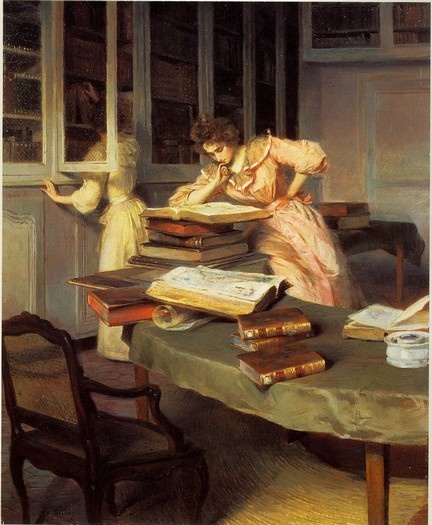
 

Elegant Woman in Library — Edouard Gelhay

9b59115eab0cb7f2b248b0568d77a948

The Face of Another — Hiroshi Teshigahara (Full Film)

March — Grant Wood

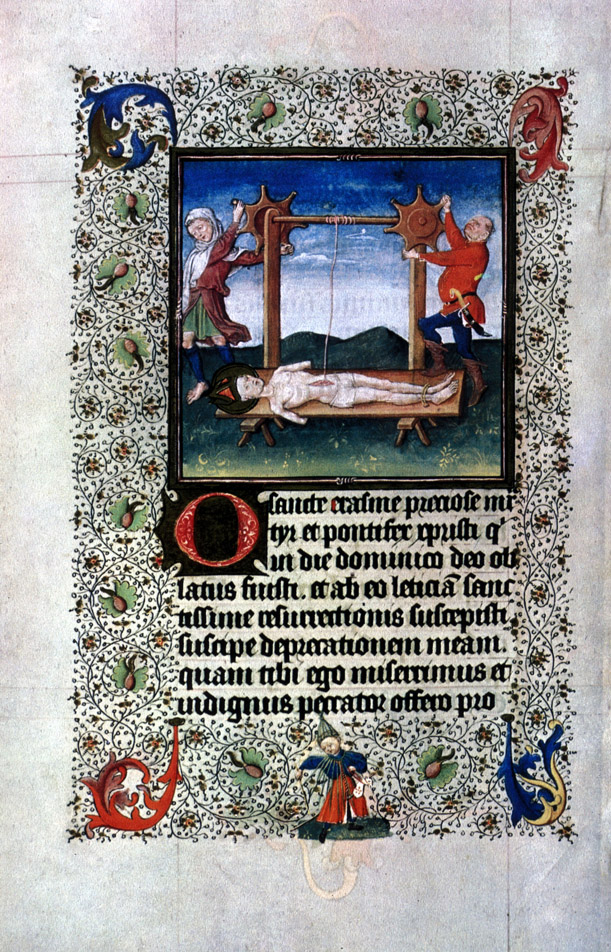
“Martyrdom of Saint Erasmus” (William H. Gass)

week11-0064

There were images that had nowhere to hang but in his head, images he remembered from books but of which he had no other copy; particularly one, from a strangely beautiful illuminated manuscript called The Hours of Catherine of Cleves, that depicted the martyrdom of Saint Erasmus. The presumptive saint lies on a raised plank, naked except for a loincloth. His abdomen has been opened and his intestines attached to a windlass erected above him. Thereupon, like a length of sausage or a length of rope, his innards are being wound by two figures, one male, one possibly female, each working hard to turn the spokes, their faces, however, averted from the scene. The saint does not appear to have wrists or hands. Eight turns have already been taken. The sky is empty except for a few clouds; the earth is empty except for two hills and some small yellow flowers. Around this painting, framed like a picture, is a delicate thin line made of curlicues and a field of tiny petals stalked by imaginary butterflies. At the bottom a small boy wearing a collar of thin sticks is riding a hobbyhorse.

His curiosity aroused by this calamitous vision, Skizzen sought more bio concerning Saint Erasmus. One source simply said that “although he existed, almost nothing is known about him.” This sentence stayed with Skizzen as stubbornly as the piteous illumination. What a blessed condition Erasmus must have enjoyed! Although he existed, almost nothing was known of him. Although nothing was known of him, as a saint, he existed. He existed, yet he had lived such a saintly life there was nothing of him to be known. Still another authority was not as sanguine. It claimed that the cult of Erasmus spread with such success that twelve hundred years later the martyr was invoked as one of the Fourteen Holy Helpers, whoever they were, and had become patron saint of sailors as well as kids who had colic. What was known, during those hundreds of years, was not known of the saint but of some figure he had thrown about himself as you would a ghostly garment or a costume for the dance. Proudly, Professor Skizzen pasted Erasmus in his memory book. A.d. 300. He was sprayed with tar and set alight. He was jailed, rescued by an angel, disemboweled. On a day in a.d. He died for me.

From William H. Gass’s novel  Middle C.

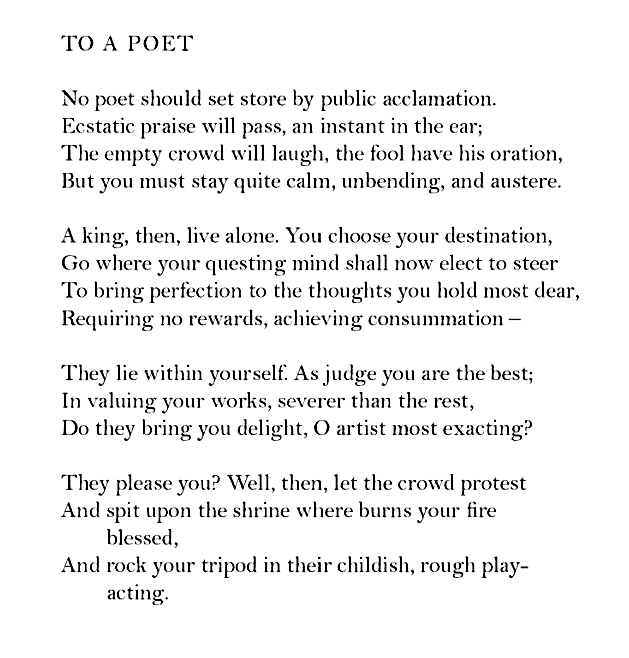
“To a Poet” — Alexander Pushkin

poet

Rat Evolution — Alexis Rockman

“The feeling of the sublime is a mixed feeling” (Schiller)

The feeling of the sublime is a mixed feeling. It is at once a painful state, which in its paroxysm is manifested by a kind of shudder, and a joyous state, that may rise to rapture, and which, without being properly a pleasure, is greatly preferred to every kind of pleasure by delicate souls. This union of two contrary sensations in one and the same feeling proves in a peremptory manner our moral independence. For as it is absolutely impossible that the same object should be with us in two opposite relations, it follows that it is we ourselves who sustain two different relations with the object. It follows that these two opposed natures should be united in us, which, on the idea of this object, are brought into play in two perfectly opposite ways. Thus we experience by the feeling of the beautiful that the state of our spiritual nature is not necessarily determined by the state of our sensuous nature; that the laws of nature are not necessarily our laws; and that there is in us an autonomous principle independent of all sensuous impressions.

The sublime object may be considered in two lights. We either represent it to our comprehension, and we try in vain to make an image or idea of it, or we refer it to our vital force, and we consider it as a power before which ours is nothing. But though in both cases we experience in connection with this object the painful feeling of our limits, yet we do not seek to avoid it; on the contrary we are attracted to it by an irresistible force. Could this be the case if the limits of our imagination were at the same time those of our comprehension? Should we be willingly called back to the feeling of the omnipotence of the forces of nature if we had not in us something that cannot be a prey of these forces. We are pleased with the spectacle of the sensuous infinite, because we are able to attain by thought what the senses can no longer embrace and what the understanding cannot grasp. The sight of a terrible object transports us with enthusiasm, because we are capable of willing what the instincts reject with horror, and of rejecting what they desire. We willingly allow our imagination to find something in the world of phenomena that passes beyond it; because, after all, it is only one sensuous force that triumphs over another sensuous force, but nature, notwithstanding all her infinity, cannot attain to the absolute grandeur which is in ourselves. We submit willingly to physical necessity both our well-being and our existence. This is because the very power reminds us that there are in us principles that escape its empire. Man is in the hands of nature, but the will of man is in his own hands.

Nature herself has actually used a sensuous means to teach us that we are something more than mere sensuous natures. She has even known how to make use of our sensations to put us on the track of this discovery—that we are by no means subject as slaves to the violence of the sensations. And this is quite a different effect from that which can be produced by the beautiful; I mean the beautiful of the real world, for the sublime itself is surpassed by the ideal. In the presence of beauty, reason and sense are in harmony, and it is only on account of this harmony that the beautiful has attraction for us. Consequently, beauty alone could never teach us that our destination is to act as pure intelligences, and that we are capable of showing ourselves such. In the presence of the sublime, on the contrary, reason and the sensuous are not in harmony, and it is precisely this contradiction between the two which makes the charm of the sublime—its irresistible action on our minds. Here the physical man and the moral man separate in the most marked manner; for it is exactly in the presence of objects that make us feel at once how limited the former is that the other makes the experience of its force. The very thing that lowers one to the earth is precisely that which raises the other to the infinite.

From Frederick Schiller’s essay “On the Sublime.

Silence — Tantiana Deiry

631e6a6db45c6b3232f1561d55cb4258

“Everything has been merely attempted, nothing completed” (Thomas Bernhard)

At the same time I had to tell myself that we invariably made excessive demands of everything and everybody: nothing is done thoroughly enough, everything is imperfect, everything has been merely attempted, nothing completed. My unhealthy craving for perfection had come to the surface again. It actually makes us ill if we always demand the highest standards, the most thorough, the most fundamental, the most extraordinary, when all we find are the lowest, the most superficial, the most ordinary. It doesn’t get us anywhere, except into the grave. We see decline where we expect improvement, we see hopelessness where we still have hope: that’s our mistake, our misfortune. We always demand everything, when in the nature of things we should demand little, and that depresses us. We see somebody on the heights, and he comes to grief while he is still on the low ground. We want to achieve everything, and we achieve nothing. And naturally we make the highest, the very highest demands of ourselves, completely leaving out of account human nature, which is after all not made to meet the highest demands. The world spirit, as it were, overestimates the human spirit. We are always bound to fail because we set our sights a few hundred per cent higher than is appropriate. And if we look, wherever we look, we see only people who have failed because they set their sights too high. But on the other hand, I reflect, where should we be if we constantly set our sights too low?

From Thomas Bernhard’s novel Concrete.

Nostalgia — Luke Pearson

“All art constantly aspires towards the condition of music”

Avian Flower Serpent — Fred Tomaselli

“Good Old Neon” — David Foster Wallace

“Good Old Neon”

by

David Foster Wallace

My whole life I’ve been a fraud. I’m not exaggerating. Pretty much all I’ve ever done all the time is try to create a certain impression of me in other people. Mostly to be liked or admired. It’s a little more complicated than that, maybe. But when you come right down to it it’s to be liked, loved. Admired, approved of, applauded, whatever. You get the idea. I did well in school, but deep down the whole thing’s motive wasn’t to learn or improve myself but just to do well, to get good grades and make sports teams and perform well. To have a good transcript or varsity letters to show people. I didn’t enjoy it much because I was always scared I wouldn’t do well enough. The fear made me work really hard, so I’d always do well and end up getting what I wanted. But then, once I got the best grade or made All City or got Angela Mead to let me put my hand on her breast, I wouldn’t feel much of anything except maybe fear that I wouldn’t be able to get it again. The next time or next thing I wanted. I remember being down in the rec room in Angela Mead’s basement on the couch and having her let me get my hand up under her blouse and not even really feeling the soft aliveness or whatever of her breast because all I was doing was thinking, ‘Now I’m the guy that Mead let get to second with her.’ Later that seemed so sad. This was in middle school. She was a very big-hearted, quiet, self-contained, thoughtful girl — she’s a veterinarian now, with her own practice — and I never even really saw her, I couldn’t see anything except who I might be in her eyes, this cheerleader and probably number two or three among the most desirable girls in middle school that year. She was much more than that, she was beyond all that adolescent ranking and popularity crap, but I never really let her be or saw her as more, although I put up a very good front as somebody who could have deep conversations and really wanted to know and understand who she was inside. Continue reading ““Good Old Neon” — David Foster Wallace”

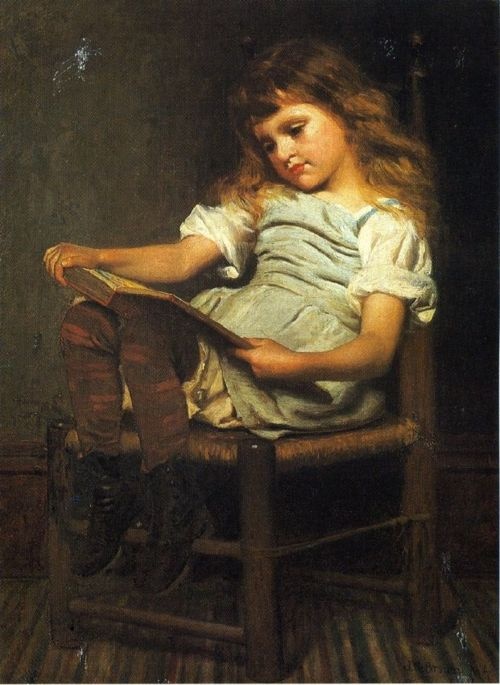
First Reader — John George Brown

f0a8c1518203e6e58749f42315129a4f

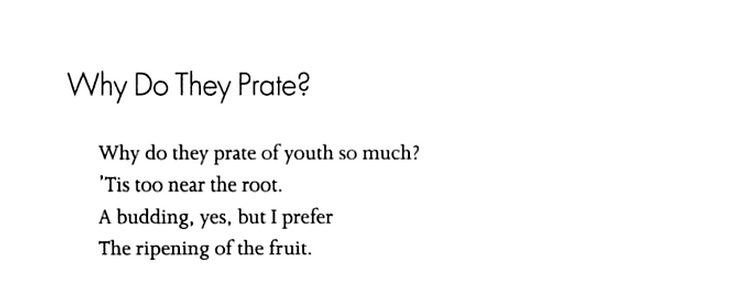
“Why Do They Prate?” — Helene Johnson

root

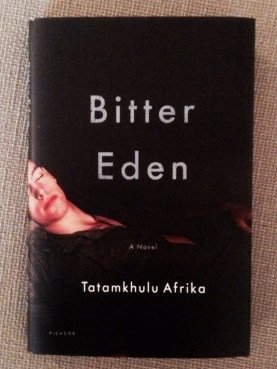
Bitter Eden (Book Acquired, 2.12.2014)

20140223-181957.jpg

This one looks pretty good. Blurb from publisher Picador:

Bitter Eden is based on Tatamkhulu Afrika’s own capture in North Africa and his experiences as a prisoner of war during World War II in Italy and Germany. This frank and beautifully wrought novel deals with three men who must negotiate the emotions that are brought to the surface by the physical closeness of survival in the male-only camps. The complex rituals of camp life and the strange loyalties and deep bonds among the men are heartbreakingly depicted. Bitter Eden is a tender, bitter, deeply felt book of lives inexorably changed, and of a war whose ending does not bring peace.

Read an excerpt here.