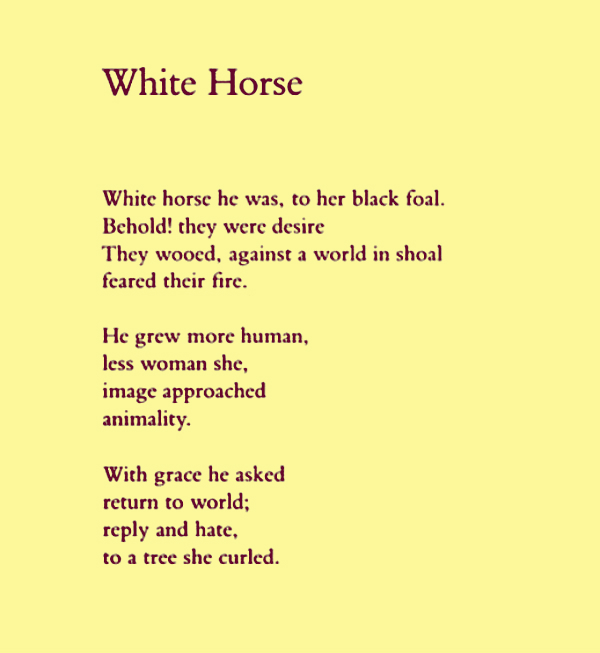
“Storm” — H.D.

storm

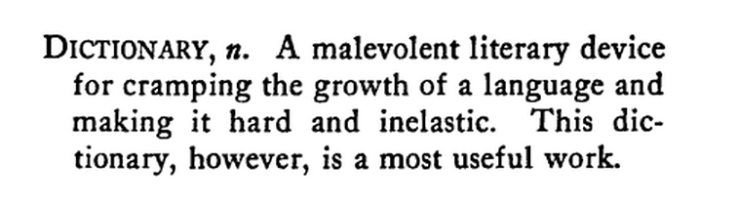
“The Index” — J.G. Ballard

“The Index”

by J.G. Ballard

EDITOR’S NOTE. From abundant internal evidence it seems clear that the text printed below is the index to the unpublished and perhaps suppressed autobiography of a man who may well have been one of the most remarkable figures of the twentieth century. Yet of his existence nothing is publicly known, although his life and work appear to have exerted a profound influence on the events of the past fifty years. Physician and philosopher, man of action and patron of the arts, sometime claimant to the English throne and founder of a new religion, Henry Rhodes Hamilton was evidently the intimate of the greatest men and women of our age. After World War II he founded a new movement of spiritual regener­ation, but private scandal and public concern at his grow­ing megalomania, culminating in his proclamation of himself as a new divinity, seem to have led to his down­fall. Incarcerated within an unspecified government insti­tution, he presumably spent his last years writing his autobiography of which this index is the only surviving fragment.

A substantial mystery still remains. Is it conceivable that all traces of his activities could be erased from our records of the period? Is the suppressed autobiography itself a disguised roman à clef, in which the fictional hero exposes the secret identities of his historical contempo­raries? And what is the true role of the indexer himself, clearly a close friend of the writer, who first suggested that he embark on his autobiography? This ambiguous and shadowy figure has taken the unusual step of index­ing himself into his own index. Perhaps the entire compi­lation is nothing more than a figment of the over­wrought imagination of some deranged lexicographer. Alternatively, the index may be wholly genuine, and the only glimpse we have into a world hidden from us by a gigantic conspiracy, of which Henry Rhodes Hamilton is the greatest victim.

A

Acapulco, 143

Acton, Harold, 142–7, 213

Alcazar, Siege of, 221–5

Alimony, HRH pays, 172, 247, 367, 453

Anaxagoras, 35, 67, 69–78, 481

Apollinaire, 98

Arden, Elizabeth, 189, 194, 376–84

Autobiography of Alice B. Toklas, The (Stein), 112

Avignon, birthplace of HRH, 9–13; childhood holidays, 27; research at Pasteur Institute of Ophthalmology, 101; attempts to restore anti-Papacy, 420–35

B

Bal Musette, Paris, 98

Balliol College, Oxford, 69–75, 231

Beach, Sylvia, 94–7

Berenson, Bernard, conversations with HRH, 134; offer of adoption, 145; loan of Dürer etching, 146; law-suits against HRH, 173–85

Bergman, Ingrid, 197, 134, 267

Biarritz, 123

Blixen, Karen von (Isak Dinesen), letters to HRH, declines marriage proposal, 197

Byron, Lord, 28, 76, 98, 543 Continue reading ““The Index” — J.G. Ballard”

“Say Something Surrealistic” (Zippy the Pinhead)

Zippy 2 001

Did You Speak to Me? — William Merritt Chase

“A Respectable Woman” — Kate Chopin

“A Respectable Woman”

by Kate Chopin

Mrs. Baroda was a little provoked to learn that her husband expected his friend, Gouvernail, up to spend a week or two on the plantation.

They had entertained a good deal during the winter; much of the time had also been passed in New Orleans in various forms of mild dissipation. She was looking forward to a period of unbroken rest, now, and undisturbed tete-a-tete with her husband, when he informed her that Gouvernail was coming up to stay a week or two.

This was a man she had heard much of but never seen. He had been her husband’s college friend; was now a journalist, and in no sense a society man or “a man about town,” which were, perhaps, some of the reasons she had never met him. But she had unconsciously formed an image of him in her mind. She pictured him tall, slim, cynical; with eye-glasses, and his hands in his pockets; and she did not like him. Gouvernail was slim enough, but he wasn’t very tall nor very cynical; neither did he wear eyeglasses nor carry his hands in his pockets. And she rather liked him when he first presented himself.

But why she liked him she could not explain satisfactorily to herself when she partly attempted to do so. She could discover in him none of those brilliant and promising traits which Gaston, her husband, had often assured her that he possessed. On the contrary, he sat rather mute and receptive before her chatty eagerness to make him feel at home and in face of Gaston’s frank and wordy hospitality. His manner was as courteous toward her as the most exacting woman could require; but he made no direct appeal to her approval or even esteem.

Once settled at the plantation he seemed to like to sit upon the wide portico in the shade of one of the big Corinthian pillars, smoking his cigar lazily and listening attentively to Gaston’s experience as a sugar planter.

“This is what I call living,” he would utter with deep satisfaction, as the air that swept across the sugar field caressed him with its warm and scented velvety touch. It pleased him also to get on familiar terms with the big dogs that came about him, rubbing themselves sociably against his legs. He did not care to fish, and displayed no eagerness to go out and kill grosbecs when Gaston proposed doing so. Continue reading ““A Respectable Woman” — Kate Chopin”

Breakfast at Berneval — Pierre-Auguste Renoir

The Cabinet of Jan Svankmajer — The Brothers Quay

Reclining Nude — Giovanni Boldini

“The main difficulty with the book business” (Donald Barthelme)

The main difficulty with the book business is that a book is two kinds of objects. You have, on the one hand, a thing that a reasonable and prudent man might decide is a book. You have on the other hand an object which looks very much like a book, feels very much like a book, but is in actuality a bucket of peanut butter covered with a thin layer of chocolate sauce. These things are sold in the same way. The latter seems to sell better, for some mysterious reason, than the former. A good example of this that I ran into recently is a book called The First Time, which apparently has to do with accounts of initial sexual experiences of either eminent or reasonably well-known people. This, I would say, is a bucket of peanut butter. Actually, they missed. They should have done a book called The Last Time, which would not only be funnier but more poignant. The idea is copyrighted, by the way. Take notes.

From remarks Donald Barthelme delivered at a 1975 conference at the Library of Congress. Published in Tracy Daugherty’s book Hiding Man: A Biography of Donald Barthelme.

Oki no Jiro Hiroari Killing a Monstrous Tengu — Utagawa Kuniyoshi

The Simpsons Riff on Hayao Miyazaki

The Beach — Alfred Victor Fournier

beach-scene-660x557

January — Grant Wood

RIP Amiri Baraka

RIP Amiri Baraka, 1934-2014

“An archeological slice. Not much glitter.” (Donald Barthelme)

INTERVIEWER

Which reminds me: Some of your detractors say that you’re merely fashionable.

BARTHELME

Well, the mere has always been a useful category.

INTERVIEWER

That you’re a jackdaw, and your principle of selection is whatever glitters most.

BARTHELME

I weep and tear my hair. And disagree.

INTERVIEWER

Let’s look at a specific jackdaw’s nest, the barricade in “The Indian Uprising.”

BARTHELME

I don’t see anything particularly fashionable. The table made from a hollow-core door may be a 1960s reference but aren’t people still making them?

INTERVIEWER

But your barricade is not intended as straightforward realism; these things are artifacts of a certain culture.

BARTHELME

An archeological slice. Not much glitter.

INTERVIEWER

Won’t it require scholarly annotation in the future?

BARTHELME

I’d say no. If you read The Swiss Family Robinson and you’re reading about what they unpack from the pinnace as they shuttle from ship to shore you don’t need any footnotes, even though there may be four hundred pounds of tallow in the cargo. You have a vague recollection that it’s used to make candles.

Actually I think the jackdaw business is a function of appearing in the New Yorker with some frequency. People read the fiction with after images of Rolls Royces and Rolexes still sizzling in their eyes. Rare is the reviewer who can resist mentioning the magazine’s ads when talking about the fiction. One is gilded by association.

INTERVIEWER

Suppose we turn things around. Suppose I say that when I read that story I’m not at all concerned about whether people made tables from hollow-core doors in the 1960s. Rather, I’m interested in the speaker, who in the metaphorical context of the story is besieged by Comanches.

BARTHELME

Is besieged by very much more than Comanches, but also by Comanches. He’s not meant to be a walking-around person so much as a target, a butt. The arrows of the Comanches but also sensory insult, political insult, there are references to the war there, to race, to torture, jingoism . . . But none of the references in the story were picked at random, and none are used simply as decor. If they seem random it’s probably because the range of reference is rather wide for a short piece—you have Patton and Frank Wedekind and the seventh cavalry coexisting on the same plane—but the crowding is part of the design, is the design.

From Donald Barthelme’s The Paris Review interview.

Pyramid of Fire (Pyramid of Flame) — Charles Burchfield