Library Rules of the Insane Asylum of California (1861)

1. The Library of the male department shall be under the charge of the Supervisor. Every volume taken therefrom shall be charged to the borrower, except for the use of the patients, when it shall be charged to the Attendant, into whose ward it is taken, who will be responsible for its being used with ordinary care and returned in proper time.

2. If a volume shall be lost or destroyed, by any patient, the Attendant, having charge of the patient, will report the fact to the Supervisor, and, if practicable, exhibit the fragments. If lost or destroyed, by any other person, it must be replaced.

3. No one will be permitted to take from the library more than one volume at a time, or to keep a volume more than two weeks, without permission from the Superintendent or Assistant Physician, except Bibles, Testaments and Prayer books placed in the hands of the patients for daily reading.

4. The Supervisor will be responsible for books taken from the library and not charged.

5. The Library of the female department will be under the charge of the Matron, who, in its management, will be governed by the above rules, prescribing the duties and responsibilities of the Supervisor.

From Rules and Regulations of the Insane Asylum of California (1861).

Michelangelo Being Shown the Belvedere Torso — Jean-Leon Gerome

Private Conversation — Felix Vallotton

“Delight becomes pictorial” — Emily Dickinson

delight

Reading, rereading, trying to read

20131226-142706.jpg

“All art constantly aspires towards the condition of music”

Illustration for A Little Boy Lost — Dorothy Lathrop

“Of Games to Be Played by Those Who Draw” — Leonardo da Vinci

OF GAMES TO BE PLAYED BY THOSE WHO DRAW.

When, Oh draughtsmen, you desire to find relaxation in games you should always practise such things as may be of use in your profession, by giving your eye good practice in judging accurately of the breadth and length of objects. Thus, to accustom your mind to such things, let one of you draw a straight line at random on a wall, and each of you, taking a blade of grass or of straw in his hand, try to cut it to the length that the line drawn appears to him to be, standing at a distance of 10 braccia; then each one may go up to the line to measure the length he has judged it to be. And he who has come nearest with his measure to the length of the pattern is the best man, and the winner, and shall receive the prize you have settled beforehand. Again you should take forshortened measures: that is take a spear, or any other cane or reed, and fix on a point at a certain distance; and let each one estimate how many times he judges that its length will go into that distance. Again, who will draw best a line one braccio long, which shall be tested by a thread. And such games give occasion to good practice for the eye, which is of the first importance in painting.

From Leonardo’s Notebook

Woman Reading — Will Barnet

56635

Nativity (Holy Night, Christmas) — Lucas Cranach the Elder

Posted in Art

“the familiar story of virgin birth on December twenty-fifth, mutilation and resurrection” (William Gaddis)

His father seemed less than ever interested in what passed around him, once assured Wyatt’s illness was done. Except for the Sunday sermon, public activities in the town concerned him less than ever. Like Pliny, retiring to his Laurentine villa when Saturnalia approached, the Reverend Gwyon avoided the bleak festivities of his congregation whenever they occurred, by retiring to his study. But his disinterest was no longer a dark mantle of preoccupation. A sort of hazardous assurance had taken its place. He approached his Sunday sermons with complaisant audacity, introducing, for instance, druidical reverence for the oak tree as divinely favored because so often singled out to be struck by lightning. Through all of this, even to the sermon on the Aurora Borealis, the Dark Day of May in 1790 whose night moon turned to blood, and the great falling of stars in November 1833, as signs of the Second Advent, Aunt May might well have noted the persistent non-appearance of what she, from that same pulpit, had been shown as the body of Christ. Certainly the present members of the Use-Me Society found many of his references “unnecessary.” It did not seem quite necessary, for instance, to note that Moses had been accused of witchcraft in the Koran; that the hundred thousand converts to Christianity in the first two or three centuries in Rome were “slaves and disreputable people,” that in a town on the Nile there were ten thousand “shaggy monks” and twice that number of “god- dedicated virgins”; that Charlemagne mass-baptized Saxons by driving them through a river being blessed upstream by his bishops, while Saint Olaf made his subjects choose between baptism and death. No soberly tolerated feast day came round, but that Reverend Gwyon managed to herald its grim observation by allusion to some pagan ceremony which sounded uncomfortably like having a good time. Still the gray faces kept peace, precarious though it might be. They had never been treated this way from the pulpit. True, many stirred with indignant discomfort after listening to the familiar story of virgin birth on December twenty-fifth, mutilation and resurrection, to find they had been attending, not Christ, but Bacchus, Osiris, Krishna, Buddha, Adonis, Marduk, Balder, Attis, Amphion, or Quetzalcoatl. They recalled the sad day the sun was darkened; but they did not remember the occasion as being the death of Julius Caesar. And many hurried home to closet themselves with their Bibles after the sermon on the Trinity, which proved to be Brahma, Vishnu, and Siva; as they did after the recital of the Immaculate Conception, where the seed entered in spiritual form, bringing forth, in virginal modesty, Romulus and Remus.

If the mild assuasive tones of the Reverend offended anywhere, it was the proprietary sense of his congregation; and with true Puritan fortitude they resisted any suggestion that their bloody sacraments might have known other voices and other rooms. They could hardly know that the Reverend’s powers of resistance were being taxed more heavily than their own, where he withstood the temptation to tell them details of the Last Supper at the Eleusinian Mysteries, the snake in the Garden of Eden, what early translators of the Bible chose to let the word ‘thigh’ stand for (where ancient Hebrews placed their hands when under oath), the symbolism of the Triune triangle and, in generative counterpart so distressing to early fathers of the Church, the origin of the Cross.

From William Gaddis’s novel The Recognitions.


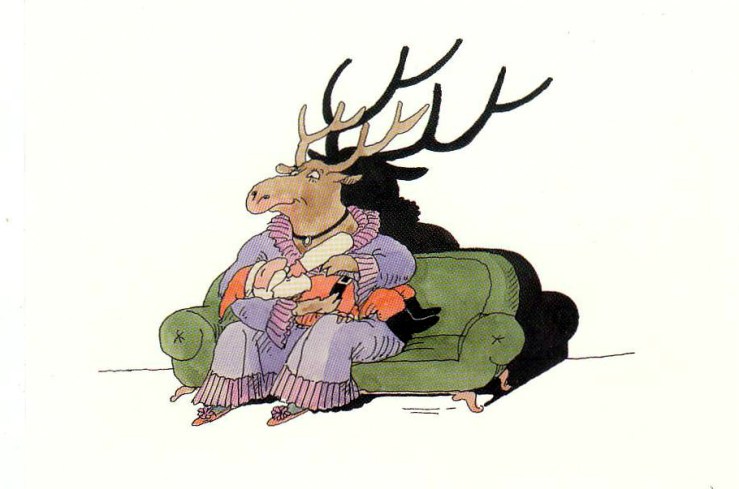
Tomi Ungerer Christmas Card

tomi ungerer

Journal entry, December 25, 1854 (Nathaniel Hawthorne)

December 25th.–Commodore P—- called to see me this morning,–a brisk, gentlemanly, offhand, but not rough, unaffected, and sensible man, looking not so elderly as he ought, on account of a very well made wig. He is now on his return from a cruise in the East Indian seas, and goes home by the Baltic, with a prospect of being very well received on account of his treaty with Japan. I seldom meet with a man who puts himself more immediately on conversable terms than the Commodore. He soon introduced his particular business with me,–it being to inquire whether I would recommend some suitable person to prepare his notes and materials for the publication of an account of his voyage. He was good enough to say that he had fixed upon me, in his own mind, for this office; but that my public duties would of course prevent me from engaging in it. I spoke of Herman Melville, and one or two others; but he seems to have some acquaintance with the literature of the day, and did not grasp very cordially at any name that I could think of; nor, indeed, could I recommend any one with full confidence. It would be a very desirable task for a young literary man, or, for that matter, for an old one; for the world can scarcely have in reserve a less hackneyed theme than Japan.

This is a most beautiful day of English winter; clear and bright, with the ground a little frozen, and the green grass along the waysides at Rock Ferry sprouting up through the frozen pools of yesterday’s rain. England is forever green. On Christmas Day, the children found wall-flowers, pansies, and pinks in the garden; and we had a beautiful rose from the garden of the hotel grown in the open air. Yet one is sensible of the cold here, as much as in the zero atmosphere of America. The chief advantage of the English climate is that we are not tempted to heat our rooms to so unhealthy a degree as in New England.

I think I have been happier this Christmas than ever before,–by my own fireside, and with my wife and children about me,–more content to enjoy what I have,–less anxious for anything beyond it in this life. My early life was perhaps a good preparation for the declining half of life; it having been such a blank that any thereafter would compare favorably with it. For a long, long while, I have occasionally been visited with a singular dream; and I have an impression that I have dreamed it ever since I have been in England. It is, that I am still at college,–or, sometimes, even at school,–and there is a sense that I have been there unconscionably long, and have quite failed to make such progress as my contemporaries have done; and I seem to meet some of them with a feeling of shame and depression that broods over me as I think of it, even when awake. This dream, recurring all through these twenty or thirty years, must be one of the effects of that heavy seclusion in which I shut myself up for twelve years after leaving college, when everybody moved onward, and left me behind. How strange that it should come now, when I may call myself famous and prosperous!–when I am happy, too!

From Nathaniel Hawthorne’s English Note-Books.


Christmas Morning — Carl Larsson

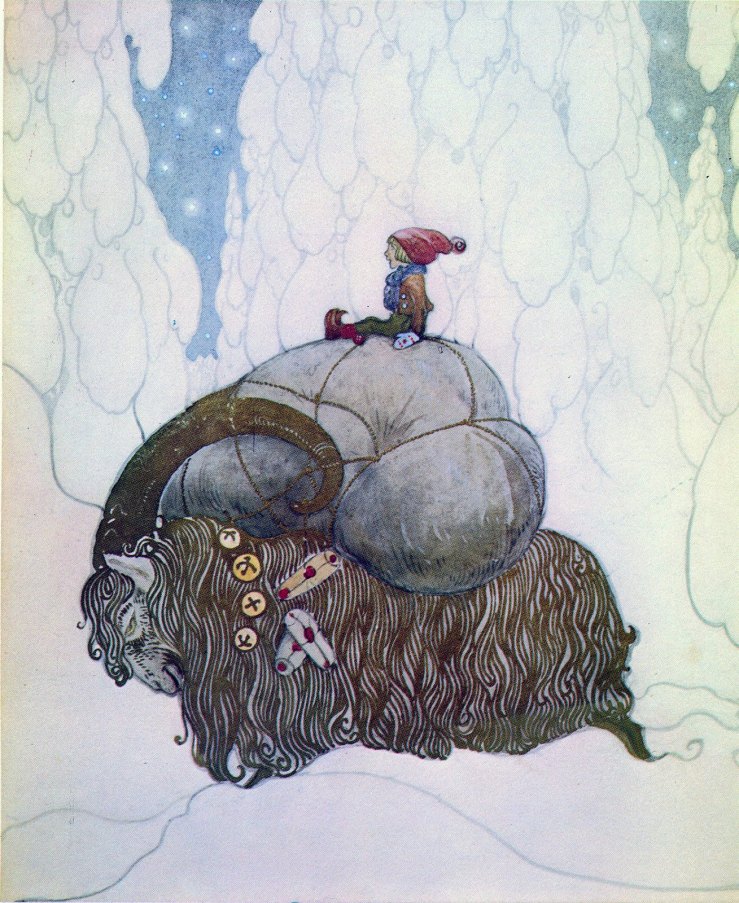
Julbocken (Yule Goat) — John Bauer

Julbocken (1912 - John Bauer)

“Christmas Eve” — Anne Sexton

“Christmas Eve” by Anne Sexton

Oh sharp diamond, my mother!
I could not count the cost
of all your faces, your moods-
that present that I lost.
Sweet girl, my deathbed,
my jewel-fingered lady,
your portrait flickered all night
by the bulbs of the tree.

Your face as calm as the moon
over a mannered sea,
presided at the family reunion,
the twelve grandchildren
you used to wear on your wrist,
a three-months-old baby,
a fat check you never wrote,
the red-haired toddler who danced the twist,
your aging daughters, each one a wife,
each one talking to the family cook,
each one avoiding your portrait,
each one aping your life.

Later, after the party,
after the house went to bed,
I sat up drinking the Christmas brandy,
watching your picture,
letting the tree move in and out of focus.
The bulbs vibrated.
They were a halo over your forehead.
Then they were a beehive,
blue, yellow, green, red;
each with its own juice, each hot and alive
stinging your face. But you did not move.
I continued to watch, forcing myself,
waiting, inexhaustible, thirty-five.

I wanted your eyes, like the shadows
of two small birds, to change.
But they did not age.
The smile that gathered me in, all wit,
all charm, was invincible.
Hour after hour I looked at your face
but I could not pull the roots out of it.
Then I watched how the sun hit your red sweater, your withered neck,
your badly painted flesh-pink skin.
You who led me by the nose, I saw you as you were.
Then I thought of your body
as one thinks of murder-

Then I said Mary-
Mary, Mary, forgive me
and then I touched a present for the child,
the last I bred before your death;
and then I touched my breast
and then I touched the floor
and then my breast again as if,
somehow, it were one of yours

Get It (Peanuts)

get it