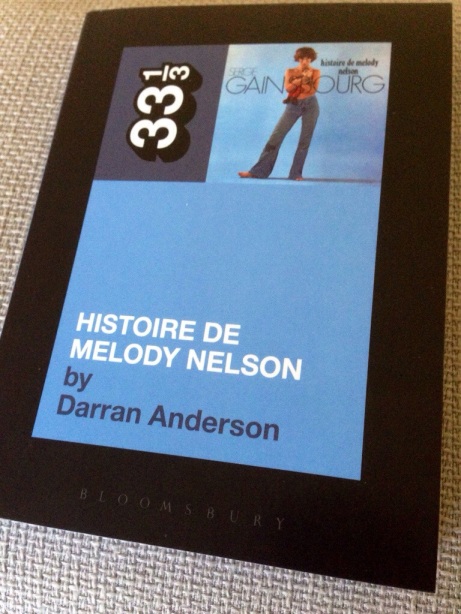
Serge Gainsbourg’s Histoire de Melody Nelson Gets the 33 1/3 Treatment (Book Acquired, 10.23.2013)

20131027-130605.jpg

Things I am a fan of: Serge Gainsbourg, Darran Anderson, and the 33 1/3 series. The 33 1/3 imprint focuses on specific albums, and the results are usually far more engaging than standard biographical fare. Histoire de Melody Nelson is the series’s latest entry; here, Darran Anderson takes on Serge Gainsbourg’s dark, moody, sexy, weird album (listen to it/see it here). I still remember the first time I heard Melody, back in college. Gainsbourg’s track with a breathy, orgasmic Brigitte Bardot “Je t’aime… moi non plus” was pretty much a party standard for my friends and me, and “Bonnie & Clyde” found its way onto plenty of mixtapes in the late ’90s. These bubblegum vamps didn’t really prepare me for Melody. I remember going to a friend’s apartment; he had just bought the album and had it playing on repeat. Dark, spacious, very short and full of strange shifts, from orchestral bombast to odd moments of quiet, the album made me feel weird. Such a weird album is a worthy topic for a book, and Anderson’s entry is a marvelous description and analysis of the artistic, cultural, and philosophical sources that Gainsbourg synthesized in Melody. Check out some of Anderson’s blog entries; they provide a compelling overview of his book:

The Origins of Melody – Nabokov’s LolitaBarbarella, Boris Vian, Sibelius, Mondo Cane.

The Avant Garde or Nothing – Gainsbourg and Vannier as innovators and a focus on their lost classics.

Initials O.G. – Serge Gainsbourg’s Hip-hop afterlife.

Connan Mockasin – Kiwi Psychedelia and the Ghost of Melody Nelson.

The book’s blurb:

Outside his native France, the view of Serge Gainsbourg was once of a one-hit wonder lothario. This has been slowly replaced by an awareness of how talented and innovative a songwriter he was. Gainsbourg was an eclectic, protean figure; a Dadaist, poète maudit, Pop-Artist, libertine and anti-hero. An icon and iconoclast.

His masterpiece is arguably Histoire de Melody Nelson, an album suite combining many of his signature themes; sex, taboo, provocation, humour, exoticism and ultimately tragedy. Composed and arranged with the great Jean-Claude Vannier, its score of lush cinematic strings and proto-hip hop beats, combined with Serge’s spoken-word poetry, has become remarkably influential across a vast musical spectrum; inspiring soundtracks, indie groups and electronic artists. In recent years, the album’s reputation has grown from cult status to that of a modern classic with the likes of Beck, Portishead, Mike Patton, Air and Pulp paying tribute.

How did the son of Jewish Russian immigrants, hounded during the Nazi Occupation, rise to such notoriety and acclaim, being celebrated by President François Mitterand as “our Baudelaire, our Apollinaire”? How did the early chanson singer evolve into a musical visionary incorporating samples, breakbeats and dub into his music, decades ahead of the curve? And what are the roots and legacy of a concept album about a Rolls Royce, a red-haired Lolita muse, otherworldly mansions, plane crashes and Cargo Cults?
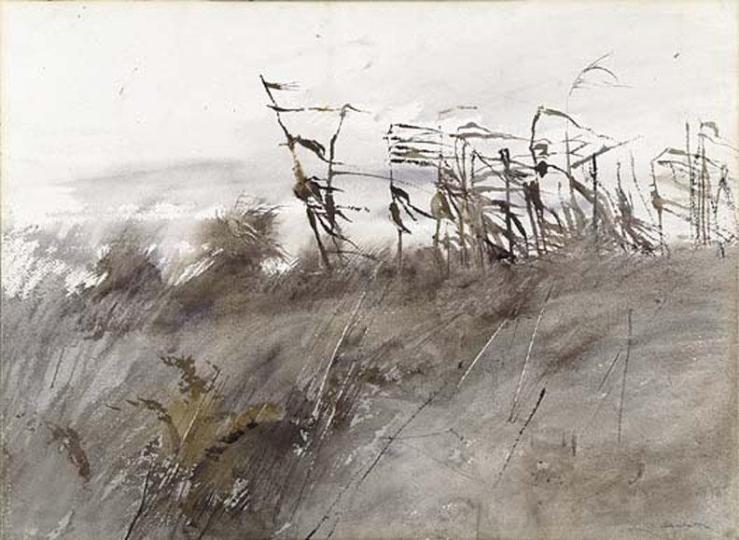
 

November First — Andrew Wyeth

andrew-wyeth-november-first

“The Non-Entity” — William Carlos Williams

wcw

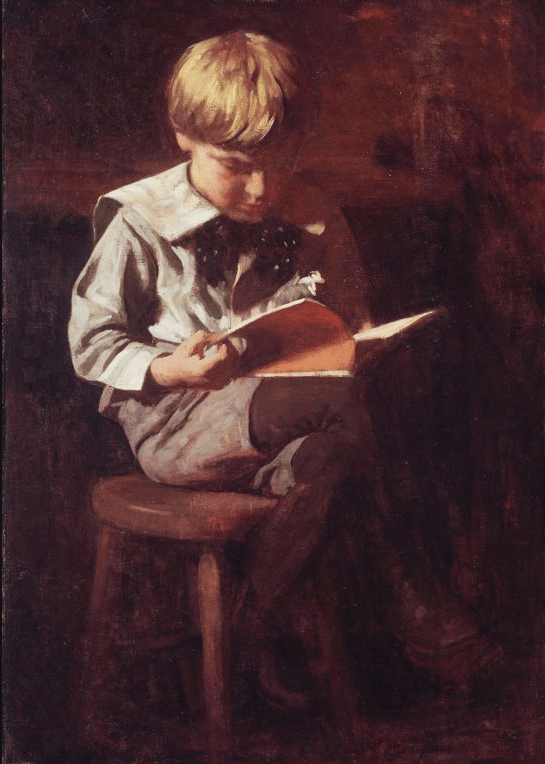
Boy Reading — Thomas Pollock Anshutz

anshutz

Werner Herzog Talks About His Film Nosferatu

nosferatu_1979_poster_02

Watch the full version of Werner Herzog’s Nosferatu (with English subtitles).

Jack O’ Lanterns 2013

20131031-070249.jpg

20131031-070307.jpg

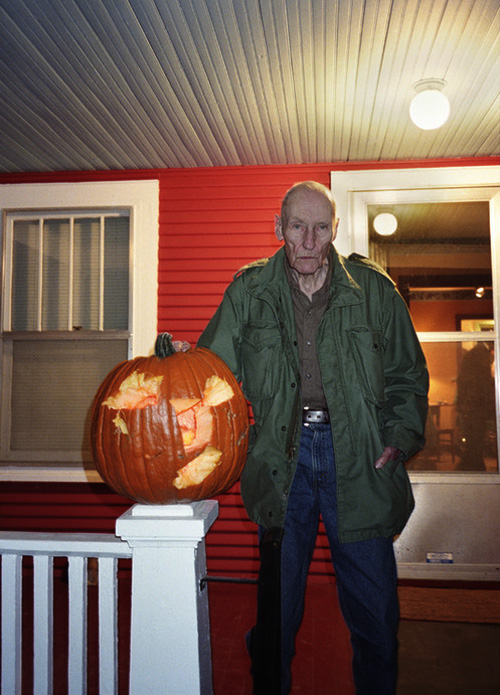
William Burroughs and His Hatchet-Carved Jack O’ Lantern

burroughs jack o lantern

(Via).

“…a face worthy of a murderer” (From Hell)

A page from Alan Moore and Eddie Campbell’s outstanding graphic novel From Hell, an encyclopedic account of the Jack the Ripper murders. In this scene, our evil protagonist Dr. Gull undergoes a transcendent experience, and appears to William Blake, inspiring The Ghost of a Flea

Blake’s The Head of the Ghost of a Flea

I pulled the image of From Hell from this fantastic detailed review by Miguel at St. Orberose (far better than my own my own meager tackle at writing about the book). Plenty more images there, along with a comprehensive analysis of (what I take to be) Moore’s best work.

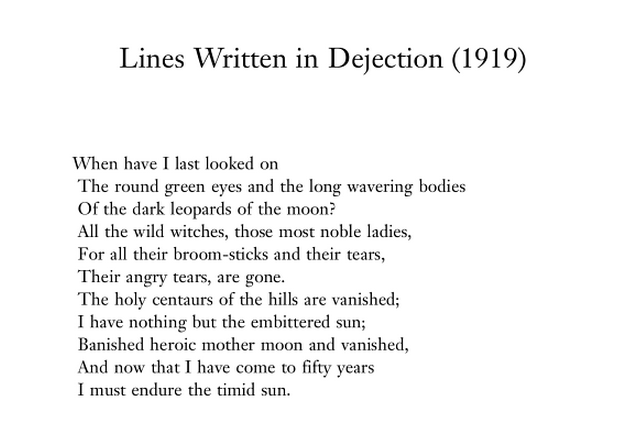
“All the wild witches” (Yeats)

yeats

Halloween — Grandma Moses

See Edgar Allan Poe, D.W. Griffith’s 1909 Short Film

“The Werewolf” — Eugene Field

“The Werewolf” by Eugene Field

In the reign of Egbert the Saxon there dwelt in Britain a maiden named Yseult, who was beloved of all, both for her goodness and for her beauty. But, though many a youth came wooing her, she loved Harold only, and to him she plighted her troth.

Among the other youth of whom Yseult was beloved was Alfred, and he was sore angered that Yseult showed favor to Harold, so that one day Alfred said to Harold: “Is it right that old Siegfried should come from his grave and have Yseult to wife?” Then added he, “Prithee, good sir, why do you turn so white when I speak your grandsire’s name?”

Then Harold asked, “What know you of Siegfried that you taunt me? What memory of him should vex me now?”

“We know and we know,” retorted Alfred. “There are some tales told us by our grandmas we have not forgot.”

So ever after that Alfred’s words and Alfred’s bitter smile haunted Harold by day and night.

Harold’s grandsire, Siegfried the Teuton, had been a man of cruel violence. The legend said that a curse rested upon him, and that at certain times he was possessed of an evil spirit that wreaked its fury on mankind. But Siegfried had been dead full many years, and there was naught to mind the world of him save the legend and a cunning-wrought spear which he had from Brunehilde, the witch. This spear was such a weapon that it never lost its brightness, nor had its point been blunted. It hung in Harold’s chamber, and it was the marvel among weapons of that time. Continue reading ““The Werewolf” — Eugene Field”

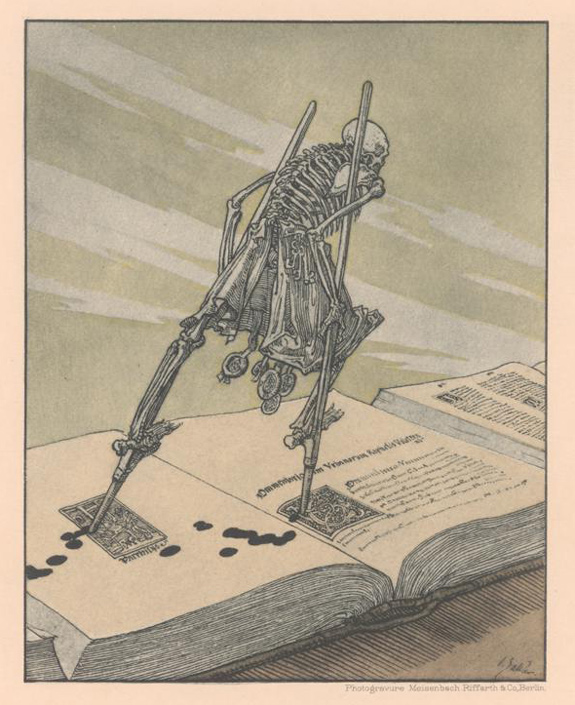
Illustration to A Modern Dance of Death — Joseph Sattler

02-joseph-sattler-modern-dance-of-death-1894

therapy — Michael Raedecker

Blind Nut Seekers, Dumb Cake, True-Lover Test, and Other Games for Halloween

From Mary F. Blain’s Games for Hallowe’en (1912):

BLIND NUT SEEKERS

Let several guests be blindfolded. Then hide nuts or apples in various parts of room or house. One finding most nuts or apples wins prize.

DUMB CAKE

Each one places handful of wheat flour on sheet of white paper and sprinkles it over with a pinch of salt. Some one makes it into dough, being careful not to use spring water. Each rolls up a piece of dough, spreads it out thin and flat, and marks initials on it with a new pin. The cakes are placed before fire, and all take seats as far from it as possible. This is done before eleven p.m., and between that time and midnight each one must turn cake once. When clock strikes twelve future wife or husband of one who is to be married first will enter and lay hand on cake marked with name. Throughout whole proceeding not a word is spoken. Hence the name “Dumb Cake.” (If supper is served before 11:30, “Dumb Cake” should be reserved for one of the After- Supper Tests.)

TRUE-LOVER TEST

Two hazel-nuts are thrown into hot coals by maiden, who secretly gives a lover’s name to each. If one nut bursts, then that lover is unfaithful; but if it burns with steady glow until it becomes ashes, she knows that her lover is true. Sometimes it happens, but not often, that both nuts burn steadily, and then the maiden’s heart is sore perplexed.

WEB OF FATE

Long bright colored strings, of equal length are twined and intertwined to form a web.

Use half as many strings as there are guests.

Remove furniture from center of a large room—stretch a rope around the room, from corner to corner, about four feet from the floor. Tie one end of each string to the rope, half at one end and half at one side of the room; weave the strings across to the opposite end and side of the room and attach to rope. Or leave furniture in room and twine the strings around it.

Each guest is stationed at the end of a string and at a signal they begin to wind up the string until they meet their fate at the other end of it.

The lady and gentleman winding the same string will marry each other, conditions being favorable; otherwise they will marry someone else. Those who meet one of their own sex at the other end of the string will be old maids or bachelors.

The couple finishing first will be wedded first.

A prize may be given the lucky couple, also to the pair of old maids and the pair of bachelors finishing first.

THREADING A NEEDLE

Sit on round bottle laid lengthwise on floor, and try to thread a needle. First to succeed will be first married.

(More).

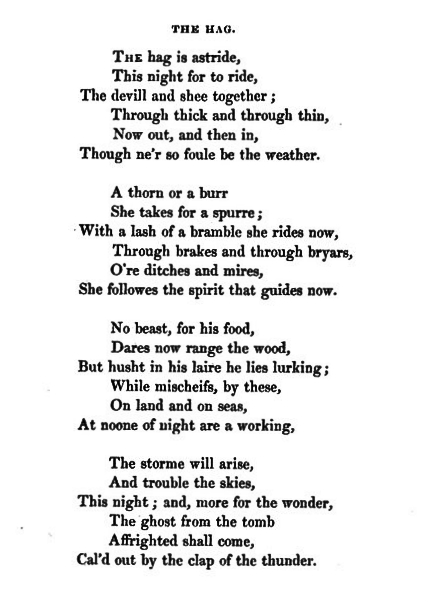
“The Hag” — Robert Herrick

the hag

The Sealed Room, D.W. Griffith’s 1909 Adaptation of Edgar Allan Poe’s “The Cask of Amontillado”