“My First Romance” — Lafcadio Hearn

“My First Romance” by Lafcadio Hearn

There has been sent to me, across the world, a little book stamped, on its yellow cover, with names of Scandinavian publishers – names sounding of storm and strand and surge. And the sight of those names, worthy of Frost-Giants, evokes the vision of a face – simply because that face has long been associated, in my imagination, with legends and stories of the North – especially, I think, with the wonderful stories of Björnstjerne Björnson.

It is the face of a Norwegian peasant-girl of nineteen summers – fair and ruddy and strong. She wears her national costume: her eyes are grey like the sea, and her bright braided hair is tied with a blue ribbon. She is tall; and there is an appearance of strong grace about her, for which I can find no word. Her name I never learned, and never shall be able to learn; – and now it does not matter. By this time she may have grandchildren not a few. But for me she will always be the maiden of nineteen summers – fair and fresh from the land of the Hrimthursar – a daughter of gods and Vikings. From the moment of seeing her I wanted die for her; and I dreamed of Valkyrja and of Vala-maids, of Freyja and of Gerda. . . .

She is seated, facing me, in an American railroad-car – a third-class car, full of people whose forms have become indistinguishably dim in memory. She alone remains luminous, vivid: the rest have faded into shadow – all except a man, sitting beside me, whose dark Jewish face, homely and kindly, is still visible in profile. Through the window on our right she watches the strange new world through which we are passing: there is a trembling beneath us, and a rhythm of thunder, while the train sways like a ship in a storm.

An emigrant-train it is; and she, and I, and all those dim people are rushing westward, ever westward – through days and nights that seem preternaturally large – over distances that are monstrous. The light is of a summer day; and shadows slant to the east.

The man beside me says:

“She must leave us tomorrow; – she goes to Redwing, Minnesota. . . . You like her very much? – yes, she’s a fine girl. I think you wish that you were also going to Redwing, Minnesota?”

I do not answer. I am angry that he should know what I wish. And it is very rude of him, I think, to let me know that he knows.

Mischievously, he continues:

“If you like her so much, why don’t you talk to her? Tell me what you would like to say to her; and I’ll interpret for you. . . . Bah! you must not be afraid of the girls!”

Oh! – the idea of telling him what I should like to say to her! . . . Yet it is not possible to see him smile, and to remain vexed with him.

Anyhow, I do not feel inclined to talk. For thirty-eight hours I have not eaten anything; and my romantic dreams, nourished with tobacco-smoke only, are frequently interrupted by a sudden inner aching that makes me wonder how long I shall be able to remain without food. Three more days of railroad travel – and no money! . . . My neighbor yesterday asked me why I did not eat; – how quickly he changed the subject when I told him! Certainly I have no right to complain: there is no reason why he should feed me. And I reflect upon the folly of improvidence.

Then my reflection is interrupted by the apparition of a white hand holding out to me a very, very large slice of brown bread with an inch-thick cut of yellow cheese thereon; and I look up, hesitating, into the face of the Norwegian girl. Smiling, she says to me, in English, with a pretty, childish accent:

“Take it, and eat it.”

I take it, I devour it. Never before nor since did brown bread and cheese seem to me so good. Only after swallowing the very last crumb do I suddenly become aware that, in my surprise and hunger, I forgot to thank her. Impulsively, and at the wrong moment, I try to say some grateful words.

Instantly, and up to the roots of her hair, she flushes crimson: then, bending forward, she puts some question in a clear sharp tone that fills me with fear and shame. I do not understand the question: I understand only that she is angry; and for one cowering moment my instinct divines the power and the depth of Northern anger. My face burns; and her grey eyes, watching it burn, are grey steel; and her smile is the smile of a daughter of men who laugh when they are angry. And I wish myself under the train – under the earth – utterly out of sight forever. But my dark neighbor makes some low-voiced protest – assures her that I had only tried to thank her. Whereat the level brows relax, and she turns away, without a word, to watch the flying landscape; and the splendid flush fades from her cheek as swiftly as it came. But no one speaks: the train rushes into the dusk of five and thirty years ago . . . and that is all!

. . . What can she have imagined that I said? . . . My swarthy comrade would not tell me. Even now my face burns again at the thought of having caused a moment’s anger to the kind heart that pitied me – brought a blush to the cheek of the being for whose sake I would so gladly have given my life . . . But the shadow, the golden shadow of her, is always with me; and, because of her, even the name of the land from which she came is very, very dear to me.

Not to Be Reproduced — René Magritte

“Terminator Too” — Tom Clark

“Terminator Too” by Tom Clark—

Poetry, Wordsworth
wrote, will have no
easy time of it when
the discriminating

powers of the mind
are so blunted that
all voluntary
exertion dies, and

the general
public is reduced
to a state of near
savage torpor, morose,

stuporous, with
no attention span
whatsoever; nor will
the tranquil rustling

of the lyric, drowned out
by the heavy, dull
coagulation
of persons in cities,

where a uniformity
of occupations breeds
cravings for sensation
which hourly visual

communication of
instant intelligence
gratifies like crazy,
likely survive this age.

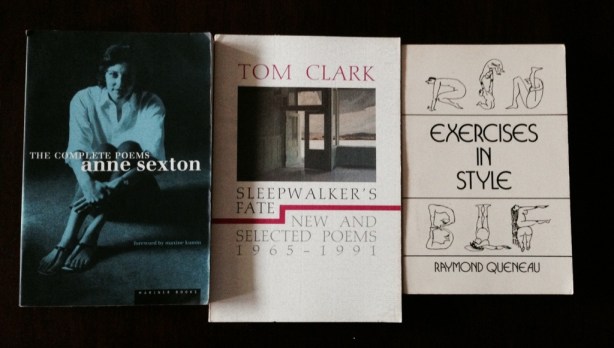
Clark/Queneau/Sexton (Books Acquired, 9.27.2013)

20130928-173447.jpg

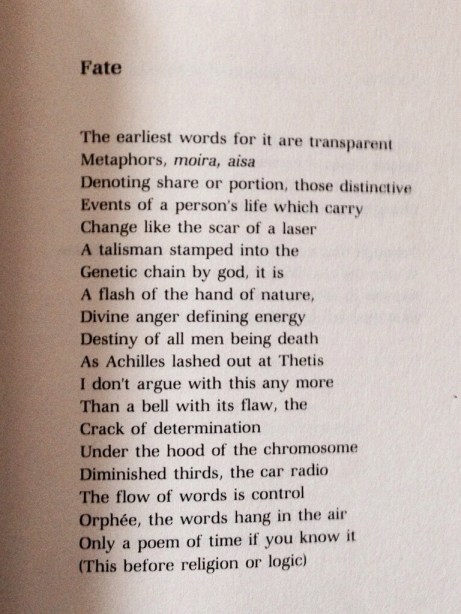
“Fate,” Tom Clark:

20130928-173505.jpg

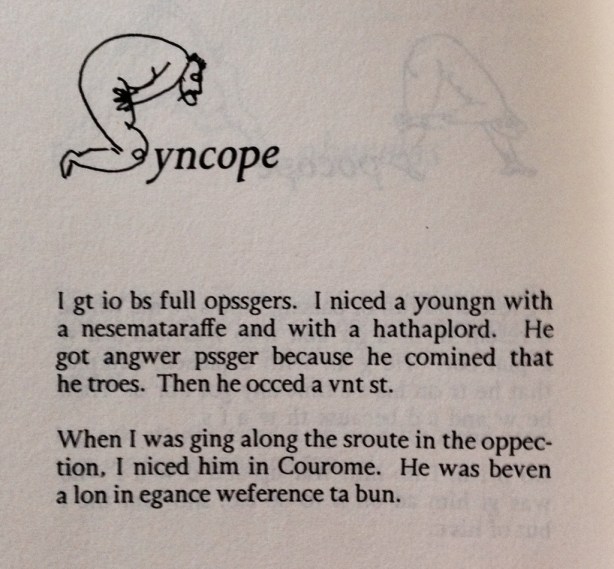
“Syncope,” Raymond Queneau:

20130928-173513.jpg

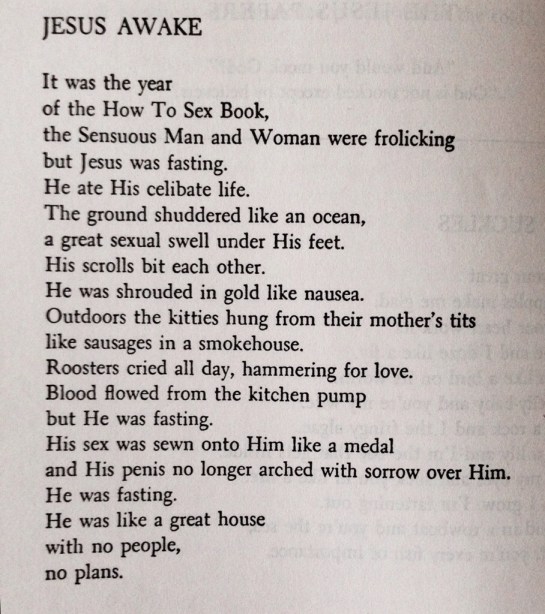
“Jesus Awake,” Anne Sexton:

20130928-173456.jpg

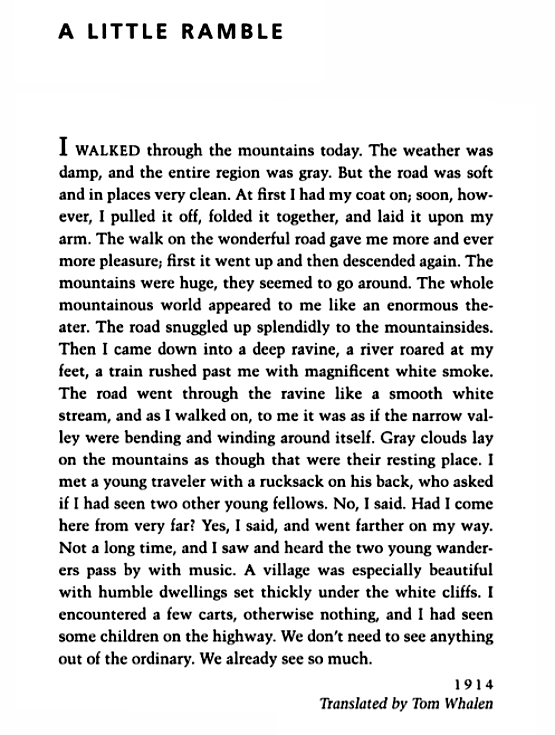
“A Little Ramble” — Robert Walser

alr

Allegory of Air — Jean-Baptiste Oudry

Ingrid Bergman’s Home Movies

The War Between Frogs and Mice — Theodor Severin Kittelsen

“A picnic party in the woods” / September 28, 1841 Journal Entry from Nathaniel Hawthorne

A picnic party in the woods, yesterday, in honor of little Frank Dana’s birthday, he being six years old. I strolled out, after dinner, with Mr. Bradford, and in a lonesome glade we met the apparition of an Indian chief, dressed in appropriate costume of blanket, feathers, and paint, and armed with a musket. Almost at the same time, a young gypsy fortune-teller came from among the trees, and proposed to tell my fortune. While she was doing this, the goddess Diana let fly an arrow, and hit me smartly in the hand. The fortune-teller and goddess were in fine contrast, Diana being a blonde, fair, quiet, with a moderate composure; and the gypsy (O. G.) a bright, vivacious, dark-haired, rich-complexioned damsel,–both of them very pretty, at least pretty enough to make fifteen years enchanting. Accompanied by these denizens of the wild wood, we went onward, and came to a company of fantastic figures, arranged in a ring for a dance or a game. There was a Swiss girl, an Indian squaw, a negro of the Jim Crow order, one or two foresters, and several people in Christian attire, besides children of all ages. Then followed childish games, in which the grown people took part with mirth enough,–while I, whose nature it is to be a mere spectator both of sport and serious business, lay under the trees and looked on. Meanwhile, Mr. Emerson and Miss Fuller, who arrived an hour or two before, came forth into the little glade where we were assembled. Here followed much talk. The ceremonies of the day concluded with a cold collation of cakes and fruit. All was pleasant enough,–an excellent piece of work,–“would’t were done!” It has left a fantastic impression on my memory, this intermingling of wild and fabulous characters with real and homely ones, in the secluded nook of the woods. I remember them, with the sunlight breaking through overshadowing branches, and they appearing and disappearing confusedly,–perhaps starting out of the earth; as if the every-day laws of nature were suspended for this particular occasion. There were the children, too, laughing and sporting about, as if they were at home among such strange shapes,–and anon bursting into loud uproar of lamentation, when the rude gambols of the merry archers chanced to overturn them. And apart, with a shrewd, Yankee observation of the scene, stands our friend Orange, a thick-set, sturdy figure, enjoying the fun well enough, yet, rather laughing with a perception of its nonsensicalness than at all entering into the spirit of the thing.

This morning I have been helping to gather apples. The principal farm labors at this time are ploughing for winter rye, and breaking up the greensward for next year’s crop of potatoes, gathering squashes, and not much else, except such year-round employments as milking. The crop of rye, to be sure, is in process of being threshed, at odd intervals.

I ought to have mentioned among the diverse and incongruous growths of the picnic party our two Spanish boys from Manilla,–Lucas, with his heavy features and almost mulatto complexion; and José, slighter, with rather a feminine face,–not a gay, girlish one, but grave, reserved, eying you sometimes with an earnest but secret expression, and causing you to question what sort of person he is.

From a September 28, 1841 journal entry in Nathaniel Hawthorne’s American Note-Books.

In the Boat — Konstantin Korovin

Fight with Cudgels — Francisco Goya

List with No Name #39

  1. Do the Right Thing
  2. Bamboozled
  3. 25th Hour
  4. Malcolm X
  5. Crooklyn
  6. Red Hook Summer
  7. She’s Gotta Have It
  8. Summer of Sam
  9. School Daze
  10. Mo’ Better Blues
  11. Jungle Fever
  12. Miracle at St. Anna
  13. Get on the Bus
  14. Girl 6
  15. She Hate Me

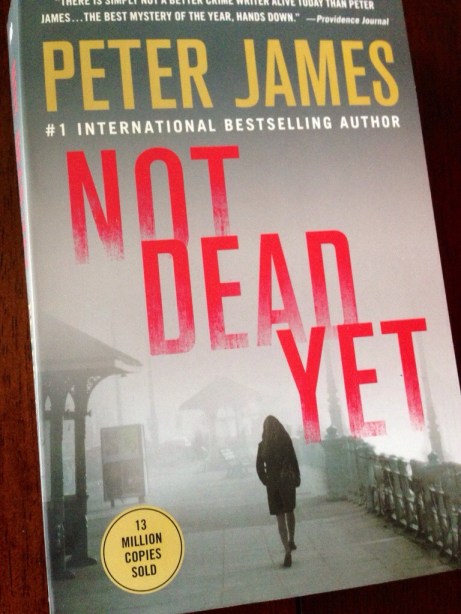
Not Dead Yet (Book Acquired, 9.19.2013)


20130924-200519.jpg

Peter James’s Not Dead Yet. Publisher’s blurb:

For LA producer Larry Brooker, this is the movie that could bring the fortune that has so long eluded him . . .

For rock superstar, Gaia, desperate to be taken seriously as an actor, this is the role that could get her an Oscar nomination…

For the City of Brighton and Hove, the publicity value of a major Hollywood movie being filmed on location, about the city’s greatest love story – between King George IVth and Maria Fitzherbert – is incalculable.

For Detective Superintendent Roy Grace of Sussex CID, it is a nightmare unfolding in front of his eyes. An obsessed stalker is after Gaia. One attempt on her life is made days before she leaves her Bel Air home to fly to Brighton. Now, he has been warned, the stalker may be at large in his city, waiting, watching, planning.


(Not Quite Reviews of) Stuff I Read in September

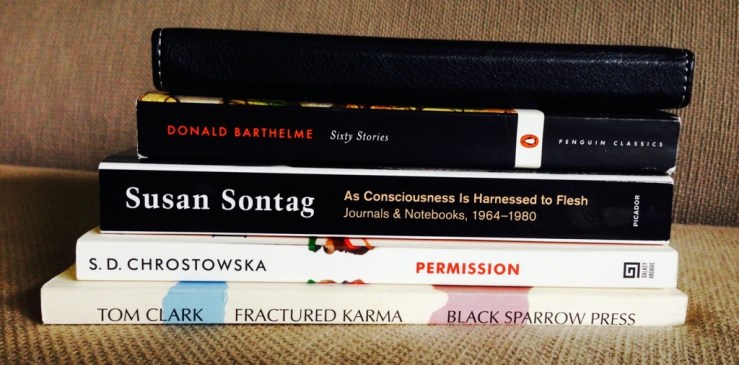
20130927-141817.jpg

So somehow in September, I neglected to write a single book review—not even a riff!—on this blog. Mea culpa, mea culpa. This oversight (not really an oversight) I mayhap blame on the nascent Fall semester. Or perhaps I should pin it on a certain fatigue after working my way through Pynchon’s mammoth beast Against the Day and Bernhard’s caustic Gargoyles at the end of the summer. But I shouldn’t blame the Thomases. No, I’ve been reading too much at once again. Bad habit.

So, what have I been reading?

Thomas Bernhard’s early novel Frost (on my Kindle, in the dark, often not exactly sober). I posted an excerpt of Ben Marcus’s review of the novel earlier, which I think does a nice job of describing Bernhard’s project. I’m really close to the end, but the novel wears me down—I experienced a similar feeling when I doubled up Correction and The Loser—I should’ve taken a break I think. Still, an excellent, funny read.

Donald Barthelme’s Sixty Stories: I don’t know why anyone wouldn’t own this book. There are a lot of negatives in that sentence; let me reword: Sixty Stories is perfect, a trove, a performance of an author doing stuff that no other author can do. I think I read most of this in college and just sort of went “check” next to it and moved on and I’m certain I didn’t get what he was doing like I do now—just amazing stuff.

I’ve already posted a few excerpts from the latest collection of Susan Sontag’s journals and notebooks, As Consciousness Is Harnessed to Flesh. I like this collection more than the last one—there’s almost a curatorial aspect to Sontag, who is perhaps in her intellectual prime near the end of the journals—or, maybe prime is not the right word; rather, it’s like her mind (which we get to access in some sense via her entries) is so finely attuned (and at times perfectly out of tune) with the intellectual milieu of the day. I’ll be posting a full review sometime in the next two weeks.

S.D. Chrostowska’s novel Permission, new from Dalkey Archive, is lovely stuff—and again, it’ll get its own proper review on here once I can muster the strength. Chrostowska does all sorts of things here that shouldn’t work—cite directly from Blanchot, Derrida, et al—but it does work. The novel is Sebaldian, soaked in history and literature, a book about books, writing about writing. Full review forthcoming. Short review: It’s very very good.

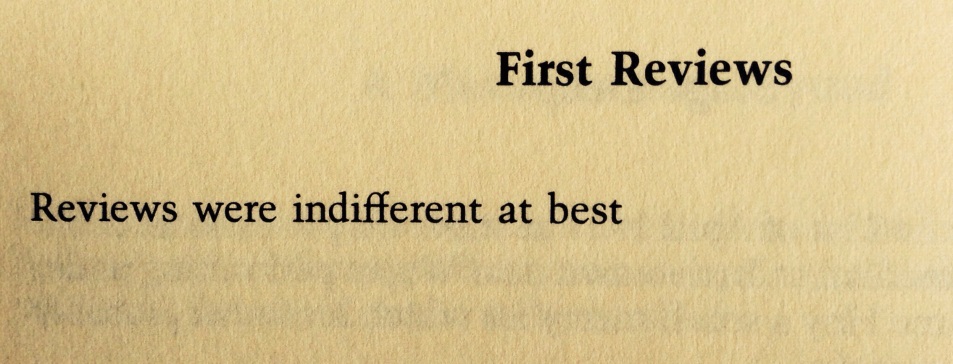
I picked up Tom Clark’s Fractured Karma two weeks ago somewhat randomly. My local bookshop had reorganized some shelves, putting all the Black Sparrow titles together. Fractured Karma must have been on top, because I don’t see how else I would’ve picked up a book with the word “karma” in the title. The book opened to this page:

20130927-141831.jpg

That’s all there is on that page, and something about it—the form, the phrasing—cracked me up. It’s part of a long poem called “He was born blind” about the British comedy actor George Formby. The poem is amazing: I read it there in the store. It reminded me immediately of David Markson’s notecard novels—something about how Clark includes so much reality into his poem. But there’s also this perceptive (if oblique) sense of humor behind it all. I ended up devouring the book, reading the whole thing that weekend. It was one of those holy shit reading moments, frankly. Once I finish typing this I’m going to go pick my kids up and we’re going to go to the bookstore and I’m going to get another Tom Clark book and read it this weekend.

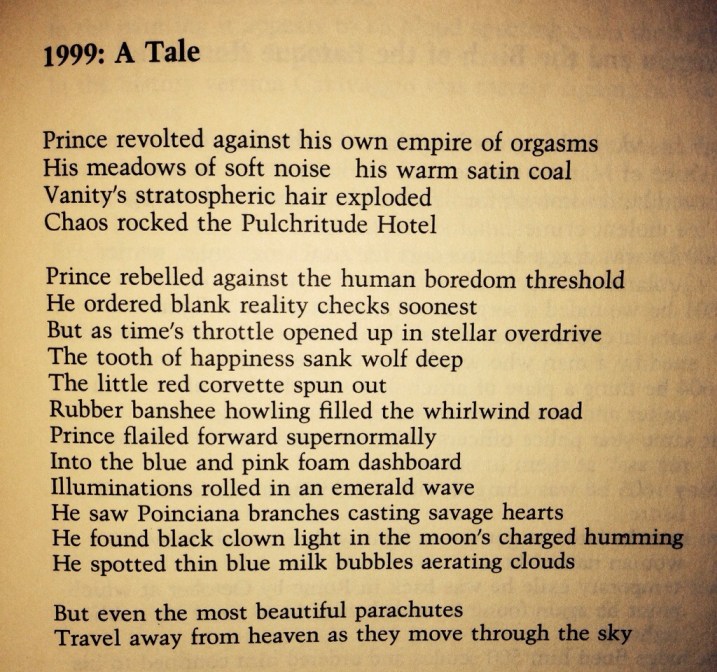
Here’s his poem about The Purple One:

20130927-141838.jpg


The Revenge — George de Forest Brush

It’s very confusing (Calvin & Hobbes)

ch130922

The Search — Ali Banisadr

3_ab-thesearchs