Read Donald Barthelme’s Story “Me and Miss Mandible”

“Me and Miss Mandible” by Donald Barthelme

13 September

Miss Mandible wants to make love to me but she hesitates because I am officially a child; I am, according to the records, according to the gradebook on her desk, according to the card index in the principal’s office, eleven years old. There is a misconception here, one that I haven’t quite managed to get cleared up yet. I am in fact thirty-five, I’ve been in the Army, I am six feet one, I have hair in the appropriate places, my voice is a baritone, I know very well what to do with Miss Mandible if she ever makes up her mind.

In the meantime we are studying common fractions. I could, of course, answer all the questions, or at least most of them (there are things I don’t remember). But I prefer to sit in this too-small seat with the desktop cramping my thighs and examine the life around me. There are thirty-two in the class, which is launched every morning with the pledge of allegiance to the flag. My own allegiance, at the moment, is divided between Miss Mandible and Sue Ann Brownly, who sits across the aisle from me all day long and is, like Miss Mandible, a fool for love. Of the two I prefer, today, Sue Ann; although between eleven and eleven and a half (she refuses to reveal her exact age) she is clearly a woman, with a woman’s disguised aggression and a woman’s peculiar contradictions. Strangely neither she nor any of the other children seem to see any incongruity in my presence here.

15 September

Happily our geography text, which contains maps of all the principal land-masses of the world, is large enough to conceal my clandestine journal-keeping, accomplished in an ordinary black composition book. Every day I must wait until Geography to put down such thoughts as I may have had during the morning about my situation and my fellows. I have tried writing at other times and it does not work. Either the teacher is walking up and down the aisles (during this period, luckily, she sticks close to the map rack in the front of the room) or Bobby Vanderbilt, who sits behind me, is punching me in the kidneys and wanting to know what I am doing. Vanderbilt, I have found out from certain desultory conversations on the playground, is hung up on sports cars, a veteran consumer of Road & Track. This explains the continual roaring sounds which seem to emanate from his desk; he is reproducing a record album called Sounds of Sebring.

19 September

Only I, at times (only at times), understand that somehow a mistake has been made, that I am in a place where I don’t belong. It may be that Miss Mandible also knows this, at some level, but for reasons not fully understood by me she is going along with the game. When I was first assigned to this room I wanted to protest, the error seemed obvious, the stupidest principal could have seen it; but I have come to believe it was deliberate, that I have been betrayed again.

Now it seems to make little difference. This life-role is as interesting as my former life- role, which was that of a claims adjuster for the Great Northern Insurance Company, a position which compelled me to spend my time amid the debris of our civilization: rumpled fenders, roofless sheds, gutted ware houses, smashed arms and legs. After ten years of this one has a tendency to see the world as a vast junkyard, looking at a man and seeing only his (potentially) mangled parts, entering a house only to trace the path of the inevitable fire. Therefore when I was installed here, although I knew an error had been made, I countenanced it, I was shrewd; I was aware that there might well be some kind of advantage to be gained from what seemed a disaster. The role of The Adjuster teaches one much.  Continue reading “Read Donald Barthelme’s Story “Me and Miss Mandible””

Resting in Bed — James McNeill Whistler

Almond Tree in Blossom — Vincent van Gogh

David Bowie’s Top 100 Must Read Books

David Bowie’s Top 100 Must Read Books:

The Age of American Unreason, Susan Jacoby, 2008

The Brief Wondrous Life of Oscar Wao, Junot Díaz, 2007

The Coast of Utopia (trilogy), Tom Stoppard, 2007

Teenage: The Creation of Youth 1875-1945, Jon Savage, 2007

Fingersmith, Sarah Waters, 2002

The Trial of Henry Kissinger, Christopher Hitchens, 2001

Mr. Wilson’s Cabinet of Wonder, Lawrence Weschler, 1997

A People’s Tragedy: The Russian Revolution 1890-1924, Orlando Figes, 1997

The Insult, Rupert Thomson, 1996

Wonder Boys, Michael Chabon, 1995

The Bird Artist, Howard Norman, 1994

Kafka Was The Rage: A Greenwich Village Memoir, Anatole Broyard, 1993

Beyond the Brillo Box: The Visual Arts in Post-Historical Perspective, Arthur C. Danto, 1992

Sexual Personae: Art and Decadence from Nefertiti to Emily Dickinson, Camille Paglia, 1990

David Bomberg, Richard Cork, 1988

Sweet Soul Music: Rhythm and Blues and the Southern Dream of Freedom, Peter Guralnick, 1986

The Songlines, Bruce Chatwin, 1986

Hawksmoor, Peter Ackroyd, 1985

Nowhere To Run: The Story of Soul Music, Gerri Hirshey, 1984

Nights at the Circus, Angela Carter, 1984

Money, Martin Amis, 1984

White Noise, Don DeLillo, 1984

Flaubert’s Parrot, Julian Barnes, 1984

The Life and Times of Little Richard, Charles White, 1984

A People’s History of the United States, Howard Zinn, 1980

A Confederacy of Dunces, John Kennedy Toole, 1980

Interviews with Francis Bacon, David Sylvester, 1980

Darkness at Noon, Arthur Koestler, 1980

Earthly Powers, Anthony Burgess, 1980

Raw (a ‘graphix magazine’) 1980-91

Viz (magazine) 1979 –

The Gnostic Gospels, Elaine Pagels, 1979

Metropolitan Life, Fran Lebowitz, 1978

In Between the Sheets, Ian McEwan, 1978

Writers at Work: The Paris Review Interviews, ed. Malcolm Cowley, 1977

The Origin of Consciousness in the Breakdown of the Bicameral Mind, Julian Jaynes, 1976

Tales of Beatnik Glory, Ed Saunders, 1975

Mystery Train, Greil Marcus, 1975

Selected Poems, Frank O’Hara, 1974

Before the Deluge: A Portrait of Berlin in the 1920s, Otto Friedrich, 1972

In Bluebeard’s Castle: Some Notes Towards the Re-definition of Culture, George Steiner, 1971

Octobriana and the Russian Underground, Peter Sadecky, 1971

The Sound of the City: The Rise of Rock and Roll, Charlie Gillete, 1970

The Quest For Christa T, Christa Wolf, 1968

Awopbopaloobop Alopbamboom: The Golden Age of Rock, Nik Cohn, 1968

The Master and Margarita, Mikhail Bulgakov, 1967

Journey into the Whirlwind, Eugenia Ginzburg, 1967

Last Exit to Brooklyn, Hubert Selby Jr., 1966

In Cold Blood, Truman Capote, 1965

City of Night, John Rechy, 1965

Herzog, Saul Bellow, 1964

Puckoon, Spike Milligan, 1963

The American Way of Death, Jessica Mitford, 1963

The Sailor Who Fell From Grace With The Sea, Yukio Mishima, 1963

The Fire Next Time, James Baldwin, 1963

A Clockwork Orange, Anthony Burgess, 1962

Inside the Whale and Other Essays, George Orwell, 1962

The Prime of Miss Jean Brodie, Muriel Spark, 1961

Private Eye (magazine) 1961 –

On Having No Head: Zen and the Rediscovery of the Obvious, Douglas Harding, 1961

Silence: Lectures and Writing, John Cage, 1961

Strange People, Frank Edwards, 1961

The Divided Self, R. D. Laing, 1960

All The Emperor’s Horses, David Kidd, 1960

Billy Liar, Keith Waterhouse, 1959

The Leopard, Giuseppe Di Lampedusa, 1958

On The Road, Jack Kerouac, 1957

The Hidden Persuaders, Vance Packard, 1957

Room at the Top, John Braine, 1957

A Grave for a Dolphin, Alberto Denti di Pirajno, 1956

The Outsider, Colin Wilson, 1956

Lolita, Vladimir Nabokov, 1955

Nineteen Eighty-Four, George Orwell, 1949

The Street, Ann Petry, 1946

Black Boy, Richard Wright, 1945

(Via).


Father and Son — Marin Majić

“October” — Tom Clark

october

October — Karoly Ferenczy

Slavoj Žižek on John Carpenter’s They Live and Christopher Nolan’s The Dark Knight Rises

Watch the Cream of Slovene analyze some film in this excerpt from The Pervert’s Guide to Ideology. (Via.)

Portrait of a Stout Man — Master of Flémalle

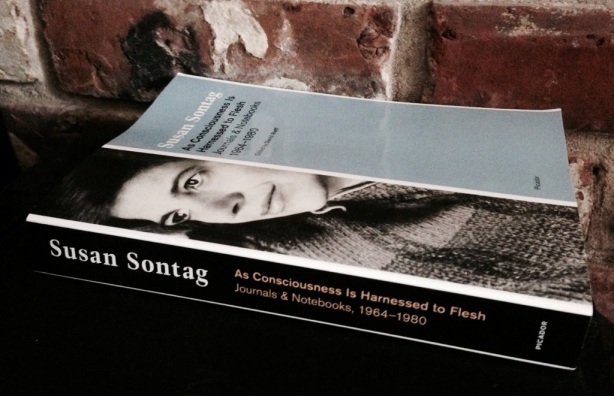
“Recycling one’s own life with books” |Thirteen Notes on Susan Sontag’s Notebook Collection, As Consciousness Is Harnessed to Flesh

20130929-103619.jpg

1. “In my more extravagant moments,” writes David Rieff in his introduction to Susan Sontag’s As Consciousness Is Harnessed to Flesh, “I sometimes think that my mother’s journals, of which this is the second of three volumes, are not just the autobiography she never got around to writing…but the great autobiographical novel she never cared to write.”

2. In my review of Reborn, the first of the trilogy Rieff alludes to, I wrote, “Don’t expect, of course, to get a definitive sense of who Sontag was, let alone a narrative account of her life here. Subtitled Journals & Notebooks 1947-1963Reborn veers closer to the “notebook” side of things.”

As Consciousness Is Harnessed to Flesh is far closer to the ‘notebook’ side of things too, which I think most readers (or maybe I just mean me here) will appreciate.

3. I mean, this isn’t the autobiographical novel that Rieff suggests it might be (except of course it is).

Consciousness/Flesh offers something better: access to Sontag’s consciousness in its prime, not quite ripe, but full, heavy, bursting with intellectual energy,  her mind attuned to (and attuning) the tumult of the time the journals cover, 1964 through 1980.

It’s an autobiography stripped of the pretense of presentation; it’s a novel stripped of the pretense of storytelling.

4. Sontag’s intellect and spirit course through the book’s 500 pages, eliding any distinction between lives personal and professional. “What sex is the ‘I’?” she writes, “Who has the right to say ‘I’?” The journals see her working through (if not resolving, thankfully) such issues.

5. An entry from late 1964, clearly background for Sontag’s seminal essay “Notes on Camp” (itself a series of notes), moves through a some thoughts on artists and poets, from Warhol to Breton to Duchamp (“DUCHAMP”) to simply “Style,” which, Rieff’s editorial note tells us, has a box drawn around it. The entry then moves to define

Work of Art

An experiment, a research (solving a “problem”) vs. form of a play

—before turning to a series of notes on the films of Michelangelo Antonioni.

6. A page or two later (1965) delivers the kind of gold vein we wish to discover in author’s notebooks:

PLOTS & SITUATIONS

Redemptive friendship (two women)

Novel in letters: the recluse-artist and his dealer a clairvoyant

A voyage to the underworld (Homer, Vergil [sic]Steppenwolf)

Matricide

An assassination

A collective hallucination (Story)

A theft

A work of art which is really a machine for dominating human beings

The discovery of a lost mss.

Two incestuous sisters

A space ship has landed

An ageing movie actress

A novel about the future. Machines. Each man has his own machine (memory bank, codified decision maker, etc.) You “play the machine. Instant everything.

Smuggling a huge art-work (painting? Sculpture?) out of the country in pieces—called “The Invention of Liberty”

A project: sanctity (based on SW [Simone Weil]—with honesty of Sylvia Plath—only way to solve sex “I” is talk about it

Jealousy

7. The list above—and there’s so much material like it in Consciousness/Flesh—is why I love author’s notebooks, We get to see the raw material here and imagine along with the writer (if we choose), free of the clutter and weight of execution, of prose, of damnable detail.

There’s something joyfully cryptic about Sontag’s notes, like the solitary entry “…Habits of despair” in late July of 1970—or a few months later: “A convention of mutants (Marvel comics).”

If we wish we can puzzle the notes out, treat them as clues or keys that fit to the work she was publishing at the time or to the personal circumstances of her private life. Or (and to be clear, I choose this or) we can let these notes stand as strange figures in an unconventional autobiographical novel.

8. Those looking for more direct material about Sontag’s life (and really, why do you want more and what more do you want?) will likely be disappointed—everything here is oblique (lovely, lovely oblique).

Still, there are moments of intense personal detail, like this 1964 entry where Sontag describes her body:

Body type

  • Tall
  • Low blood pressure
  • Needs lots of sleep
  • Sudden craving for pure sugar (but dislike desserts—not a high enough concentration)
  • Intolerance for liquor
  • Heavy smoking
  • Tendency to anemia
  • Heavy protein craving
  • Asthma
  • Migraines
  • Very good stomach—no heartburn, constipation, etc.
  • Negligible menstrual cramps
  • Easily tired by standing
  • Like heights
  • Enjoy seeing deformed people (voyeuristic)
  • Nailbiting
  • Teeth grinding
  • Nearsighted, astigmatism
  • Frileuse (very sensitive to cold, like hot summers)
  • Not very sensitive to noise (high degree of selective auditory focus)

There’s more autobiographical detail in that list than anyone craving a lurid expose could (should) hope for.

9. For many readers (or maybe I just mean me here) Consciousness/Flesh will be most fascinating as a curatorial project.

Sontag offers her list of best films (not in order),her ideal short story collection, and more. The collection often breaks into lists—like the ones we see above—but also into names—films, authors, books, essays, ideas, etc.

10. At times, Consciousness/Flesh resembles something close to David Markson’s so-called “notecard” novels (Reader’s Block, This Is Not a NovelVanishing Point, The Last Novel):

Napoleon’s wet, chubby back (Tolstoy).

and

Wordsworth’s ‘wise passiveness.’

and

Nabokov talks of minor readers. ‘There must be minor readers because there are minor writers.’

and

Camus (Notebooks, Vol. II): ‘Is there a tragic dilettante-ism?'”

and

‘To think is to exaggerate.’ — Valéry.

and so on…

11. Sometimes, the lists Sontag offers—

(offers is not the right verb at all here—these are Sontag’s personal journals and notebooks, her private ideas, material never intended for public consumption, but yes we are greedy, yes; and some of us (or maybe I just mean me here) are greedier than others, far more interested in her private ideas and notes and lists than the essays and stories and novels she generated from them—and so no, she didn’t offer this, my verb is all wrong)

—sometimes Sontag [creates/notes/generates] very personal lists, like “Movies I saw as a child, when they came out” (composed 11/25/65). There’s something tender here, imagining the child Sontag watching Fantasia or Rebecca or Citizen Kane or The Wizard of Oz in the theater; and then later, the adult Sontag, crafting her own lists, making those connections between past and present.

12. While Reborn showcased the intimate thoughts of a nascent (and at times naïve) intellect, Consciousness/Flesh shows us an assured writer at perhaps her zenith. In September of 1975, Sontag defines herself as a writer:

I am an adversary writer, a polemical writer. I write to support what is attacked, to attack what is acclaimed. But thereby I put myself in an emotionally uncomfortable position. I don’t, secretly, hope to convince, and can’t help being dismayed when my minority taste (ideas) becomes majority taste (ideas): then I want to attack again. I can’t help but be in an adversary relation to my own work.

13. Readers looking for a memoir or biography might be disappointed in Consciousness/Flesh; readers who seek to scrape its contours for “wisdom” (or worse, writing advice) should be castigated.

But As Consciousness Is Harnessed to Flesh will reward those readers who take it on its own terms as an oblique, discursive (and incomplete) record of Sontag’s brilliant mind.

I’ll close this riff with one last note from the book, a fitting encapsulation of the relationship between reader and author—and, most importantly, author-as-reader-and-rereader:

Recycling one’s own life with books.

As Consciousness Is Harnessed to Flesh is new in trade paperback from Picador; you can read excerpts from the book at their site.

Melancholy and Mystery of a Street — Ulf Puder

“Lines” — William Carlos Williams

lines

Who Is Sleeping On My Pillow — Mamma Andersson

mamma andersson_ 2010zwirner_whoissleepingonmypillow

Brilliantly — Theodor Severin Kittelsen

Stop Making Sense — Talking Heads

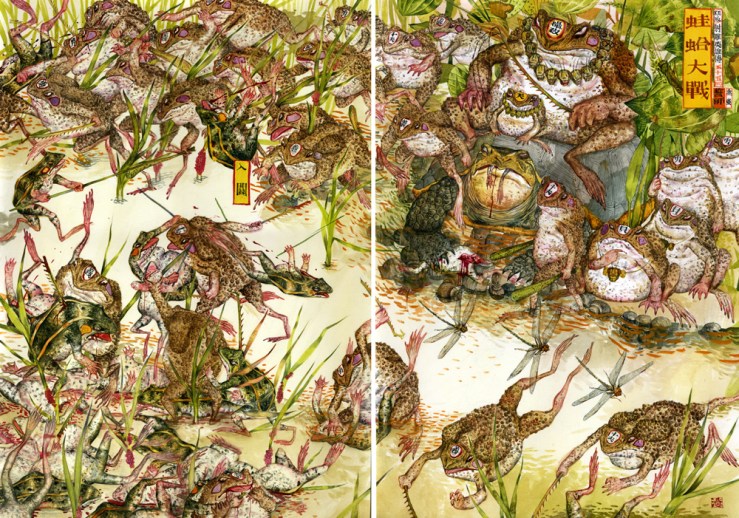
Frog Wars (Detail) — Mu Pan

frog2