“The Gorgon’s Head” by Nathaniel Hawthorne

“The Gorgon’s Head” by Nathaniel Hawthorne

PERSEUS was the son of Danaë, who was the daughter of a king. And when Perseus was a very little boy, some wicked people put his mother and himself into a chest, and set them afloat upon the sea. The wind blew freshly, and drove the chest away from the shore, and the uneasy billows, tossed it up and down; while Danaë clasped her child closely to her bosom, and dreaded that some big wave would dash its foamy crest over them both. The chest sailed on, however, and neither sank nor was upset; until, when night was coming, it floated so near an island that it got entangled in a fisherman’s nets, and was drawn out high and dry upon the sand. The island was called Seriphus, and it was reigned over by King Polydectes, who happened to be the fisherman’s brother.

This fisherman, I am glad to tell you, was an exceedingly humane and upright man. He showed great kindness to Danaë and her little boy; and continued to befriend them, until Perseus had grown to be a handsome youth, very strong and active, and skilful in the use of arms. Long before this time, King Polydectes had seen the two strangers–the mother and her child–who had come to his dominions in a floating chest. As he was not good and kind, like his brother the fisherman, but extremely wicked, he resolved to send Perseus on a dangerous enterprise, in which he would probably he killed, and then to do some great mischief to Danaë herself. So this bad-hearted king spent a long while in considering what was the most dangerous thing that a young man could possibly undertake to perform. At last, having hit upon an enterprise that promised to turn out as fatally as be desired, he sent for the youthful Perseus.

The young man came to the palace, and found the king sitting upon his throne. Continue reading ““The Gorgon’s Head” by Nathaniel Hawthorne”

Portrait of Eric Satie — Santiago Rusinol

The Fight — James Ensor

“I lost a world the other day” — Emily Dickinson

Capture

Morrissey — Dawn Mellor

The Séance Society (Book Acquired, 9.18.2013)

20130924-200501.jpg

Michael Nethercott’s The Séance Society. Blurbish review from Publisher’s Weekly:

Nethercott’s first full-length novel, a classically styled Holmesian whodunit set in 1956, introduces Lee Plunkett, an underemployed PI following reluctantly in his late father’s detective footsteps, and Mr. O’Nelligan, a charmingly low-key and literary-minded Irishman. Together they investigate the death of Trexler Lloyd, a rich eccentric, egomaniac, and patron of the arts of spirit communication, who appears to have been electrocuted at a private demonstration of “the Spectricator,” a device for speaking with the dead, at his home in Braywick, Conn. The plot manages to be twisty while proceeding logically, though the unanalyzed clues are often obvious enough that the reader must assume that Plunkett is none too clever and the smarter O’Nelligan is holding his cards close before the grand gathering and reveal. The household’s collection of psychics, servants, and ghosts are a colorful lot, but in the end are merely quirky where they could have been hilariously bold. Agent: Susan Gleason, Susan Gleason Literary Agency

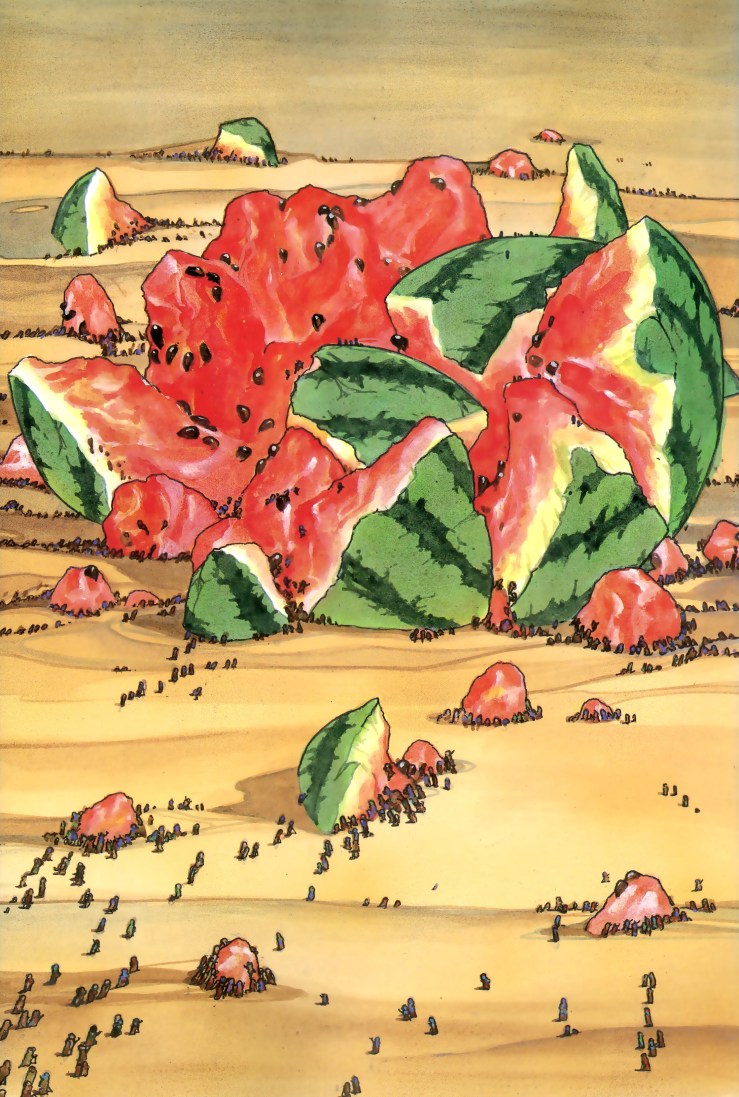
Watermelon — Katsuhiro Otomo

watermelon

(More/via).

Seven Jests from Leonardo da Vinci’s Notebooks

1281.

When wine is drunk by a drunkard, that wine is revenged on the drinker.

1283.

An artizan often going to visit a great gentleman without any definite purpose, the gentleman asked him what he did this for. The other said that he came there to have a pleasure which his lordship could not have; since to him it was a satisfaction to see men greater than himself, as is the way with the populace; while the gentleman could only see men of less consequence than himself; and so lords and great men were deprived of that pleasure.

1285.

A JEST.

A man wishing to prove, by the authority of Pythagoras, that he had formerly been in the world, while another would not let him finish his argument, the first speaker said to the second: “It is by this token that I was formerly here, I remember that you were a miller.” The other one, feeling himself stung by these words, agreed that it was true, and that by the same token he remembered that the speaker had been the ass that carried the flour.

A JEST.

It was asked of a painter why, since he made such beautiful figures, which were but dead things, his children were so ugly; to which the painter replied that he made his pictures by day, and his children by night.

1289.

An old man was publicly casting contempt on a young one, and boldly showing that he did not fear him; on which the young man replied that his advanced age served him better as a shield than either his tongue or his strength.

1291.

A JEST.

A man was desired to rise from bed, because the sun was already risen. To which he replied: “If I had as far to go, and as much to do as he has, I should be risen by now; but having but a little way to go, I shall not rise yet.”

1292.

A man, seeing a woman ready to hold up the target for a jousting match, exclaimed, looking at the shield, and considering his spear: “Alack! this is too small a workman for so great a business.”

From the Notebooks of Leonardo da Vinci.


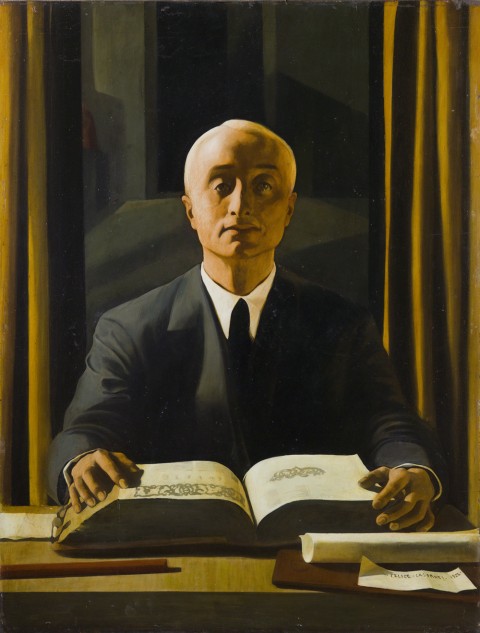
Portrait of Riccardo Gualino — Felice Casorati

03-Casorati_-480x633

Putney Swope — Robert Downey Sr. (Full Film)


Nocturne Black and Gold (The Rag Shop, Chelsea) — James McNeill Whistler

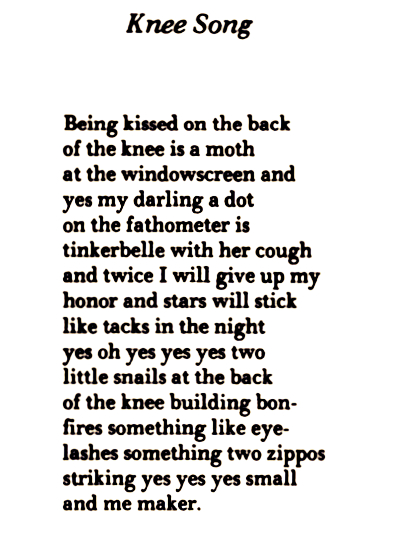
“Knee Song” — Anne Sexton

sexton

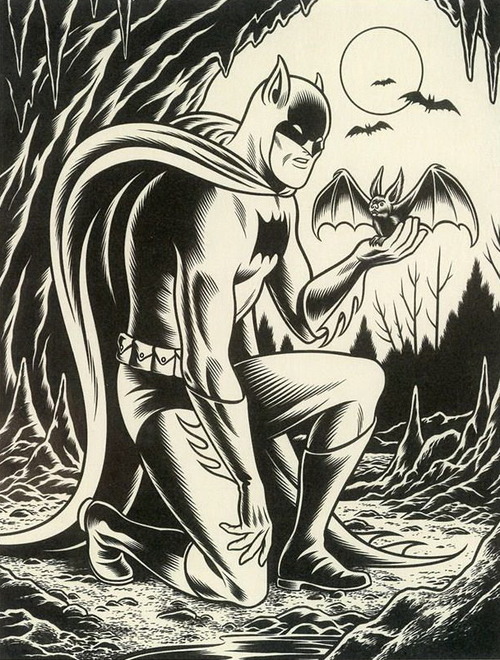
Batman — Charles Burns

batman burns

The Antagonist (Book Acquired, 9.23.2013)

20130924-200527.jpg

The kind people at Random House sent a copy of Lynn Coady’s The Antagonist, which is new in trade paperback next month. Their blurb:

A piercing epistolary novel, The Antagonist explores, with wit and compassion, how the impressions of others shape, pervert, and flummox both our perceptions of ourselves and our very nature.

Gordon Rankin Jr., aka “Rank,” thinks of himself as “King Midas in reverse”—and indeed misfortune seems to follow him at every turn. Against his will and his nature, he has long been considered—given his enormous size and strength—a goon and enforcer by his classmates, by his hockey coaches, and, not least, by his “tiny, angry” father. He gamely lives up to their expectations, until a vicious twist of fate forces him to flee underground. Now pushing forty, he discovers that an old, trusted friend from his college days has published a novel that borrows freely from the traumatic events of Rank’s own life. Outraged by this betrayal and feeling cruelly misrepresented, he bashes out his own version of his story in a barrage of e-mails to the novelist that range from funny to furious to heartbreaking.

With The Antagonist, Lynn Coady demonstrates all of the gifts that have made her one of Canada’s most respected young writers. Here she gives us an astonishing story of sons and fathers and mothers, of the rewards and betrayals of male friendship, and a large-spirited, hilarious, and exhilarating portrait of a man tearing his life apart in order to put himself back together.

The book got a strange review from Ron Charles in The Washington Post that’s worth reading if your interest is piqued; from that review:

It’s an extraordinarily clever and sympathetic exploration of the cross-currents of male friendship, the intense relationships we make and abandon in school. How ill-fitting those intimacies feel years later whenever a college reunion or some chance encounter forces us to try them on again. Who owns our adolescent memories, our forgotten brutalities, our drunken confessions of affection and dread? (By the way, there are three Lynn Coadys on Facebook, but you were easy to find.)

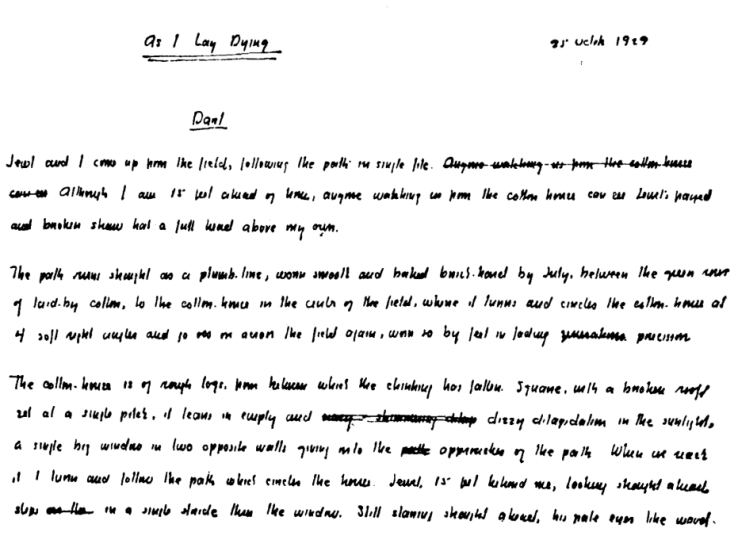
Manuscript Page of Faulkner’s As I Lay Dying

faulkner-w

“Ad Astra” — William Faulkner

“Ad Astra” by William Faulkner

I DON’T KNOW what we were. With the exception of Comyn, we had started out Americans, but after three years, in our British tunics and British wings and here and there a ribbon, I don’t suppose we had even bothered in three years to wonder what we were, to think or to remember.

And on that day, that evening, we were even less than that, or more than that: either beneath or beyond the knowledge that we had not even wondered in three years. The subadar, after a while he was there, in his turban and his trick major’s pips, said that we were like men trying to move in water. “But soon it will clear away,” he said. “The effluvium of hatred and of words. We are like men trying to move in water, with held breath watching our terrific and infinitesimal limbs, watching one another’s terrific stasis without touch, without contact, robbed of all save the impotence and the need.”

We were in the car then, going to Amiens, Sartoris driving and Comyn sitting half a head above him in the front seat like a tackling dummy, the subadar, Bland and I in back, each with a bottle or two in his pockets. Except the subadar, that is. He was squat, small and thick, yet his sobriety was colossal. In that maelstrom of alcohol where the rest of us had fled our inescapable selves he was like a rock, talking quietly in a grave bass four sizes too big for him: “In my country I was prince. But all men are brothers.”

But after twelve years I think of us as bugs in the surface of the water, isolant and aimless and unflagging. Not on the surface; in it, within that line of demarcation not air and not water, sometimes submerged, sometimes not. You have watched an unbreaking groundswell in a cove, the water shallow, the cove quiet, a little sinister with satiate familiarity, while beyond the darkling horizon the dying storm has raged on. That was the water, we the flotsam. Even after twelve years it is no clearer than that. It had no beginning and no ending. Out of nothing we howled, unwitting the storm which we had escaped and the foreign strand which we could not escape; that in the interval between two surges of the swell we died who had been too young to have ever lived.

We stopped in the middle of the road to drink again. The land was dark and empty. And quiet: that was what you noticed, remarked. You could hear the earth breathe, like coming out of ether, like it did not yet know, believe, that it was awake. “But now it is peace,” the subadar said. “All men are brothers.”

(Read the rest of “Ad Astra”).

Room in New York — Edward Hopper