Aged Phoenix — Paul Klee

Melville Underwater Camera

20130912-114628.jpg

From David Wiesner’s marvelous wordless wonder book Flotsam.

“A Note on Realism” — Robert Louis Stevenson

“A Note on Realism” by Robert Louis Stevenson

Style is the invariable mark of any master; and for the student who does not aspire so high as to be numbered with the giants, it is still the one quality in which he may improve himself at will.  Passion, wisdom, creative force, the power of mystery or colour, are allotted in the hour of birth, and can be neither learned nor simulated.  But the just and dexterous use of what qualities we have, the proportion of one part to another and to the whole, the elision of the useless, the accentuation of the important, and the preservation of a uniform character from end to end—these, which taken together constitute technical perfection, are to some degree within the reach of industry and intellectual courage.  What to put in and what to leave out; whether some particular fact be organically necessary or purely ornamental; whether, if it be purely ornamental, it may not weaken or obscure the general design; and finally, whether, if we decide to use it, we should do so grossly and notably, or in some conventional disguise: are questions of plastic style continually rearising.  And the sphinx that patrols the highways of executive art has no more unanswerable riddle to propound.

In literature (from which I must draw my instances) the great change of the past century has been effected by the admission of detail.  It was inaugurated by the romantic Scott; and at length, by the semi-romantic Balzac and his more or less wholly unromantic followers, bound like a duty on the novelist.  For some time it signified and expressed a more ample contemplation of the conditions of man’s life; but it has recently (at least in France) fallen into a merely technical and decorative stage, which it is, perhaps, still too harsh to call survival.  With a movement of alarm, the wiser or more timid begin to fall a little back from these extremities; they begin to aspire after a more naked, narrative articulation; after the succinct, the dignified, and the poetic; and as a means to this, after a general lightening of this baggage of detail.  After Scott we beheld the starveling story—once, in the hands of Voltaire, as abstract as a parable—begin to be pampered upon facts.  The introduction of these details developed a particular ability of hand; and that ability, childishly indulged, has led to the works that now amaze us on a railway journey.  A man of the unquestionable force of M. Zola spends himself on technical successes.  To afford a popular flavour and attract the mob, he adds a steady current of what I may be allowed to call the rancid.  That is exciting to the moralist; but what more particularly interests the artist is this tendency of the extreme of detail, when followed as a principle, to degenerate into merefeux-de-joie of literary tricking.  The other day even M. Daudet was to be heard babbling of audible colours and visible sounds. Continue reading ““A Note on Realism” — Robert Louis Stevenson”

Reading the Newspaper — Fyodor Bronnikov

Bomb Island — Peter Doig

Wonder Woman — Bill Sienkiewicz

wwbs

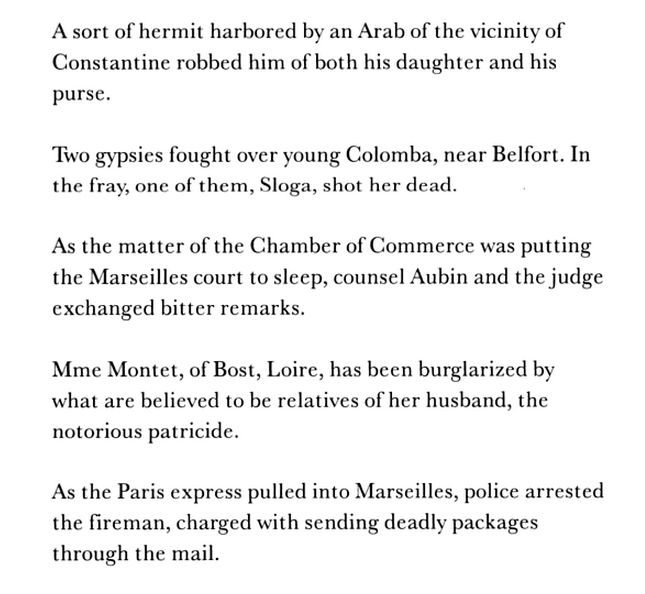
Five from Félix Fénéon

ffff

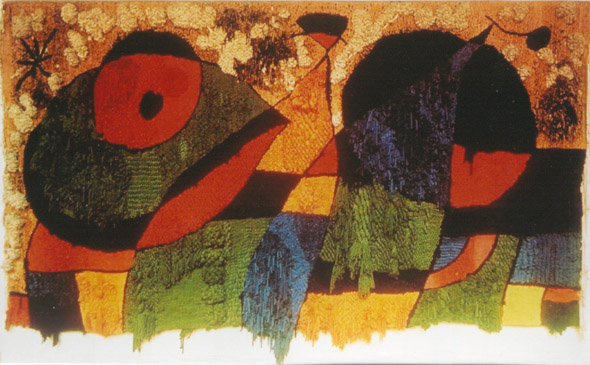
World Trade Center Tapestry — Joan Miró

wtctjm

“The only form of discourse” (Donald Barthelme)

“The only form of discourse of which I approve,” Miss R. said in her dry, tense voice, “is the litany. I believe our masters and teachers as well as plain citizens should confine themselves to what can safely be said. Thus when I hear the words pewter, snake, tea, Fad #6 sherry, serviette, fenestration, crown, blue coming from the mouth of some public official, or some raw youth, I am not disappointed. Vertical organisation is also possible,” Miss R. said, “ as in

pewter

snake

tea

fad #6 sherry

serviette

fenestration

crown

blue.

I run to liquids and colours,” she said, “but you, you may run to something else, my virgin,’ my darling, my thistle, my poppet, my own. Young people,” Miss R. said, “run to more and more unpleasant combinations as they sense the nature of our society. Some people,” Miss R. said, “run to conceits or wisdom but I hold to the hard, brown, nutlike word. I might point out that there is enough aesthetic excitement here to satisfy anyone but a damned fool.” I sat in solemn silence.

From Donald Barthelme’s short story “The Indian Uprising”; read the full story.

Reading Girl — Rik Wouters

Melancholy — William Blake

“Childhood is still running along beside us like a little dog” (Thomas Bernhard)

“Childhood is still running along beside us like a little dog who used to be a merry companion, but who now requires our care and splints, and myriad medicines, to prevent him from promptly passing on.” It went along rivers, and down mountain gorges. If you gave it any assistance, the evening would construct the most elaborate and costly lies. But it wouldn’t save you from pain and indignity. Lurking cats crossed your path with sinister thoughts. Like him, so nettles would sometimes draw me into fiendish moments of unchastity. As with him, my fear was made palatable by raspberries and blackberries. A swarm of crows were an instant manifestation of death. Rain produced damp and despair. Joy pearled off the crowns of sorrel plants. “The blanket of snow covers the earth like a sick child.” No infatuation, no ridicule, no sacrifice. “In classrooms, simple ideas assembled themselves, and on and on.” Then stores in town, butchers’ shop smells. Façades and walls, nothing but façades and walls, until you got out into the country again, quite abruptly, from one day to the next. Where the meadows began, yellow and green; brown plowland, black trees. Childhood: shaken down from a tree, so much fruit and no time! The secret of his childhood was contained in himself. Growing up wild, among horses, poultry, milk, and honey. And then: being evicted from this primal condition, bound to intentions that went way beyond himself. Designs. His possibilities multiplied, then dwindled in the course of a tearful afternoon. Down to three or four certainties. Immutable certainties. “How soon it is possible to spot dislike. Even without words, a child wants everything. And attains nothing.” Children are much more inscrutable than adults. “Protractors of history. Conscienceless. Correctors of history. Bringers-on of defeat. Ruthless as you please.” As soon as it could blow its own nose, a child was deadly to anything it came in touch with. Often—as it does me—it gives him a shock, when he feels a sensation he had as a child, provoked by a smell or a color, but that doesn’t remember him. “At such a moment you feel horribly alone.”

From Thomas Bernhard’s novel Frost.


Untitled (Hostess & Sailor) — Wang Xingwei

(More).

Facts, Questions, and Images from Nathaniel Hawthorne’s Note-Books

  1. The Abyssinians, after dressing their hair, sleep with their heads in a forked stick, in order not to discompose it.
  2. At the battle of Edge Hill, October 23, 1642, Captain John Smith, a soldier of note, Captain Lieutenant to Lord James Stuart’s horse, with only a groom, attacked a Parliament officer, three cuirassiers, and three arquebusiers, and rescued the royal standard, which they had taken and were guarding. Was this the Virginian Smith?
  3. Stephen Gowans supposed that the bodies of Adam and Eve were clothed in robes of light, which vanished after their sin.
  4. Lord Chancellor Clare, towards the close of his life, went to a village church, where he might not be known, to partake of the Sacrament.
  5. In the tenth century, mechanism of organs so clumsy, that one in Westminster Abbey, with four hundred pipes, required twenty-six bellows and seventy stout men. First organ ever known in Europe received by King Pepin, from the Emperor Constantine, in 757. Water boiling was kept in a reservoir under the pipes; and, the keys being struck, the valves opened, and steam rushed through with noise. The secret of working them thus is now lost. Then came bellows organs, first used by Louis le Débonnaire.
  6. After the siege of Antwerp, the children played marbles in the streets with grape and cannon shot.
  7. A shell, in falling, buries itself in the earth, and, when it explodes, a large pit is made by the earth being blown about in all directions,–large enough, sometimes, to hold three or four cart-loads of earth. The holes are circular.
  8. A French artillery-man being buried in his military cloak on the ramparts, a shell exploded, and unburied him.
  9. In the Netherlands, to form hedges, young trees are interwoven into a sort of lattice-work; and, in time, they grow together at the point of junction, so that the fence is all of one piece.

From Nathaniel Hawthorne’s American Note-Books.


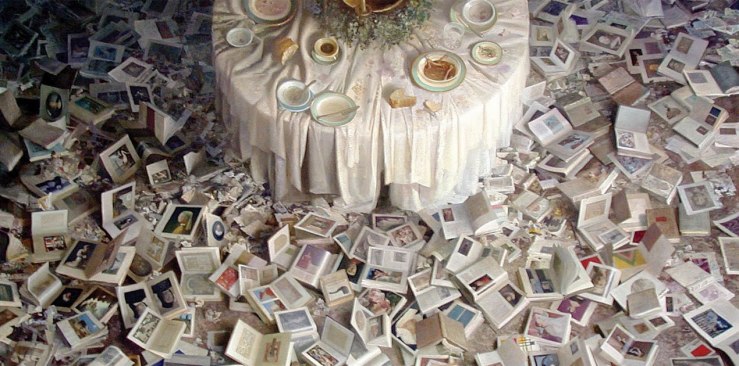
Cockaigne — Vincent Desiderio

Vincent-Desiderio-Cockaigne

Happy Machine — Masaaki Yuasa

Biblioklept Is Seven Today, So Here are Seven Sets of Seven Somethings

*

Seven Reviews of Seven Books I Love

The Rings of Saturn — W.G. Sebald

Denis Johnson’s Train Dreams Is a Perfect Novella

The Pale King — David Foster Wallace

Candide — Voltaire

I Riff on Clarice Lispector’s Novella The Hour of the Star, a Strange Work of Pity, Humor, Terror, and Abjection

The Collected Stories of Lydia Davis

Intertexuality and Structure in Roberto Bolaño’s 2666

*

Seven Hands (Van Gogh)

*

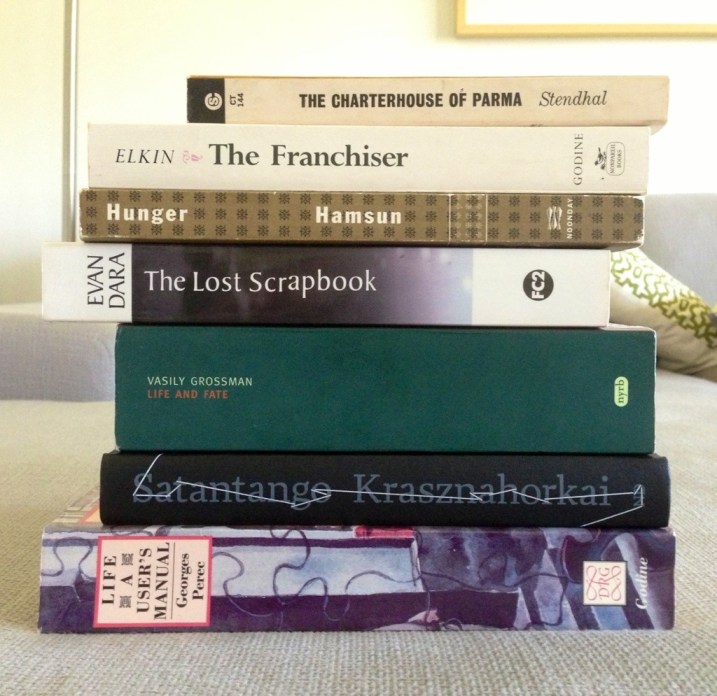
Seven Books I’d Like to Read Sometime in the Next Seven Years

20130909-164115.jpg

*

Seven Negative Reviews

Why I Abandoned Chad Harbach’s Over-Hyped Novel The Art of Fielding After Only 100 Pages

Jonathan Lethem’s Bloodless Prose

I Super Hated Gary Shteyngart’s Super Sad True Love Story

The Instructions — Adam Levin

Sunset Park — Paul Auster

The Passage — Justin Cronin

The Sot-Weed Factor — John Barth

*

Seven Ballerinas (Picasso)

*

Seven Perfect Short Stories

“The Death of Me” — Gordon Lish

“A Good Man Is Hard to Find” — Flannery O’Connor

“Emergency” — Denis Johnson

“The School” — Donald Barthelme

“Sweat” — Zora Neale Hurston

“Wakefield” — Nathaniel Hawthorne

“Good Old Neon” — David Foster Wallace

*

Seven Deadly Sins (Bosch)

*