Amity — Bernard Fleetwood-Walker

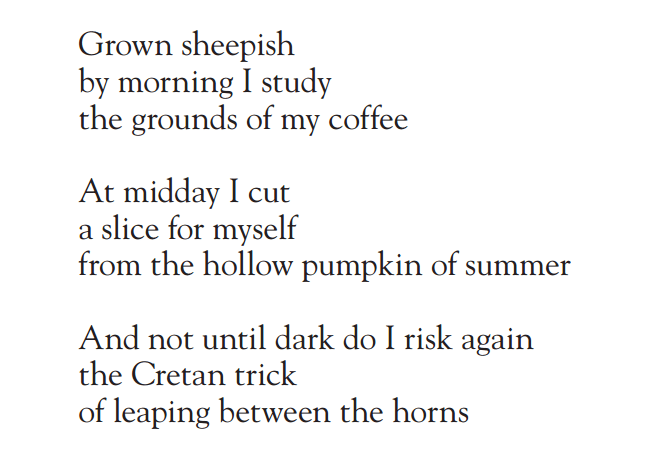
W.G. Sebald Poem-Fragment

Capture

Don Quixote — Ub Iwerks

Teju Cole’s Dictionary of Received Ideas

Yesterday on Twitter, Teju Cole shared a series of definitions—some ironic, some hilarious funny, all perceptive.

The series of definitions immediately reminded me of Ambrose Bierce’s sardonic work The Devil’s Dictionary, but Cole later tweeted that he had Gustave Flaubert’s Le Dictionnaire des Idées Reçues (The Dictionary of Received Ideas) in mind as a model.

Cole reiterated Flaubert’s influence again when he published the tweets today at The New Yorker under the title “In Place of Thought“—a little sample:

AMERICAN. With the prefix “all,” a blonde.

CHILDREN. The only justification for policy. Always say “our children.” The childless have no interest in improving society.

HILARIOUS. Never simply say “funny.”

HIP HOP. Old-school hip hop, i.e., whatever was popular when you were nineteen, is great. Everything since then is intolerable.

HIPSTER. One who has an irrational hatred of hipsters.

INTERNET. A waste of time. Have a long online argument with anyone who disagrees.

JAZZ. America’s classical music. The last album was released in 1965.

LITERALLY. Swear you’d rather die than use “literally” as an intensifier.

POET. Always preceded by “published.” Function unknown.

Bonus—from Flaubert’s Dictionnaire:

BLACK – Always preceded by “pitch”.

CHILDREN – Affect a lyric tenderness towards  them, when people are about.

INTRODUCTION — Obscene word.

LITERATURE — Idle pastime.

METAPHORS — Always too many in poems. Always too many in anybody’s writing.

OPTIMIST — Synonym for imbecile.

POETRY — Entirely useless; out of date.

THINK (TO) — Painful. Things that compel us to think are generally neglected.

Let’s Go Girls — Michails Korneckis

Fascination and Voyeuristic Attraction (Notes from Susan Sontag’s Notebook, 8/28/65)

My fascination with:

Disembowellment [sic]

Stripping down

Minimum conditions (from Robinson Crusoe to concentration camps)

Silences, muteness

My voyeuristic attraction to:

Cripples (Trip to Lourdes—they arrive from Germany in sealed trains)

Freaks

Mutants

—Notes from Susan Sontag’s notebook dated 8/28/65 Marseilles; published as part of the collection As Consciousness Is Harnessed to Flesh.


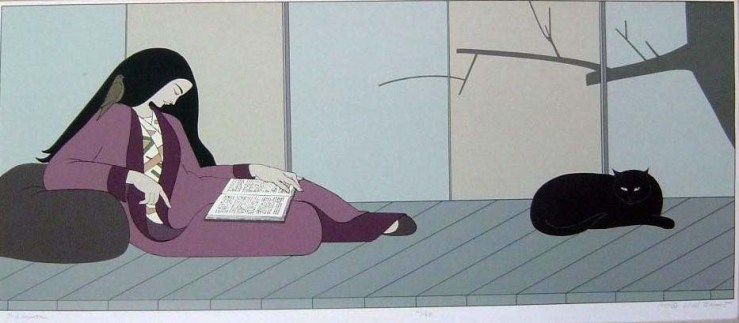
Aurora — Will Barnet

barnett_red_aurora

King Hobgoblin Sleeping — Hugo Simberg

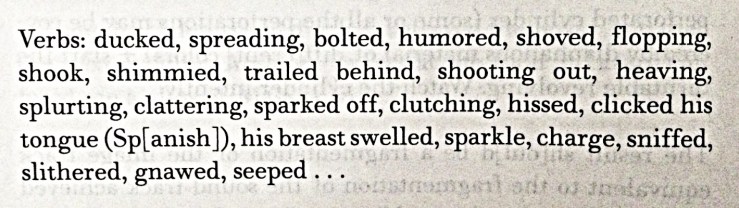
Verbs (Susan Sontag)

ss

Proust Penchant (Glen Baxter)

Rumours of my penchant

“Lines” — John Keats

Capture

“The two basic stories of all times are Cinderella and Jack the Giant Killer” and other notes from F. Scott Fitzgerald

  1. Art invariably grows out of a period when in general the artist admires his own nation and wants to win its approval. This fact is not altered by the circumstances that his work may take the form of satire for satire is the subtle flattery of a certain minority in a nation. The greatest artists grow out of these periods as the tall head of the crop. They may seem not to be affected but they are.
  2. Great art is the contempt of a great man for small art.
  3. The queer slanting effect of the substantive, the future imperfect, a matter of intuition or ear to O’Hara, is unknown to careful writers like Bunny and John.
  4. When the first rate author wants an exquisite heroine or a lovely morning, he finds that all the superlatives have been worn shoddy by his inferiors. It should be a rule that bad writers must start with plain heroines and ordinary mornings, and, if they are able, work up to something better.
  5. Man reads good reviews of his book so many times that he begins finally to remodel his style on them and use their rhythms.
  6. Realistic details like Dostoiefski glasses
  7. The two basic stories of all times are Cinderella and Jack the Giant Killer—the charm of women and the courage of men. The 19th century glorified the merchant’s cowardly son. Now a reaction.
  8. The Steinbeck scene. Out of touch with that life. The exact observation there.
  9. The episodic book, (Dos P. + Romaine etc.) may be wonderful, but the fact remains that it is episodic, and and such definition implies a limitation. You are with the character until the author gets tired of him—then you leave him for a while. In the true novel, you have to stay with the character all the time, and you acquire a sort of second wind about him, a depth of realization.
  10. In a short story, you have only so much money to buy just one costume. Not the parts of many. One mistake in the shoes or tie, and you’re gone.
  11. Play—For Act II. Something happens that to audience, changes entire situation, such as significant suitcase to country, or old terror apparently buried in Act I.

—From F. Scott Fitzgerald’s The Notebooks.

Homework — Nikolay Bogdanov-Belsky

The Chums of Chance Reading List (Thomas Pynchon’s Against the Day)

hgdTitles of The Chums of Chance books mentioned in Thomas Pynchon’s Against the Day:
  • The Chums of Chance and the Evil Halfwit
  • The Chums of Chance and the Curse of the Great Kahuna
  • The Chums of Chance and the Ice Pirates
  • The Chums of Chance Nearly Crash into the Kremlin
  • The Chums of Chance and the Caged Women of Yokohama
  • The Chums of Chance and the Wrath of the Yellow Fang
  • The Chums of Chance at Krakatoa
  • The Chums of Chance Search for Atlantis
  • The Chums of Chance in Old Mexico
  • The Chums of Chance in the Bowels of the Earth
  • The Chums of Chance at the Ends of the Earth

The Chums of Chance bits have been some of my favorites in Pynchon’s Against the Day, and have given me more than one occasion to riff. There’s something wonderfully generative (and even generous) about these pulpy, romantic titles—an invitation to daydream, to fly with the boys a bit.

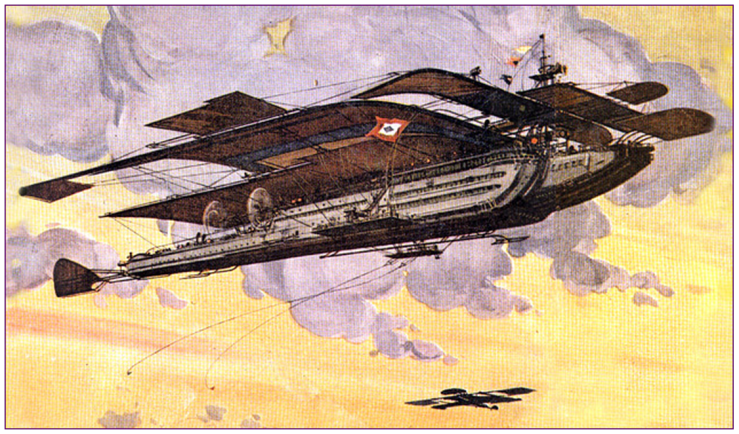
The painting of the airship at the top is by Harry Grant Dart, whose comic strip The Explorigator undoubtedly influenced Pynchon’s vision of The Chums of Chance. You can perhaps glean some of that inspiration in this 1908 broadside:

Explorigator19080503Intro


The Drunkard’s Progress

drunkards

(Via).