“The Coffee-House of Surat” — Leo Tolstoy

“THE COFFEE-HOUSE OF SURAT” by Leo Tolstoy

(After Bernardin de Saint-Pierre)

In the town of Surat, in India, was a coffee-house where many travellers and foreigners from all parts of the world met and conversed.

One day a learned Persian theologian visited this coffee-house. He was a man who had spent his life studying the nature of the Deity, and reading and writing books upon the subject. He had thought, read, and written so much about God, that eventually he lost his wits, became quite confused, and ceased even to believe in the existence of a God. The Shah, hearing of this, had banished him from Persia.

After having argued all his life about the First Cause, this unfortunate theologian had ended by quite perplexing himself, and instead of understanding that he had lost his own reason, he began to think that there was no higher Reason controlling the universe.

This man had an African slave who followed him everywhere. When the theologian entered the coffee-house, the slave remained outside, near the door, sitting on a stone in the glare of the sun, and driving away the flies that buzzed around him. The Persian having settled down on a divan in the coffee-house, ordered himself a cup of opium. When he had drunk it and the opium had begun to quicken the workings of his brain, he addressed his slave through the open door:

“Tell me, wretched slave,” said he, “do you think there is a God, or not?”

“Of course there is,” said the slave, and immediately drew from under his girdle a small idol of wood.

“There,” said he, “that is the God who has guarded me from the day of my birth. Every one in our country worships the fetish tree, from the wood of which this God was made.”

This conversation between the theologian and his slave was listened to with surprise by the other guests in the coffee-house. They were astonished at the master’s question, and yet more so at the slave’s reply.

One of them, a Brahmin, on hearing the words spoken by the slave, turned to him and said:

“Miserable fool! Is it possible you believe that God can be carried under a man’s girdle? There is one God—Brahma, and he is greater than the whole world, for he created it. Brahma is the One, the mighty God, and in His honour are built the temples on the Ganges’ banks, where his true priests, the Brahmins, worship him. They know the true God, and none but they. A thousand score of years have passed, and yet through revolution after revolution these priests have held their sway, because Brahma, the one true God, has protected them.” Continue reading ““The Coffee-House of Surat” — Leo Tolstoy”

A Lady Reading a Newspaper — Carl Larsson

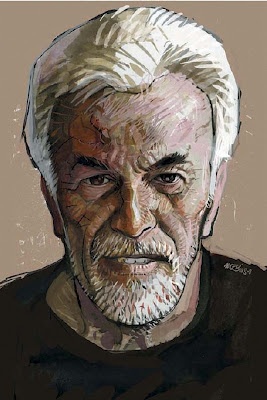
Portrait of Alejandro Jodorowsky — Moebius

jodorowsky moebius

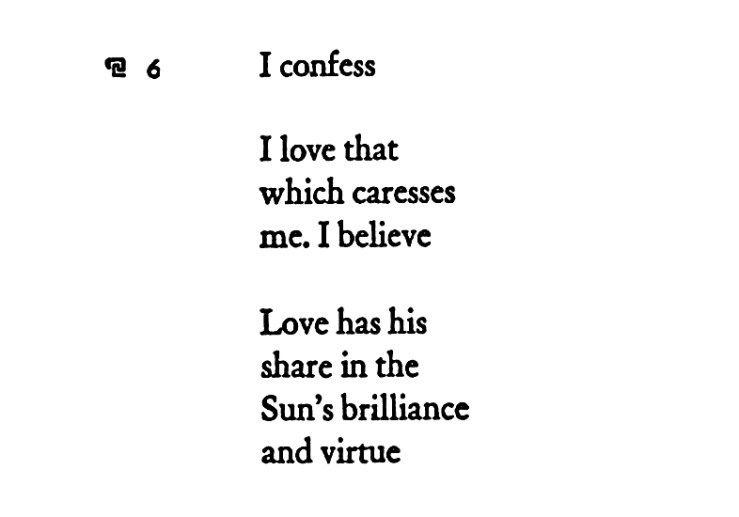
I confess (Sappho)

confess

A Monkey Encampment — David Teniers the Younger

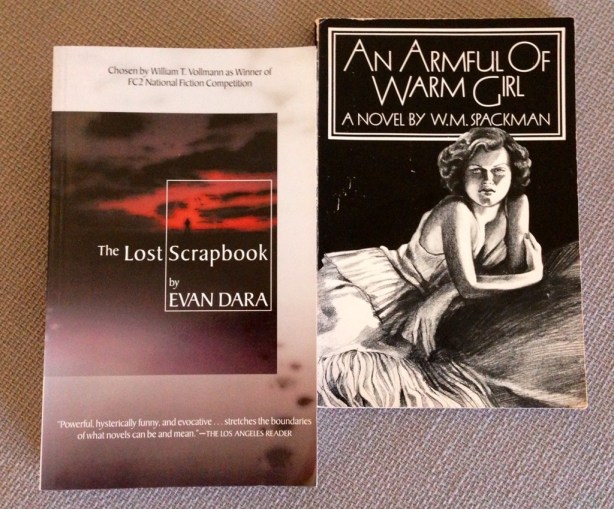
Books Acquired, 8.06.2013

20130809-114547.jpg

Woman Grinding Coffee — Vincent van Gogh

A Coffee Thesaurus

A COFFEE THESAURUS — From William H. Ukers’s All About Coffee (1922)

Encomiums and descriptive phrases applied to the plant, the berry, and the beverage

The Plant

The precious plant
This friendly plant
Mocha’s happy tree
The gift of Heaven
The plant with the jessamine-like flowers
The most exquisite perfume of Araby the blest
Given to the human race by the gift of the Gods

The Berry

The magic bean
The divine fruit
Fragrant berries
Rich, royal berry
Voluptuous berry
The precious berry
The healthful bean
The Heavenly berry
The marvelous berry
This all-healing berry
Yemen’s fragrant berry
The little aromatic berry
Little brown Arabian berry
Thought-inspiring bean of Arabia
The smoking, ardent beans Aleppo sends
That wild fruit which gives so beloved a drink

The Beverage

Nepenthe
Festive cup
Juice divine
Nectar divine
Ruddy mocha
A man’s drink
Lovable liquor
Delicious mocha
The magic drink
This rich cordial
Its stream divine
The family drink
The festive drink
Coffee is our gold
Nectar of all men
The golden mocha
This sweet nectar
Celestial ambrosia
The friendly drink
The cheerful drink
The essential drink
The sweet draught
The divine draught
The grateful liquor
The universal drink
The American drink
The amber beverage
The convivial drink
The universal thrill
King of all perfumes
The cup of happiness
The soothing draught
Ambrosia of the Gods
The intellectual drink
The aromatic draught
The salutary beverage
The good-fellow drink
The drink of democracy
The drink ever glorious
Wakeful and civil drink
The beverage of sobriety
A psychological necessity
The fighting man’s drink
Loved and favored drink
The symbol of hospitality
This rare Arabian cordial
Inspirer of men of letters
The revolutionary beverage
Triumphant stream of sable
Grave and wholesome liquor
The drink of the intellectuals
A restorative of sparkling wit
Its color is the seal of its purity
The sober and wholesome drink
Lovelier than a thousand kisses
This honest and cheering beverage
A wine which no sorrow can resist
The symbol of human brotherhood
At once a pleasure and a medicine
The beverage of the friends of God
The fire which consumes our griefs
Gentle panacea of domestic troubles
The autocrat of the breakfast table
The beverage of the children of God
King of the American breakfast table
Soothes you softly out of dull sobriety
The cup that cheers but not inebriates
Coffee, which makes the politician wise
Its aroma is the pleasantest in all nature
The sovereign drink of pleasure and health
The indispensable beverage of strong nations
The stream in which we wash away our sorrows
The enchanting perfume that a zephyr has brought
Favored liquid which fills all my soul with delight
The delicious libation we pour on the altar of friendship
This invigorating drink which drives sad care from the heart


Girl Reading in a Salon — Giovanni Boldini

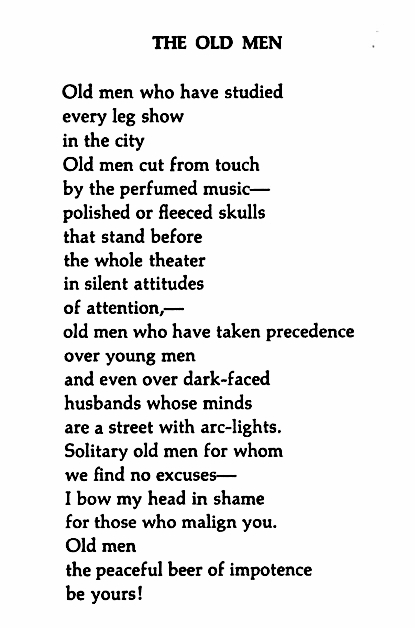
“The Old Men” — William Carlos Williams

old men

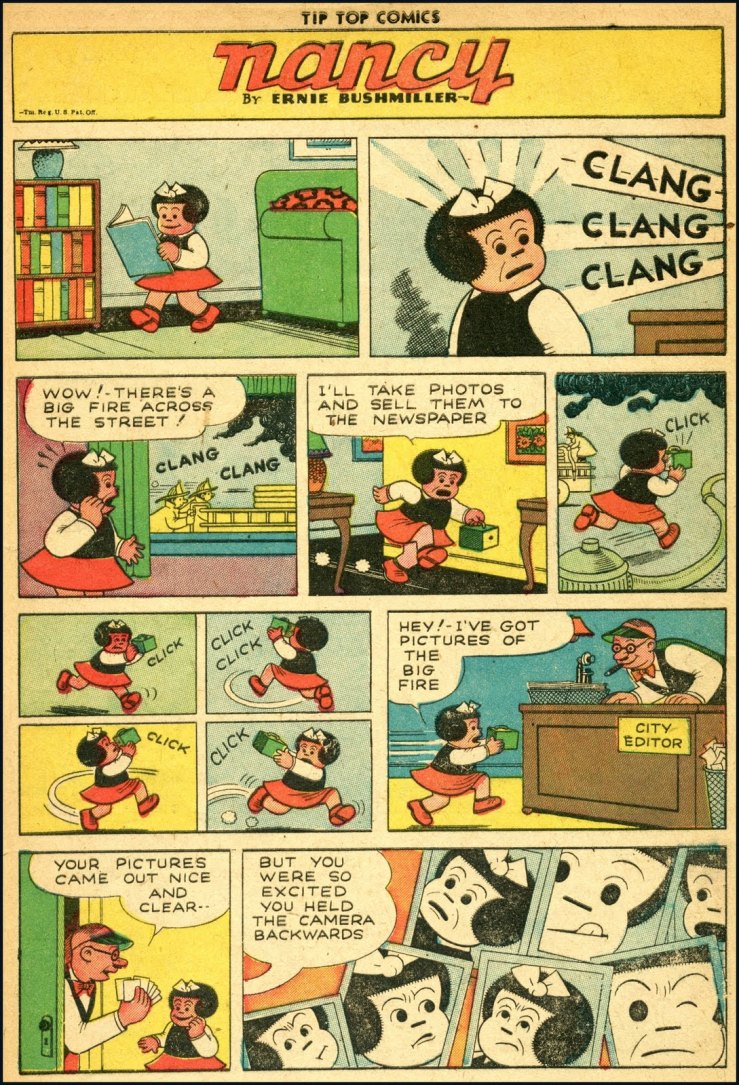
Nancy Takes Selfies (Ernie Bushmiller)

bushmiller_1951_02_tiptip_166_b_nancy

(Via/more).

Paul Thomas Anderson on Max Ophuls

The Week with Four Thursdays — Balthus

From Thomas Bernhard’s Novel Gargoyles, The Story of the Deceased Teacher

While we ate, my father also told me the following story about the deceased teacher. Once when he was a boy, his grandmother had taken him along into the deep woods to pick blackberries. They lost their way completely, wandered for hours, and could not find the way out of the woods. Darkness fell, and still they had not found the path. They kept going in the wrong direction all the time. Finally grandmother and grandson curled up in a hollow, and lying pressed close together, survived the night. They were lost all the next day and spent a second night in another refuge. Not until the afternoon of the second day did they suddenly emerge from the woods, only to find they had all along gone in a direction opposite from that of their home. Totally exhausted, they had struggled on to the nearest farmhouse.

This ordeal had quickly brought about the grandmother’s death. And her grandson, not yet six, had had his entire future ruined by it, my father said.

You could always conclude that the disasters in a man’s life derived from earlier, usually very early, injuries to his body and his psyche, my father averred. Modern medicine was aware of this, but still made far too little use of such knowledge.

“Even today most doctors do not look into causes,” my father said. “They concern themselves only with the most elementary patterns of treatment. They’re hypocrites who do nothing but prescribe medicines and close their eyes to the psyches of people who because of their helplessness and a disastrous tradition entrust themselves completely to their doctors. And most doctors are lazy and cowardly.”

Putting yourself at their mercy meant putting yourself at the mercy of chance and total unfeelingness, trusting to a pseudo-science, my father said. “Most doctors nowadays are unskilled workers in medicine. And the greatest mystifiers. I never feel more insecure than when I’m among my colleagues. Nothing is more sinister than medicine.”

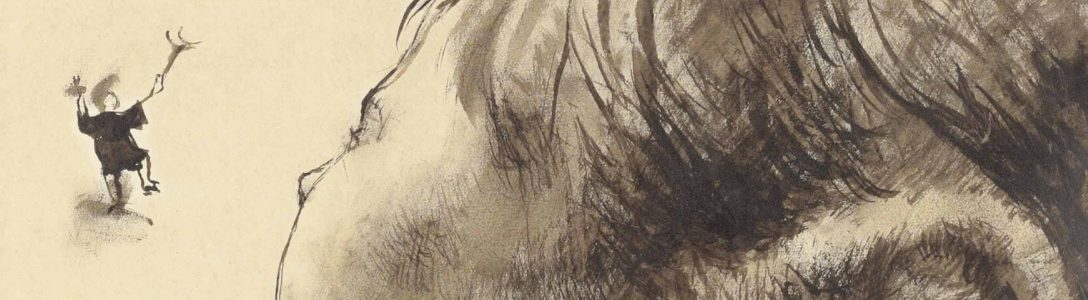
In the last months of his life the teacher had developed an astonishing gift for pen drawing, my father said. The demonic elements that more and more came to light in his drawings shocked his parents. In delicate lines he drew a world “intent upon self-destruction” that terrified them: birds torn to pieces, human tongues ripped out by the roots, eight-fingered hands, smashed heads, extremities torn from bodies not shown, feet, hands, genitals, people suffocated as they walked, and so on. In those last months the bony structure of the young man’s skull became more and more prominent. And he drew his own portrait frequently, hundreds, thousands of times. When the young teacher talked, the disastrous way his mind was set became apparent. My father had considered taking some of the drawings and showing them to a gallery owner he knew in Graz. “They would make a good exhibition,” he said. “I don’t know anyone who draws the way the teacher did.” The teacher’s surrealism was something completely original, for there was nothing surreal in his drawings; what they showed was reality itself. “The world is surrealistic through and through,” my father said. “Nature is surrealistic, everything is surrealistic.” But he felt that art one exhibited was destroyed by the very act of being exhibited, and so he dropped the idea of doing anything with the teacher’s drawings. On the other hand, he was afraid the schoolmaster’s parents would throw away the drawings or burn them—thousands of them!—from ignorance of how good they were and because they were still frightened, anxious, and wrought up about these drawings. So he had decided to take them. “I’ll simply take them all with me,” he said. He had no doubt they would be handed over to him.

The teacher’s parents must have kept thinking of their sick son’s unfortunate bent whenever they looked at him during his last illness, my father said. “What a terrible thing it is that when you know of some deviation, some unnaturalness, or some crime in connection with a person, as long as he lives you can never look at him without thinking about that deviation, unnaturalness, or crime.”

From his bed the teacher had a view of the peak of the Bundscheck on one side and the rounded top of the Wölkerkogel on the other side. “You can feel this whole stark landscape in his drawings,” my father said.

The teacher’s parents said, however, that during his last days he had not spoken at all, only looked at the landscape outside his window. But the landscape he saw was entirely different from theirs, my father said, and different from the landscape we see when we look at it. What he depicted was an entirely different landscape, “everything totally different.”

—From Thomas Bernhard’s novel Gargoyles.


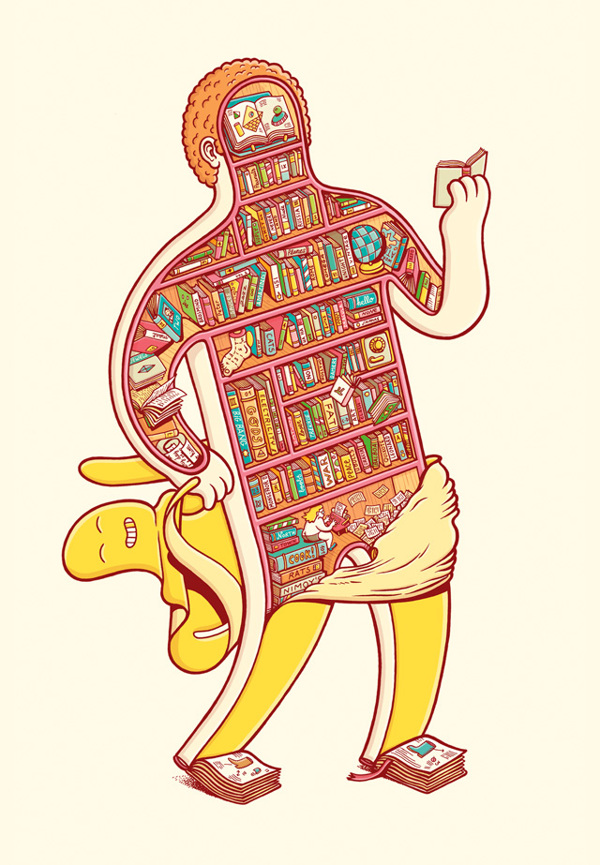
What’s Inside? #18 (Library Man) — Brosmind

whats-inside-18

(More).

List with No Name #36

  1. Fargo
  2. A Serious Man
  3. The Big Lebowski
  4. Miller’s Crossing
  5. Barton Fink
  6. Blood Simple
  7. No Country for Old Men
  8. O Brother, Where Art Thou?
  9. The Man Who Wasn’t There
  10. Raising Arizona
  11. Burn After Reading
  12. True Grit
  13. The Hudsucker Proxy
  14. The Ladykillers
  15. Intolerable Cruelty

Untitled (Cubism and Abstract Art) — Steve Wolfe