Barry Hannah Visits a Louisiana Leper Colony

Barry Hannah visits a Louisiana leper colony in “Old Terror, New Hearts,” republished this week in Oxford Americans; the piece originally ran in the October/November 1995 issue of the magazine. Opening paragraphs:

It was a massive Federalist plantation, lazy and handsome among two-century oaks and palm trees. You could imagine FDR had just visited to cut a ribbon last week. I had heard throughout my life the curious rumor of a leper “colony” down in south Louisiana. This news reached me when I was a boy in Clinton, Mississippi, and one did not know quite what to do with it. Colony evoked folks lost in an exotic fastness. Leper of course was as bad as it got, poor devils. I had a sense of these creatures execrated and driven onto some isle in a vicious swamp. In that, my young imagination was not far wrong. Louisiana was alarming and peculiar anyway. There were plenty of Catholics, many seemed touched by at least mild cases of voodoo, and adults went public with their gaudiest dreams.

Nothing at the time was more peculiar to me than the armored mammal of Louisiana, the armadillo, which I had seen dead on the road as I traveled to relatives in Baton Rouge. It was a thing aggressively obsolete in animal history but still mucking its way along, its stupid ranks torn to flat bits by modern autos on pavement laid down through the bogs. I could not know how closely related these creatures were to the poor lepers themselves. Among animals, only armadillos have leprosy. Among mankind, nobody has suffered opprobrium for six thousand years like the leper. At Carville, where I finally got over forty years of mildly curious ignorance, I saw the doubloons from last year’s Mardi Gras at Carville were imprinted on one side with an armadillo. On the other was the Federalist infirmary building: Gillis W.Long Hansen’s Disease Center1921. Hansen was the Norwegian doctor who first isolated the leprosy bacillus in the late nineteenth century. In 1921 the state leprosarium was taken over by the Public Health Service.

Now it is the Service’s last remaining hospital. In that state of advanced idiocy that has made me a living so far and may be the birthright of a Mississippi writer, I asked a therapist working with two Asian-American patients after their hand surgery if he was a flight surgeon, his uniform so naval and all. He explained, as further did Captain Jim Birke, most formidable pedorthist, that the Public Health Service originated after the Revolutionary War as a naval medical branch. Thus the costume of the Surgeon General, which has baffled others too tactful to ask.

Read the rest of Hannah’s essay “Old Terror, New Hearts.”

“The Skull” — Philip K. Dick

“The Skull” by Philip K. Dick

“WHAT is this opportunity?” Conger asked. “Go on. I’m interested.”

The room was silent; all faces were fixed on Conger—still in the drab prison uniform. The Speaker leaned forward slowly.

“Before you went to prison your trading business was paying well—all illegal—all very profitable. Now you have nothing, except the prospect of another six years in a cell.”

Conger scowled.

“There is a certain situation, very important to this Council, that requires your peculiar abilities. Also, it is a situation you might find interesting. You were a hunter, were you not? You’ve done a great deal of trapping, hiding in the bushes, waiting at night for the game? I imagine hunting must be a source of satisfaction to you, the chase, the stalking—”

Conger sighed. His lips twisted. “All right,” he said. “Leave that out. Get to the point. Who do you want me to kill?”

The Speaker smiled. “All in proper sequence,” he said softly.


THE car slid to a stop. It was night; there was no light anywhere along the street. Conger looked out. “Where are we? What is this place?”

The hand of the guard pressed into his arm. “Come. Through that door.”

Conger stepped down, onto the damp sidewalk. The guard came swiftly after him, and then the Speaker. Conger took a deep breath of the cold air. He studied the dim outline of the building rising up before them.

“I know this place. I’ve seen it before.” He squinted, his eyes growing accustomed to the dark. Suddenly he became alert. “This is—”

“Yes. The First Church.” The Speaker walked toward the steps. “We’re expected.”

“Expected? Here?

“Yes.” The Speaker mounted the stairs. “You know we’re not allowed in their Churches, especially with guns!” He stopped. Two armed soldiers loomed up ahead, one on each side.

“All right?” The Speaker looked up at them. They nodded. The door of the Church was open. Conger could see other soldiers inside, standing about, young soldiers with large eyes, gazing at the ikons and holy images.

“I see,” he said.

“It was necessary,” the Speaker said. “As you know, we have been singularly unfortunate in the past in our relations with the First Church.”

“This won’t help.”

“But it’s worth it. You will see.” Continue reading ““The Skull” — Philip K. Dick”

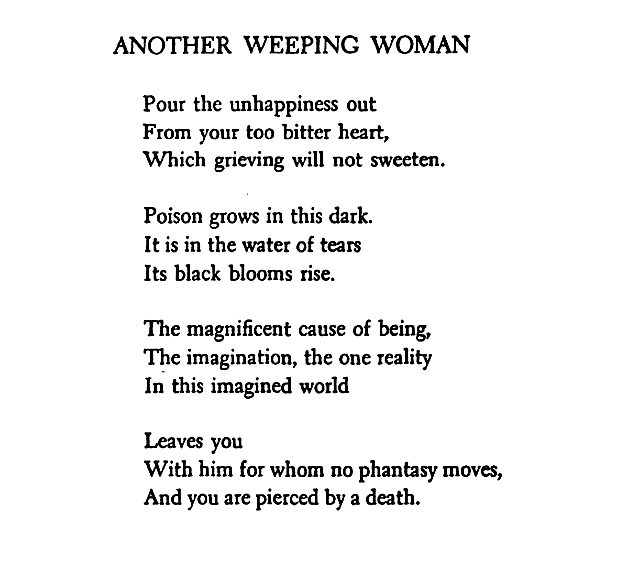
“Another Weeping Woman” — Wallace Stevens

ws

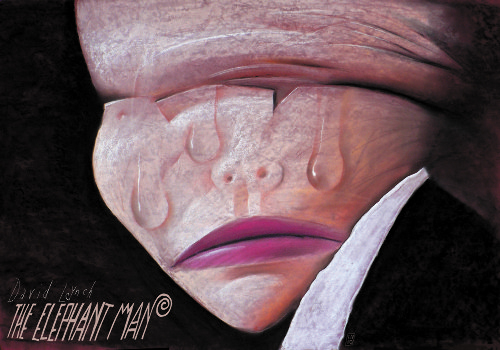
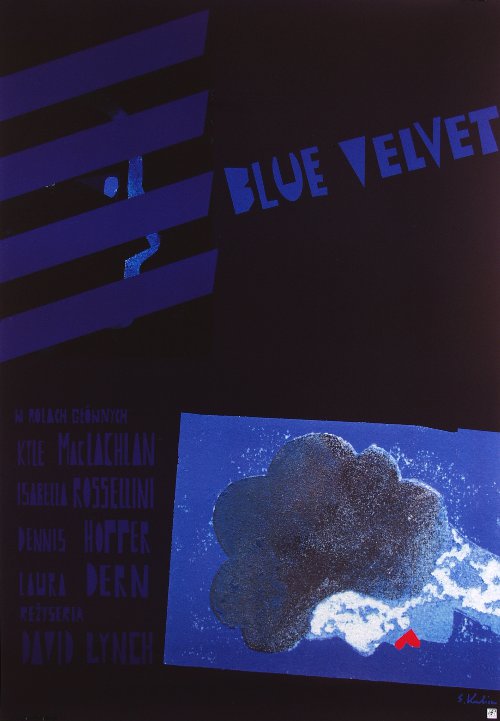
Polish Posters of David Lynch Films

Polish Poster

Polish Poster

dlbv1

dltp

Polish Poster

Polish Poster

dlie

Bonus Czech poster:

dlwah

Film Footage of the First Bloomsday Celebration in 1954

Film footage of the first Bloomsday celebration (June 16, 1954)–a great find by Antoine Malette, who posted the video along with an account of the journey as told in Flann O’Brien: An Illustrated Biography. The film was shot by John Ryan, and shows an extremely inebriated Brian O’Nolan (aka Flann O’Brien) having to be helped around by pals Anthony Cronin and Patrick Kavanagh. We’re also treated to a scene of Kavanagh taking a piss with Joyce’s cousin Tom Joyce, a dentist who joined the merry band. (The scene will undoubtedly recall to you that marvelous moment in Ulysses when “first Stephen, then Bloom, in penumbra urinated“). The troupe didn’t quite finish their mission, getting sidetracked by booze and quarrels. Read the full account at Malette’s site.

Eight Notes on “Life” from Samuel Butler’s Note-Books

  1. The beginning of life is the beginning of an illusion to the effect that there is such a thing as free will and that there is such another thing as necessity – the recognition of the fact that there is an “I can” and an “I cannot,” an “I may” and an “I must.”
  2. Life is not so much a riddle to be read as a Gordian knot that will get cut sooner or later.
  3. Life is the distribution of an error – or errors.
  4. Life is a superstition.  But superstitions are not without their value.  The snail’s shell is a superstition, slugs have no shells and thrive just as well.  But a snail without a shell would not be a slug unless it had also the slug’s indifference to a shell.
  5. Life is one long process of getting tired.
  6. Life is the art of drawing sufficient conclusions from insufficient premises.
  7. Life is eight parts cards and two parts play, the unseen world is made manifest to us in the play.
  8. Life is like music, it must be composed by ear, feeling and instinct, not by rule.  Nevertheless one had better know the rules, for they sometimes guide in doubtful cases – though not often.

—From Samuel Butler’s Note-Books.


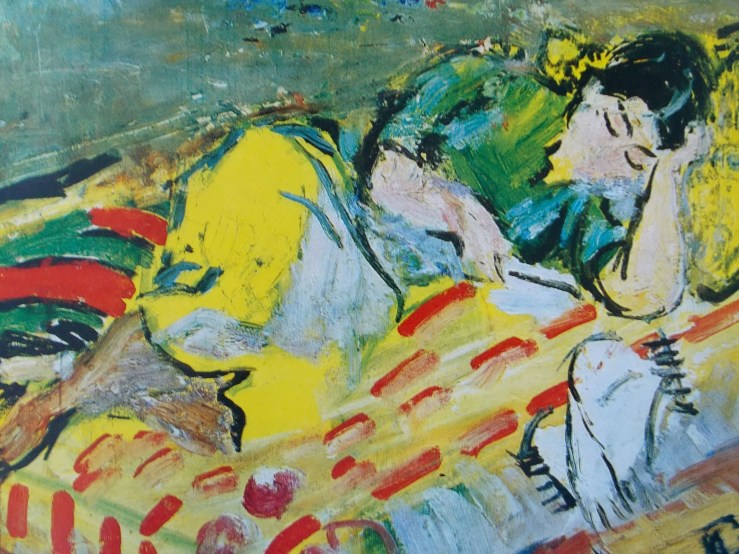
Reclining Woman Reading — Alexandru Ciucurencu

Reclining-Woman-Reading-Alexandru-Ciucurencu

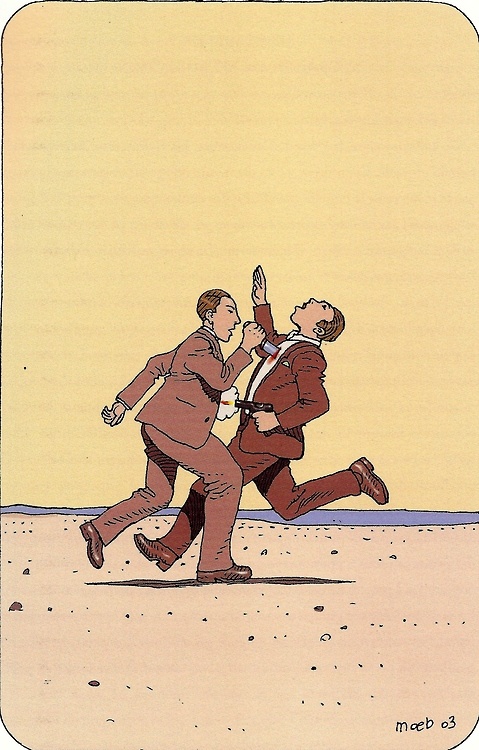
Double Murder — Moebius

double murder moebius

“Herman Melville” — Conrad Aiken

“Herman Melville” by Conrad Aiken:

‘My towers at last!’—
What meant the word
from what acknowledged circuit sprung
and in the heart and on the tongue
at sight of few familiar birds
when seaward his last sail unfurled
to leeward from the wheel once more
bloomed the pale crags of haunted shore
that once-more-visited notch of world:
and straight he knew as known before
the Logos in Leviathan’s roar
he deepest sounding with his lead
who all had fathomed all had said.

Much-loving hero—towers indeed
were those that overhung your log
with entries of typhoon and fog
and thunderstone for Adam’s breed:
man’s warm Sargasso Sea of faith
dislimned in light by luck or fate
you for mankind set sail by hate
and weathered it, and with it death.
And now at world’s end coasting late
in dolphined calms beyond the gate
which Hercules flung down, you come
to the grim rocks that nod you home.
Depth below depth this love of man:
among unnumbered and unknown
to mark and make his cryptic own
one landfall of all time began:
of all life’s hurts to treasure one
and hug it to the wounded breast,
in this to dedicate the rest,
all injuries received or done.
Your towers again but towers now blest
your haven in a shoreless west
o mariner of the human soul
who in the landmark notched the Pole
and in the Item loved the Whole.


Down with Beauty/tapestry (Books Acquired, 7.17.2013)

20130723-112451.jpg

Two very intriguing new titles from Reality Street: Ken Edwards’s Down with Beauty, and tapestry by Philip Terry.

Here’s the publisher’s blurb for Down with Beauty:

DOWN WITH BEAUTY explores, in a series of linked dialogues, dramatic monologues and short fictions, the themes of exile, the aftermath of war, paranoia, improvised music and nothingness. The collection is completed with the full text of NOSTALGIA FOR UNKNOWN CITIES, previously published separately.  Some samples herehere and here – others will be revealed.

A very strange, scattered book—lovely.

Here’s Reality Street’s blurb for tapestry:

Taking as its starting point marginal images in the Bayeux Tapestry, which have been left largely unexplained by historians, Terry retells the story of the Norman Conquest from the point of view of the tapestry’s English embroiderers. Combining magic realism and Oulipian techniques, this is a tour de force of narrative and language.

tapestry also got a great review from The Guardian’s Nicholas Lezard:

By showing a language in flux,tapestry draws you into its world: that of the creation of the Bayeux tapestry (which, as we are reminded in the book by an exasperated narrator, isn’t a tapestry at all, but a work of embroidery) by a group of nuns in the late 11th century at a priory in Kent. …

Medieval works lend themselves to the picaresque, or multiple narration – think of The Decameròn or The Canterbury Tales. So while there is an overarching narrative, that of the commission and creation of the tapestry, work is paused while each nun tells a story related to her work. If you look at the tapestry, you will remember, or notice, that there are numerous extraneous designs along the borders that would appear to have nothing to do with the matter of the Norman usurpation. Terry has noticed, as have others, the Aesopian motifs that occur, and includes slender, playful versions, sometimes modernised, of Aesop’s fables himself. My favourite is one in which a lion, confronting Aesop, asks him to tell him a fable before the lion eats him. So Aesop says he was confronted by a lion who asked him to tell a fable … and so on; and eventually the lion gets bored and goes away.

Great to see some new stuff that’s, well, really new

Don Quixote and Sancho Panza in the Terrifying Forest at Night — Gustave Doré

(More at Gustave Doré’s Don Quixote)

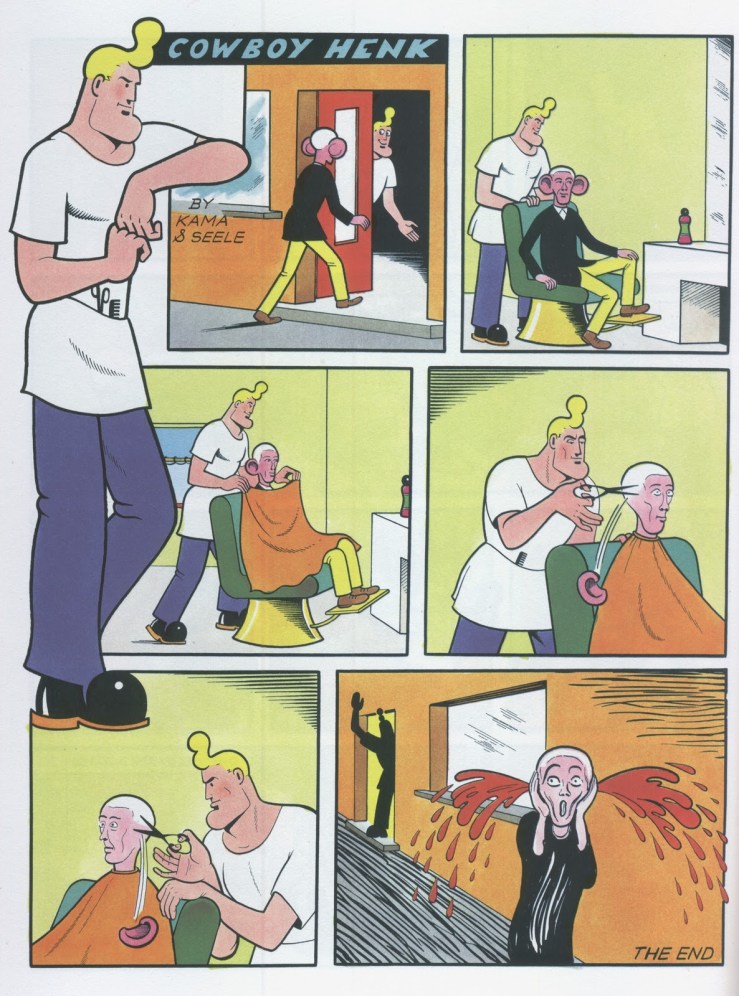
The Scream (Kamagurka & Herr Seele’s Cowboy Henk)

henk scream

Six Ideas and Images from Nathaniel Hawthorne’s Note-Books

  1. In an old London newspaper, 1678, there is an advertisement, among other goods at auction, of a black girl, about fifteen years old, to be sold.
  2. We sometimes congratulate ourselves at the moment of waking from a troubled dream: it may be so the moment after death.
  3. The race of mankind to be swept away, leaving all their cities and works. Then another human pair to be placed in the world, with native intelligence like Adam and Eve, but knowing nothing of their predecessors or of their own nature and destiny. They, perhaps, to be described as working out this knowledge by their sympathy with what they saw, and by their own feelings.
  4. A singular fact, that, when man is a brute, he is the most sensual and loathsome of all brutes.
  5. A snake taken into a man’s stomach and nourished there from fifteen years to thirty-five, tormenting him most horribly. A type of envy or some other evil passion.
  6. A sketch illustrating the imperfect compensations which time makes for its devastations on the person,–giving a wreath of laurel while it causes baldness, honors for infirmities, wealth for a broken constitution,–and at last, when a man has everything that seems desirable, death seizes him. To contrast the man who has thus reached the summit of ambition with the ambitious youth.

Notations from Nathaniel Hawthorne’s American Note-Books.

Map Reading — Stanley Spencer

Nicolas Winding Refn Picks DVDs from the Criterion Collection Closet