Read an Excerpt from Adam Novy’s Work in Progress, The Gore and the Splatter

Hobart has published an excerpt of Adam Novy’s work in progress, The Gore and Splatter. I was a big fan of Adam’s last novel, The Avian Gospels, a dystopian take on terror and gypsies and birds. When I interviewed Adam a few years ago, he told me he was “writing a novel about the life and times of Medusa. It’s called The Gore and the Splatter. Ryan Chang got a bit more info about the novel in his interview with Adam, posted yesterday at Electric Literature:

I’m working on a novel about Perseus and Medusa before they get discovered. The early days of Perseus and Medusa. It takes place partially in mythic Greece and partially the suburb I grew up in. The characters are in the middle of mythic history. One thing about mythology I’ve always been really interested is what the characters know about their place and time in history. There’s this idea that the world is new and folks are creating meaning as they go along. Do they know they’re creating meaning? And what would it be like to be a teenager under those circumstances? Or a parent raising those teenagers, what would it be like?

I’m looking forward to this one. Until then we have the excerpt. Here is an excerpt of the excerpt:

Pentheus’s bedroom: hardly large enough to fit his mattress, a modest trunk of clothes, a wooden torso on a stick that wore his armor while he slept, and an altar to Athena. The floorplanks creaked, the roof leaked water, porous walls keened in wind. He’d let his mother and his nephews have the bedrooms with the windows. The den was also small, and too close to the kitchen for these rooms to be considered separate entities, and this house, such as it was, sat unevenly on pylons of old concrete, for the ground was a decline of dirt and sand on a rambling scrappy hillside, where any rugged vegetables that flourished in the desperate little gardens were scavengered immediately by rabbits.

The bungalow wasn’t quite dysfunctional, merely ugly, small, grotty, and way beyond the prospect of improvement. Still, the sneaky sisters Casey and Arden enjoyed their lives in an unfairly lavish home, and the house where the miraculous atrocity had happened, with the river and the tree, was nigh short of a mansion, if an ugly, nouveau, tasteless one. Perhaps whoever’d lived there had been killed for being vulgar. Pentheus had been working in a lumber yard adjacent to The Turnbull Farm—a huge, efficient version of the farm where Casey and Arden lived—when Mister Reddy heard that he was tall and took him on as his assistant. Your feet are very big, he’d said, you’ll leave a large carbon footprint. Pentheus thought he’d caught his golden opportunity, but all he got to do was walk beside the boss in heavy armor, sweat until he felt that he would rot, follow incoherent orders and let teenage girls humiliate him. And the pay was just as crappy as the lumber yard. Agave, his own mother, was a maid for Mister Turnbull. She was sixty-eight years old, but still she cooked, scrubbed the floor, washed stains from the clothes of messy children whose privilege didn’t exactly translate into manners. Pentheus and Agave paid their rent to Mister Reddy, who was Mister Turnbull’s partner, though Mister Reddy and Mister Turnbull also paid their salaries. Pentheus and his mother were little more than conduits for money as it looped its way inexorably back to whence it came. Jayden, Pentheus’s nephew, had said they were a kind of large intestine, where food was turned to shit and got excreted without their being able to enjoy it. Pentheus sometimes wished the boy was less articulate.

Birthday — Dorothea Tanning

10-Birthday_4

“The Seven Vagabonds” — Nathaniel Hawthorne

“The Seven Vagabonds” — Nathaniel Hawthorne

Rambling on foot in the spring of my life and the summer of the year, I came one afternoon to a point which gave me the choice of three directions. Straight before me the main road extended its dusty length to Boston; on the left a branch went toward the sea, and would have lengthened my journey a trifle of twenty or thirty miles, while by the right-hand path I might have gone over hills and lakes to Canada, visiting in my way the celebrated town of Stamford. On a level spot of grass at the foot of the guide-post appeared an object which, though locomotive on a different principle, reminded me of Gulliver’s portable mansion among the Brobdignags. It was a huge covered wagon—or, more properly, a small house on wheels—with a door on one side and a window shaded by green blinds on the other. Two horses munching provender out of the baskets which muzzled them were fastened near the vehicle. A delectable sound of music proceeded from the interior, and I immediately conjectured that this was some itinerant show halting at the confluence of the roads to intercept such idle travellers as myself. A shower had long been climbing up the western sky, and now hung so blackly over my onward path that it was a point of wisdom to seek shelter here.

“Halloo! Who stands guard here? Is the doorkeeper asleep?” cried I, approaching a ladder of two or three steps which was let down from the wagon.

The music ceased at my summons, and there appeared at the door, not the sort of figure that I had mentally assigned to the wandering showman, but a most respectable old personage whom I was sorry to have addressed in so free a style. He wore a snuff-colored coat and small-clothes, with white top-boots, and exhibited the mild dignity of aspect and manner which may often be noticed in aged schoolmasters, and sometimes in deacons, selectmen or other potentates of that kind. A small piece of silver was my passport within his premises, where I found only one other person, hereafter to be described.

“This is a dull day for business,” said the old gentleman as he ushered me in; “but I merely tarry here to refresh the cattle, being bound for the camp-meeting at Stamford.” Continue reading ““The Seven Vagabonds” — Nathaniel Hawthorne”

Hotel Room — Edward Hopper

Figures in Red Boat — Peter Doig

Doig-Figures-in-Red-Boat

Plagiarism

Knock knock.

An art thief is a man who takes pictures.

Tragedy is when I cut my finger. Comedy is when you fall into an open sewer and die.

It was the blurst of times.

Take my wife—please.

You have a better chance of stopping a serial killer than a serial thief in comedy.

I shot an elephant in my pajamas.

I have a scoop for you. I stole his act. I camouflaged it with punchlines, and to really throw people off, I did it before he did

Satire is tragedy plus time. You give it enough time, the public, the reviewers will allow you to satirize it. Which is rather ridiculous, when you think about it.

Ducks will never hug! This devastating thought will consume my evening.

I’m wild about his turnip tops.
Likes the way he warms my chops!
I can’t do without my kitchen man.
Now when I eat his donut
All I leave is just the hole.
And if he really needs it,
He can use my sugar bowl!

I’d like to give my kid an interesting name. Like a name with no vowels … just like 40 Fs, that’s his name.

Just realized ducks can’t hug and now I can’t sleep.

Rice is great when you’re hungry and you want 2,000 of something.

I think I am, therefore I am. I think.

I intend to live forever, or die trying.

We all pay for life with death, so everything in between should be free.

Life is a four-letter word.

#1: Hey, I hear you got a job as a salesman.
#2: Sure did. Pays real good.
#1: What do you sell?
#2: I sell salt.
#1: Is that right? I’ll be. I sell pepper.
#2: Shake!

Let’s face it, some people have a way with words. Other people, uhh . . . oh . . . not have way, I guess.

I’d like to have 19 kids. I think naming them, that’s going to be fun. I already have names picked out. First kid — boy, girl, I don’t care — I’m naming it Rrrrrrrrrrrr.

A burrito is a sleeping bag for ground beef.

The funniest food: ‘kumquats.’ I don’t even bring them home anymore. I sit there laughing and they go to waste.

Inside of a dog it’s too dark to read.

What are three words a woman never wants to hear when she’s making love?
“Honey, I’m home!”

Just realized giraffes can’t hug and now I can’t sleep.

My real name is bdbdbdbdbdbd. My sister’s name was yullyullyull.

You’re watching a guy do your material and people are laughing, but they’re laughing because they think this performer has a brilliant mind and he’s a funny person.

Just realized horses can’t hug and now I can’t sleep.

A drunk was in front of a judge. The judge says, “You’ve been brought here for drinking.”
The drunk says “Okay, let’s get started.”

I think he sort of got some of my jokes in his head and got sloppy.

Who’s there?

Turtles. Zebras.

Little tiny hairs.

It takes forever to cook a baked potato in a conventional oven. Sometimes I just throw one in there, even if I don’t want one. Cause by the time it’s done, who knows?

The Aristocrats!

The Storm — Edvard Munch

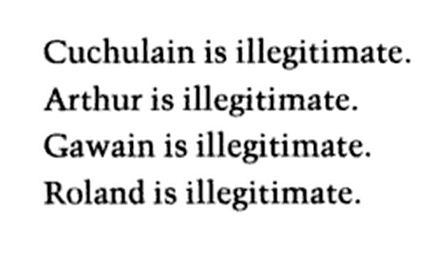
Illegitimate (David Markson)

Capture

Brian Wilson All Cuddled Up with His Manipulative Psychologist

The Dream (Paolo and Francesca) — Umberto Boccioni

“On Noise” — Arthur Schopenhauer

Kant has written a treatise on The Vital Powers; but I should like to write a dirge on them, since their lavish use in the form of knocking, hammering, and tumbling things about has made the whole of my life a daily torment. Certainly there are people, nay, very many, who will smile at this, because they are not sensitive to noise; it is precisely these people, however, who are not sensitive to argument, thought, poetry or art, in short, to any kind of intellectual impression: a fact to be assigned to the coarse quality and strong texture of their brain tissues. On the other hand, in the biographies or in other records of the personal utterances of almost all great writers, I find complaints of the pain that noise has occasioned to intellectual men. For example, in the case of Kant, Goethe, Lichtenberg, Jean Paul; and indeed when no mention is made of the matter it is merely because the context did not lead up to it. I should explain the subject we are treating in this way: If a big diamond is cut up into pieces, it immediately loses its value as a whole; or if an army is scattered or divided into small bodies, it loses all its power; and in the same way a great intellect has no more power than an ordinary one as soon as it is interrupted, disturbed, distracted, or diverted; for its superiority entails that it concentrates all its strength on one point and object, just as a concave mirror concentrates all the rays of light thrown upon it. Noisy interruption prevents this concentration. This is why the most eminent intellects have always been strongly averse to any kind of disturbance, interruption and distraction, and above everything to that violent interruption which is caused by noise; other people do not take any particular notice of this sort of thing. The most intelligent of all the European nations has called “Never interrupt” the eleventh commandment. But noise is the most impertinent of all interruptions, for it not only interrupts our own thoughts but disperses them. Where, however, there is nothing to interrupt, noise naturally will not be felt particularly. Sometimes a trifling but incessant noise torments and disturbs me for a time, and before I become distinctly conscious of it I feel it merely as the effort of thinking becomes more difficult, just as I should feel a weight on my foot; then I realise what it is. Continue reading ““On Noise” — Arthur Schopenhauer”

Nude from the Rear, Reading — Edgar Degas

Kurosawa: The Last Emperor (Documentary by Alex Cox)

“…the amazing, world-reversing night of Fourth of July Eve 1899” (Pynchon’s Against the Day)

For years after, there were tales told in Colorado of the amazing, world-reversing night of Fourth of July Eve 1899. Next day’d be full of rodeos, marching bands, and dynamite explosions—but that night there was man-made lightning, horses gone crazy for miles out into the prairie, electricity flooding up through the iron of their shoes, shoes that when they finally came off and got saved to use for cowboy quoits, including important picnic tourneys from Fruita to Cheyenne Wells, why they would fly directly and stick on to the spike in the ground, or to anything else nearby made of iron or steel, that’s when they weren’t collecting souvenirs on their way through the air—gunmen’s guns came right up out of their holsters and buck knives out from under pants legs, keys to traveling ladies’ hotel rooms and office safes, miners’ tags, fencenails, hairpins, all seeking the magnetic memory of that long-ago visit. Veterans of the Rebellion fixing to march in parades were unable to get to sleep, metallic elements had so got to humming through their bloodmaps. Children who drank the milk from the dairy cows who grazed nearby were found leaning against telegraph poles listening to the traffic speeding by through the wires above their heads, or going off to work in stockbrokers’ offices where, unsymmetrically intimate with the daily flow of prices, they were able to amass fortunes before anyone noticed. .

A passage from Thomas Pynchon’s novel Against the Day.


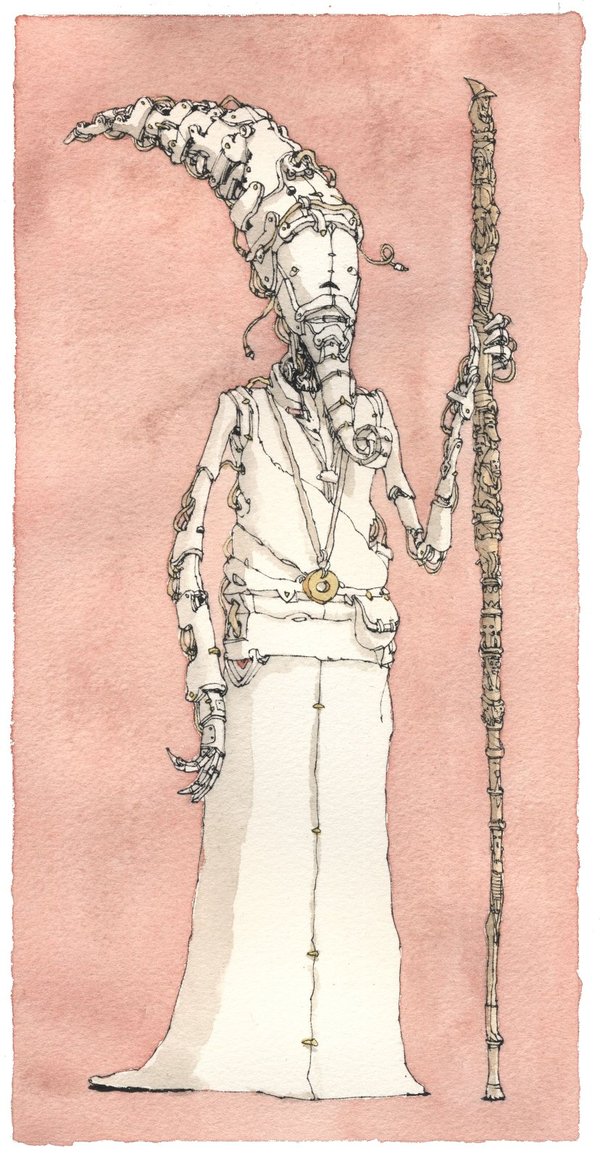
Gandalf Bot — Mattias Adolfsson

gandalf

(More/via).

List with No Name #28

  1. Carlos Castaneda
  2. Tom Robbins
  3. Paulo Coelho
  4. John Irving
  5. Tom Wolfe
  6. Bret Easton Ellis
  7. James McInerney
  8. Mark Leyner
  9. Miranda July
  10. Tao Lin

Mike Leigh Offers an Alphabetized List of Themes in His Film Life Is Sweet