Death of Marat — Edvard Munch

“Of Death” — Francis Bacon

“Of Death” — Francis Bacon

MEN fear death, as children fear to go in the dark; and as that natural fear in children, is increased with tales, so is the other. Certainly, the contemplation of death, as the wages of sin, and passage to another world, is holy and religious; but the fear of it, as a tribute due unto nature, is weak. Yet in religious meditations, there is sometimes mixture of vanity, and of superstition. You shall read, in some of the friars’ books of mortification, that a man should think with himself, what the pain is, if he have but his finger’s end pressed, or tortured, and thereby imagine, what the pains of death are, when the whole body is corrupted, and dissolved; when many times death passeth, with less pain than the torture of a limb; for the most vital parts, are not the quickest of sense. And by him that spake only as a philosopher, and natural man, it was well said, Pompa mortis magis terret, quam mors ipsa. Groans, and convulsions, and a discolored face, and friends weeping, and blacks, and obsequies, and the like, show death terrible. It is worthy the observing, that there is no passion in the mind of man, so weak, but it mates, and masters, the fear of death; and therefore, death is no such terrible enemy, when a man hath so many attendants about him, that can win the combat of him. Revenge triumphs over death; love slights it; honor aspireth to it; grief flieth to it; fear preoccupateth it; nay, we read, after Otho the emperor had slain himself, pity (which is the tenderest of affections) provoked many to die, out of mere compassion to their sovereign, and as the truest sort of followers. Nay, Seneca adds niceness and satiety: Cogita quamdiu eadem feceris; mori velle, non tantum fortis aut miser, sed etiam fastidiosus potest. A man would die, though he were neither valiant, nor miserable, only upon a weariness to do the same thing so oft, over and over. It is no less worthy, to observe, how little alteration in good spirits, the approaches of death make; for they appear to be the same men, till the last instant. Augustus Caesar died in a compliment; Livia, conjugii nostri memor, vive et vale. Tiberius in dissimulation; as Tacitus saith of him, Jam Tiberium vires et corpus, non dissimulatio, deserebant. Vespasian in a jest, sitting upon the stool; Ut puto deus fio. Galba with a sentence; Feri, si ex re sit populi Romani; holding forth his neck. Septimius Severus in despatch; Adeste si quid mihi restat agendum. And the like. Certainly the Stoics bestowed too much cost upon death, and by their great preparations, made it appear more fearful. Better saith he, qui finem vitae extremum inter munera ponat naturae. It is as natural to die, as to be born; and to a little infant, perhaps, the one is as painful, as the other. He that dies in an earnest pursuit, is like one that is wounded in hot blood; who, for the time, scarce feels the hurt; and therefore a mind fixed, and bent upon somewhat that is good, doth avert the dolors of death. But, above all, believe it, the sweetest canticle is’, Nunc dimittis; when a man hath obtained worthy ends, and expectations. Death hath this also; that it openeth the gate to good fame, and extinguisheth envy.—Extinctus amabitur idem.
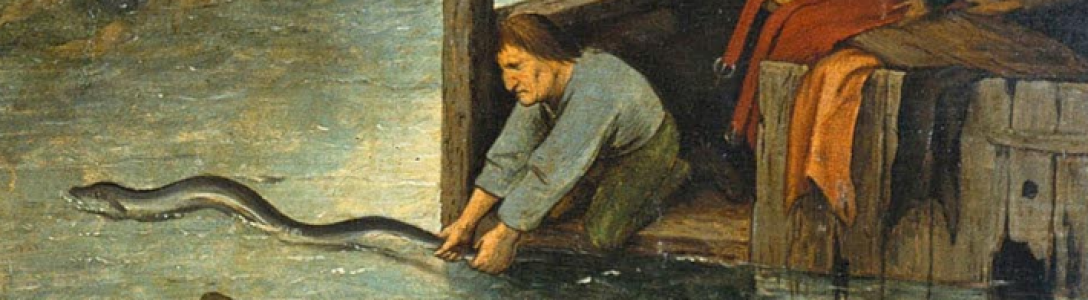
 

Claude Monet (The Reader) — Pierre-Auguste Renoir

“When a Woman Loves” — R. Kelly / Swede Mason Remix

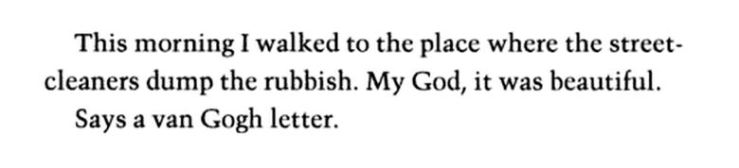
Van Gogh Anecdote (David Markson)

Capture

List with No Name #21

  1. 10,000 BC
  2. 1492
  3. 1776
  4. 1812
  5. 1900
  6. 1941
  7. “1969”
  8. 1969
  9. “1979”
  10. 1984
  11. “1999”
  12. 1999
  13. “2000”
  14. 2001
  15. 2010
  16. 2012
  17. 2046
  18. 2666


“Stare at the Sun” — Eleanor Friedberger

Spiral Jetty (Sketch) — Robert Smithson

Werner Herzog on Les Blank

“A Little Cloud” — James Joyce

“A Little Cloud” by James Joyce

EIGHT years before he had seen his friend off at the North Wall and wished him godspeed. Gallaher had got on. You could tell that at once by his travelled air, his well-cut tweed suit, and fearless accent. Few fellows had talents like his and fewer still could remain unspoiled by such success. Gallaher’s heart was in the right place and he had deserved to win. It was something to have a friend like that.

Little Chandler’s thoughts ever since lunch-time had been of his meeting with Gallaher, of Gallaher’s invitation and of the great city London where Gallaher lived. He was called Little Chandler because, though he was but slightly under the average stature, he gave one the idea of being a little man. His hands were white and small, his frame was fragile, his voice was quiet and his manners were refined. He took the greatest care of his fair silken hair and moustache and used perfume discreetly on his handkerchief. The half-moons of his nails were perfect and when he smiled you caught a glimpse of a row of childish white teeth.

As he sat at his desk in the King’s Inns he thought what changes those eight years had brought. The friend whom he had known under a shabby and necessitous guise had become a brilliant figure on the London Press. He turned often from his tiresome writing to gaze out of the office window. The glow of a late autumn sunset covered the grass plots and walks. It cast a shower of kindly golden dust on the untidy nurses and decrepit old men who drowsed on the benches; it flickered upon all the moving figures—on the children who ran screaming along the gravel paths and on everyone who passed through the gardens. He watched the scene and thought of life; and (as always happened when he thought of life) he became sad. A gentle melancholy took possession of him. He felt how useless it was to struggle against fortune, this being the burden of wisdom which the ages had bequeathed to him. Continue reading ““A Little Cloud” — James Joyce”

The Submissive Reader — Rene Magritte

Slavoj Žižek Discusses Philosophy, Topless in Bed (And So On and So On)

Roger Ebert Annotates Ozu’s Floating Weeds

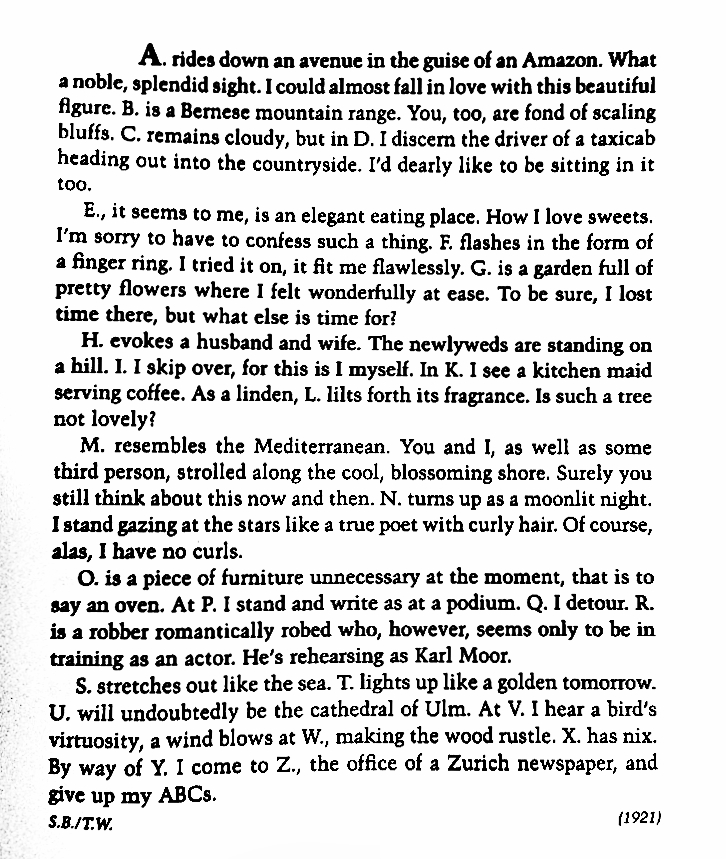
“The Alphabet” — Robert Walser

rw

Lydia Davis/Denis Johnson/Curzio Malaparte (Books Acquired, 4.06.2013)

20130408-201552.jpg

Purged the books pictured in the lower right-hand corner and picked up a few: Curzio Malaparte’s Kaputt, which has intrigued me for awhile now, Denis Johnson’s Fiskadoroin the Vintage Contemporaries edition no less!—and Lydia Davis’s novel The End of the Story, which I somehow haven’t read yet. Hypothesis: Lydia Davis and Denis Johnson may be America’s greatest living novelists (?).


Fiction Rule of Thumb (xkcd)

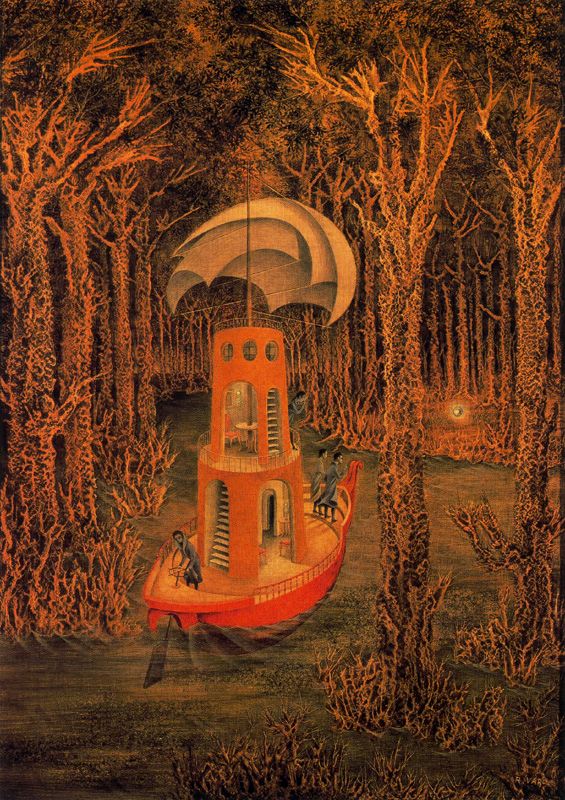
Find — Remedios Varo

find-1956