The First Thanksgiving, 1973 by Warrington Colescott (1921 – 2018)
A grave and dark-clad company!” quoth Goodman Brown.
In truth, they were such. Among them, quivering to-and-fro, between gloom and splendor, appeared faces that would be seen, next day, at the council-board of the province, and others which, Sabbath after Sabbath, looked devoutly heavenward, and benignantly over the crowded pews, from the holiest pulpits in the land. Some affirm, that the lady of the governor was there. At least, there were high dames well known to her, and wives of honored husbands, and widows, a great multitude, and ancient maidens, all of excellent repute, and fair young girls, who trembled lest their mothers should espy them. Either the sudden gleams of light, flashing over the obscure field, bedazzled Goodman Brown, or he recognized a score of the church-members of Salem village, famous for their especial sanctity. Good old Deacon Gookin had arrived, and waited at the skirts of that venerable saint, his reverend pastor. But, irreverently consorting with these grave, reputable, and pious people, these elders of the church, these chaste dames and dewy virgins, there were men of dissolute lives and women of spotted fame, wretches given over to all mean and filthy vice, and suspected even of horrid crimes. It was strange to see, that the good shrank not from the wicked, nor were the sinners abashed by the saints. Scattered, also, among their pale-faced enemies, were the Indian priests, or powows, who had often scared their native forest with more hideous incantations than any known to English witchcraft.
Interviewer: You mention the influence of Faulkner. Who are some of the writers around at the moment who you admire and who influence you?
Hannah: Cormac McCarthy. It’s not just the language, although I can’t imagine loving his books without the special language. He’s one of the few writers who has a vision. Relentless. It’s very rough—almost fascistic, as nature is. Darwinian. But he gives such reverence to nature itself. I think that is why he seems atavistic; he likes the fact that there was a time when boulders, trees, mosses with lichens—all their individual names participated right next to man. And even though there are horrible things that happen in his books, he’s quite sure that we have disconnected ourselves from the good stuff. He can make a gorgeous, almost epic, page out of a man riding a horse through a half decent meadow somewhere in Mexico. Actually, it kind of makes me excited in a positive way—does not depress me as it does others—because it makes me a participant in the universe. You are no longer just a dead man, floating. You’re right there with the stars, smoke, the peace, and the beauty—as well as the violence. It makes you a player.
From a 1996 interview with Barry Hannah. Published in a 2011 issue of Mississippi Review.
[Editorial note: The following citations come from one-star Amazon reviews of Cormac McCarthy’s novel The Passenger. I think The Passenger is a brilliant, messy, baggy synthesis of much of the philosophical and aesthetic themes of McCarthy’s previous work; I loved it.
In the evening he saddled his horse and rode out west from the house. The wind was much abated and it was very cold and the sun sat blood red and elliptic under the reefs of bloodred cloud before him. He rode where he would always choose to ride, out where the western fork of the old Comanche road coming down out of the Kiowa country to the north passed through the westernmost section of the ranch and you could see the faint trace of it bearing south over the low prairie that lay between the north and middle forks of the Concho River. At the hour he’d always choose when the shadows were long and the ancient road was shaped before him in the rose and canted light like a dream of the past where the painted ponies and the riders of that lost nation came down out of the north with their faces chalked and their long hair plaited and each armed for war which was their life and the women and children and women with children at their breasts all of them pledged in blood and redeemable in blood only. When the wind was in the north you could hear them, the horses and the breath of the horses and the horses’ hooves that were shod in rawhide and the rattle of lances and the constant drag of the travois poles in the sand like the passing of some enormous serpent and the young boys naked on wild horses jaunty as circus riders and hazing wild horses before them and the dogs trotting with their tongues aloll and foot-slaves following half naked and sorely burdened and above all the low chant of their traveling song which the riders sang as they rode, nation and ghost of nation passing in a soft chorale across that mineral waste to darkness bearing lost to all history and all remembrance like a grail the sum of their secular and transitory and violent lives.
From Cormac McCarthy’s novel All the Pretty Horses—
—which I picked up again the other day to find a passage in connection to The Passenger and started rereading. The swelling rhythm of this passage would have knocked my socks off had I been wearing socks.
Versions of the phrase What else repeat throughout The Passenger, sometimes at the beginning of a sentence but more often than not as a two-word statement or question. It’s a verbal tic not unlike the plentiful instances of They rode on to be found in Blood Meridian, and like that phrase, it serves as a linguistic placeholder that both moves the action of the novel and also advances one of its central philosophical themes.
What else? here is plaintive, existential, but also human, relatable.
The novel Blood Meridian (1985) establishes Cormac McCarthy as unchallenged king of literary mule carnage. No fewer than fifty-nine specific mules die in the book, plus dozens more that are alluded to in groups and bunches. Mules are shot, roasted, drowned, knifed, and slain by thirst; but the largest number, 50 out of a conducta of 122 mules carrying quicksilver for mining, plummet from a single cliff during an ambush, performing an almost choreographic display of motion and color, “the animals dropping silently as martyrs, turning sedately in the empty air and exploding on the rocks below in startling bursts of blood and silver as the flasks broke open and the mercury loomed wobbling in the air in great sheets and lobes and small trembling satellites. . . . Half a hundred mules had been ridden off the escarpment.”
A small mule danced in a flowered field. He stopped to watch it. It rose on its hind legs like a satyr and sawed its head about. It whinnied and hauled at its rope and kicked and it stopped and stood splayfooted and stared at Western and then went hopping and howling. It had browsed through a nest of wasps but Western didnt know how to help it and he went on.
The Passenger, Cormac McCarthy
This minor scene in the last pages of The Passenger seems like another previously-rare self-referential move on McCarthy’s part. Our “unchallenged king of literary mule carnage” sets up what appears, at first, a bucolic, even corny image—a mule dancing in a field of flowers. The pastoral, frolicking image comes undone under scrutiny—the mule is not at play but under duress. But the duress is not the result of a moral malice. It’s simply natural. Western cannot assuage the mule’s pain, he can only observe it, which he does so with a stoic measure of sympathy.
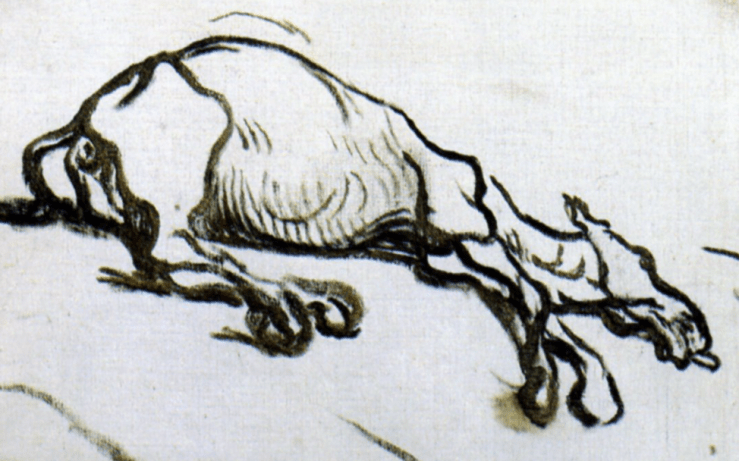
Detail from Don Quixote, Sancho Panza and the Dead Mule, Honore Daumier, 1867
He said that the souls of horses mirror the souls of men more closely than men suppose and that horses also love war. Men say they only learn this but he said that no creature can learn that which his heart has no shape to hold.
All the Pretty Horses, Cormac McCarthy
The other dream was this. There was a riderless horse standing at a gate at dawn. Some other country, some other time. The news that the horse brings is a day’s ride old, no more. The horse’s dreams were once of mares and grass and water. The sun. But those dreams are no more. His is a world of blood and slaughter and the screams of men and animals all of which he has little understanding of. The horse stands at the gate with his head bowed while the day breaks. He wears a cloak of knitted steel dark with blood and he stands with one forefoot tilted upon the stones. No one comes. The news does not arrive.
The Passenger, Cormac McCarthy
The above passage was probably the saddest moment in The Passenger for me. The speaker is the ghost of Long John Sheddan, present in the consciousness of Bobby Western. It is the horse’s dream inside of Sheddan’s dream (inside of Western’s dream (McCarthy’s dream)) that I find so sad—an Edenic vision flooded with the reality of blood and violence, by the mechanics of war. The horse stalks the stones of the earth, awaiting a revelation that does not come to pass. No one comes. The news does not arrive.
I always thought when I got older that God would sort of come into my life in some way. He didn’t. I don’t blame him. If I was him I’d have the same opinion about me that he does.
No Country for Old Men, Cormac McCarthy
I waited to hear from God and I never did.
The Passenger, Cormac McCarthy
Like most writers committed to pessimism, McCarthy is never very far from theodicy. Relentless pain, relentlessly displayed, has a way of provoking metaphysical complaint. . . .
But [in Blood Meridian] McCarthy stifles the question of theodicy before it can really speak. His myth of eternal violence—his vision of men “invested with a purpose whose origins were antecedent to them”—asserts, in effect, that rebellion is pointless because this is how it will always be. Instead of suffering, there is represented violence; instead of struggle, death; instead of lament, blood.
I don’t know if Wood has written on the latest, not last, but close-to-last, novel from McCarthy. The only review I’ve read was a short tweet from a contemporary Irish writer whose latest novel I very-much admired. He did not think The Passenger was good. I believe he wrote that it was, in fact, very bad. I really loved The Passenger, and when I finally get this last little riff out of my system, I might even read some reviews.
In the dawn there is a man progressing over the plain by means of holes which he is making in the ground. He uses an implement with two handles and he chucks it into the hole and he enkindles the stone in the hole with his steel hole by hole striking the fire out of the rock which God has put there. On the plain behind him are the wanderers in search of bones and those who do not search and they move haltingly in the light like mechanisms whose movements are monitored with escapement and pallet so that they appear restrained by a prudence or reflectiveness which has no inner reality and they cross in their progress one by one that track of holes that runs to the rim of the visible ground and which seems less the pursuit of some continuance than the verification of a principle, a validation of a sequence and causality as if each round and perfect hole owed its existence to the one before it there on that prairie upon which are the bones and the gatherers of bones and those who do not gather. He strikes fire in the hole and draws out his steel. Then they all move on again.
Blood Meridian, Cormac McCarthy
In the end, she had said, there will be nothing that cannot be simulated. And this will be the final abridgment of privilege. This is the world to come. Not some other. The only alternate is the surprise in those antic shapes burned into the concrete.
The Passenger, Cormac McCarthy
The final moments of The Passenger, particularly Alicia Western’s words (via Bobby’s memory) seem to echo the gnostic dream that is the epilogue of Blood Meridian. Her apocalyptic final line (again, via Bobby’s consciousness) evokes the consequences of the atomic bomb, a new original sin of creation: “My father’s latterday petroglyphs and the people upon the road naked and howling.”
Alicia chooses to erase herself from the world, while Bobby stays in it, lives. The final moments of The Passenger point to a sliver of metaphysical hope:
He knew on the day of his death he would see her face and he could hope to carry that beauty with him into the darkness with him, the last pagan on earth, singing softly on his pallet in an unknown tongue.
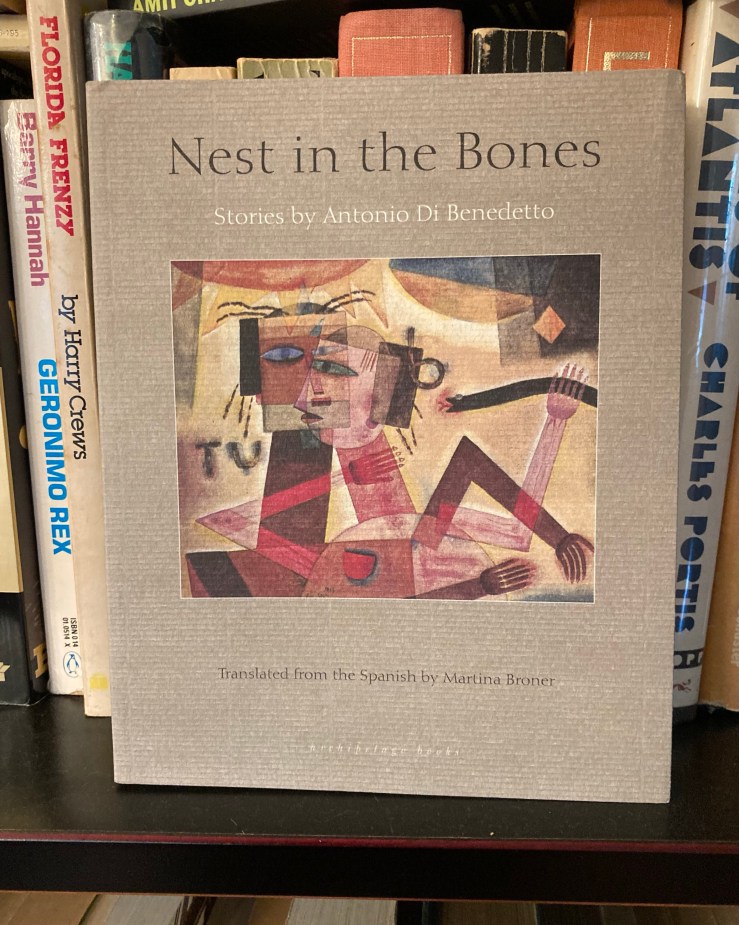
Indie Archipelago had a nice online sale the other week, so I ordered Nest in the Bones, a collection of stories by Antonio di Benedetto (translated by Martina Broner). Archipelago’s jacket copy:
Antonio Di Benedetto wrote with constant poetic innovation. His genre-defying stories, often dark and unexpectedly moving, explore the space between imagination and reality, tragedy and melodrama, civilization and barbarism. Nest in the Bones attests to Di Benedetto’s mastery of the short form as well as his impressive range across genres and styles. Di Benedetto was a writer’s writer, admired by Julio Cortázar, Roberto Bolaño, and Ricardo Piglia, who counted Di Benedetto, next to Borges, as one of the two great models of Latin American literature.
On my regular route, from the office to my room, from my room to the office, I go through the pedestrian tunnel that opens up at Goya, sneaks under Calle Doctor Esquerdo, and emerges in front of the honey shop. Around the corner, on the street lined with what once were gaslights, is where I live.
Where the tunnel flattens under the avenue and the buses, where the sound goes dead, was the dog. In winter I would see him wrapped in a blanket.
His owner most often lay dozing on the ground. He didn’t parade the dog; nor did he play the violin or accordion, as so many do; nor did he display a sign asking for public charity: “I am unemployed, my wife is dead, I have six children, my shack burned down.” His hat, upside down on the ground, did all the work.
I found his understated style interesting, and I admired the patience of the dog, who was probably fed only occasionally with food bought from the daily gathering of pesetas.







 Biblioklept