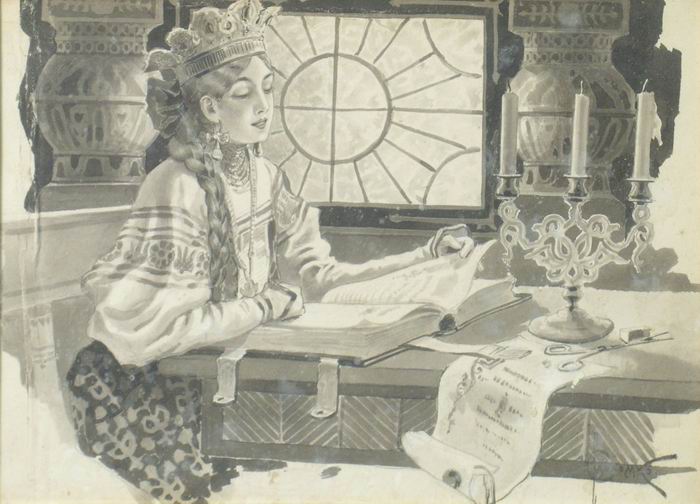
“The Story of Gulnare of the Sea” (Arabian Nights)

“The Story of Gulnare of the Sea”

from The Arabian Nights: Their Best Known Tales (1909)

There was, in olden time, and in an ancient age and period, in the land of the Persians, a king named Shahzeman, and the place of his residence was Khorassan. He had not been blest, during his whole life, with a male child nor a female; and he reflected upon this, one day, and lamented that the greater portion of his life had passed, and he had no heir to take the kingdom after him as he had inherited it from his fathers and forefathers. So the utmost grief befell him on this account.

Now while he was sitting one day, one of his mamelukes came in to him, and said to him: “O my lord, at the door is a slave-girl with a merchant: none more beautiful than she hath been seen.” And he replied: “Bring to me the merchant and the slave-girl.” The merchant and the slave-girl therefore came to him; and when he saw her, he found her to resemble the lance in straightness and slenderness. She was wrapped in a garment of silk embroidered with gold, and the merchant uncovered her face, whereupon the place was illuminated by her beauty, and there hung down from her forehead seven locks of hair reaching to her anklets. The King, therefore, wondered at the sight of her, and at her beauty, and her stature and justness of form; and he said to the merchant: “O sheikh, for how much is this damsel to be sold?” The merchant answered: “O my lord, I purchased her for two thousand pieces of gold of the merchant who owned her before me, and I have been for three years travelling with her, and she hath cost, to the period of her arrival at this place, three thousand pieces of gold; and she is a present from me unto thee.” Upon this, the king conferred upon him a magnificent robe of honour, and gave orders to present him with ten thousand pieces of gold. So he took them, and kissed the hands of the king, thanking him for his beneficence, and departed. Then the king committed the damsel to the tirewomen, saying to them: “Amend the state of this damsel, and deck her, and furnish for her a private chamber, and take her into it.” He also gave orders to his chamberlains that everything which she required should be conveyed to her. The seat of government where he resided was on the shore of the sea, and his city was called the White City. And they conducted the damsel into a private chamber, which chamber had windows overlooking the sea; and the king commanded his chamberlains to close all the doors upon her after taking to her all that she required. Continue reading ““The Story of Gulnare of the Sea” (Arabian Nights)”

Sleeping Girl — Pietro Antonio Rotari

girl with book

The Dream — Frida Kahlo

the-dream-the-bed-1940

In Cold Blood (Full Film)

“All visible objects, man, are but as pasteboard masks” (Moby-Dick)

Hark ye yet again—the little lower layer. All visible objects, man, are but as pasteboard masks. But in each event—in the living act, the undoubted deed—there, some unknown but still reasoning thing puts forth the mouldings of its features from behind the unreasoning mask. If man will strike, strike through the mask! How can the prisoner reach outside except by thrusting through the wall? To me, the white whale is that wall, shoved near to me. Sometimes I think there’s naught beyond. But ’tis enough. He tasks me; he heaps me; I see in him outrageous strength, with an inscrutable malice sinewing it. That inscrutable thing is chiefly what I hate; and be the white whale agent, or be the white whale principal, I will wreak that hate upon him. Talk not to me of blasphemy, man; I’d strike the sun if it insulted me. For could the sun do that, then could I do the other; since there is ever a sort of fair play herein, jealousy presiding over all creations. But not my master, man, is even that fair play. Who’s over me? Truth hath no confines.

From Chapter 36 of Herman Melville’s Moby-Dick. The speaker, of course, is Ahab.


Check out Film Critic Armond White’s 2012 Better Than List

Critic/contrarian Armond White has released his 2012 “Better Than” list, where he uses one film to pick on another. Great stuff, even if you disagree. A few samples:

Sacrifice > The Master
Chen Kaige finds the roots of culture in patriarchal responsibility; P.T. Anderson loses culture’s meaning in anti-religious hysteria and high-art folly. Chen also featured superior acting by competing father figures You Ge and Xuegi Wang.

Holy Motors > Cosmopolis
Leos Carax’s dreamy limousine kineticism shamed Cronenberg’s oft-entrancing limousine stage drama. Carax parked and bloomed. Cronenberg parked then harangued.

Dark Horse > The Turin Horse
Todd Solondz’s modern soap opera steadily, comically bored into our self-deceptions, while Bela Tarr’s highbrow jape steadily bored us.

The Lady > Lincoln
Luc Besson’s bio-pic examined Aung San Suu Kyi’s marital and political commitment, while Spielberg’s unholy marriage to Tony Kushner pushed the cult of personality. Aphorisms vs. Propaganda.

Ghost Rider: Spirit of Vengeance, Taken 2 > Zero Dark Thirty
Neveldine-Taylor and Olivier Megaton revealed the post-9/11 zeitgeist in genre tropes, while Bigelow reduced the zeitgeist to an enigmatic comic strip, a “mission accomplished” delusion.

A Thousand Words > Argo
Brian Robbins and Eddie Murphy dared the most personal Hollywood critique since Clifford Odets’ The Big Knife; Ben Affleck trivialized Hollywood accountability.


Andrei Tarkovsky: The Collector of Dreams (Book Acquired, 12.29.2012)

20130107-202014.jpg

Layla Alexander-Garrett’s memoir Andrei Tarkovsky: The Collector of Dreams is new from Glagoslav. Their blurb:

The Sacrifice is Andrei Tarkovsky’s final masterpiece. The film was shot in Sweden, during the summer of 1985, while Tarkovsky was in exile; it turned out to be his final testament. Day after day, while the film was being made, Layla Alexander-Garrett – Tarkovsky’s on-site interpreter – kept a diary which forms the basis of her award-winning book Andrei Tarkovsky: The Collector Of Dreams. In this book the great director is portrayed as a real, living person: tormented, happy, inexhaustibly kind but at times harsh, unrelenting, conscience-stricken and artistically unfulfilled.

I’ve been riffling through it over the past few days. Alexander-Garrett describes her time with Tarkovsky in vivid detail—there’s a concrete richness to the book, and the author doesn’t try to psychoanalyze or interpret or otherwise interpose herself between the reader and the subject. More to come.

Little Nemo Strip — Winsor McCay

“A Reflection” — Kate Chopin

“A Reflection” by Kate Chopin—

Some people are born with a vital and responsive energy. It not only enables them to keep abreast of the times; it qualifies them to furnish in their own personality a good bit of the motive power to the mad pace. They are fortunate beings. They do not need to apprehend the significance of things. They do not grow weary nor miss step, nor do they fall out of rank and sink by the wayside to be left contemplating the moving procession.

Ah! that moving procession that has left me by the road-side! Its fantastic colors are more brilliant and beautiful than the sun on the undulating waters. What matter if souls and bodies are failing beneath the feet of the ever-pressing multitude! It moves with the majestic rhythm of the spheres. Its discordant clashes sweep upward in one harmonious tone that blends with the music of other worlds—to complete God’s orchestra.

It is greater than the stars—that moving procession of human energy; greater than the palpitating earth and the things growing thereon. Oh! I could weep at being left by the wayside; left with the grass and the clouds and a few dumb animals. True, I feel at home in the society of these symbols of life’s immutability. In the procession I should feel the crushing feet, the clashing discords, the ruthless hands and stifling breath. I could not hear the rhythm of the march.

Salve! ye dumb hearts. Let us be still and wait by the roadside.


Reading — Sergey Solomko

ssreading

“One of the Greatest Wrestling Fans” — Andy Warhol Interviewed by Mean Gene Okerlund Backstage at WWF

“Moby Dick ye have seen—Moby Dick—Moby Dick!” (Moby-Dick)

“It’s a white whale, I say,” resumed Ahab, as he threw down the topmaul: “a white whale. Skin your eyes for him, men; look sharp for white water; if ye see but a bubble, sing out.”

All this while Tashtego, Daggoo, and Queequeg had looked on with even more intense interest and surprise than the rest, and at the mention of the wrinkled brow and crooked jaw they had started as if each was separately touched by some specific recollection.

“Captain Ahab,” said Tashtego, “that white whale must be the same that some call Moby Dick.”

“Moby Dick?” shouted Ahab. “Do ye know the white whale then, Tash?”

“Does he fan-tail a little curious, sir, before he goes down?” said the Gay-Header deliberately.

“And has he a curious spout, too,” said Daggoo, “very bushy, even for a parmacetty, and mighty quick, Captain Ahab?”

“And he have one, two, three—oh! good many iron in him hide, too, Captain,” cried Queequeg disjointedly, “all twiske-tee be-twisk, like him—him—” faltering hard for a word, and screwing his hand round and round as though uncorking a bottle—”like him—him—”

“Corkscrew!” cried Ahab, “aye, Queequeg, the harpoons lie all twisted and wrenched in him; aye, Daggoo, his spout is a big one, like a whole shock of wheat, and white as a pile of our Nantucket wool after the great annual sheep-shearing; aye, Tashtego, and he fan-tails like a split jib in a squall. Death and devils! men, it is Moby Dick ye have seen—Moby Dick—Moby Dick!”

From Chapter 36 of Herman Melville’s Moby-Dick.

“How Are You Getting Home?” — Sparks

“The Battle of Sempach” — Robert Walser

“The Battle of Sempach” by Robert Walser

One day, in the middle of high summer, a military expedition was advancing slowly down the dusty country road that led towards a district of Luzern. The bright, actually more than bright, sun dazzled down over swaying armour serving to cover human bodies, over prancing horses, over helmets and parts of faces, over equine heads and tails, over ornaments and plumes and stirrups as big as snowshoes. To the right and to the left of the shining military expedition spread out meadows with thousands of fruit trees in them up as far as hills that, looming up out of the blue-smelling, half-hazy distance, beckoned and had the same effect as light and carefully painted window dressing. It was before noon and the heat was already oppressive. It was a meadowy heat, a heat contained in grass, hay and dust, for thick clouds of dust were being thrown up that sometimes descended like a veil over parts and sections of the army. Sluggishly, ploddingly, carelessly the long cavalcade moved forward. Sometimes it looked like a shimmering and elongated snake, sometimes like a lizard of enormous girth, sometimes like a large piece of cloth, richly embroidered with figures and colourful shapes and ceremoniously trailed as with ladies, elderly and domineering ones as far as I’m concerned, accustomed to dragging trains behind them. In all this military might’s method and way of doing things, in the stamping of feet and the clinking of weapons, in this rough and ready clatter lurked an “as far as I’m concerned” that was uniform, something impudent, full of confidence, something upsetting, slowly pushing to one side. All these knights were conversing, as far as their iron-clad mouths would allow them, in joyful verbal banter with each other. Peals of laughter rang out and this sound was admirably suited to the bright tones emitted by weapons and chains and golden belts. The morning sun still appeared to caress a good deal of brass and finer metal. The sounds of tin whistles flew sunward. Now and again one of the many footmen walking as if on stilts would tender to his mounted lord a delicate titbit, stuck on a silver fork, right up to his swaying saddle. Wine was drunk on the move, poultry consumed and nothing edible spat out, with an easy-going, carefree amiability, for this was no earnest war involving chivalry they were riding to, but more of a punitive expedition, a statutory rape, bloody, scornful, histrionic things. Everybody there thought so and everybody saw already the heap of cut-off heads that would redden the meadow. Among the leaders of the expedition was many a wonderful noble young man splendidly attired, sitting on horseback like a male angel flown down from a blue uncertain heaven. Many a one had taken off his helmet to make things more comfortable for himself and given it to an attendant to carry. By doing so he displayed to the air a peculiarly finely drawn face that was a mixture of innocence and exuberance. They were telling the latest jokes and discussing the most up-to-date stories of courtly women. The serious ones in their company they tolerated as best they could; it seemed today as if a pensive expression was deemed to be improper and unchivalrous. The hair of the young knights who had taken their helmets off, shone and smelt of oil and unguents and sweet-smelling water that they had poured on it as if it had been a matter of riding to visit a coquette to sing her charming love songs. Their hands, from which the iron gauntlets had been taken off, did not look like those of warriors, but manicured and pampered, slender and white like the hands of young girls. Continue reading ““The Battle of Sempach” — Robert Walser”

South Wind, A Lovely Penguin Books Original (Book Acquired, 1.04.2013)

20130107-201944.jpg

Big thanks to Ryan Mihaly for sending me this copy of Norman Douglas’s novel South Wind, which is the 11th Penguin Book (1st printing, 1935). This book is beautiful and it was very kind of Ryan to send it to me. Ryan writes reviews (good ones!) at Flying Object.

South Wind is now in the public domain, so you can read it for free if you like. Here are the first few paragraphs:

The bishop was feeling rather sea-sick. Confoundedly sea-sick, in fact.

This annoyed him. For he disapproved of sickness in every shape or form. His own state of body was far from satisfactory at that moment; Africa—he was Bishop of Bampopo in the Equatorial Regions—had played the devil with his lower gastric department and made him almost an invalid; a circumstance of which he was nowise proud, seeing that ill-health led to inefficiency in all walks of life. There was nothing he despised more than inefficiency. Well or ill, he always insisted on getting through his tasks in a businesslike fashion. That was the way to live, he used to say. Get through with it. Be perfect of your kind, whatever that kind may be. Hence his sneaking fondness for the natives—they were such fine, healthy animals.

Fine, healthy animals; perfect of their kind! Africa liked them to “get through with it” according to their own lights. But there was evidently a little touch of spitefulness and malice about Africa; something almost human. For when white people try to get through with it after their particular fashion, she makes hay of their livers or something. That is what had happened to Thomas Heard, D.D., Bishop of Bampopo. He had been so perfect of his kind, such an exemplary pastor, that there was small chance of a return to the scenes of his episcopal labours. Anybody could have told him what would happen. He ought to have allowed for a little human weakness, on the part of the Black Continent. It could not be helped. For the rest, he was half inclined to give up the Church and take to some educational work on his return to England. Perhaps that was why he at present preferred to be known as “Mr. Heard.” It put people at their ease, and him too.

Whence now this novel and unpleasant sensation in the upper gastric region? Most annoying! He had dined discreetly at his hotel the evening before; had breakfasted with moderation. And had he not voyaged in many parts of the world, in China Seas and round the Cape? Was he not even then on his return journey from Zanzibar? No doubt. But the big liner which deposited him yesterday at the thronged port was a different concern from this wretched tub, reeking with indescribable odours as it rolled in the oily swell of the past storm through which the MOZAMBIQUE had ridden without a tremor. The benches, too, were frightfully uncomfortable, and sticky with sirocco moisture under the breathless awning. Above all, there was the unavoidable spectacle of the suffering passengers, natives of the country; it infected him with misery. In attitudes worthy of Michelangelo they sprawled about the deck, groaning with anguish; huddled up in corners with a lemon-prophylactic against sea-sickness, apparently-pressed to faces which, by some subtle process of colour-adaptation, had acquired the complexion of the fruit; tottering to the taffrail….

There was a peasant woman dressed in black, holding an infant to her breast. Both child and parent suffered to a distressing degree. By some kindly dispensation of Providence they contrived to be ill in turns, and the situation might have verged on the comical but for the fact that blank despair was written on the face of the mother. She evidently thought her last day had come, and still, in the convulsions of her pain, tried to soothe the child. An ungainly creature, with a big scar across one cheek. She suffered dumbly, like some poor animal. The bishop’s heart went out to her.

He took out his watch. Two more hours of discomfort to be gone through!
Then he looked over the water. The goal was far distant.

Wonder Woman — Jaime Hernandez

JaimeHernandez_WWD07

Note on Infinite Jest — Evan Lavender-Smith

Essay describing the structure of Infinite Jest as Hofstadterian strange loop, the novel’s structure being that of a circle with a missing section—between the last and first pages—which must be filled in by the reader who has been, by the end of the novel, prepared, practiced, coached to do so, just as life allegedly teaches one how to die.

From Evan Lavender-Smith’s From Old Notebooks.