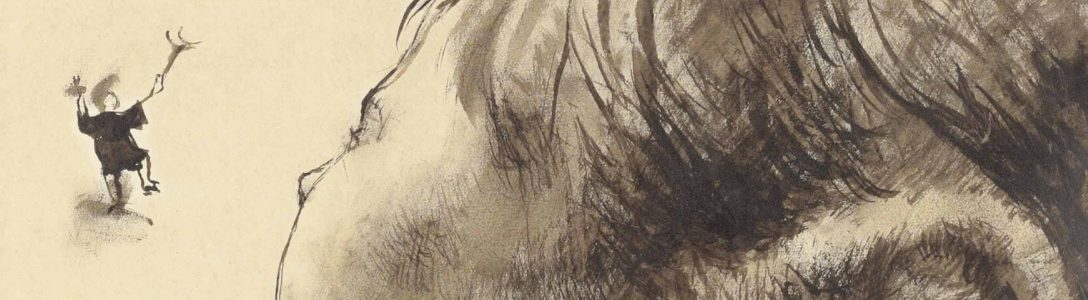
“The Witch” — Anton Chekhov

“The Witch” — Anton Chekhov

IT was approaching nightfall. The sexton, Savely Gykin, was lying in his huge bed in the hut adjoining the church. He was not asleep, though it was his habit to go to sleep at the same time as the hens. His coarse red hair peeped from under one end of the greasy patchwork quilt, made up of coloured rags, while his big unwashed feet stuck out from the other. He was listening. His hut adjoined the wall that encircled the church and the solitary window in it looked out upon the open country. And out there a regular battle was going on. It was hard to say who was being wiped off the face of the earth, and for the sake of whose destruction nature was being churned up into such a ferment; but, judging from the unceasing malignant roar, someone was getting it very hot. A victorious force was in full chase over the fields, storming in the forest and on the church roof, battering spitefully with its fists upon the windows, raging and tearing, while something vanquished was howling and wailing…. A plaintive lament sobbed at the window, on the roof, or in the stove. It sounded not like a call for help, but like a cry of misery, a consciousness that it was too late, that there was no salvation. The snowdrifts were covered with a thin coating of ice; tears quivered on them and on the trees; a dark slush of mud and melting snow flowed along the roads and paths. In short, it was thawing, but through the dark night the heavens failed to see it, and flung flakes of fresh snow upon the melting earth at a terrific rate. And the wind staggered like a drunkard. It would not let the snow settle on the ground, and whirled it round in the darkness at random.

Savely listened to all this din and frowned. The fact was that he knew, or at any rate suspected, what all this racket outside the window was tending to and whose handiwork it was.

“I know!” he muttered, shaking his finger menacingly under the bedclothes; “I know all about it.” Continue reading ““The Witch” — Anton Chekhov”

Woman Reading — Gustave Caillebotte

“Birds and Birds and Birds” — Walt Whitman

A little later—bright weather.—An unusual melodiousness, these days, (last of April and first of May) from the blackbirds; indeed all sorts of birds, darting, whistling, hopping or perch’d on trees. Never before have I seen, heard, or been in the midst of, and got so flooded and saturated with them and their performances, as this current month. Such oceans, such successions of them. Let me make a list of those I find here:

Black birds (plenty,) Meadow-larks (plenty,)
Ring doves, Cat-birds (plenty,)
Owls, Cuckoos,
Woodpeckers, Pond snipes (plenty,)
King-birds, Cheewinks,
Crows (plenty,) Quawks,
Wrens, Ground robins,
Kingfishers, Ravens,
Quails, Gray snipes,
Turkey-buzzards, Eagles,
Hen-hawks, High-holes,
Yellow birds, Herons,
Thrushes, Tits,
Reed birds, Woodpigeons.

Early came the

Blue birds, Meadow-lark,
Killdeer, White-bellied swallow,
Plover, Sandpiper,
Robin, Wilson’s thrush,
Woodcock, Flicker.

From Walt Whitman’s Specimen Days.


R.L. Burnside’s Sons Hambone

After the Party — Andy Warhol

Snakes — M.C. Escher

Charles Bukowski’s Worst Hangover

“The Right Eye of the Commander” — Bret Harte

“The Right Eye of the Commander” — Bret Harte

The year of grace 1797 passed away on the coast of California in a southwesterly gale. The little bay of San Carlos, albeit sheltered by the headlands of the blessed Trinity, was rough and turbulent; its foam clung quivering to the seaward wall of the Mission garden; the air was filled with flying sand and spume, and as the Senor Commandante, Hermenegildo Salvatierra, looked from the deep embrasured window of the Presidio guardroom, he felt the salt breath of the distant sea buffet a color into his smoke-dried cheeks.

The Commander, I have said, was gazing thoughtfully from the window of the guardroom. He may have been reviewing the events of the year now about to pass away. But, like the garrison at the Presidio, there was little to review; the year, like its predecessors, had been uneventful—the days had slipped by in a delicious monotony of simple duties, unbroken by incident or interruption. The regularly recurring feasts and saints’ days, the half-yearly courier from San Diego, the rare transport ship and rarer foreign vessel, were the mere details of his patriarchal life. If there was no achievement, there was certainly no failure. Abundant harvests and patient industry amply supplied the wants of Presidio and Mission. Isolated from the family of nations, the wars which shook the world concerned them not so much as the last earthquake; the struggle that emancipated their sister colonies on the other side of the continent to them had no suggestiveness. In short, it was that glorious Indian summer of California history around which so much poetical haze still lingers—that bland, indolent autumn of Spanish rule, so soon to be followed by the wintry storms of Mexican independence and the reviving spring of American conquest.

The Commander turned from the window and walked toward the fire that burned brightly on the deep ovenlike hearth. A pile of copybooks, the work of the Presidio school, lay on the table. As he turned over the leaves with a paternal interest, and surveyed the fair round Scripture text—the first pious pothooks of the pupils of San Carlos—an audible commentary fell from his lips: “‘Abimelech took her from Abraham’—ah, little one, excellent!—’Jacob sent to see his brother’—body of Christ! that upstroke of thine, Paquita, is marvelous; the Governor shall see it!” A film of honest pride dimmed the Commander’s left eye—the right, alas! twenty years before had been sealed by an Indian arrow. He rubbed it softly with the sleeve of his leather jacket, and continued: “‘The Ishmaelites having arrived—'”

He stopped, for there was a step in the courtyard, a foot upon the threshold, and a stranger entered. With the instinct of an old soldier, the Commander, after one glance at the intruder, turned quickly toward the wall, where his trusty Toledo hung, or should have been hanging. But it was not there, and as he recalled that the last time he had seen that weapon it was being ridden up and down the gallery by Pepito, the infant son of Bautista, the tortilla-maker, he blushed and then contented himself with frowning upon the intruder. Continue reading ““The Right Eye of the Commander” — Bret Harte”

The Reading — Federico Zandomeneghi

Stańczyk During a Ball at the Court of Queen — Jan Matejko

“Old and New Year Ditties” — Christina Rossetti

“Old and New Year Ditties” by Christina Rossetti

I

New Year met me somewhat sad:
Old Year leaves me tired,
Stripped of favourite things I had
Baulked of much desired:
Yet farther on my road to-day
God willing, farther on my way.

New Year coming on apace
What have you to give me?
Bring you scathe, or bring you grace,
Face me with an honest face;
You shall not deceive me:
Be it good or ill, be it what you will,
It needs shall help me on my road,
My rugged way to heaven, please God.

II

Watch with me, men, women, and children dear,
You whom I love, for whom I hope and fear,
Watch with me this last vigil of the year.
Some hug their business, some their pleasure-scheme;
Some seize the vacant hour to sleep or dream;
Heart locked in heart some kneel and watch apart.

Watch with me blessèd spirits, who delight
All through the holy night to walk in white,
Or take your ease after the long-drawn fight.
I know not if they watch with me: I know
They count this eve of resurrection slow,
And cry, “How long?” with urgent utterance strong.

Watch with me Jesus, in my loneliness:
Though others say me nay, yet say Thou yes;
Though others pass me by, stop Thou to bless.
Yea, Thou dost stop with me this vigil night;
To-night of pain, to-morrow of delight:
I, Love, am Thine; Thou, Lord my God, art mine.

III

Passing away, saith the World, passing away:
Chances, beauty and youth sapped day by day:
Thy life never continueth in one stay.
Is the eye waxen dim, is the dark hair changing to grey
That hath won neither laurel nor bay?
I shall clothe myself in Spring and bud in May:
Thou, root-stricken, shalt not rebuild thy decay
On my bosom for aye.
Then I answered: Yea.

Passing away, saith my Soul, passing away:
With its burden of fear and hope, of labour and play;
Hearken what the past doth witness and say:
Rust in thy gold, a moth is in thine array,
A canker is in thy bud, thy leaf must decay.
At midnight, at cockcrow, at morning, one certain day
Lo, the Bridegroom shall come and shall not delay:
Watch thou and pray.
Then I answered: Yea.

Passing away, saith my God, passing away:
Winter passeth after the long delay:
New grapes on the vine, new figs on the tender spray,
Turtle calleth turtle in Heaven’s May.
Though I tarry wait for Me, trust Me, watch and pray:
Arise, come away, night is past and lo it is day,
My love, My sister, My spouse, thou shalt hear Me say.
Then I answered: Yea.


R.I.P. 2012

RIP Charles Durning

RIP Pandit Ravi Shankar

RIP Comix Legend Spain Rodriguez

RIP Roy Bates, Prince of Sealand

RIP Tony Scott

RIP Joe Kubert

RIP Robert Hughes

RIP Gore Vidal

RIP Chris Marker

RIP Mystery Writer Donald J. Sobol, Creator of Encyclopedia Brown

RIP Andrew Sarris

RIP Ray Bradbury

RIP Doc Watson

RIP Carlos Fuentes

RIP Maurice Sendak

RIP Adam Yauch

RIP Levon Helm

RIP Neil Armstrong

RIP Cynthia Dall

RIP Harry Crews, an Underappreciated Southern Great

RIP Jean Giraud aka Moebius

RIP Mike Kelley

RIP Etta James

RIP Davy Jones

RIP Earl Scuggs

The Lion of St. Mark — Vittore Carpaccio

if . . . . — Lindsay Anderson (Full Film)

(Read my review).

Pond Pass — Neil Welliver

Slow Century (2002 Pavement Documentary)