
(No subtitles, but do you really need them? No, that’s right, you don’t).
Enjoy Thanksgiving with Our Literary Recipes Roundup

***
Enjoy Thanksgiving with our menu of literary recipes:
F. Scott Fitzgerald’s Turkey Twelve Ways
Zora Neale Hurston’s Mulatto Rice
James Joyce’s Burnt Kidney Breakfast
Herman Melville’s Whale Steaks
Ernest Hemingway’s Absinthe Cocktail, Death in the Afternoon
Vladimir Nabokov’s Eggs à la Nabocoque
Thomas Pynchon’s Banana Breakfast
Robert Crumb’s Macaroni Casserole
Truman Capote’s Caviar-Smothered Baked Potatoes with 80-Proof Russian Vodka
Emily Dickinson’s Cocoanut Cake
Thomas Jefferson’s Vanilla Ice Cream
Christmas Bonus: George Orwell’s Recipes for Plum Cake and Christmas Pudding
Contrast (Order and Chaos) — M.C. Escher

A Seven Point Riff on David Foster Wallace’s David Markson Essay
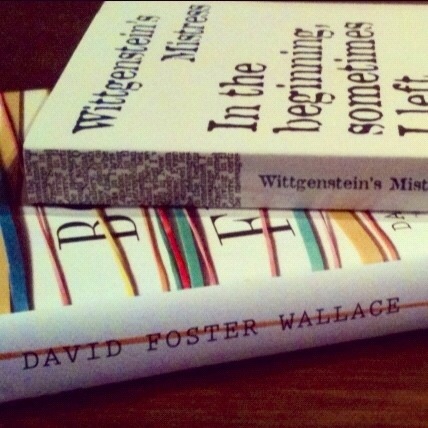
1. Like many David Foster Wallace fans, I’d already read many of the essays collected in the posthumous Both Flesh and Not. I hadn’t read “The Empty Plenum: David Markson’s Wittgenstein’s Mistress” though, originally published in a 1990 issue of The Review of Contemporary Fiction.
I suspect that the Markson essay hasn’t been collected up until now because it is so focused on Wittgenstein’s Mistress—this in contrast to, say “How Tracy Austin Broke My Heart” (Consider the Lobster) which is nominally about Austin’s autobiography but really about much bigger frying fish, like fan-idol relationships and ghostwriting and genre, or “Greatly Exaggerated,” which, again is nominally a review of Dix’s Morte d’Author: An Autopsy but is really more about postmodernism in general. I can’t recall exactly—maybe in his Charlie Rose interview—but Wallace said that he wanted the pieces in his books to be about more than just the ephemeral surface-level topic at hand; like most writers, he was contending for posterity. Wallace’s Markson essay is about Wittgenstein’s philosophy and the state of postmodern or experimental writing in the late 1980s and certain feminist analytic approaches to literature—but mostly it’s a detailed review of Markson’s novel—and it’s not trying to be anything more—which is actually really nice.
2. I read Wittgenstein’s Mistress on David Foster Wallace’s recommendation (I could add the modifier “like many David Foster Wallace fans” here again, I suspect). (That recommendation– “Five direly underappreciated U.S. novels >1960”—is also reprinted in Flesh (perhaps superfluously)). (While I’m getting all parenthetical: I read all five books Wallace recommended and all were excellent).
Here’s Wallace’s recommendation:
“W’s M” is a dramatic rendering of what it would be like to live in the sort of universe described by logical atomism. A monologue, formally very odd, mostly one-sentence 6s. Tied with “Omensetter’s Luck” for the all-time best U.S. book about human loneliness. These wouldnt constitute ringing endorsements if they didnt happen all to be simultaneously true — i.e., that a novel this abstract and erudite and avant-garde that could also be so moving makes “Wittgenstein’s Mistress” pretty much the high point of experimental fiction in this country.
—This is in some ways a condensation of his essay “The Empty Plenum,” where he writes:
Markson’s is not a pop book, and it’s not decocted philosophy or a docudrama-of-the-week. Rather, for me, the novel does artistic & emotional justice to the politico-ethical implications of Ludwig Wittgenstein’s abstract mathematical metaphysics , makes what is designed to be a mechanism pulse, breathe, suffer, live, etc. In so doing, it pays emotional tribute to a philosopher who by all evidence lived in a personal spiritual torment over the questions too many of his academic followers have made into elaborate empty exercises.
3. After Wittgenstein’s Mistress, Markson wrote four more novels, or anti-novels, if you like, sometimes called the note-card novels, novels “of intellectual reference and allusion, so to speak minus much of the novel,” as Novelist puts it in The Last Novel. I read these novels after WM: better-if-not-as-precise (in its metaphoricity) verb: I devoured them. Refinement isn’t exactly the right word, but Markson’s last four novels distill the elliptical and monotone style that he began in WM into a kind of word collage, a frieze of loops, motifs, ideas that the reader has the privilege/burden to construct meaning from. At the beginning of his essay on WM, Wallace posits that the novel is an “INTERPRET-ME” novel; the four novels after WM go beyond INTERPRET-ME—they ask the reader to construct-me, build-me, make-me. These late novels cast away the onus of a narrator; they jettison the already-jettisoned figure of Kate, narrator of Wittgenstein’s Mistress, the last person on earth. And perhaps because of all this, I’ve come to think that they are in many ways superior to WM (or at least showcase a clear evolution in Markson’s style)—that they more purely enact the canon-making, curatorial process that I take to be the core of Markson’s last five books.
4. Here’s Wallace on Markson’s curatorial curve:
The curator’s job—to recall, choose, arrange: to impose order & so communicate meaning—is marvelously synechdochic of the life of the solipsist, of the survival strategies apposite one’s existence as monad in a world of diffracted fact.
Except a big question is: whence facts, if the world is “empty”?
And then Wallace goes about answering this question w/r/t (am I borrowing too many Wallacian shortcuts here?) Wittgenstein’s philosophy. (And this I will not attempt to summarize here).
5. But I will quote Wallace again:
[Wittgenstein] never actually wrote anything about the exquisite tensions between atomism & attendant solipsism on the one hand & distinctively human values & qualities on the other. But, see, this is exactly what Mr. Markson does in WM; and in this way Markson’s novel succeeds in speaking where Wittgenstein is mute, weaving Kate’s obsession with responsibility (for the world’s emptiness) gorgeously into the character’s mandala of cerebral conundrum & spiritual poverty.
6. The greatest weaknesses of Wallace’s essay:
a). He doesn’t do a great job of explicating specifically how Wittgensteinian philosophy—or even themes—are alluded to by Markson in WM. (Or maybe I’m just a weak reader).
b). He gets bogged down in a long discussion of WM as a male-authored text featuring a female narrator w/r/t passivity vs. agency and object vs. subject and Helen vs. Eve (etc.) that I think is ultimately the kind of business far better sorted out in the novel itself.
7. The greatest strength of Wallace’s essay:
He made me want to reread Wittgenstein’s Mistress.
In Which Bret Easton Ellis Finally Comes to Understand Women
Bret Easton Ellis took to Twitter last night to share some more of his profound insights.
Here, he sets the stage for us and delivers a powerful thesis (all in under 140 characters!):

And of course, some supporting details (including a bit of biology):
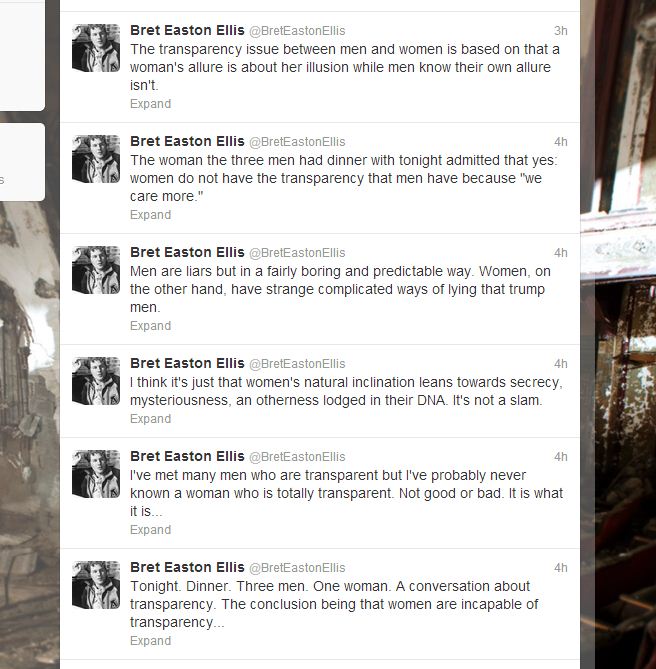
Mr. Ellis even replies to one of his followers! (I like the touch of self loathing):

A rousing conclusion statement:

And a fitting epilogue:

Bravo!
Incantation — Felicien Rops

Two Bombings (The Battle of Algiers)
Self Portrait — Moebius

Emily Dickinson’s Cocoanut Cake Recipe
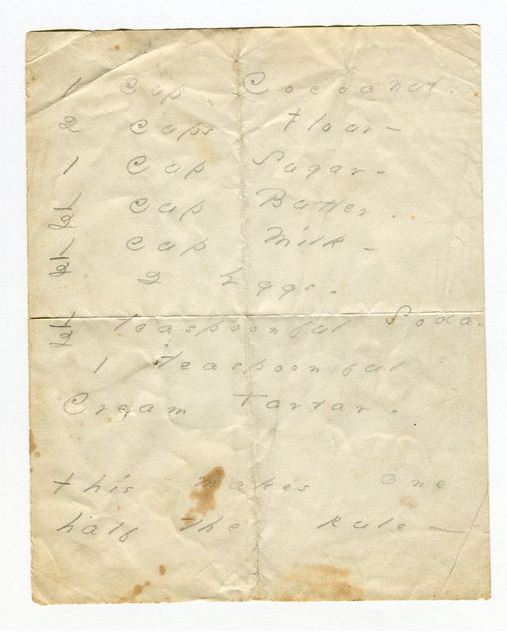
Emily Dickinson’s recipe for cocoanut cake, via Tori Avey at the The History Kitchen. Avey’s post is great—she guides the reader through making the cake, includes photos of the process, and even pairs the recipe with an appropriate poem. And of course, she transcribes Dickinson’s scratchy notes:
Emily Dickinson’s Cocoanut Cake
1 cup cocoanut
2 cups flour
1 cup sugar
1/2 cup butter
1/2 cup milk
2 eggs
1/2 teaspoonful soda
1 teaspoonful cream of tartarThis makes one half the rule–
The Cook & The Dinner — Giuseppe Arcimboldo


Reprobates (Book Acquired, 11.16.2012)
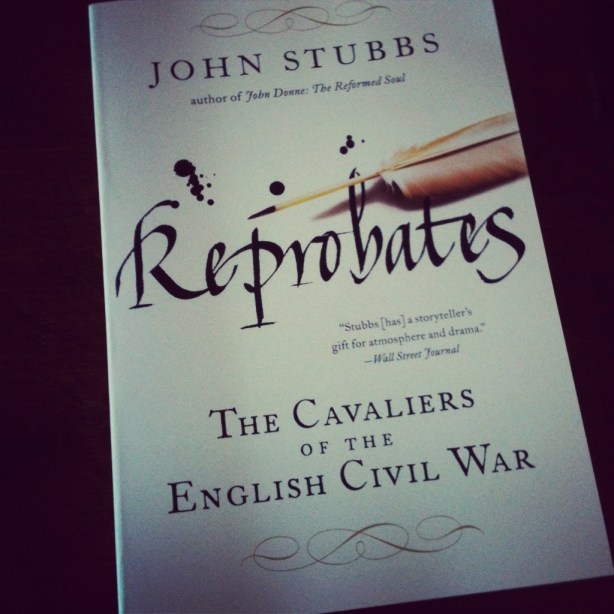
This one looks pretty cool—Reprobates, John Stubbs’s history of the English Civil War. A cursory flip through the book suggests that the subtitle is perhaps a little misleading—Reprobates seems to be more of a survey of the shifts in English culture in the 17th century than a dry study of the actual war between Roundheads and Royalists. In his insightful review at Literary Review, Adrian Tinniswood points out that,
. . . the real focus of Stubbs’s book is the cavalier poets, that motley collection of royalist writers who gathered around the aging and irascible Ben Jonson in the late 1620s and 1630s and went on to seek their fortunes at court, simultaneously memorialising and mythologising its decline. The self-styled ‘Tribe of Ben’ – William Davenant, Thomas Carew, Sir John Suckling and the rest – remain resolutely minor figures, both in literature and in history. Most are remembered for a single poem, like Sir John Denham and ‘Cooper’s Hill’, or even a single line, like Richard Lovelace’s ‘Stone walls do not a prison make’ or Robert Herrick’s ‘Gather ye rosebuds while ye may’. Some aren’t even remembered for that. Can you recall anything Suckling wrote? . . . Under Stubbs’s affectionate but forensic gaze these reprobates seem like figures of fun in a Restoration comedy rather than the heroes they so clearly believed themselves to be.
At The Guardian, Christopher Bray finds even more comedy in these reprobates, suggesting that,
If Ben Elton ever writes another series of Blackadder, Reprobates ought to be top of his research list. Not because John Stubbs offers a daringly revisionist take on the English civil war. The book’s subtitle notwithstanding, the war occupies rather fewer than a quarter of its nearly 500 pages. What we do get, though, is a colourful braiding of poetry criticism, literary biography and social and political history – the whole lot knotted together by characters of such effervescent high spirits the sitcom form might have been invented for them.
Looks like good stuff.
Barry Hannah on Denis Johnson’s Book Jesus’ Son
Certain books, the ones I’m always looking for and hardly ever finding—true codes of entry into other hard spiritualities—you have to read while you’re walking, say, even through a crowded airport. Such was Denis Johnson’s Jesus’ Son. Those of us who’ve come out of the serious dope-and-drink world may have forgotten the strange poetry and curious religious cast of events, but Johnson hasn’t. It takes an authentic poet to catch the strange, tragic hope and cheer as well as the squalor of that life, and Johnson surely is one.
Barry Hannah on Denis Johnson’s Jesus’ Son; from the January, 1994 issue of SPIN.
Evening in the Studio — Lucian Freud

Feast of the Redeemer — Maurice Prendergast

Teorema — Pier Paolo Pasolini (Full Film)
New Rachel Carson Biography (Book Acquired, 11.13.2012)
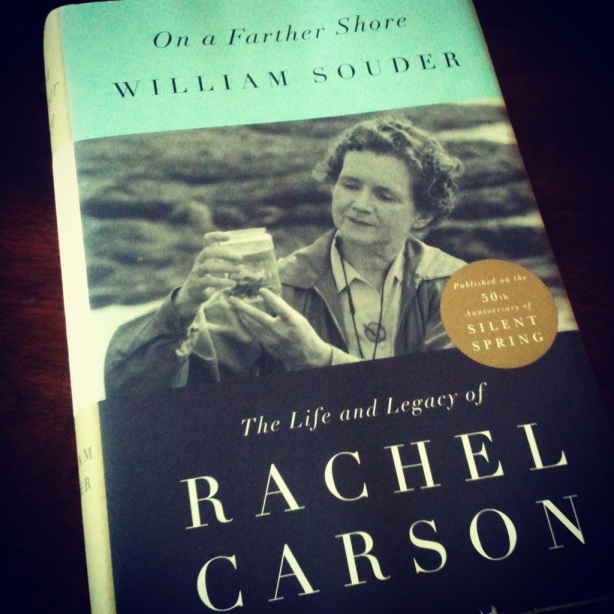
On a Farther Shore is William Souder’s big, bold biography of Rachel Carson, whose long (and often poetic) essay Silent Spring changed the way many people thought about humanity’s changing relationship with the environment. Here’s publisher Crown/Random House’s blurb:
She loved the ocean and wrote three books about its mysteries, including the international bestseller The Sea Around Us. But it was with her fourth book, Silent Spring, that this unassuming biologist transformed our relationship with the natural world.
Rachel Carson began work on Silent Spring in the late 1950s, when a dizzying array of synthetic pesticides had come into use. Leading this chemical onslaught was the insecticide DDT, whose inventor had won a Nobel Prize for its discovery. Effective against crop pests as well as insects that transmitted human diseases such as typhus and malaria, DDT had at first appeared safe. But as its use expanded, alarming reports surfaced of collateral damage to fish, birds, and other wildlife. Silent Spring was a chilling indictment of DDT and its effects, which were lasting, widespread, and lethal.
Published in 1962, Silent Spring shocked the public and forced the government to take action-despite a withering attack on Carson from the chemicals industry. The book awakened the world to the heedless contamination of the environment and eventually led to the establishment of the EPA and to the banning of DDT and a host of related pesticides. By drawing frightening parallels between dangerous chemicals and the then-pervasive fallout from nuclear testing, Carson opened a fault line between the gentle ideal of conservation and the more urgent new concept of environmentalism.
Elegantly written and meticulously researched, On a Farther Shore reveals a shy yet passionate woman more at home in the natural world than in the literary one that embraced her. William Souder also writes sensitively of Carson’s romantic friendship with Dorothy Freeman, and of her death from cancer in 1964. This extraordinary new biography captures the essence of one of the great reformers of the twentieth century.
Elizabeth Royte gave Shore a good review in The New York Times; excerpt:
Souder is at his best when he places Carson’s intellectual development in context with the nascent environmental movement. The storm over “Silent Spring,” he notes, was a “cleaving point” in history when the “gentle, optimistic proposition called ‘conservation’ began its transformation into the bitterly divisive idea that would come to be known as ‘environmentalism.’” (Souder isn’t shy about expressing his own disappointment with what he views as a permanent wall between partisans, with nature and science pitted against an “unbreakable coalition of government and industry, the massed might of the establishment.”)
I’ll let Lucy have the last word:

Thomas Jefferson’s Recipe for Vanilla Ice Cream

Manuscript from the Library of Congress, transcript (below) via Monticello’s website:
2. bottles of good cream.
6. yolks of eggs.
1/2 lb. sugarmix the yolks & sugar
put the cream on a fire in a casserole, first putting in a stick of Vanilla.when near boiling take it off & pour it gently into the mixture of eggs & sugar.
stir it well.
put it on the fire again stirring it thoroughly with a spoon to prevent it’s sticking to the casserole.
when near boiling take it off and strain it thro’ a towel.
put it in the Sabottiere*
then set it in ice an hour before it is to be served. put into the ice a handful of salt.
put salt on the coverlid of the Sabotiere & cover the whole with ice.
leave it still half a quarter of an hour.
then turn the Sabottiere in the ice 10 minutes
open it to loosen with a spatula the ice from the inner sides of the Sabotiere.
shut it & replace it in the ice
open it from time to time to detach the ice from the sides
when well taken (prise) stir it well with the Spatula.
put it in moulds, justling it well down on the knee.
then put the mould into the same bucket of ice.
leave it there to the moment of serving it.
to withdraw it, immerse the mould in warm water, turning it well till it will come out & turn it into a plate.
 Biblioklept