Hemingway Goes Topless

Ernest Hemingway fishing, Key West, 1928.

The Simpsons Play Football

Book Shelves #6, 2.05.2012

Book shelves series #6, sixth Sunday of 2012: In which we dig into the comix inside the book shelf we looked at last week.

20120205-102013.jpg

When I was 13, I sold a fairly large collection of superhero comic books and earned enough money to buy an electric guitar—a weird mutant by Fender called the Bullet—and a small practice amp. It was the early nineties, and Marvel was about to burst the comic book bubble big time by flooding the market with gimmicky covers, hologram cards, and other nonsense.

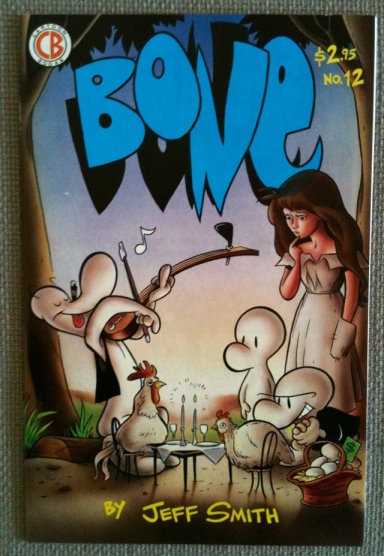
I continued to buy comics (or comix, if you prefer) over the years, although eventually economic concerns led me to just wait for graphic novel editions. Anyway, the book shelf above now contains most of the “underground” comix that I own. A few samples:

20120205-102552.jpg

20120205-102601.jpg

20120205-102611.jpg

Most of the comix in this unit though are issues of Dave Sim’s epic (and insane) series Cerebus. I bought issues of Cerebus intermittently for years at a time, usually getting frustrated and then waiting for the “phone book” graphic novel editions of the series. Sim, along with background artist Gerhard, produced 300 issues of Cerebus over 25 years. The issues from the early ’80s to the early ’90s are brilliant; eventually Sim cracked though and went on an insane, reactionary (and arguably deeply misogynistic) bent. He created his own religion, a mix of hardline Judaism, Islam, and Christianity, and the later books in the series suffered greatly, as the book detoured to chronicle projects that seemed far outside its original scope (including strange, long satires of Hemingway and Fitzgerald). Anyway, some issues:

20120205-102641.jpg

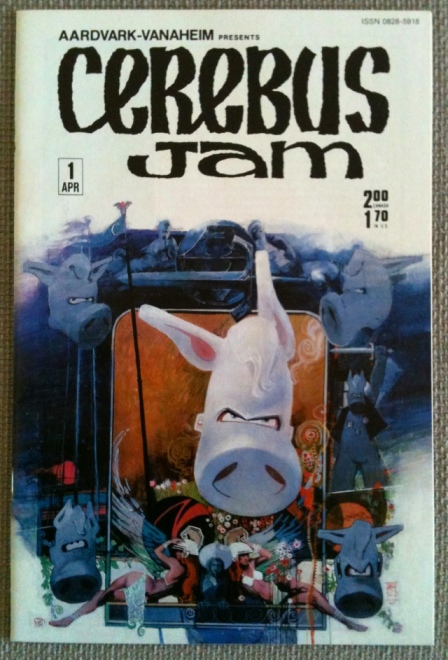
Cerebus Jam, a one-off collaboration with a cover by one of my favorite artists Bill Sienkiewicz (I still have his entire run on Marvel’s The New Mutants in a box somewhere):
20120205-102651.jpg

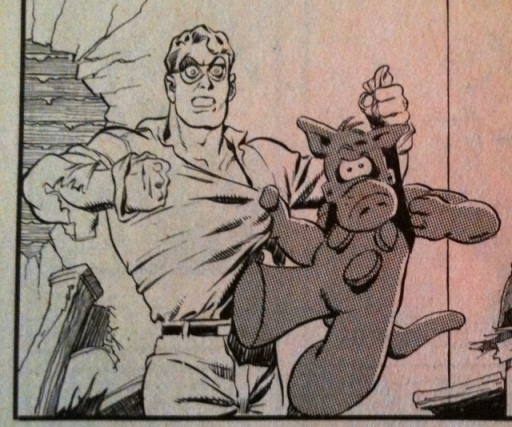
A panel from the issue’s collaboration with comic book legend Will Eisner, featuring his seminal character The Spirit:
20120205-102658.jpg

Gertrude Stein Talks American Football, American Indians

In a 1934 radio interview, Gertrude Stein talks American football:

INTERVIEWER: You saw the Yale-Dartmouth game a week ago Saturday didn’t you? Did you understand that in the American way or the football way or how?

STEIN: IN the American way. The thing that interested me was that the Modern American in his movements and his actions in a football game so resembled the red Indian dance and it proves that the physical country that made the one made the other and that the red Indian is still with us. They just put their heads down solemnly together and then double over, while on the sidelines the substitutes move in a jiggly way just like Indians. Then they all get down on all fours just like Indians.

INTERVIEWER: But those jiggles are just warming-up exercises.

STEIN: It doesn’t make any difference what they are doing it for, they are just doing it, like the way the Indian jiggles in the Indian dance and then there is that little brown ball they all bend down and worship.

INTERVIEWER: But the ideas in that is to get the ball across the goal line.

STEIN: But don’t you suppose I know that, and don’t you suppose the Indians had just as much reason and enjoyed their dancing just as much?

You Used To Be Alright, What Happened — Kristine Moran

Books Acquired, 1.27.2012

20120204-134620.jpg

Frances Brody’s Dying in the Wool is a mystery from Minotaur/St. Martin’s. Their description:

Take one quiet Yorkshire village

Bridgestead is a peaceful spot: a babbling brook, rolling hills and a working mill at its heart.  Pretty and remote, nothing exceptional happens…

Add a measure of mystery

Until the day that Master of the Mill Joshua Braithwaite goes missing in dramatic circumstances, never to be heard of again.

A sprinkling of scandal

Now Joshua’s daughter is getting married and wants one last attempt at finding her father.  Has he run off with his mistress, or was he murdered for his mounting coffers?

And Kate Shackleton—amateur sleuth extraordinaire!

Kate Shackleton has always loved solving puzzles.  So who better to get to the bottom of Joshua’s mysterious disappearance? But as Kate taps into the lives of the Bridgestead dwellers, she opens cracks that some would kill to keep closed…

20120204-134647.jpg

Jane Vows Vengeance is the third (and final?) in a series by Michael Thomas Ford where Jane Austen is a vampire. I covered the first book here (and was perhaps way kinder to the book than its conglomeration of trends deserved) and the second here. Let me cannibalize text from both previous write ups (the second write up cannibalized the first!):

In the past few years we’ve seen a spate of books where public domain characters and historical figures feature in supernatural tales, usually written in an ironic, or at least parodic mode. It seems like a heavy percentage of these books are mixed up somehow with Jane Austen, whose legacy has become grist for a literary cottage industry, with a new “re-imagining” of Pride and Prejudice or Sense and Sensibility coming out every season. Last year, Michael Thomas Ford offered the public the mix of Jane Austen and vampires we had been so desperately clamoring for,Jane Bites Back. By way of a little more context (and pure laziness), I’ll quote Biblioklept’s review of Ford’s novel–

Jane Bites Back reveres its subject, Jane Austen, even as it blatantly cashes in on the very trend that it satirizes. The book’s program shouldn’t be confused with the absurdity behind Sense and Sensibility and Seamonsters (which we liked) or the wackiness of Pride and Prejudice and Zombies (which we didn’t like), but it does adhere to the same sense of fun. Ford seems to delight in corny, over the top passages, and we’ll take it for granted that his literary tongue is in his cheek . . .

Barry Hannah Interview (Video)

Trout’s Tomb — Kurt Vonnegut

20120203-163607.jpg

“Honor Pricks Me On” — Falstaff’s Catechism (Orson Welles in Chimes at Midnight)

Book Acquired, 1.30.2012 — Dogma, Lars Iyer’s Sequel to Spurious

20120202-195422.jpg

Lars Iyer’s novel (or anti-novel, if you swing that way) Spurious was one of the better books I read last year. From my review:

Lars Iyer’s début novel Spurious is about two would-be intellectuals, W., the book’s comic hero, and his closest friend, our narrator Lars. They bitch and moan and despair: it’s the end of the world, it’s the apocalypse; they find themselves incapable of original thought, of producing any good writing. The shadow of Kafka paralyzes them. They travel about Europe, seeking out knowledge and inspiration — or at least a glimpse of some beautiful first editions of Rosenzweig. They attend dreadful academic conferences; they write letters. They flounder and fail.

Iyer was also kind enough to talk with me in a long, detailed interview.

So like basically I’m a fan, and I’ve been eager for Dogma, so I was psyched when an ARC showed up in Monday’s mail. Dogma is new from Melville House at the end of this month; more coverage to come.

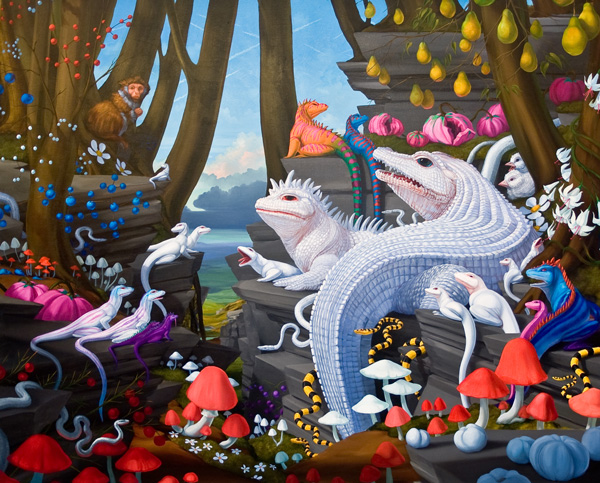
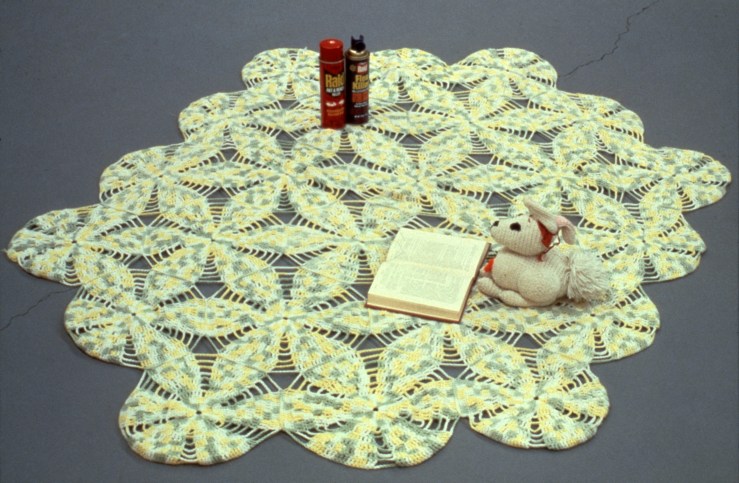
Diorama with Gasoline, Dopamine and Adrenaline — Laurie Hogin

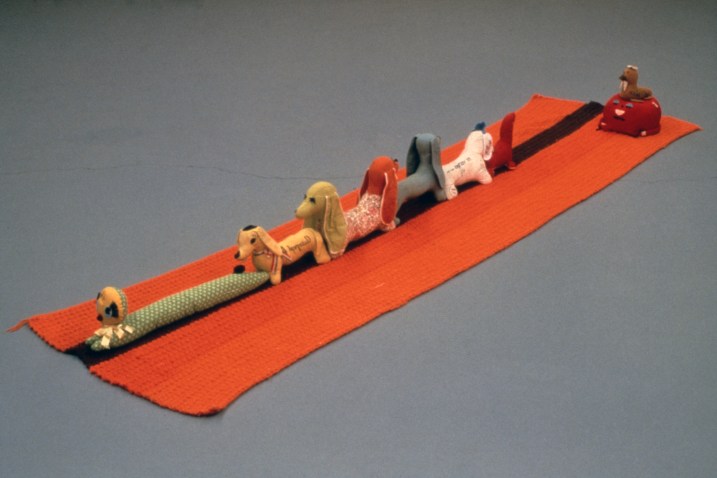
Arena #10 (Dogs) — Mike Kelley

(Via/more).

“Don’t Worry About the Government” (Live) — Talking Heads

Topless Faulkner, Part III

(See also).

RIP Mike Kelley

RIP artist/musician Mike Kelley. (Obit/more).

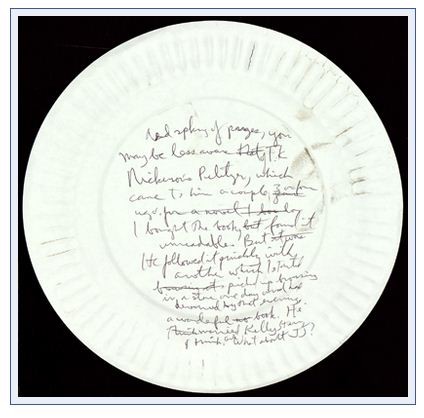
Denis Johnson’s Notes for The Name of the World, as Recorded on a Paper Plate

Tom Waits and John Lurie Go Fishing in Jamaica

(From the cult 1991 TV series Fishing with John)