
Once upon a time, young people who were lucky enough to have the leisure to read what they wanted gravitated toward texts like Little Women, The Adventures of Tom Sawyer, and Great Expectations. These books weren’t necessarily written for or marketed to teenagers, but they found (and continue to find) a hungry audience in adolescents. The rise of the modern publishing industry saw a way to feed these voracious young readers, and Young Adult–YA–has since solidified into its own genre, complete with its own set of conventions and tropes, found in fantasies, romances, adventures, and sci-fi novels alike. YA tends to enlarge themes that predominate literature as a whole–alienation, isolation, shame, transformation, and (of course) identity. The best YA literature speaks to adolescent fear, channels it into thought experiments and fantasies that help teens to cope with their changing identities. However, YA, like any genre, puts a writer at risk of being ghettoized, of having her own work thrown in with a good many bad books. In recent years, established writers like Sherman Alexie and Nick Hornby have purposefully written YA books and worked to have their books marketed as such, but perhaps many writers don’t want to be pigeonholed into a genre by having their books directed squarely at teens.
 I was thinking about this problem today when I read Michiko Kakutani’s somewhat negative review of Laurence Gonzales’s new novel Lucy in the The New York Times. I received a review copy of Lucy back in March and breezed through it in a few afternoons. It’s an enjoyable read with a preposterous plot that somehow doesn’t come across as a gimmick. The eponymous Lucy, you see, is a genetic experiment, a humanzee born of a bonobo and raised in the middle of the jungle by a (not so) mad scientist named Stone until the age of 14, when insurgents murder her erstwhile dad/creator. Lucy is summarily adopted by another scientist, Jenny Lowe, who takes her to Americaland where she learns to be a normal teen. That is, until her super-chimp powers are revealed to the good American people, who come after her, mob-persecution style. Kakutani insists on reading Gonzales’s work as a Frankenstein story, and picks at it for not explaining its science as well as Michael Crichton’s Jurassic Park. What Kakutani is failing to see is that the novel is not really about scientific hubris–it’s about how hard it is to be a teenager; specifically, it’s about how hard it is to be a teenage girl with a teenage girl body. Kakutani, apparently mistaking books for gravy, also takes Lucy to task for being “lumpy.” If Lucy lacks the finesse, explication, or subtlety that Kakutani would like it to have, then perhaps that is because she misunderstands its audience (to be fair though, Kakutani seems to frequently forget that not all books should be written to her taste).
Again at The New York Times, Tom DeHaven made a similar, if less boorish mistake, earlier this summer in his review of Simon Rich’s début novel Elliot Allagash. Here’s his lede:
If I were in the eighth grade, I’m pretty sure I’d love Simon Rich’s first novel, “Elliot Allagash.” I might even press it on my friends. (“It’s about this 13-year-old evil genius who does whatever he wants because he’s, like, a billionaire. And it’s funny. And short.”) But since more than 45 years have passed since I took up space in a middle school, I simply like it, very much — while wishing this flippant little parable about the puerility of greed had a deeper, sharper bite.
DeHaven wishes Rich’s book had a “deeper, sharper bite” — like Kakutani’s quibble with Gonzales, he wants the kind of acuity that ultimately is not best suited for the eighth and ninth grade boys who will love this book, who will press it on their friends. In my own review of Elliot Allagash, I wrote: “I don’t think that Elliot Allagash is being promoted directly as a Young Adult novel, but it will have a ready audience in the same smart crowd who dig funny, bright novels like C.D. Payne’s Youth in Revolt and Sherman Alexie’s The Absolutely True Diary of a Part-Time Indian .” But even though Elliot Allagash and Lucy aren’t being promoted by their respective publishers Random House and Knopf as YA, that doesn’t mean that they don’t have a potential audience of young adults–and it seems impossible to me that seasoned critics like Kakutani and DeHaven could be ignorant of that. Older readers might enjoy Lucy or Elliot Allagash but young readers might love them; critics shouldn’t condescend authors for not overreaching. A pretentious book is a sin and neither of these books is pretentious.



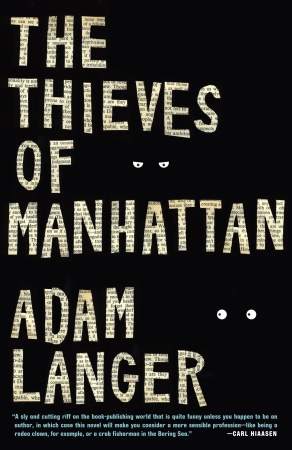 First up: Adam Langer’s new novel, The Thieves of Manhattan, a send-up of the publishing industry that sets its targets directly on the current swath of (faked) memoirs that have done gangbusters for publishers in the past few years. Ian Minot is a broke-assed barista one fuck-up away from an overdue firing, who moves from the Midwest to make it as a writer in the big city. Only he’s not doing so well–in contrast to his gorgeous Romanian girlfriend Anya whose literary star is on the rise. For Minot though, this isn’t the worst–that would be the rampant success of über-poseur Blade Markham, a wanna-be gangsta whose memoir Blade on Blade is a blatant fabrication (albeit a fabrication that no one but savvy schlemiel Minot seems to notice (or, at the least, be bothered by)). I read the first fifty-odd pages of the Thieves in one sitting–a good sign to be sure. Langer’s Minot’s voice is familiar territory, the boy who loves to mock the literati he would love to be a part of. In one of the signal moves of his patois, the names of famous authors (and characters) regularly replace common nouns–a bed becomes a proust, a full head of hair is a chabon, sex is chinaski and so on. Minot seems to be headed to running his own grift soon with the help of a man he appropriately calls the Confident Man–should be good stuff. Full review forthcoming. The Thieves of Manhattan is available July 13, 2010 from
 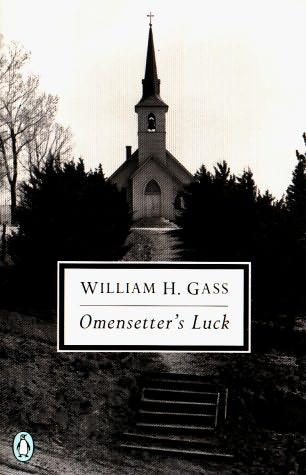 I’ve also been reading William H. Gass’s first novel, Omensetter’s Luck. It’s weird, wonderful, Faulknerish in its loose (but somehow layered and constructed) stream of consciousness. Omensetter’s Luck comprises three sections, each progressively longer; I finished the second one today, and so far the novel seems to dance around a description or accounting of its namesake, Brackett Omensetter who carts his family into the small sleepy town of Gilean, Ohio, and immediately perplexes the townsfolk with his amazing luck. As Frederic Morton put it in his contemporary
 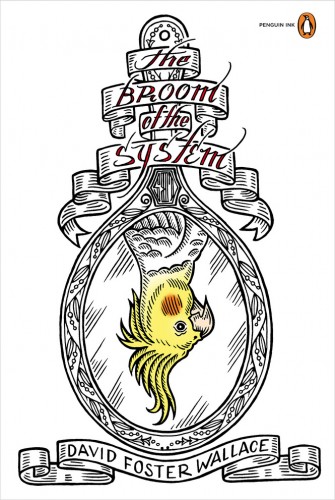 Speaking of Wallace and début novels,
  And, speaking of Wallace (again), or at least using him as a crutch–I’ve almost finished Autobiography of a Recovering Skinhead by Frank Meeink (“as told to” Jody M. Roy; they’ve sort of got the whole Malcolm X/Alex Haley thing going on there). So, yeah, why the Wallace segue? How to justify it? Well, reading Meeink’s story, the true story of an abused, battered Philadelphia kid who falls into the American neo-Nazi movement and its attendant violent crime and terrorism, who goes to prison and finds redemption and human connection and a new purpose for the nihilistic void of his life, who falls into alcoholism and drug addiction only to be redeemed again–reading Meeink’s story, even knowing its veracity (demonstrable to a point that would satisfy even Langer’s Ian Minot)–I couldn’t help but read his strong, immediate, gritty, and utterly real voice as something not unlike one of the creations in David Foster Wallace’s Brief Interviews with Hideous Men. It’s not just Meeink’s hideousness, his violence, or the grace that he works toward–all constituents of DFW’s collection–it’s that voice, the realness of the volume, surely the book’s greatest asset. Recovering Skinhead is an engrossing read, fascinating in the same way that an infected wound prompts our attention, our paradoxical compulsion and repulsion, but most of all it’s an exhilarating and exhausting performance of voice, of Meeink’s unrelenting, authentic telling of a tale, a telling that any novelist would thrill to channel. Only Meeink’s voice isn’t a novel creation: it’s real. Autobiography of a Recovering Skinhead is available now from







 New York’s WBAI
 Biblioklept