Check out parts I, II, and III.
8. Salute Your Shorts (1991-1992, Nickelodeon)
A salute to Salute. Nickelodeon’s Salute Your Shorts only ran for two seasons–a grand total of 26 episodes–but in my impressionable young mind the show seemed to last forever. It’s weird to me now that at the same time I was trying to cultivate some kind of hipness–buying my first albums (Nevermind, Out of Time, Dirty, Doolittle, Aerosmith’s Greatest Hits) and starting to reach beyond comic books and genre sci-fi and fantasy to read “adult books” (Fear and Loathing in Las Vegas, Kurt Vonnegut)–I was also hopelessly addicted to a show as goofy as Salute Your Shorts. But I was. I watched it every afternoon, delighting in the kids’ adventures at summer camp. I was particularly intrigued by pranksters Budnick and Donkeylips (I was thrilled when Budnick turned up in Terminator 2. Really). I also watched Nickelodeon’s Hey Dude, which I considered to be a pale imitation of Salute Your Shorts (a little research shows that Hey Dude actually began its two season run a full two years before Salute Your Shorts first aired). I’m not sure if I finally did get too old–or perceived myself too hip–to watch Nickelodeon, but it seems to me like Nickelodeon has been on a slow decline since the early nineties and the demise of shows like SYS and Ren and Stimpy.
Before you check out the episode below (which I know you’re psyched about), find out what Donkeylips (aka Michael Bower) has been up to. Apparently he’s a rapper now; unfortunately the section of his fantastic website (you really should go there now) devoted to “My Rap Music” (via “Media,” via “Audio”) only contains “One Mic” by Nas–still an awesome song, though.
I’ve been reading a lot of Faulkner lately. This has nothing to do with me liking Faulkner (I don’t) or thinking that he’s an American master (at this point, I’m convinced that he’s not. Rather, it seems that a few critics–notably Malcolm Cowley and Cleanth Brooks–decided either that a. Faulkner is really great and/or b. America needs a new master of literary fiction, and it might as well be Faulkner. It seems amazing to me that these two critics conned a whole generation into believing that someone whose books were so unbelievably poorly written was actually, like, a totally awesome and important writer). I’m taking a class that requires me to read Faulkner.
Anyway, over the course of my reading, I got to thinking that the Coen brothers, two guys that have made some of the best American films ever (masterful films, certainly) are fond of Faulkner: the flood in O Brother Where Art Thou? hearkens to Faulkner’s novella Old Man (as does the whole milieu of that film really), the slow southern grotesque of Blood Simple is pure Faulknerian, ditto the gloomy doom of The Man Who Wasn’t There, and the failed screenwriter W.P. Mayhew in Barton Fink is essentially a caricature of Faulkner during his days in Hollywood.
So well and anyway, the Coens have a new movie coming out, No Country for Old Men, based on the Cormac McCarthy novel of the same name. Cormac McCarthy is often compared to Faulkner, though I have no idea why. They’re American? That’s it. They’re American. Like I said though, No Country for Old Men. Early reviews suggest that this is a return to form for the Coens, who have either been stumbling or just lazily cashing in lately (see: Intolerable Cruelty; The Ladykillers)–but we’ll have to wait until November to find out. For now, check out the trailer:
At this point, I don’t know if it does any good to anyone for me to throw in my two cents regarding Cormac McCarthy’s latest novel The Road. This book won all sorts of awards and critical praise, topped The Believer‘s 2006 readers’ poll, and even became an Oprah’s Book Club selection. In fact, Cormac McCarthy gave his first ever television interview last month on The Oprah Winfrey Show, and I actually watched the damn thing. I was in the hospital; my daughter had just been born. Anyway, like I was saying, after the publication of The Road, everyone in the field of arts and letters and criticism seems to have simultaneously decided to confer “living master” status on Mr. McCarthy, most noting that he is an American writer. This is something we’re desperate for in American literature–masters of the art. And, if you cannot tell already, I have a somewhat cynical attitude toward this desperation, and a wary if not pessimistic approach to anything so unanimously lauded. So when my mother-in-law gave me a copy of The Road as a belated birthday gift–only a few days after the Oprah interview, in fact–I felt a mixture of intrigue and hesitation. I was reading The Children’s Hospital at the time (#3 on The Believer list, incidentally) which gave me some time and distance from the Oprah interview and some of the hype. When I finally finished The Children’s Hospital, I gave myself a little more distance, reading a few Faulkner short stories and a few magazine articles. Finally, I picked up The Road; I read about half of it in one sitting on a Friday night, finishing the rest of it over that weekend. I had to slow down in the end, because I knew that this book was a tragedy; I knew that (more) bad things were going to happen, and I loved the little boy and the man–the protagonists of the novel–and simply put, I put off reading as a way of putting off their deaths (I did the same with the end of The Children’s Hospital; also, just to get it out of the way, both novels are post-apocalyptic. Done with comparisons).
The premise of The Road will remind you of any number of other post-apocalyptic stories you’ve read or seen: the world is over and everything has gone to shit. However, McCarthy is unrelenting in his refusal to provide an explanation or even description for the epic disaster that precedes the events of the novel. Where most stories in the end-of-the-world genre delight in some sort of mythology, The Road eschews any fantastic back story. Instead, we get fragments, glimpses, the briefest hints. The overall effect of this lack of a reason is a stunning, awesome loneliness. This is an abandoned world, desolate, dead, cold, covered in ash. Nothing can live. Besides, the real story of The Road is the touching relationship between a nameless father and son. These are “the good guys” who “carry the fire”–this is the only mythology of the novel, the father’s only lessons to the son. The pair travels south, although their purpose is simply to stay alive, to not die. A large amount of the text is devoted to the simple day-to-day scavenging that is necessary to live, with occasional encounters with other living people being rare, unexpected, and ultimately meaningless. In a world where living people equal a good source of protein, no one can really help these two; all other people are threats–“the bad guys.” And as the novel progresses, the young boy begins to realize that the world is not so simple, that there may not be such a thing as “good guys” and “bad guys.”
The bond between the father and son, so beautifully expressed in McCarthy’s spartan prose, genuinely moved me. Their relationship propels a narrative absent of all but the dimmest kernel of hope; indeed, it doesn’t seem like there can be any future for these two at all in a world where nothing–no plants, no animals–can live. Which brings me to the last few pages of the book. I have a problem with this. First, I guess I should give a spoiler warning. Honestly, I believe that you can know the end of the book and not have it spoiled for you, but in the interest of etiquette: SPOILER WARNING! SPOILER WARNING! SPOILER WARNING! There. May we continue?
So yes, from the beginning of this book, it’s evident that either the father or the boy or both will die by the end of the book. And yes, the father does die, in a scene so moving that I actually cried. Unbelievably, however, McCarthy cops out in the last few pages of the book, and provides a deus ex machina in the form of a loving surrogate family to protect the boy. I mean, the new father figure comes literally out of nowhere and more or less says: “Okay, you’ll be safe now. Don’t worry readers, the kid is gonna make it!” This improbable resolution seems to contradict the 283 pages or so of the novel that preceded it. It seems far more likely in the world and vision that McCarthy crafted that the boy would be left alone to fend for himself. It’s almost as if McCarthy loved the boy too much to see him on his own, unattended to. And of course, a lot of his readers probably felt the same way–I certainly did. I really did. I wanted to see that kid make it, but at the same time the logic of the narrative does not support the ending that McCarthy wrote. Still, this really is a fantastic book–perhaps a bit overrated, but excellent nonetheless. Highly recommended.
Titus Andronicus, one of Shakespeare’s most overlooked plays, comes to lurid, gory glory in this late nineties adaptation. Gang rape, incest, and mutilation mark Titus as one of the downright nastiest Shakespearean works. Throw in a Thyestean banquet, and you’ve got the makings of a nightmare. The villain Aaron is on par with Iago as one of the bard’s greatest baddies.
This trailer makes the movie seem way cheesier than it really is. Trust me.
2. Romeo + Juliet (1996; directed by Baz Luhrmann)
Baz Lurhmann’s take on the ultimate boy-meets-girl story dazzles viewers in a cacophony of glitter and fireworks that captures the sheer silliness of adolescence–the real theme of Romeo and Juliet. Despite a myriad of critical naysayers, I believe Lurhmann’s hypercolor vision far superior to Zeffirelli’s 1968 version (“the one with the boobies”) so often thrust on high school kids. I actually used this version when I used to teach 9th graders. They loved it. I love it too, particularly John Leguizamo’s standout turn as Tybalt.
The first 10 minutes are excellent, if you don’t recall.
3. Macbeth (1972; directed by Roman Polanski)
Another one I show to my students. Polanski’s Macbeth is one of my favorite films, Shakespeare aside. Filmed relatively shortly after Polanski’s wife Sharon Tate was horrifically stabbed to death by the Manson family, Macbeth captures a forbidding spirit of bloody doom, sexual violence, and inescapable guilt. Beautifully shot and superbly acted, every other attempt has paled in comparison.
4. Looking for Richard (1996; directed by Al Pacino)
Wow. What a film. Pacino leads a group of thespians who try to reclaim Shakespeare “from the academics,” as one actor puts it. There’s a problem though: they’re not really sure how Richard III should go. This film captures the pre-production process for a staging of one of Shakespeare’s greatest history plays, revealing a fascinating aspect of adaptation.
This clip sums it up much better than I could:
5. Ran (1985; directed by Akira Kurosawa)
Kurosawa’s take on King Lear proves that the work of one master can be translated into something new and marvelous when placed in the hands of another master. Ran transfers the Lear story to a feudal Japan rife with warring samurai. Ran is at once an epic action film as well as a philosophic meditation on aging, a commentary on gender roles as well as a study on familial duty and love. Again, a Biblioklept fave.
This is one of the best scenes in the film, or any film, really:
6. Henry V (1989; directed by Kenneth Branagh)
Branagh has given the world more filmed adaptations of Shakespeare than would seem possible for someone to do in one lifetime, and the man is still relatively young. That said, at times his work can be stodgy, if not downright plodding. Henry V is not for everyone. This is a very, very long film, and although the battle scenes are exciting, those unfamiliar with the play will no doubt have a hard time following it–particularly the scenes in French which lack subtitles. Still, if you’re studying the Henry tetralogy, or Shakespeare’s English histories in general, then there really isn’t a better supplement. In some ways Henry V is one of the most textually faithful adaptations of a Shakespeare play I can recall. Fans of Braveheart should also note that Mel “Sugartits” Gibson essentially ripped-off large sections of Henry V when crafting that turgid turd.
A famous speech:
7. Prospero’s Books (1991; directed by Peter Greenaway)
One of the Biblioklept’s favorite directors Peter Greenaway (8 1/2 Women; The Cook, the Thief, His Wife, and Her Lover) adapted one of the Biblioklept’s favorite plays, The Tempest, into a very weird, very surreal film called Prospero’s Books. As the title suggests, this is a movie very much about the act of writing itself (a theme Greenaway also explored in his unfortunate fiasco The Pillow Book); more poignant however are the themes of forgiveness and the letting go of the desire for revenge–aspects central to the original play.
Unfortunately, for some reason Prospero’s Books is still not available in DVD, and I have located no news of plans for that to happen any time soon. So, until that time, taste a little sample:
OK. My post’s title is solely for the sake of titillation (I have also been drinking lots of sangria and watching the first HP movie on TV, and the idea of a Harry Potter sex romp is making me giggle. Twenty points from Gryffindor). Still. Just so you’re not too disappointed, check out Shags the Dustmop’s collection of erotic Harry Potter fan fiction. A half-hearted endorsement, at best. Weird and creepy.
Now, for something truly great…
Fans of if…. will no doubt be familiar with “Sanctus,” the beautiful piece of music that haunts the film. If this recording is not the same as the one in the film, it’s very close. Either way, a sublime rendition–
All the sangria and erotica and Congolese choral interpretations of Catholic masses have for some reason brought to mind the paintings of Wilfredo Lam (longtime pal of one of our favorite writers, Lydia Cabrera).
A decent enough collections of his vibrant paintings can be found here (and you can always google for more, you lazy bastard).
Finally, it is always something special when a new blog is born. Check out Falcon Hawksome. Despite the author claiming that he “can’t stand” Van Morrison’s (or Them’s, if you want to be overly technical, geek) “Gloria,” please take my word that he is something of an arbiter of taste.
“The book started out a lot more like a big happy Love Boat episode, then 9/11 (and all that followed) happened and blew it in a new direction.”–Chris Adrian (McSweeney’s interview)
Chris Adrian’s 2006 novel The Children’s Hospital begins with the end of the world. A flood of (excuse me) biblical proportions drowns every living thing on earth with the exception of a children’s hospital which has been specially engineered with the aid of an angel to withstand both the flood as well as life at sea. The residents of the newly nautical hospital–doctors, med students, specialists, nurses, some 699 sick children, portions of their families and sundry others–must navigate an uncertain future drenched in despair and loss. Their mission of helping the ill is the only thing that sustains them–initially.
Central to the story is Jemma Claflin, a mediocre third-year med student with a haunted past. Years before the deluge, each member of her family and her long-term boyfriend died in a horrific way, leaving Jemma unable to love, let alone believe in a positive future. However, as the book progresses, it becomes apparent that Jemma will have to best her fear and become the hero of this epic novel.
I really, really enjoyed The Children’s Hospital. Adrian’s writing communicates a stirring mix of immediacy and pathos, tempered in a cynical humor that sharply bites at any hint of sentimentality. Despite its 615 pages, epic scale, and use of multiple narrative viewpoints, The Children’s Hospital never sprawls into logorrhea–Adrian holds the plot reins tightly at all times, sparingly measuring details which accrue neatly to an affecting payoff. The middle 200 page section of this book is easily the best thing I’ve read in the past few years. I actually had to stand up to read it–the highest Biblioklept endorsement there is. Yes folks–if you have to stand up to read it, it’s truly excellent stuff.
You can read the entirety of Chris Adrian’s short story “A Better Angel” here.
We love America–who doesn’t? We also love the Preamble to the Constitution. Those three magic words “We the people” created a whole new country (there was also a violent revolution involved). O! the transformative power of words! How glorious that the very act of saying “we” creates a “we” (sure, at the time, the “we” really meant white landowning males, but still, let’s glory in the democratic magic folks). In appreciation of the best country in the world (yes, we’re being earnest dear reader), we present a few classic clips for your viewing pleasure.
No doubt you’ve already gloried in the glory of glorious Dennis Madalone’s glorious tune “America, We Stand as One,” but you can always glory out again.
After that, learn some history kids. Did you know that the Founding Fathers could sing? Better than Rent!
Finally, this is where Biblioklept learned the true meaning of Independence Day, and what it really means to be “Living in America”–
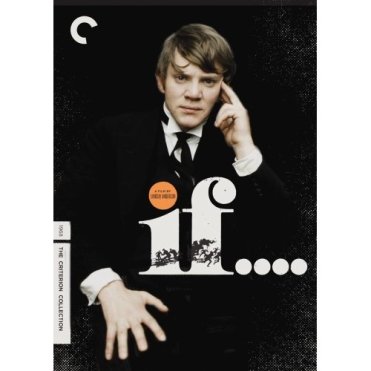
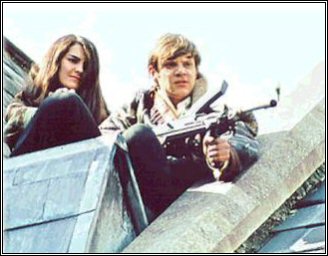
Criterion has finally given Lindsay Anderson‘s 1968 classic if…. a proper DVD release. if…. is one of my all time favorite films. Mick Travis (played with savage aplomb by a very young Malcolm McDowell) leads “The Crusaders,” a band of rebels who defy “The Whips,” the cruel upperclassmen who mete out harsh punishments at their stringent English boarding school. “What I want to know is when do we live?” asks restless Mick. However, the life of individual freedom that he wants to live is so suppressed by the cruel and dominating hierarchy of his school (a microcosm of British society) that he must take liberty by force. In one scene, the Crusaders playfully fence with each other, declaring “Death to all tyrants!” The playfulness quickly slips into violence, as the repressed urges of these would-be revolutionaries flare up. When Mick is cut, he shows his wounded hand and declares with pride “Blood! Real blood!”
Anderson loads if…. with myriad revolutionary images that foreshadow the film’s shocking ending, at the same time tempering if…. with a surrealist sense of humor that satirizes the inherent dangers in institutionalized education and groupthink in general. if…. is bitingly funny, oddly sexy, and unlike any other film I’ve ever seen. The new edition looks great (much better than my VHS dub) and sounds great, and the commentary track provided by Malcolm McDowell and film critic David Robinson is insightful and surely a must for fans of the film. But who am I kidding, if you’re a fan of this film you’ve already seen the release and listened to the commentary–right?
After devouring U.S.! a few weeks ago, I went seeking more Chris Bachelder. What d’y’know, the guy wrote an e-book, Lessons in Virtual Photography, available for free from McSweeney’s. Go figure. Check it out here. It’s pretty funny.
According to this NPR report, the MacArthur Foundation is providing a $1.1 million grant to create a new middle/high school in New York with a curriculum based on video game design. The idea here is that video game design promotes a new type of literacy vital for America’s success in the rapidly growing global economy. The report stresses a shift from older models of literacy, which focus on content memorization, to the pressing need to emphasize literacy models that engage the dynamic systems inherent in newer media.
I think that this is a fantastic idea. Some may find it a nonsensical or even radical shift in education, but we have to try something new. The educational system in this country is based on a model that hasn’t really changed since the industrial revolution. Although numeroussources rank America as having one of the highest literacy rates in the world, my own anecdotal evidence collected as a high school English teacher leads me to believe that this country is in the midst of a literacy crisis that is sure to have a major impact in the country’s ability to compete with countries like India and China.
The risks here are very, very real. Literacy is not just a matter of being able to read stop signs or popular novels or wikipedia pages–literacy is what informs the content of our cultural, social, and political discourse. And beyond the economic issues presented in our difficulty competing in fields like science and engineering–an issue that the MacArthur Foundation’s grant may help address–the everyday rhetoric in this country has become drastically dumbed-down, polarized, reduced to hackneyed platitudes and snappy sound-bites. Political and cultural discourse now consists of empty catch-phrases and meaningless psychobabble. I mean, it’s like totally gay, know what I’m sayin’?
This clip from Mike Judge’s satire Idiocracy neatly sums up the future of verbal discourse in America:
Frog Eyes are connected to The New Pornographers by way of a band called Swan Lake–Dan Bejar is in both bands. Dan Bejar’s solo stuff as Destroyer kicks ass all day long, and then kicks more ass at night. The New Pornographers have a new record coming out called Challengers, set to drop August 21 on Matador Records. Of course you can’t wait until then to hear Neko Case’s sweet voice. The New Pornographers — “Failsafe.”
We love love love the new Dizzee Rascal album, Maths and English, a big surprise considering his first two albums made no impact on us. Hear Mr. Rascal’s guide to how to succeed in the music industry (play it loud so everyone will know how hardcore you are). Dizzee Rascal — “Hardback (Industry)”
While you wait for the new Black Dice album to drop on Paw Tracks sometime later this year, tide yourself over with the A-side from their latest limited edition 12″ record disc. Black Dice — “Roll Up”
Alog have a new album out on Rune Grammafon called Amateur. It’s the perfect soundtrack for sharpening knives, feeding the azaleas, or just reading stupid magazines. Alog –“Write Your Thoughts in Water”
“[Invented by ‘Lewis Carroll’ (C. L. Dodgson) in The Hunting of the Snark (1876).]
An imaginary animal, a particularly dangerous kind of ‘snark’.
1904 B. VON HUTTEN Pam III. vi. 146 We shall see a good deal of each other. I am a boojum, and I know. 1922Edin. Rev. Oct. 241 Both these beautiful abstractions are in reality boojums. 1925Blackw. Mag. Mar. 345/1 A solitary Boojum-like person. 1950 AUDEN Enchafèd Flood (1951) i. 42 The dreadful Boojum of Nothingness.”
Make yourself proud by checking out Parts I and II.
6. Arrested Development (2003-2006, FOX)
Smart and self-referential without too much clever winking at the audience, Arrested Development was the ultimate meta-sitcom of the mid-oughties. The saga of the Bluth family was brought to life by possibly the best cast on TV ever. Jeffrey Tambor (The Larry Sanders Show) played George Bluth, the scoundrel pater familias to a family of oddballs; when George’s financial shenanigans led to the Bluth Company’s possible downfall, good son Michael (Jason Bateman, Teen Wolf Too) stepped in to take responsibility for the company. Of course, this was no easy task–Michael had to deal with his harridan of a mother Lucille (Jessica Walter, Play Misty for Me) and his selfish siblings: G.O.B. Bluth (performed with genius skill by Will Arnett), twin sister Lindsay (Portia de Rossi), and idiot baby Buster (Tony Hale)–not to mention his wacky brother-in-law, Tobias (David Cross–more on him on a second). At the same time as he must deal with both the besieged family business and his crazy kin, Michael is also trying to win World’s Best Dad with his son George Michael (played with brilliant understatement by Michael Cera, my wife’s big crush) who is secretly in love with his cousin Maebe (Alia Shawkat). Zaniness ensues. Don’t believe me? Check out the compilation of chicken dance scenes below:
Arrested Development was brilliant and hilarious, but ultimately it was for the better that it was canceled after three seasons–to be honest the premise had more than worn thin, and characters as one-dimensional as the Bluth’s couldn’t survive for too long. It was great while it lasted. We’ll always have the DVDs (until DVD is supplanted by some superior form of media archival material).
Before we go, I must make mention again of adorable Michael Cera, who will no doubt be the numba one stunna this summer in Judd Apatow’s Superbad. Check out the trailer:
7. Mr. Show (1995-1998, HBO)
So. Originally I was not going to put any HBO shows on this list. It just didn’t seem fair. But I had to make an exception for Mr. Show, Bob Odenkirk and David Cross’s acerbic and esoteric take on sketch comedy. How could I not include it? I love this show. Any clip will do–I just happen to particularly like this episode–(William Van Landingham III–jut the name cracks me up)–but if you like this and haven’t for some reason seen Mr. Show before, go ahead and just follow the whole Youtube thread, or better yet get the Mr. Show DVDs. Unlike other sketch comedy shows that rely heavily on topical situations and flash-in-the-pan pop culture references, Mr. Show‘s weirdness remains fresh and funny today (and presumably tomorrow).
From “Monk Camp”:
So. David Cross. I love the guy. He’s hilarious. But here’s something kind of weird: I find that a lot of message board trolls and internet weirdos absolutely hate this guy because–get this–he’s an asshole. Of course. Of course he’s an asshole. That’s kind of his gig. Shut Up You Fucking Baby! was hilarious. Tobias the analrapist was hilarious. He’s great in just about everything he’s on, from Biblioklept Salute alum Wondershowzen to future alum Home Movies (hold your breath for Part IV!). I’ll leave it at that. I don’t really need to defend the guy. Check out Mr. Cross’s “Open Letter to Larry the Cable Guy.”
And as not to undersell Bob Odenkirk (who is separately but equally funny) check out his new show Derek and Simon:
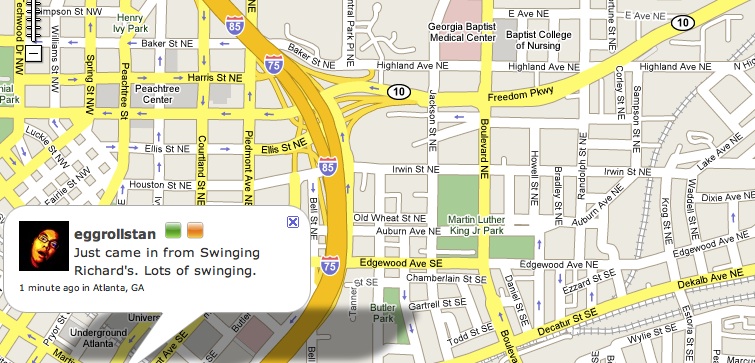
I couldn’t care less about Twitter–or any social networking site for that matter–but I just spent an hour watching Twittervision. I found myself entranced by the plenitude of avatars stochastically zipping across thousands of virtual miles (virtual miles that of course signify real miles); the oblique series of text boxes seemed to reply to each other in a bizarre conversation made wholly of non sequiturs.
George Orwell was wrong and Alduous Huxley was right. We will gladly give up our privacy, and think it’s fun to do so. I’m not complaining. Maybe I’m complaining. No, I’m not complaining. I’m sure of that. But I’m not sure that I’m recommending that you check out Twittervision. It’s really, really addictive. It’s like the Videodrome signal, or the movie in Infinite Jest (the movie is named Infinite Jest). Or that new heroin with the fun name that the kids are into these days. I just don’t know. Clearly not good for mental health.
H is for Humbert Humbert, the rascally narrator of Vladamir Nabokov’s Lolita. Throughout the novel HH, a sardonic European, provides a running critique of conformist 1950s America, his adopted home. Pining for the haunting, ineffable feeling associated with a brief, tragic childhood love, HH engineers a series of unfortunate events in order to abscond with (and eventually seduce) twelve-year old Lolita Haze. Yep. That’s right. A child-molester made this list. But if you’ve ever read Lolita, you know how charming and funny this son-of-bitch is. Lolita is in a special class of books in the Biblioklept library; it’s one of those books that I’ve read in full at least four times, and one that I pick up and read parts of every year. The first time I read Lolita, I didn’t even realize what a monster HH was–in fact, I tended to sympathize with him, even to the point of sharing his condemnation of Lolita’s bratty, manipulative nature toward the end of the novel. Like Catcher in the Rye, I first read Lolita when I was 16; like Catcher in the Rye, Lolita was an entirely different book when I read it at 21. Somehow the book managed to change again, four or five years later. I’m sure Lolita will be completely different in a year or two when I’m thirty. In fact, I vow here and now to re-read it in full right after my 30th birthday. Who knows what will have happened to it by then? How these books change on you…
Narratological shape-shifting aside Lolita deserves to be read, and read repeatedly. Nabokov’s highly alliterative prose reverberates with lyrical gymnastics, multi-lingual puns, and allusions that will make you feel oh-so clever (if you are indeed oh-so clever enough to get them, of course). Neither Kubrick’s toothless 1962 film adaption or Adrian Lyne’s gauzy 1997 attempt do any justice at all to Nabokov’s words–this is one you simply have to read. Great stuff.
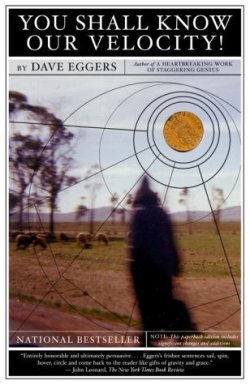
H is also for Hand, zany foil to Will, the tormented narrator ofDave Eggers’s You Shall Know Our Velocity!. In this book, the pair embarks on a futile attempt to travel the globe giving away an enormous amount of money Will has recently received as part of an injury settlement. This scheme turns out to be much more difficult and much more complicated than they had imagined. Hand is one of my favorite characters because he’s just really damn cool–a strange combination of someone’s hip older brother mixed with someone’s annoying younger brother. My favorite part of Velocity is the fifty page section where Hand takes over the narrative, casting doubt on everything that Will has previously told the reader. Will then resumes the narrative, but at that point, the book–and Will’s status as a reliable narrator–has taken an entirely different shape. Although the story ends at a wedding, Velocity is ultimately a tragedy; the very first page announces Will’s death. But again, the whole narrative is cast in ambiguity and doubt. I loved this book so much that I bought it for a friend.
(Incidentally, Hand also tuns up in “The Only Meaning of the Oil-Wet Water,” one of Eggers’s short stories collected in How We Are Hungry).
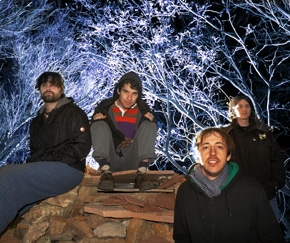
We here at Biblioklept, Inc. couldn’t be more stoked for Strawberry Jam. We all know that strawberry jam is delicious on crumpets (and if you don’t know the tasty delights of jam-on-crumpets, I suggest you indulge yourself posthaste) and Animal Collective’s new record Strawberry Jam, set to drop sometime in September on their new label Domino, will no doubt prove delicious to the ears–the perfect aural jelly for beach blanket parties and midsummer night campfires. Animal Collective’s Sung Tongs and Feels were instant classics of the oughties, and Panda Bear’s sumptuous solo album Person Pitch has provided the sing-along soundtrack for both spring and summer around the Biblioklept offices. Seriously, I’ve never heard an album as sing-allongable as Person Pitch. We love it love it love it &c.
Anyway, studio versions of Strawberry Jam‘s first three tracks (I’m basing the idea that these are the first three tracks on the album based on this track list) have been popping up here and there in the last week. These new tracks preserve the psycho-circus-carnival feel that defines the Animal Collective sound, with the creepy darkness and noise of previous albums like Here Comes the Indian seemingly absent (despite lyrics about Jack the Ripper in “Unsolved Mysteries”). We like “Chores” the best so far–but what do you think? Mp3s below–









 Biblioklept