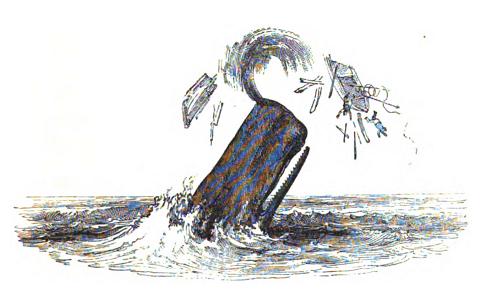
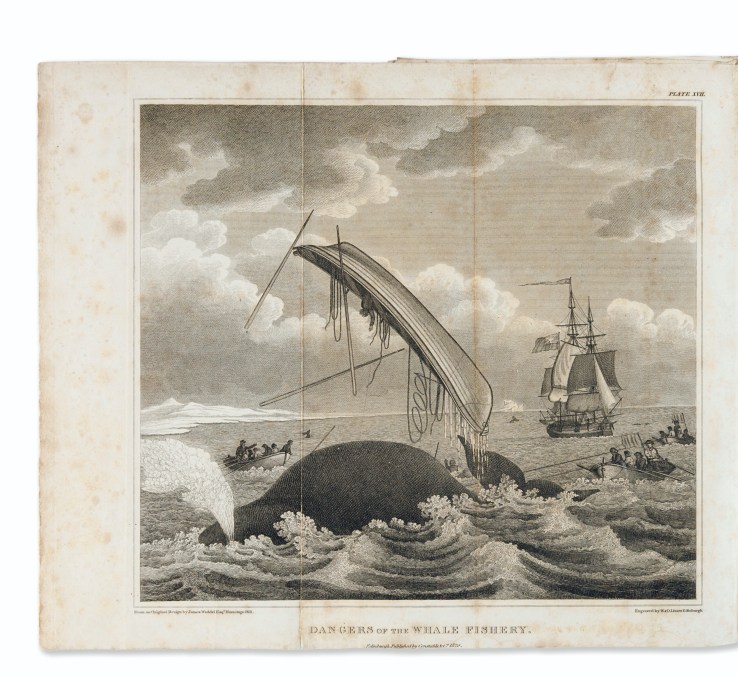
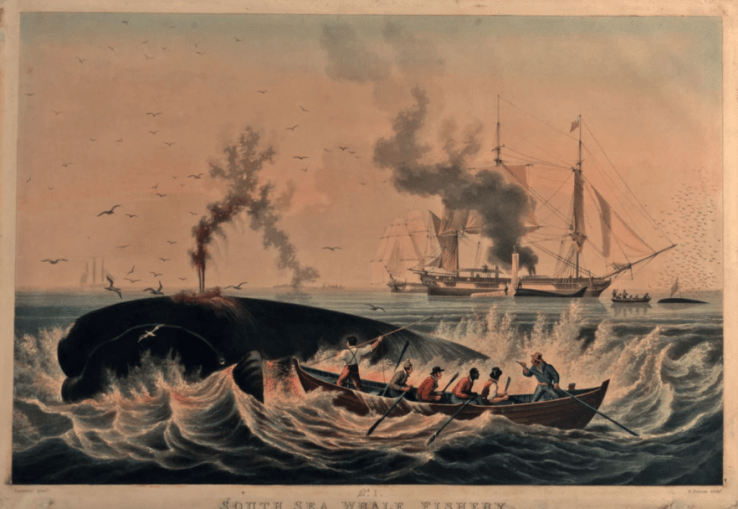
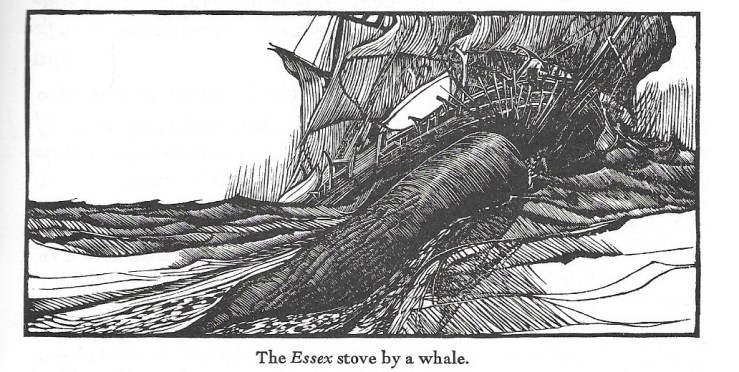
Millions of mixed shades and shadows, drowned dreams, somnambulisms, reveries | Moby-Dick reread, riff 30

I. In this riff, Chapters 109-111 of Moby-Dick.

II. Rereading these chapters—particularly Ch. 110, “Queequeg in His Coffin”—put me in a melancholy mood, a strange dark mood that I remember from previous rereads. I’m not sure why, but there’s something about Moby-Dick’s turn into its final third that’s a specific kind of sad that’s both bitter and sweet, but ultimately depressive. Maybe it’s because I know the apocalypse that’s coming. Or maybe it’s because a certain fatigue sets in. It’s a long book. Or maybe it’s because Ishmael’s expansiveness begins to fragment here, splitting off into splinters that burn down or drown. There are moments of joy and levity, but Ahab’s blasted consciousness looms over the novel. His bleak but bombastic psyche contrasts strongly with hopeful Ishmael, ushering us back to “Loomings,” to his blasted hypos.

III. Ch. 109, “Ahab and Starbuck in the Cabin.”
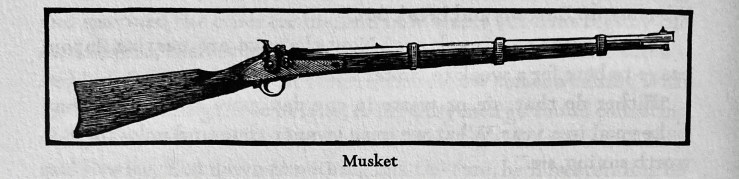
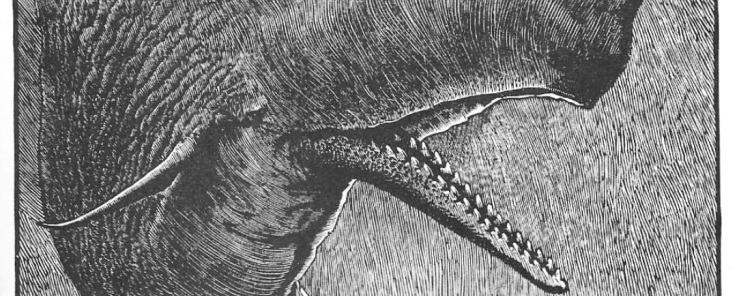
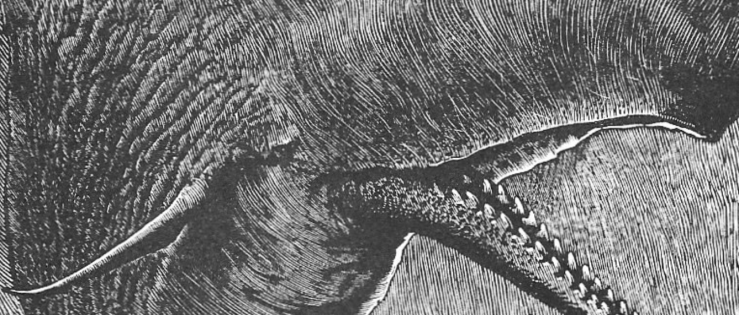
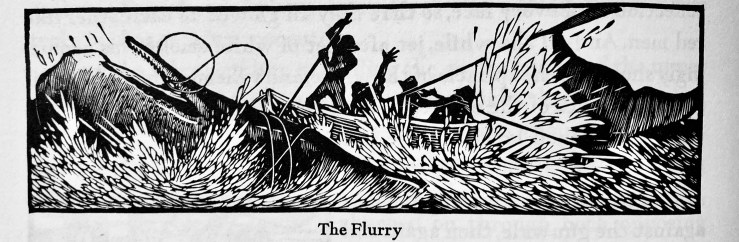
Moby-Dick illustration by Barry Moser

In this chapter, Starbuck suggests to Ahab that The Pequod stop to fix some leaky oil barrels; Ahab wants to keep pursuing Moby Dick. Starbuck reminds him of his duty to the stockholders and owners of the ship, but Ahab is already quite mad, and pulls a gun on his second in command:

Ahab seized a loaded musket from the rack (forming part of most South-Sea-men’s cabin furniture), and pointing it towards Starbuck, exclaimed: “There is one God that is Lord over the earth, and one Captain that is lord over the Pequod.—On deck!”

Starbuck retreats, but still offers himself as First Mate. He is not one for mutiny, but seeks to help his maddened captain:

Thou hast outraged, not insulted me, sir; but for that I ask thee not to beware of Starbuck; thou wouldst but laugh; but let Ahab beware of Ahab; beware of thyself, old man.”

Despite his rage, Ahab finds “something” to Starbuck’s warning:

“He waxes brave, but nevertheless obeys; most careful bravery that!” murmured Ahab, as Starbuck disappeared. “What’s that he said—Ahab beware of Ahab—there’s something there!”

Here we might find Starbuck at his most powerful. He imprints his language into Ahab’s consciousness. But he smuggles his warning in through a rhetorical gesture that recapitulates Ahab as the great terror in this affair: Ahab beware. Of Ahab.

Ahab though capitulates to Starbuck here, and orders to the mending of the barrels—although our narrator (how is it that Ishmael inhabits the officer’s cabin?) warns that, “It were perhaps vain to surmise exactly why it was, that as respecting Starbuck, Ahab thus acted.”

IV. Ch. 110, “Queequeg in His Coffin.”

This chapter deserves more than I can give to it right now.

Basically, Queeg is pretty sure that he’ll die:

Poor Queequeg! …you should have stooped over the hatchway, and peered down upon him there; where, stripped to his woollen drawers, the tattooed savage was crawling about amid that dampness and slime, like a green spotted lizard at the bottom of a well

Ishmael finds the oversoul in Queequeg’s gaze:

And like circles on the water, which, as they grow fainter, expand; so his eyes seemed rounding and rounding, like the rings of Eternity. An awe that cannot be named would steal over you as you sat by the side of this waning savage, and saw as strange things in his face, as any beheld who were bystanders when Zoroaster died. For whatever is truly wondrous and fearful in man, never yet was put into words or books.

Ishamael tries to put that ineffable down in books.

V. Queequeg, feeling his death approach, calls the carpenter to build him to “canoe like those of Nantucket”—the kind in which Nantucketeers are buried at sea.

Both Pip and Starbuck attend Queeg’s dying (not-dying) hour; Pip sees the event as an echo of his own “death” earlier on the voyage, when he is abandoned at sea.

But then “Queequeg suddenly rallied,” and the crewmen about him

asked him, then, whether to live or die was a matter of his own sovereign will and pleasure. He answered, certainly. In a word, it was Queequeg’s conceit, that if a man made up his mind to live, mere sickness could not kill him: nothing but a whale, or a gale, or some violent, ungovernable, unintelligent destroyer of that sort.

There is some violent ungovernable unintelligent destroyer of that sort on the horizon.

VI. The chapter ends with Queequeg writing on his coffin:

Many spare hours he spent, in carving the lid with all manner of grotesque figures and drawings; and it seemed that hereby he was striving, in his rude way, to copy parts of the twisted tattooing on his body. And this tattooing had been the work of a departed prophet and seer of his island, who, by those hieroglyphic marks, had written out on his body a complete theory of the heavens and the earth, and a mystical treatise on the art of attaining truth; so that Queequeg in his own proper person was a riddle to unfold; a wondrous work in one volume; but whose mysteries not even himself could read, though his own live heart beat against them; and these mysteries were therefore destined in the end to moulder away with the living parchment whereon they were inscribed, and so be unsolved to the last.

The notation above is long, but I think it points to Melville’s central themes of reading and writing in Moby-Dick—this is a novel about the hieroglyphics of the body and the soul, the unreadable readable phenomenal world that set to ciphering daily.

VII. Ch. 111, “The Pacific.”

Another of Melville’s transitional chapters. We return to Ishamel’s bosomy-voice-bosom—but our narrator is, in Melvillian terms, not a touch untroubled: “were it not for other things, I could have greeted my dear Pacific with uncounted thanks.” Those other things? Well, we’ve filled the last few riffs with them.

For Ish, the Pacific is a pacifying terrifying entity: “There is, one knows not what sweet mystery about this sea, whose gently awful stirrings seem to speak of some hidden soul beneath; like those fabled undulations of the Ephesian sod over the buried Evangelist St. John.”

He compares it to a “Potters’ Fields of all four continents” populated by

millions of mixed shades and shadows, drowned dreams, somnambulisms, reveries; all that we call lives and souls, lie dreaming, dreaming, still; tossing like slumberers in their beds; the ever-rolling waves but made so by their restlessness.

Moby-Dick is not a novel about whales and whaling; Moby-Dick is a novel about ghosts and wailing.

VIII. Ish is intoxicated by the Pacific’s rhythms: “Lifted by those eternal swells, you needs must own the seductive god, bowing your head to Pan.”

Our Ishmael again calls all souls to his big bosom, his eternal ghostly swells. He’s a pantheistic mutherfucker.

IX. But, but,

But few thoughts of Pan stirred Ahab’s brain, as standing like an iron statue at his accustomed place beside the mizen rigging, with one nostril he unthinkingly snuffed the sugary musk from the Bashee isles (in whose sweet woods mild lovers must be walking), and with the other consciously inhaled the salt breath of the new found sea; that sea in which the hated White Whale must even then be swimming. Launched at length upon these almost final waters, and gliding towards the Japanese cruising-ground, the old man’s purpose intensified itself. His firm lips met like the lips of a vice; the Delta of his forehead’s veins swelled like overladen brooks; in his very sleep, his ringing cry ran through the vaulted hull, “Stern all! the White Whale spouts thick blood!”

And bloodlust and vengeance carries out over the pacified Pacific.
The ineffaceable, sad birth-mark in the brow of man, is but the stamp of sorrow in the signers | Moby-Dick reread, riff 29

I. In this riff, Chapters 106-108 of Moby-Dick.

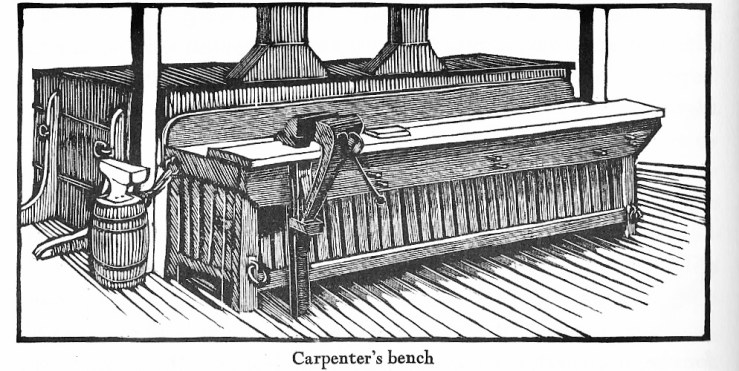
This trio of chapters introduces the carpenter, who proves a strange foil to Ahab.

Moby-Dick illustration by Barry Moser

II. Ch. 106, “Ahab’s Leg.”

Moby-Dick is a phallic novel, full of thrusts, jabs, ejaculations, and sperm sperm sperm. “Ahab’s Leg” reinforces this theme through negation. Melville (or is it Ishmael?) underscores here the notion that Ahab has been symbolically castrated by Moby Dick; this symbolic castration leads to Ahab’s revenge quest—the monomaniacal captain seeks to reassert his power through domination. (It’s all a dick swingin’ contest.)

III. The symbolic castration repeats when Ahab quits The Samuel Enderby, and endures “some small violence to his own person.” We learn that in the jostling of the boat, “his ivory leg had received a half-splintering shock.” This second figurative castration actually follows a near-literal one though:

For it had not been very long prior to the Pequod’s sailing from Nantucket, that he had been found one night lying prone upon the ground, and insensible; by some unknown, and seemingly inexplicable, unimaginable casualty, his ivory limb having been so violently displaced, that it had stake-wise smitten, and all but pierced his groin; nor was it without extreme difficulty that the agonizing wound was entirely cured.

And yet it’s clear that the wound is still not entirely cured. Ahab seeks to repair his phallic wound by way of a phallic spearing of the White Whale.

IV. The chapter continues down a stranger path. Ishmael, with his all-access pass to consciousness, relates that Ahab, reflecting on his woes, decries that, “all miserable events do naturally beget their like.” The text continues, dwelling on sodomy, hell, and the perpetuation of grief:

Yea, more than equally, thought Ahab; since both the ancestry and posterity of Grief go further than the ancestry and posterity of Joy. For, not to hint of this: that it is an inference from certain canonic teachings, that while some natural enjoyments here shall have no children born to them for the other world, but, on the contrary, shall be followed by the joy-childlessness of all hell’s despair; whereas, some guilty mortal miseries shall still fertilely beget to themselves an eternally progressive progeny of griefs beyond the grave; not at all to hint of this, there still seems an inequality in the deeper analysis of the thing. For, thought Ahab, while even the highest earthly felicities ever have a certain unsignifying pettiness lurking in them, but, at bottom, all heartwoes, a mystic significance, and, in some men, an archangelic grandeur; so do their diligent tracings-out not belie the obvious deduction. To trail the genealogies of these high mortal miseries, carries us at last among the sourceless primogenitures of the gods; so that, in the face of all the glad, hay-making suns, and soft cymballing, round harvest-moons, we must needs give in to this: that the gods themselves are not for ever glad. The ineffaceable, sad birth-mark in the brow of man, is but the stamp of sorrow in the signers.

The depressive, fatalistic tone here is pure Ahab–if Ishmael’s expansive over-soul touches the paragraph, it does so in opposition. (What an amazing passage.)

V. Ch. 107, “The Carpenter.”

A nice little chapter describing the ship’s carpenter, who is a sort of Swiss army knife of a man:

He was like one of those unreasoning but still highly useful, multum in parvo, Sheffield contrivances, assuming the exterior—though a little swelled—of a common pocket knife; but containing, not only blades of various sizes, but also screw-drivers, cork-screws, tweezers, awls, pens, rulers, nail-filers, countersinkers. So, if his superiors wanted to use the carpenter for a screw-driver, all they had to do was to open that part of him, and the screw was fast: or if for tweezers, take him up by the legs, and there they were.

He sets about crafting Ahab a new leg.

VI. Ch. 108, “Ahab and the Carpenter.”

Melville (Ishmael?) again turns his novel into a Shakespearian play, complete with stage directions. The carpenter files away at the ivory leg-to-be, while the blacksmith bangs about in the background. He sneezes as he files away at the crutch he creates.

Ahab enters, invoking the carpenter as a Promethean figure:

“Well, manmaker!”

The carpenter then sets about to measure for Ahab’s leg. Ahab sticks his stump into a vice (an implicitly sexual image). The carpenter warns him about the vice’s grip, but Ahab is malevolently jocular. He then directly invokes Prometheus;

No fear; I like a good grip; I like to feel something in this slippery world that can hold, man. What’s Prometheus about there?—the blacksmith, I mean—what’s he about?

V. Ahab essentially ignores the carpenter’s plain answers, and instead begins soliloquizing. Again, he’s monovocal in stereophonic world:

I do deem it now a most meaning thing, that that old Greek, Prometheus, who made men, they say, should have been a blacksmith, and animated them with fire; for what’s made in fire must properly belong to fire; and so hell’s probable.

VI. Ahab’s monomania crests: He sets about to become the Prometheus in the scene—but a commander Prometheus, an artistic director. His idealized “complete man” reveals more of Ahab’s singular vision—a vision that precludes all other perspectives. He conjures a heartless giant–an intellectual giant:

Hold; while Prometheus is about it, I’ll order a complete man after a desirable pattern. Imprimis, fifty feet high in his socks; then, chest modelled after the Thames Tunnel; then, legs with roots to ’em, to stay in one place; then, arms three feet through the wrist; no heart at all, brass forehead, and about a quarter of an acre of fine brains; and let me see—shall I order eyes to see outwards? No, but put a sky-light on top of his head to illuminate inwards. There, take the order, and away.

Ahab’s ideal man has no outward-seeing eyes–there is no perspective at all here except that which will “illuminate inwards.” He mentions no mouth.

VII. Ahab finally quits the carpenter’s shop, and the poor old man begins his own monologue. He repeats the key word queer ten times over in his evocation of Ahab:

Well, well, well! Stubb knows him best of all, and Stubb always says he’s queer; says nothing but that one sufficient little word queer; he’s queer, says Stubb; he’s queer—queer, queer; and keeps dinning it into Mr. Starbuck all the time—queer—sir—queer, queer, very queer.

And who is queer Ahab’s bedfellow?

Yes, now that I think of it, here’s his bedfellow! has a stick of whale’s jaw-bone for a wife!

Let us squeeze ourselves universally into the very milk and sperm of kindness | Moby-Dick reread, riff 25

I. In this riff, Chapters 94-98 of Moby-Dick.

In these chapters, Ishmael (again) describes the business of rendering oil and etcetera from a whale’s corpse. The chapters show again Ishmael’s push-pull narration style, vacillating between the physical/commercial and the metaphysical/philosophical.

II. Ch. 94, “A Squeeze of the Hand.”

A perfect chapter in a perfectly imperfect book. Go ahead and read (it’s fine to read it on its own).

Look—I’m gonna quote the hell out of this chapter. Ish and his fellows set to a big ole tub of sperm, by which he means, of course, spermaceti, the vital stuff found in an organ in the sperm whale’s head; the vital stuff that energizes and lights Ishmael’s world. On that self-same sperm:

It had cooled and crystallized to such a degree, that when, with several others, I sat down before a large Constantine’s bath of it, I found it strangely concreted into lumps, here and there rolling about in the liquid part. It was our business to squeeze these lumps back into fluid. A sweet and unctuous duty! No wonder that in old times this sperm was such a favourite cosmetic. Such a clearer! such a sweetener! such a softener! such a delicious molifier! After having my hands in it for only a few minutes, my fingers felt like eels, and began, as it were, to serpentine and spiralise.

The next sentence—a full paragraph—is something else:

As I sat there at my ease, cross-legged on the deck; after the bitter exertion at the windlass; under a blue tranquil sky; the ship under indolent sail, and gliding so serenely along; as I bathed my hands among those soft, gentle globules of infiltrated tissues, woven almost within the hour; as they richly broke to my fingers, and discharged all their opulence, like fully ripe grapes their wine; as I snuffed up that uncontaminated aroma,—literally and truly, like the smell of spring violets; I declare to you, that for the time I lived as in a musky meadow; I forgot all about our horrible oath; in that inexpressible sperm, I washed my hands and my heart of it; I almost began to credit the old Paracelsan superstition that sperm is of rare virtue in allaying the heat of anger; while bathing in that bath, I felt divinely free from all ill-will, or petulance, or malice, of any sort whatsoever.

The sentence above: 161 words, eleven semicolons, fourteen commas, one dash, and of course, one final period. In these words and characters—halts and stops, connections and jumps—Ishmael converts his pain, his “horrible oath,” his drastic hypos, his desire to go about knocking the hats off men, his general misanthropy—he converts all of this into a moment of transcendence.

The moment of transcendence extends into a kind of spermy mindmeld:

Squeeze! squeeze! squeeze! all the morning long; I squeezed that sperm till I myself almost melted into it; I squeezed that sperm till a strange sort of insanity came over me; and I found myself unwittingly squeezing my co-laborers’ hands in it, mistaking their hands for the gentle globules. Such an abounding, affectionate, friendly, loving feeling did this avocation beget; that at last I was continually squeezing their hands, and looking up into their eyes sentimentally; as much as to say,—Oh! my dear fellow beings, why should we longer cherish any social acerbities, or know the slightest ill-humor or envy! Come; let us squeeze hands all round; nay, let us all squeeze ourselves into each other; let us squeeze ourselves universally into the very milk and sperm of kindness.

Here, I think is the the grand thesis of Moby-Dick.

III. But no. That’s not the thesis. That’s the grand ecstatic epiphany of joy, which Ishmael deflates in the next paragraph:

Would that I could keep squeezing that sperm for ever! For now, since by many prolonged, repeated experiences, I have perceived that in all cases man must eventually lower, or at least shift, his conceit of attainable felicity; not placing it anywhere in the intellect or the fancy; but in the wife, the heart, the bed, the table, the saddle, the fireside, the country; now that I have perceived all this, I am ready to squeeze case eternally. In thoughts of the visions of the night, I saw long rows of angels in paradise, each with his hands in a jar of spermaceti.

Locate the epiphany elsewhere than the intellect or the fancy then: wife, bed, saddle, etc.

—Say it, no ideas but in things—, wrote William Carlos Williams not quite a century later.

IV. Ishmael turns from ideas to things. He lists some of the other magic potions in the sperm whale’s body: white-horse, plum pudding, slobgollion, gurry, and nippers. 

The chapter ends with Ish describing the process by which a spademan and gaffman cut the whale into pieces. It’s a mechanical, thingy business, one that points back to the reason for Ahab’s revenge quest:

 This spade is sharp as hone can make it; the spademan’s feet are shoeless; the thing he stands on will sometimes irresistibly slide away from him, like a sledge. If he cuts off one of his own toes, or one of his assistants’, would you be very much astonished? Toes are scarce among veteran blubber-room men.

Toes are scarce, but perhaps not as vital as legs.

V. Ch. 95, “The Cassock.”

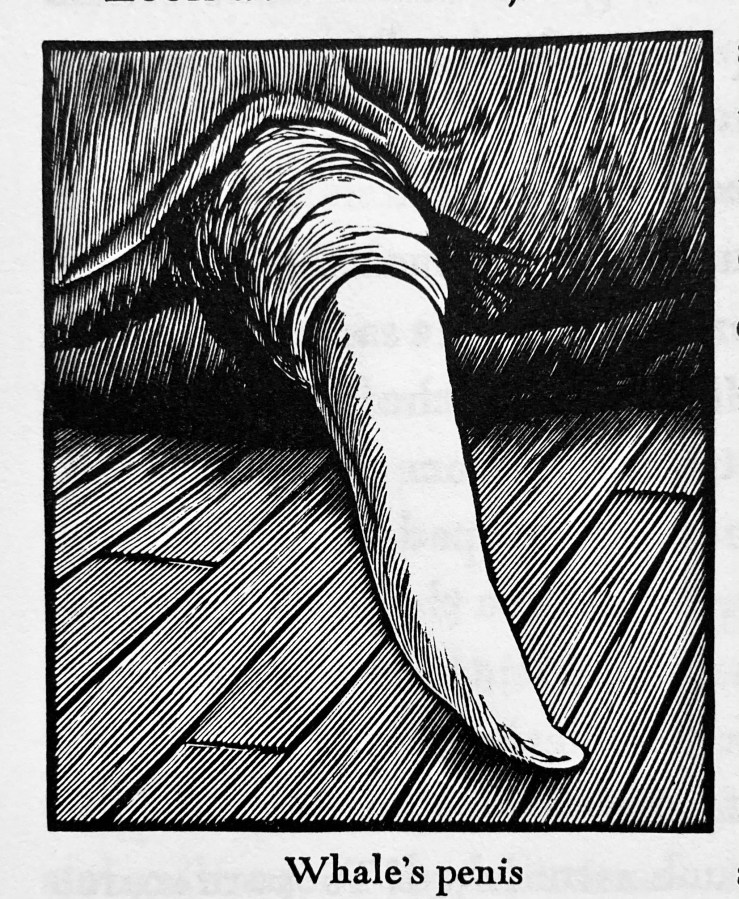
Another short chapter on a long subject. Ishmael describes-but-not-defines “a very strange, enigmatical object . . . lying along lengthwise in the lee scuppers.” His description is an accumulation of negations:

Not the wondrous cistern in the whale’s huge head; not the prodigy of his unhinged lower jaw; not the miracle of his symmetrical tail; none of these would so surprise you, as half a glimpse of that unaccountable cone,—longer than a Kentuckian is tall, nigh a foot in diameter at the base, and jet-black as Yojo, the ebony idol of Queequeg.

And what is that enormous jet black cone? A “grandissimus, as the mariners call it.”

It’s the whale’s dick, natch.

Moby-Dick illustration by Barry Moser

Ishmael compares it to the idol “found in the secret groves of Queen Maachah in Judea” — the Asherah pole — and points out that “King Asa, her son, did depose her, and destroyed the idol, and burnt it for an abomination.”

This is a phallic book full of castrations, cuttings off both figurative and literal.

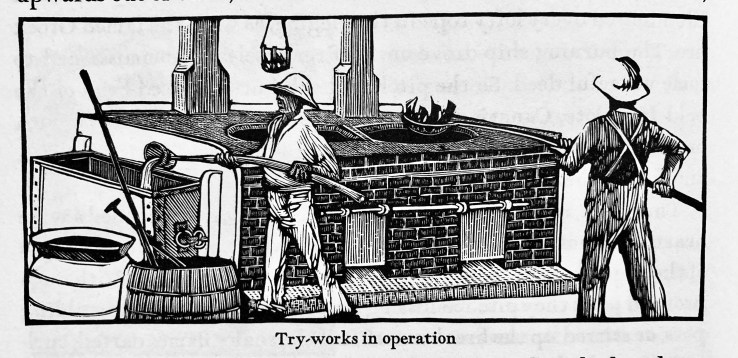
VI. Ch. 96, “The Try-Works”

Another chapter initially focused on the practical business of whaling. In this case, we learn about the try-works, where blubber is cooked down to oil. I’ll let Moser’s illustration stand in here:

Moby-Dick illustration by Barry Moser

And here:

The chapter ends though in a great metaphysical rush, as Ish goes from things back to ideas:

The truest of all men was the Man of Sorrows, and the truest of all books is Solomon’s, and Ecclesiastes is the fine hammered steel of woe. “All is vanity.” ALL. This wilful world hath not got hold of unchristian Solomon’s wisdom yet. But he who dodges hospitals and jails, and walks fast crossing graveyards, and would rather talk of operas than hell; calls Cowper, Young, Pascal, Rousseau, poor devils all of sick men; and throughout a care-free lifetime swears by Rabelais as passing wise, and therefore jolly;—not that man is fitted to sit down on tomb-stones, and break the green damp mould with unfathomably wondrous Solomon.

The chapter concludes with a puzzling set of metaphors:

There is a wisdom that is woe; but there is a woe that is madness. And there is a Catskill eagle in some souls that can alike dive down into the blackest gorges, and soar out of them again and become invisible in the sunny spaces. And even if he for ever flies within the gorge, that gorge is in the mountains; so that even in his lowest swoop the mountain eagle is still higher than other birds upon the plain, even though they soar.

VII. Ch. 97, “The Lamp.”

In this very short (three-paragraph) chapter, Ishmael notes that whalemen light their lamps from the oil of the animals they hunt.

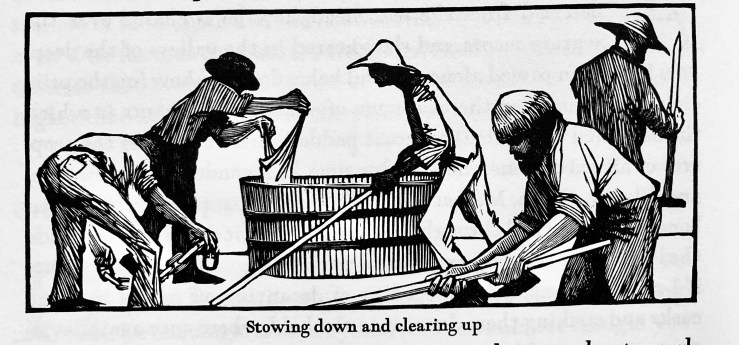
VIII. Ch. 98, “Stowing Down and Clearing Up.”

A chapter about cleaning up. Ish declares that, “were it not for the tell-tale boats and try-works, you would all but swear you trod some silent merchant vessel, with a most scrupulously neat commander. The unmanufactured sperm oil possesses a singularly cleansing virtue.” In other words, despite all the butchery, blood, and bits involved, there’s something in the whale itself that purifies the decks after a good scrub down.

The chapter ends with Ishmael recognizing the mechanical repetition of his business though—no wonder the Modernists revived Moby-Dick!

Yet this is life. For hardly have we mortals by long toilings extracted from this world’s vast bulk its small but valuable sperm; and then, with weary patience, cleansed ourselves from its defilements, and learned to live here in clean tabernacles of the soul; hardly is this done, when—There she blows!—the ghost is spouted up, and away we sail to fight some other world, and go through young life’s old routine again.

Oh! the metempsychosis! Oh! Pythagoras, that in bright Greece, two thousand years ago, did die, so good, so wise, so mild; I sailed with thee along the Peruvian coast last voyage—and, foolish as I am, taught thee, a green simple boy, how to splice a rope!

Moby-Dick illustration by Barry Moser

The intense concentration of self in the middle of such a heartless immensity, my God! who can tell it?  | Moby-Dick reread, riff 24

Moby-Dick illustration by Barry Moser

I. In this riff, Chapters 91, 92, and 93 of Moby-Dick.

II. Ch. 91, “The Pequod Meets The Rose-bud.”

Stubb stars in this humorous chapter in which The Pequod encounters a French vessel which is towing a pair of “what the fishermen call a blasted whale, that is, a whale that has died unmolested on the sea, and so floated an unappropriated corpse.” The smell from these two dead whales is awful. (Ish claims the odor is “worse than an Assyrian city in the plague, when the living are incompetent to bury the departed.”)

We soon learn the French ship bears an ironic name: “Bouton de Rose,”—Rose-button, or Rose-bud; and…this was the romantic name of this aromatic ship.”

Stubb hails the ship to ask Ahab’s famous question to all the ships The Pequod encounter, but the The Rose-bud has not seen the White Whale. Ahab leaves off, letting Stubb take over the chapter with his cruel comedy:

He now perceived that the Guernsey-man, who had just got into the chains, and was using a cutting-spade, had slung his nose in a sort of bag.

“What’s the matter with your nose, there?” said Stubb. “Broke it?”

“I wish it was broken, or that I didn’t have any nose at all!” answered the Guernsey-man, who did not seem to relish the job he was at very much. “But what are you holding yours for?”

“Oh, nothing! It’s a wax nose; I have to hold it on. Fine day, ain’t it? Air rather gardenny, I should say; throw us a bunch of posies, will ye, Bouton-de-Rose?”

“What in the devil’s name do you want here?” roared the Guernsey-man, flying into a sudden passion.

The Guernsey-man is irritated because his captain knows nothing of whales and refuses to discard the rotten animals, which his crew understand to be worthless. Stubb, however, thinks that one of the whales might be full of ambergris, a valuable substance, and he hatches a cunning plan to get the whale for himself. Stubb enlists the Gurnsey-man’s help in his plan: Stubb will appear as an expert witness on whales to The Rose-bud’s captain (ironically, a former perfumier)–only the captain speaks no English—so the Gurnsey-man will translate. However, the Gurnsey-man will simply say whatever he wants (namely, that they should cut the whales loose).

The scene plays out in comedy that I think still holds up today:

“What shall I say to him first?” said he.

“Why,” said Stubb, eyeing the velvet vest and the watch and seals, “you may as well begin by telling him that he looks a sort of babyish to me, though I don’t pretend to be a judge.”

“He says, Monsieur,” said the Guernsey-man, in French, turning to his captain, “that only yesterday his ship spoke a vessel, whose captain and chief-mate, with six sailors, had all died of a fever caught from a blasted whale they had brought alongside.”

Upon this the captain started, and eagerly desired to know more.

“What now?” said the Guernsey-man to Stubb.

“Why, since he takes it so easy, tell him that now I have eyed him carefully, I’m quite certain that he’s no more fit to command a whale-ship than a St. Jago monkey. In fact, tell him from me he’s a baboon.”

The scene continues in this line, with Stubb repeatedly insulting the captain who remains unaware of his abuse. When the captain offers Stubb a glass of wine to thank him for his advice, he replies thus:

“Thank him heartily; but tell him it’s against my principles to drink with the man I’ve diddled. In fact, tell him I must go.”

“He says, Monsieur, that his principles won’t admit of his drinking; but that if Monsieur wants to live another day to drink, then Monsieur had best drop all four boats, and pull the ship away from these whales, for it’s so calm they won’t drift.”

Stubb makes off with the whale and digs into it with his spade. He hits gold:

“I have it, I have it,” cried Stubb, with delight, striking something in the subterranean regions, “a purse! a purse!”

Dropping his spade, he thrust both hands in, and drew out handfuls of something that looked like ripe Windsor soap, or rich mottled old cheese; very unctuous and savory withal. You might easily dent it with your thumb; it is of a hue between yellow and ash colour. And this, good friends, is ambergris, worth a gold guinea an ounce to any druggist.

III. Stubb is the star of “The Pequod Meets The Rose-bud.” The chapter showcases his wit, and affords him all the best lines—lines a far cry from Ahab’s Shakespearean mode.

But this particular chapter also underlines my suspicion that Stubb is the villain of Moby-Dick. He’s cruel and greedy, duplicitous and hardhearted. He’s the opposite of largehearted Ishmael. Stubb has shown his double-edged comic cruelty earlier in the novel—most notably in the way he bullies his boat’s crew with sweethearted insults, but also in Ch. 64, “Stubb’s Supper,” when he plays cruel fun on Fleece, the Black cook of The Pequod. Stubb’s cruel avarice comes to a head in Ch. 93, “The Castaway.” But let’s first attend to Ch. 92, “Ambergris.”

IV. Ch. 92, “Ambergris.”

“Who would think, then, that such fine ladies and gentlemen should regale themselves with an essence found in the inglorious bowels of a sick whale!” Ishmael ponders near the beginning of this short chapter, which again riffs on a major theme of Moby-Dick; namely, how every thing earthly (and unearthly) finds its definition in its opposition.

V. Ch. 93, “The Castaway.”

Right.

So. Anyway. Per point III—I think I was arguing that Stubb is something of an asshole. He’s a bully, a bad boss, and despite the genial empathy in Ishmael’s voice (Melville’s voice?) that extends to all the horribles of The Pequod, he does not acquit himself well in “The Castaway.”

Ish sets the tragic scene from the outset:

It was but some few days after encountering the Frenchman, that a most significant event befell the most insignificant of the Pequod’s crew; an event most lamentable; and which ended in providing the sometimes madly merry and predestinated craft with a living and ever accompanying prophecy of whatever shattered sequel might prove her own.

In other words: The fate of poor Pip, the Black cabin boy, prefigures the fate of all the crew of the damned Pequod—-

and—

VI. (And, parenthetically—

I’ve been falling asleep to an audiobook of Cormac McCarthy’s novel Blood Meridian, which many many many folks have pointed out follows Moby-Dick, both rhetorically and thematically

(I mean hey, consider those opening lines:

“Call me Ishmael”

“See the child.

 )

And anyway, I sort of dip into Blood Meridian in random places, finding concurrent moments, motifs, intersections—

And in the Tarot scene of Blood Meridian, the Judge tells the Black Jackson that “In your fortune lie our fortunes all” — an echo here of the fate of poor Pip.

)

VII. And anyway,

—So, “in the ambergris affair Stubb’s after-oarsman chanced so to sprain his hand, as for a time to become quite maimed; and, temporarily, Pip was put into his place.”


Pip was put into his place.

Pip freaks out and jumps from the boat his first time, a jump that results in the loss of a whale. Sadistic Stubb is stern (and more than racist) in his rebuke:

“Stick to the boat, Pip, or by the Lord, I won’t pick you up if you jump; mind that. We can’t afford to lose whales by the likes of you; a whale would sell for thirty times what you would, Pip, in Alabama. Bear that in mind, and don’t jump any more.” Hereby perhaps Stubb indirectly hinted, that though man loved his fellow, yet man is a money-making animal, which propensity too often interferes with his benevolence.

(Old Ishmael (and Old Melville) — what’s with the verb hinted there?)

And so and well—

But we are all in the hands of the Gods; and Pip jumped again. It was under very similar circumstances to the first performance; but this time he did not breast out the line; and hence, when the whale started to run, Pip was left behind on the sea, like a hurried traveller’s trunk. Alas! Stubb was but too true to his word. It was a beautiful, bounteous, blue day; the spangled sea calm and cool, and flatly stretching away, all round, to the horizon, like gold-beater’s skin hammered out to the extremest. Bobbing up and down in that sea, Pip’s ebon head showed like a head of cloves. No boat-knife was lifted when he fell so rapidly astern. Stubb’s inexorable back was turned upon him; and the whale was winged. In three minutes, a whole mile of shoreless ocean was between Pip and Stubb. Out from the centre of the sea, poor Pip turned his crisp, curling, black head to the sun, another lonely castaway, though the loftiest and the brightest.

Ishmael understands the incredible existential loss of being castaway in the wide waste of the sea:

…the awful lonesomeness is intolerable. The intense concentration of self in the middle of such a heartless immensity, my God! who can tell it?

Poor Pip goes mad. His fate will be the fate of the company proper.

And if Ishmael’s sympathy sympathizes the victim, so too does it sympathize the villain—-

For the rest, blame not Stubb too hardly. The thing is common in that fishery; and in the sequel of the narrative, it will then be seen what like abandonment befell myself.

—and yet that sympathy is an empathetic prefiguring gust of our narrator Ish’s ultimate fate.

And what are you, reader, but a Loose-Fish and a Fast-Fish, too? | Moby-Dick reread, riff 23

Detail from a Barry Moser illustration to Moby-Dick


I. In this riff: Chapters 88-90 of Moby-Dick.

II. Ch. 88, “Schools and Schoolmasters.”

In this chapter, Ishmael distinguishes between the two types of “schools” of whales—the harem schools, which are comprised of all adult females and one male (Ish calls the harem-lord the “Grand Turk”), and the all-male schools. Ish points out that these Grand Turks aren’t great dads:

…like certain other omnivorous roving lovers that might be named, my Lord Whale has no taste for the nursery, however much for the bower; and so, being a great traveller, he leaves his anonymous babies all over the world; every baby an exotic.

Ish points out that the all-male schools are far more aggressive than the harem schools. Too, the young males are quick to abandon their wounded fellows:

Another point of difference between the male and female schools is still more characteristic of the sexes. Say you strike a Forty-barrel-bull—poor devil! all his comrades quit him. But strike a member of the harem school, and her companions swim around her with every token of concern, sometimes lingering so near her and so long, as themselves to fall a prey.

III. Ch. 89, “Fast-Fish and Loose-Fish.”

In this marvelous chapter, Ishmael begins in a legal mode and ends in a philosophical one. He gives us the (unofficial but self-legislated) code of all whalers:

I. A Fast-Fish belongs to the party fast to it.

II. A Loose-Fish is fair game for anybody who can soonest catch it.

This doctrine we all may know from our playground days, when it took this form: “Finders keepers, Losers weepers.”

Ever the expansive expander, Ish suggests that “these two laws touching Fast-Fish and Loose-Fish, I say, will, on reflection, be found the fundamentals of all human jurisprudence . . . Is it not a saying in every one’s mouth, Possession is half of the law: that is, regardless of how the thing came into possession?”

He then pivots, sympathetically pointing out that for all of “fundamentals of human jurisprudence,” property and the power over property comes down to coercive force:

But often possession is the whole of the law. What are the sinews and souls of Russian serfs and Republican slaves but Fast-Fish, whereof possession is the whole of the law? What to the rapacious landlord is the widow’s last mite but a Fast-Fish? What is yonder undetected villain’s marble mansion with a door-plate for a waif; what is that but a Fast-Fish? What is the ruinous discount which Mordecai, the broker, gets from poor Woebegone, the bankrupt, on a loan to keep Woebegone’s family from starvation; what is that ruinous discount but a Fast-Fish? What is the Archbishop of Savesoul’s income of £100,000 seized from the scant bread and cheese of hundreds of thousands of broken-backed laborers (all sure of heaven without any of Savesoul’s help) what is that globular £100,000 but a Fast-Fish? What are the Duke of Dunder’s hereditary towns and hamlets but Fast-Fish? What to that redoubted harpooneer, John Bull, is poor Ireland, but a Fast-Fish? What to that apostolic lancer, Brother Jonathan, is Texas but a Fast-Fish? And concerning all these, is not Possession the whole of the law?

Laws and mores are but window dressing, pasteboard masks veiling the brutally true untrue truth that Might makes right.

But Ish isn’t done. He points out that, “if the doctrine of Fast-Fish be pretty generally applicable, the kindred doctrine of Loose-Fish is still more widely so,” and then underlines his application with examples of conquest and imperialism:

What was America in 1492 but a Loose-Fish, in which Columbus struck the Spanish standard by way of waifing it for his royal master and mistress? What was Poland to the Czar? What Greece to the Turk? What India to England? What at last will Mexico be to the United States? All Loose-Fish.

Swept away in his oversoul passions, Ishmael moves from historical and political examples to metaphysical territory, eventually suggesting (in another of the novel’s many metatextual moves) that the relationship between reader and author is but another application of the loose-fish/fast-fish doctrine:

What are the Rights of Man and the Liberties of the World but Loose-Fish? What all men’s minds and opinions but Loose-Fish? What is the principle of religious belief in them but a Loose-Fish? What to the ostentatious smuggling verbalists are the thoughts of thinkers but Loose-Fish? What is the great globe itself but a Loose-Fish? And what are you, reader, but a Loose-Fish and a Fast-Fish, too?

IV. Ch. 90, “Heads or Tails.”

Ish begins with what he claims is a order “from the books of the Laws of England: “De balena vero sufficit, si rex habeat caput, et regina caudam.” Bracton, l. 3, c. 3.” He proceeds to tell us that this law stipulates that

…of all whales captured by anybody on the coast of that land, the King, as Honorary Grand Harpooneer, must have the head, and the Queen be respectfully presented with the tail. A division which, in the whale, is much like halving an apple; there is no intermediate remainder.”

I love that last bit in which we are reminded that power will grab all parts of a substance leaving no intermediate remainder for the powerless.

The mystic-marked whale remains undecipherable | Moby-Dick reread, riff 17

Moby-Dick illustration by Barry Moser

I. In this riff: Chapters 61-73 of Moby-Dick.

II. Ch. 61, “Stubb Kills a Whale.”

In this chapter, Stubb kills a whale.

III. Ch. 62, “The Dart.”

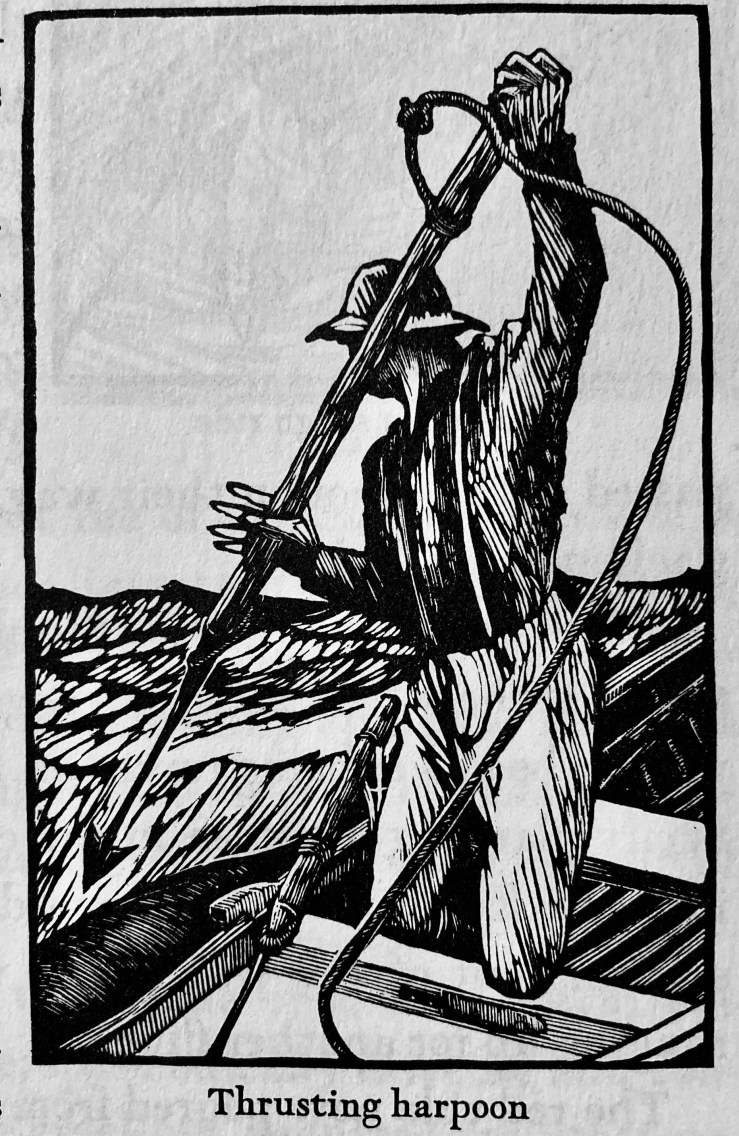
In this chapter, Ishmael argues that harpooneers should not have to row so that their throwing arms are not fatigued when the time comes to lance a whale.

Moby-Dick illustration by Barry Moser

IV. Ch. 63, “The Crotch.”

Ishmael begins this chapter by noting his propensity toward a discursive narrative style: “Out of the trunk, the branches grow; out of them, the twigs. So, in productive subjects, grow the chapters.”

He then suggests that “The crotch alluded to on a previous page deserves independent mention.”

I’m reminded of the time I made a list of smutty-sounding chapter titles in Moby-Dick.

V. Ch. 64, “Stubb’s Supper.”

Stubb eats some of that whale he killed a few chapters back.

Moby-Dick illustration by Barry Moser

VI. Ch. 65, “The Whale as a Dish.”

Ishmael riffs on eating whales—sperm whales in particular—and concedes that they are generally too unctuous for the palates of landlubbers. He’s all for eating the brains:

In the case of a small Sperm Whale the brains are accounted a fine dish. The casket of the skull is broken into with an axe, and the two plump, whitish lobes being withdrawn (precisely resembling two large puddings), they are then mixed with flour, and cooked into a most delectable mess, in flavor somewhat resembling calves’ head, which is quite a dish among some epicures…

VII. Ch. 66, “The Shark Massacre.”

Sharks eat at Stubb’s whale too, which has been tied to the side of The Pequod overnight. Queequeg kills some of the sharks, and hoists one on deck to take its skin. It almost bites his hand off.

VIII. Ch. 67, “Cutting In.”

Another one of Ishmael’s technically-oriented chapters, with little in the way of philosophy. He describes the process by which the crew strips the blubber from the whale.

Moby-Dick illustration by Barry Moser

IX. Ch. 68, “The Blanket.”

Another one of Ishmael’s philosophically-oriented chapters. Here, he ponders, “what and where is the skin of the whale?” Ishmael notes that over the whale’s blubber there is an “infinitely thin, transparent substance, somewhat resembling the thinnest shreds of isinglass.” He says that this “isinglass,” when dried, makes a good bookmark for his “whale-books”

It is transparent, as I said before; and being laid upon the printed page, I have sometimes pleased myself with fancying it exerted a magnifying influence. At any rate, it is pleasant to read about whales through their own spectacles, as you may say.

Ultimately though, this isinglass is but the “skin of the skin” and the whale’s blubber is his “blanket.”

It is telling that Ishmael reads whale books through a whale lens. Indeed, his whole mission is to read the whale, and in “The Blanket” he turns the whale’s body into a text beyond his ciphering, noting that the body of the sperm whale is “all over obliquely crossed and re-crossed with numberless straight marks in thick array.” He continues::

But these marks do not seem to be impressed upon the isinglass substance above mentioned, but seem to be seen through it, as if they were engraved upon the body itself. Nor is this all. In some instances, to the quick, observant eye, those linear marks, as in a veritable engraving, but afford the ground for far other delineations. These are hieroglyphical; that is, if you call those mysterious cyphers on the walls of pyramids hieroglyphics, then that is the proper word to use in the present connexion. By my retentive memory of the hieroglyphics upon one Sperm Whale in particular, I was much struck with a plate representing the old Indian characters chiselled on the famous hieroglyphic palisades on the banks of the Upper Mississippi. Like those mystic rocks, too, the mystic-marked whale remains undecipherable.

X. Ch. 69, “The Funeral.”

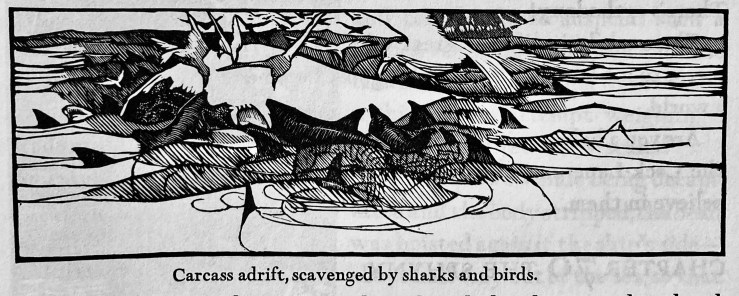
The whale’s corpse is cut loose to endure the mocking “funeral” of every scavenger of the sea and sky.

Thus, while in life the great whale’s body may have been a real terror to his foes, in his death his ghost becomes a powerless panic to a world.

Are you a believer in ghosts, my friend? There are other ghosts than the Cock-Lane one, and far deeper men than Doctor Johnson who believe in them.

The last two lines of the chapter—quoted above—again point to the idea that perhaps our Ish is himself a ghost.

Moby-Dick illustration by Barry Moser

XI. Ch. 70, “The Sphynx.”

The crew decapitated Stubb’s whale and kept it on deck. In another one of those How is Ishmael witnessing this wait is he like a ghost or something? scenes, Ish manages to overhear Captain Ahab’s batshit soliloquy to the dead head:

It was a black and hooded head; and hanging there in the midst of so intense a calm, it seemed the Sphynx’s in the desert. “Speak, thou vast and venerable head,” muttered Ahab, “which, though ungarnished with a beard, yet here and there lookest hoary with mosses; speak, mighty head, and tell us the secret thing that is in thee. Of all divers, thou hast dived the deepest. That head upon which the upper sun now gleams, has moved amid this world’s foundations. Where unrecorded names and navies rust, and untold hopes and anchors rot; where in her murderous hold this frigate earth is ballasted with bones of millions of the drowned; there, in that awful water-land, there was thy most familiar home. Thou hast been where bell or diver never went; hast slept by many a sailor’s side, where sleepless mothers would give their lives to lay them down. Thou saw’st the locked lovers when leaping from their flaming ship; heart to heart they sank beneath the exulting wave; true to each other, when heaven seemed false to them. Thou saw’st the murdered mate when tossed by pirates from the midnight deck; for hours he fell into the deeper midnight of the insatiate maw; and his murderers still sailed on unharmed—while swift lightnings shivered the neighboring ship that would have borne a righteous husband to outstretched, longing arms. O head! thou hast seen enough to split the planets and make an infidel of Abraham, and not one syllable is thine!”

XII. Ch. 71, “The Jeroboam’s Story.”

Ahab’s interrogation of the whale’s head is cut short when the call goes up that another ship—the aptly named Jeroboam—is in hailing distance. Our boy Ahab just has to get some news about his White Whale.

The crew of The Jeroboam elect to keep their distance from The Peqoud. Their Captain Mayhew suggests they have a plague of some kind on board, but it becomes evident that the plague might be a kind of madness. The crew of Mayhew’s ship are under the sway of a Shaker sailor who believes himself to be the Archangel Gabriel. Anyway, it turns out that The Jeroboam has encountered Moby Dick; in fact, Mayhew’s chief mate Macey died hunting the great beast—all while Gabriel chanted prophecies of doom. Symbolically underlining the foreshadowing in this episode, The Pequod carries aboard a letter for Macey from his wife, who does not yet know she is a widow. And in even more symbolic foreshadowing, when Starbuck attempts to pass the letter to Mayhew,

…as if by magic, the letter suddenly ranged along with Gabriel’s eager hand. He clutched it in an instant, seized the boat-knife, and impaling the letter on it, sent it thus loaded back into the ship. It fell at Ahab’s feet. Then Gabriel shrieked out to his comrades to give way with their oars, and in that manner the mutinous boat rapidly shot away from the Pequod.

To steal a line from Melville’s later short masterpiece Bartleby: “Dead letters! does it not sound like dead men?”

XIII. Ch. 72, “The Monkey-Rope.”

In this chapter—another chapter with a hyphenated title!—in this chapter, Ishmael goes back to some technical business of whaling, explaining that while hauling in Stubb’s whale, Queequeg had to insert the blubber hook into the whale—which means he had to be over the side of the boat, on the whale itself. In this process, Queequeg and Ishmael are connected by a “monkey-rope” — a rope tethering the two between belts.

“It was a humorously perilous business for both of us,” Ishmael notes, a line that again underscores Moby-Dick’s compounding — hyphenating — modes of comedy and terror. The chapter also again reminds us that Ish and Queeg are like a married couple: “for better or for worse, we two, for the time, were wedded.” As is often the case, Ishmael goes into a philosophical reverie:

So strongly and metaphysically did I conceive of my situation then, that while earnestly watching his motions, I seemed distinctly to perceive that my own individuality was now merged in a joint stock company of two; that my free will had received a mortal wound; and that another’s mistake or misfortune might plunge innocent me into unmerited disaster and death. …still further pondering, I say, I saw that this situation of mine was the precise situation of every mortal that breathes; only, in most cases, he, one way or other, has this Siamese connexion with a plurality of other mortals.

XIV. Ch. 73, “Stubb and Flask Kill a Right Whale; and Then Have a Talk over Him.”

In this chapter, Stubb and Flask kill a right whale and then have a talk over him.

Moby-Dick illustration by Barry Moser

The great Leviathan is that one creature in the world which must remain unpainted to the last | Moby-Dick reread, riff 15

I. In this riff: Ch. 55, 56, and 57 of Moby-Dick.

Each of these chapters concerns graphic—artistic and scientific—depictions of whales. Ishmael dwells mostly upon the failure of artists to truthfully represent the whale, but also concedes that the task is near impossible. Nevertheless, Ish attests that he “shall ere long paint to you as well as one can without canvas, something like the true form of the whale as he actually appears to the eye of the whaleman…”

II. Ch. 55, “Of the Monstrous Pictures of Whales.”

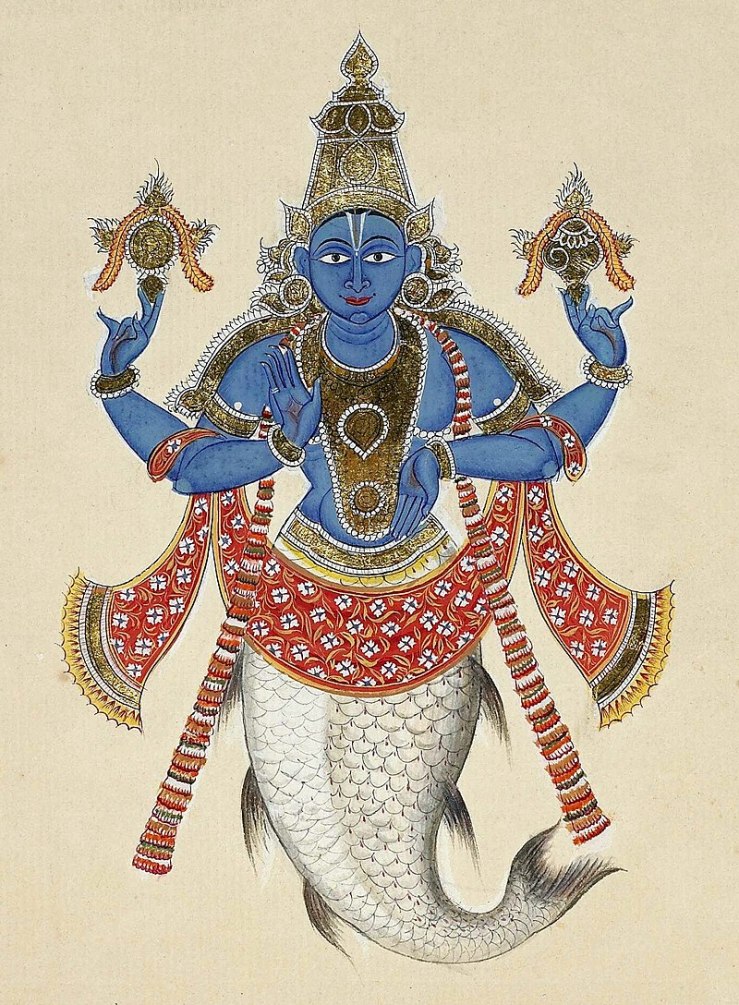
Ishmael avers that erroneous depictions of whales are likely based in antiquity: “It may be that the primal source of all those pictorial delusions will be found among the oldest Hindoo, Egyptian, and Grecian sculptures.” He goes on,

Now, by all odds, the most ancient extant portrait anyways purporting to be the whale’s, is to be found in the famous cavern-pagoda of Elephanta, in India. …The Hindoo whale referred to, occurs in a separate department of the wall, depicting the incarnation of Vishnu in the form of leviathan, learnedly known as the Matse Avatar. But though this sculpture is half man and half whale, so as only to give the tail of the latter, yet that small section of him is all wrong. It looks more like the tapering tail of an anaconda, than the broad palms of the true whale’s majestic flukes.

I couldn’t locate an image of Ish’s Elaphanta icon, but here’s an unsigned depiction of Vishnu in this form from an 1816 portfolio of “deities, mendicants and ritual scenes such as a wedding and cremation.”

III. (Barry Moser, who illustrated the edition of Moby-Dick I’m rereading, wisely stayed away from most of these “picture” episodes.)

IV. Let us continue:

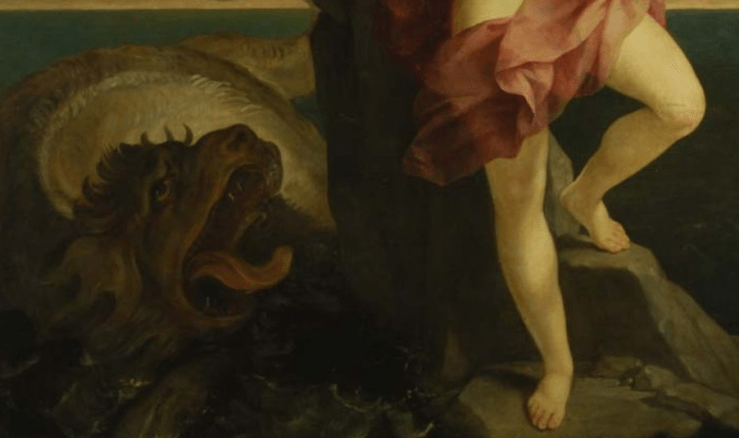
It is Guido’s picture of Perseus rescuing Andromeda from the sea-monster or whale. Where did Guido get the model of such a strange creature as that?

–and–

Nor does Hogarth, in painting the same scene in his own “Perseus Descending,” make out one whit better.

–and–

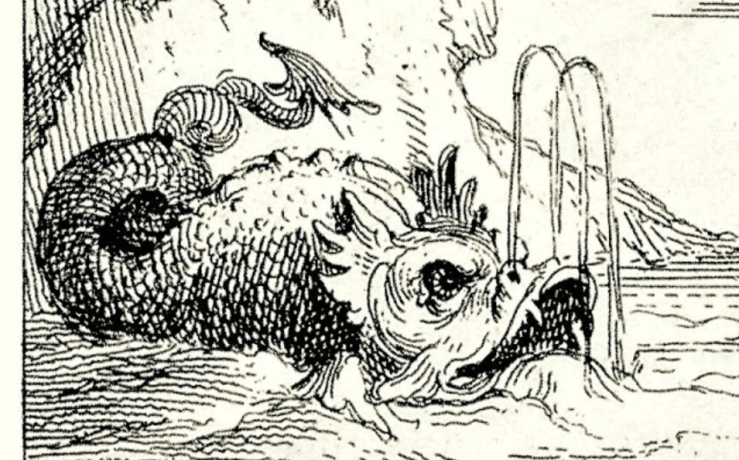
Then, there are the Prodromus whales of old Scotch Sibbald

–and—

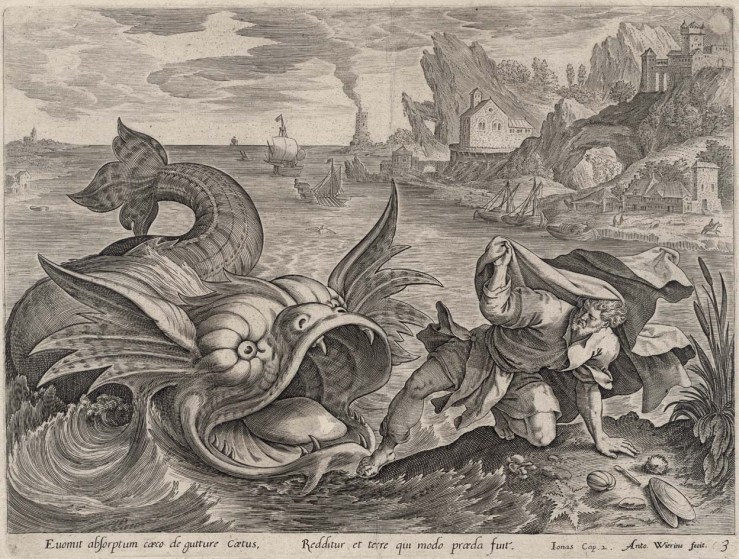
Jonah’s whale, as depicted in the prints of old Bibles and the cuts of old primers.

Jonah, 1585 by Antonius Wierix
–and–

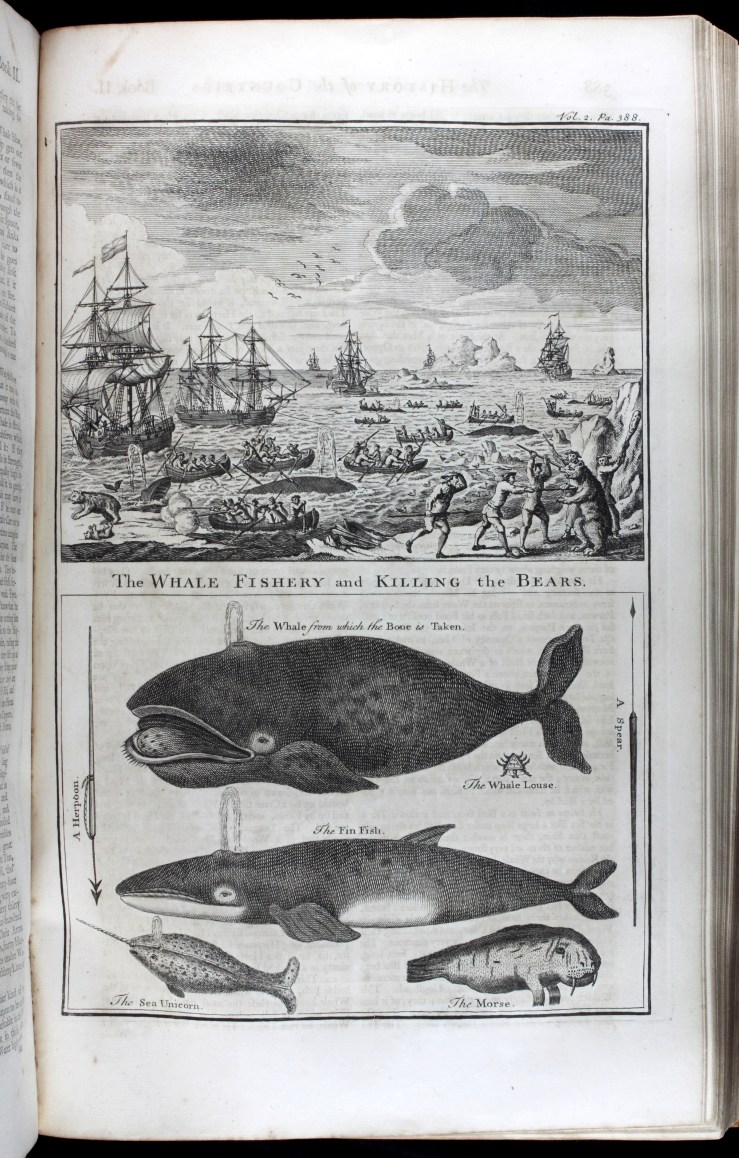
 In old Harris’s collection of voyages there are some plates of whales extracted from a Dutch book of voyages, A.D. 1671, entitled “A Whaling Voyage to Spitzbergen in the ship Jonas in the Whale, Peter Peterson of Friesland, master.” In one of those plates the whales, like great rafts of logs, are represented lying among ice-isles, with white bears running over their living backs. In another plate, the prodigious blunder is made of representing the whale with perpendicular flukes.

–and–

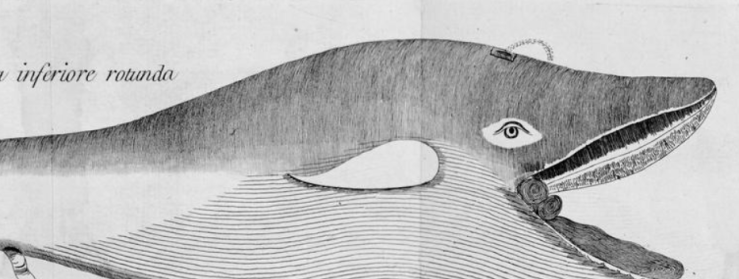
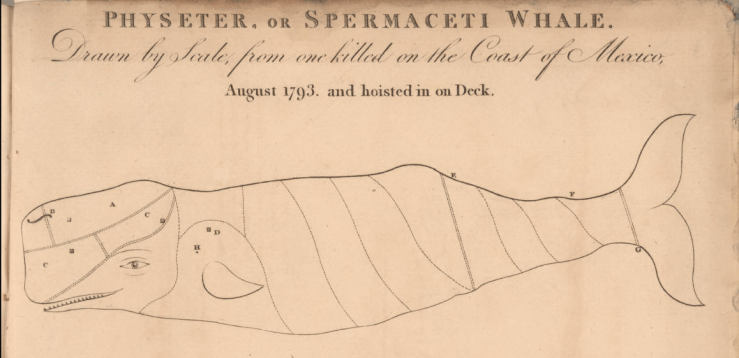
Then again, there is an imposing quarto, written by one Captain Colnett, a Post Captain in the English navy, entitled “A Voyage round Cape Horn into the South Seas, for the purpose of extending the Spermaceti Whale Fisheries.” In this book is an outline purporting to be a “Picture of a Physeter or Spermaceti whale, drawn by scale from one killed on the coast of Mexico, August, 1793, and hoisted on deck.”

–and–

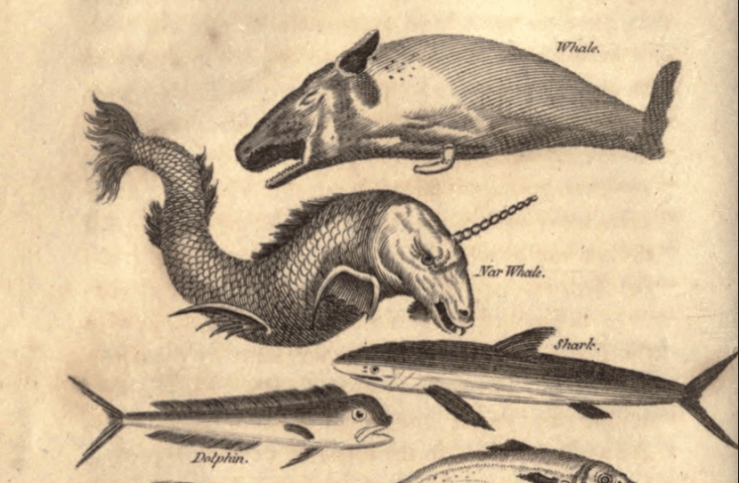
Look at that popular work “Goldsmith’s Animated Nature.” In the abridged London edition of 1807, there are plates of an alleged “whale” and a “narwhale.” I do not wish to seem inelegant, but this unsightly whale looks much like an amputated sow; and, as for the narwhale, one glimpse at it is enough to amaze one, that in this nineteenth century such a hippogriff could be palmed for genuine upon any intelligent public of schoolboys.

–and–

Then, again, in 1825, Bernard Germain, Count de Lacépède, a great naturalist, published a scientific systemized whale book, wherein are several pictures of the different species of the Leviathan.

–and–

But the placing of the cap-sheaf to all this blundering business was reserved for the scientific Frederick Cuvier, brother to the famous Baron. In 1836, he published a Natural History of Whales, in which he gives what he calls a picture of the Sperm Whale. Before showing that picture to any Nantucketer, you had best provide for your summary retreat from Nantucket. In a word, Frederick Cuvier’s Sperm Whale is not a Sperm Whale, but a squash.

V. Ishmael then forgives these artists’ failures:

But these manifold mistakes in depicting the whale are not so very surprising after all. Consider! Most of the scientific drawings have been taken from the stranded fish; and these are about as correct as a drawing of a wrecked ship, with broken back, would correctly represent the noble animal itself in all its undashed pride of hull and spars. …The living whale, in his full majesty and significance, is only to be seen at sea in unfathomable waters; and afloat the vast bulk of him is out of sight…

VI. Ishmael then reminds us that the whale is a sort of metaphysical thing: “For it is one of the more curious things about this Leviathan, that his skeleton gives very little idea of his general shape,” unlike, say, Jeremy Bentham.

VII. Ishmael’s first pictorial chapter ends his chapter with a warning of sorts:

For all these reasons, then, any way you may look at it, you must needs conclude that the great Leviathan is that one creature in the world which must remain unpainted to the last. True, one portrait may hit the mark much nearer than another, but none can hit it with any very considerable degree of exactness. So there is no earthly way of finding out precisely what the whale really looks like. And the only mode in which you can derive even a tolerable idea of his living contour, is by going a whaling yourself; but by so doing, you run no small risk of being eternally stove and sunk by him. Wherefore, it seems to me you had best not be too fastidious in your curiosity touching this Leviathan.

Ishmael’s warning points—again—to The Pequod’s impending doom.

VIII. Ch. 56, “Of the Less Erroneous Pictures of Whales, and the True Pictures of Whaling Scenes.”

Ishmael:

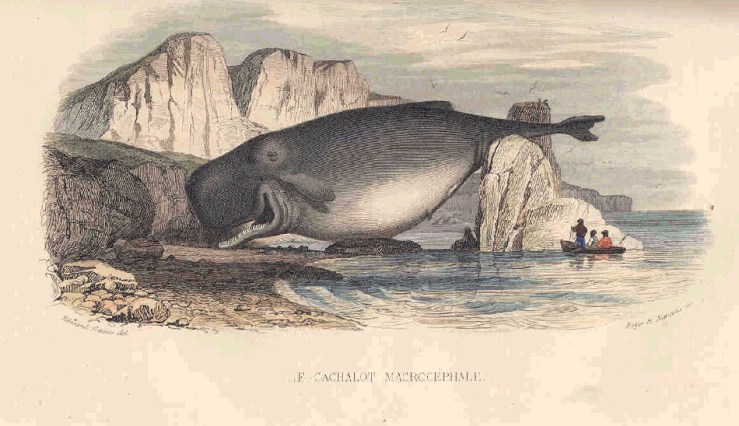
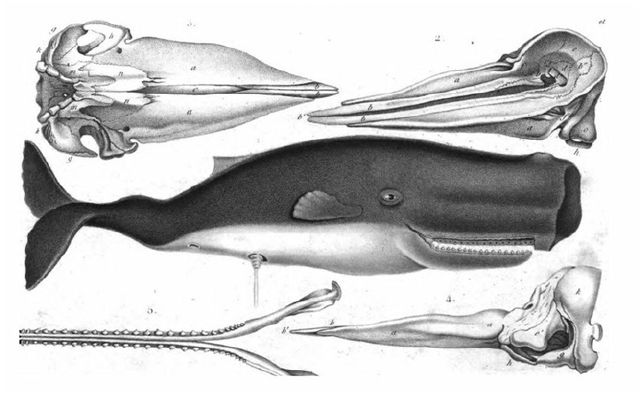
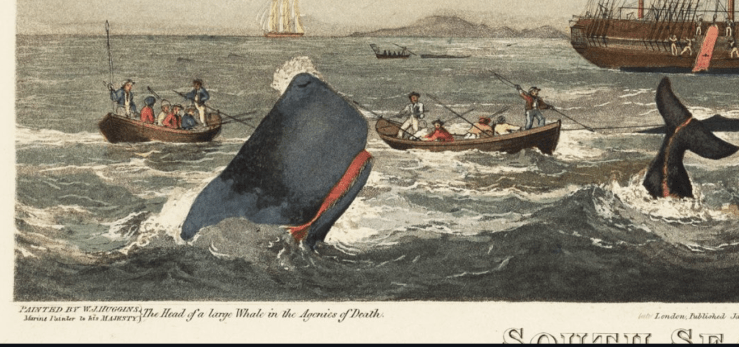
I know of only four published outlines of the great Sperm Whale; Colnett’s, Huggins’s, Frederick Cuvier’s, and Beale’s. In the previous chapter Colnett and Cuvier have been referred to. Huggins’s is far better than theirs; but, by great odds, Beale’s is the best.

Here is a detail from W.J. Huggin’s South Sea Whale Fishery (1825):

–and from Beale’s volume

Ishmael then mentions William Scoresby, whose disastrous depictions also likely helped inform the imagery at the climax of Moby-Dick:

Ishmael is also very fond of two engravings from Ambroise Lous Garneray, the second of which he describes thus—

In the second engraving, the boat is in the act of drawing alongside the barnacled flank of a large running Right Whale, that rolls his black weedy bulk in the sea like some mossy rock-slide from the Patagonian cliffs. His jets are erect, full, and black like soot; so that from so abounding a smoke in the chimney, you would think there must be a brave supper cooking in the great bowels below. Sea fowls are pecking at the small crabs, shell-fish, and other sea candies and maccaroni, which the Right Whale sometimes carries on his pestilent back. And all the while the thick-lipped leviathan is rushing through the deep, leaving tons of tumultuous white curds in his wake, and causing the slight boat to rock in the swells like a skiff caught nigh the paddle-wheels of an ocean steamer. Thus, the foreground is all raging commotion; but behind, in admirable artistic contrast, is the glassy level of a sea becalmed, the drooping unstarched sails of the powerless ship, and the inert mass of a dead whale, a conquered fortress, with the flag of capture lazily hanging from the whale-pole inserted into his spout-hole.

I think it must be this–

IX. Ch. 57, “Of Whales in Paint; in Teeth; in Wood; in Sheet-Iron; in Stone; in Mountains; in Stars.”

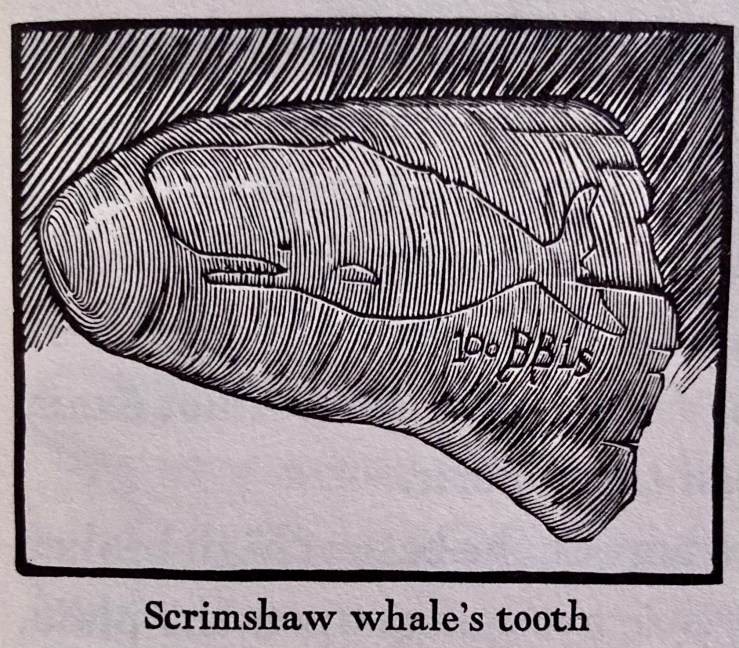
I wrote above that Barry Moser pretty much stays out of these pictorial chapters, but he does include this lovely little illustration in Ch. 57:

Moby-Dick illustration by Barry Moser

On scrimshaw:

Throughout the Pacific, and also in Nantucket, and New Bedford, and Sag Harbor, you will come across lively sketches of whales and whaling-scenes, graven by the fishermen themselves on Sperm Whale-teeth, or ladies’ busks wrought out of the Right Whale-bone, and other like skrimshander articles, as the whalemen call the numerous little ingenious contrivances they elaborately carve out of the rough material, in their hours of ocean leisure.

(So I just spent the last half hour looking for this tiny little scrimshaw pocket knife I bought when I was ten years old in Honolulu — it was the winter of 1989 and we were going home-not-really-home to Florida for Christmas from Dunedin, New Zealand. We got to spend a few days in Honolulu and I bought a “scrimshaw” knife in the market. “Like Moby-Dick,” my father said, or something like that. I know the knife is here somewhere, in some box or crate, squirreled away, more beautiful in my mind’s eye than an iPhone pic could capture.)

X. These three chapters end with Ishmael’s reaffirmation to go a’whaliln’ — to see for himself, and not through, to quote Walt Whitman, “take things at second or third hand, not look through the eyes of the dead, nor feed on the spectres in books.”

Our boy Ish ends the chapter horny for life:

With a frigate’s anchors for my bridle-bitts and fasces of harpoons for spurs, would I could mount that whale and leap the topmost skies, to see whether the fabled heavens with all their countless tents really lie encamped beyond my mortal sight!


And of all these things the Albino whale was the symbol. Wonder ye then at the fiery hunt? | Moby-Dick reread, riff 12

Moby-Dick illustration by Barry Moser

I. In this riff: Ch. 37-48.

II. Oof. Twelve chapters. Not sure how up to covering them I am, but let’s go—

III. Ch. 37, “Sunset.”

Ahab has just revealed that The Pequod’s true mission is vengeance on Moby Dick. “Sunset” is a short chapter and continues the Shakespearian mode initiated in Ch. 36, “The Quarter-Deck.” (It begins with the stage direction, “By the Mainmast; Starbuck leaning against it.”) We enter poor Starbuck’s inner monologue: “My soul is more than matched; she’s overmanned; and by a madman! Insufferable sting, that sanity should ground arms on such a field!”

This rhetorical conceit—a play on a stage with players—playfully plays out over the next few chapters, culminating in Ch. 40, “Midnight, Forecastle,” which reads like a playwright’s script. Ishmael is subsumed into this dramatic grammar, a bit player. Or perhaps he is the orchestrator of events. Or maybe just the recording witness. In any case, he arrives back to himself in—

IV. Ch. 41, “Moby Dick”—

Which begins,

I, Ishmael, was one of that crew; my shouts had gone up with the rest; my oath had been welded with theirs; and stronger I shouted, and more did I hammer and clinch my oath, because of the dread in my soul. A wild, mystical, sympathetical feeling was in me; Ahab’s quenchless feud seemed mine.

Ahab’s quenchless feud seemed mine: Ishmael’s first-person returns, but he assumes a kind of vacant post—he’s been absorbed into the unity of the crew, a unity in turn subsumed into Ahab’s monomania. In “Moby Dick” Ishmael provides a working background summary of Moby Dick’s history, including his encounter with Ahab. At the same time, it seems Ishmael’s consciousness has somehow absorbed portions of Ahab’s:

But, as in his narrow-flowing monomania, not one jot of Ahab’s broad madness had been left behind; so in that broad madness, not one jot of his great natural intellect had perished. That before living agent, now became the living instrument. If such a furious trope may stand, his special lunacy stormed his general sanity, and carried it, and turned all its concentred cannon upon its own mad mark; so that far from having lost his strength, Ahab, to that one end, did now possess a thousand fold more potency than ever he had sanely brought to bear upon any one reasonable object.

But I skipped a few chapters. Where were we?

V. Ch. 39, “First Night-Watch.”

Another very short chapter, another interior monologue—this time, “(Stubb solus, and mending a brace.)” We mostly get a bit of character-building: “Well, Stubb, wise Stubb—that’s my title—well, Stubb, what of it, Stubb? Here’s a carcase. I know not all that may be coming, but be it what it will, I’ll go to it laughing.”

Go to it laughingMoby-Dick is a tragedy, but it’s also a grand comedy.

VI. Ch. 40, “Midnight, Forecastle.”

The crew of The Pequod turns into a chorus. Chorus is not the right word: our boys are not on the same page (except that they literally are). A bit drunk from Ahab’s spirits, they indulge in songs. Melville marks most sailors not by name, but by origin: Dutch Sailor, China Sailor, Lascar Sailor, and so on. The final lines go to the cabin boy Pip though:

PIP (shrinking under the windlass). Jollies? Lord help such jollies! Crish, crash! there goes the jib-stay! Blang-whang! God! Duck lower, Pip, here comes the royal yard! It’s worse than being in the whirled woods, the last day of the year! Who’d go climbing after chestnuts now? But there they go, all cursing, and here I don’t. Fine prospects to ’em; they’re on the road to heaven. Hold on hard! Jimmini, what a squall! But those chaps there are worse yet—they are your white squalls, they. White squalls? white whale, shirr! shirr! Here have I heard all their chat just now, and the white whale—shirr! shirr!—but spoken of once! and only this evening—it makes me jingle all over like my tambourine—that anaconda of an old man swore ’em in to hunt him! Oh, thou big white God aloft there somewhere in yon darkness, have mercy on this small black boy down here; preserve him from all men that have no bowels to feel fear!

Poor Pip is already half mad on the road to ruin, his language jangled and his psyche scarred. It’ll get worse.

Moby-Dick illustration by Barry Moser

VII. Ch. 42, “The Whiteness of the Whale.”

Like maybe just read this one.

(That’s lazy on my part, right?

Okay, so—

“The Whiteness of the Whale” is one of the better chapters of Moby-Dick.

“What the white whale was to Ahab, has been hinted; what, at times, he was to me, as yet remains unsaid,” starts Ishmael, and then precedes to say, say, say—-and yet he tiptoes around the calamity at the book’s climax. (This ghost will foreshadow but not spoil.)

The third paragraph of this chapter goes on for almost five hundred words. Here it is (skip it if you like):

Though in many natural objects, whiteness refiningly enhances beauty, as if imparting some special virtue of its own, as in marbles, japonicas, and pearls; and though various nations have in some way recognised a certain royal preeminence in this hue; even the barbaric, grand old kings of Pegu placing the title “Lord of the White Elephants” above all their other magniloquent ascriptions of dominion; and the modern kings of Siam unfurling the same snow-white quadruped in the royal standard; and the Hanoverian flag bearing the one figure of a snow-white charger; and the great Austrian Empire, Cæsarian, heir to overlording Rome, having for the imperial colour the same imperial hue; and though this pre-eminence in it applies to the human race itself, giving the white man ideal mastership over every dusky tribe; and though, besides, all this, whiteness has been even made significant of gladness, for among the Romans a white stone marked a joyful day; and though in other mortal sympathies and symbolizings, this same hue is made the emblem of many touching, noble things—the innocence of brides, the benignity of age; though among the Red Men of America the giving of the white belt of wampum was the deepest pledge of honor; though in many climes, whiteness typifies the majesty of Justice in the ermine of the Judge, and contributes to the daily state of kings and queens drawn by milk-white steeds; though even in the higher mysteries of the most august religions it has been made the symbol of the divine spotlessness and power; by the Persian fire worshippers, the white forked flame being held the holiest on the altar; and in the Greek mythologies, Great Jove himself being made incarnate in a snow-white bull; and though to the noble Iroquois, the midwinter sacrifice of the sacred White Dog was by far the holiest festival of their theology, that spotless, faithful creature being held the purest envoy they could send to the Great Spirit with the annual tidings of their own fidelity; and though directly from the Latin word for white, all Christian priests derive the name of one part of their sacred vesture, the alb or tunic, worn beneath the cassock; and though among the holy pomps of the Romish faith, white is specially employed in the celebration of the Passion of our Lord; though in the Vision of St. John, white robes are given to the redeemed, and the four-and-twenty elders stand clothed in white before the great white throne, and the Holy One that sitteth there white like wool; yet for all these accumulated associations, with whatever is sweet, and honorable, and sublime, there yet lurks an elusive something in the innermost idea of this hue, which strikes more of panic to the soul than that redness which affrights in blood.

(There are also a few really long footnotes in “The Whiteness of the Whale.”)

VIII. The last two sentences of “The Whiteness of the Whale” might serve as a tidy summary of Moby-Dick’s tropes and themes:

And of all these things the Albino whale was the symbol. Wonder ye then at the fiery hunt?

And so they hunt the object of their ideal, as if that would give life meaning and order.

IX. Ch. 43, “Hark!”

A short chapter composed almost entirely in dialogue, but without the markers of a drama. Instead, Melville puts his character’s lines in quotation marks and lets them go back and forth. The chapter basically is more foreshadowing for the eventual revelation of Fedallah and his hidden crew.

X. Ch. 44, “The Chart.”

More on Ahab’s mad questing. We learn his plans to intercept the white whale. As always, Ishmael is permitted into psychic environs that seem as if they should be verboten. He is somehow present in Ahab’s slumbering and waking:

Ah, God! what trances of torments does that man endure who is consumed with one unachieved revengeful desire. He sleeps with clenched hands; and wakes with his own bloody nails in his palms.

A self-crucifying-Christ?

Moby-Dick illustration by Barry Moser

XI. Ch. 45, “The Affidavit.”

Ishmael seeks to validate the veracity of his tale with us, his readers. He invokes several “factual” (non-fiction!) texts, including an account from a man he claims as an uncle.

A key idea:

So ignorant are most landsmen of some of the plainest and most palpable wonders of the world, that without some hints touching the plain facts, historical and otherwise, of the fishery, they might scout at Moby Dick as a monstrous fable, or still worse and more detestable, a hideous and intolerable allegory.

Ishmael tells us this is no allegory, perhaps signalling this is definitely an allegory—but a failed allegory, an ambiguous attempt at allegory, an allegory where object, symbol, and lesson will refuse to align neatly.

XII. Ch. 46, “Surmises.”

Moby-Dick is a novel of masters and commanders, and body and soul, themes I haven’t touched too much upon:

To accomplish his object Ahab must use tools; and of all tools used in the shadow of the moon, men are most apt to get out of order. He knew, for example, that however magnetic his ascendency in some respects was over Starbuck, yet that ascendency did not cover the complete spiritual man any more than mere corporeal superiority involves intellectual mastership; for to the purely spiritual, the intellectual but stand in a sort of corporeal relation.

XIII. Ch. 47, “The Mat-Maker.”

Does Melville love hyphens or what? Like so many of the chapters of Moby-Dick are hyphenated—and the title is hyphenated, even if the whale isn’t. Anyway. “The Mat-Maker” is a bit of stage business to remind us that Ish and Queeg are, like, working on a whale ship and are part of noble Starbuck’s crew. And then Tashtego calls out a whale. And then they lower boats.

XIV. Ch. 48, “The First Lowering.”

For all it’s philosophizin’, Moby-Dick is still an adventure story, and “The First Lowering” glows with vibrant action.

We are introduced to the secret phantoms that were stowed away beneath decks—Fedallah and his crew, Ahab’s secret assassins. While Ishmael is generally magnanimous and unbounded by prejudice, the novel gives way here to ugly racism:

The figure that now stood by its bows was tall and swart, with one white tooth evilly protruding from its steel-like lips. A rumpled Chinese jacket of black cotton funereally invested him, with wide black trowsers of the same dark stuff. But strangely crowning this ebonness was a glistening white plaited turban, the living hair braided and coiled round and round upon his head. Less swart in aspect, the companions of this figure were of that vivid, tiger-yellow complexion peculiar to some of the aboriginal natives of the Manillas;—a race notorious for a certain diabolism of subtilty, and by some honest white mariners supposed to be the paid spies and secret confidential agents on the water of the devil, their lord, whose counting-room they suppose to be elsewhere.

At an aesthetic level, Melville’s Ishmael is perhaps trying to work through an allegory of whiteness, using yellowness here in unkind and unwise methods—but I don’t think so. It’s just ugly.

XV. “The First Lowering” prefigures the disaster at the end of Moby-Dick. It’s a rough dress rehearsal for the outcome of Ahab’s mad quest, and it ends with Ish, Queeg, and Starbuck imperiled, “Wet, drenched through, and shivering cold, despairing of ship or boat”:

Floating on the waves we saw the abandoned boat, as for one instant it tossed and gaped beneath the ship’s bows like a chip at the base of a cataract; and then the vast hull rolled over it, and it was seen no more till it came up weltering astern. Again we swam for it, were dashed against it by the seas, and were at last taken up and safely landed on board. Ere the squall came close to, the other boats had cut loose from their fish and returned to the ship in good time. The ship had given us up, but was still cruising, if haply it might light upon some token of our perishing,—an oar or a lance pole.

XVI. Will Ish and Queeg survive? Has the ship given them up? Tune in next time, for Ch. 49 — “The Hyena”!

God keep me from ever completing anything | Moby-Dick reread, riff 9

I. In this riff: Chapters 28-32.

II. I just finished Ch. 32, “Cetology,” which ends with this marvelous sentiment:

God keep me from ever completing anything. This whole book is but a draught—nay, but the draught of a draught.

III. (Ishmael makes good here on one a sentiment he expresses at the chapter’s outset: “any human thing supposed to be complete, must for that very reason infallibly be fault.”)

IV. The notion of a “draught of a draught” again points to Moby-Dick’s emerging metatextuality, a conceit Ishmael (and, of course, Melville) initiates in Chs. 23 and 24.

V. “Cetology” is Ish’s attempt to “grope down into the bottom of the sea after them; to have one’s hands among the unspeakable foundations, ribs, and very pelvis of the world; this is a fearful thing” While the likely antecedent of the pronoun “them” in the above sentence is whales, one has to search the paragraph above to find it. I think Melville here opens his metaphor. To go a’whaling is to plumb depths.

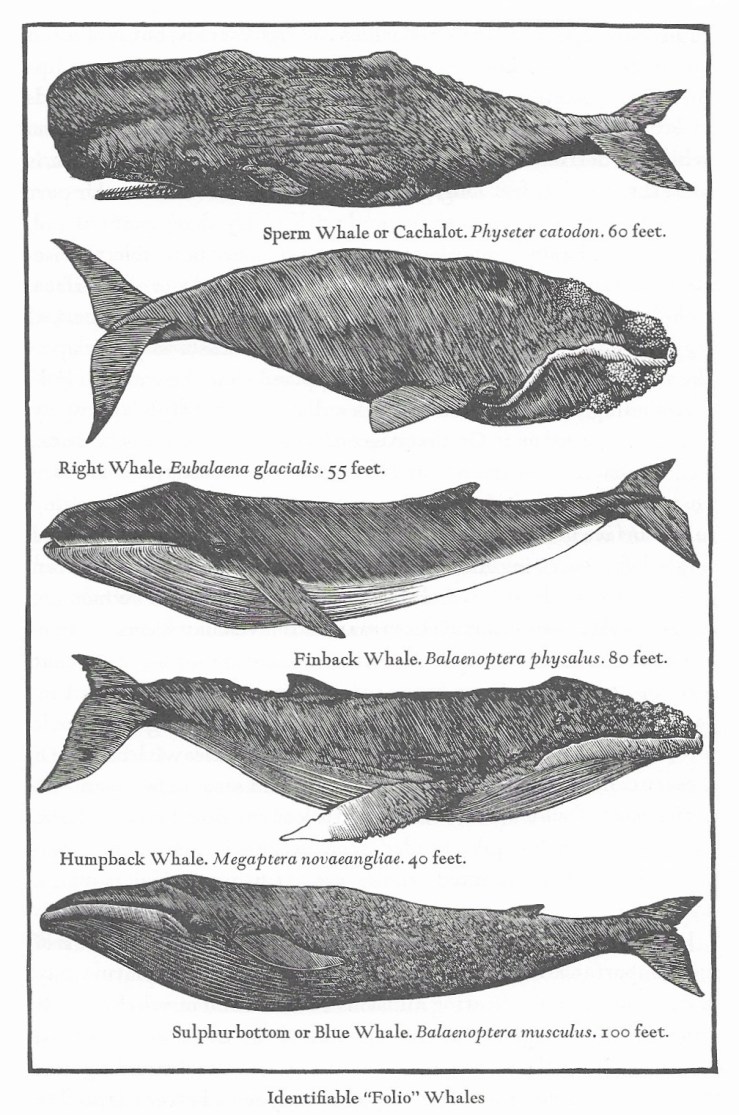
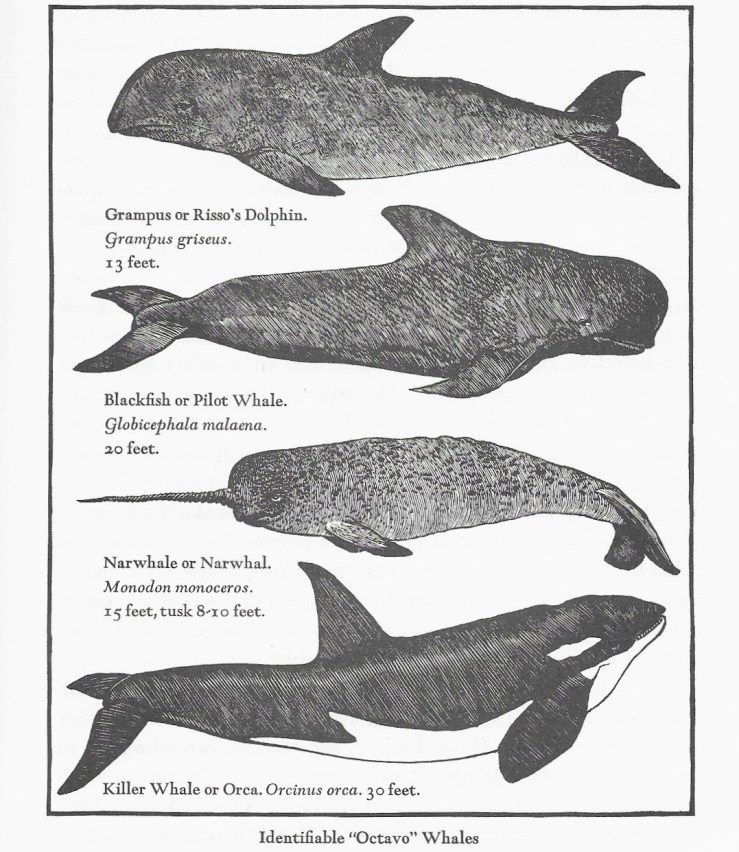
VI. (“Cetology” is likely one of the chapters that turn a lot of readers off. It appears to be mostly whale facts, although it is not. It is Ishmael riffing on what he has seen of whales, porpoises, dolphins—which is really Melville riffing on what he has seen of these creatures.)

VII. (Parenthetically: Ishmael takes “the good old fashioned ground that the whale is a fish, and call[s] upon holy Jonah to back me.”)

VIII. But back to metatextuality—in “Cetology,’ Ish organizes his descriptions of whales in bookish terms:

 I divide the whales into three primary BOOKS (subdivisible into CHAPTERS), and these shall comprehend them all, both small and large.

I. THE FOLIO WHALE; II. the OCTAVO WHALE; III. the DUODECIMO WHALE.

Ishmael seeks to read the natural world, but also to name and comprehend it in his own terms. He’s radically open to to encountering the deepest divers, but he’s beholden to romantically translating them into a literature of his own making.

IX. Ch. 28, “Ahab.”

Ahab, who has hitherto haunted Ishmael’s consciousness, finally appears. Rather than attempting to summarize, I’ll simply cite:

He looked like a man cut away from the stake, when the fire has overrunningly wasted all the limbs without consuming them, or taking away one particle from their compacted aged robustness. His whole high, broad form, seemed made of solid bronze, and shaped in an unalterable mould, like Cellini’s cast Perseus. Threading its way out from among his grey hairs, and continuing right down one side of his tawny scorched face and neck, till it disappeared in his clothing, you saw a slender rod-like mark, lividly whitish. It resembled that perpendicular seam sometimes made in the straight, lofty trunk of a great tree, when the upper lightning tearingly darts down it, and without wrenching a single twig, peels and grooves out the bark from top to bottom, ere running off into the soil, leaving the tree still greenly alive, but branded. Whether that mark was born with him, or whether it was the scar left by some desperate wound, no one could certainly say.

Ahab’s physical manifestation points toward the ambiguity at the heart of Moby-Dick: Is he hero or villain; is he marked by divine intervention or scarred by his own chosen battles?

X. (Either way, our boy Ishmael is smitten.)

XI. “Ahab” is, despite its reveal of a major character, a transitional chapter. The Pequod moves from the cold waters off New England into more tropical climes and “the warbling persuasiveness of the pleasant, holiday weather.”

How is dour Ahab affected?

More than once did he put forth the faint blossom of a look, which, in any other man, would have soon flowered out in a smile.

XII. (The would have there is everything. This is a novel of hints, double negatives, ambiguities.)

XIII. Ch. 29, “Enter Ahab; to Him, Stubb.”

Ch. 29 initiates Melville’s Shakespearean mode; Moby-Dick seems to turn into a stage drama, players staged in Ishmael’s consciousness. We learn of Ahab’s foul moods, and his tendency to clunk around with his ivory pegleg late at night above decks while his hardworking crew sleep below:

Old age is always wakeful; as if, the longer linked with life, the less man has to do with aught that looks like death. Among sea-commanders, the old greybeards will oftenest leave their berths to visit the night-cloaked deck.

Stubb makes the mistake of confronting Ahab and suggesting he apply “a globe of tow…to the ivory heel” to mute its cacophony. But Ahab will not be silenced. He rebukes Stubb in violent language: “…be called ten times a donkey, and a mule, and an ass, and begone, or I’ll clear the world of thee!”

XIV. The long final paragraph of Ch. 29, although set off in quotation marks, nevertheless reads like Stubb’s internal monologue. Other voices have taken over the narrative before now, most notably Father Mapple in Ch. 4—but Stubb’s aside marks a rhetorical move whereby Ish somehow witnesses voices that seem impossible to access—private thoughts, whispered asides.

XV. Ishmael’s ghostly powers present again in Ch. 30, “The Pipe.” He focuses in on Ahab enthroned:

In old Norse times, the thrones of the sea-loving Danish kings were fabricated, saith tradition, of the tusks of the narwhale. How could one look at Ahab then, seated on that tripod of bones, without bethinking him of the royalty it symbolized? For a Khan of the plank, and a king of the sea, and a great lord of Leviathans was Ahab.

Ishmael then somehow dips into Ahab’s soliloquy. Pipe smoke no longer soothes the tortured captain. He tosses his still-lit pipe into the ocean, a symbol of…something?

XVI. In Ch. 31, “Queen Mab,” Ishmael again breeches an impossible private space. This time it’s a conversation between Stubb and Flask. Conversation isn’t the right term, really — “Queen Mab” is essentially Stubb’s complaint about being slighted by Ahab, delivered in a monologue to Flask. He relates a dream, all about being kicked by the captain. The kick recalls a remembered moment earlier in the novel when Peter Coffin, proprietor of the Spouter-Inn, relates unwittingly kicking his young child Sam from the bed while the family sleeps together. The symbolic orphaning-expulsion repeats in Ch. 22, “Merry Christmas,” when Captain Peleg kicks Ishmael in the ass.

XVII. I started with Ch. 32, “Cetology.” Here are Barry Moser’s illustrations:

Humbug or bugbear | Riff 6 on rereading Herman Melville’s Moby-Dick (The Ramadan/His Mark/The Prophet)

Moby-Dick illustration by Barry Moser

I. In this riff: Ch. 17, “The Ramadan,” Ch. 18, “His Mark,” and Ch. 19, “The Prophet.”

II. “The Ramadan” again underscores Moby-Dick’s theme of death and resurrection. In Ch. 16, “The Ship,” Queequeg shuts himself up in his room to undertake a “sort of Lent or Ramadan, or day of fasting, humiliation, and prayer.” This “Ramadan” extends much further than Ish imagined it would, and he soon grows concerned that Queequeg may have fallen into “apoplexy.” He communicates his concerns to the inn’s chambermaid, who loses her head and yells for the proprietor, Mrs. Hussey, who loses her head in turn:

‘He’s killed himself,’ she cried. ‘It’s unfort’nate Stiggs done over again—there goes another counterpane—God pity his poor mother!—it will be the ruin of my house. Has the poor lad a sister? Where’s that girl?—there, Betty, go to Snarles the Painter, and tell him to paint me a sign, with—“no suicides permitted here, and no smoking in the parlor;”—might as well kill both birds at once. Kill? The Lord be merciful to his ghost!’

The scene plays comically—Queeg is perfectly fine—but the comedy is an ironic prefiguration of Queequeg’s fate in Moby-Dick’s strange, tragic climax.

III. At the beginning of “The Ramadan,” Ishmael claims a largehearted, ecumenical open-mindedness towards “everybody’s religious obligations, never mind how comical. Ishmael sings a very different tune at the end of the chapter, however:

 I labored to show Queequeg that all these Lents, Ramadans, and prolonged ham-squattings in cold, cheerless rooms were stark nonsense; bad for the health; useless for the soul; opposed, in short, to the obvious laws of Hygiene and common sense. I told him, too, that he being in other things such an extremely sensible and sagacious savage, it pained me, very badly pained me, to see him now so deplorably foolish about this ridiculous Ramadan of his. Besides, argued I, fasting makes the body cave in; hence the spirit caves in; and all thoughts born of a fast must necessarily be half-starved. This is the reason why most dyspeptic religionists cherish such melancholy notions about their hereafters. In one word, Queequeg, said I, rather digressively; hell is an idea first born on an undigested apple-dumpling; and since then perpetuated through the hereditary dyspepsias nurtured by Ramadans.

Is Ishmael’s viewpoint Melville’s authorial position? Or is Ishmael missing something in Queequeg’s mute devotions that Melville is asking us to pick up on?

IV. In “His Mark,” Ishmael introduces Queequeg to the Quaker captains Bildad and Peleg. Alarmed at his “savage” appearance, Peleg presses the pair for Queeg’s “papers” — for documentation that he’s converted to Christianity. Ish quickly supplies a lie, claiming that Queeg is “a member of the first Congregational Church,” but when pressed harder, turns his lie into a kind of truth of Emersonian over-soulism:

‘I mean, sir, the same ancient Catholic Church to which you and I, and Captain Peleg there, and Queequeg here, and all of us, and every mother’s son and soul of us belong; the great and everlasting First Congregation of this whole worshipping world; we all belong to that; only some of us cherish some queer crotchets no ways touching the grand belief; in that we all join hands.’

‘Splice, thou mean’st splice hands,’ cried Peleg, drawing nearer.

V. While the Quaker captains are impressed by Ishmael’s spiritual oratory, it’s Queequeg’s skill with the harpoon that earns the islander a place on The Pequod. After he demonstrates his acumen by harpooning a speck of tar floating on the water’s surface, Peleg offers him a job:

‘We must have Hedgehog there, I mean Quohog, in one of our boats. Look ye, Quohog, we’ll give ye the ninetieth lay, and that’s more than ever was given a harpooneer yet out of Nantucket.’

The chapter’s comic tone culminates in Queequeg signing his mark to a misappellation:

VI. As is so often the case in Moby-Dick, comedy shifts into more serious matters. Dour Bildad asks his comrade how he could not think of death and eternity in times of peril:

‘Tell me, when this same Pequod here had her three masts overboard in that typhoon on Japan, that same voyage when thou went mate with Captain Ahab, did’st thou not think of Death and the Judgment then?’

Peleg contrasts Bildad’s morose death-obsession with a drive to survive, to live:

‘Death and the Judgment then? What? With all three masts making such an everlasting thundering against the side; and every sea breaking over us, fore and aft. Think of Death and the Judgment then? No! no time to think about Death then. Life was what Captain Ahab and I was thinking of; and how to save all hands—how to rig jury-masts—how to get into the nearest port; that was what I was thinking of.’

VII. The next chapter is “The Prophet,” where leaving the Quaker captains, Ish and Queeg are immediately accosted by a severe-looking stranger:

 He was but shabbily apparelled in faded jacket and patched trowsers; a rag of a black handkerchief investing his neck. A confluent small-pox had in all directions flowed over his face, and left it like the complicated ribbed bed of a torrent, when the rushing waters have been dried up.

He asks if they’ve signed onto The Pequod, and tells them that they should worry about losing their souls, before mumbling that maybe a chap’s better off without one: “A soul’s a sort of a fifth wheel to a wagon.”

The stranger then warns them about Captain Ahab, who lost “his leg last voyage, according to the prophecy.” The stranger concedes that Ahab has enough soul to make up for all deficiencies of that sort in other chaps.”

Ishmael is not too alarmed by the man and asks for his name: Elijah. Named for the prophet who resisted evil Baal, Elijah is an ambiguous figure. Is he truly a prophet whose heedings should be followed, or simply a madman. Ishmael chooses to read him thus: “he was nothing but a humbug, trying to be a bugbear”; in other words, he was nothing but a hoaxer, trying to be a monster.

And yet the words Ishmael chooses phonetically splice into each other—humbugbear—pointing towards the novel’s shifting tones and ambiguous symbols. Elijah’s warnings have a strange effect on Ishmael:

…his ambiguous, half-hinting, half-revealing, shrouded sort of talk, now begat in me all kinds of vague wonderments and half-apprehensions, and all connected with the Pequod; and Captain Ahab; and the leg he had lost…and the voyage we had bound ourselves to sail; and a hundred other shadowy things.

A hundred other shadowy things to come.

No more my splintered heart and maddened hand were turned against the wolfish world | Riff 4 on rereading Herman Melville’s Moby-Dick (A Bosom Friend/Nightgown/Biographical/Wheelbarrow)

Moby-Dick illustration by Barry Moser

I. “A Bosom Friend” (Ch. 10)  is another one of the remarkable key early chapters of Moby-Dick. It twins Ch. 4, “The Counterpane,” book-ending Ishmael’s Wild New Bedford Nights with Queequeg.

II. While Ishmael’s largehearted acceptance and quick love for Queequeg probably does not seem as eccentric to contemporary readers as it might have been to Melville’s 1851 audience, it’s nevertheless an enduring emblem of Moby-Dick’s expansive spirit.

“Better sleep with a sober cannibal than a drunken Christian,” Ish intones in Ch. 3; by Ch. 10, he admiringly attests that, “Queequeg was George Washington cannibalistically developed.” In a curt but not impolite dismissal of his own culture’s moral compass, Ish declares he’ll, “try a pagan friend…since Christian kindness has proved but hollow courtesy.” Like Huck Finn, another American prototype who wishes to escape into the wild, Ishmael will always value raw truth over empty artifice.

III. There are so many good lines in “A Bosom Friend,” but I think this must be my favorite:

…I began to be sensible of strange feelings. I felt a melting in me. No more my splintered heart and maddened hand were turned against the wolfish world.

Ishmael claims that Queequeg, a “soothing savage” has “redeemed” the world for him.

IV. It is more than possible (and so much has been written on M-D that I’m sure much has been made on the topic) that Ish (and Melville) has (have) taken what might be a complex and nuanced character in Queequeg and othered it into a flat projection screen.

Ishmael, who finds “no civilized hypocrisies and bland deceits” in Queeg, might be accused of turning his bosom friend into a romanticized avatar of Ish’s own desire for a noble “savage” unconstrained by the dictates of Christian morality. However, the events of the novel and its developed characterization of Queequeg do not merit such a facile reading (or is my estimation at this point).

V. Indeed—and to jump ahead, maybe—in Ch. 12, “Biographical,” we learn Queequeg’s origin story.

Queeg is a prince of “Rokovoko, an island far away to the West and South.”

Pause a moment, and look it up, seek it out.

(Wait! “It is not down in any map; true places never are.”)

Queequeg desires to travel the world in the hopes of advancing his culture, and, like so many folks in M-D, runs away to sea (to see). However, his time on whaleboats and in ports of the western world soon soon reveal to him that “it’s a wicked world in all meridians.”

He decides to “die a pagan.”

VI. Notably and necessarily, Queequeg’s “Biographical” chapter is delivered entirely in Ishmael’s voice (unlike Ch. 9, “The Sermon,” where Father Mapple overtakes the narrative).

Queequeg is always a linguistic outsider in M-D—and indeed, an outsider in general, an outsider among outsiders—but also a superhuman superhero, as the events of Ch. 13, “The Wheelbarrow,” show.

VII. I seem to be skipping around, so, fine, okay—

—in “The Wheelbarrow,” Ish and Queeg take a packet schooner from New Bedford to Nantucket, where they plan to join a whaling ship’s crew. On the schooner, one of the several “boobies and bumpkins” aboard mocks Queequeg. Queeg catches ahold of the redneck and tosses him playfully into the air, leaving him shaken but unhurt. Captain, crew, and passengers threaten the “devil” outsider, but chaos erupts when the main-sail’s boom sets loose due because of high winds. The boom knocks the redneck into the ocean. Others panic; Queeg calmly secures the spar dives into the ocean, and rescues his mocker: “The poor bumpkin was restored,” Ishmael remarks. He then tells us that “From that hour I clove to Queequeg like a barnacle; yea, till poor Queequeg took his last long dive,” foreshadowing that not all are to be resurrected in Moby-Dick.

VIII. (Or, alternately—all are to be resurrected in Moby-Dick, but only through Ishmael’s wailing tale.)

IX. But I have skipped around so much—back to Ch. 10, “A Bosom Friend.” In one of the more-remarked upon moments in the book, Ish and Queeg tie the knot after a good smoke:

…he pressed his forehead against mine, clasped me round the waist, and said that henceforth we were married; meaning, in his country’s phrase, that we were bosom friends; he would gladly die for me, if need should be. In a countryman, this sudden flame of friendship would have seemed far too premature, a thing to be much distrusted; but in this simple savage those old rules would not apply.

X. Ishmael then, through a kind of tortuous logic, describes why he, “a good Christian; born and bred in the bosom of the infallible Presbyterian Church,” “must turn idolator” and pray to Queeg’s pagan idol. It’s what God would want him to do, see? Ishmael’s logic is predicated on two simple principles:

–He is “to do to my fellow man what I would have my fellow man to do to me”

and

–“Queequeg is my fellow man”

For me, the remarkable part of Ishmael’s commitment to Queequeg isn’t the first Jesusian imperative to do unto others—it is, in other terms, to recognize the other as a fellow man.This recognition is the moral imperative of Moby-Dick.

XI. And then a sweet ending: “Thus, then, in our hearts’ honeymoon, lay I and Queequeg—a cosy, loving pair.”

XII. “Nightgown,” Ch. 11, is a short chapter where something remarkable and likely inexplicable occurs: Ishmael and Queequeg learn to communicate.

And not just communicate at the level of base transaction or simple need, but rather share philosophical and even aesthetic viewpoints, as born out in the details of Queequeg’s story in Ch. 12, “Biographical.” Again, we might criticize Ishmael as ventriloquizing Queequeg, painting his own broad romantic visions over the possibility of a complex and nuanced character that Melville can’t muster. But I ultimately believe—or at least, I believe up until now on this reread—that Ish and Queeg’s accelerated ability to communicate points to an aspirational transcendental horizon, post-culture, post-language.

XIII. “Nightgown” also has one of my favorite moments in Moby-Dick, a little riff by Ishmael that anticipates the deconstruction of oppositions we later locate in the work of late twentieth-century language theorists:

We felt very nice and snug, the more so since it was so chilly out of doors; indeed out of bed-clothes too, seeing that there was no fire in the room. The more so, I say, because truly to enjoy bodily warmth, some small part of you must be cold, for there is no quality in this world that is not what it is merely by contrast. Nothing exists in itself. If you flatter yourself that you are all over comfortable, and have been so a long time, then you cannot be said to be comfortable any more. But if, like Queequeg and me in the bed, the tip of your nose or the crown of your head be slightly chilled, why then, indeed, in the general consciousness you feel most delightfully and unmistakably warm.

XIV. (As a final note—I remembered this passage in Thanksgiving, 2020, after receiving a very sad text message from my aunt, who we would not be seeing that year, after having not seen her for July 4th—like so many other people feeling the smallbig losses of the year, of the absences of festival and visitation—but also feeling those traditions of festival and visitation so much dearer and warmer in their absence. Nothing exists in itself.)

Nameless, unimaginable, silent form or phantom | Riff 2 on rereading Herman Melville’s Moby-Dick (The Carpet-Bag/The Spouter-Inn/The Counterpane)

I. Much has been made of Ishmael’s first night with Queequeg, and I don’t aim to add to it in any estimable way. Ch. 4 of Moby-Dick—what I take to be a key chapter, although there are probably too many supposed keys to this great big book—Ch. 4 of Moby-Dick, “The Counterpane,” begins: “Upon waking next morning about daylight, I found Queequeg’s arm thrown over me in the most loving and affectionate manner.”

II. (Later Ish refers to Queeg’s “bridegroom clasp”; in the previous chapter, he tells us that he “never slept better in [his] life” — this after initially finding it impossible to fall asleep in Peter Coffin’s old bed, its mattress possibly “stuffed with corn-cobs or broken crockery.”)

III. Like I said, much has been made of Ish & Queeg, and I don’t know what else I can say. I just love it. I love Ishmael’s initial horror, his yelling for landlord Coffin, his quick realization that his prejudices might be undone via first-hand/eye experience. “Better sleep with a sober cannibal than a drunken Christian,” he tells us, even if he’s wary of Queeg smoking his tomahawk pipe in bed: “It’s dangerous. Besides, I ain’t insured.”

Moby-Dick illustration by Barry Moser

IV. (M-D might be like the main American text in homosocial studies, I guess.)

V. Let’s come back to that key chapter “The Counterpane” in a moment—how about chapters 2 and 3, “The Carpet-Bag” and “The Spouter-Inn”? I guess here is a good place to be clear,

I don’t know who these riffs are for. I mean, I hope if you’ve never read Moby-Dick they make you want to read it and if you’ve read it before maybe it’ll spark you to read again. I don’t want this to just be me summarizing the book. Let me release my anxiety by leaving the italics and maybe opening a new numeral—

VI. “The Carpet-Bag”:

Ish leaves “Manhatto” and arrives in New Bedford, although he’s too late to make it to Nantucket to join the crew of a whaler and fulfill his mission of Not Being Suicidal. The chapter ends with this remarkable paragraph:

Now, that Lazarus should lie stranded there on the curbstone before the door of Dives, this is more wonderful than that an iceberg should be moored to one of the Moluccas. Yet Dives himself, he too lives like a Czar in an ice palace made of frozen sighs, and being a president of a temperance society, he only drinks the tepid tears of orphans.

The Lazarus theme twists all through M-D, right through its cataclysmic ending. It’s clearly there from the opening paragraphs—Ish’s wishes to revive himself—but this is the first overt reference.

VII. The resurrection motif is enriched in “The Counterpane.”

VIII. (Quote above—I really just love the imagery of rich boy Dives who “only drinks the tepid tears of orphans”! And the knock on his being in a temperance society!)

IX. “The Spouter-Inn”: A nice bit of worldbuilding, as the kids might say (M-D is surely a phantasy).

Proprietor Peter Coffin (“Coffin?—Spouter?—Rather ominous in that particular connexion”)—Peter Coffin is far funnier than I remembered. He fucks with Ish, setting him up for a night with Queeg, who’s been out selling a shrunken head. (In a marvelous little episode, he begins to sand down a dining bench for Ish to sleep on.)

Coffin (a carpenter of sorts) prefigures much of the death/rebirth theme to come in M-D. He also tiptoes the novel’s comic-tragic-something-else axis; his initial japes and jabs at Ish in this chapter give way to a heartfelt moment of near-tragedy, as he explains the origin of the bed Ish will share with Queeg:

—it’s a nice bed; Sal and me slept in that ere bed the night we were spliced. There’s plenty of room for two to kick about in that bed; it’s an almighty big bed that. Why, afore we give it up, Sal used to put our Sam and little Johnny in the foot of it. But I got a dreaming and sprawling about one night, and somehow, Sam got pitched on the floor, and came near breaking his arm. Arter that, Sal said it wouldn’t do.

The marriage bed is spliced to infanticidal violence, to the violent exclusion of children.

Moby-Dick illustration by Barry Moser

X. So let’s get to Ch. 4, to “The Counterpane,” Ishmael’s first night with Queequeg in ole Coffin’s marriage bed.

XI. I wrote “first night” above, but that’s wrong—it’s first morning I mean—the first morning after the first night. The day after.

XII. And yesterday, I wrote, in a riff on rereading M-D, that we get to know little of Ishmael’s past. I think that that statement’s true, but Ish does give us crucial information about the worst moment of his life, a kind of founding trauma that the rest of the novel’s quest might be set against.

XIII. Forgive the long quote:

My sensations were strange. Let me try to explain them. When I was a child, I well remember a somewhat similar circumstance that befell me; whether it was a reality or a dream, I never could entirely settle. The circumstance was this. I had been cutting up some caper or other—I think it was trying to crawl up the chimney, as I had seen a little sweep do a few days previous; and my stepmother who, somehow or other, was all the time whipping me, or sending me to bed supperless,

—Okay I have to pause here and ask—Why chimney?

XIV. Continue, Ish:

—my mother

Wait — “my mother”? Not “stepmother”?

XV. –sorry–

…my mother dragged me by the legs out of the chimney and packed me off to bed, though it was only two o’clock in the afternoon of the 21st June, the longest day in the year in our hemisphere. I felt dreadfully. But there was no help for it, so up stairs I went to my little room in the third floor, undressed myself as slowly as possible so as to kill time, and with a bitter sigh got between the sheets.

Our boy Ish is punished, sent to relinquish his consciousness (and any and all adventuring) on the summer solstice.

XVI. He continues (again, emphasis mine):

I lay there dismally calculating that sixteen entire hours must elapse before I could hope for a resurrection. Sixteen hours in bed! the small of my back ached to think of it. And it was so light too; the sun shining in at the window, and a great rattling of coaches in the streets, and the sound of gay voices all over the house.

Ish is without hope here. No Lazarus thing, no resurrection dealie. And all in the whitest brightest light. This in the satanic dark black white novel Moby-Dick.

XVII. Lil’ Ish’s trauma intensifies, and he begs reprieve from the wicked step-mom, but “she was the best and most conscientious of stepmothers, and back I had to go to my room.”

XVIII. He continues; the bold-face emphasis is mine:

For several hours I lay there broad awake, feeling a great deal worse than I have ever done since, even from the greatest subsequent misfortunes.

And then Ishmael has this wild nightmare-not-epiphany:

At last I must have fallen into a troubled nightmare of a doze; and slowly waking from it—half steeped in dreams—I opened my eyes, and the before sun-lit room was now wrapped in outer darkness. Instantly I felt a shock running through all my frame; nothing was to be seen, and nothing was to be heard; but a supernatural hand seemed placed in mine.

XIX. (Melville hits on the terror of a metaphysical encounter here, a phantom moment encoded into a childhood consciousness that cannot name what is happening to it.)

XX: And then Lil’ Ish’s counterpane of days past entangles with the current counterpane of “The Counterpane” in an

My arm hung over the counterpane, and the nameless, unimaginable, silent form or phantom, to which the hand belonged, seemed closely seated by my bed-side. For what seemed ages piled on ages, I lay there, frozen with the most awful fears, not daring to drag away my hand; yet ever thinking that if I could but stir it one single inch, the horrid spell would be broken. I knew not how this consciousness at last glided away from me; but waking in the morning, I shudderingly remembered it all, and for days and weeks and months afterwards I lost myself in confounding attempts to explain the mystery. Nay, to this very hour, I often puzzle myself with it.

XXI. (That “nameless, unimaginable, silent form or phantom” — prefiguration of Moby-Dick? of Ahab? of the cruel wet cold world? or just a child’s small big fears?)

XXII. (In any case, this seems to be Ishmael’s epiphanic founding trauma.)

XXIII. And to bring it back to where I started,

Much has been made of Ishmael’s first night with Queequeg.

Let’s end on the morning after—a kind of healing epiphany, coded in otherness, exploration, and strange love:

Now, take away the awful fear, and my sensations at feeling the supernatural hand in mine were very similar, in their strangeness, to those which I experienced on waking up and seeing Queequeg’s pagan arm thrown round me.

Behind God’s back | On Thulani Davis’s poetry collection Nothing but the Music

Here are the first lines of Thulani Davis’s 1978 poem “Mecca Flats 1907”:

On this landscape

Like a thin air

Hard to breathe

Behind God’s back

I see the doors

I wanted to underline the line Behind God’s back—such an image! But the book itself is so pretty, lithe, lovely. Better to leave it unmarked?

The book is Nothing but the Music, a new collection of Thulani Davis’s poems. Its subtitle Documentaries from Nightclubs, Dance Halls, & a Tailor’s Shop in Dakar: 1974-1992 is a somewhat accurate description of the content here. These are poems about music—about Cecil Taylor and The Commodores and Thelonious Monk and Henry Threadgill and Bad Brains and more. “About” is not really the right word, and of course these poems are their own music; reading them aloud reveals a complexity of rhyme and rhythm that might be lost to the eye on the page.

But where was I—I wanted to underline the line Behind God’s back, but I didn’t. I didn’t even dogear the page. Instead, I went back to read Davis’s acknowledgements, a foreword by Jessica Hagedorn, and an introduction by Tobi Haslett. The material sets the stage and provides context for the poems that follow. Davis’s acknowledgments begin:

I have heard this music in a lot of clubs that no longer exist, opera houses in Italy that will stand another hundred years parks in Manhattan, Brooklyn, L.A., San Francisco, and Washington, DC as well as on Goree Island and in Harare, Zimbabwe. Some of it was in lofts in lower Manhattan now inhabited by millionaires, crowded bistros in Paris that are close, and legendary sites like Mandel Hall and the Apollo, radio studios, recording studios, and my many homes.

Acknowledging the weird times that have persisted (behind God’s back or otherwise), Davis touches on the COVID-19 lockdown that took the joy of live music from her—and then returned it in the strange form of “masked protesters massed in the streets singing ‘Lean on Me'” during the protests following the murder of George Floyd.

Poems in Nothing but the Music resonate with the protests against police violence and injustice we’ve seen this year. The speaker of “Back Stage Drama (For Miami)” (surely Davis herself?) repeats throughout the poem that “I was gonna talk about a race riot,” but the folks around her are absorbed in other, perhaps more minute affairs:

They all like to hang out

Thinking is rather grim to them.

Composed in 1980, the poem documents an attempt to attempt to address the riots in May of the same year in Miami, Florida, after several police officers were acquitted in the murder of Arthur McDuffie, a black man.

The speaker of the poem embeds a poetic plea, a poem-within-a-poem:

I said, ‘they’re mad, they’re on the the bottom going down/

stung by white justice in a white town

and then there’s other colored people

who don’t necessarily think they’re colored people

taking up the middle/leaving them the ground.’

But her would-be audience is weary:

I am still trying to talk about this race riot.

Minnie looked up and said, ‘We don’t have anywhere

to put any more dead.’

Snake put on his coat to leave, ‘We never did,

we never did.’

1992’s “It’s Time for the Rhythm Revue” takes for its erstwhile subject the riots that ensued after the acquittal of the LAPD officers who beat Rodney King. The subject is far more complex though—the speaker of the poem desires joy of course, not violence:

did they acquit somebody in LA?

will we burn it down on Saturday

or dance to the Rhythm Revue

the not too distant past

when we thought we’d live on?

Is God’s back turned—or do the protagonists just live behind it?:

…I clean my house

listening to songs from the past

times when no one asked anyone

if they’d seen a town burn

cause baby everybody had.

In Nothing but the Music, music is part and parcel of the world, entangled in the violence and injustice of it all, not a mere balm or solace but lifeforce itself, a point of resistance against it all. In “Side A (Sir Simpleton/Celebration), the first of two poems on Henry Threadgill’s 1979 album X-75, Vol. I, Davis’s narrator evokes

at the turning of the day

in these winters/in the city’s bottomless streets

it seems sometimes we live behind god’s back

we/the life blood

of forgotten places/unhallowed ground

sometimes in these valleys

turning the corner of canyons now filled with blinding light streams caught between this rock & a known hard place

sometimes in utter solitude

a chorale/a sweetness/makes us whole & never lost

And again there that line, a note from a previous jam—it seems sometimes we live behind god’s back—I’ll dogear it here, digitally, underline it in my little blog scrapbook.

I think seems is the right verb though, above. Does the star of “Lawn Chair on the Sidewalk” not remain in God’s gaze?

there’s a junkie sunning himself

under my front tree

that tree had to fight for life

on this Brooklyn street

disease got to its limbs

while still young

Typing the lines out, I wonder who I meant by star above.

Nothing but the Music is filled with stars. Here’s avant-piano great Cecil Taylor in “C.T. at the Five Spot”:

this is not about romance & dream

it’s about a terrible command performance of the facts

of time & space & air

In a synesthestic moment, the speaker merges her art with its subject:

the player plays/Mr. Taylor plays

delicate separate licks of poems

brushes in tones lighter & tighter/closer in space

In the end it’s one art:

I have heard this music

ever since I can remember/I have heard this music

There are plenty more famous musicians, of course, but more often than not minor players emerge with the greatest force. There’s the unknown hornplayer whose ecstatic playing inspired 1975’s “He Didn’t Give Up/He Was Taken.” In “Leaving Goree” there are the “two Bambara women…gold teeth gleaming” who “sit like mountains” and then explode in song.

Davis crafts here characters with deft economy. Here’s the aforementioned couple of “Back Stage Drama (For Miami)”:

Snake & Minnie

who love each other dearly

drink in different bars,

ride home in separate cars.

They like to kiss goodnight

with unexplored lips.

They go out of town

to see each other open.

Or the hero of 1982’s “Bad Brains, A Band”—

the idea that they think must scare people to death

the only person I ever met from southeast DC

was a genius who stabbed her boyfriend for sneaking up on her in the kitchen

she was tone deaf and had no ear for French


she once burned her partner in bid whist

for making a mistake

At the core of it all is Davis’s strong gliding voice, pure and clean, channeling miracle music and synthesizing it into new sounds. The speaker of “C.T. at the Five Spot” assessed Taylor’s performance as a work of physics, a transcendence beyond “romance & dream,” but the speaker of 1982’s “Zoom (The Commodores)” gets caught up in the aural romance of The Commodore’s pop magic:

zoom I love you

cause you won’t say no/cause you don’t want to go

cause it’s so cruel without love

give me the tacky grandeur of Atlantic City

on the Fourth of July

the corny promises of Motown

give me the romance & the Zoom.

I love those corny promises too. The romance and the zoom are not, at least in my estimation, behind God’s back, but rather, if you believe in that sort of thing, might be God’s special dream. Nothing but the Music cooks raw joy and raw pain into something sublime. I like poems best when they tell stories, and Davis is a storyteller. The poems here capture place and time, but most of all sound, sound, rhythm, and sound. Lovely stuff.

Nothing but the Music is forthcoming from Blank Forms Editions.

Blog about some recent reading

I have a leak in my roof and I’ve canceled my Thanksgiving plans and I’m not sure what to do about the soft coup, but, books—

Top to bottom:

I’m still scratching my head about Two Stories by Osvaldo Lamborghini (translated by Jessica Sequeira). Sneaky strange stuff, prose-poem stuff like elastic concrete, or concrete elastic.

Started Robert Stone’s Dog Soldiers last night (on the late David Berman’s recommendation) and really digging it so far. Set at the end of the Vietnam War, it seems to be about a heroin deal going sideways. Maybe the CIA is involved, maybe not. Everyone’s a bit grimy. I guess it comes from the Hemingway tree, or really, maybe, the Stephen Crane tree—Denis Johnson’s tree, Leonard Gardner’s tree, Raymond Carver’s tree, etc. Reminds me a lot of Johnson’s Angels (and, to some extent, Tree of Smoke), but also Russell Banks’s 1985 novel Continental Drift, which I read years ago, hated, and still remember—which means I think it must be a really good novel?

I wrote Top to bottom up at the top, but Leonard Gardner’s Fat City is in line with Stone’s Dog Soldiers—Stone’s losers, I guess. The book is about an “old” boxer (he’s not thirty) on the way out of his career and a young boxer on the rise. (Rise here is a really suspect term.) I really can’t believe I was 41 when I read this. I should’ve read it at 20. I wouldn’t have understood it the same way, of course, and the biggest sincerest compliment I can pin on the novel is that I would’ve loved it at 20 but I know that I would’ve appreciated it more 20 years later. There are plenty of novels that I read and think, Hmm, would’ve loved this years ago, but now, nah, but Fat City is wonderful. It’s a boxing story, sure, but it’s really a book about bodies breaking down, aging, getting stuck in dreams and fantasies. Gardner’s only novel (!) is simultaneously mock-tragic and real tragic, pathetic and moving, and very very moving. Great stuff.

John Brunner’s big fat dystopian novel Stand on Zanzibar frankly overwhelmed me and then sorta underwhelmed me there at the end. This sci-fi classic is a big weird shaggy dog that managed to predict the future in all kinds of ways, and it’s mean and funny, but it’s also bloated and booming, the kind of novel that sucks all the air out of the room. It’s several dozen essays dressed up as sci-fi adventure—not a bad deal in and of itself—but there’s very little space left for the reader.

David Ohle’s lean mean mutant Motorman is a dystopia carved from stranger stuff. Ohle’s cult novel leaves plenty of room for the reader to wonder and wander around in. Abject, spare, funny, and depressing, Motorman sputters and jerks on its own nightmare logic. Its hapless hero Moldenke anti-quests through an artificial world, tumbling occasionally into strange moments of agency, but mostly lost and unillusioned in a broken universe. I loved it.

After I finished it, I made a list with no name of books that are “like” Motorman in their “unalikeness” to other books:


Blog about some recent reading

From the bottom of the stack to the top:

I read most of Padgett Powell’s 1984 debut Edisto in a few sittings, settling down easily into its rich evocation of a strange childhood in the changing Southern Sea Islands. I’d always been ambivalent about Powell, struggling and failing to finish some of his later novels (Mrs. Hollingsworth’s MenThe Interrogative Mood), but Edisto captured me from its opening lines. The story takes two simple tacks–it’s a coming of age tale as well as a stranger-comes-to-town riff. Powell’s sentences are lively and invigorating; they show refinement without the wearing-down of being overworked. The book is fresh, vital.

So when I finished Edisto, I thought I’d go for some more early Padgett. On Friday I picked up his second novel, A Woman Named Drown, started it that afternoon, and put it down 70 pages later the following afternoon. There wasn’t a single sentence that made me want to read the next sentence. Worse, it was turning into an ugly slog, a kind of attempt to refine Harry Crews’s dirty south into something closer to grimy eloquence. I like gross stuff, but this wasn’t my particular flavor.

In between, I took another palate cleansing essay from Brian Dillon’s collection Suppose a Sentence. Dillon’s collection of essays is perfect for resetting a reader’s mood between texts. Each essay reflects, sometimes obliquely, sometimes more directly on a single sentence from a range of authors. Good stuff.

I am working on a full review of William Melvin Kelley’s cult classic Dunfords Travels Everywheres. I have misused the phrase “cult classic” in the preceding sentence Dunfords has been long out of print, almost impossible to find, and largely unheralded for the past few decades. However, new editions from Anchor are rectifying this problem. The book is weird, a bit shaggy, funny and perplexing. More thoughts to come.

When I put down Powell’s A Woman Named Drown I picked up Grace Krilanovich’s novel The Orange Eats Creeps. I bought Orange back in July, pulling it out based on its spine (Two Dollar Radio, a small press I admire) and its title (c’mon!). The Steve Erickson blurb sealed the deal. I’m really digging Orange right now. It’s a novel about Slutty Teenage Hobo Vampire Junkies (the narrators term) bumming around and sucking blood and drugs in the Pacific Northwest. It reminds me a lot of Kathryn Bigelow’s film Near Dark, Tim Hunter’s film River’s Edge, and Harmony Korine’s film Gummo. There’s also a healthy dose of Twin Peaks in here, as well as the abject contours of Charles Burns’s Black Hole.

I’ve also been using Pierre Senges’s Studies of Silhouettes (English translation by Jacob Siefring) as literary palate cleansers, opening the book at random to read Senges’s strange riffs on Kafka’s leads. As Siefring’s blurb puts it, “Each of the texts in this work proceed from the fragments and cryptic beginnings found scattered throughout the notebooks Max Brod took possession of after Kafka’s death.” The results are sometimes very funny, sometimes profound, sometimes both. I hope to have a fuller review down the line.

Blog about “Authors’ Authors,” a 1976 round up of various authors’ favorite books that year

The New York Times published “Authors’ Authors” on 5 Dec. 1976. The piece “asked a number of authors, ranging from Vladimir Nabokov to John Dean, to tell us the three books they most enjoyed this year and to say, in a sentence or two, why.”

There’s of course something silly and even gossipy about such articles, which fall far from literary criticism, of course. But, simultaneously, these kinds not-really-lists are fun. I came across the article looking for something else, and ended up reading it all. There are plenty of my favorite authors as well as notable authors who contributed to the piece: Ishmael Reed, William H. Gass, Eudora Welty, Maurice Sendak, Henry Miller, Joan Didion, and loads more. What’s most interesting to me are the “new” books many books include—I mean books published in (or around) 1976. Some I’ve never heard of, others are classics (of one fashion or another) and many are long long forgotten.

John Cheever’s answer opens the list with an appropriate warning:

I’ve always thought the response to these questionnaires cranky and pretentious and associated them with the darkest hours of Sunday. I mention this only to make it clear that you are free to throw my reply away.

He selects the only book by John Updike I’ve retained, Picked-Up Pieces, cites Richard Condon’s The Manchurian Candidate as an airplane read, and reflects on Daniel Deronda:

It may be a reflection on George Eliot’s refinement or my grossness but my most vivid recollection of this estimable classic is a scene where Deronda enthusiastically seizes the oar of a wherry. It seemed the only robust gesture in the book.

(I had to look up the word wherry.)

Cheever’s pick Updike is on the list, providing a bit of satire on the whole business:

I also found some of Nabokov’s response amusing, although I don’t think it was his intention. He gives us “the three books I read during the three summer months of 1976 while hospitalized in Lausanne”: Dante’s Inferno (“in Singleton’s splendid translation”, The Butterflies of North America by William H. Howe (natch), and his own book, The Original of Laura. Nabokov describes it as

The not quite finished manuscript of a novel which I had begun writing and reworking before my illness and which was completed in my mind: I must have gone through it some 50 times and in my diurnal delirium kept reading it aloud to a small dream audience in a walled garden. My audience consisted of peacocks, pigeons, my long dead parents, two cypresses, several young nurses crouching around, and a family doctor so old as to be almost invisible. Perhaps because of my stumblings and fits of coughing the story of my poor Laura had less success with my listeners than it will have, I hope, with intelligent reviewers when properly published.

Nabokov never finished The Original of Laura. A version of it was published in 2009.

Conservative commentator William F. Buckley picked books by John McPhee, Hugh Kenner,  and Malcolm Muggeridge. Joyce Carol Oates liked Ted Hughes’s Season Songs. Despite having “has no taste for contemporary fiction,” Maurice Sendak recommends Leonard Michaels’ collection I Would Have Saved Them If I Could. Maxine Hong Kingston breaks the rule of three, adding Nabokov’s Ada to her trio. Philip Roth includes Bruno Schulz’s The Street of Crocodiles, which was part of a series of translations Roth “edited.” Robert Coles liked Walker Percy’s The Message in the Bottle. Lois Gould lists Anne Rice’s Interview with the Vampire, possibly one of the most enduringly popular books of 1976. Saul Bellow enjoyed Richard Yates’s The Easter Parade. Richard Yates enjoyed Larry McMurty’s Terms of Endearment. Nora Ephron loved Joan Didion’s A Book of Common Prayer. Joan Didion loved Renata Adler’s Speedboat. Cynthia Ozick gives only one title, Leon Edel’s biography of Henry James.

Henry Miller kept it short and sweet:

James Dickey loved something called Dreamthorp by Alexander Smith:

A book of gentle meditations on death in the remote English village: the quietest book of essays I know. To read it is like sinking under the leaves and views and grass of a gentle and caring cemetery and being profoundly glad to be there.

Eudora Welty sticks mostly to Virginia Woolf, recommending the second volume of Woolf’s letters (“Nothing in this book to get between the reader and the writer: Virginia Woolf in her own words, her own mind, speaking for herself”) as well as Mrs Dalloway’s Party. Welty also references Brewer’s Dictionary of Phrase and Fable, which I now must track down.

William H. Gass cites two bona fide postmodern classics and an oddity I’ve never heard of:

J R by William Gaddis. Perhaps the supreme masterpiece of acoustical collage. A real contribution to the art of fiction.

The Geek by Craig Nova. A hard, brilliantly visual novel which is equal in quality to early Hawkes. Few American writers have such a sensuous yet masterfully controlled style.

The Franchiser by Stanley Elkin. Elkin is a genius. I am happy he is also a friend. There are paragraphs in this book in which the language leaps from the page and flies away. The critics owe Elkin much bowing and scraping.

Ishmael Reed describes a book called Dangerous Music by by Jessica Tarahata Hagedorn, a writer I’d never heard of until now:

While the boys were drawing graffiti what were the girls doing? They were writing “Ditty Bop” books, black and white speckled composition books usually, full of gossip, desire, fashion, recipes, proverbs and boyfriends. Written in fire-engine red lipstick “Ditty Bop” books spell “cause” c-u‐z. Nikki Giovanni (“Gemini”) and Alison Mills (“Francisco”) have written classics of the genre. Now Jessica Hagedorn, who makes the S.F. rounds with her West Coast Gangster Choir, has penned the Latino‐Filipino version of the “Ditty Bop.” Reviewers describe “Ditty Bop” books as “sultry”; this one is that. It is a joyous, mean, mambo book blessed by the patron Saint of Latino‐Filipino Ditty Bops, Carmen Miranda.

He also recommends Shouting by by Joyce Carol Thomas, who, thankfully, is not Joyce Carol Oates.

Two authors picked up John Updike’s Picked-Up Pieces (Joyce Carol Oates and John Cheever).

Gabriel Garcia Marquez is cited three times on the list: twice for Autumn of the Patriarch (Lewis Thomas and Bernard Malamud) and once for One Hundred Years of Solitude (John Dean).

John Dean’s Blind Ambition shows up three times (Ishmael Reed, Bob Woodward, and Nikki Giovanni).

Somehow, Nikki Giovanni is the only writer to include Alex Haley’s Roots in a list.