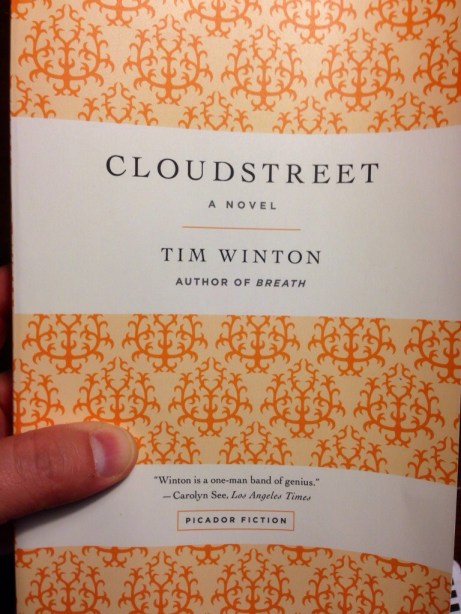
Cloudstreet (Book Acquired, 11.12.2013)

20131118-162531.jpg

Tim Winton’s Cloudstreet. Publisher’s blurb:

After two separate catastrophes, two very different families leave the country for the bright lights of Perth. The Lambs are industrious, united, and—until God seems to turn His back on their boy Fish—religious. The Pickleses are gamblers, boozers, fractious, and unlikely landlords.

Change, hardship, and the war force them to swallow their dignity and share a great, breathing, shuddering house called Cloudstreet. Over the next twenty years, they struggle and strive, laugh and curse, come apart and pull together under the same roof, and try as they can to make their lives.

Winner of the Miles Franklin Award and recognized as one of the greatest works of Australian literature, Cloudstreet is Tim Winton’s sprawling, comic epic about luck and love, fortitude and forgiveness, and the magic of the everyday.

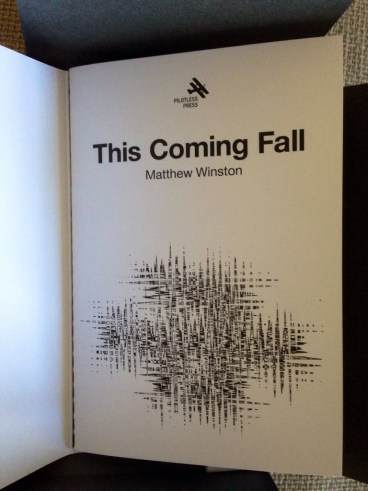
This Coming Fall (Book Acquired, Some Time at the End of October, 2013)

20131027-125350.jpg

Matthew Winston’s This Coming Fall. 

Another beautiful little book from Pilotless Press.

Their blurb:

These days it feels like we are living inside a failing machine. Enter the two-room apartment of This Coming Fall, though, and you begin to see just how far things could spin out of control. Walk from one room to the next and back again. Hear each room’s voice. You will soon realize these are the voices not of some dismal future, but of a present still obscured under the noise of our daily lives. But listen closely to the dialogue between them and one starts to resemble the voice of god, the other the voice of the faithful. Listen for long enough, and you will see that it could be the same voice after all, echoing from room to room and back again.

20131027-125343.jpg

Read my review of the first Pilotless Press project, The Mundane History of Lockwood Heights.

The Book of Men (Book Acquired, 10.25.2013)

20131027-125451.jpg

The Book of Men  is curated (and not, curiously, edited, which is the word I thought we used, but hey, whatever) by Colum McCann. Publisher’s blurb:

To help launch the literary nonprofit Narrative 4, Esquire asked eighty of the world’s greatest writers to chip in with a story, all with the title, “How to Be a Man.”

The result is The Book of Men, an unflinching investigation into the essence of masculinity.

The Book of Men probes, with the poignant honesty and imagination that only these writers could deliver, the slippery condition of manhood. You will find men striving and searching, learning and failing to learn, triumphing and aspiring; men who are lost and men navigating their way toward redemption. These stories don’t just explore what it is to be a man or how to achieve manliness, but ultimately what it is to be a human—with all of its uncertainty, complexity, clumsiness, and beauty.

With contributions from literary luminaries as diverse as the subjects they capture, and curated by the editors of Esquire, National Book Award winner Colum McCann, and Narrative 4, a global nonprofit devoted to using storytelling as a means to empathy, The Book of Men might not teach you how to negotiate a deal or mix a Manhattan, but it does scratch at that most eternal of questions: What is a man?

Lots of shorties here. Here’s Chimamanda Ngozi Adichie’s entry:

Our Sundays always tasted like peppers that flared hot in the rice and soups and stews. We sat in the kitchen, knees fresh from pews, and watched our houseboy pounding them in pairs. He held the phallic pestle—thump thump thump—while we coughed and spluttered with watery eyes. Nobody tastes them raw, it wasn’t wise. But we did, and then we’d shout and jump to the fridge for ice.
My mom sang an Igbo song about strong women. It wasn’t too trite, but it told of places she didn’t know, streams, goddesses, women who couldn’t read. Women like that would squeeze peppers, I heard, and force them between their daughters’ legs—“so they’ll stop following boys.” But Eros was good for sons. No peppers to curb sons’ paths to manhood.


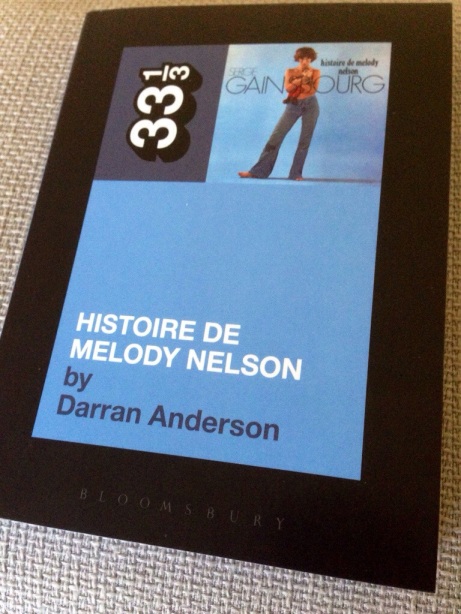
Serge Gainsbourg’s Histoire de Melody Nelson Gets the 33 1/3 Treatment (Book Acquired, 10.23.2013)

20131027-130605.jpg

Things I am a fan of: Serge Gainsbourg, Darran Anderson, and the 33 1/3 series. The 33 1/3 imprint focuses on specific albums, and the results are usually far more engaging than standard biographical fare. Histoire de Melody Nelson is the series’s latest entry; here, Darran Anderson takes on Serge Gainsbourg’s dark, moody, sexy, weird album (listen to it/see it here). I still remember the first time I heard Melody, back in college. Gainsbourg’s track with a breathy, orgasmic Brigitte Bardot “Je t’aime… moi non plus” was pretty much a party standard for my friends and me, and “Bonnie & Clyde” found its way onto plenty of mixtapes in the late ’90s. These bubblegum vamps didn’t really prepare me for Melody. I remember going to a friend’s apartment; he had just bought the album and had it playing on repeat. Dark, spacious, very short and full of strange shifts, from orchestral bombast to odd moments of quiet, the album made me feel weird. Such a weird album is a worthy topic for a book, and Anderson’s entry is a marvelous description and analysis of the artistic, cultural, and philosophical sources that Gainsbourg synthesized in Melody. Check out some of Anderson’s blog entries; they provide a compelling overview of his book:

The Origins of Melody – Nabokov’s LolitaBarbarella, Boris Vian, Sibelius, Mondo Cane.

The Avant Garde or Nothing – Gainsbourg and Vannier as innovators and a focus on their lost classics.

Initials O.G. – Serge Gainsbourg’s Hip-hop afterlife.

Connan Mockasin – Kiwi Psychedelia and the Ghost of Melody Nelson.

The book’s blurb:

Outside his native France, the view of Serge Gainsbourg was once of a one-hit wonder lothario. This has been slowly replaced by an awareness of how talented and innovative a songwriter he was. Gainsbourg was an eclectic, protean figure; a Dadaist, poète maudit, Pop-Artist, libertine and anti-hero. An icon and iconoclast.

His masterpiece is arguably Histoire de Melody Nelson, an album suite combining many of his signature themes; sex, taboo, provocation, humour, exoticism and ultimately tragedy. Composed and arranged with the great Jean-Claude Vannier, its score of lush cinematic strings and proto-hip hop beats, combined with Serge’s spoken-word poetry, has become remarkably influential across a vast musical spectrum; inspiring soundtracks, indie groups and electronic artists. In recent years, the album’s reputation has grown from cult status to that of a modern classic with the likes of Beck, Portishead, Mike Patton, Air and Pulp paying tribute.

How did the son of Jewish Russian immigrants, hounded during the Nazi Occupation, rise to such notoriety and acclaim, being celebrated by President François Mitterand as “our Baudelaire, our Apollinaire”? How did the early chanson singer evolve into a musical visionary incorporating samples, breakbeats and dub into his music, decades ahead of the curve? And what are the roots and legacy of a concept album about a Rolls Royce, a red-haired Lolita muse, otherworldly mansions, plane crashes and Cargo Cults?


Jonathan Littell’s Latest, The Fata Morgana Books (Book Acquired, 10.21.2013)

20131027-130105.jpg

The Fata Morgana Books collects four novellas from Jonathan Littell and is forthcoming from Two Line Press, a new indie specializing in publishing English language translations of some of the world’s best literature. Here is their blurb about The Fata Morgana Books, Littell’s follow up to The Kindly Ones:

Ranging from swimming pools to art galleries, from beds to battlefields, and a few mythical places, these novellas are narrated by hermaphrodites, ghosts, wanderers, and wonders. Littell here once again mixes his love of the grotesque with time-twisting narratives and ethereal protagonists. Like an Italo Calvino or a Clarice Lispector, Littell channels the emotions of loss and desire to illuminate the shadowy depths of solitude, reflection, longing, and lust.

With fleet prose and Proustian self-reflection, these stories range from chaotic airlifts to a series of bullfights under the hot sun, fatal negotiations resolved as mathematical equations, and the nine circles of Hell. Commanding and beguiling, The Fata Morgana Books rings with depth and mystery, always pushing through to explore the in-between spaces: between thoughts, between bodies, between hungers and their satisfactions, between eyes and the things they look at.

I was psyched to get a review copy of The Fata Morgana Books; Littell’s previous novel about an SS officer’s depraved undertakings, The Kindly Ones, stuck with me in a weird, gross, foul way. In my review I suggested that it was “a novel that might as well take place in the asshole, or at least the colon.”

I read the first novella in The Fata Morgana BooksEtudes, which is comprised of four stories that read like an overture for what will come. The first piece, “A Summer Sunday,” sets an unnerving and estranging tone, where pleasure seems to mingle with ennui and dread:

That Sunday, then, after the beer near the cemetery, I accompanied B. to meet our friend A. and we went out to lunch at a beautiful, somewhat isolated restaurant with a terrace only half enclosed, which allowed one to stay out in the open air without breaking police regulations too much. We ate slowly, all afternoon, lamb chops with an onion salad, and drank a bottle of red wine. Afterward, B. and I shared a cigar, too dry but a great pleasure nonetheless. Then we bought some cakes and went over for drinks on my balcony, opposite the cemetery, with the two towers at our feet. It wasn’t till the next day, reading the papers, that we realized just how bad the weekend had been. But the summer had been like that for six weeks already, and it seemed likely it would continue that way.

By “The Wait,” the next chapter of Etudes, we’ve descended into Littell’s abject terrain. More to come in a full review.
Nature’s Nightmare, A Study of David Foster Wallace’s Oblivion (Book Acquired, 10.12.2013)

20131013-093333.jpg

I was psyched when Greg Carlisle’s Nature’s Nightmare: Analyzing David Foster Walalce’s Oblivion showed up in the mail. (You might recall Carlisle as the author of Elegant Complexity, a study of Infinite Jest). Blurb from publisher Slideshow Media Group:

Carlisle gives an in-depth narrative analysis of each story: “Mr. Squishy,” “The Soul is Not a Smithy,” “Incarnations of Burned Children,” “Another Pioneer,” “Good Old Neon,” “Philosophy and the Mirror of Nature,” “Oblivion,” and “The Suffering Channel.” Carlisle’s methodical approach walks readers through Wallace’s thematic interests and situates Oblivion in the broader arc of Wallace’s career. Every passage of each story is analyzed in terms of 1) interrelation of narrative form and content, 2) relation of story to the theme of oblivion, 3) recurring thematic motifs in Wallace’s work, and 4) assessment of content in relation to Infinite Jest and The Pale King. The book includes nine charts that illustrate narrative devices Wallace employs throughout the stories. Jason Kottke called Elegant Complexity the reference book for Infinite Jest and now Nature’s Nightmare is the primary reference work for Oblivion.

I read the introduction and first chapter, covering “Mr. Squishy,” this weekend, and Carlisle’s perceptive analysis made me want to reread the story. Of course, I had to scan over the chapter for “Good Old Neon,” maybe my favorite Wallace story and arguably his best piece of writing. Here’s the diagram from that chapter (did I neglect to mention that there are diagrams?):

20131013-093341

Full review forthcoming.


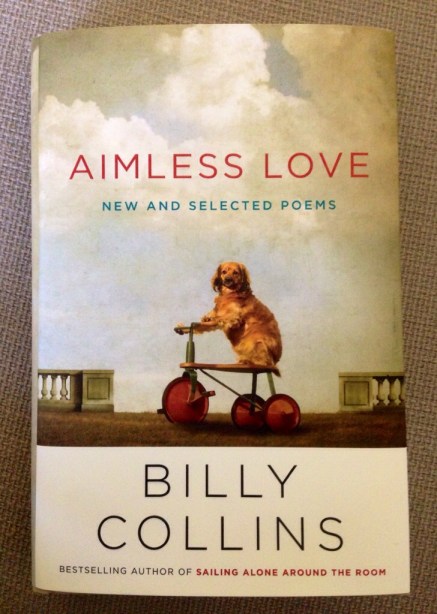
Billy Collins’s Aimless Love (Book Acquired, 10.08.2013)

20131013-093256.jpg

Aimless of Love, new from Billy Collins this month. Blurb:

From the two-term Poet Laureate of the United States Billy Collins comes his first compilation of new and selected poems in twelve years. Aimless Love combines more than fifty new poems with selections from four previous books—Nine Horses, The Trouble with Poetry, Ballistics, and Horoscopes for the Dead. Collins’s unmistakable voice, which brings together plain speech with imaginative surprise, is clearly heard on every page, reminding us how he has managed to enrich the tapestry of contemporary poetry and greatly expand its audience. His work is featured in top literary magazines such as The New YorkerPoetry, and The Atlantic, and he sells out reading venues all across the country. Appearing regularly in The Best American Poetryseries, his poems appeal to readers and live audiences far and wide and have been translated into more than a dozen languages. By turns playful, ironic, and serious, Collins’s poetry captures the nuances of everyday life while leading the reader into zones of inspired wonder. In the poet’s own words, he hopes that his poems “begin in Kansas and end in Oz.” Touching on the themes of love, loss, joy, and poetry itself, these poems showcase the best work of this “poet of plenitude, irony, and Augustan grace” (The New Yorker).

Sample:

20131013-093309.jpg


The Diary of Edward the Hamster 1990-1990 (Book Acquired, Some Time Last Month)

20131006-154358.jpg

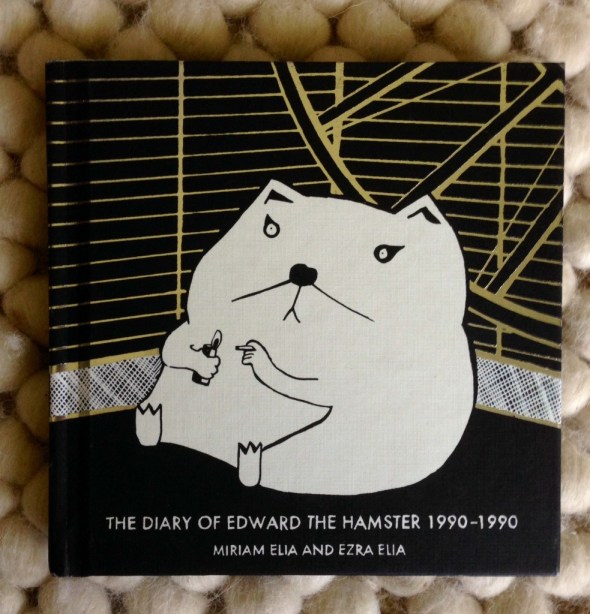
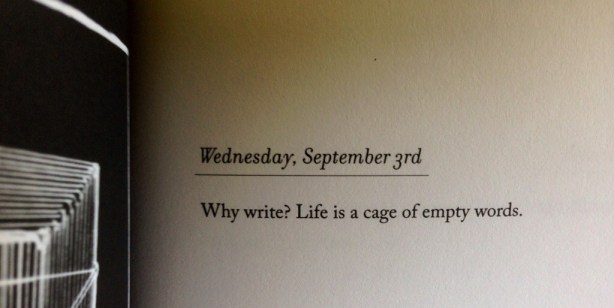
“What’s this cute little book?” my wife asked, picking up Miriam Elia and Ezra Elia’s short hardback novelty The Diary of Edward the Hamster 1990-1990. I’m sure this is the hoped-for reaction from the publishers and producers: the reader, attracted to the aesthetics of this small, square (and shiny!) picture book will pick it up and then laugh at its content—see, this hamster thinks, he feels, he writes. And he experiences ennui, existential boredom. Here is the book neatly summed up:

20131006-154406.jpg

The Diary of Edward the Hamster 1990-1990 is a one-note affair that delivers the same joke over 80 pages. The art is nice and the packaging is lovely, but the premise isn’t really that funny—certainly not funny enough to sustain over the book’s length (which is already pamphlet-short).

Parlor Games (Book Acquired, 9.15.2013)

20131006-154302.jpg

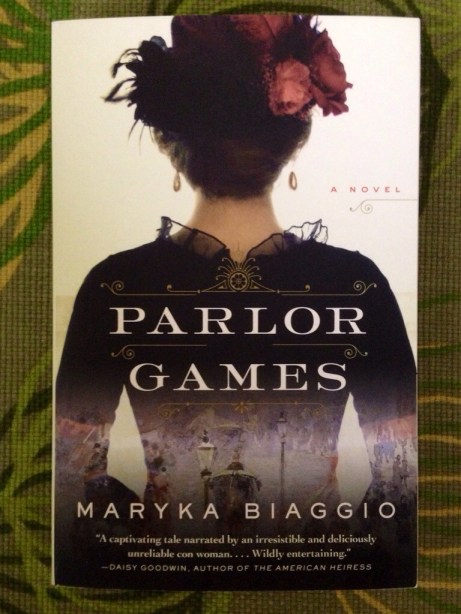
Parlor Games by Maryka Biaggio. Publisher Random House’s blurb:

It’s 1887, and eighteen-year-old May Dugas has ventured to Chicago in hopes of earning enough money to support her family. Yet when circumstances force her to take up residence at the city’s most infamous bordello, she chooses to use her feminine wiles to extract not only sidelong looks but also large sums of money from the men she encounters. Insinuating herself into high society, May lands a well-to-do fiancé—until, that is, a Pinkerton detective named Reed Doherty intervenes.

Reed has made it his mission to bring May to justice, and he pursues her across the world, from Shanghai to London and back, until he makes one last daring attempt to corner her. But May still has a few tricks up her sleeve, tricks that just might prove she’s one tough woman to catch.

The Orphan Choir (Book Acquired, 9.17.2013)

20130924-200511.jpg

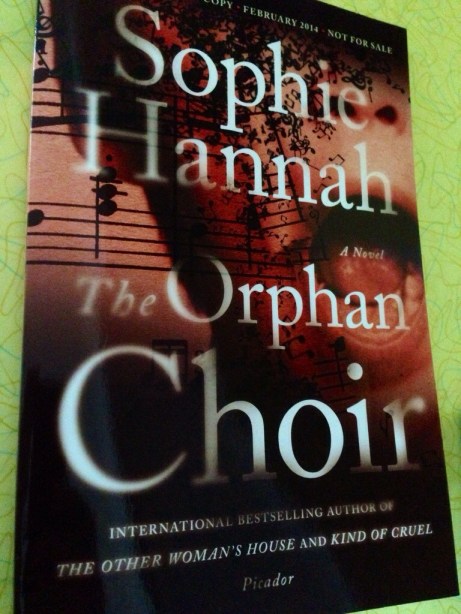
Sophie Hannah’s The Orphan Choir gets a U.S. release from Picador next year, so I grabbed the Australian blurb (Picador’s site doesn’t even list the book yet):

Louise is bereft. Her seven-year-old son Joseph has been sent away to boarding school against her wishes, and she misses him desperately. And the neighbour from hell is keeping her awake at night by playing loud, intrusive music. So when the chance comes to move to the country, she jumps at it as a way of saving her sanity. Only it doesn’t. Because the music seems to have followed her. Except this time it’s choral music, sung by a choir of children that only she can see and hear…

Never read Sophie Hannah but I’ve seen many of the spines of her books at the used bookstore I go to when I’m looking for Barry Hannah books.


The Séance Society (Book Acquired, 9.18.2013)

20130924-200501.jpg

Michael Nethercott’s The Séance Society. Blurbish review from Publisher’s Weekly:

Nethercott’s first full-length novel, a classically styled Holmesian whodunit set in 1956, introduces Lee Plunkett, an underemployed PI following reluctantly in his late father’s detective footsteps, and Mr. O’Nelligan, a charmingly low-key and literary-minded Irishman. Together they investigate the death of Trexler Lloyd, a rich eccentric, egomaniac, and patron of the arts of spirit communication, who appears to have been electrocuted at a private demonstration of “the Spectricator,” a device for speaking with the dead, at his home in Braywick, Conn. The plot manages to be twisty while proceeding logically, though the unanalyzed clues are often obvious enough that the reader must assume that Plunkett is none too clever and the smarter O’Nelligan is holding his cards close before the grand gathering and reveal. The household’s collection of psychics, servants, and ghosts are a colorful lot, but in the end are merely quirky where they could have been hilariously bold. Agent: Susan Gleason, Susan Gleason Literary Agency

The Antagonist (Book Acquired, 9.23.2013)

20130924-200527.jpg

The kind people at Random House sent a copy of Lynn Coady’s The Antagonist, which is new in trade paperback next month. Their blurb:

A piercing epistolary novel, The Antagonist explores, with wit and compassion, how the impressions of others shape, pervert, and flummox both our perceptions of ourselves and our very nature.

Gordon Rankin Jr., aka “Rank,” thinks of himself as “King Midas in reverse”—and indeed misfortune seems to follow him at every turn. Against his will and his nature, he has long been considered—given his enormous size and strength—a goon and enforcer by his classmates, by his hockey coaches, and, not least, by his “tiny, angry” father. He gamely lives up to their expectations, until a vicious twist of fate forces him to flee underground. Now pushing forty, he discovers that an old, trusted friend from his college days has published a novel that borrows freely from the traumatic events of Rank’s own life. Outraged by this betrayal and feeling cruelly misrepresented, he bashes out his own version of his story in a barrage of e-mails to the novelist that range from funny to furious to heartbreaking.

With The Antagonist, Lynn Coady demonstrates all of the gifts that have made her one of Canada’s most respected young writers. Here she gives us an astonishing story of sons and fathers and mothers, of the rewards and betrayals of male friendship, and a large-spirited, hilarious, and exhilarating portrait of a man tearing his life apart in order to put himself back together.

The book got a strange review from Ron Charles in The Washington Post that’s worth reading if your interest is piqued; from that review:

It’s an extraordinarily clever and sympathetic exploration of the cross-currents of male friendship, the intense relationships we make and abandon in school. How ill-fitting those intimacies feel years later whenever a college reunion or some chance encounter forces us to try them on again. Who owns our adolescent memories, our forgotten brutalities, our drunken confessions of affection and dread? (By the way, there are three Lynn Coadys on Facebook, but you were easy to find.)

The O. Henry Prize Stories 2013 (Book Acquired, Sometime Last Week)

20130914-084712.jpg

Here are the table of contents for the 2013 O. Henry Prize Stories:

Your Duck Is My Duck, by DEBORAH EISENBERG
Sugarcane, by DEREK PALACIO
The Summer People, by KELLY LINK
Leaving Maverley, by ALICE MUNRO
White Carnations, by POLLY ROSENWAIKE
Sail, by TASH AW
Anecdotes, by ANN BEATTIE
Lay My Head, by L. ANNETTE BINDER
He Knew, by DONALD ANTRIM
The Visitor, by ASAKO SERIZAWA
Where Do You Go? by SAMAR FARAH FITZGERALD
Aphrodisiac, by RUTH PRAWER JHABVALA
Two Opinions, by JOAN SILBER
They Find the Drowned, by MELINDA MOUSTAKIS
The Mexican, by GEORGE MCCORMICK
Tiger, by NALINI JONES
Pérou, by LILY TUCK
Sinkhole, by JAMIE QUATRO
The History of Girls, by AYŞE PAPATYA BUCAK
The Particles, by ANDREA BARRETT

My favorite thing about the list is that I’ve only heard of a handful of the writers here. Read the introduction here.

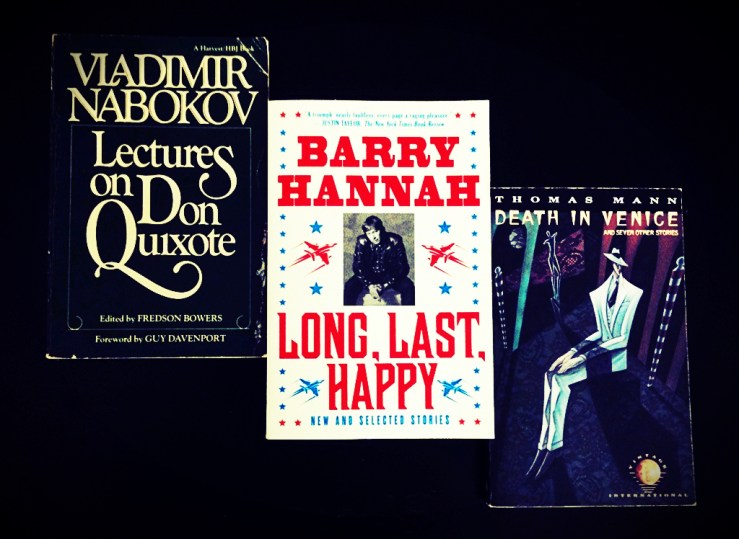
Hannah/Nabokov/Mann (Books Acquired, 8.30.2013)

20130905-153520

Paradise City (Book Acquired, 8.26.2013)

20130830-073951.jpg

The name of this writer is Archer Mayor, which is like two professions and is too good to be made up. Paradise City is “A Joe Gunther Novel,” and I assume it somehow involves Axl Rose. Har har. Actually it’s set in Vermont. Publisher’s blurb:

Joe Gunther and his team at the Vermont Bureau of Investigation are alerted to a string of unrelated burglaries across Vermont. Someone, in addition to flatscreens, computers, and stereos, has also been stealing antiques and jewelry.

Meanwhile, in Boston, an elderly woman surprises some thieves in her Beacon Hill home and is viciously murdered. The Boston police find that not only is the loot similar to what’s being stolen in Vermont, but it may have the same destination. Word is out that someone powerful is purchasing these particular kinds of items in the “Paradise City” of Northampton, Mass.

Gunther, the Boston Police, and the vengeful granddaughter of the murdered old lady convene on Northampton, eager to get to the bottom of the mystery and find the “responsible parties”—although each is motivated to mete out some very different penalties.


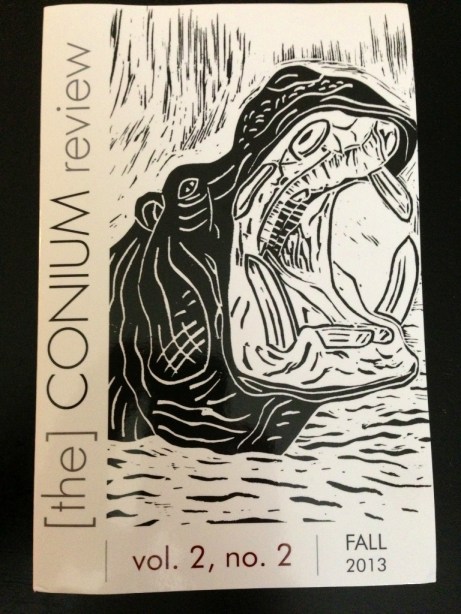
The Conium Review, Vol. 2, No. 2 (Book Acquired, 8,19.2013)

20130824-102848.jpg

This came in the mail a few weeks ago; I read a few of the poems and flash fictions, but haven’t had made time for the stories or the novella. From the The Conium Review’s website:

This issue of The Conium Review contains seventeen poems, five pieces of flash fiction, four short stories, and one novella. The contributing poets and writers are Elena Botts, Valentina Cano, Paola Capó-García, Patrick Cole, Darren C. Demaree, Thomas Dodson, Edward A. Dougherty, Ginger Graziano, Alamgir Hashmi, Kyle Hemmings, Nicholas Kriefall, Connie A. Lopez-Hood, Carlo Matos, Gretchen McGill, Robert McGuill, Thomas Mundt, Catherine Owen, Natalie Peeterse, Richard King Perkins II, Octavio Quintanilla, Charles Rafferty, Scott Ragland, Jonathan H. Roberts, M. A. Schaffner, Jacob Schepers, Claude Clayton Smith, and Emily Strauss. The cover art is courtesy of Loren Kantor.


But Where Is the Lamb? (Book Acquired, 8.23.2013)

20130824-102817.jpg

But Where Is the Lamb? by James Goodman. The book is about Genesis ch. 22, the story where God says to Abraham, kill me your son. Good design on this one:

20130824-102824.jpg

Publisher Random House’s blurb:

“I didn’t think he’d do it. I really didn’t think he would. I thought he’d say, whoa, hold on, wait a minute. We made a deal, remember, the land, the blessing, the nation, the descendants as numerous as the sands on the shore and the stars in the sky.”

So begins James Goodman’s original and urgent encounter with one of the most compelling and resonant stories ever told—God’s command to Abraham to sacrifice his son Isaac.

A mere nineteen lines in the book of Genesis, it rests at the heart of the history, literature, theology, and sacred rituals of Judaism, Christianity, and Islam. For more than two millennia, people throughout the world have grappled with the troubling questions about sacrifice, authority, obedience, and faith to which the story gives rise. Writing from the vantage of “a reader, a son, a Jew, a father, a skeptic, a historian, a lover of stories, and a writer,” Goodman gives us an enthralling narrative history that moves from its biblical origins to its place in the cultures and faiths of our time. He introduces us to the commentary of Second Temple sages, rabbis and priests of the late antiquity, and early Islamic exegetes (some of whom imagined that Ishmael was the nearly sacrificed son). He examines Syriac hymns (in which Sarah stars), Hebrew chronicles of the First Crusade (in which Isaac often dies), and medieval English mystery plays. He looks at the art of Europe’s golden age, the philosophy of Kant and Kierkegaard, and the panoply of twentieth-century interpretation, sacred and profane, including the work of Bob Dylan, Elie Wiesel, and A. B. Yehoshua. In illuminating how so many others have understood this story, Goodman tells a gripping and provocative story of his own.