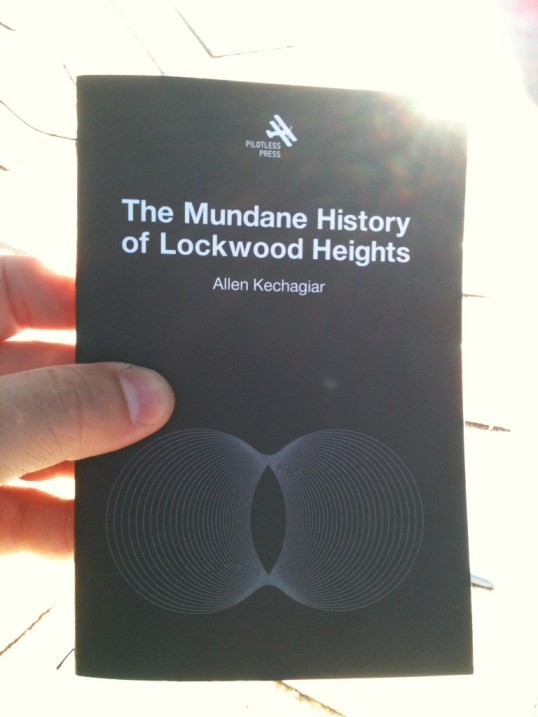
“The Mundane History of Lockwood Heights” is a lovely little chapbook, new from Pilotless Press, an Athenian outfit (uh, Greek, not Georgian) that knows how to put together an aesthetically-pleasing text. “Lockwood Heights” is their first release. It’s by Allen Kechagiar, who, full disclosure, I’ve been email-friendly with for a several years now.
What’s “Lockwood Heights” about?
An unnamed narrator, a young man, returns to his hometown in California, the titular Lockwood Heights, “another far station, another dead end valley prone to fire, another far suburb with no other cause than the profit it would generate for its contractors.” With little going for it in a depressed economy, the citizens of Lockwood Heights allow porn production to become their town’s raison d’etre. Studios move in and the girls of Lockwood Heights soon find they can essentially auction off their virginity on camera:
They struggle to keep their virginity intact (or at any rate their parents struggle to keep it so) and hope that they will be chosen as the royal heir’s queen consort. Here, at Lockwood Heights, we had our very own race: at its finish line there was no prince to greet the winners, but a whole menagerie, or more accurately a bestiary, comprising of artificially tanned Californian would-have-beens, barely legal girls with gigantic strap-ons, transvestites and hermaphrodites, midgets and giants, obese, anorexic, effeminate, silicon-enhanced or not, all of them with a ticket to her body, standing in a metaphorical queue. A body that wasn’t hers to control anymore. The studio owned it from then on, through the unwritten contracts of promised fame that is rarely delivered.
They were also called the Treasurers or The Knights Who Say No. Their motto was non numquam. Their herald was a locked gate.
The various histories of these girls fill most of “The Mundane History of Lockwood Heights,” and as the narrator often uses the first-person plural “we” (that is, the high school boys), the story sometimes takes on a melancholy and wistful tone similar to Eugenides’s The Virgin Suicides. These are the finest moments of “Heights,” compact and precise narratives that relate the sad (and sometimes not-so-sad) lives of these girls who make porn (or, in some cases, refuse to).
It’s not just the girls of Lockwood Heights who sell their bodies on film—our protagonist comes home to sell all he has left, his “twin virginity” to be lost for a director who is sometimes called the Stanley Kubrick of porn. Scenes of the narrator meeting the casting director, his costar, and other workers on the film’s production are interspersed with the girl stories, as well as the backdrop of the narrator’s homecoming. His father has died, his mother is absent, and a strange little ersatz closet has been constructed in one of the house’s corridors. The interrelationship between these three elements is not as fully developed as it could be; I found myself wanting more. I also wanted more of the strange, aphoristic asides the narrator occasionally offers, like this one:
When we sleep we do not live in the full sense of the word. We rehearse death. Our dreams, the fallout of our daily lives, can only be remembered. They cannot be lived.
When they happen, we do not exist.
In its best moments (and there are plenty of those), “Heights” commands the reader’s attention with its bizarre mix of pathos and the pathetic, with sharp humor that threatens to tip into something more sinister. The southern California exurb Kechagiar crafts recalls the slightly off dystopias of George Saunders—the kind of place we wish were more removed from our immediate reality. “The Mundane History of Lockwood Heights” feels like the starting point of something bigger, more expansive, more detailed—and I’d want to read that something. Recommended.







 Biblioklept