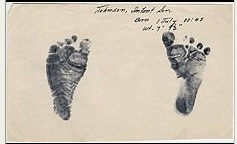
The Harry Ransom Center has acquired novelist Denis Johnson’s baby footprints (along with other archival material, including manuscripts, annotations, and other personal material). Read more here. Read our reviews of Johnson’s books Tree of Smoke, Jesus’ Son, and Nobody Move.
Once upon a time, young people who were lucky enough to have the leisure to read what they wanted gravitated toward texts like Little Women, The Adventures of Tom Sawyer, and Great Expectations. These books weren’t necessarily written for or marketed to teenagers, but they found (and continue to find) a hungry audience in adolescents. The rise of the modern publishing industry saw a way to feed these voracious young readers, and Young Adult–YA–has since solidified into its own genre, complete with its own set of conventions and tropes, found in fantasies, romances, adventures, and sci-fi novels alike. YA tends to enlarge themes that predominate literature as a whole–alienation, isolation, shame, transformation, and (of course) identity. The best YA literature speaks to adolescent fear, channels it into thought experiments and fantasies that help teens to cope with their changing identities. However, YA, like any genre, puts a writer at risk of being ghettoized, of having her own work thrown in with a good many bad books. In recent years, established writers like Sherman Alexie and Nick Hornby have purposefully written YA books and worked to have their books marketed as such, but perhaps many writers don’t want to be pigeonholed into a genre by having their books directed squarely at teens.
I was thinking about this problem today when I read Michiko Kakutani’s somewhat negative review of Laurence Gonzales’s new novel Lucy in the The New York Times. I received a review copy of Lucy back in March and breezed through it in a few afternoons. It’s an enjoyable read with a preposterous plot that somehow doesn’t come across as a gimmick. The eponymous Lucy, you see, is a genetic experiment, a humanzee born of a bonobo and raised in the middle of the jungle by a (not so) mad scientist named Stone until the age of 14, when insurgents murder her erstwhile dad/creator. Lucy is summarily adopted by another scientist, Jenny Lowe, who takes her to Americaland where she learns to be a normal teen. That is, until her super-chimp powers are revealed to the good American people, who come after her, mob-persecution style. Kakutani insists on reading Gonzales’s work as a Frankenstein story, and picks at it for not explaining its science as well as Michael Crichton’s Jurassic Park. What Kakutani is failing to see is that the novel is not really about scientific hubris–it’s about how hard it is to be a teenager; specifically, it’s about how hard it is to be a teenage girl with a teenage girl body. Kakutani, apparently mistaking books for gravy, also takes Lucy to task for being “lumpy.” If Lucy lacks the finesse, explication, or subtlety that Kakutani would like it to have, then perhaps that is because she misunderstands its audience (to be fair though, Kakutani seems to frequently forget that not all books should be written to her taste).
Again at The New York Times, Tom DeHaven made a similar, if less boorish mistake, earlier this summer in his review of Simon Rich’s début novel Elliot Allagash. Here’s his lede:
If I were in the eighth grade, I’m pretty sure I’d love Simon Rich’s first novel, “Elliot Allagash.” I might even press it on my friends. (“It’s about this 13-year-old evil genius who does whatever he wants because he’s, like, a billionaire. And it’s funny. And short.”) But since more than 45 years have passed since I took up space in a middle school, I simply like it, very much — while wishing this flippant little parable about the puerility of greed had a deeper, sharper bite.
DeHaven wishes Rich’s book had a “deeper, sharper bite” — like Kakutani’s quibble with Gonzales, he wants the kind of acuity that ultimately is not best suited for the eighth and ninth grade boys who will love this book, who will press it on their friends. In my own review of Elliot Allagash, I wrote: “I don’t think that Elliot Allagash is being promoted directly as a Young Adult novel, but it will have a ready audience in the same smart crowd who dig funny, bright novels like C.D. Payne’s Youth in Revolt and Sherman Alexie’s The Absolutely True Diary of a Part-Time Indian.” But even though Elliot Allagash and Lucy aren’t being promoted by their respective publishers Random House and Knopf as YA, that doesn’t mean that they don’t have a potential audience of young adults–and it seems impossible to me that seasoned critics like Kakutani and DeHaven could be ignorant of that. Older readers might enjoy Lucy or Elliot Allagash but young readers might love them; critics shouldn’t condescend authors for not overreaching. A pretentious book is a sin and neither of these books is pretentious.
After five five fun-filled (mostly) sun-soaked days on Florida’s glorious Gulf Coast, Biblioklept returns from July 4th reveries. I found time to finish Adam Langer’sThe Thieves of Manhattan–full review forthcoming, but now, I’m still in a lazy-loungy mood: so, links and vids and so forth–
First, I ripped my title from Edgar Allan Poe’s “The Fall of the House of Usher,” which you obviously knew of course, gentle reader, because of course you’ve read it, but maybe you haven’t seen Jan Svankmajer’s 1981 film adaptation. Creepy stop motion that completely dispenses with actors. Ignore the subtitles.
Another great little film I saw this weekend is Oliver Laric’s Versions (2010), an essay that playfully updates Walter Benjamin’s “The Work of Art in the Age of Mechanical Reproduction.” Watch Versions. A choice line–perhaps appropriated?–from Laric’s essay: “There is more work in interpreting interpretations than in interpreting things and more books about books than any other subject.”
Still on film: watched John Huston’s 1956 adaptation of Moby-Dick on a lazy post-July 4th demi-hangover. Melville’s novel is unfilmable, really, but Huston’s effort isn’t half bad, although the tone of “high adventure” and the downright jaunty soundtrack hardly fit the grisly images of whale killing that permeate the work. The climax doesn’t really read as big as it should either. Key scene: Orson Welles delivers Father Mapple’s sermon–
Finally, I listened to a good chunk of the audiobook of David Mitchell’s new novel The Thousand Autumns of Jacob de Zoet. Good stuff so far (great stuff, really), and a full review forthcoming, but for now, here’s Dave Eggers’s review.
The Takeaway has put up some audio clips of David Foster Wallace, from the archives of David Lipsky, author of Although of Course You End Up Becoming Yourself: A Road Trip with David Foster Wallace. Not much, but we’ll take it.
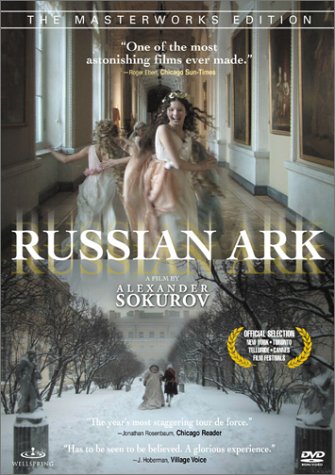
Before I get into the details of Aleksandr Sokurov’s 2002 film Russian Ark, I implore you to stop reading my review and simply get a hold of the film and watch it. It’s a marvelous, rewarding, dreamy experience. That’s not a very convincing argument of course, but I think that the best way to see this gorgeous film is with no preconceptions, with as little information as possible–not because there are plot twists that a review might give away, but rather because the pleasure of Russian Ark is its narrative immediacy–and any review will seek to mediate that immediacy. So I’ve hemmed and hawed. If you need further convincing, read on.
It’s hard to know where to begin, so I’ll let Don DeLillo do it for me. In his latest novella, Point Omega, his filmmaker protagonist describes it as an ideal for the kind of truth he’d like to capture in one of his own films:
There’s a Russian film, feature film, Russian Ark, Aleksandr Sokurov. A single extended shot, about a thousand actors and extras, three orchestras, history, fantasy, crowd scenes, ballroom scenes and then an hour into the movie a waiter drops a napkin, no cut, can’t cut, camera flying down hallways and around corners. Ninety-nine minutes.
That was enough for me to get hold of Russian Ark and watch it, or rather experience it (I think experience is the best verb here, corny as that sounds), but perhaps, gentle reader, you’d like some plot details. Let’s give it a shot. The film begins in darkness, with its unnamed/unseen protagonist describing the vague details of his last memory, a violent accident that he remembers little about. But before we go on, I should point out a few things: this protagonist is unseen because he is essentially the camera; his movement propels the film–is the film–and although he is his own character, he is also a surrogate for the audience. His first-person experience dictates the film, is the film, and although he has ghostly access to the characters who float through the gorgeous halls of the State Hermitage in St. Petersburg, they cannot see or hear him. There is one character who can see him however, an unnamed black-clad 19th-century French aristocrat who the protagonist comes to call “the European.” Neither the European or the protagonist understand why they are in the Hermitage or how they got there; the European is even more perplexed to find that he now speaks perfect Russian. Unlike the protagonist, the European can interact with the denizens of the Hermitage, and interact he does, by turns offending, menacing, or charming (or at least attempting to charm) the characters that the pair encounters as they drift through the ballrooms, galleries, and courtyards of this beautiful palace. Initially, the European repeatedly insults Russian culture, which he believes a pale imitation of European aesthetics. He even protests that one of the fine orchestras that they stumble upon must be manned with Italian players, as Russian musicians simply couldn’t be so skilled. But as they wander the halls, the European slowly succumbs to the rich beauty and opulence of the Hermitage; although he never states it outright, he relents his prejudice against Russian culture, and perhaps even learns a new way of seeing beauty.
And who wouldn’t be moved by the beauty here? Russian Ark functions in some way as a guided tour of the Hermitage, although that term, “guided tour” implies a stuffiness that’s antithetical to the looseness of this film. The camera lingers on a painting or statue; the protagonist offers his thoughts, the European his; perhaps an erstwhile docent steps in to explicate a point of technique or symbolism. It’s wonderful. In one stunning moment (scene would not be the right word for this movie which is of course one long scene), the European argues violently with a boy over a painting of the apostles Peter and Paul. The boy admits to knowing nothing of the scriptures, yet he’s deeply moved by the wisdom and promise that the painting connotes; the European cannot understand how the painting’s aura alone can transmit its meaning to the ignorant lad. The scene begins at 6:38 in the clip below:
The European’s clash with the boy echoes the larger (and yet subtle) clashes of the film, as characters, artworks, and musical styles of different epochs float into or burst out of or parade around in the grand rooms of the Hermitage. There’s Pushkin, Peter the Great, Catherine the Great, Anastasia. There’s an incredible scene where Tsar Nicholas I is offered an apology by the Shah of Iran for the death of an ambassador; there’s a wonderful ballroom dance that moves the European to great joy. In one of the film’s pockets of horror, a layman labors in a strange utility room building his coffin; it is the siege of Leningrad in WWII where over a million people died at the hands of the Nazis. The European, of course, has no knowledge of these events, being after his time, and the disjunction between the protagonist’s contemporary perspective of history and his own provides for a fascinating, if not wholly fleshed out, conflict.
Indeed, one of the greatest pleasures of Russian Ark is its refusal to narrativize or philosophize history beyond a first-person perspective walk through the halls of the Hermitage. The movie erupts into little pockets of exuberant joy or strange, desperate violence; sometimes the protagonist is drawn in, but just as often he’s repelled, and looks for another avenue, like a dreamer willing his own escape. To call the movie dream-like would be an understatement, and like a dream, Russian Ark‘s divergent set pieces overwhelm the senses in their rich splendor. Like the protagonist and the European, I found myself repeatedly entranced by a painting or a concert or a dance or a strange little moment, only to be interrupted by another character intruding into the frame, bearing new information, discordant news that disrupts the dream logic (while paradoxically ushering in a new set piece). Russian Ark distracts its audience, sending them inward; in contemplation, the viewer loses the thread–but is there a thread? Is real life a narrative? Are dreams even narratives? Some of my favorite moments of the film happened when my anxiety at having been distracted by some gorgeous detail was confirmed by the protagonist, who all of a sudden has lost the European, or who is startled by the bustling arrival of new people. But of course, in this film, the viewer is the protagonist.
But writing about Russian Ark is no good, not really. You have to just see it (but I already said that, right?) To quote again from DeLillo’s Point Omega, “The true life is not reducible to words spoken or written, not by anyone, ever.” Sokurov’s film collapses history and art and beauty into a beautiful, edifying, sometimes terrifying dream, a dream that, in its adherence to first-person perspective, is a marvelous approximation of true life. Highly recommended.
Musicologist Jan Swafford’s article “Why E-books Will Never Replace Real Books” at Slate makes a good case for why we’ll still want printed books in the age of the iPad and Kindle (not that I needed convincing). From the article:
So real books and e-books will coexist. That has happened time and again with other new technologies that were prophesied to kill off old ones. Autos didn’t wipe out horses. Movies didn’t finish theater. TV didn’t destroy movies. E-books won’t destroy paper and ink. The Internet and e-books may set back print media for a while, and they may claim a larger audience in the end. But a lot of people who care about reading will want the feel, the smell, the warmth, the deeper intellectual, emotional, and spiritual involvement of print.
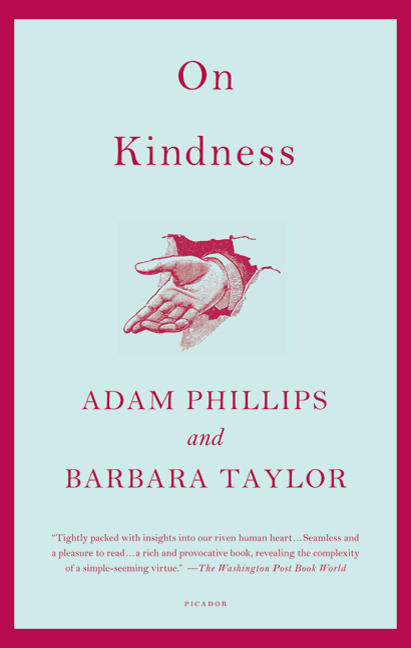
On Kindness seeks to answer why “It is now generally assumed that people are basically selfish and that fellow feeling is either a weakness or a luxury or a more sophisticated form of selfishness.” Psychoanalyst Adam Phillips and historian Barbara Taylor quickly demonstrate that up until the “so-called dawn of modernity” in the Enlightenment, people simply believed themselves to be naturally kind. The advent of the ideals of self-reliance and independence (along with the appeals of aggressive mercantile capitalism) led to a zeitgeist–one that still exists–in which kindness is a form or weakness, or a type of duty, like philanthropy, that negates its own purity. In short, Phillips and Taylor point to a general feeling that real kindness might not exist–and then argue, quite convincingly, against this general feeling.
The book’s second chapter, “A Short History of Kindness” outlines the philosophy and social practice of kindness from the time of Seneca through to Freud. Phillips and Taylor choose Jean-Jacques Rousseau as their champion, with Thomas Hobbes (and his famous dictum of bellum omnium contra omnes) as a recurring villain. But it’s Freud who dramatically problematizes modern attitudes toward kindness, with the radical idea that “aggression itself can be a form of kindness; that when aggression isn’t envious rage or the revenge born of humiliation, it contains the wish for a more intimate exchange, a profounder, more unsettling kindness between people. In short, psychoanalysis makes sentimentality and nostalgia, not hatred, the enemies of kindness.” This complicates the relationships between children and parents; psychoanalysis renders kindness unnatural. The resulting confusion leaves us open to the idea that acts of kindness might leave us radically exposed or otherwise in harm’s way. Even worse, modern society elevates and idealizes kindness into “a virtue so difficult to sustain that only the magically good can manage it” — this “destroys people’s faith in real or ordinary kindness.” But, Phillips and Taylor want to assure us, real and ordinary kindness does exist. “We depend on each other not just for our survival but for our very being,” they argue in their final chapter. “The self without sympathetic attachments is either a fiction or a lunatic.” So, what are the solutions? Philips and Taylor clearly argue that the pleasures of kindness they advocate cannot stem from “moral superiority or domineering beneficence or the protection racket of good feelings. Nor are acts of kindness to be seen as acts of will or effort or moral resolution.” Instead, our authors argue for “a revived awareness of something that is already felt and known.”
On Kindness is a compact, tightly-wound tract of 114 pages that can be read quickly by a general audience, but nevertheless takes some time to digest. Picador’s trade paperback edition (new this month) is handsome and small enough to fit into a cargo pocket, purse, or beach bag. It seems of a piece with Picador’s Big Ideas/Small Books series, erudite works that consider big subjects without ever falling into traps of academic solipsism. Recommended.
Your narrator speaks a lot about his philosophy on boredom. How much of this do you share with him?
Well, I would have to say quite a lot. I mean, I truly believe – as Bertrand Russell did before me – that if we truly embraced boredom there would be less violence in the world. When I say truly embrace boredom I mean that we should make an effort not to fight it – we especially shouldn’t do something just to stop us from feeling bored (this just leads to the type of passive nihilism the philosopher Simon Critchley warns us about). I think we should just accept it and naturally feel bored and ultimately do nothing. Fighting boredom only leads to friction, which can cause myriad things, including the type of violence that haunts my novel. But I know this is a losing battle. It is a losing battle because boredom reveals to us the nothingness that makes up our lives: the gaping void of our existence, its meaninglessness and finiteness. Obviously this gaping void scares the shit out of us. And it is because of this intrinsic fear that we mostly fail.
I have terrible writer’s block. It’s not that I have nothing to say, it’s just that I can’t seem to say it. Or that I write sentences like the previous one and shudder at their awkward clunky artless awfulness. But I’m gonna press through it, write through it, and share a few thoughts on what I’ve read this week–
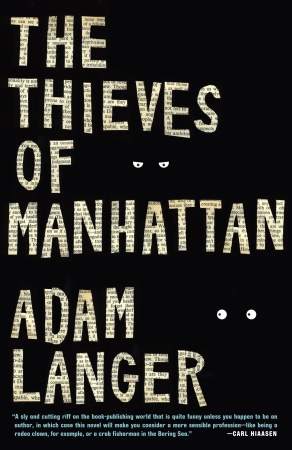
First up: Adam Langer’s new novel, The Thieves of Manhattan, a send-up of the publishing industry that sets its targets directly on the current swath of (faked) memoirs that have done gangbusters for publishers in the past few years. Ian Minot is a broke-assed barista one fuck-up away from an overdue firing, who moves from the Midwest to make it as a writer in the big city. Only he’s not doing so well–in contrast to his gorgeous Romanian girlfriend Anya whose literary star is on the rise. For Minot though, this isn’t the worst–that would be the rampant success of über-poseur Blade Markham, a wanna-be gangsta whose memoir Blade on Blade is a blatant fabrication (albeit a fabrication that no one but savvy schlemiel Minot seems to notice (or, at the least, be bothered by)). I read the first fifty-odd pages of the Thieves in one sitting–a good sign to be sure. Langer’s Minot’s voice is familiar territory, the boy who loves to mock the literati he would love to be a part of. In one of the signal moves of his patois, the names of famous authors (and characters) regularly replace common nouns–a bed becomes a proust, a full head of hair is a chabon, sex is chinaski and so on. Minot seems to be headed to running his own grift soon with the help of a man he appropriately calls the Confident Man–should be good stuff. Full review forthcoming. The Thieves of Manhattan is available July 13, 2010 from Spiegel & Grau.
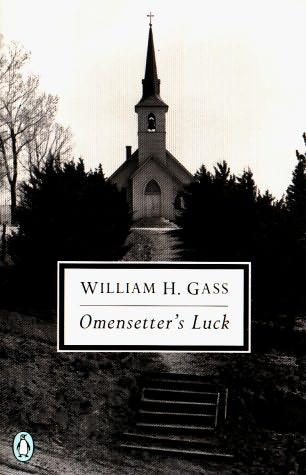
I’ve also been reading William H. Gass’s first novel, Omensetter’s Luck. It’s weird, wonderful, Faulknerish in its loose (but somehow layered and constructed) stream of consciousness. Omensetter’s Luck comprises three sections, each progressively longer; I finished the second one today, and so far the novel seems to dance around a description or accounting of its namesake, Brackett Omensetter who carts his family into the small sleepy town of Gilean, Ohio, and immediately perplexes the townsfolk with his amazing luck. As Frederic Morton put it in his contemporary 1966 New York Times review, “It quickly becomes apparent that as other people have green thumbs, [Omensetter] has a green soul. The cosmos and he live in mysterious congruity.” There’s much to commend and unpack in Gass’s writing here, but the pleasure of his musical rhythm are enough for me now (in my writer’s block, I retreat to aesthetic criticism [shudders]). Besides, do I really have to recommend this novel when David Foster Wallace already did so in his semi-famous list “Five Direly Underappreciated U.S. Novels > 1960”? No, I don’t, that’s right. Here’s Wallace on Omensetter’s Luck: “Gass’ first novel, and his least avant-gardeish, and his best. Basically a religious book. Very sad. Contains the immortal line ‘The body of Our Saviour shat but Our Saviour shat not.’ Bleak but gorgeous, like light through ice.”
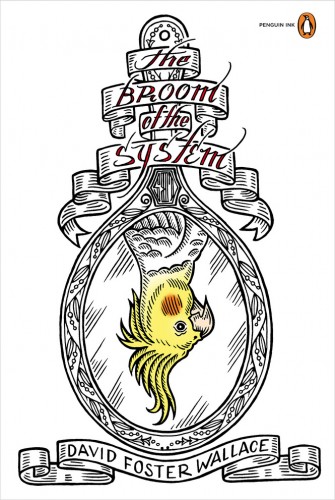
Speaking of Wallace and début novels, Richard Rayner at The Los Angeles Times has reviewed Wallace’s first book The Broom of the System, which is being republished at the end of this month with a cool new cover by tattoo artist Duke Riley. A considered, well-written review, one which prompted me to dig out (okay, bad verb phrase choice; no unearthing involved, my Wallace volumes are neatly aligned together on a shelf in my living room) my copy of Broom. I remember reading a friend’s copy in the burning humidity of a Gainesville summer, in ’98 or ’99, reading the book in long chunks. I tried to read it again after I finishing Infinite Jest but it seemed kinda sorta goofy (albeit purposely, Pynchonesquely goofy). Anyway, Rayner’s review makes a strong case for a re-reading.
And, speaking of Wallace (again), or at least using him as a crutch–I’ve almost finished Autobiography of a Recovering Skinheadby Frank Meeink (“as told to” Jody M. Roy; they’ve sort of got the whole Malcolm X/Alex Haley thing going on there). So, yeah, why the Wallace segue? How to justify it? Well, reading Meeink’s story, the true story of an abused, battered Philadelphia kid who falls into the American neo-Nazi movement and its attendant violent crime and terrorism, who goes to prison and finds redemption and human connection and a new purpose for the nihilistic void of his life, who falls into alcoholism and drug addiction only to be redeemed again–reading Meeink’s story, even knowing its veracity (demonstrable to a point that would satisfy even Langer’s Ian Minot)–I couldn’t help but read his strong, immediate, gritty, and utterly real voice as something not unlike one of the creations in David Foster Wallace’s Brief Interviews with Hideous Men. It’s not just Meeink’s hideousness, his violence, or the grace that he works toward–all constituents of DFW’s collection–it’s that voice, the realness of the volume, surely the book’s greatest asset. Recovering Skinhead is an engrossing read, fascinating in the same way that an infected wound prompts our attention, our paradoxical compulsion and repulsion, but most of all it’s an exhilarating and exhausting performance of voice, of Meeink’s unrelenting, authentic telling of a tale, a telling that any novelist would thrill to channel. Only Meeink’s voice isn’t a novel creation: it’s real. Autobiography of a Recovering Skinhead is available now from Hawthorne Books.
Images from Luigi Serafini’s surreal cryptoencyclopedia, Codex Seraphinianus. Learn more by reading Justin Taylor’s essay from the May 2007 issue of The Believer.
This month, the good folks at Picador are issuing an expanded edition of Paul Auster’s essays, memoirs, prefaces, true stories, anecdotes, and interviews. Inconspicuously titled Collected Prose and running to just under six hundred pages, the volume includes Auster’s début work The Invention of Solitude in its entirety. Solitude is a strange blend of personal memoir, an account of the young writer’s reaction to and relationship with the death (and life) of his father, as well as a philosophical meditation on the absurdity of family, art, and time. Collected Prose also includes the later memoir, Hand to Mouth, a reflective piece on Auster’s early failures as he tries to make it as a writer, including his time in Paris, his marriage to Lydia Davis, his hunger, and his poverty. While Solitude inaugurates many of the experimental structures and postmodern tropes that Auster would be identified with throughout his career as a novelist, the flatter, more direct style of Hand to Mouth is more indicative of the tone of much of Collected Prose. There’s a journalistic directness and keen earnestness to Auster’s essays that perhaps belie his postmodern bona fides. That’s a good thing, allowing Auster to communicate directly about his sometimes challenging subjects to a wider audience. Style aside, both of the book-length memoirs at the front end of Collected Prose neatly delineate the themes that preoccupy much of the rest of the book: art, language, writing, writers, poverty, absurdity, movement, New York City, and so on. And although the book turns away from Auster’s memoirs and true stories in its second half, presenting his essays, editorials, and prefaces, there’s still a sharp sense of Auster in each essay. These are personal essays. Auster writes about his friend Philippe Petite, the French high-wire artist; he writes about the literal hunger artists face, using Knut Hamsun and Franz Kafka as examples; he writes a vindication for Dada daddy Hugo Ball; he writes on over half a dozen relatively obscure poets to let us know why they matter. There are wonderful little moments, like “The Story of My Typewriter,” where Auster exclaims his love for his quiet Olympia (he buys 50 typewriter ribbons fearing the specie’s eventual extinction). The book reprints the Sam Messner paintings that originally accompanied Auster’s text (or, perhaps, vice versa).
Another great moment is the essay “Hawthorne at Home,” which takes a look at a little known piece by Nathaniel Hawthorne called Twenty Days with Julian & Little Bunny. Hawthorne’s piece is more or less a straightforward narrative account of Hawthorne alone with his five-year old son Julian and his pet rabbit for three weeks while wife Sophia visited the Peabodys. While Auster gives the reader a lesson on Hawthorne and his composition of The Scarlet Letter here, the essay focuses on the idyllic charm of a father and son, a rare subject in Hawthorne’s oeuvre. As a bonus, Herman Melville makes a cameo. “Hawthorne at Home” is the sort of essay that makes you want to go read the source material; it sent me hunting for a used copy of American Notebooks.
As one might imagine, Collected Prose is absolutely larded with writers, and lovingly so. Auster does not suffer from the inclination toward meanness that so many critics feel toward their peers, perhaps because he writes foremost from the perspective of an artist. Not that it’s difficult to praise Art Spiegelman (“The Art of Worry”) or pray for Salman Rushdie (um, “A Prayer for Salman Rushdie”) or speak to the genius of Samuel Beckett (“Remembering Beckett on His One Hundredth Birthday”) and Jim Jarmusch (“Night on Earth: New York”)–but Auster illuminates their work in a way that transcends the postmodern concerns of technique, place, and politics, and speaks directly to a certain aesthetic excellence. His love for storytellers extends beyond the pros, of course, evinced in his work with NPR’s National Story Project. He credits wife Siri with coming up with the idea of having NPR listeners write and submit their own original stories, but his enthusiasm for her idea resonates in his warm preface to the eventual book that collected the listeners’ submissions. Auster writes, “I learned that I am not alone in my belief that the more we understand of the world, the more elusive and confounding that world becomes.” The world becomes more “confounding” after the 9/11 attacks, of course, and like so many other writers Auster attempted to somehow measure the tragedy in words. “Random Notes–September 11, 2001–4:00 PM” is a scrap, a fragment, a shell-shocked missive that ends with the haunting words “And so the twenty-first century finally begins.”
It might be misleading to call Collected Prose a good introduction to Paul Auster’s nonfiction–can a work so comprehensive, so massive be a mere starting point?–but it is a great introduction, so there. It’s also a fantastic overview of critical, literary, and artistic theory, written from a deeply personal perspective. Let’s hope that fifteen years from now we’ll have another expanded edition of Auster’s prose; in the meantime, we can look forward to his new novel Sunset Park this November. Highly recommended.
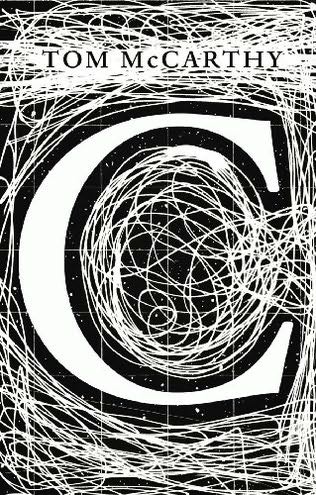
Finished Tom McCarthy’s newest novel Clast night. It doesn’t come out until this autumn–and I’ll post, y’know, a long, detailed review then–but for now–
The book is tremendous. You should start looking forward to it now. Great, great stuff. Loved it. Will read it again. Very highly recommended. You get the idea.
Bloomsday, an annual celebration of James Joyce’s Ulysses, is upon us today with moreexcitement than ever. Even with the festivities, the book’s reputation for density, erudition, and inscrutability still daunts many readers–leading to a glut of guidebooks, summaries, and annotations. Ironically, rather than inviting first-time readers to the text, the sheer volume of these guides to Ulysses can paradoxically repel. Their very existence seems predicated on an intense need, and although some of the guides out there can be helpful, others can get in the way. This need not be. Ulysses deserves its reputation as one the best books in the English language. It generously overflows with insight into the human experience, and it’s very, very funny. And, most importantly, anyone can read it.
Here are a few thoughts on how to read Ulysses, enumerated–because people like lists:
1. Ignore all guides, lists, maps, annotations, summaries, and lectures. You don’t need them; in fact, they could easily weigh down what should be a fun reading experience. Jump right into the text. Don’t worry about getting all the allusions or unpacking all the motifs.
Pretty soon though, you’ll get to the third chapter, known as “Proteus.” It’s admittedly hard to follow. You might want a guide at this point. Or you might just want to give up. (Of course, you might be a genius and totally get what Stephen is thinking about as he wanders the beach. Good for you). If frustration sets in, I suggest skipping the chapter and getting into the rich, earthy consciousness of the book’s hero, Leopold Bloom in chapter four, “Calypso.” It’s great stuff. You can always go back to chapter three later, of course. The real key, at least in my opinion, to reading (and enjoying) Ulysses is getting into Bloom’s head, matching his rhythm and pacing. Do that and you’re golden.
I’ve already advised you, gentle reader, not to follow any guides, so please, ignore the rest of my advice. Quit reading this post and start reading Ulysses.
For those who wish to continue–
2. Choose a suitable copy of the book. The Gabler edition will keep things neat and tidy and it features wide margins for all those clever game-changing annotations you’ll be taking. Several guides, including Harry Blamire’s The New Bloomsday Book align their annotation to the Gabler edition’s pagination.
3. Make a reading schedule and stick to it. The Gabler edition of Ulysses is nearly 700 pages long. That’s a long, long book–but you can read it in just a few weeks. There are eighteen episodes in Ulysses, some longer and more challenging than others, but reading one episode every two days should be no problem. If you can, try to read one episode in one sitting each day. As the book progresses, you’ll find yourself going back to previous chapters to find the figures, motifs, and traces that dance through the book.
4. So you’ve decided you need a guide. First, try to figure out what you want from the guide. Basic plot summary? Analysis? Explication? There’s plenty out there–too much really–so take the time to try to figure out what you want from a guide and then do some browsing and skimming before committing.
The most famous might be Stuart Gilbert’s James Joyce’s Ulysses, a dour book that manages to suck all the fun out of Joyce’s work. In a lecture on Ulysses, Vladimir Nabokov warned “against seeing in Leopold Bloom’s humdrum wanderings and minor adventures on a summer day in Dublin a close parody of the Odyssey,” noting that “it would be a complete waste of time to look for close parallels in every character and every scene in the book.” Nabokov scathingly continued: “One bore, a man called Stuart Gilbert, misled by a tongue-in-cheek list compiled by Joyce himself, found in every chapter the domination of one particular organ . . . but we shall ignore that dull nonsense too.” It’s perhaps too mean to call Gilbert’s guide “nonsense,” but it’s certainly dull. Harry Blamire’s The New Bloomsday Book is a line-by-line annotation that can be quite helpful when Joyce’s stream of consciousness gets a bit muddy; Blamire’s explications maintain a certain analytical neutrality, working mostly to connect the motifs of the book but letting the reader manage meaning. Don Gifford’s Ulysses Annotated is an encyclopedia of minutiae that will get in the way of any first time reader’s enjoyment of the book. Gifford’s notes are interesting but they can distract the reader from the text, and ultimately seem aimed at scholars and fanatics.
Most of the guidebooks I’ve seen for Ulysses share a common problem: they are obtrusive. I think that many readers who want some guidance or insight to aid their reading of Ulysses, rather than moving between books (what a chore!), should listen to some of the fantastic lectures on Joyce that are available. James Heffernan’s lectures for The Teaching Company provide a great overview of the book with some analysis; they are designed to be listened to in tandem with a reading of the book. Frank Delaney has initiated a new series of podcast lectures called re:Joyce; the first lecture indicates a promising series. The best explication I’ve heard though is a series of lectures by Joseph Campbell called Wings of Art. Fantastic stuff, and probably the only guide you really need. It’s unfortunately out of print, but you can find it easily via extralegal means on the internet. Speaking of the internet–there’s obviously a ton of stuff out there. I’ll withhold comment–if you found this post, you can find others, and have undoubtedly already seen many of the maps, schematics, and charts out there.
5. Keep reading. Reread. Add time to that reading schedule you made if you need to. But most of all, have fun. Skip around. If you’re excited about Molly’s famous monologue at the end of the book, go ahead and read it. Again, the point is to enjoy the experience. If you can trick a friend into reading it with you, so much the better. Have at it.
New York’s WBAI will continue their 32 year tradition of celebrating Bloomsday tomorrow with a live broadcast featuring a host of actors reading aloud from James Joyce’s Ulysses. Readings begin at 7pm and continue until 2am. Performers include Paul Muldoon, Alec Baldwin, Jerry Stiller, Charles Busch, T. Ryder Smith, Bob Dishy, Judy Graubart, Aaron Beall, Amy Stiller, Paul Dooley, Bob Odenkirk, John O’Callaghan, Brian O’Doherty, Kate Valk, Mara McEwin, James Kennedy, Jim Fletcher, Richard Maxwell, Anna Goodman-Herrick, Janet Coleman, David Dozer, Emily Mitchell, and Tara Bahna-James. More at their blog.
In This Is Where We Live, Janelle Brown’s follow-up to her 2008 début All We Ever Wanted Was Everything, an artsy newly wed couple find their dreams and their marriage unraveling when the payments on their adjustable rate mortgage suddenly double. Claudia and Jeremy are happy at the novel’s outset, living comfortably in their Los Angeles bungalow. Her film Spare Parts garners a huge buzz at Sundance and he reforms a new band after the breakup of his old group The Invisible Spot; they envision their new neighborhood as a contemporary counterpart to the Laurel Canyon creative scene of the 1960s. But then their ARM adjusts and Spare Parts flops. Claudia has to take a job teaching (Gasp! Oh, the terror! In a particularly funny scene, she shows The Graduate to her film students and one of them raises her hand to declare that her father was one of the film’s executive producers). The couple soon has to take in a roommate. Complicating matters even more is the return of Aoki, Jeremy’s unstable–and now famous–ex-girlfriend, who manipulates him every chance she gets. Aoki, a cartoonishly unhinged avant-gardiste, serves as a foil to the more grounded figure of Claudia; as Claudia begins to mature into a more pragmatic, adult personality, Aoki’s siren song calls Jeremy to return to chaos. This Is Where We Live is timely, of course, and Brown takes pains to show how these two “creatives” could overlook such meaningful financial details when looking to buy a home. Some will find Brown’s sympathetic vision of the privileged L.A. art scene off-putting or even shallow, but the novel’s core exploration of a troubled young marriage will resonate with many readers. This Is Where We Live is available in hardback from Spiegel & Grau on June 15, 2010.
Little Green, Loretta Stinson’s début novel, tells the story of Janie, an orphan who runs away from her stepmother. Life on the road is tough, and Janie has to make money somehow, dancing in strip bars and even bartering for sex when necessary. When she meets a charmer named Paul who is ten years older than her, she feels instantly closer to him–and naturally hits the road again. Hitchhiking is never a good idea though, kids, especially in a loner’s van, and Janie is brutally beaten. She finds herself under the care of the man who owns the last bar she danced at, and in time, under the care of Paul, reiterating one of the novel’s major themes of cyclical violence and female dependence on a man. Paul is a small-time drug dealer whose habits extend beyond weed and acid into heroin and meth. As his drug addiction spirals, he tries to find some control by manipulating Janie; in time, he beats her so terribly that she has to go to the hospital. Janie leaves him but he stalks her wherever she goes, forcing her to find her own strength and self-reliance as the novel reaches its redemptive climax. Paul is probably the most interesting character in Little Green, and although it would be unfair to call Janie a flat character, she spends much of the novel as a victim. In contrast, Paul’s addiction and behaviors are studied with a psychological depth that attempts to understand–without ever rationalizing–his actions. While the novel is hardly sympathetic to him, Stinson resists painting Paul as a static monster; the payoff is a villain far-more frightening because of his authenticity. Authenticity is what keeps Little Green (for the most part) from verging into melodramatic Lifetime movie of the week territory. Stinson’s finely detailed evocation of the Pacific Northwest of the late 1970s explores how attitudes about gender roles, women’s rights, and drugs came to a seething breaking point a decade after the summer of love. Significantly (and sadly), the novel’s depiction of domestic violence reads with a wholly contemporary immediacy. Little Green is new in handsome trade paperback this month from Hawthorne Books, who will donate a portion of sales revenue to the National Domestic Violence Hotline.
Tracy Winn’s debut, Mrs. Somebody Somebody covers over half a century–from Korea to Iraq, in the book’s terms–in the lives of the regular folk of the mining town of Lowell, MA. The book comprises ten stories that can easily stand on their own, but combined together form a novel-in-stories, an evocative portrait of a working-class town under duress. Winn weaves blood lines through generational and political conflicts and re-examines her book’s themes through a variety of perspectives. The result is a layered, detailed reckoning with history and place, class and conflict, drawn in rich, resonant colors. Mrs. Somebody Somebody is new in trade paperback this month from Random House.
According to a report in yesterday’s Guardian, the British Library has acquired J.G. Ballard’s archival material, including hand-written manuscripts, drafts, letters, and photos. The British Library will make Ballard’s materials fully accessible to the public. From the article:
Ballard was a man of routine and, in the first instance, wrote all his work by hand, once saying he could always tell if a novel had been written on a typewriter (and later computer). One of the highlights of the archive is the far from neatly handwritten first 840-page draft of Empire of the Sun, which is a collage of crossings out, revisions, corrections and additions.
After the first draft Ballard would then type it up and ruthlessly go through it again. The second draft of Crash is in the archive and it is even more crazily corrected. Andrews said: “I think some of those individual pages are works of art. There’s a determination and in some cases a violence.” Also in the archive are notepads with headings such as “topics that interest me”, full of his thoughts and ideas for stories and novels, as well as items relating to the Lunghua internment camp of his childhood.