Typical male protagonist

The figure of Rip Van Winkle presides over the birth of the American imagination; and it is fitting that our first successful homegrown legend should memorialize, however playfully, the flight of the dreamer from the shrew—into the mountains and out of time, away from the drab duties of home and town toward the good companions and the magic keg of beer. Ever since, the typical male protagonist of our fiction has been a man on the run, harried into the forest and out to sea, down the river or into combat—anywhere to avoid “civilization,” which is to say, the confrontation of a man and a woman which leads to the fall to sex, marriage, and responsibility. One of the factors that determine theme and form in our great books is the strategy of evasion, this retreat to nature and childhood which makes our literature (and life!) so charmingly and infuriatingly “boyish.”

From the introduction of Leslie Fiedler’s Love and Death in the American Novel.

My baby Biblioklept turns nine today, so nine sets of nine somethings

This blog is nine today (9/9 hey), which seems old for a blog.

Here are nine sets of nine somethings.

Nine Discourses on Commodus by Cy Twombly

Nine novels I want to re-read soon:

  1. J.R., William Gaddis
  2. The Golden Notebook, Doris Lessing
  3. The Lost Scrapbook, Evan Dara
  4. The House of Seven Gables, Nathaniel Hawthorne
  5. The Pale King, David Foster Wallace
  6. The Rings of Saturn, W.G. Sebald
  7. Mumbo Jumbo, Ishmael Reed
  8. Two Serious Ladies, Jane Bowles
  9. Against the Day, Thomas Pynchon

Continue reading “My baby Biblioklept turns nine today, so nine sets of nine somethings” →

Three Books

image

I, Robot by Isaac Asimov. Hardback. A Doubleday “Book Club Edition.” No clear date of publication, but the jacket design is by Johannes Regn. This book was my father’s. I’ve only kept it because of the cover. I keep it facing out, covering the broken spines of other Asimov novels I’ll never read again.image

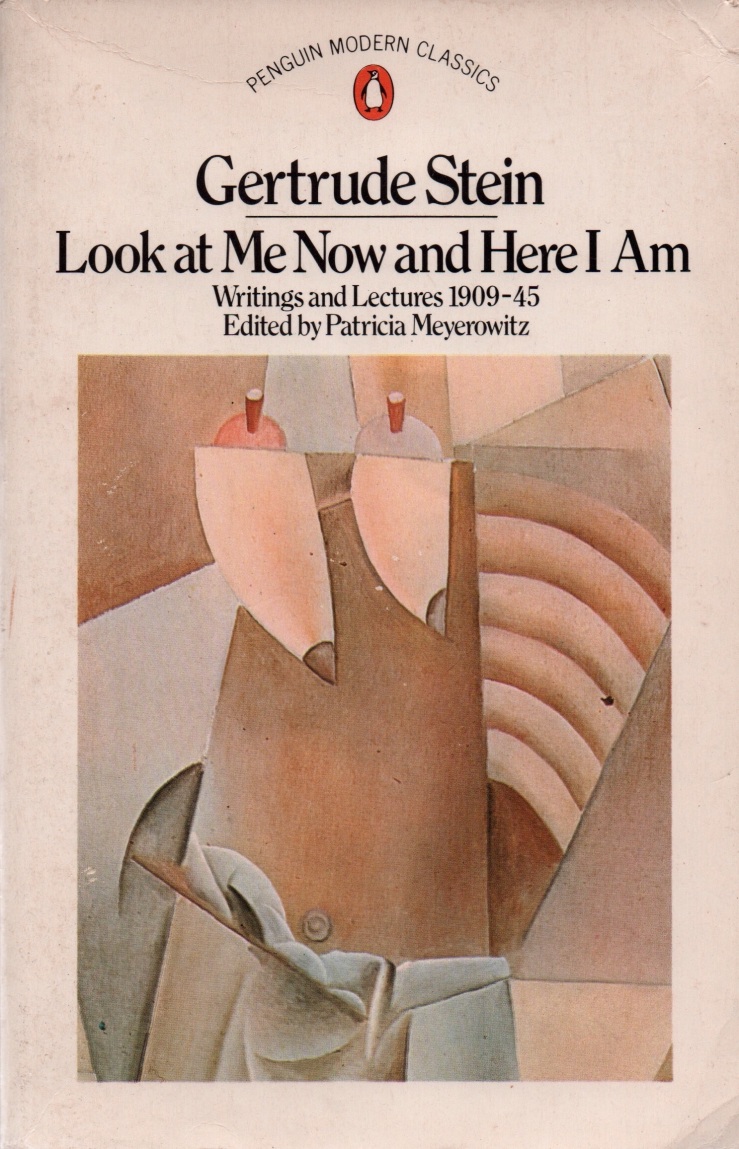
Look at Me Now and Here I Am: Writings and Lectures 1909-1945 by Gertrude Stein (edited by Patricia Meyerowitz. A Penguin Modern Classics trade paperback edition, printed in 1984 (I think) in Great Britain (I think–the colophon is confusing as hell). The cover features a detail from Picasso’s Woman in an Armchair. I spent 10 minutes flicking through Phil Baines’s Penguin by Design but couldn’t determine the designer. The first page bears two bookstore stamps, one from Russakoff’s Bookstore in Philadelphia, and one from the bookstore where I bought it. This is a book one can just pick up and read and random and be rewarded. I’m always reading bits of it so it’s never shelved.image

The Lime Works by Thomas Bernhard. A 2010 first edition trade paperback by Vintage International. The cover design is by Eva Brandstotter, who designed all of these Bernhard editions for Vintage. I was lucky enough to scoop up five TB’s all at once at my favorite used bookstore. I’ve had the urge to read Thomas Bernhard but it’s still too damn hot here in swampy muggy humid Florida to read Thomas Bernhard which I think only makes sense, this sentiment I’ve just expressed, if you’ve actually read Thomas Bernhard.

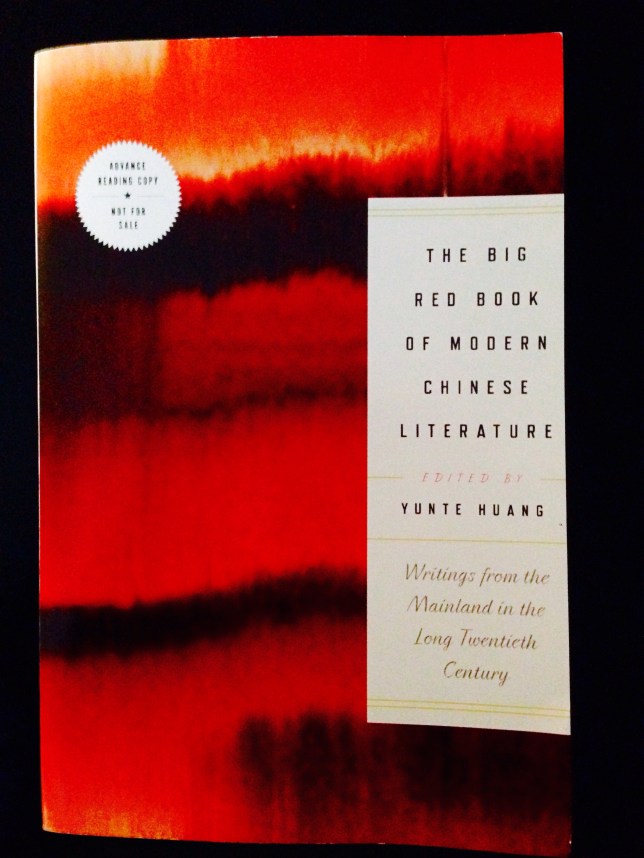
The Big Red Book of Modern Chinese Literature (Book acquired, 8.07.2015)

IMG_8270

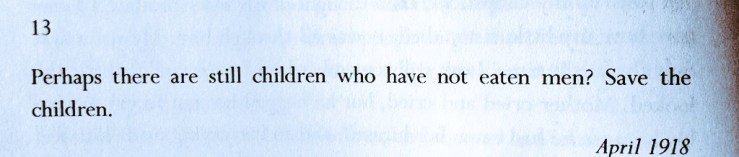
So I finally cracked into Norton’s forthcoming anthology, The Big Red Book of Modern Chinese Literature today. Knowing almost nothing of Chinese literature, I read Can Xue’s story “Hut on the Mountain” first (A+ stuff) and then went back to the beginning to read Lu Xun’s “A Madman’s Diary,” which ends with this line:IMG_8271

—like who wouldn’t want to read a story that ends that way?

Anyway, the book looks really fascinating. Editor Yunte Huang has put together a compelling mix of genres covering the last century. More to come, but here’s Norton’s blurb for now:

A panoramic literary anthology that tells the inner story of China in the twentieth century.

A search for the soul of modern China, this revelatory volume brings together significant works, in outstanding translations, from nearly fifty Chinese writers. It includes poems, essays, fiction, songs, and speeches written in an astonishing array of moods and styles, from sublime lyricism to witty surrealism to poignant documentary to the ironic, the absurd, the transgressive, and the defiant.

Reflecting on his own experience coming of age in China as a student in the time of Tiananmen, Yunte Huang provides essential context in an opening essay and in headnotes, timelines, and brief introductions to the Republican, Revolutionary, and Post-Mao eras. Both personal and authoritative, his selections make for a joyously informative read. From belles lettres to literary propaganda, from poetic revolution to pulp fiction, The Big Red Book is an eye-opening, mesmerizing, and indispensable portrait of China in the tumultuous twentieth century.

The Red Notebook — Agata Kawa

carnet04

Reviews and riffs of August, 2015 (and an unrelated octopus)

I don’t like August and I’m glad it’s over.

I only wrote a few riffs and reviews in August, failing to write at length about Gordon Lish’s Cess and Victor Hussenot’s The Spectators and Vladimir Nabokov’s Pale Fire. Also: Neal Stephenson’s novel The Diamond Age, which I audited the audiobook of—great stuff, a novel that posits the book as a primary and insuperable technology. And some films too—Michael Mann’s Thief (amazing); Quest for Fire (why were the Baby Boomers so obsessed with cave people?); Ex Machina (a well-acted design-porn riff on Bluebeard that has no real ideas about its central theme, human consciousness).

I also watched and loved and didn’t write about the second season finale of True Detective—loved it—a tragic hyperbole, a big exclamation point, a sympathetic punchline to the season’s paternal anxieties. I found the final shot unexpectedly moving—the season’s female leads moving through the traffic of humanity, strapped with a child, knives, the future.

In August—

I riffed on season 2 of True Detective, arguing for its merits as a neon noir satire.

Ryan Chang and I talked about New American Stories, an anthology edited by Ben Marcus. We riffed on the selections, scope, and the first story, Saïd Sayrafiezadeh’s “Paranoia.”

I wrote a barely-coherent, probably incoherent review of Philip K. Dick’s novel Martian Time-Slip. The sub(or is it super?)text of the review is that I am a Permanently Paranoid American.

I also wound up writing a bit on Paul Kirchner’s trip strip The Bus yesterday. For years now, I’ve run some kind of regular Sunday post to anchor the site—it was death masks for a while, book shelves after…maybe something else I’m forgetting now (?)—but running The Bus was the most fun I had.

I’m not sure what I’ll run this Sunday for a new series, but something serialish so…

Promised octopus, by Utagawa Kuniyoshi—


I’ve salvaged not a word (Cormac McCarthy’s Suttree)

From all old seamy throats of elders, musty books, I’ve salvaged not a word. In a dream I walked with my grandfather by a dark lake and the old man’s talk was filled with incertitude. I saw how all things false fall from the dead. We spoke easily and I was humbly honored to walk with him deep in that world where he was a man like all men. From the small end of a corridor in the autumn woods he watched me go away to the world of the waking. If our dead kin are sainted we may rightly pray to them. Mother Church tells us so. She does not say that they’ll speak back, in dreams or out. Or in what tongue the stillborn might be spoken. More common visitor. Silent. The infant’s ossature, the thin and brindled bones along whose sulcate facets clove old shreds of flesh and cerements of tattered swaddle. Bones that would no more than fill a shoebox, a bulbous skull. On the right temple a mauve halfmoon.

I read Cormac McCarthy’s Suttree five years ago and still haven’t recovered.

I started listening to the audiobook of it this week as I returned to my fall work (school) commute—the language is marvelous in the reading—but I have to go back and dwell on passages, like the one above, which resonates strongly with so much of McCarthy’s work—the son or grandson communing with the dead father, out of dimness, opposite equals advancing. And damn, somehow I’d forgotten that Suttree had a stillborn twin brother. And that the novel begins with a suicide. More to come.

Vision of a Knight — Raphael

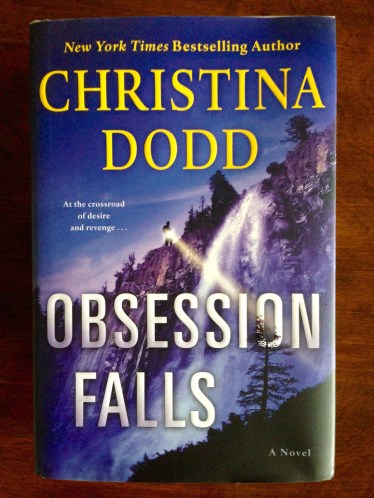
Obsession Falls (Book acquired, some time in August, 2015)

IMG_8164

Christina Dodd’s novel Obsession Falls is new in hardback and ebook from Macmillan. Their blurb:

In Obsession Falls, New York Times bestselling author Christina Dodd returns to the town of Virtue Falls, Washington-an idyllic place on the surface, but one that holds close its secrets…

When Taylor Summers witnesses the death threat to a young boy, she does the only thing she can do-she sacrifices herself to distract the killers. Her reward is a life in ruins, on the run in the wilderness, barely surviving a bitter winter and the even more bitter knowledge she has lost everything: her career, her reputation, her identity. She finds refuge in Virtue Falls, and there comes face to face with the knowledge that, to live her life again, she must enlist the help of the man who does not trust her to defeat the man who would destroy her.

She’s being hunted, but it’s time to turn the tables….

A conversation about New American Stories, an anthology curated by Ben Marcus (Part 1)

IMG_8017

Over the next few weeks, Biblioklept contributor Ryan Chang and I will be discussing New American Stories, an anthology edited—or maybe “curated” is the right word, although I’m not sure—by Ben Marcus.  

Edwin Turner: You got your copy of New American Stories? Let’s talk about the cover, the intro, and the first story,  Saïd Sayrafiezadeh’s “Paranoia.”

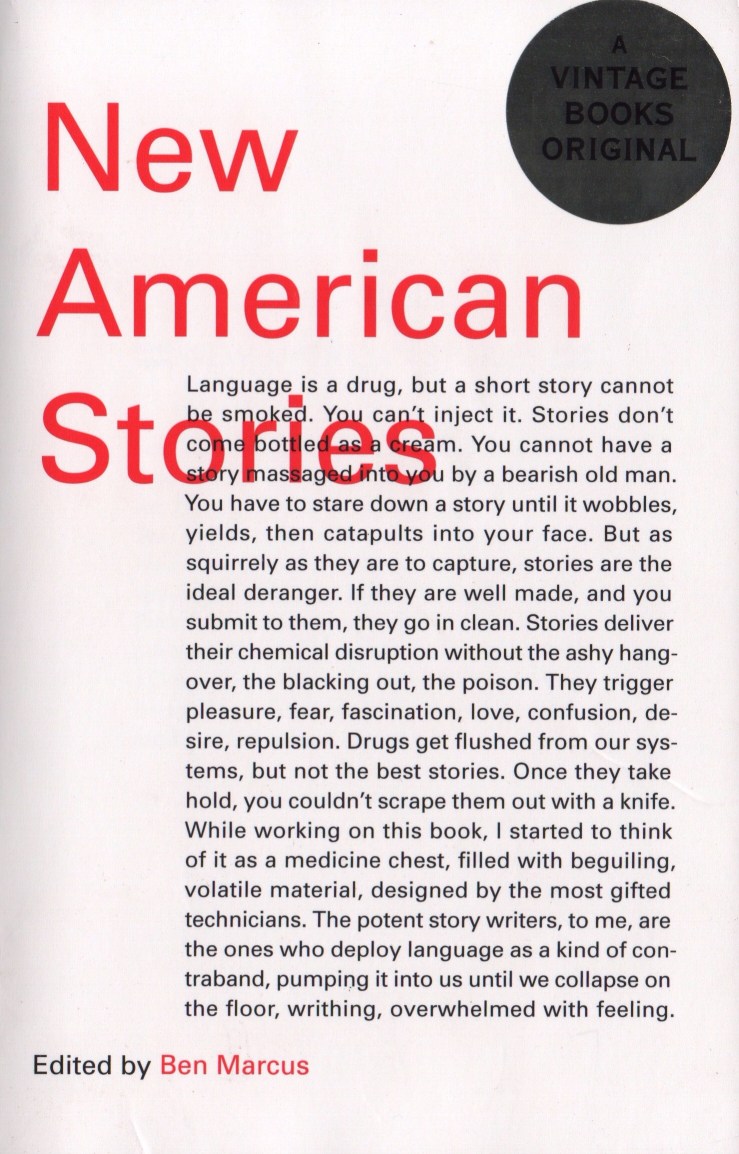
Ryan Chang: The cover and the introduction, and hence the context of the selections, elegantly mesh, which is more than I can say for 99% of covers. But I like anything that Mendelsund touches. It’s quiet, understated, but an excellent visual metaphor for what Marcus discusses in his introduction. The best part about this cover is the spot where part of the word “Stories” tries to mingle with the blocked passage from the introduction. The two don’t merely coexist, or mesh at all, but exist in this static conflict. It seems to be what Marcus wants most out of this new anthology; it occurs to me that I don’t have a lot of anthologies because a) I find them pretty boring, b) if it’s going to be an anthology, it’s going to be non-Anglo and -American — most of the time, the anthologies featuring these authors are already on my shelf in one way or another, and when I flip through them in the book store, the new context in which I find an author (say, someone like Richard Yates and Barry Hannah) isn’t new and exciting.


img_8019ET:
The cover is great—spine too. I agree with you that it’s “quiet”—although that’s a strange word, y’know, considering there’s so much going on there—so much text. But the book is handsome, and the cover presents as a baseline postmodern conundrum—
Where does the text begin? The authorship question is there too, on the second page, the “Also by Ben Marcus” page—as if Marcus were the author of the collection. Which in a way he kinda sorta is—the whole mixtape/DJ/curator thing—I mean he’s the author of the “anthology,” the tracklist, the occasion. I’m generally suspicious of the overuse of the term “curator,” but I think it’s ultimately more apt than editor. And Marcus spins a cool set. The book is a tasty gateway drug.

Anthologies were really important to me when I was 15, 16, 23…but now I tend to think of them entirely in teaching terms, often in very jaded terms, honestly. I would love to be able to look over the selections here with fresher eyes, if you know what I mean. As a freshman in college, I read the 1994 anthology The Vintage Book of Contemporary Short Stories, which Tobias Wolff edited. It would be impossible for me to overestimate the importance of that for me—it introduced me to Barry Hannah, Denis Johnson, Ann Beattie, Raymond Carver, and all these other writers who simply weren’t on my radar. In retrospect, I realize that that anthology represented a very particular kind of writing, but I think Wolff captured something of an era there.

RC: The posture of most anthologies is to celebrate/represent the coalesced spirit of a kind of writing, or an era. And I only realized this reading through Marcus’s introduction. He writes, “This anthology aims to present … a sampler of behaviors and feelings we can very nearly have only through reading. A sourcebook of compulsory emotions.” I really like this. The focus of NAS is on language — as is to be expected in Marcus’s hands — and not on, say, a particular identity, era, or whatever. This is an anthology about the breadth of styles and forms — which brings me back to the cover. It’s a really brilliant illustration of Marcus’s guiding aesthetic principle in his own work and here: the productive tension between form and content. The scope of selection is wide, and encouraging from someone known to run in “experimental circles.” This is an anthology about aesthetic modes, not being an American.

ET: Parts of Marcus’s introduction feel a little like a wide-eyed sermon for the choir to me, but maybe I’m being cynical. Maybe I want him to be cynical with me. We all know why we’re here; get to the stories. His riffs on language and what and why we (might) use language offer an adequate “defense” of the title/mission New Stories—but there’s not really an engagement with the American aspect there, which, I suppose, might have played into a deeply ideological thing, a statement thing. Maybe A Sourcebook of Compulsory Emotions is a much much better title. But—but! But that first story, Saïd Sayrafiezadeh’s “Paranoia”—that’s a very American story, or, rather, that’s a story about America: nationalism, capitalism, racism, militarism, football, a Fourth of July scene? Oh, and, paranoia.

RC: The first story is a great opener, I think. It’s a classic realist mode, which, after reading the introduction, will get the reader to think, “Will something weird happen?” The weirdness that happens is the “moral honesty” that Marcus talks about in the introduction: the weirdness is in how normal this story is. I say classic and realist and I mean that the plot is straightforward, its language is plain and mostly functional (that is, free of any acoustical poetic attention or syntactical destruction), and about, quote-unquote, real people. Here’s the weird, and it’s not even that weird: the small talk we take for granted — i.e., when we ask the other person how they’re doing; in “Paranoia,” it’s the weather — becomes this refrain for each section in the story; Sayrafiezadeh deftly shows that repetition — i.e. stability — gives only the illusion of comfort, and that comfort in almost-knowing the weather is a salve against the American reality: that the worst will always happen. I won’t give the story away for anyone reading this post, but “Paranoia” works on two really brilliant moves. They’re pretty obvious maneuvers, but I think it shows that even in a more straightforward form, if one hones in on the tension between form and content — that is, diction/syntax and images the former evokes — some affecting writing is bound to occur. The other way — a commitment to a particular position — political, moral or otherwise — comes off cheap and stale.

ET: “Paranoia” asks its reader to attend closely to diction: “That word’s not called for!” is a through-line in the story. I almost wrote tale for story there (attending to diction), but “Paranoia” is not a tale. There’s no neat bow at the end. It succeeds on vibe, on mood, on the evocation of menace its title promises.

RC: Yeah, you’re right — it demands that the reader divert their attention away from the televised bombings of “the peninsula,” and on the subversive, subdermal ways in which language organizes reality — exactly how Marcus describes language in his introduction.

ET: So…let’s read the last story together next, no? Then, you pick one that’s a reread for you, but not for me, and we’ll read it—and then I’ll do the same—pick a reread for me that you haven’t read? Good?

St. John Devouring the Book from the Apocalypse — Albrecht Durer

Is it true that Nabokov called Hemingway and Conrad “writers of books for boys”?

IMG_7929

From a 1964 Playboy interview. Republished in Strong Opinions.

New American Stories, a collection edited by Ben Marcus (Book acquired, 8.04.2015)

IMG_7908

New American Stories is an anthology out now in enormous paperback from Vintage. The collection was collected by collector Ben Marcus. An excerpt from his introduction:

Language is a drug, but a short story cannot be smoked. You can’t inject it. Stories don’t come bottled as a cream. You cannot have a story massaged into you by a bearish old man. You have to stare down a story until it wobbles, yields, then catapults into your face. And yet, as squirrely as they are to capture, stories are the ideal deranger. If they are well made, and you submit to them, they go in clean. Stories deliver their chemical disruption without the ashy hangover, the blacking out, the poison. They trigger pleasure, fear, fascination, love, confusion, desire, repulsion. Drugs get flushed from our systems, but not the best stories. Once they take hold, you couldn’t scrape them out with a knife. While working on this book, I started to think of a it as a medicine chest, filled with beguiling, volatile material, designed by the most gifted technicians. The potent story writers, to me, are the ones who deploy language as a kind of contraband, pumping it into us until we collapse on the floor, writhing, overwhelmed with feeling.

You actually can smoke a short story, but to do so is inadvisable.

I’ll be riffing on the book over the next few weeks with our Correspondent in Colorado, Mr. Ryan Chang.

Here’s the tracklist:

Said Sayrafiezadeh, Paranoia

Rebecca Lee,  Slatland

Jesse Ball, The Early Deaths of Lubeck, Brennan, Harp, and Carr

Deborah Eisenberg, Some Other, Better Otto

Anthony Doerr, The Deep

Yiyun Li, A Man Like Him

George Saunders, Home

NoViolet Bulawayo, Shhh

Maureen McHugh, Special Economics

Sam Lipsyte, This Appointment Occurs in the Past

Lydia Davis, Men

Donald Antrim, Another Manhattan

Zadie Smith*, Meet the President!

Denis Johnson, The Largesse of the Sea Maiden

Joy Williams, The Country

Christine Schutt, A Happy Rural Seat of Various View Lucinda’s Garden

Don DeLillo, Hammer and Sickle

Mathias Svalina, Play

Lucy Corin, Madmen

Mary Gaitskill, The Arms and Legs of the Lake

Wells Tower, Raw Water

Rachel Glaser, Pee on Water

Tao Lin, Love is a Thing on Sale for More Money than There Exists

Rebecca Curtis, The Toast

Robert Coover, Going for a Beer

Charles Yu, Standard Loneliness Package

Deb Olin Unferth, Wait Till You See Me Dance

Kyle Coma-Thompson, The Lucky Body

Rivka Galchen, The Lost Order

Donald Ray Pollack, Fish Sticks

Kelly Link, Valley of the Girls

Claire Vaye Watkins, The Diggings

*Isn’t she English? I guess it’s the stories that are American.

A probably incomplete list of books I’ve read so far this year

The Crying of Lot 49, Thomas Pynchon

Dockwood, Jon McNaught

A German Picturesque, Jason Schwartz

Inherent Vice, Thomas Pynchon

Two Serious Ladies, Jane Bowles

Flee, Evan Dara

Birchfield Close, Jon McNaught

Signs Preceding the End of the World, Yuri Herrera

Infinite Fictions, David Winters

Syrian Notebooks, Jonathan Littell

Girl in a Band, Kim Gordon

Can’t and Won’t, Lydia Davis

Gravity’s Rainbow, Thomas Pynchon

Gaha: Babes of the Abyss, Jon Frankel

The Spectators, Victor Hussenot

Mumbo Jumbo, Ishmael Reed

Infinite Jest, David Foster Wallace

The Wallcreeper, Nell Zink

Cess, Gordon Lish

Station Eleven, Emily St. John Mandel

High Rise, J.G. Ballard

Millennium People, J.G. Ballard

Pale Fire, Vladimir Nabokov


Updating the reviews page to this blog today (a chore! a bore!) I realized just how many books I’d read this year and failed to write about…so far, anyway. The list above is probably incomplete, and only includes books I read cover-to-cover (or in a few cases audited on mp3)—so stuff like essays by William Gass and collections like Vollmann’s Last Stories and William T. Vollmann: A Critical Companion (etc.) I left off. And yes, I’m aware that the list is heavy on white guys.

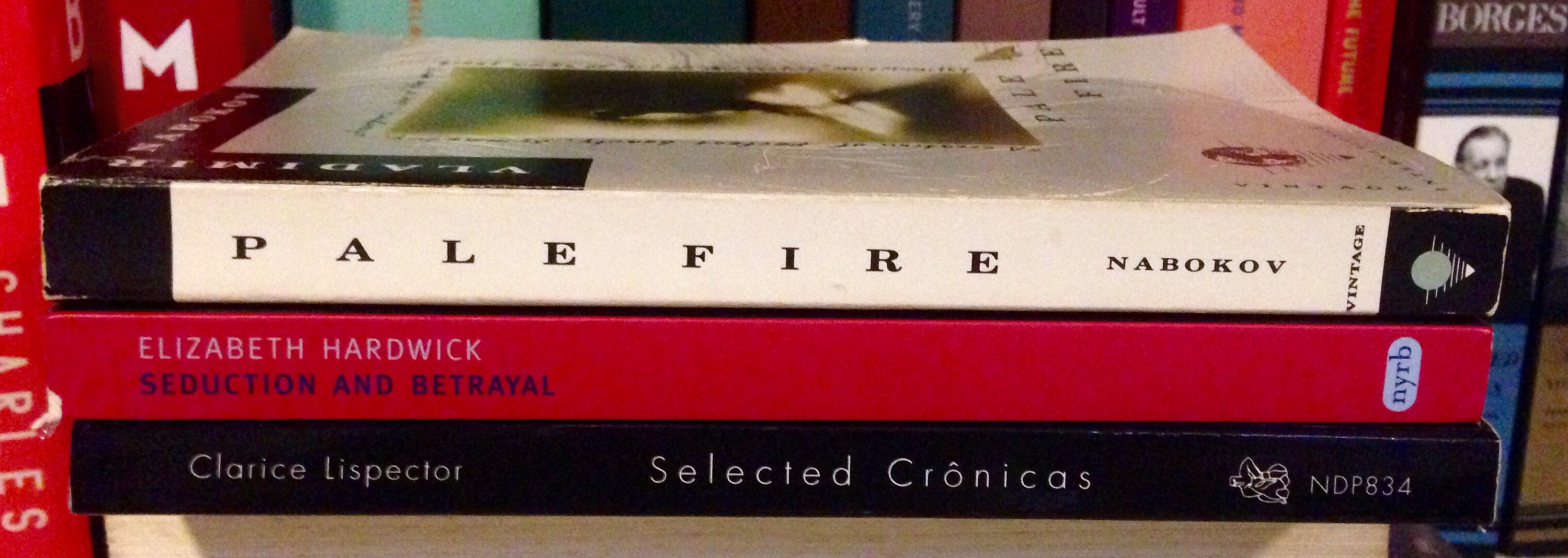
Nabokov/Hardwick/Lispector (Books acquired, 7.21.2015)

I picked up Vladimir Nabokov’s novel Pale Fire on a weird whim. I mean, I quite literally passed by it in the bookshop I frequent; it was misshelved, or unshelved, really. Someone had left it in sci-fi, near the “Bs” (B-for-Ballard, if you must know). Pale Fire, eh? I thought. Can’t remember this one. Because I had never read it, somehow. An amazing novel, one I dove into after sampling a bit of Clarice Lispector’s Selected Cronicas (still sampling—this is one of those books that’s lovely to dip gently into between selections) and after failing to get through the first essay in Elizabeth Hardwick’s Seduction and Betrayal. Not sure if I can (should?) muster a “review” of Pale Fire, but it’s one of the better prepostmodern-postmodernist novels I’ve ever read—very very funny and a beautiful mindfuck.

Maid Reading in the Library — Edouard John Mentha

“The Adventure of the Three Robbers” by Apuleius

“The Adventure of the Three Robbers” by Apuleius

An episode from The Golden Ass, reproduced here from The Lock and Key Library’s Classic Detective and Mystery Stories of All Nations series, edited by Julian Hawthorne. The translator is likely Frederick Taber Cooper.


As Telephron reached the point of his story, his fellow revelers, befuddled with their wine, renewed the boisterous uproar. And while the old topers were clamoring for the customary libation to laughter, Byrrhæna explained to me that the morrow was a day religiously observed by her city from its cradle up; a day on which they alone among mortals propitiated that most sacred god, Laughter, with hilarious and joyful rites. “The fact that you are here,” she added, “will make it all the merrier. And I do wish that you would contribute something amusing out of your own cleverness, in honor of the god, to help us duly worship such an important divinity.”

“Surely,” said I, “what you ask shall be done. And, by Jove! I hope I shall hit upon something good enough to make this mighty god of yours reveal his presence.”

Hereupon, my slave reminding me what hour of night it was, I speedily got upon my feet, although none too steadily after my potations, and, having duly taken leave of Byrrhæna, guided my zigzag steps upon the homeward way. But at the very first corner we turned, a sudden gust of wind blew out the solitary torch on which we depended, and left us, plunged in the unforeseen blackness of night, to stumble wearily and painfully to our abode, bruising our feet on every stone in the road. Continue reading ““The Adventure of the Three Robbers” by Apuleius” →