And now, a note for those of you who consider this a vulgarly supernatural tale: It may well be that ambitious people of any stripe find themselves compelled to schematize the subjects of their solicitude into, say, Jews to be liquidated, or Jews to be saved. There might not be might not be time to learn the name of every Esther or Isaac who falls within Operation Reinhard’s purview. And the further those subjects (I mean objects) get altered in accordance with the purpose, the more problematic it becomes to perceive their irrelevantly human qualities. I quote the testimony of Michal Chilczuk, Polish People’s Army (he’d participated in the liberation of Sachsenhausen): But what I saw were people I call humans, but it was difficult to grasp that they were humans. What did Chilczuk mean by this? To put it aphoristically, a human skeleton is not human. It frightens us because it proves the truth of that gravestone epitaph so common in the age of Holbein: What I once was, so you are. What I am now, so you will be. The gaze of those dark, sharp-edged eye-sockets seems implacable, and the many teeth, which haunted Edgar Allan Poe, snarl much too nakedly, bereft of those festive pink ribbons of flesh we call “lips,” whose convolutions and involutions can express mirth, friendliness, even tenderness. A human skull’s smile is as menacing as a crocodile’s. Since death itself is nothing, the best our minds can do to represent it is through that expressionless face of bone which one day will be ours, and to which we cannot help imparting an expression. Under such circumstances, how can that expression be reassuring?
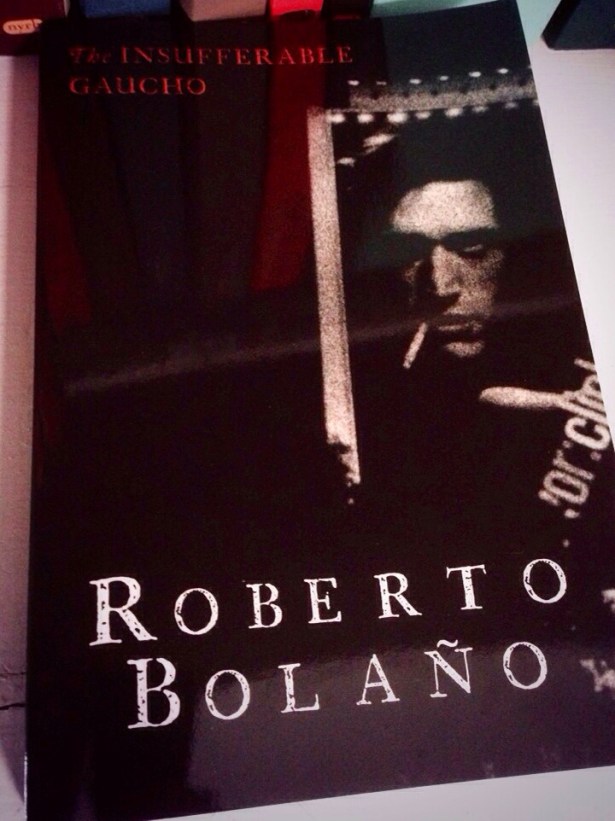
Roberto Bolaño’s The Insufferable Gaucho, which I’ve sort of saved for a few years—put off isn’t the right phrase, but sort of, knowing it as companion to Last Evenings on Earth, y’know, saved it for later—Roberto Bolaño’s The Insufferable Gaucho is very difficult to photograph. Very shiny.
[Ed. note: The following citations come from one-star Amazon reviews of Thomas Pynchon’s novel Gravity’s Rainbow. Yes, I’ve done this a few times before (see also: George Orwell’s 1984, Melville’s Moby-Dick,Joyce’s Ulysses and Markson’sWittgenstein’s Mistress) and to be clear, I think some of the one-star reviews of Gravity’s Rainbow make some interesting points–although most of the reviewers seem to be upset over the book’s reputation/status, and attack that (and by extension, postmodernism) instead of attempting to analyze what Pynchon was actually, y’know, trying to do. I’ve preserved the reviewers’ unique styles of punctuation and spelling].
Who put it into Pynchon’s head that he could write?
After reading over one hundred fifty pages, all I could believe was the story set during WWII, but I wasn’t sure.
This is not literature.
After I finished reading this book twenty years ago, I left it in my apartment building’s laundry room for whomever might be interested in it. The book sat there for months and nobody was interested in it enough to take it home. Finally, it was ruined when a water pipe burst and, I presume, it is now landfill in Staten Island.
Tedious.
There is not an ounce of humanity in this book. I finally threw it against a wall in disgust.
Pynchon writes liberal, paranoid diatribes against any and all institutions, especially conservative ones
I felt empty and used.
I’ve been told the nominating committee (made up mostly of book reviewers) nominated this for the Pulitzer Prize as best fiction. The awards committee (mostly book editors) rejected it as an unreadable piece of crap. I agree with the editors.
This book’s failings are in part a function of it’s time — the early 70’s – when culture was naively experimental, half-baked, vulgar, and exhibitionist.
When one contrasts Vonnegut’s Slaughterhouse Five with this book, it’s like comparing an Olympic sprinter with an obese man running for the bus with a hot dog in one hand and a soda in the other.
I honestly preferred J.G. Ballard’s Crash to this book.
It seems to me it’s very easy to be “a literary master” in this way. It’s much more difficult to write something very clear and simple that people can easily understand (and yet still be profound and say something new).
Woody Allen used to be funny. Monty Python was occasionally funny.
Any author who uses “further” for “farther” (as Pynchon does, among many other errors) should never make anyone’s “best novelist” list.
To this reader, Pynchon sounds like the unabomber with a better thesaurus.
One of those books that professors are constantly forcing students to read because the novelist can’t attract a following on his own merits and ability to entertain.
I only finished it beacuse I was on jury duty.
I thought this novel was a complete waste of my time and it amazes me to hear so many praise what I think was paranoid and resembles silly cult literature. My father had a book back in the fifties sponsored by an extreme right wing group that was equally paranoid and absurd.
Pynchon couldn’t write anything funny if his life depended upon it.
Pynchon is like a high school football bully who says “Okay, I’m gonna trow da ball as hard as I can–you see if you can catch it”. No thanks Spike.
I mean, even the first page of this book offends my sensibilities.
An entire novel centered on the unrealistic, flimsy idea that a man getting erections will attract missiles? Some missiles may be heat seaking but the temperature of blood found in the groin during erections is no longer near the degree it takes to attract heat seaking weaponry. Get your facts right, Pynchon. A scientist you ain’t.
Reminds me of John Coltrane’s Ascension album, which for the entire album sounds like the band is warming up but never gets to play, but the elitist snobs just adore it.
A good argument for a good old fashioned book burning.
The majority of this book consists of sentence after sentence and paragraph after paragraph that don’t have any apparent correlation to each other.
wow, all the hard work that this man put in just to bore me! the effort alone is worth a star. gallant attempt mr pynchon.
This is one of those “university novels” (as opposed to “popular” novels that people actually read and love) that “you have to work hard at to appreciate”.
It’s like viewing a `painting’ of a blank canvas titled Untitled.
I lived in Germany a few years ago and found this book in a train station. Someone had just walked off and left it. After about ten pages, realizing that Pynchon was an intellectual rip-off artist, I secured it a trash can where no one could find it. I like to think I protect the public from pollution.
Maybe it’s entertaining if you take huge quantities of lsd, otherwise it’s a nightmare.
It is terrible.
I cannot summarize the story, because I couldnt find one.
…obviously written by some self-loving, over-indulged, hippie.
I tend to lump this book in with the rest of the general malaise surrounding the innate nihilism of Postmodernism.
This book makes me a little sad, because I think that Pynchon, had he not gone over to the dark side, could have been a brilliant prose stylist, if not anything else.
…feels like being flayed alive by words alone. I wanted to stab myself in the head just to relieve the pain.
This is like Ulysses.
Add a star if you enjoy constant reference to penises and vulva and all kinds of deviant sex acts.
I should sue the author for migraine.
To sum it up: it is too much work to read this book.
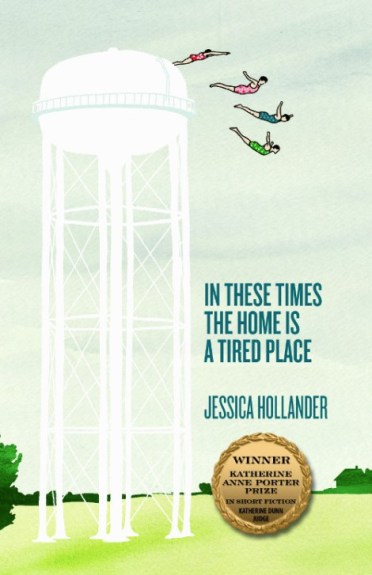
I was deeply impressed by the short stories in Jessica Hollander’s In These Times the Home Is a Tired Place (University of North Texas Press). In my review, I wrote that
Every story in Jessica Hollander’s début collection In These Times the Home Is a Tired Place feels thoroughly real, deeply authentic, and if we already know the contours of these plots—perhaps having lived some of them ourselves—Hollander makes us experience them anew with her bristling, strange sentences. Hollander writes here of families on the brink and families broken, families fragmenting and families forgetting. She conjures domestic spaces limned with ghosts and memories, children and parents who aren’t quite sure how to be a family, but who nevertheless try—even if trying is really just imagining.
Jessica was kind enough to discuss her writing with me over a series of emails, sharing her thoughts on sentences, families, and zombies.
Biblioklept: When did you start working on the stories that make up In These Times the Home Is a Tired Place? The collection feels really unified in its tone, themes, and images. Many of the stories were published in different journals and magazines before they were collected—did you always envision them collected? Were there stories you left out that you felt didn’t fit?
Jessica Hollander: I worked on a lot of these stories while in my MFA program, so over four years, though a couple date back even further than that. I was interested in trying out new voices and forms, but I kept examining similar questions and anxieties, just from different angles. During the years I wrote most of these stories, I lived through a lot of “big” moments – marriage, parenthood, home-ownership – and writing was a way to deal with some of my anxieties in doing what our society tells us we should do. I constantly questioned why I wanted these things—if I really wanted them or if I’d only been conditioned to want them. I thought a lot about identity and what happens to it once you start taking on roles with so much cultural baggage attached to them, as I became a wife, a mother, etc., which is why in some of the stories the characters are even referred to by these titles. It’s a battle between the role and their individuality.
I didn’t think about writing the stories for a collection. I knew I was “worrying” particular subject matter that was important to me, and it was exciting to see trends in tone and imagery develop, but it wasn’t until I’d accumulated a mass of work that I started sifting through it. And many stories were left out that didn’t seem to fit or that years later didn’t interest me as much anymore.
Biblioklept: One thing I love about the stories in the collection is how they take on those “big” moments you mention—how alienating it is all of a sudden to inhabit a new role that’s already been socially scripted in some way. Do your stories start from those conflicts, or from something else? I mean, do you start by trying to write (through, against, about) the anxieties, or do the stories germinate in other ways?
JH: Most of the time I don’t have a clear idea of what I’m going to write about. I’ll start with a character or a small scene inspired by something I saw or experienced, but often I’ll start with style—wanting to try out a modular story or write about characters who have titles instead of names or I’ll want to try a particular point of view I haven’t written from in awhile or I will write a sentence and see if I’m interested in the voice. I have to be interested in the sentence level to push a story further, so sentences come before themes or even character for me. But that’s what was strange and exciting about the stories that came together to form this collection—I seemed to keep worrying over these similar themes, anxieties over identity and role-shifts, but it wasn’t planned. I guess that’s the part of writing that the subconscious has a bigger hand in. A lot of my extended family was surprised when they read the collection because the stories seemed so pessimistic about things like family and connections between people. They tell my parents, “But she had such a happy childhood!” And now they see me, and I am married and have kids and (besides general anxieties) I am happy (though it’s hard to write that word without quotations—what does “happy” mean?). And of course these stories are fiction, it isn’t me, but it all still comes from me and things I’m thinking about on some level.
Jessica Hollander
Biblioklept: I can imagine those family reactions—because the stories seem so real, so true, so authentic. But I think a lot of that authenticity originates from the sentences, which you bring up here. In many of the stories, the reader gets a whole story out of just a sentence or two, and part of that story comes from the disconnect between the way a character might perceive the world and the way that the other sentences have represented that world—like the poor babysitter of the title story. Is the sentence as important to you as a reader as it is to you as a writer?
JH: The sentence is important to me as a reader. There was a time when I didn’t really even think about what language could do to a story—I only noticed macro-level things like plot and character, then later I got more interested in image and metaphor. Now, to me, it seems like the central energy of a piece comes from the sentences. If I’m not interested in the writing, if there’s no strangeness or surprises or just some poetic sense of words interacting with each other, I rarely stick around to find out about plot and character.
Biblioklept: I think the sentences in your collection mediate the tension between the simultaneous reality/irreality of domestic life, of the weirdness of being in a family—that a family is a set of contingent relationships, never stable. In one of our earlier emails, you mentioned working on new material with a “hyper-real semi-comic tone but with some darker threads” and that there might be “zombies and haunted houses and things” in your latest work. Is this a conscious shift away from the content of your collection, which focuses so much on families?
JH: Oh, no, the stories I’m working on now are still all about family and relationships, but I’m having some fun drawing from the female gothic tradition, examining the dark sides of domestic life and pressures of social/gender roles. Gothic literature is interested in what’s unexplainable, both inside and outside of us, and looks at impulses based in emotion and not logic. There’s hauntings from the past and monsters inside of us, battles between logic and emotion, repressing feelings that later manifest destructively, and humans being drawn to the sublime and the numinous: things that inspire both fear and awe, that remind us of our own demise, but encourage us to see beauty in sadness, death, and suffering. So certainly relevant to families!
Biblioklept: You teach writing now here in the South—do you think that the Southern Gothic tradition has influence you at all? Why do you think that we so strongly identify Southern lit as Gothic?
JH: Gothic is often about hauntings from the past, and I think a lot of people view the south as haunted, by slavery and economic disparities and the war. A lot of southern gothic writers (Faulkner, O’Connor, Williams) confront or critique southern romanticism, a longing for the old south as a magical place where chivalry and passionate emotions thrived that was unfortunately corrupted/destroyed by outsiders and modernity. But we know the old south was not so beautiful as that; it was of course a complex place where a lot of dark things passed between humans. Classic Gothic literature (Frankenstein, Dracula, Castle of Otranto, Edgar Allan Poe’s work) is romantic, too, with long passages about the sublimity of nature and characters moved by strong emotions (including grief, despair, anger, and love), but Gothic always exposes the dark urges of humans, and how people inevitably contribute to their own demise.
Biblioklept: What authors do you encourage your students to read?
JH: I’m really conscious of exposing students to a lot of different styles of writing, from traditional realism to postmodern experiments, so we can talk about how choices different authors make in terms of language, image, structure, portrayal of reality, and so on shape theme and meaning. This seems like the best way to prepare students to make conscientious choices when defining their own aesthetic interests and to recognize the wide variety of options available to them. Toward the realism side of things, I like Michael Cunningham, Dan Chaon, and Jennifer Egan; for maximalism, Alice Munroe; Lorrie Moore, Miranda July and Raymond Carver I use for hyper-realism and minimalism; Christine Schutt for lyricism; Sherman Alexie, Haruki Murakami, and Kellie Link for magical realism and surrealism; Jessica Hagedorn and Michael Martone for formalism; and George Saunders and Stacey Richter for absurdism. And it depends on the class. I use different authors for the gothic class and for the linked story workshop I’m teaching now, but I always try for variety.
Biblioklept: Have you ever stolen a book?
JH: I haven’t stolen a book from a store or library, but there’s one book that I borrowed and never returned: the Complete Stories by Flannery O’Connor. When I lived in North Carolina a few years, I lent a writer friend my copy of Salinger’s Catcher in the Rye, which she amazingly hadn’t read, and she lent me the O’Connor book, which amazingly I hadn’t read. I was happy with the one I ended up with. She must’ve been, too, or maybe she forgot we’d switched, but we never swapped those books back to each other. Maybe it foreshadowed my move further south to Alabama and my interest in dark humor and gothicism.
“Good Old Neon” is (in my estimation) Wallace’s finest piece of sustained prose, and his most tortured exploration of the tension between authenticity and performance.
Peters’s essay also features a number of photographs from Wallace’s high school yearbook, which are interesting, sure, but they actually fit into the essay.
Breaking into the strands and allusions that feed “Good Old Neon” (including Dostoevsky, Tolstoy, Hawthorne, and Hemingway), Peters’s essay has a riff-like quality (is that why I like it so much?), but there’s also a thesis here, one that I think actually answers alarmist/reactionary “death of the novel”/”end of literature” “think pieces” (how do you like that last clause for phrases in quotation marks?).
Then check out Peter’s essay. A sample of his analysis:
If you read “Good Old Neon” and then read D. T. Max’s biography of Wallace, Every Love Story Is a Ghost Story (the epigraph of which is a line from “Neon”), you see one example after another of stuff from Wallace’s life that Neal says happened to him. Being raised by people “of high ideals and values, humanists”; making fun of his sister as a kid and pretending like she was obese and jumping out of the way when she passed him in the hallway; having a knack for mathematical logic and logical paradoxes; having “a killer G.P.A.”; playing a varsity sport; being a philanderer with women; being on the professional fast track by the time he was in his 20s; getting into religion and meditation as a way of dealing with his troubles; living in the vicinity of the cornfields of Illinois; committing suicide. At the end of the story, when Neal’s ghost is hovering over Wallace and their high school yearbook, and as the latter is thinking about how impossible it is to try and pass through the exterior image of a person and to enter into the realm of his psyche, you wonder if what’s really going on in this story is something more akin to what happens between Dorian Gray and his picture, or William Wilson and his double, or Dr. Jekyll and Mr. Hyde, or Bruce Banner and the Incredible Hulk, or the two Tyler Durdens in Fight Club, or even between Martin Sheen and his reflection in the mirror in Hearts of Darkness, which is to say, you wonder if what’s going on here is a sort of a spiritual/philosophical death match, a duel between two opposite tendencies that are internal to a psyche but in the world of these stories are teased into two separate but similar-looking characters, into doubles or doppelgängers who both need each other and then perversely also try to destroy each other. And the dialectic that these characters are working out is Apollo v. Dionysus, the superego v. the id, the false self v. the true self, the rational civilized scientific order v. spontaneity and passion and a community of spirit. The drama that makes these stories interesting is that there’s no boring, middling, mediating ego term to calm things down and to make concessions and to prevent the dialectic from exploding. Hence: Dorian Gray stabs himself; William Wilson stabs himself; Mr. Hyde is either going to be executed or to commit suicide; The Hulk goes Smash; Tyler Durden shoots himself; Martin Sheen has a heart attack and has to be flown off the set of Apocalypse Now. And as for “Good Old Neon,” the struggle is between Neal, the golden child, against the “real, more enduring and sentimental” David Wallace who’s looking at their pictures in the high school yearbook. It’s the struggle between a nihilist who’s yet actively making the society function, and a believer who has a desire for solid, non-alienated, human relationships, but who’s quietly, sadly, sitting in a recliner and watching the nihilists run.





 I was deeply impressed by the short stories in Jessica Hollander’s In These Times the Home Is a Tired Place (




 Biblioklept