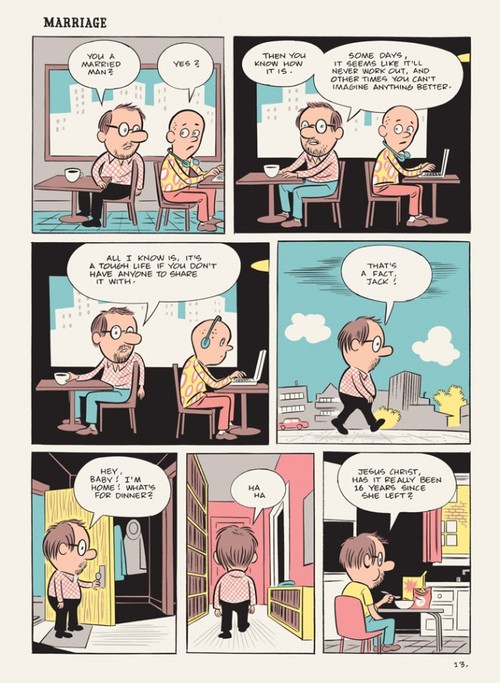
From Daniel Clowes’s graphic novel Wilson, available from Drawn & Quarterly.
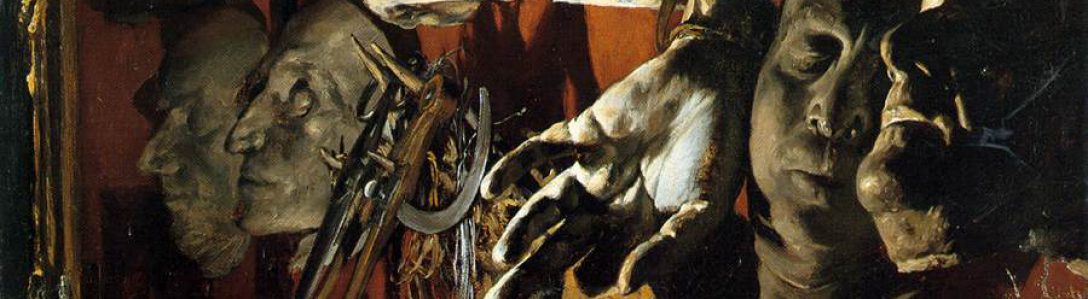
From Daniel Clowes’s graphic novel Wilson, available from Drawn & Quarterly.

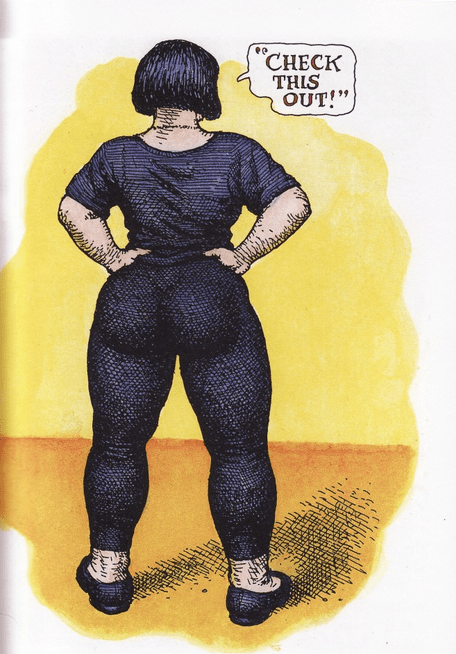
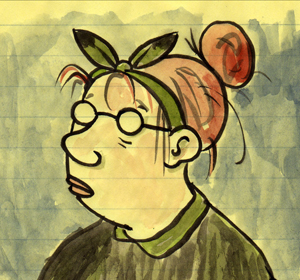 The AV Club’s Tasha Robinson interviews comix legend Lynda Barry. In the (rather lengthy) interview, Barry discusses teaching her craft–
It’s a really hard thing to teach students. The two things I always try to teach them is, one, you have to stay in motion. It doesn’t mean that you have to just write blah, blah, blah, blah, blah. Write the alphabet. You have to stay in motion. And the other thing is, when you get stuck, don’t read over what you just wrote. Especially if you have a computer. Maybe by hand is not so bad, but with a computer, what happens is… My experience has always been that there is a point when the story just stops. Always. You know, it’s just like when you’re dancing. There’s a time when you’re fake-dancing, because the groove has stopped. Then you’re back in the groove. So if people understood that that’s a natural part of making something, and they knew what to do during that time… But what people will do if they’re writing on a computer is, when that time comes and it’s quiet for a minute, they panic and go back and start fixing stuff above it that was not even broken. You can’t start to fix something until you know what it’s for, you know? So I always try to get my students to just sustain the state of mind for a certain amount of time. Even though I use 24 panels for my students, they’ll have seven minutes to just sustain this open state of mind while they’re writing, keep their hand in motion. But it’s really tough to get them to believe me, to just to even give it a try. And then once they do, it’s really fun.
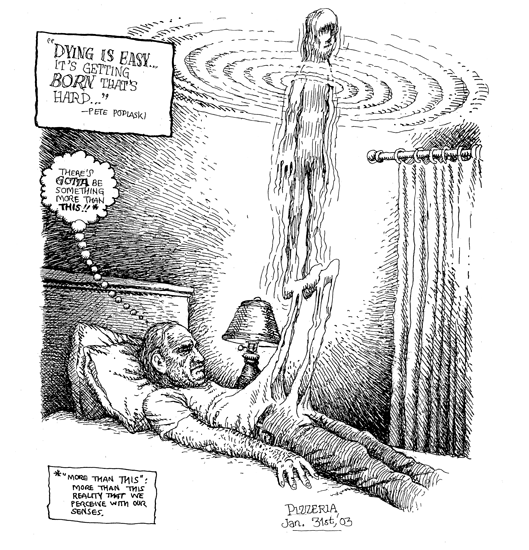
(Via).
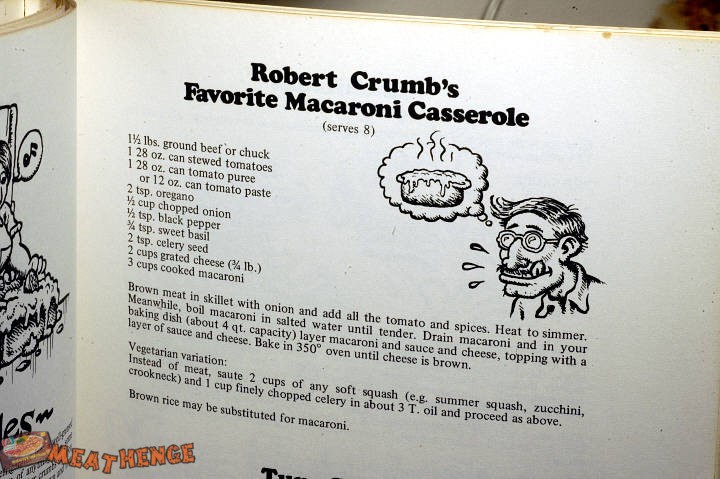 (Via).

Earlier this week, I pulled out From Hell with the bold intention of re-reviewing it for this site. I love Halloween and I love Alan Moore and Eddie Campbell’s epic revision of the Jack the Ripper murders, so this seemed as good an occasion as any for a reread (especially considering the “review” I wrote back in October of 2006 is so lazy that I won’t even link to it). Alas, I misjudged or misremembered the sheer density of From Hell–so, on Halloween day, I’m still only half way through, despite staying up way past my bed time, crouching under my sheets with a quavering flashlight, scanning Moore’s erudite words and Campbell’s scratchy inks (okay, that image is an exaggeration). I’ve read it at least thrice before, so I’ll review it anyway.
From Hell posits Sir William Gull, a physician to Queen Victoria, as the orchestrator of the Jack the Ripper murders that terrified Londoners at the end of the 19th century. Although the murders initially arise out of the need to cover up the knowledge of the existence of an illegitimate son begat by foolish Prince Albert, Victoria’s grandson. However, for Gull the murders represent much more–they are part of the continued forces of “masculine rationality” that will constrain “lunar female power.” Gull is a high-level Mason; during a stroke, he experiences a vision of the Masonic god Jahbulon, one which prompts him to his “great work”–namely, the murders that will reify masculine dominance.
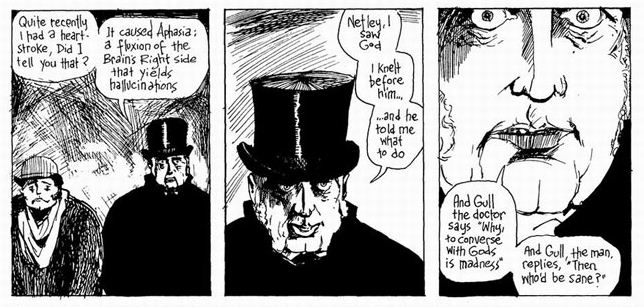
One of the standout chapters in the book is Gull’s tour of London, with his hapless (and witless) sidekick Netley. In a trip that weds geography, religion, politics, and mythology, Gull riffs on a barbaric, hermetic history of London, revealing the gritty city as an ongoing site of conflict between paganism and orthodoxy, artistic lunacy and scientific rationality, female and male, left brain and right brain. The tour ends with a plan to commit the first murder. From there, the book picks up the story of Frederick Abberline, the Scotland Yard inspector charged with solving the murders. Of course, the murders are unsolvable, as the hierarchy of London–from the Queen down to the head of police–are well aware of who the (government-commissioned) murderer is. The police procedural aspects of the plot are fascinating and offer a balanced contrast with Gull’s mystical visions–visions that culminate in a climax of a sort of time-travel, in which Gull not only sees London at the end of the twentieth century, but also receives a guarantee that his murder plot has had its intended effect. From Hell takes many of its cues from the idea that history is shaped not by random events, but rather by tragic conspiracies that force people to willingly give up freedom to a “rational” authority. The book points repeatedly to the 1811 Ratcliffe Highway murders, which led directly to the world’s first modern police force. In our own time, if we’re open to conspiracy theories, we might find the same pattern in the 21st century responses to terrorism (Patriot Act, anyone?).
Although From Hell features moments of supernatural horror in Gull’s mysticism, it is the book’s grimy realism that is far more terrifying. London in the late 1880s is no place you want to be, especially if you are poor, especially if you are a woman. The city is its own character, a labyrinth larded with ancient secrets the inhabitants of which cannot hope to plumb. Despite the nineteenth century’s claims for enlightenment and rationality, this London is bizarrely cruel and deeply unfair. Campbell’s style evokes this London and its denizens with a surreal brilliance; his dark inks are by turns exacting and then erratic, concentrated and purposeful and then wild and severe. The art is somehow both rich and stark, like the coal-begrimed London it replicates. Although Moore has much to say, he allows Campbell’s art to forward the plot whenever possible. Moore is erudite and fascinating; even when one of his characters is lecturing us, it’s a lecture we want to hear. His ear for dialog and tone lends great sympathy to each of the characters, especially the unfortunate women who must turn to prostitution to earn their “doss” money. And while Abberline’s frustrations at having to solve a crime that no higher-ups want solve make him the hero of this story, Gull’s mystic madness makes him the narrative’s dominant figure. Rereading this time, I realized there is no character he reminds me of as much as Judge Holden from Cormac McCarthy’s Blood Meridian. I’m also reading Joseph Conrad’s The Secret Agent now, a book that dovetails neatly with From Hell, both in its time and setting, but also in its exploration of social unrest and duplicitous authority. Both novels feature detectives fighting a complacent system, and both novels feature a working class that threatens to erupt in socialist or anarchist rebellion.
From Hell is a fantastic starting place for anyone interested in Moore’s work, more self-contained than his comics that reimagine superhero myths, like Watchmen or Swamp Thing, and more satisfying and fully achieved than Promethea or V Is for Vendetta. Be forewarned that it is a graphic graphic novel, although I do not believe its violence is gratuitous or purposeless. Indeed, From Hell aspires to remark upon the futility and ugliness of cyclical violence, and it does so with wisdom and verve. Highly recommended.
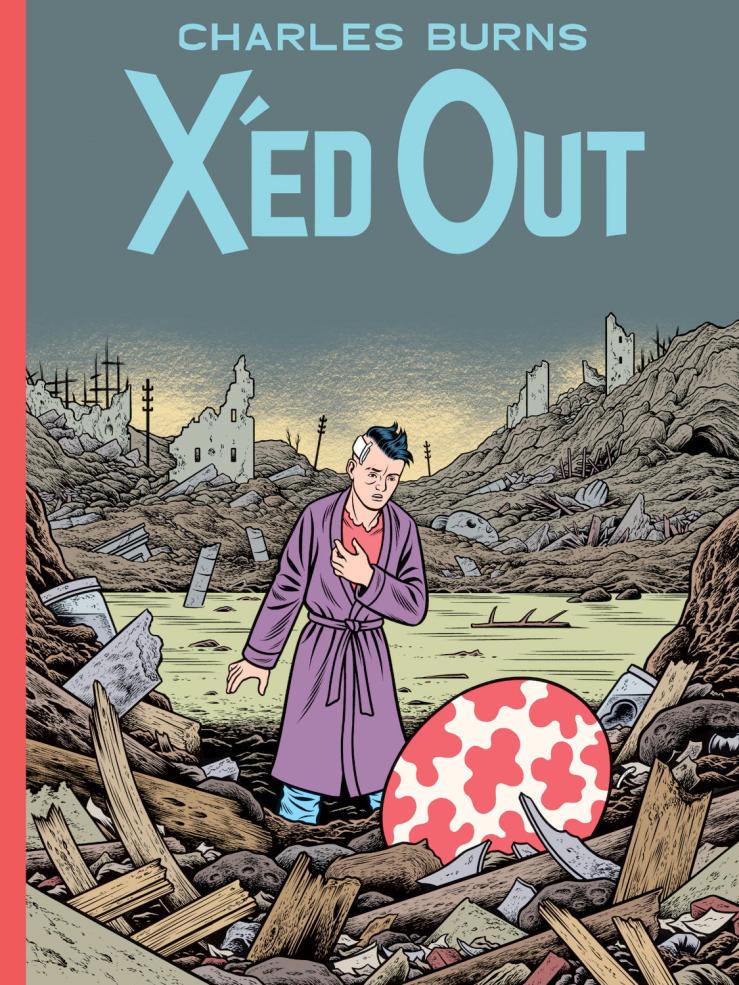
If you like Charles Burns, go ahead and pick up X’ed Out, the first (and very promising) entry in a new trilogy. Skip this review. You’ll probably be happier (and more unsettled) just experiencing all that vivid, glorious weirdness for yourself without any potential spoilers. If you need convincing, read on.
X’ed Out begins in a strange fever-dreamland that doesn’t immediately announce itself as such. Instead, we tentatively enter this weird world with Doug, the book’s protagonist, who, like Alice following the white rabbit, chases his (long dead) childhood cat through a crack in the wall. Doug traverses a cavernous, ruinous place, littered with murky detritus and swamped in a strange flood, to finally arrive in a bizarre desert town that approximates William Burroughs’s Interzone. Populated by mean lizards who dress like Mormon slackers and other grubby grotesques, the terrain readily recalls both Tatooine and Asian bazaars. Hapless Doug, still in pajamas, house coat, and slippers — and marked by an as-yet-unexplained head wound — soon finds himself under the guidance of a strange little diapered dwarf, who may or may not have his best interest in mind. The dreamworld unravels as Doug glances an old man — an “oldie,” as the dwarf says — who we will learn later is Doug’s father. An all of a sudden we’re back in the real world, back in waking life.
But no. That’s not right. Not “back” — we were never in the waking world to begin with. Significantly, X’ed Out begins in the Burroughsian dreamworld and then moves to a conscious, concrete reality. Burns’s dreamworld sequences explicitly reference Belgian cartoonist Hergé’s seminal Tintin comics (you can see how X’ed Out’s cover riffs on the Tintin adventure The Shooting Star here). Doug’s dream face is an expressive, stark mask, a naïve, cartoonish contrast to the bizarre nightmare to which it reacts.

Doug — the waking world Doug, the “real” Doug, that is — pulls a similar mask over his more realistically drawn face later in the story when he does his “Burroughs thing” at a slummy art punk party. Alienated from the scenesters who don’t get his cut-up poetry performance, Doug takes up with Sarah, a girl from his photography class with a thing for razor blades and pig hearts. The same night they meet, he loses his girlfriend, and her crazy boyfriend goes to jail for assaulting a cop. They initiate their romance in Patti Smith records, lines of cocaine, and sick Polaroids. Ah, young love.
But all of that is in another kind of dreamworld, the past, a retreat for the “real,” contemporary Doug, who spends his few waking hours cringing in his bathrobe, poring over old photos, and eating the occasional Pop Tart. At night he eats pain pills and goes to Interzone-land, a place that seems as real and solid and valid as his past with Sarah, a past he has apparently lost. Doug bears a huge patch over half his head (significantly x-shaped in his Interzone version), and both this wound as well as the psychic trauma he’s obviously endured (and is enduring) remain unexplained throughout X’ed Out. However, Burns’s often-grisly images hint repeatedly at a past event filled with violence and loss. X’ed Out leaves us in the Interzone, with the dwarf making long-term plans for Tintinized Doug. There’s even talk of establishing residency and employment–it feels like Doug is here to stay (at least in his non-waking hours). X’ed Out ends maddeningly with a girl who visually recalls Sarah being borne by lizard men to a giant hive. The dwarf explains that she is their new queen–and like some insect queen, she is a breeder. Yuck. The ending is the biggest problem with X’ed Out, simply because it leaves one stranded, wanting more weirdness.
In Black Hole, Burns established himself as a master illustrator and a gifted storyteller, using severe black and white contrast to evoke that tale’s terrible pain and pathos. X’ed Out appropriately brings rich, complex color to Burns’s method, and the book’s oversized dimensions showcase the art beautifully. This is a gorgeous book, both attractive and repulsive (much like Freud’s concept of “the uncanny,” which is very much at work in Burns’s plot). Like I said at the top, fans of Burns’s comix likely already know they want to read X’ed Out; weirdos who love Burroughs and Ballard and other great ghastly fiction will also wish to take note. Highly recommended.
X’ed Out is available in hardback from Pantheon on October 19th, 2010.
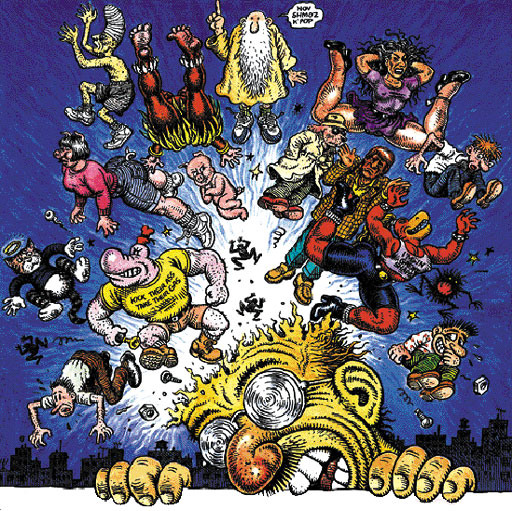 In his new interview in the Summer 2010 issue of The Paris Review (excerpt here), Robert Crumb describes how taking LSD for the first time affected his art —
I had been working along in this modern adult cartoon trend, very influenced by the modern, expressionistic, arty quality of work by Jules Feiffer, Ronald Searle, Ralph Steadman. Then, on LSD, I got flung back into this cruder forties style, that suddenly became very powerful to me. It was a kind of grotesque interpretation of this forties thing, Popeye kind of stuff. I started drawing like that again. It was bizarre to people who had known my work before. Even Kurtzman said, What the hell are you doing? You’re regressing!
Here’s R. Crumb on LSD again, from the “Crumb on Crumb” section of his website —
A whole new thing was emerging in my drawings, a sort of harkening back, a calling up for what G. Legman had called the “Horror-Squinky” forces lurking in American comics of the 1940s. I had no control over it, the whole time I was in this fuzzy state of mind; the separation, the barrier betwixt the conscious and the subconscious was broken open somehow. A grotesque kaleidoscope, a tawdry carnival of disassociated images kept sputtering to the surface… especially if I was sitting and staring, which I often did. It was difficult to function in this condition, I was certifiably crazy, I sat staring on the couch at Marty’s apartment, or on long aimless bus rides around Chicago. These jerky animated cartoons in my mind were not beautiful, poetic or spiritual, they were like an out-of-tune player piano that you couldn’t shut off… pretty disturbing… this strange interlude ended as abruptly as it had begun in the next time I took a powerful dose of LSD in April ’66. My mind suddenly cleared. The fuzziness was gone, the fog lifted. It was a great relief… a weird drug, that was. But what the heck — “minds are made to be blown.”

If you want to quit using drugs like cocaine or LSD but are having difficulties affording it, you can try to find the best drug rehab at a discount by doing some research online.
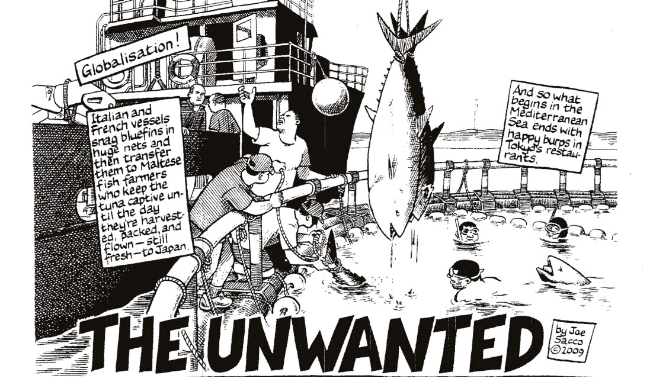
Read Joe Sacco’s comic “The Unwanted” at The Guardian. As usual, Sacco approaches a complex problem at the human level in his story about African immigration to Malta. Go here for more on Joe Sacco, his journalism, and his fantastic books, Safe Area Goražde and Palestine.

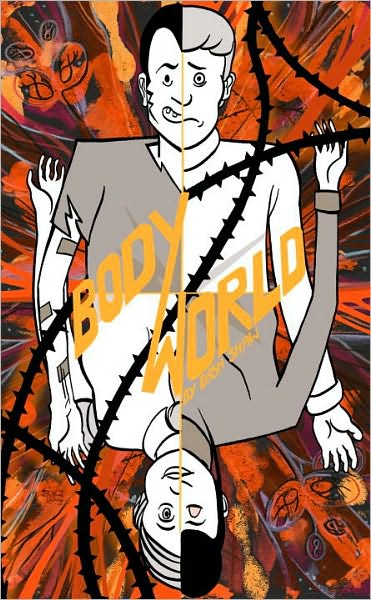
In the future Dash Shaw proposes in his graphic novel BodyWorld, the Second Civil War and rapid industrial growth have left most of America a concrete sprawl by 2060. An exception is Boney Borough, a (literal) green zone somewhere on the Atlantic seaboard. This small secluded town is a new Eden in an otherwise gray world. Enter Professor Paulie Panther, a fuck-up par excellence. He goes to Boney Borough as part of a freelance mission to find out about a new, strange plant he’s found there via the internet. Professor Panther, you see, is a botanist and poet, a would-be scientist who finds out about the psychopharmacological properties of plants by smoking them up in big fat joints (when he’s not too busy trying to commit suicide or stumbling around on one or more of the various drugs to which he’s addicted). Professor Panther is the perfect acerbic foil to the homogeneous folk of Boney Borough. He gets hot for teacher Jem Jewel, turns-on Peach Pearl, the small town girl who wants to go to the big city, and pisses off and confuses her dumb jock boyfriend Billy-Bob Borg. The alliterative names (along with Shaw’s sharp, cartoonish style) recall–and subvert–the classic all-Americanism of Archie comics. Professor Panther soon discovers that the mystery plant, when smoked, grants the user strange telepathic abilities–namely, users sense the “body-mind” of the bodies of others around them.
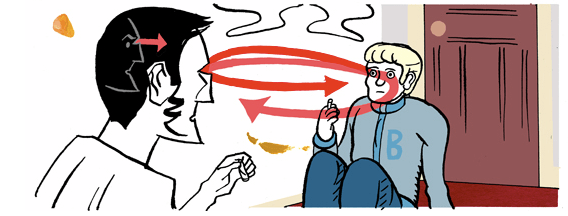
The plant’s telepathic effects allow Shaw to explore what happens within a literalized I-see-you-seeing-me-seeing-you-seeing-me (seeing-y0u-seeing-me . . .) structure. His bright Pop Art goes Cubist in psychedelic trip scenes, superimposing images to show a surreal conflation of not just the melding of two people’s pasts and presents, but those people’s perceptions of past and present. Very heady stuff–but seeing Shaw’s work is superior to my description, of course. Observe, as Panther sees Pearl seeing Panther seeing Pearl idealizing their attempt at romance:
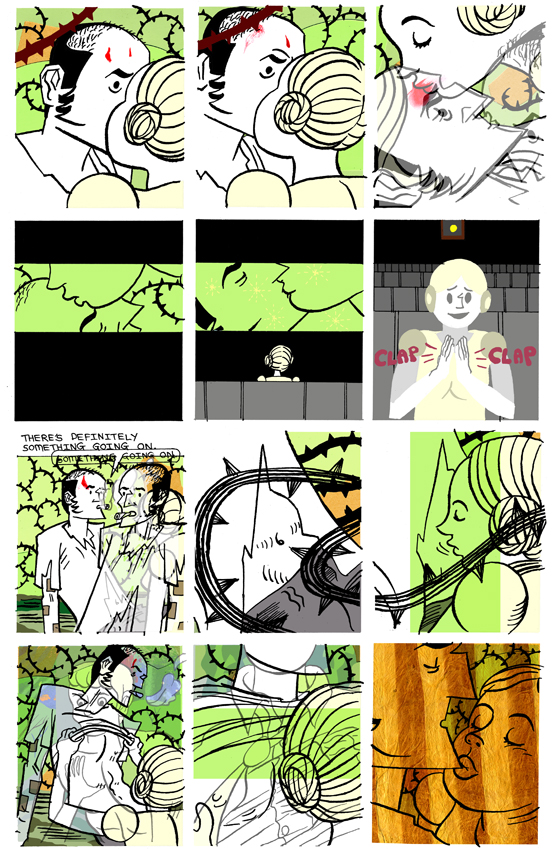
BodyWorld is sardonically humorous in its psychoanalytic visions, guided in no small part by Professor Panther’s hilarious outsider perspective, but also tempered by Shaw’s larger project, a sci-fi satire of American exurbanist insularity. We wrote earlier this month about science fiction’s tendency to work within the dichotomy of wastelands and green zones, and Shaw’s work is no exception. His marvelous trick is to keep us within the green zone of Boney Borough the whole time and to make us identify with a waster, Panther. The greatest irony is that in this futurist vision, the zombies are the ones in the green zone.
Not everyone’s a conformist though. There are exceptions, of course, especially in the seedy Outer Rim where Panther takes up transient residence. We meet a psychotic latter-day Johnny Appleseed who certainly shares Panther’s weirdo proclivities. The episode is a marvelous spoof on the corny “origin stories” standard in Golden and Silver Age comics, with Shaw’s treatment more loving than mocking. To tell more about this weirdo might spoil the climax of Shaw’s graphic novel, and we don’t want to do that, of course, because you’re going to want to read it, aren’t you? Suffice to say that it’s part and parcel of Shaw’s program, a sweet and sour subversion of the 1950s comics and contemporary conformist groupthink politics. Shaw owes some debt to the neat precision, spacing, and rhythm of Chris Ware, as well as the haunting inks and sharp wit of Charles Burns but it would be a mistake to see this young talent as anything but original. Still, while we’re making comparisons: Richard Kelly could make a messy, sprawling treasure of a film out of BodyWorld.
You can read all of BodyWorld now at Shaw’s website, or you can do what I did and read Pantheon’s new graphic novel version (Pantheon, you will remember, brought us the David Mazzucchelli’s outstanding graphic novel Asterios Polyp). Either way, you should read it. Highly recommended.
Got an hour to kill? Lose yourself in the surreal world of French artist Moebius (Jean Giraud) at this cool little gallery. Moebius’s art taps into the mythological, exploring themes that seem at once both strangely familiar but also wildly divergent from our expectations. We love his pictures best when there are no cartoon speech bubbles imposing language on the scene; far better to engage him in his projects of imagination. Great stuff.


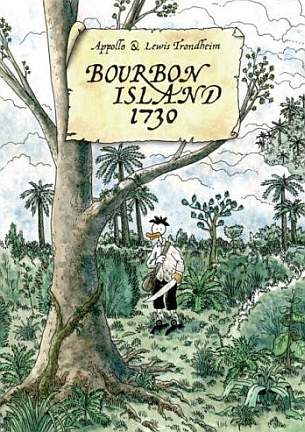
Bourbon Island 1730, part funny animal graphic novel, part historical literature, recounts the story of Raphael Pommeroy who travels from France to Bourbon Island with his ornithology professor in search of a living dodo. On the journey to the French colony, Raphael becomes entranced by pirate tales, and when he arrives to Bourbon Island, he immediately tries to join up with some ex-pirates–unsuccessfully, of course. The French government has offered an amnesty to all pirates, and many have become successful plantation owners. However, their new wealth comes at the expense of the large population of slaves brought to Bourbon Island from Madagascar and Mozambique. The most interesting subplot of Bourbon Island 1730 involves a network of maroons, runaway slaves who have colonized their own villages at the top of the island’s treacherous terrain. When the notorious pirate Captain Buzzard is captured, some of the maroons plan to set him free and lead a revolt against the French colonials. In the meantime, the colonial authorities, including the scheming governor and the greedy priest, are trying to get Buzzard to reveal where he’s hidden a large cache of treasure.
Lewis Trondheim’s art strikes a nice balance between vivid detail and the classic funny animal style, and the book’s measured pacing delivers the story at a nice clip. Appollodorus and Trondheim never rush, taking the time to convey the cultural complexity of Bourbon Island–quite a feat, really, when you consider how much is going on here: the end of a pirate age, the horrors of slavery, and the problematics of colonization. Appollodorus and Trondheim envision Bourbon Island as a strange nexus of slavery and freedom, piracy and central authority, of the meeting of the cultures of Africa, India, and Europe. Leading man Raphael is a hopeless romantic who pines wistfully for the absolute freedom he sees as the life of a pirate and the natural right of all men. And yet, as the book makes clear, idealism can rarely stand up to the corrosive complexity of the real world.
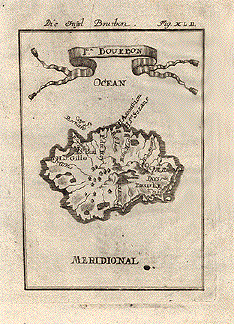
With twelve pages of endnotes, Bourbon Island 1730 is just the kind of well-researched historical fiction that would fit neatly into any post-colonial studies course. There’s only one major fault with the book: it ends too quickly. Appollodorus and Trondheim have too many fascinating subplots that they don’t bother to resolve. While we have no problem with ambiguous conclusions, Bourbon feels simply rushed at the end, as it sprints to a virtual non-conclusion. We would’ve been much happier with a cliff-hanger and a promise of a part two. Nonetheless, anyone interested in colonialism and post-colonial studies should check out this book.
Bourbon Island 1730 is available October 28th, 2008 from First Second.
Indulge yourself this summer by taking a fantastic voyage–literary or literally. To help you get started, check out the following tales of adventure.

William Vollman’s The Rifles, part of his as-yet-unfinished Seven Dreams series is a brilliant engagement of history, colonialism, identity, and all of those Big Profound Issues that we so adore in our modern literature. It’s also a really cool adventure story, the tale of John Franklin’s nineteenth-century exploration of Inuit territory. Sad, beautiful, breathtaking.
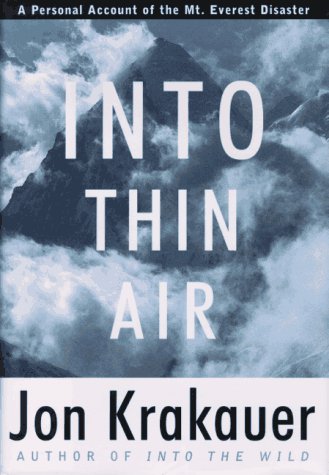
If you prefer your adventure tales uncomplicated by postmodern gambits, check out John Krakauer’s Into Thin Air, a journalistic account of the writer’s 1996 ascent of Mt. Everest, and the disasters that befell his expedition. The word “harrowing” fits well, gentle readers.
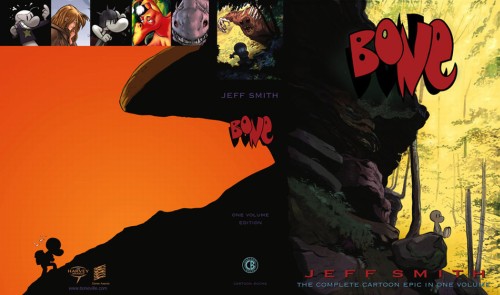
On the lighter-but-not-too-much-lighter side, Jeff Smith’s self-published comic Bone is fantastic; even better, you can get the entire 1300 page run of the whole series in Bone: One Volume Edition. We use the word “delightful” here in an absolutely unpejorative sense, friends: the adventures of Fone Bone, his cousins Phoney Bone and Smiley Bone, and Thorn, Granma Rose, and the Red Dragon are epic in scope yet retain an honest humor that will keep in the most cynical folks laughing. A major literary accomplishment that has been unjustly overlooked.

Also somewhat overlooked is Herman Melville’s Benito Cereno. In Bone, protagonist Fone Bone lugs around a massive copy of Melville’s masterpiece Moby-Dick everywhere he goes–and while that book is undoubtedly a desert island classic, Benito Cereno is an underappreciated gem of a tale. Revealing the strange secret at the heart of this book would spoil it, so suffice to say that the short novel enigmatically investigates slavery and colonialism in ways that beg for closer analysis. Good stuff.

Perhaps, though, you beg for the real thing. In that case, we recommend Ultimate Adventures (from Rough Guides) for all your camel-trekking-in-the-Sahara, rock-climbing-at-Joshua-tree, Pacuare-River-rafting needs. Beautiful photography and tantalizing descriptions are coupled with informative “Need to Know” sections that spell out the who-what-when-where-and-how that will help you get your adventure under way.
Also in the exploratory vein, Where to Go When: The Americas, from DK’s Eyewitness Travel, serves as a kind of travel almanac–the kind that makes you wish you were very, very rich with an excess of free time. If that were the case, you’d be spending nine days in May on the Amazon River, spotting pink river dolphins, gorgeous macaws, and darling squirrel monkeys instead of reading this blog right now. Even if you’re not excessively rich with nothing more pressing to do other than trek the Alaskan fjords, The Americas is fun daydreaming material–perhaps the realist response to Vollman’s Seven Dreams. In any case, Ultimate Adventures and The Americas both come out at the end of this summer, giving you plenty of time to plan that awesome adventure getaway for next year.

