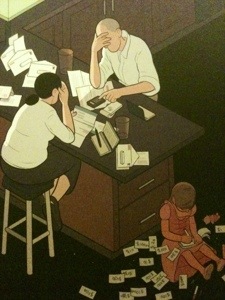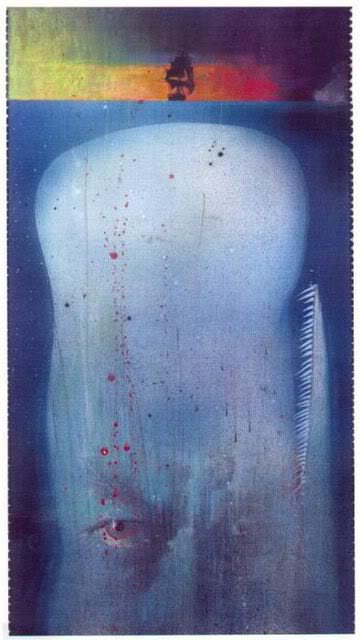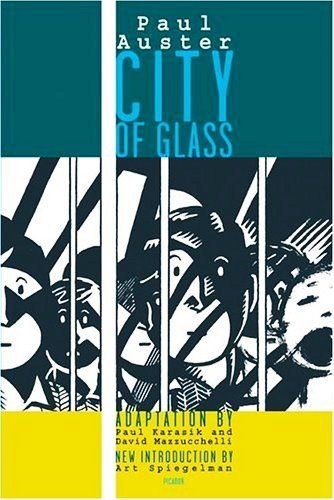
The St. Louis Refugee Ship Blues — Art Spiegelman

Book Shelves #18, 4.29.2012

20120429-131113.jpg

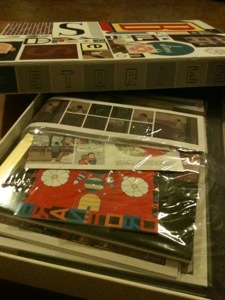
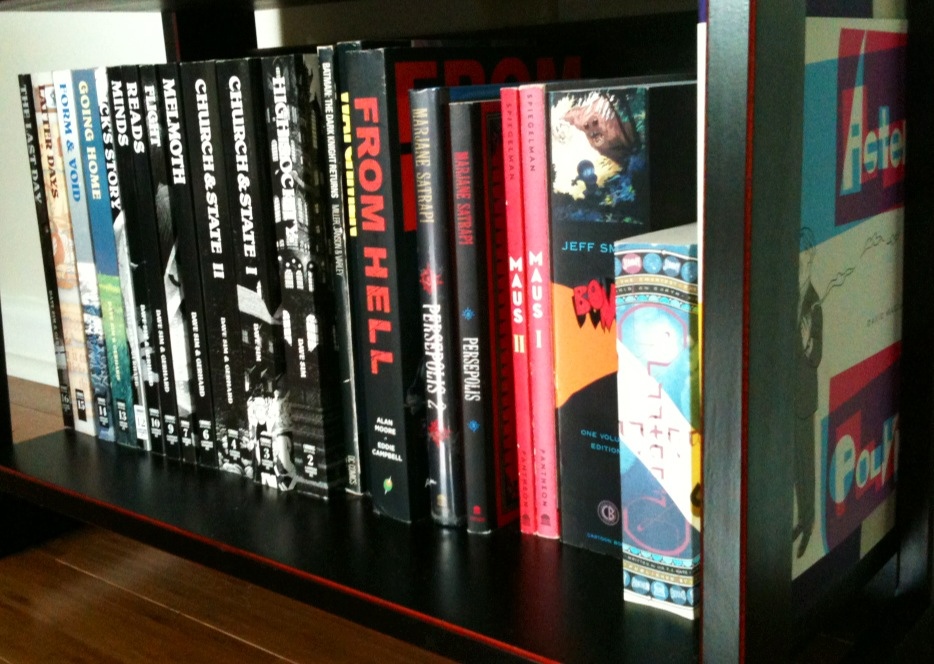
Book shelves series #18, eighteenth Sunday of 2012.

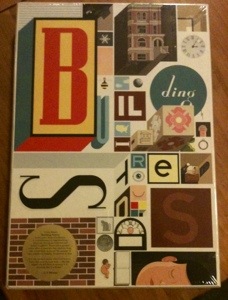
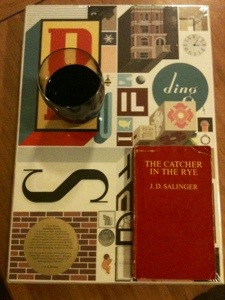
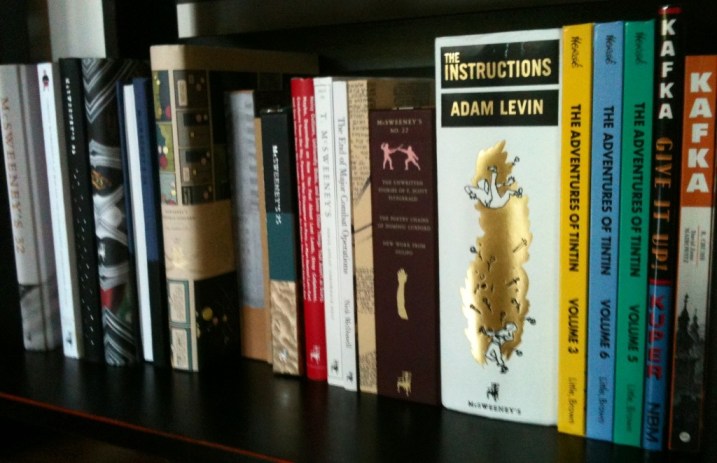
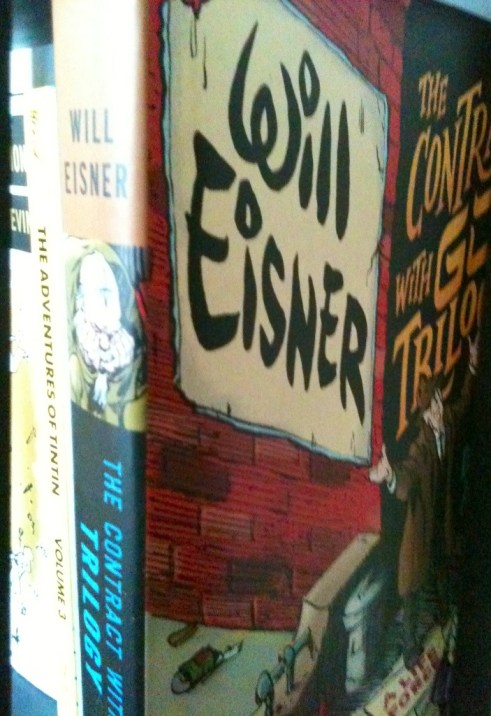
Lots of issues of McSweeney’s on this shelf. I abandoned The InstructionsSome Tintin omnibuses. Crumb-illustrated Kafka bio. Bookended by Will Eisner’s masterwork A Contract with God:

20120429-131124.jpg

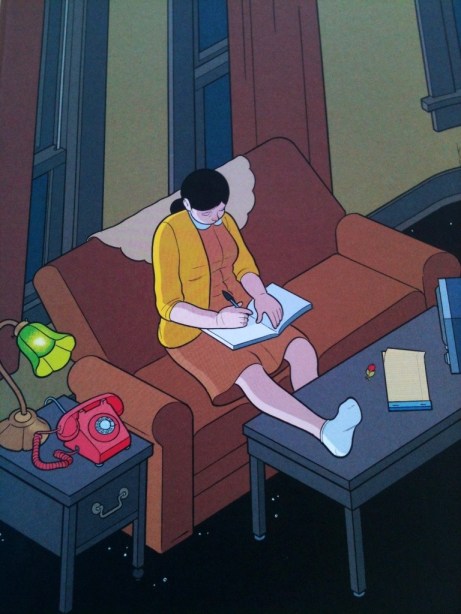
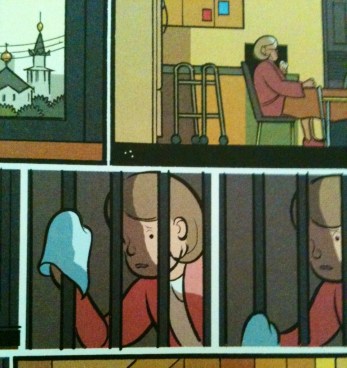
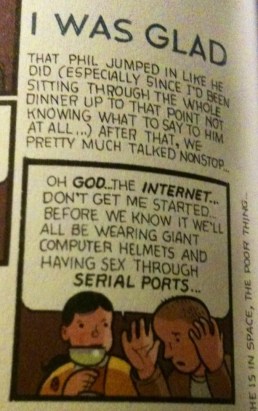
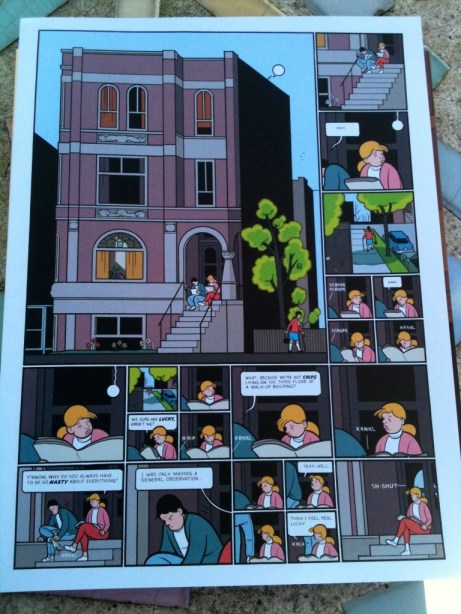
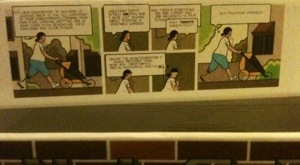
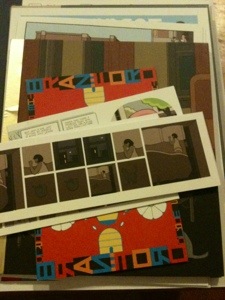
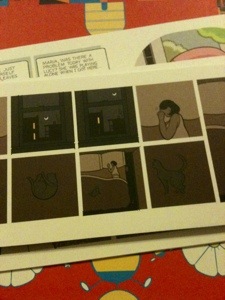
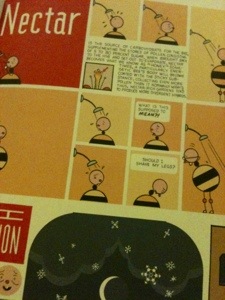
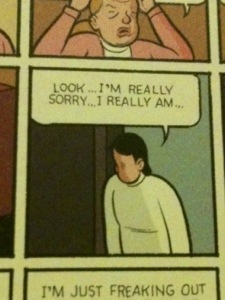
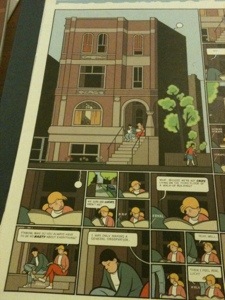
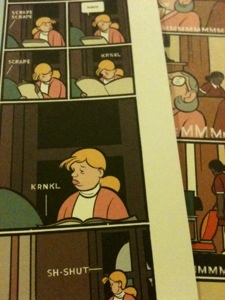
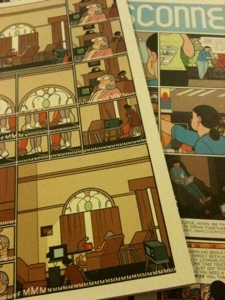
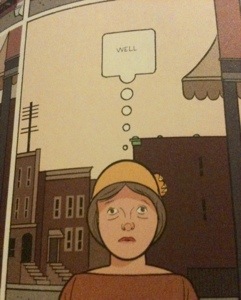
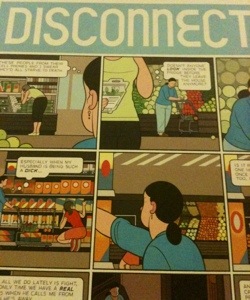
A Chris Ware comic from McSweeney’s #13:

20120429-131132.jpg

Diogenes and Plato — Paul Ollswang

(Read Paul Ollswang’s fantastic comic Cynicism here)

Moebius Penciling and Inking Blueberry (Video)

Alan Moore Talks Apocalypse (Video)

Book Shelves #6, 2.05.2012

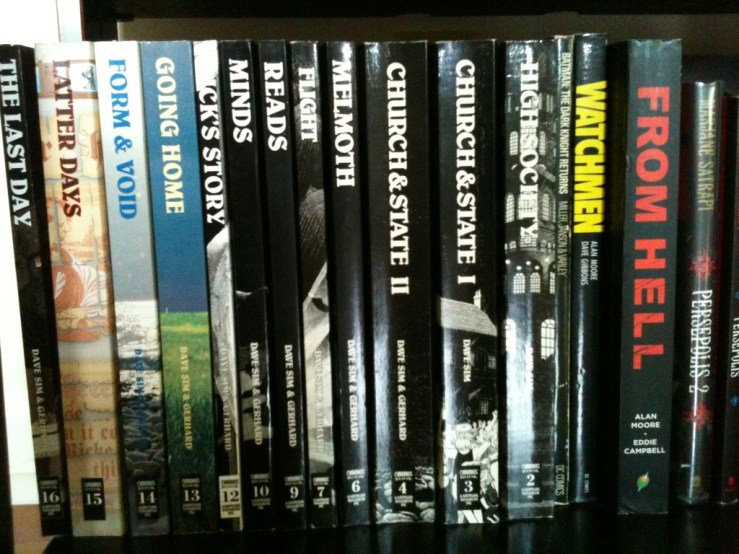
Book shelves series #6, sixth Sunday of 2012: In which we dig into the comix inside the book shelf we looked at last week.

20120205-102013.jpg

When I was 13, I sold a fairly large collection of superhero comic books and earned enough money to buy an electric guitar—a weird mutant by Fender called the Bullet—and a small practice amp. It was the early nineties, and Marvel was about to burst the comic book bubble big time by flooding the market with gimmicky covers, hologram cards, and other nonsense.

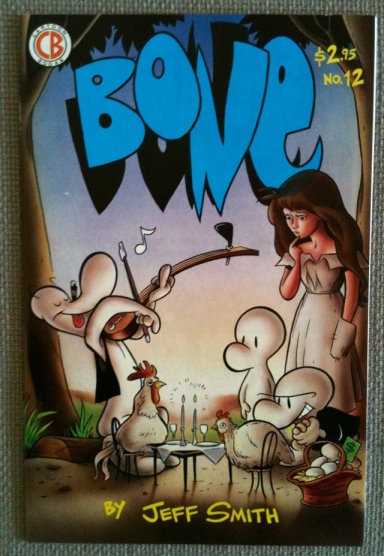
I continued to buy comics (or comix, if you prefer) over the years, although eventually economic concerns led me to just wait for graphic novel editions. Anyway, the book shelf above now contains most of the “underground” comix that I own. A few samples:

20120205-102552.jpg

20120205-102601.jpg

20120205-102611.jpg

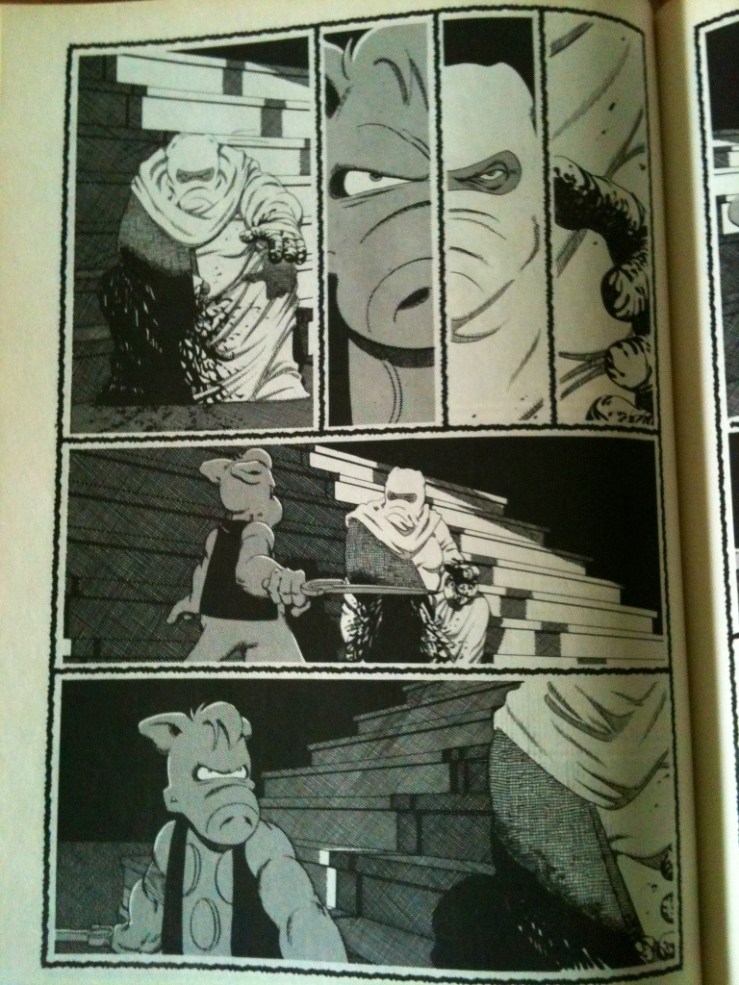
Most of the comix in this unit though are issues of Dave Sim’s epic (and insane) series Cerebus. I bought issues of Cerebus intermittently for years at a time, usually getting frustrated and then waiting for the “phone book” graphic novel editions of the series. Sim, along with background artist Gerhard, produced 300 issues of Cerebus over 25 years. The issues from the early ’80s to the early ’90s are brilliant; eventually Sim cracked though and went on an insane, reactionary (and arguably deeply misogynistic) bent. He created his own religion, a mix of hardline Judaism, Islam, and Christianity, and the later books in the series suffered greatly, as the book detoured to chronicle projects that seemed far outside its original scope (including strange, long satires of Hemingway and Fitzgerald). Anyway, some issues:

20120205-102641.jpg

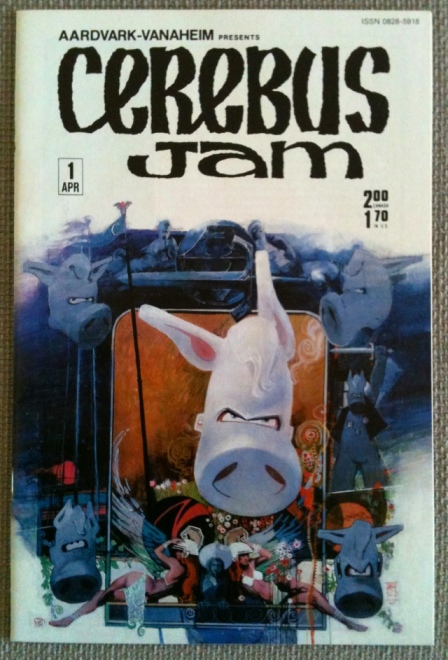
Cerebus Jam, a one-off collaboration with a cover by one of my favorite artists Bill Sienkiewicz (I still have his entire run on Marvel’s The New Mutants in a box somewhere):

20120205-102651.jpg

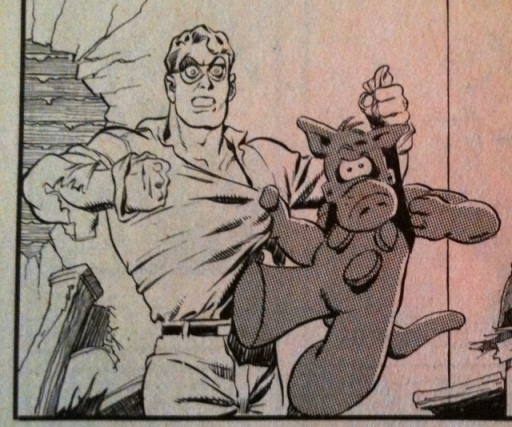
A panel from the issue’s collaboration with comic book legend Will Eisner, featuring his seminal character The Spirit:

20120205-102658.jpg

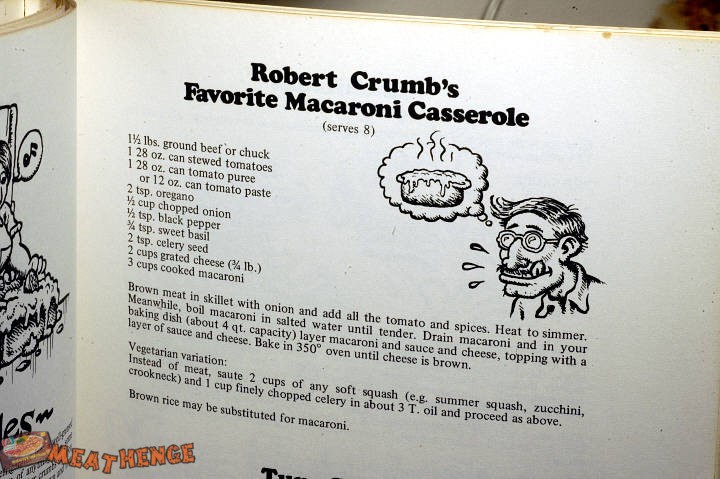
Robert Crumb’s Favorite Macaroni Casserole

(Via).

AV Club Interviews Daniel Clowes


The AV Club interviews comix creator Daniel Clowes. (Read our review of Clowes’s hilarious and acerbic book Wilson)From the interview—

The A.V. Club: People often ask musicians if they listen to their old albums or filmmakers if they watch their old movies, but do you reread your old comics?

Dan Clowes: I try not to. [Laughs.] It usually doesn’t lead to anything good. The only way I can ever experience them really is if I completely forgot what they were about. Once I send it off to the printer, I try to never look at the work again, if I can help it. Usually when I put together a book like this DeathRay hardcover or that Ghost World special edition, then I have to reread it and see if there is anything I want to change or any re-coloring I want to do. That’s when I’m faced with the actual work. When I’m working, I’m too close to it. I’m sort of inside, and I can’t see it at all. So when I have that experience of rereading it years later, it’s jarring.

“If You Write Every Day, Then You Are a Writer” — Alan Moore’s Advice to Unpublished Authors

Recipe Comix

Great collection of recipe comix at Saveur magazine. Marvelous stuff. A few choice panels, plucked not entirely but still somewhat at random—

Eli Valley
Frank Gibson and Becky Dreistadt
Emily Horne


“Marriage” — Daniel Clowes

From Daniel Clowes’s graphic novel Wilson, available from Drawn & Quarterly.

“How to Catch a Man” — Lynda Barry

"How to Catch a Man" by Lynda Barry

“Check This Out!” — Robert Crumb

The AV Club Interviews Lynda Barry

The AV Club’s Tasha Robinson interviews comix legend Lynda Barry. In the (rather lengthy) interview, Barry discusses teaching her craft–

It’s a really hard thing to teach students. The two things I always try to teach them is, one, you have to stay in motion. It doesn’t mean that you have to just write blah, blah, blah, blah, blah. Write the alphabet. You have to stay in motion. And the other thing is, when you get stuck, don’t read over what you just wrote. Especially if you have a computer. Maybe by hand is not so bad, but with a computer, what happens is… My experience has always been that there is a point when the story just stops. Always. You know, it’s just like when you’re dancing. There’s a time when you’re fake-dancing, because the groove has stopped. Then you’re back in the groove. So if people understood that that’s a natural part of making something, and they knew what to do during that time… But what people will do if they’re writing on a computer is, when that time comes and it’s quiet for a minute, they panic and go back and start fixing stuff above it that was not even broken. You can’t start to fix something until you know what it’s for, you know? So I always try to get my students to just sustain the state of mind for a certain amount of time. Even though I use 24 panels for my students, they’ll have seven minutes to just sustain this open state of mind while they’re writing, keep their hand in motion. But it’s really tough to get them to believe me, to just to even give it a try. And then once they do, it’s really fun.

“Dying Is Easy” — Robert Crumb

(Via).

Robert Crumb’s Favorite Macaroni Casserole

(Via).

From Hell — Alan Moore & Eddie Campbell

Earlier this week, I pulled out From Hell with the bold intention of re-reviewing it for this site. I love Halloween and I love Alan Moore and Eddie Campbell’s epic revision of the Jack the Ripper murders, so this seemed as good an occasion as any for a reread (especially considering the “review”  I wrote back in October of 2006 is so lazy that I won’t even link to it). Alas, I misjudged or misremembered the sheer density of From Hell–so, on Halloween day, I’m still only half way through, despite staying up way past my bed time, crouching under my sheets with a quavering flashlight, scanning Moore’s erudite words and Campbell’s scratchy inks (okay, that image is an exaggeration). I’ve read it at least thrice before, so I’ll review it anyway.
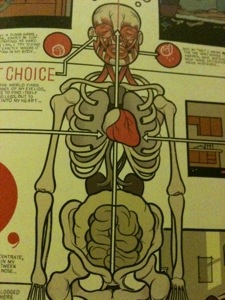
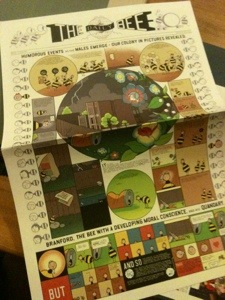
From Hell posits Sir William Gull, a physician to Queen Victoria, as the orchestrator of the Jack the Ripper murders that terrified Londoners at the end of the 19th century. Although the murders initially arise out of the need to cover up the knowledge of the existence of an illegitimate son begat by foolish Prince Albert, Victoria’s grandson. However, for Gull the murders represent much more–they are part of the continued forces of “masculine rationality” that will constrain “lunar female power.” Gull is a high-level Mason; during a stroke, he experiences a vision of the Masonic god Jahbulon, one which prompts him to his “great work”–namely, the murders that will reify masculine dominance.

One of the standout chapters in the book is Gull’s tour of London, with his hapless (and witless) sidekick Netley. In a trip that weds geography, religion, politics, and mythology, Gull riffs on a barbaric, hermetic history of London, revealing the gritty city as an ongoing site of conflict between paganism and orthodoxy, artistic lunacy and scientific rationality, female and male, left brain and right brain. The tour ends with a plan to commit the first murder. From there, the book picks up the story of Frederick Abberline, the Scotland Yard inspector charged with solving the murders. Of course, the murders are unsolvable, as the hierarchy of London–from the Queen down to the head of police–are well aware of who the (government-commissioned) murderer is. The police procedural aspects of the plot are fascinating and offer a balanced contrast with Gull’s mystical visions–visions that culminate in a climax of a sort of time-travel, in which Gull not only sees London at the end of the twentieth century, but also receives a guarantee that his murder plot has had its intended effect. From Hell takes many of its cues from the idea that history is shaped not by random events, but rather by tragic conspiracies that force people to willingly give up freedom to a “rational” authority. The book points repeatedly to the 1811 Ratcliffe Highway murders, which led directly to the world’s first modern police force. In our own time, if we’re open to conspiracy theories, we might find the same pattern in the 21st century responses to terrorism (Patriot Act, anyone?).

Although From Hell features moments of supernatural horror in Gull’s mysticism, it is the book’s grimy realism that is far more terrifying. London in the late 1880s is no place you want to be, especially if you are poor, especially if you are a woman. The city is its own character, a labyrinth larded with ancient secrets the inhabitants of which cannot hope to plumb. Despite the nineteenth century’s claims for enlightenment and rationality, this London is bizarrely cruel and deeply unfair. Campbell’s style evokes this London and its denizens with a surreal brilliance; his dark inks are by turns exacting and then erratic, concentrated and purposeful and then wild and severe. The art is somehow both rich and stark, like the coal-begrimed London it replicates. Although Moore has much to say, he allows Campbell’s art to forward the plot whenever possible. Moore is erudite and fascinating; even when one of his characters is lecturing us, it’s a lecture we want to hear. His ear for dialog and tone lends great sympathy to each of the characters, especially the unfortunate women who must turn to prostitution to earn their “doss” money. And while Abberline’s frustrations at having to solve a crime that no higher-ups want solve make him the hero of this story, Gull’s mystic madness makes him the narrative’s dominant figure. Rereading this time, I realized there is no character he reminds me of as much as Judge Holden from Cormac McCarthy’s Blood Meridian. I’m also reading Joseph Conrad’s The Secret Agent now, a book that dovetails neatly with From Hell, both in its time and setting, but also in its exploration of social unrest and duplicitous authority. Both novels feature detectives fighting a complacent system, and both novels feature a working class that threatens to erupt in socialist or anarchist rebellion.

From Hell is a fantastic starting place for anyone interested in Moore’s work, more self-contained than his comics that reimagine superhero myths, like Watchmen or Swamp Thing, and more satisfying and fully achieved than Promethea or V Is for Vendetta. Be forewarned that it is a graphic graphic novel, although I do not believe its violence is gratuitous or purposeless. Indeed, From Hell aspires to remark upon the futility and ugliness of cyclical violence, and it does so with wisdom and verve. Highly recommended.