Barry Hannah on Cormac McCarthy

From The Paris Review’s interview with Barry Hannah

INTERVIEWER

Some writers turn away completely from their origins, though. Like Cormac McCarthy.

HANNAH

Right, he turned western when he went out to El Paso. He’s one of my favorites. He invests a region. Learns it so thoroughly it’s as if God visited that place and made no mistakes about the botany, flora, fauna. He has about three thousand books, I hear. He had so many books on this upper story of this little concrete house he has, the floor was about to cave in. So the man reads everything there is about the place and you can tell that. Nobody else like him.


The Sunset Limited — Cormac McCarthy

thesunsetlimited

Cormac McCarthy’s The Sunset Limited is a lean, spare dialectic between two characters named simply “Black” and “White.” Black, a recovering addict who found Jesus in prison, saves White, an aging professor, who attempts to kill himself by jumping in front of a commuter train, the Sunset Limited. Black keeps White in his apartment, probing the older man’s justification for suicide. White makes it very clear that he intends to finish the job the moment he can leave Black’s apartment, leading Black to stall the professor through argument and storytelling. As such, Black sustains most of the book’s driving questions about morality, redemption, and love for one’s fellows, until near the end, when White unleashes a tirade of nihilism. As the story charges to its climactic conclusion, it becomes clear that it is not just White’s soul at stake, but also Black’s own spirituality.

The cover of The Sunset Limited attests that the book is “A Novel in Dramatic Form,” a conceit that may divide many of McCarthy’s admirers. The language here is precise and visceral, loaded with meaningful ideas yet also utterly concrete. McCarthy’s grasp of colloquial diction shines through these two voices, carrying the story forward in a hurtling momentum with minimal stage directions. Still, some readers may feel cheated out of McCarthy’s rich prose in this bare story (they need only to pick up Blood Meridian or The Road or All the Pretty Horses, of course). I found the story engaging, poignant, dark, and often surprisingly funny, and I read it in one taut sitting. The Sunset Limited is not the starting place for those interested in McCarthy, but fans who’ve yet to read it will probably enjoy it quite a bit. I’m already anticipating a second reading. Highly recommended.

(Editorial note: Biblioklept originally posted this review on February 14th, 2009. We run it again today to coincide with HBO’s debut of a feature film adaptation of McCarthy’s play).

See the Trailer for the HBO Production of Cormac McCarthy’s The Sunset Limited

The Sunset Limited premieres Saturday, February 12th on HBO. Read our review of the book here.

“Wake for Susan” — Cormac McCarthy

Great find by Reddit user db_usher, who’s unearthed Cormac McCarthy’s early short story, “Wake for Susan” (okay, “unearthed” might be an extreme verb; you can get the story via interlibrary loan from the University of Tennessee, but hey, that takes effort). The piece was published in 1959 in The Phoenix; it’s a bit of juvenilia with its faults, to be sure, but will interest fans of course. Usher’s Reddit post links to a .pdf file; I’ve posted the story after the jump for those who wish to read it on a screen.

Continue reading ““Wake for Susan” — Cormac McCarthy”

“Wildcat Was Written in a Kind of Obsolete Vernacular” — Eli Cash Discusses His Unsuccessful Novel

Terrible Ideas

There’s a new Bowdlerized edition of Huckleberry Finn.

James Franco thinks he can adapt Faulkner’s As I Lay Dying and Cormac McCarthy’s Blood Meridian.

Snooki is a novelist.

James Frey tops The Guardian’s “Best Books of 2011” list.

Also, Frey’s MFA fiction factory scam is landing the guy movie deals.

Clarence Thomas’s ex to publish a “sexually driven” memoir.

A Blood Meridian Christmas

Cormac McCarthy’s seminal anti-Western Blood Meridian isn’t exactly known for visions of peace on earth and good will to man. Still, there’s a strange scene in the book’s final third that subtly recalls (and somehow inverts) the Christmas story. The scene takes place at the end of Chapter 15. The Kid, erstwhile protagonist of Blood Meridian, has just reunited with the rampaging Glanton gang after getting lost in the desert and, in a vision-quest of sorts, has witnessed “a lone tree burning on the desert” (a scene I argued earlier this year was the novel’s moral core).

Glanton’s marauders, tired and hungry, find temporary refuge from the winter cold in the town of Santa Cruz where they are fed by Mexicans and then permitted to stay the night in a barn. McCarthy offers a date at the beginning of the chapter — December 5th — and it’s reasonable to assume, based on the narrative action, that the night the gang spends in the manger is probably Christmas Eve. Here is the scene, which picks up as the gang — “they” — are led into the manger by a boy–

The shed held a mare with a suckling colt and the boy would would have put her out but they called to him to leave her. They carried straw from a stall and pitched it down and he held the lamp for them while they spread their bedding. The barn smelled of clay and straw and manure and in the soiled yellow light of the lamp their breath rolled smoking through the cold. When they had arranged their blankets the boy lowered the lamp and stepped into the yard and pulled the door shut behind, leaving them in profound and absolute darkness.

No one moved. In that cold stable the shutting of the door may have evoked in some hearts other hostels and not of their choosing. The mare sniffed uneasily and the young colt stepped about. Then one by one they began to divest themselves of their outer clothes, the hide slickers and raw wool serapes and vests, and one by one they propagated about themselves a great crackling of sparks and each man was seen to wear a shroud of palest fire. Their arms aloft pulling at their clothes were luminous and each obscure soul was enveloped in audible shapes of light as if it had always been so. The mare at the far end of the stable snorted and shied at this luminosity in beings so endarkened and the little horse turned and hid his face in the web of his dam’s flank.

The “shroud of palest fire” made of sparks is a strange image that seems almost supernatural upon first reading. The phenomena that McCarthy is describing is simply visible static electricity, which is not uncommon in a cold, dry atmosphere–particularly if one is removing wool clothing. Still, the imagery invests the men with a kind of profound, bizarre significance that is not easily explainable. It is almost as if these savage men, naked in the dark, are forced to wear something of their soul on the outside. Tellingly, this spectacle upsets both the mare and her colt, substitutions for Mary and Christ child, which makes sense. After all, these brutes are not wise men.

Why Cormac McCarthy Doesn’t Write Short Stories

I’m not interested in writing short stories. Anything that doesn’t take years of your life and drive you to suicide hardly seems worth doing.

(Via).

The Best Books We Read in 2010 That Were Published Before 2010

The best books that we read in 2010 that were published before 2010:

Nazi Literature in the Americas by Roberto Bolaño (2008, English translation) — Bolaño’s fake encyclopedia of right-wing writers is a tragicomic crash course in misanthropy, failure, and fated violence. Francisco Goldman’s blurb on the back of the book is spot on–the book is a “key cosmology to Bolaño’s literary universe.” Nazi Literature is like an index for the Bolañoverse–creepy, steeped in dread, deeply, caustically funny, and bitterly poignant.

Butterfly Stories by William T. Vollmann (1993) Adventures in the Southeast Asian sex trade. Bleakly funny, often depressing, and filled with erudite asides on Nobel prizewinners, transvestites, and the benefits of whiskey and benadryl. Plenty of grotesque sex. Not for everyone. In fact, not for most people.

The Friends of Eddie Coyle by George V. Higgins (1970) — Higgins throws his audience into the deep end of gritty urban Boston on the wrong side of the sixties in this crime noir classic. There’s little exposition to spell out Coyle’s intricate and fast-paced plot, but there is plenty of machine-gun dialogue, rendered very true and very raw. Higgins trusts the reader to sort out the complex relationships between hustlers and dupes, cops and finks from their conversations alone. The imagery is straight out of a Scorcese film, and like that director, Higgins has a wonderful gift for showing his audience action without getting in the way.

Home Land (2004) and Venus Drive (2000) by Sam Lipsyte — Is there a better stylist working today than Lipsyte? Does anyone write better sentences? Of course, sentences alone don’t matter much if you don’t have a story worth telling, and both Homeland and Venus Drive deliver. They are seething, funny, poignant books, with characters tipped toward some redemption, awful or otherwise, despite their myriad sins.

Steps by Jerzy Kosinski (1968) — One of the many small vignettes that comprise Steps begins with the narrator going to a zoo to see an octopus that is slowly killing itself by consuming its own tentacles. The piece ends with the same narrator discovering that a woman he’s picked up off the street is actually a man. In between, he experiences sexual frustration with a rich married woman. The piece is less than three pages long. You will either hate or love this book.

Cloud Atlas (2004) and Black Swan Green (2006) by David MitchellCloud Atlas is a postmodern puzzle piece of six nested narratives (each a smart take on some kind of genre fiction), informed by Nietzsche’s idea of eternal recurrence; Black Swan Green (which for some reason we forgot to review here) is a funny and heartwarming coming-of-age story of a boy who copes with his terrible stutter and his parents’ crumbling marriage in early 1980’s England. The books have little in common save their brilliance–which seems kinda sorta unfair. It also seems unfair that Mitchell put them out so quickly. Damn him.

Angels by Denis Johnson (1983) — Angels begins as a small book about not very much and ends as a small book about pretty much everything. Johnson has a keen eye and keener ear for the kinds of marginal characters many of us would rather overlook all together, people who live and sweat and suffer in the most wretched, unglamorous, and anti-heroic vistas of a decayed America. The great achievement of the novel (beyond Johnson’s artful sentences) is in staging redemption for a few–not all, but a few–of its hopeless anti-heroes.

Suttree by Cormac McCarthy (1979) — A beautiful, rambling riff on American literature — Suttree picks up on Emerson and Twain, Faulkner and Whitman, and flows into a new, wild territory that is pure McCarthy. Is it his best novel? Could be. Read it.

“Searching for Suttree” — Wes Morgan Photographs Cormac McCarthy’s Knoxville

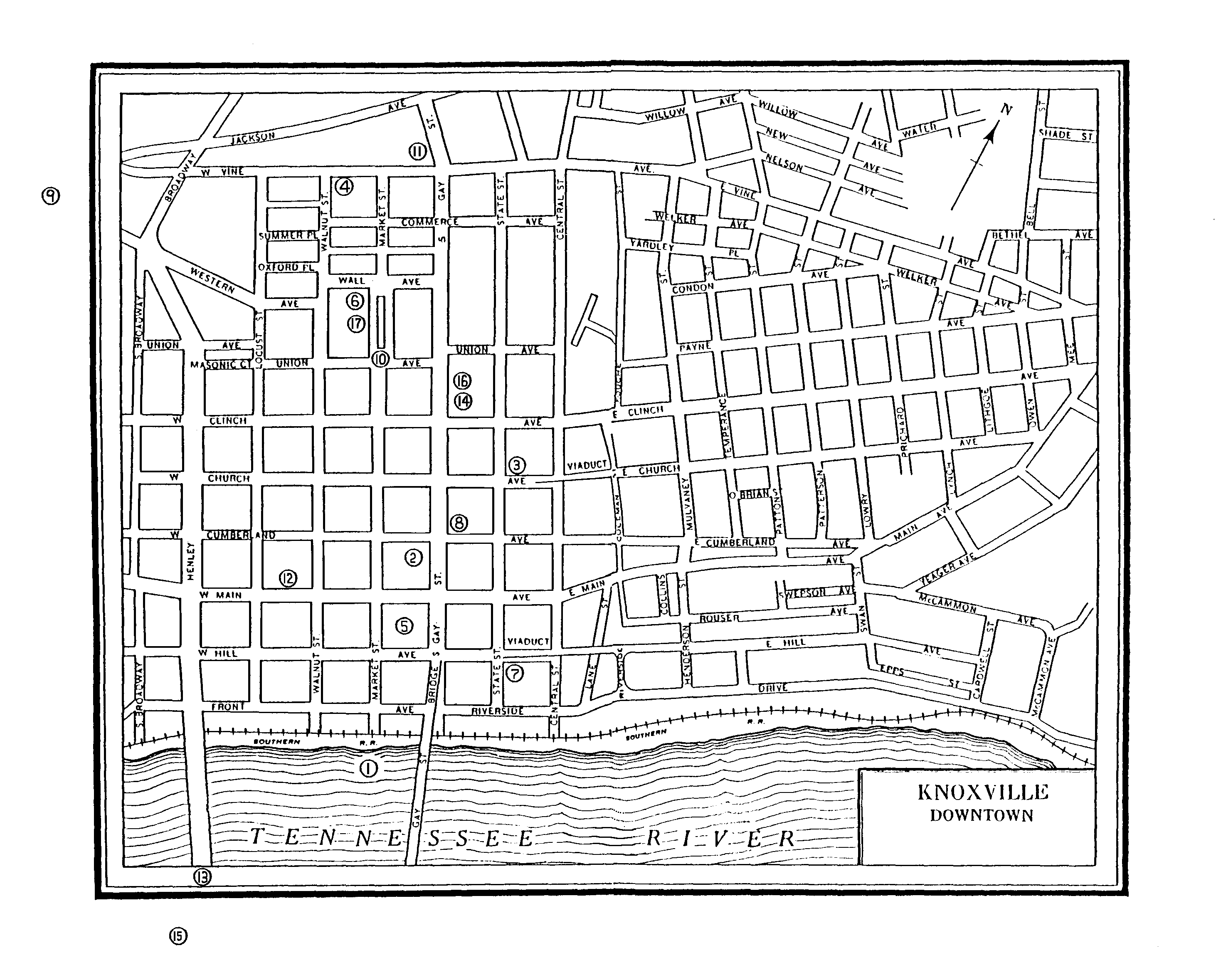
University of Tennessee professor Wes Morgan has documented some of the key locations in Cormac McCarthy’s novel Suttree. A few samples, but check out his website for more–

"Suttree's Home" (#1 on the map) -- This photograph is taken looking east from the Henley Street Bridge. It shows the Gay Street Bridge in the background with Volunteer Landing at the center. It is on this left bank of the Tennessee River, about where Volunteer Landing is located, that Suttree docked his houseboat. The suicide (p. 9) jumped from the Gay Street Bridge and the "...edge of the railroad" (p. 10) mentioned can be seen to the left of the parking lot. First Creek (p. 115) enters the Tennessee River on the left just above the docked riverboat.
The Huddle -- "They came down the steep street and turned in two by two." (p. 72) The Huddle, now vacant, was located at 219 Cumberland Avenue just a few yards east of Gay Street. The location had previously been occupied by a cab company before The Huddle opened in 1952 or 1953. Its mention in the text in 1951 is an anachronism
Ragpicker's Home -- The ragpicker's "...dark cavern beneath the vaulted concrete...." (p. 11) where "Water ran from a clay drain tile and went down a stone gully" (p. 421). The ragpicker's home under the south end of the Henley Street Bridge

Suttree — Cormac McCarthy

In his 1992 interview with The New York TimesCormac McCarthy said, “The ugly fact is books are made out of books. The novel depends for its life on the novels that have been written.” McCarthy’s fourth novel, 1979’s Suttree is such a book, a masterful synthesis of the great literature — particularly American literature — that came before it. And like any masterful synthesis, Suttree points to something new, even as it borrows, lifts, and outright steals from the past. But before we plumb its allusions and tropes and patterns, perhaps we should overview the plot, no?

The novel rambles over several years in the life of Cornelius Suttree. It is the early 1950s in Knoxville, Tennessee, and Suttree ekes out a mean existence on the Tennessee River as a fisherman, living in a ramshackle houseboat on the edge of a shantytown. This indigent life is in fact a choice: Suttree is the college-educated son of an established, wealthy family. His choice is a choice for freedom and self-reliance, those virtues we like to think of, in our prejudicial manner, as wholly and intrinsically American. Suttree then is both Emersonian and Huck Finnian, a reflective and insightful man who finds his soul via a claim to agency over his own individuality, an individuality poised in quiet, defiant rebellion against the conforming forces of civilization. These forces manifest most pointedly in the Knoxville police, a brutal, racist organization, but we also see social constraint in the form of familial duty. One thinks of the final lines of Huckleberry Finn: “I reckon I got to light out for the Territory ahead of the rest, because Aunt Sally she’s going to adopt me and sivilize me and I can’t stand it. I been there before.”

Like Huck, Suttree aims to resist all forces that would “sivilize” him. His time on the river and in the low haunts of Tennessee (particularly the vice-ridden borough of McAnally) brings him into close contact with plenty of other outcasts, but also his conscience, which routinely mulls over its place in the world. Suttree is punctuated by–perhaps even organized by–several scenes of hallucination. Some of these psychotrips result from drunkeness, one comes from accidentally ingesting the wrong kind of mushrooms (or, the right kind, if that’s your thing), and the final one, late in the novel, sets in as Suttree suffers from a terrible illness. In his fever dream, a small nun–surely a manifestation of the guilt that would civilize us–accuses him–

Mr. Suttree it is our understanding that at curfew rightly decreed by law in that hour wherein night draws to its proper close and the new day commences and contrary to conduct befitting a person of your station you betook yourself to various low places within the shire of McAnally and there did squander several ensuing years in the company of thieves, derelicts, miscreants, pariahs, poltroons, spalpeens, curmudgeons, clotpolls, murderers, gamblers, bawds, whores, trulls, brigands, topers, tosspots, sots and archsots, lobcocks, smellsmocks, runagates, rakes, and other assorted and felonious debauchees.

The passage is a marvelous example of McCarthy’s stream-of-consciousness technique in Suttree, moving through the various voices that would ventriloquize Suttree, into the edges of madness, strangeness, and the sublimity of language. The tone moves from somber and portentous into bizarre imagery that blends humor and pathos. This is the tone of Suttree, a language that gives voice to transients and miscreants, affirming the dignity of their humanity even as it details the squalor of their circumstance.

It is among these criminals and whores, transvestites and gamblers that Suttree affirms his own freedom and humanity, a process aided by his comic foil, Gene Harrogate. Suttree meets Harrogate on a work farm; the young hillbilly is sent there for screwing watermelons. After his release, Harrogate moves to a shantytown in Knoxville. He’s the country mouse determined to become the city rat, the would-be Tom Sawyer to Suttree’s older and wiser Huck Finn. Through Harrogate’s endless get-rich-quick schemes, McCarthy parodies that most-American of tales, the Horatio Alger story. Simply put, the boy is doomed, on his  “way up to the penitentiary” as Suttree constantly admonishes. In one episode, Harrogate tries to buy arsenic from “a grayhaired and avuncular apothecary” to poison bats he hopes to sell to a hospital (don’t ask)–

May I help you? said the scientist, his hands holding each other.

I need me some strychnine, said Harrogate.

You need some what?

Strychnine. You know what it is dont ye?

Yes, said the chemist.

I need me about a good cupful I reckon.

Are you going to drink it here or take it with you?

Shit fire I aint goin to drink it. It’s poisoner’n hell.

It’s for your grandmother.

No, said Harrogate, craning his neck suspectly. She’s done dead

Suttree, unwilling father-figure, eventually buys the arsenic for the boy against his better judgment. The scene plays out as a wonderful comic inversion of William Faulkner’s “A Rose for Emily,” from which it is so transparently lifted. McCarthy borrows liberally from Faulkner here, of course, most notably in the language and style of the novel, but also in scenes like this one, or a later episode that plays off Faulkner’s comic-romantic story of a man and a woman navigating the aftermath of a flood, “Old Man.” Unpacking the allusions in Suttree surpasses my literary knowledge or skill, but McCarthy is generous, if oblique, with his breadcrumb trail. Take, for example, the following sentence: “Suttree with his miles to go kept his eyes to the ground, maudlin and muttersome in the bitter chill, under the lonely lamplight.” The forced phrase “miles to go” does not immediately present itself as a reference to Robert Frost’s famous poem, yet the direction of the sentence retreats into the history of American poetry; with its dense alliteration and haunted vowels, it leads us into Edgar Allan Poe territory. Only a few dozen pages later, McCarthy boldly begins a chapter with theft: “In just spring the goatman came over the bridge . . .” The reference to e.e. cummings explicitly signifies McCarthy’s intentions to play with literature. Later in the book, while tripping on mushrooms in the mountains, Suttree is haunted by “elves,” the would-be culprits in Frost’s poem “Mending Wall.” The callback is purposeful, but tellingly, McCarthy’s allusions are not nearly as fanciful as their surface rhetoric might suggest: the goatman does not belong in Knoxville–he’s an archaic relic, forced out of town by the police; the elves are not playful spirits but dark manifestations of a tortured psyche.

Once one spots the line-lifting in Suttree it’s hard to not see it. What’s marvelous is McCarthy’s power to convert these lines, these riffs, these stories, into his own tragicomic beast. An early brawl at a roadhouse recalls the “Golden Day” episode of Ralph Ellison’s Invisible Man; a rape victim’s plight echoes Hubert Selby’s “Tralala”; we find the comic hobos of John Steinbeck’s Cannery Row–we even get the road-crossing turtle from The Grapes of Wrath. A later roadhouse chapter replays the “Circe/Nighttown” nightmare in James Joyce’s Ulysses. Ulysses is an easy point of comparison for Suttree, which does for Knoxville what Joyce did for Dublin. Suttree echoes Ulysses’s language, both in its musicality and appropriation of varied voices, as well as its ambulatory structure, its stream-of-consciousness technique, its rude earthiness, and its size (nearly 600 pages). But, as I argued earlier, there’s something uniquely American about Suttree, and its literary appropriations tend to reflect that. Hence, we find Mark Twain, Herman Melville, Ernest Hemingway, Walt Whitman, Emerson and Thoreau, Emily Dickinson, and William Carlos Williams, to name just a few writers whose blood courses through this novel (even elegant F. Scott Fitzgerald is here, in an unexpected Gatsbyish episode late in the novel).

Making a laundry list of writers is weak criticism though, and these sources–all guilty of their own proud plagiarisms–are mentioned only as a means to an end, to an argument that what McCarthy does in Suttree is to synthesize the American literary tradition with grace and humor, while never glossing over its inherent dangers and violence. So, while it appropriates and plays with the tropes of the past, Suttree is still pure McCarthy. Consider the following passage, which arrives at the end of a drunken, awful spree, Suttree locked up for the night–

He closed his eyes. The gray water that dripped from him was rank with caustic. By the side of a dark dream road he’d seen a hawk nailed to a barn door. But what loomed was a flayed man with his brisket tacked open like a cooling beef and his skull peeled, blue and bulbous and palely luminescent, black grots his eyeholes and bloody mouth gaped tonguless. The traveler had seized his fingers in his jaws, but it was not alone this horror that he cried. Beyond the flayed man dimly adumbrate another figure paled, for his surgeons move about the world even as you and I.

Suttree’s dark vision points directly toward the language of McCarthy’s next novel, 1985’s Blood Meridian, roundly considered his masterpiece. Critics who disagree tend to point to Suttree as the pinnacle of McCarthy’s writing. I have no interest at this time in weighing the books against each other, nor do I think that doing so would be especially enlightening. For all of their sameness, they are very different animals: Suttree provides us intense access to its hero’s consciousness, where Blood Meridian always keeps the reader on the outside of its principals’ souls (if those grotesques could be said to have souls). And while Blood Meridian does display some humor, it is the blackest and driest humor I’ve ever read. Suttree is broader and more compassionate; it even has a fart joke. Blood Meridian, at least in my estimation (and many critics will contend this notion) has no flawed episodes; much of this results from the book’s own internal program–it resists love, compassion, and even human dignity. In contrast, Suttree is punctuated by two deaths the audience is meant to read as tragic, yet I found it impossible to do so. The first is the death of Suttree’s child, whom he has abandoned, along with its mother. As such, he is not permitted to take part in the funeral, observing the process rather from its edges. The second tragedy is the death of Suttree’s young lover in a landslide. The book begs us to empathize with Suttree, just as he often empathizes with the marginal figures in the novel, but ultimately these tragedies are a failed ploy. They underwrite a sublime encounter with death for Suttree, an encounter that deepens and enriches his character while paradoxically freeing him from the burdens of social duty and familial order. McCarthy is hardly alone in such a move; indeed, it seems like the signature trope of American masculine literature to me. It’s the move that Huck Finn wishes to make when he promises to light out for the Territory to escape the civilizing body of Aunt Sally; it’s the ending that Hemingway was compelled to give to Frederic Henry at the end of A Farewell to Arms; it’s all of Faulkner, with his mortification of fatherhood and the dramatic responsibility fatherhood entails. It is a cost analysis that neglects any potential benefits.

But these are small criticisms of a large, beautiful, benevolent novel, a book that begs to be reread, a rambling picaresque of comic and tragic proportions. “I learned that there is one Suttree and one Suttree only,” our hero realizes, but this epiphany is set against a larger claim. Near the end of the novel, Suttree goes to check on an old ragman who he keeps a watchful eye on. He finds the man dead, his shack robbed, his body looted. Despairing over the spectacle’s abject lack of humanity, Suttree cries, “You have no right to represent people this way,” for “A man is all men. You have no right to your wretchedness.” Here, Suttree’s painful epiphany is real and true, an Emersonian insight coded in the darkest of Whitman’s language. If there is one Suttree and one Suttree only, he is still beholden to all men; to be anti-social or an outcast is not to be anti-human. Self-hood is ultimately conditional on others and otherness. To experience the other’s wretchedness is harrowing; to understand the other’s wretchedness and thus convert it to dignity is life-affirming and glorious. Suttree is a brilliant, bold, marvelous book. Very highly recommended.

Cormac McCarthy’s Turtle Soup

In Cormac McCarthy’s novel Suttree, an Indian named Michael prepares a turtle soup for Suttree. First, catch the turtle. Then, kill the turtle, making sure to discard its head–

The Indian braced his feet and swung it up dripping from the river and onto the rocks and it squatted there watching them, its baleful pig’s eyes blinking. It was tied through the lower jaw with a section of wire and the Indian took hold of the wire and tugged at it. The turtle bated and hissed, its jaws gasped. The Indian had out his pocketknife and now he opened it and he pulled the turtle’s obscene neck out taut and with a quick upward motion of the blade severed the head. Suttree involuntarily drew back. The turtle’s craggy head swung from the wire and what lay between the braced forefeet was a black and wrinkled dog’s cunt slowly pumping gouts of near black blood. The blood ran down over the stones and dripped in the water and the turtle shifted slowly on the rock and started toward the river. The Indian undid the wire and flung the head into the river . .  .

Appetizing, no? Now that you’ve thrown the bloody head in the river (or your garbage can or wherever you throw turtle heads), it’s time to dress the beast–

Suttree laid the turtle on the rock and the Indian scouted about him until he came up with a goodsized stone.

Watch out, he said.

Suttree stepped back.

The Indian raised the stone and brought it down upon the turtle’s back. The shell collapsed with a pulpy buckling sound.

I never saw a turtle dressed before, said Suttree. But the Indian had knelt and was cutting away the broken plates of shell with his pocketknife and pitching them into the river. He pulled the turtle’s meat up off the plastron and gouged away the scant bowels with his thumb. He skinned out the feet. What hung headless in his grip as he raised it aloft was a wet gray foetal mass, a dim atavism limp and dripping.

Plenty of meat there, said the Indian. He laid it out on the rock and bent and swished the blade of his knife in the river.

Okay. Now that you’ve removed the shell and gouged away the scant bowels with your thumbs, it’s time to prepare the wet gray foetal mass.

Put him in a pot and cook him slow. Lots of vegetables. Lots of onions. I got my own things I put in.

Got it? Lots of onions. Slow cook that dim, limp, dripping atavism. The fact that the Indian has his “own things” that he puts in implies a call to the reader to experiment with the recipe. And how did Suttree like his turtle?

He spooned up a piece of the meat and cradled it in his mouth to cool it. He chewed it. It was succulent and rich, a flavor like no other.

Cormac McCarthy’s Bloody Mary and Other Author Cocktails

At HTML, chief mixologist Jimmy Chen has concocted a satirical round of writer cocktails. Here’s “Cormac McCarthy’s Bloody Mary” (which calls for something called a “salary stick” — not sure what that is, but we suggest a celery stalk if you can’t find one)–

This is fun-mean–

And this is just mean-mean–


Blood Meridian Contest Winner Announced

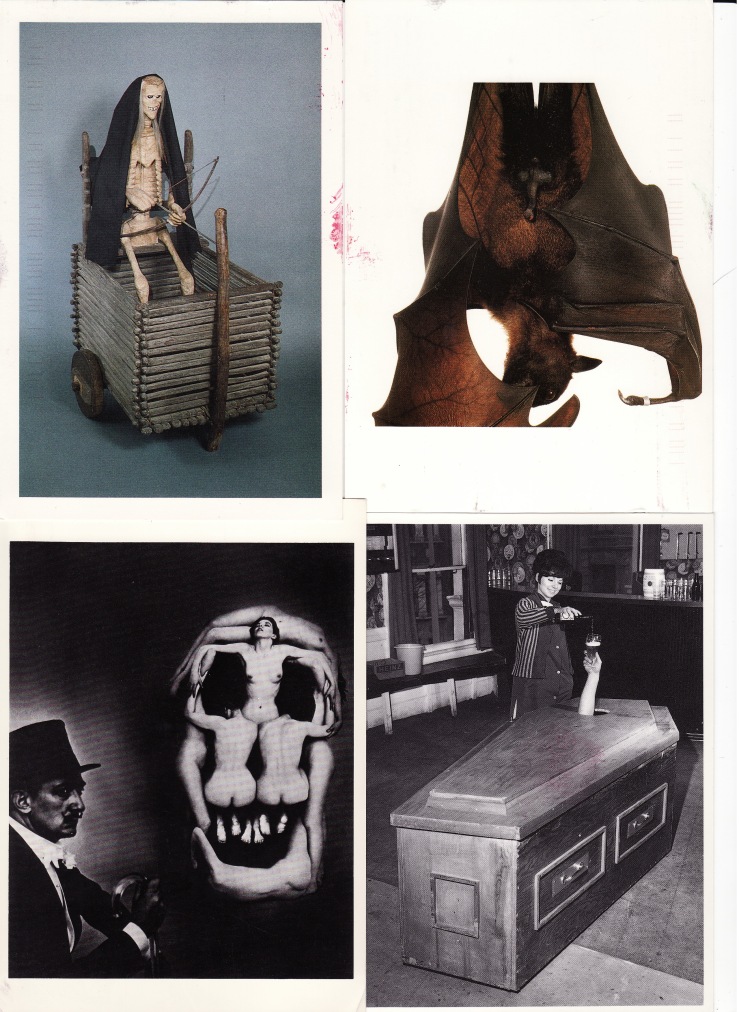
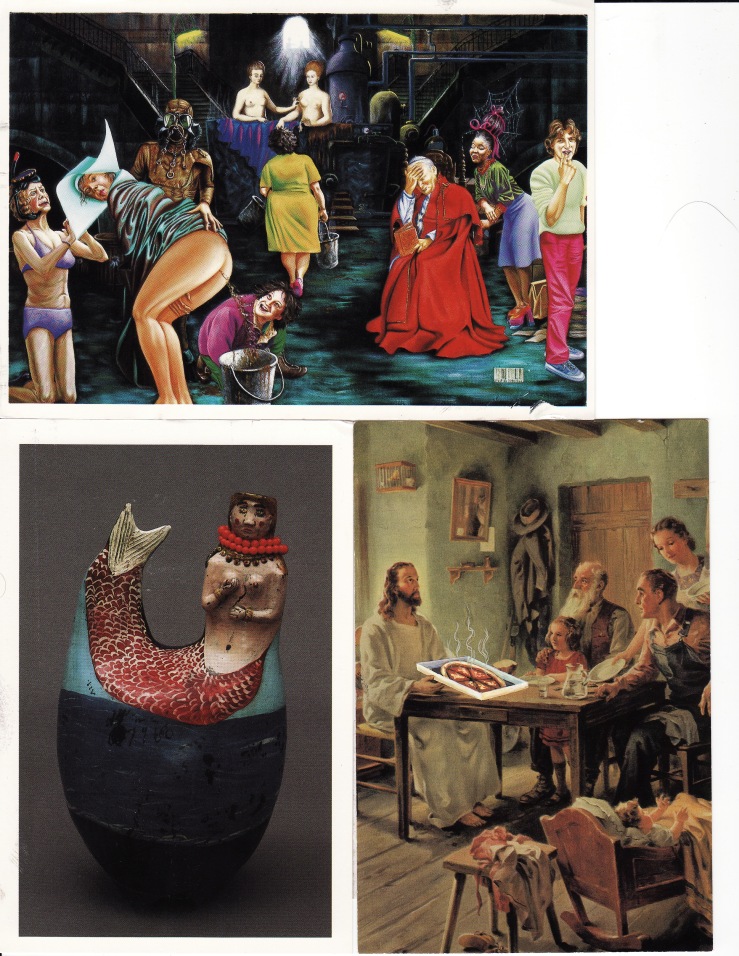
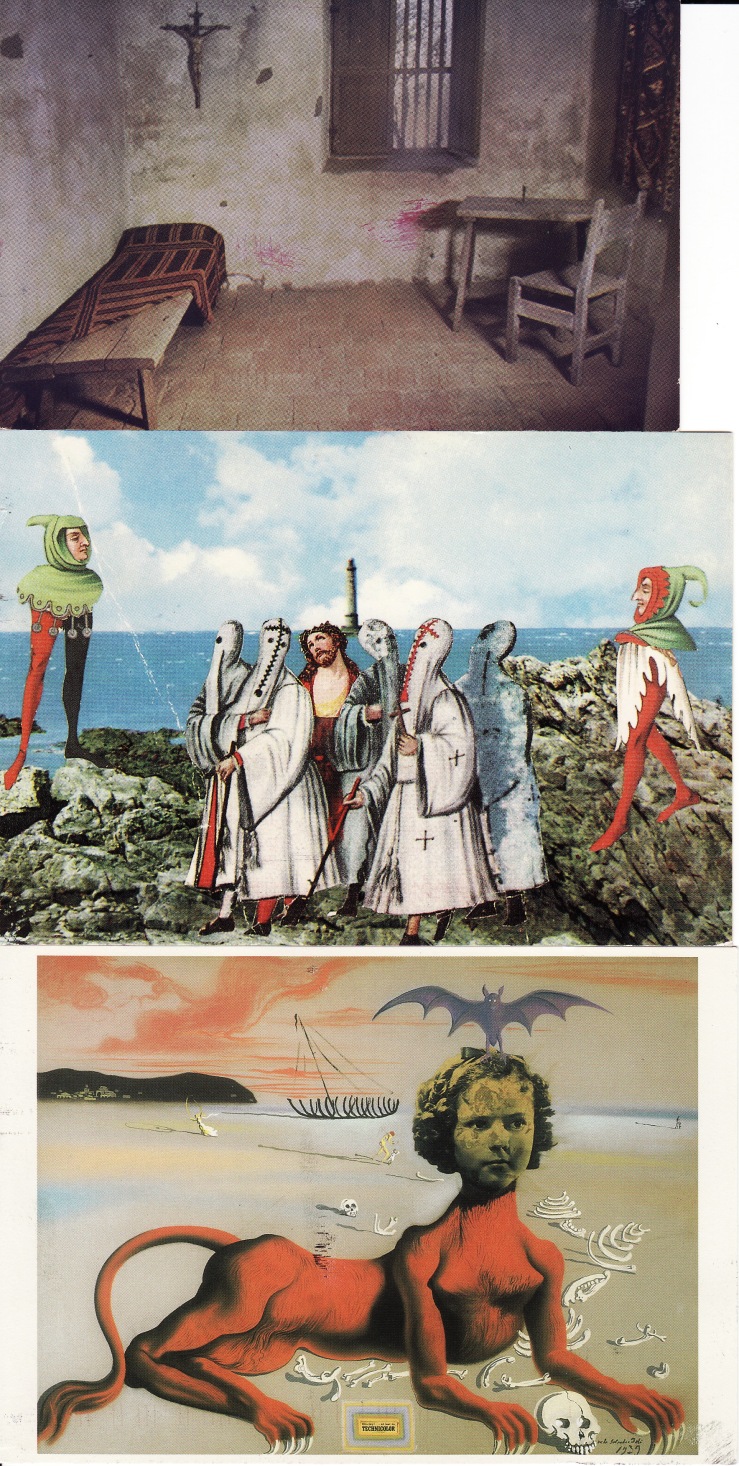
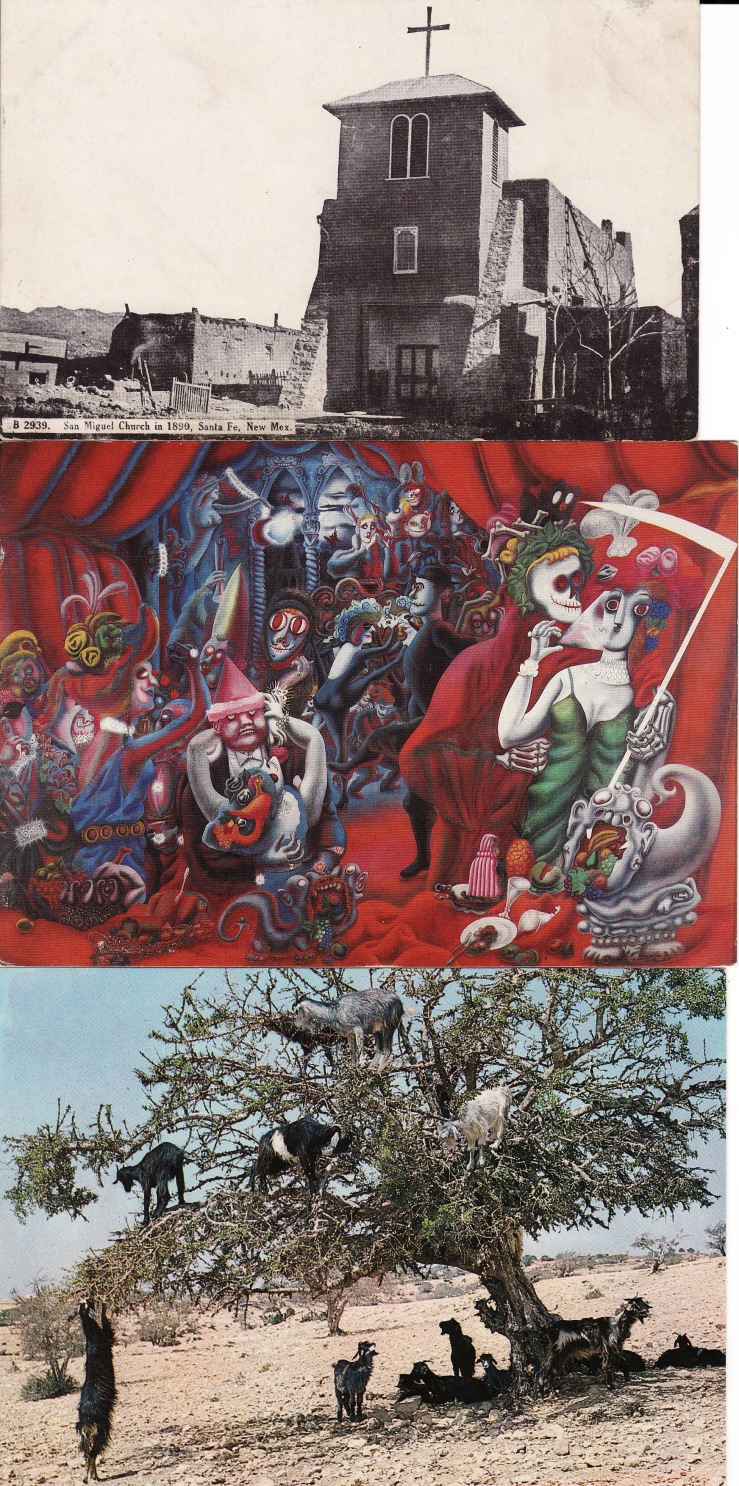
Big congratulations to Michael Cooke, a librarian from Flower Mound, Texas who is the winner of our Blood Meridian contest. Michael will receive a copy of the 25th anniversary hardback edition of Cormac McCarthy’s seminal anti-Western/awesome Western courtesy Biblioklept and Modern Library. Michael had the unfair advantage of being from Texas, and he totally cheated by sending in a baker’s dozen postcards, which was totally awesome. Cheating and being evil is the core of Blood Meridian. Each of Michael’s stark, garish, gritty, surreal, or just plain wicked postcards came with a wonderful corollary quote from the novel. The postcards come from Michael’s personal collection; he’s had some of them for years, and they’re from all over the place, several came from New Mexico, Cormac McCarthy’s chosen home. Here comes the weird–

“It was a lone tree burning on the desert” — Blood Meridian’s Moral Core

Cormac McCarthy’s Blood Meridian begins as a strange, violent picaresque bildungsroman, detailing the adventures of a teenage runaway known only as “the kid.” When the Kid falls in with John Glanton’s marauders, the narrative lens expands and pulls back; Glanton’s gang essentially envelopes the Kid’s personality. The pronoun “they” dominates the Kid’s own agency, for the most part, and the massive figure of Judge Holden usurps the narrative’s voice. The effect is that the Glanton gang’s killing, raping, and scalping spree becomes essentially de-personalized, and, to a certain extent, amoralized.

The Kid, and perhaps the ex-priest Tobin and the Kid’s erstwhile partner Toadvine, are the only major characters who bear any semblance of conventional morality in the narrative. The Kid exhibits a willingness to help others early on when he agrees to stitch one of Tobin’s wounds; later, he removes an arrowhead from a wounded man when no other member of the company will (Tobin chides him for caring, declaring that the wounded man would have killed the Kid had the Kid’s efforts been unsuccessful). For most of the central narrative though, the Kid’s individual actions are consumed into the gang’s “they.” However, at the beginning of chapter 15 the narrative focuses again on the Kid, who is charged with killing a wounded man named Shelby to “spare” him from the approaching Mexican army (this is a bizarre version of mercy in Blood Meridian). Shelby pleads to live and the Kid allows it, even giving the man some water from his own canteen. After he leaves he catches up with a man named Tate whose horse is wounded. Tate remarks on the boy’s foolishness for helping him, but the Kid does so nonetheless, sharing Tate’s burden as they try to make their way back to the rest of their party. Tate is soon killed by Mexican scouts. In both cases, the outcome of the Kid’s moral actions–the will to help, to save, to preserve life–are negated by the book’s narrative outcomes, but I would argue that his intentions in the face of violence somehow secure his humanity.

His journey alone to rejoin the Glanton gang is figured as a kind of vision quest, a strange echo of Christ in the desert, perhaps. At its core–and perhaps the moral core of the book–is the following strange passage–

It was a lone tree burning on the desert. A herladic tree that the passing storm had left afire. The solitary pilgrim drawn up before it had traveled far to be here and he knelt in the hot sand and held his numbed hands out while all about in that circle attended companies of lesser auxiliaries routed forth into the inordinate day, small owls that crouched silently and stood from foot to foot and tarantulas and solpugas and vinegarroons and the vicious mygale spiders and beaded lizards with mouths black as a chowdog’s, deadly to man, and the little desert basilisks that jet blood from their eyes and the small sandvipers like seemly gods, silent and the same, in Jedda, in Babylon. A constellation of ignited eyes that edged the ring of light all bound in a precarious truce before the torch whose brightness had set back the stars in their sockets.

The burning tree alludes to YHWH’s appearance to Moses as a burning bush, and also the tree of smoke that led the Israelites through the desert. Significantly, all the strange, terrible creatures of the desert come to meet around it in a “precarious truce.” The burning tree inverts the natural, inescapable violence that dominates the novel and turns it into a solitary, singular moment of peace. When the Kid awakes–alone–the tree is merely a “smoldering skeleton of a blackened scrog.” God is not in the permanence of the object but rather in the witnessing of the event–Blood Meridian locates (a version of a) god in the natural violence of burning and consumption. There is a strong contrast here, I believe, with the book’s other version of god, the Judge’s proclamation that “War is god.” The Judge, a cunning, devilish trickster, wants to reduce (or enlarge) war to all contest of wills, to pure violence–to divorce it from any ideological structure. Yet the burning tree episode reveals natural violence divorced from ideology. The animals (and the man, the Kid) suspend their Darwinian animosities in order to witness the sublime. The episode is silent, outside of language, order, ideology. This silence is echoed in the novel’s final confrontation between the Judge and the Kid, who retorts simply “You ain’t nothin'” to the Judge’s barrage of grandiose language. While the rejoinder may not save the Kid, its rejection perhaps saves his soul (if such a thing exists in the novel, which I believe it does). So, while larger-than-life Judge Holden may dominate the novel, Cormac McCarthy has nonetheless given us another moral road to follow, should we choose to.

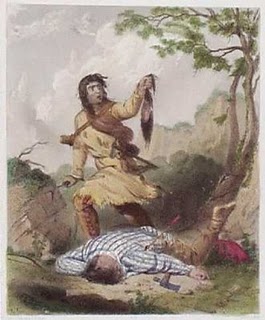
“. . . and seizing them up by their hair and passing their blades about the skulls of the living and the dead alike and snatching aloft the bloody wigs”

Blood Meridian week continues–more jolly times.

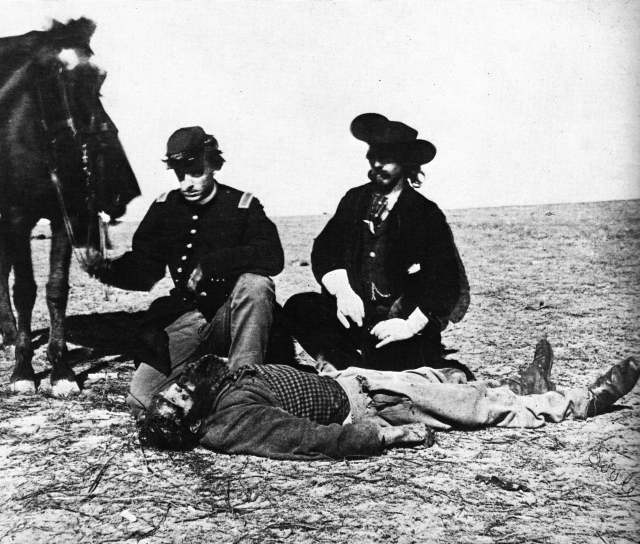
Buffalo hunter Ralph Morrison killed and scalped by Cheyennes in December 1868, near Fort Dodge, Kansas. Photographer: William S. Soule (1836-1908).
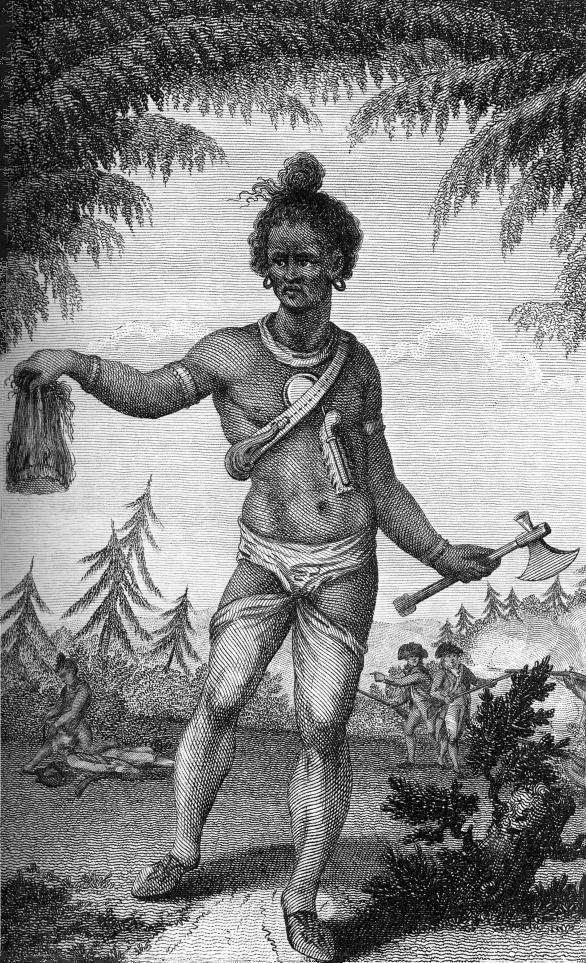
Indian Warrior with Scalp, 1789, by Barlow.
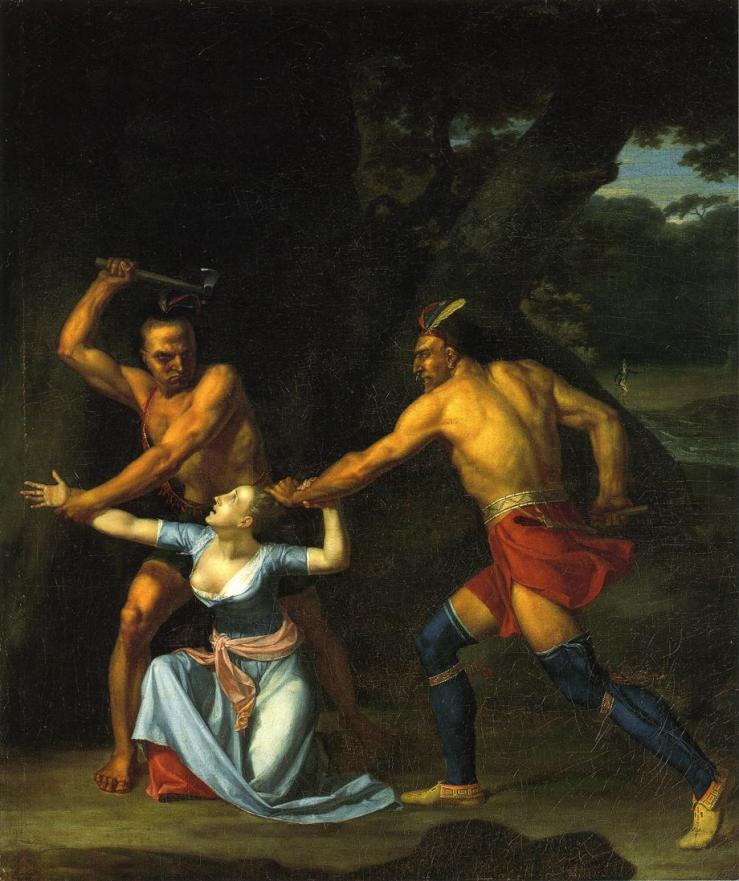
The Death of Jane McCrea, by John Vanderlyn, 1804.
Robert McGee, circa 1861.
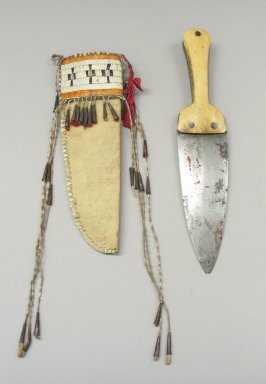
Eastern, Sioux (Native American). Scalping Knife and Sheath, 1801-1833
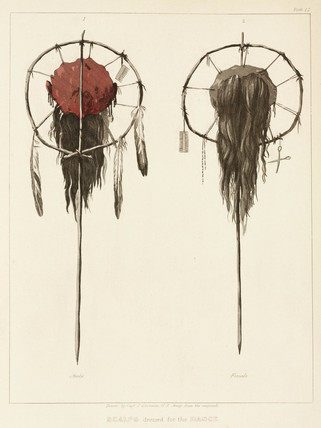
Engraving after Captain Seth Eastman, US Army, of a male and female scalp strung on frames, with combs, feathers and a pair of scissors. Circa 1847.
Hannah Duston
Death Whoop by Seth Eastman. Late nineteenth century.
"A scene on the frontiers as practiced by the 'humane' British and their 'worthy' allies," attributed to William Charles, 1812.

“The Authentic American Apocalyptic Novel” — Harold Bloom on Blood Meridian

The Triumph of Death, Pieter Bruegel the Elder, c. 1562

Harold Bloom’s esteem for Blood Meridian may have done much to advance the novel’s reputation over the past decade. His essay on the book, first published in his 2000 collection How to Read and Why and later included as the preface to Random House’s Modern Library editions, makes a strong case for Blood Meridian’s canonical status. Bloom begins, in typical Bloomian fashion–the anxiety of influence is always at work–by situating McCarthy’s book against other heavies–

Blood Meridian (1985) seems to me the authentic American apocalyptic novel, more relevant even in 2000 than it was fifteen years ago. The fulfilled renown of Moby-Dick and of As I Lay Dying is augmented by Blood Meridian, since Cormac McCarthy is the worthy disciple both of Melville and of Faulkner. I venture that no other living American novelist, not even Pynchon, has given us a book as strong and memorable as Blood Meridian . . .

The Garden of Earthly Delights — Hell, Hieronymus Bosch, 1503-1504

Bloom goes  on to rate Blood Meridian over DeLillo’s Underworld, several books by Philip Roth, and even McCarthy’s own All the Pretty Horses. Indeed, Bloom proclaims Blood Meridian “the ultimate Western, not to be surpassed.” This doesn’t mean that Bloom is at home with the book’s violence; he confesses that it took him two attempts to read through its “overwhelming carnage.” Still, he makes a case for reading it in spite of its gore–

Nevertheless, I urge the reader to persevere, because Blood Meridian is a canonical imaginative achievement, both an American and a universal tragedy of blood. Judge Holden is a villain worthy of Shakespeare, Iago-like and demoniac, a theoretician of war everlasting. And the book’s magnificence–its language, landscape, persons, conceptions–at last transcends the violence, and converts goriness into terrifying art, an art comparable to Melville’s and to Faulkner’s.

Bloom repeatedly invokes Melville and Faulkner in his essay, arguing that Blood Meridian’s “high style” is one of its key strengths (unlike fellow aesthetic critic James Wood, who seems to think that McCarthy is a windbag). The trajectory of Bloom’s essay follows Melville and Shakespeare, finding in Judge Holden both a white whale (and not so much an Ahab) and an Iago. He writes–

Since Blood Meridian, like the much longer Moby-Dick, is more prose epic than novel, the Glanton foray can seem a post-Homeric quest, where the various heroes (or thugs) have a disguised god among them, which appears to be the Judge’s Herculean role. The Glanton gang passes into a sinister aesthetic glory at the close of chapter 13, when they progress from murdering and scalping Indians to butchering the Mexicans who have hired them.

I think that Bloom’s great insight here is to read the book as a prose epic as opposed to a linear novel; to see that Blood Meridian foregrounds a deeply tragic and ironic reworking of the great American myth of Manifest Destiny. While hardly a pastiche, the book is somehow a collage; a massive, deafening collage that numbs, stuns, and overwhelms with its layers of thick, bloody prose. The effect is akin to the apocalyptic paintings of Hieronymus Bosch and Pieter Bruegel. Dense and full of allusion, paintings like The Triumph of Death and The Garden of Earthly Delights surge over the senses, destabilizing narrative logic. Like Blood Meridian, these paintings employ a graphic grammar that disorients and then reorients. They are apocalyptic in all senses of the word: both revelatory and portentously conclusive. And like Blood Meridian, they showcase “a sinister aesthetic glory” (to use Bloom’s term), a terrible, awful, awesome ugliness that haunts us with repulsive beauty.