The Murderess — Edvard Munch

Derrida Contemplates His Death on Film

“On the Fear of Death” — William Hazlitt

“On the Fear of Death” by William Hazlitt

And our little life is rounded with a sleep.

Perhaps the best cure for the fear of death is to reflect that life has a beginning as well as an end. There was a time when we were not: this gives us no concern—why, then, should it trouble us that a time will come when we shall cease to be? I have no wish to have been alive a hundred years ago, or in the reign of Queen Anne: why should I regret and lay it so much to heart that I shall not be alive a hundred years hence, in the reign of I cannot tell whom?

When Bickerstaff wrote his Essays I knew nothing of the subjects of them; nay, much later, and but the other day, as it were, in the beginning of the reign of George III., when Goldsmith, Johnson, Burke, used to meet at the Globe, when Garrick was in his glory, and Reynolds was over head and ears with his portraits, and Sterne brought out the volumes of Tristram Shandyyear by year, it was without consulting me: I had not the slightest intimation of what was going on: the debates in the House of Commons on the American War, or the firing at Bunker’s Hill, disturbed not me: yet I thought this no evil—I neither ate, drank, nor was merry, yet I did not complain: I had not then looked out into this breathing world, yet I was well; and the world did quite as well without me as I did without it! Why, then, should I make all this outcry about parting with it, and being no worse off than I was before? There is nothing in the recollection that at a certain time we were not come into the world that ‘the gorge rises at’—why should we revolt at the idea that we must one day go out of it? To die is only to be as we were before we were born; yet no one feels any remorse, or regret, or repugnance, in contemplating this last idea. It is rather a relief and disburthening of the mind: it seems to have been holiday-time with us then: we were not called to appear upon the stage of life, to wear robes or tatters, to laugh or cry, be hooted or applauded; we had lain perdus all this while, snug, out of harm’s way; and had slept out our thousands of centuries without wanting to be waked up; at peace and free from care, in a long nonage, in a sleep deeper and calmer than that of infancy, wrapped in the softest and finest dust. And the worst that we dread is, after a short, fretful, feverish being, after vain hopes and idle fears, to sink to final repose again, and forget the troubled dream of life!… Ye armed men, knights templars, that sleep in the stone aisles of that old Temple church, where all is silent above, and where a deeper silence reigns below (not broken by the pealing organ), are ye not contented where ye lie? Or would you come out of your long homes to go to the Holy War? Or do ye complain that pain no longer visits you, that sickness has done its worst, that you have paid the last debt to nature, that you hear no more of the thickening phalanx of the foe, or your lady’s waning love; and that while this ball of earth rolls its eternal round, no sound shall ever pierce through to disturb your lasting repose, fixed as the marble over your tombs, breathless as the grave that holds you! And thou, oh! thou, to whom my heart turns, and will turn while it has feeling left, who didst love in vain, and whose first was thy last sigh, wilt not thou too rest in peace (or wilt thou cry to me complaining from thy clay-cold bed) when that sad heart is no longer sad, and that sorrow is dead which thou wert only called into the world to feel! Continue reading ““On the Fear of Death” — William Hazlitt”

Love and Death — Francisco Goya

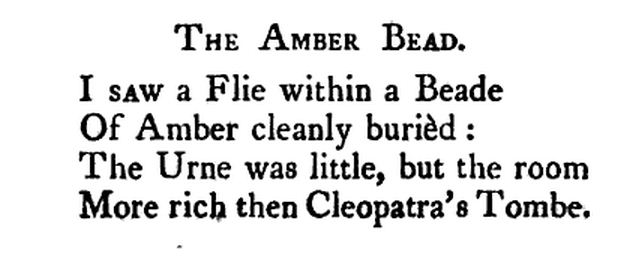
“The Amber Bead” — Robert Herrick

herrick

“What inn is this?” — Emily Dickinson

ed

Read “The Werewolf,” A Short Fable by Angela Carter

“The Werewolf,” a short story by Angela Carter (collected in The Bloody Chamber and Burning Your Boats):

It is a northern country; they have cold weather, they have cold hearts.Cold; tempest; wild beasts in the forest. It is a hard life. Their houses are built of logs, dark and smoky within. There will be a crude icon of the virgin behind a guttering candle, the leg of a pig hung up to cure, a string of drying mushrooms. A bed, a stool, a table. Harsh, brief, poor lives.To these upland woodsmen, the Devil is as reals as you or I. More so; they have not seen us nor even know that we exist, but the Devil they glimpse often in the graveyards, those bleak and touching townships of the dead where the graves are marked with portraits of the deceased in the naif style and there are no flowers to put in front of them, no flowers grow there, so they put out small votive offerings, little loaves, sometimes a cake that the bears come lumbering from the margins of the forests to snatch away. At midnight, especially on Walpurgisnacht, the Devil holds picnics in the graveyards and invites the witches; then they dig up fresh corpses, and eat them. Anyone will tell you that.Wreaths of garlic on the doors keep out the vampires. A blue-eyed child born feet first on the night of St. John’s Eve will have second sight. When they discover a witch – some old woman whose cheeses ripen when her neighbours’ do not, another old woman whose black cat, oh, sinister! follows her about all the time, they strip the crone, search for her marks, for the supernumerary nipple her familiar sucks. They soon find it. Then they stone her to death.

Winter and cold weather.

Go and visit grandmother, who has been sick. Take her the oatcakes I’ve baked for her on the hearthstone and a little pot of butter.

The good child does as her mother bids – five miles’ trudge through the forest; do not leave the path because of the bears, the wild boar, the starving wolves. Here, take your father’s hunting knife; you know how to use it.

The child had a scabbby coat of sheepskin to keep out the cold, she knew the forest too well to fear it but she must always be on her guard. When she heard that freezing howl of a wolf, she dropped her gifts, seized her knife, and turned on the beast.

It was a huge one, with red eyes and running, grizzled chops; any but a mountaineer’s child would have died of fright at the sight of it. It went for her throat, as wolves do, but she made a great swipe at it with her father’s knife and slashed off its right forepaw.

The wolf let out a gulp, almost a sob, when it saw what had happened to it; wolves are less brave than they seem. It went lolloping off disconsolately between the trees as well as it could on three legs, leaving a trail of blood behind it. The child wiped the blade of her knife clean on her apron, wrapped up the wolf’s paw in the cloth in which her mother had packed the oatcakes and went on towards her grandmother’s house. Soon it came on to snow so thickly that the path and any footsteps, track or spoor that might have been upon it were obscured.

She found her grandmother was so sick she had taken to her bed and fallen into a fretful sleep, moaning and shaking so that the child guessed she had a fever. She felt the forehead, it burned. She shook out the cloth from her basket, to use it to make the old woman a cold compress, and the wolf’s paw fell to the floor.

But it was no longer a wolf’s paw. It was a hand, chopped off at the wrist, a hand toughened with work and freckled with old age. There was a wedding ring on the third finger and a wart in the index finger. By the wart, she knew it for her grandmother’s hand.

She pulled back the sheet but the old woman woke up, at that, and began to struggle, squawking and shrieking like a thing possessed. But the child was strong, and armed with her father’s hunting knife; she managed to hold her grandmother down long enough to see the cause of her fever. There was a bloody stump where her right hand should have been, festering already.

The child crossed herself and cried out so loud the neighbours heard her and come rushing in. They know the wart on the hand at once for a witch’s nipple; they drove the old woman, in her shift as she was, out into the snow with sticks, beating her old carcass as far as the edge of the forest, and pelted her with stones until she fell dead.

Now the child lived in her grandmother’s house; she prospered.

“My life closed twice before its close” — Emily Dickinson

My life closed twice before its close—
It yet remains to see
If Immortality unveil
A third event to me

So huge, so hopeless to conceive
As these that twice befell.
Parting is all we know of heaven,
And all we need of hell.

—Emily Dickinson.

“I reason, Earth is short–” — Emily Dickinson

“I reason, Earth is short–” by Emily Dickinson:

I reason, Earth is short —
And Anguish — absolute —
And many hurt,
But, what of that?

I reason, we could die —
The best Vitality
Cannot excel Decay,
But, what of that?

I reason, that in Heaven —
Somehow, it will be even —
Some new Equation, given —
But, what of that?


Suicide as a National Folk Art (Thomas Bernhard’s Correction)

Suicide, Luc Tymans

In this passage from Thomas Bernhard’s Correction we can see the strange, bleak, black humor that characterizes the novel:

It’s a folk art of sorts, I said to Hoeller, always longing to kill oneself but being kept by one’s watchful intelligence from killing oneself, so that the condition is stabilized in the form of lifelong controlled suffering, it’s an art possessed only by this people and those belonging to it. We’re a nation of suicides, I said, but only a small percentage actually kill themselves, even though ours is the highest percentage of suicides in the world, even though we in this country hold the world’s record for suicide, I said. What mainly goes on in this country and among these people is thinking about suicide, everywhere, in the big cities, in the towns, in the country, a basic trait of this country’s population is the constant thought of suicide, they might be said to take pleasure in thinking constantly, steadily, without allowing anything to distract them, about how to do away with themselves at any time. It is their way of keeping their balance, I said, to think constantly about killing themselves without actually killing themselves. But of course the rest of the world doesn’t understand, and so whatever they think about us and regardless of what they say about us and of how they always and invariably treat us, every single one of us, they are all wrong. It’s a simple fact, I said, that our country is misunderstood, no matter how well intentioned the rest of the world may appear, what it sees when it looks at Austria and its people is total madness as a stable state of mind, a constant.

(For those interested: Austria currently ranks 24th in the world in suicide per capita)


Chris Ware on DFW’s Novel The Pale King

Crippled Robot painting by Chris Ware

Cartoonist/graphic novelist/chronicler of shame and despair Chris Ware wrote about his favorite books for Foyles bookstore. The list includes UlyssesMoby-Dick, and works by cartoonists like Lynda Barry and Ivan Brunetti. Here’s what Ware wrote about David Foster Wallace’s posthumous novel The Pale King:

The first great novel of the 21st century uses the sinister beauty of the American Tax Code as a springboard from which to launch into a genuinely serious discussion of the origins and importance of civic responsibility amidst the hazy, blurred stupidity of a country in quick decline. Contrary to many reviews, I don’t think it’s about boredom, and it’s certainly not boring. Another posthumous editor-to-manuscript resuscitation, the book hangs heavy with the clotted spectre of Wallace’s suicide, which makes the writing glow all the more painfully through it.

Who saw him die? / I, said the Fly

From Death and Burial of Poor Cock Robin by H.L. Stephens, 1865.

Death — Jacek Malczewski

“Death Belongs to the Realm of Faith” — Jacques Lacan (Film)

“John Mortonson’s Funeral” — Ambrose Bierce

“John Mortonson’s Funeral,” a very short story by Ambrose Bierce

John Mortonson was dead: his lines in ‘the tragedy “Man”‘ had all been spoken and he had left the stage.

The body rested in a fine mahogany coffin fitted with a plate of glass. All arrangements for the funeral had been so well attended to that had the deceased known he would doubtless have approved. The face, as it showed under the glass, was not disagreeable to look upon: it bore a faint smile, and as the death had been painless, had not been distorted beyond the repairing power of the undertaker. At two o’clock of the afternoon the friends were to assemble to pay their last tribute of respect to one who had no further need of friends and respect. The surviving members of the family came severally every few minutes to the casket and wept above the placid features beneath the glass. This did them no good; it did no good to John Mortonson; but in the presence of death reason and philosophy are silent.

As the hour of two approached the friends began to arrive and after offering such consolation to the stricken relatives as the proprieties of the occasion required, solemnly seated themselves about the room with an augmented consciousness of their importance in the scheme funereal. Then the minister came, and in that overshadowing presence the lesser lights went into eclipse. His entrance was followed by that of the widow, whose lamentations filled the room. She approached the casket and after leaning her face against the cold glass for a moment was gently led to a seat near her daughter. Mournfully and low the man of God began his eulogy of the dead, and his doleful voice, mingled with the sobbing which it was its purpose to stimulate and sustain, rose and fell, seemed to come and go, like the sound of a sullen sea. The gloomy day grew darker as he spoke; a curtain of cloud underspread the sky and a few drops of rain fell audibly. It seemed as if all nature were weeping for John Mortonson.

When the minister had finished his eulogy with prayer a hymn was sung and the pall-bearers took their places beside the bier. As the last notes of the hymn died away the widow ran to the coffin, cast herself upon it and sobbed hysterically. Gradually, however, she yielded to dissuasion, becoming more composed; and as the minister was in the act of leading her away her eyes sought the face of the dead beneath the glass. She threw up her arms and with a shriek fell backward insensible.

     The mourners sprang forward to the coffin, the friends followed, and as the clock on the mantel solemnly struck three all were staring down upon the face of John Mortonson, deceased.

They turned away, sick and faint. One man, trying in his terror to escape the awful sight, stumbled against the coffin so heavily as to knock away one of its frail supports. The coffin fell to the floor, the glass was shattered to bits by the concussion.

From the opening crawled John Mortonson’s cat, which lazily leapt to the floor, sat up, tranquilly wiped its crimson muzzle with a forepaw, then walked with dignity from the room.


The Flood — Hans Baldung

RIP Ray Bradbury

RIP Ray Bradbury, 1920-2012.

Thanks for helping teach me how to read.

Here’s Bradbury sharing some writing advice: