Angels — Denis Johnson

Angels, Denis Johnson’s 1983 début novel, begins as a small book about not very much and ends as a small book about pretty much everything. Johnson has a keen eye and keener ear for the kinds of marginal characters many of us would rather overlook all together, people who live and sweat and suffer in the most wretched, unglamorous, and anti-heroic vistas of a decayed America. The great achievement of the novel (beyond Johnson’s artful sentences) is in staging redemption for a few–not all, but a few–of its hopeless anti-heroes.

Take Jamie, for instance. Angels opens on this unfortunate young woman as she’s hauling her two young children onto a Greyhound bus. She’s leaving her cheating husband for relatively unknown prospects, lugging her children around like literal and symbolic baggage. Jamie should be sympathetic, but somehow she’s not. She’s someone we’d probably rather not look at, yelling at her kids while she drags on a Kool. Even she knows it. Of two nuns on the bus: “But Jamie could sense that they found her make-up too thick, her pants too tight. They knew she was leaving her husband, and figured she’d turn for a living to whoring. She wanted to tell them what was what, but you can’t talk to a Catholic.” Jamie finds a closer companion, or at least someone equally bored and equally prone to drinking and substance abuse, in Bill Houston. The ex-con, ex-navy man is soon sharing discreet boilermakers with her on the back of the bus, and she makes the first of many bad decisions in deciding to shack up with him over the next few weeks in a series of grim motels.

The bus, the bus stations, the motels, the bars–Johnson details ugly, urgent gritty second-tier cities and crumbling metropolises at the end of the seventies. The effect is simply horrifying. This is a world that you don’t want to be in. Johnson’s evocation never veers into the grotesque, however; he never risks tipping into humor, hyperbole, or distance. The poetic realism of his Pittsburgh or his Chicago is virulent and awful, and as Jamie drunkenly and druggily lurches toward an early trauma, one finds oneself hoping that even if she has to fall, dear God, just let those kids be okay. It’s tempting to accuse Johnson of using the kids to manipulate his audience’s sympathy, but that’s not really the case. Sure, there’ s a manipulation, but it veers toward horror, not sympathy. (And anyway, all good writing manipulates its audience). Johnson’s milieu here is utterly infanticidal and Jamie is part and parcel of the environment: “Jamie could feel the muscles in her leg jerk, she wanted so badly to kick Miranda’s rear end and send her scooting under the wheels, of, for instance, a truck.”

Jamie is of course hardly cognizant of the fact that her treatment of her children is the psychological equivalent of kicking them under a truck. She’s a bad mother, but all of the people in this novel are bad; only some are worse–much worse–than others. Foolishly looking for Bill Houston on the streets of Chicago, she notices that “None of these people they were among now looked at all legitimate.” Jamie is soon conned, drugged, and gang-raped by a brother and his brother-in-law; the sister/wife part of that equation serves as babysitter during the horrific scene.

And oh, that scene. I put the book down. I put the book away. For two weeks. The scene is a red nightmare, the tipping point of Jamie’s sanity, and the founding trauma that the rest of the novel must answer to–a trauma that Bill Houston, specifically, must somehow pay for, redress, or otherwise atone. The rape and its immediate aftermath are hard to stomach, yet for Johnson it’s no mere prop or tasteless gimmick. Rather, the novel’s narrative thrust works to somehow answer to the rape’s existential cruelty, its base meanness, its utter inhumanity. Not that getting there is easy.

Angels shifts direction after the rape, retreating to sun-blazed Arizona, Bill Houston’s boyhood home and home to his mother and two brothers. There’s a shambling reunion, the book’s closest moment of levity, but it’s punctuated and punctured by Jamie’s creeping insanity, alcoholism, and drug addiction. Johnson’s signature humor is desert-dry and rarely shows up to relieve the narrative tension. Jamie hazily evaporates into the background of the book as the Houston brothers, along with a dude named Dwight Snow, plan a bank robbery. Another name for Angels might be Poor People Making Bad Decisions out of Sheer Desperation. Burris, the youngest Houston, has a heroin habit to feed. James Houston is just bored and nihilistic and seems unable to enjoy his wife and child and home. On hearing about the bank robbery plan, Jamie achieves a rare moment of insight: “Rather unexpectedly it occurred to her that her husband Curt, about whom she scarcely ever thought, had been a nice person. These people were not. She knew that she was in a lot of trouble: that whatever she did would be wrong.” And of course, Jamie’s right.

The bank robbery goes wrong–how could it not?–but to write more would risk spoiling much of the tension and pain at the end of Angels. Those who’ve read Jesus’ Son or Tree of Smoke will see the same concern here for redemption, the same struggle, the same suffering. While Jesusian narratives abound in our culture, Johnson is the rare writer who can make his characters’ sacrifices count. These are people. These are humans. And their ugly little misbegotten world is hardly the sort of thing you want to stumble into, let alone engage in, let alone be affected by, let alone be moved by. But Johnson’s characters earn these myriad affections, just as they earn their redemptions. Angels is clearly not for everyone, but fans of Raymond Carver and Russell Banks should make a spot for it on their reading lists (as well as Johnson fans like myself who haven’t gotten there yet). Highly recommended.
Biblioklept’s 777th Post Spectacular

Welcome to Biblioklept’s 777th Post Spectacular*

*Not guaranteed to be spectacular.

777 seems like a beautiful enough number to celebrate, and because we’re terribly lazy, let’s celebrate by sharing reviews of seven of our favorite novels that have been published since this blog started back in the hoary yesteryear of 2006. In (more or less) chronological order–

The Children’s Hospital–Chris Adrian — A post-apocalyptic love boat with metaphysical overtones, Adrian’s end of the world novel remains underrated and under-read.

The Road — Cormac McCarthy That ending gets me every time. The first ending, I mean, the real one, the one between the father and son, not the tacked on wish-fulfillment fantasy after it. Avoid the movie.

A Mercy — Toni Morrison –Slender and profound, A Mercy should be required reading for all students of American history. Or maybe just all Americans.

Tree of Smoke — Denis Johnson — Nobody knew we needed another novel about the Vietnam War and then Johnson went and showed us that we did. But it’s fair to say his book is about more than that; it’s an espionage thriller about the human soul.

2666 — Roberto Bolaño — How did he do it? Maybe it was because he was dying, his life-force transferred to the page. Words as viscera. God, the blood of the thing. 2666 is both the labyrinth and the minotaur.

Asterios Polyp — David Mazzucchelli — We laughed, we cried, and oh god that ending, right? Wait, you haven’t read Asterios Polyp yet? Is that because it’s a graphic novel, a, gasp, comic book? Go get it. Read it. Come back. We’ll wait.

C — Tom McCarthy — Too much has been made over whether McCarthy’s newest novel (out in the States next week) is modernist or Modernist or post-modernist or avant-garde or whatever–these are dreadfully boring arguments when stacked against the book itself, which is complex, rich, enriching, maddening.

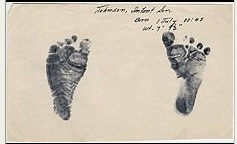
UT’s Harry Ransom Center Acquires Denis Johnson’s Baby Footprints (and Other Archival Material)

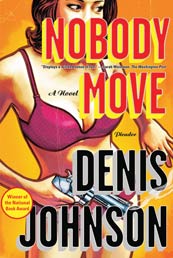
The Harry Ransom Center has acquired novelist Denis Johnson’s baby footprints (along with other archival material, including manuscripts, annotations, and other personal material). Read more here. Read our reviews of Johnson’s books Tree of Smoke, Jesus’ Son, and Nobody Move.

Denis Johnson’s Nobody Move and the Pleasures of Postmodern Crime Fiction

There’s an admirable precision to Denis Johnson’s Nobody Move, a dark and funny crime caper originally serialized in Playboy over four months in 2008, now available in trade paperback from Picador. Johnson limits himself to a handful of characters, a span of a few days, and four fifty-page segments to tell his story. Johnson’s economy resonates from his tight plotting and structure down to his cool, concise sentences. He works in noir archetypes, to be sure–there’s the hard-luck loser in over his head, the femme fatale with a troubled past (and present), the sadistic thug and his moll, and the sinister mastermind. Johnson’s feat here is to present all of this in a manner that’s simultaneously invigorating to the genre but also a confirmation of its pleasures.

Consider Johnson’s erstwhile protagonist, Jimmy Luntz. The name alone seems to tell us everything about this guy, a lousy gambler who spends much of his time on the run. He owes money to the wrong guys, and when a gorilla appropriately named Gambol comes to collect, Luntz makes the mistake of shooting but not killing him. Johnson traffics in immediacy in Nobody Move–there’s not a lot of backstory or dwelling on psychological motivation, thankfully–but he does offer up the occasional nugget, like this one:

Early in his teens Luntz had fought Golden Gloves. Clumsy in the ring, he’d distinguished himself the wrong way–the only boy to get knocked out twice. He’d spent two years at it. His secret was that he’d never, before or since, felt so comfortable or so at home as when lying on his back listening to the far-off music of the referee’s ten-count.

And that’s all the personal history we really need about Luntz. It’s the gaps in the story that are so engaging, that force the reader to play the role of detective in this crime story. To this end, Johnson starts the story in media res, with Luntz leaving a disappointing competition performance of his barbershop chorus. He spends much of the novel’s first half still in his white tux. The novel’s end — well, I won’t spoil the end, of course — but let’s just say that the end of the novel finds our characters poised for further nefarious adventures. But there I go, getting ahead of myself. A little more on plot: Gambol, wounded by Jimmy, finds himself being nursed by a woman named Mary. Their nascent relationship is one of the highlights of the book, funny and cruel, a bizarre study in unlikely romance. Meanwhile, Jimmy hooks up with Anita Desilvera, a dark-eyed bombshell with a serious drinking problem and a series of upcoming court dates. They complicate their problems by going on the lam together. Gambol eventually comes looking for Jimmy (he wants to literally eat his testicles) and drama and danger ensue.

Denis Johnson is arguably among the best living American writers today, having produces no fewer than two masterpieces (Tree of Smoke, one of my favorite books of the past ten years, and Jesus’ Son, one of my favorite books ever). So when he wrote a genre fiction piece under a deadline for Playboy, many critics and readers wondered what he was up to. Was he serious? How serious were we supposed to take the work? Did he need the money? The book itself offers some answers. Nobody Move is fantastic as a genre exercise, witty, dark, lean, and hard-boiled, transcending the bad or formulaic writing that can plague the genre’s novels but never trying to transcend its tropes. Put another way, Johnson here demonstrates that he can master a genre that is not his, and that he can do it under the constraints of space and time. That’s quite a feat, if you think about it, especially if you compare Nobody Move to Thomas Pynchon’s recent genre exercise, Inherent Vice, or the detective-centered works of Jonathan Lethem like Motherless Brooklyn and Gun, With Occasional Music. Pynchon’s work is in many ways a covert, loving goof on the genre, but it’s still more or less a “Thomas Pynchon” book. Lethem likes the idea of writing crime noir, but he wants to subvert it, mash it up with sci-fi, see it as a form of post-modern allegory. Roberto Bolaño is almost painfully aware of this in his fiction–his narrator in Distant Star gets to play at being a detective for a bit, but finds that it’s not nearly as fun as he would like it to be. The Savage Detectives views literature and art as a crime scene to puzzle out. And 2666 . . . well, you know about 2666 (hang on wait, you don’t know about 2666? You should really get that taken care of). Or take James Ellroy’s postmoderinst crime fiction, which owes, unwittingly or not, as much to Don DeLillo as it does to Raymond Chandler. These are all great writers, of course. But I think contrasting what they are trying to do with what Johnson is trying to do is instructive.

There’s a purity to Nobody Move, to its utter willingness to simply be what it is–and many folks won’t like that; they may even accuse Johnson of slumming. Perhaps they think it’s easy to write a tight, funny crime novel. Perhaps they know it’s not, and they think that Johnson is being solipsistic, or even mercenary. In any case, Nobody Move will probably stand outside of Johnson’s canon. And that’s unfair. Cinematic and highly visual, it recalls some of the Coen brothers’ finest work, like Blood Simple and The Man Who Wasn’t There, and even Tarantino’s Jackie Brown (minus the messy sprawl). Perhaps the best thing about Nobody Move–other than the sheer pleasure of reading it over a few afternoons, of course–is that it might motivate readers to pick up Jesus’ Son or even Tree of Smoke. For many readers, especially young readers, genre is a vital gateway to what many of us prejudicially call “more serious” literature. So pick up Nobody Move, read it, love it, and then pass it on to someone who needs to know about Denis Johnson. Recommended.

Nobody Move is available in trade paperback from Picador on April 24, 2010.

In Brief — New (and Not So New) Noir Novels

Got a great little gang of new noir (or at least noirish) novels from Picador last week. These handsome trade paperbacks are all available April 27, 2010. Full reviews all around forthcoming, but until then–

Denis Johnson’s Nobody Move is a tight snare drum of a comedy crime novel. Jimmy Luntz, still decked out in his white barbershop chorus tux (don’t ask) gets into trouble with a big gorilla he owns money too. On the run, he meets smoldering bombshell Anita. More trouble ensues. Nobody Move, originally serialized in Playboy, is a dark, funny genre exercise propelled by Johnson’s sharp dialogue and keen eye for detail. Johnson’s restraint and economy demonstrate writerly chops, but its his story and his characters that made me stay up too late reading last night.
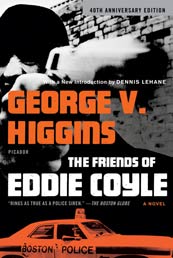
I’m kind of embarrassed that I’d never heard of George V. Higgins’s seminal crime novel, The Friends of Eddie Coyle, the story of a down-on-his luck gunrunner trying to get a break on a three-year sentence. Picador’s new edition celebrates the book’s 40th anniversary. Higgins’s electric dialogue thrusts the reader right into the action, trading narrative clarity for a smoky milieu of backroom deals and gritty alleys. But my phrasing here sounds way too corny and trite. Forgive me, I don’t really know how to write about good crime fiction because I’m so unused to it. I’ll lazily favorably compare The Friends of Eddie Coyle to David Simon’s Baltimore crime epic The Wire.

I’ve been too engrossed with Coyle and Nobody Move the past few days to do more than skim over Clancy Martin’s How to Sell, a novel about grifters and scam artists in the jewelery world, but I did read and very much enjoy its first chapter, where the protagonist pawns his mother’s wedding ring (“the only precious thing she had left”) and yet still manages to keep reader sympathy (mine, at least). Martin worked for years in the fine jewelery business. He also translates Nietzsche and Kierkegaard. Zadie Smith says of How to Sell: “It’s a little like Dennis Cooper with a philosophical intelligence, or Raymond Carver without hope. But mostly it’s like itself.” I like that.
If you’re still not in a  noirish mood, I’ll make one more attempt to piqué your interest. In what has to be one of the greatest opening shots in the history of cinema, Orson Welles begins his dark crime thriller Touch of Evil with a continuous tracking shot of a car that . . . hang on, I shouldn’t tell you what happens if you don’t know yet. Just watch the scene. It mines the same border-horror that those other noir-masters Roberto Bolaño and David Lynch also evoke so well.

Size Matters

I went to my favorite local bookstore this afternoon and for reasons beyond me I was compelled to pick up Jonathan Littell’s divisive 2009 novel The Kindly Ones, a massive tome running to almost 1000 pages in its trade paperback edition. Okay. The reasons I bought it are not completely beyond me: they mostly stem from Paul La Farge’s essay “A Scanner Darkly,” published in the May, 2009 issue of The Believer. Previous Believer feature essays have led to me picking up excellent books by writers I’d never heard of, including 2666 and The Rings of Saturn. Anyway, the book is massive, and I don’t really have time to read it any time soon. There is a hobbit-sized stack of review copies lingering by my nightstand, more arriving all the time, not to mention the books I habitually pick up weekly. Which, more often than not, tend to be pretty big like, uh, The Kindly Ones.

Why is this? Why the attraction to big books? In his essay included at the end of Bolaño’s 2666, Ignacio Echevarría cites a passage from the book where literature professor Amalfitano wonders that:

Now even bookish pharmacists are afraid to take on the great, imperfect, torrential works, books that blaze paths into the unknown. They choose the perfect exercises of the great masters. Or what amounts to the same thing: they want to watch the great masters spar, but they have no interest in real combat, when the great masters struggle against something that terrifies us all, that something that cows us and spurs us on, amid blood and mortal wounds and stench.

The “bookish pharmacist” in question has explained that he favors the preciseness of “Bartleby” over Moby-Dick, the polish of The Metamorphosis over The Trial. Amalfitano, Bolaño’s stand-in, points out that it takes “the great, imperfect, torrential works” to “blaze paths into the unknown.” Put another way, the masters need space; space to overflow, make errors, experiment, joust with other masters, play in and with time. Obviously, the passage (as Echevarría and a million other critics have noted) is a defense for the sprawl of 2666 itself, but I think it speaks to why many readers are drawn to the big books. They can be ragged and overflowing but they also have more room to take the measure of spirit, soul, life. They can evoke this world and others. They can be grand.

Not to say that the smaller books can’t do this in turn. Denis Johnson’s Jesus’ Son is masterful in its precision and humor. But Tree of Smoke is the better book. David Foster Wallace’s Infinite Jest trumps everything else the man wrote. White Noise is more manageable than (and perhaps superior to) Underworld, but the bigger book allows Don DeLillo the space he needs to explore so much of American history and American psyche. And these are just contemporary examples. There’s James Joyce and Marcel Proust, Dostoevsky and Tolstoy. Sterne. Cervantes. Supply your own names.

But I also love novellas and those long short stories of strange size like Joyce’s “The Dead” or, yes, “Bartleby” (sidebar: Really, what is “Bartleby”? A long short story? A short novella? What is it?). There’s something pure and refreshing about them, especially when consumed quickly, especially when consumed between a few of those long books. And a confession: I love it when review copies come in that hover around 200 pages, particularly when the novel is the writer’s first or second. There’s a glut, a horrendous, miserable glut, of first-time novelists who feel they must say everything about everything in 380 or 450 or, God forbid, 500+ pages. It’s really too much. I suppose the rule, if there has to be a rule (there doesn’t) is impossibly simple (and perhaps just impossible): if you’re going to write a really, really big book, make sure it’s addictive, compulsive reading. I’m not sure if The Kindly Ones is great art or a potboiler posing as art, but I am pretty certain that its length alone, for whatever reason, is part of its attraction.

Venus Drive — Sam Lipsyte

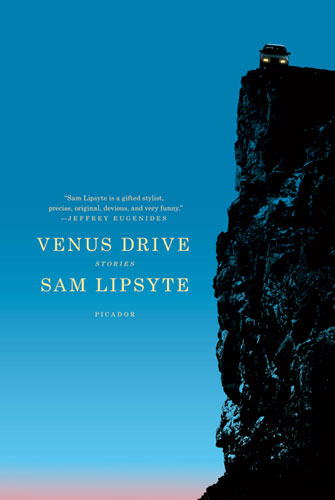
Sam Lipsyte’s forthcoming novel The Ask is already poised to be one of the major critical successes of 2010. In concordance with its publication, Picador will print a new trade paperback edition of his short story collection Venus Drive, the first such publication since its original debut from Open City a decade ago.

The thirteen stories in Venus Drive compose a sort of novel-in-stories. The title of the collection takes its name from a banal suburban street mentioned in a few of the stories, and many of the characters seem like iterations of the same type or voice. There are washed up would-be indie rock stars, small-time coke peddlers, and underemployed and overeducated addicts. There are deviants and perverts and outsiders. There are bullies. There are dead or dying mothers, dead or dying sisters. In short, Venus Drive is its own tightly-drawn, tightly-coiled, and highly-compressed world.

As the plot points double and re-double in these stories, so do the themes. “Our culture is afraid of death, and considers it something we must wage battle against,” says Tessa, a pain specialist, a peripheral character in “Cremains.” She continues: “I say, surrender, submit. Go gentle. Terminal means terminal.” Death informs almost all of these stories in some way, and Tessa’s commentary presents the problem with death, or at least the problem these characters have with dealing with death: it’s not easy to go gentle. It goes against our culture and our nature to surrender. If she’s presented as a voice of wisdom, she’s also an ironic character, one of the many would-be authorities Lipsyte’s weirdos and outsiders can’t help but mock. “The Drury Girl,” part-suburban satire and pure pathos, posits a pre-pubescent narrator obsessed with his teenage babysitter; his dad’s cancer plays second fiddle to his lust. Thus the story neatly ties together the overarching themes of Venus Drive, sex and death. Admittedly, these are probably the only real themes of proper literature, but Lipsyte does it so damn well and lays it all out so bare and does so in such humor and grace that it really sticks. It’s good stuff.

That humor is desert-dry, of course, and succeeds so well because his characters are so endearing in their pathetic pathologies. The antiheroes of “Beautiful Game” and “My Life, for Promotional Use Only,” are also-rans in the sordid history of underground rock, addicts approaching washed-up (Are they the same person? Maybe. They have different names, of course. Doesn’t matter). A scene from “Beautiful Game” shows the ambivalence at the core of many of these characters: “At the bank machine, Gary doesn’t check the balance. Better to leave it to the gods. Someday the bank machine will shun him. Why know when?” Gene, the ex-rocker in “My Life, for Promotional Use Only” now suffers the indignities of working for his ex-girlfriend. Everyone in the story is an ex-something, everyone is growing up and leaving art (or is it “Art”?) behind. In a poignant and funny and cruel scene, familiar to many of us, Gene sees some of himself in a waitress:

Rosalie calls over the waitress and they talk for a while about somebody’s new art gallery. The waitress is famous for a piece where she served the Bloody Marys mixed with her menstrual blood. Word had it she overdid the tabasco.

I wait for the moment when our waitress stops being a notorious transgressor of social mores and becomes a waitress again, look for it in her eyes, that sad blink, and order a beer.

Gene, a former “notorious transgressor of social mores” himself feels both sorrow and hate for the waitress. He sees her job as menial and pathetic — just like his own. He doesn’t seem to think much of her art, either. Lipsyte telegraphs so much there with so few words, his sentences clean, spare, precise, and rarely of the compound variety. There’s a truncated, clipped rhythm that Lipsyte builds over the thirteen-story run that helps propel the immediacy of his tales. The stories are short, too; the longest is sixteen pages and most run to eight or ten. Lipsyte’s rhetorical gift is to shine the grubby and, at times, his sentences can feel almost too perfect, too-fussed over–but this (minor) complaint, it must be noted, comes from someone who admires occasional ambiguity or incoherence. Lipsyte removes his own authorial voice and thus achieves lucidity in his characters’ voices; somehow, though — and paradoxically — these voices bear the ghostly trace of his absence. But that seems like a silly conversation, and certainly not one for this post.

Venus Drive reminds me very much of one of my favorite books, Denis Johnson’s Jesus’ Son, which I would also call a novel-in-stories, also a spare and precise collection, also a study of weirdos and addicts and outsiders. Jesus’ Son is something of a standard in creative writing workshops (or at least it used to be) and a sensible teacher would add Venus Drive to her syllabus as well. Finally, like Jesus’ Son, Lipsyte’s book is seething, funny, and poignant, with characters tipped toward some redemption, awful or otherwise, for all their myriad sins. The book might take its name from a geographic location, but the “Venus drive” is also a spiritual inclination toward love and hope. Highly recommended.

Venus Drive is available March 2nd, 2010 in trade paperback from Picador.

Tree of Smoke — Denis Johnson

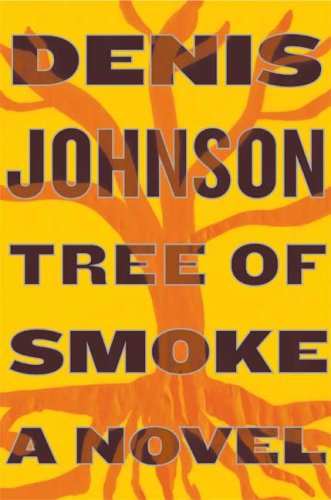
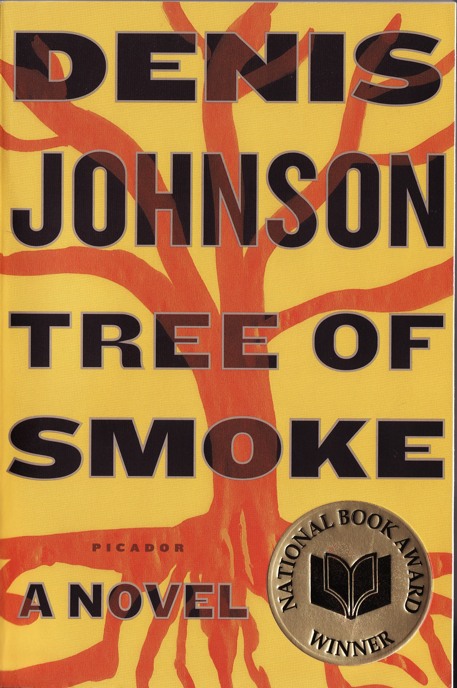
One year after it topped book critics’ best-of 2007 lists everywhere (including ours), Denis Johnson’s Vietnam War epic Tree of Smoke is finally available in a handsome trade-paperback. Picador’s edition retains the original orange and yellow cover, only now affixed with the proud blazon “National Book Award Winner.” However, that Tree of Smoke won this prestigious award no doubt ruffled a few feathers. It still remains an urgently divisive work.

Although plenty of critics and readers loved the novel, including The New York Times‘s Jim Lewis (who cautiously called it “something like a masterpiece”) and Michiko Kakutani, it has had more than its fair share of haters. Consider B.R. Myers’s downright mean review, “A Bright Shining Lie” in The Atlantic. Here, Myers displays the worst kind of vitriol. He’s the critic who feels the need not only to trumpet his hatred of the work he’s assessing, but also to lambaste the dignity, taste, and intellect of anyone who would disagree with him. Myers specifically attacks Johnson’s rhetorical style, his diction and syntax, and concludes that those idiots who would praise such inane, base, and clichéd language (idiots like me, that is) are clearly the cause of all current social and political problems and “have no right to complain about incoherent government.” Uh, sure. Myers’s baseless zealotry aside, it’s worth looking at the popular reception of Tree of Smoke, and what better place to do so than scouring Amazon reviews, right?

A cynic might say that Amazon reviews are the bottom-barrel of literary criticism, yet it’s still worth considering the almost perfectly mathematical split between 5- and 4-starred reviews of the book and 1- and 2-starred reviews (although none of the negative reviews I read on Amazon suggested that praising Johnson’s novel disenfranchised one from political opinions). Put simply, most people tend to either hate or love Tree of Smoke, which, I believe, is a sign of great art. And, were I inclined to inflate my rhetoric to a grandiose level like Myers, I might here wax philosophical about opinion, perspective, history, and the value of great art to ignite debate and discussion within the marketplace of ideas. However, I don’t think a book review is necessarily the best venue to make grand sweeping statements. At best, such writing presents a shallow or hollow endorsement of a collective truth (e.g. “Everyone assesses literature from their own perspective and therefore everyone values books differently”); at worst–in the case of Myers’s grotesque review–we get a pompous, overblown, self-important declaration (here, praising Tree of Smoke = losing the ability to authoritatively comment on society or politics) that can only be supported within the limited rhetorical bounds created the sophist has constructed (i.e. Myers’s review). But I’ve made a long digression, and, worse, I’ve failed to really discuss the book at all.

My initial review of Tree of Smoke last year was really a review of Will Patton’s masterful audio-recording of the novel (I was reading Ulysses for graduate school at the time and simply did not have the time to read both). I loved the experience; Patton did a great job, and I found myself wholly addicted to the narrative. When the advance copy of Tree showed up in the mail earlier this week, I immediately re-read the coda of the book in a single sitting. I would say the measure of a great narrative is not its core, its climax, or its beginning, but how well the conclusion is able to deliver the promises established throughout the book. Tree of Smoke delivers, and its ending continues to haunt the reader well after the book has been set aside. Readers like Myers may not get the payoff–he claims that “Johnson’s failure to understand [his character’s] faith is such that when he uses it to end the novel on an uplifting note, the reader feels nothing.” However, I hardly think that a watery Hallmark-word like “uplifting” properly connotes the weight, pathos, and sheer pain that Johnson conveys and addresses at the end of the book (Myers’s shallow diagnosis leads me to believe he merely skimmed the novel). Ethics of literary criticism aside, the real triumph of Tree of Smoke is simply that Johnson manages to comment in a new way on a subject that, by 2007, had been done to death. Who knew that we needed another story about the Vietnam War? Denis Johnson, apparently. Read the book for yourself. Very highly recommended.

Tree of Smoke is available in paperback from Picador on 2 September, 2008.

Essential Short Story Collections: Jesus’ Son

Welcome to a new feature at the Biblioklept, “Essential Short Story Collections,” in which we take a look at some, uh, short story collections that are essential (how’s that for a tautology?). Because we here at Biblioklept Headquarters USA always put Jesus first, and because his latest novel Tree of Smoke was so dang good, why not start with Denis Johnson’s 1992 collection Jesus’ Son?

jesusson.jpg

Jesus’ Son is almost a novel in short story form. The unnamed narrator of the stories is an alcoholic drug addict who manages to survive through a mix of petty thievery, odd odd jobs, and straight-up bumming it. The collection opens with “Car Crash While Hitchhiking.” The title of this story is in no way misleading. And although the first story winds up with the narrator hospitalized and blacking out (initiating a motif in Jesus’ Son), the next story, “Two Men” finds him reasonably healthy and up to no good. “Two Men” is a meditation on the bonds of friendship and an outstanding example of Johnson’s tight prose:

I was being taken out of the dance by my two good friends. I had forgotten my friends had come with me, but there they were. Once again I hated the two of them. The three of us had formed a group based on something erroneous, some basic misunderstanding that hadn’t yet come to light, and so we kept on in one another’s company, going to bars and having conversations. Generally one of these false coalitions died after a day or a day and a half, but this one had lasted more than a year. Later on one of them got hurt when we were burglarizing a pharmacy, and the other two of us dropped him bleeding at the back entrance of the hospital and he was arrested and all the bonds were dissolved.

Friends! Good stuff. Other stand-outs in the collection include “Work,” a story about stealing copper wire, and “Emergency,” a tale involving copping pills from an emergency room job. Reminiscent of Hunter S. Thompson, “Emergency” perfectly captures drug-addled paranoia overflowing into petty existential questing. An encounter with some normals:

A family in a big Dodge, the only car we’d seen in a long time, slowed down and gawked out the windows as they passed by. The father said, “What is it, a snake?”

“No, it’s not a snake,” Georgie said, It’s a rabbit with babies inside it.”

“Babies!” the mother said, and the father sped the car forward, over the protests of several little kids in the back.

Georgie came back to my side of the truck with his shirtfront stretched out in front of him as if he were carrying apples in it, or some such, but they were, in fact, slimy miniature bunnies. “No way I’m eating those things, ” I told him.

The last story in Jesus’ Son, “Beverly Home,” finds our narrator in a somewhat more stable position, working in a retirement home and attending NA and AA meetings. His one vice and indulgence is voyeurism; he takes to watching a Mennonite couple through their windows at night, progressing from deviant sex-obsession to pining for their mundane life:

I got so I enjoyed seeing them sitting in their living room talking, almost not talking at all, reading the Bible, saying grace, eating their supper in the kitchen alcove, as much as I liked watching her naked in the shower.

At the end of the book, moved by the strange spectacle of a man washing his wife’s feet, the narrator finds a kind of hope and redemption for the future:

All these weirdos, and me getting a little better every day right in the midst of them. I had never known, never even imagined for a heartbeat, that there might be a place for people like us.

200px-jesus_son_ver5.jpg

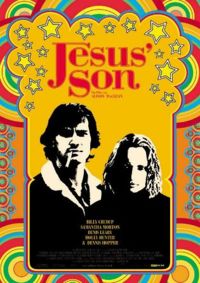
I mentioned above that Jesus’ Son can almost be read as a novel, but make no mistake–it is a collection of short stories, character sketches, vignettes that add up to something greater. The 2000 film adaptation of the movie makes this quite clear. Although the film, starring Billy Crudup as the unnamed narrator, is not half bad, the disconnected and fragmentary nature of the book–which reinforced the book’s themes of existential alienation and minor redemption–comes across as episodic and even whimsical in the movie.

I highly recommend Jesus’ Son, and I hope that people who “don’t have time to read” will make a little space in their day for this slim but substantial book. Most of the stories can be read in under half an hour, so why not pick up a copy?

Tree of Smoke–Denis Johnson

tree-of-smoke.jpg

I finished Denis Johnson’s sprawling Vietnam War epic Tree of Smoke the same weekend that I finished James Joyce’s Ulysses. I managed to do this thanks to BBC America’s fantastic audio book version of Tree of Smoke, read by Will Patton–there’s simply no other way I would’ve managed to read both books. After finishing Tree of Smoke, that special depression reserved for only the best of books set in (you know that feeling–where the book you looked forward to every day is now over, and you feel a little sad and want more). I immediately started listening to it again (after I finished Ulysses I simply felt exhausted–Molly Bloom’s infamous monologue was fantastic (and sexy!), and I read it in one sitting, but still…the book inspires a special fatigue. More on all of this in a future post. I only bring the two up together as they are both very long books I finished this weekend; without pretense or shame, I attest that I enjoyed Johnson’s book over Joyce’s).

I plan to buy and reread (not sure if reread is the right verb) Tree of Smoke as soon as soon as it comes out in paperback. For now, here’s a very brief review: go buy this book and read it immediately. If you don’t have time to read it, get the 18-disc, 24 hour audiobook. Will Patton’s reading is astounding. He manages to meet and express the expansive range of voices and viewpoints in Johnson’s novel–newbie CIA spooks, double agents, overwhelmed relief workers, nihilist GIs, zealous field operatives, and more–in a way that brings the appropriate depth and personality to each character without ever being obtrusive or obnoxious (as can sometimes happen with audiobooks). Patton’s reading is on par with the best audiobook readings I’ve ever heard, and those of you who frequently listen to audiobooks know the difference this can make. He seems to fully appreciate the scope and magnitude of Johnson’s piece on Vietnam (sidenote: Patton played a bit-part in the underrated and overlooked 1999 film adaptation of Johnson’s novel-in-stories collection, Jesus’ Son).

But I’m not really doing justice to Johnson’s novel here. To call it a Vietnam war novel is like calling Prince a simple R&B artist–a facile description that doesn’t capture the subject. To be sure, it is a Vietnam war novel, but one that self-consciously riffs off of both The Ugly American and The Quiet American–with shades of Apocalypse Now to boot. At the same time, Johnson deftly injects mythology and philosophy directly into his character’s voices, into their conversations and letters, into the books they read and the papers they write, without ever once clumsily forcing a theme or motif. Unlike lesser writers, Johnson never slaps the reader in the face with all his clever ideas. Instead, all his clever ideas–meditations on colonialism, war, the minotaur myth, self-sacrifice, religion, data and analysis, love and betrayal–are part of an enthralling plot propelled by the most realistic dialog I’ve heard in a long, long time. If a better book is published in 2007, please let me know. Highly highly highly recommended.