I Review Neal Stephenson’s Zany, Prescient Novel Snow Crash (And Comment on the Impending Film Adaptation)

Neal Stephenson’s 1992 novel Snow Crash opens with an extended scene in which the book’s protagonist races to deliver a pizza on time for the mafia. The scene is thrilling and ridiculous, establishing the book’s frenetic, ironic tone and painting a rough outline of Snow Crash’s milieu. Like  many sprawling works of speculative fiction, Snow Crash is more interested in rendering its milieu in vibrant, hyperkinetic color than it is concerned with delivering plot and character development. Snow Crash’s plot is the sort of joyfully convoluted careening mess that makes a reviewer (okay, this reviewer) shudder at the thought of having to successfully paraphrase, so I’m not even going to make an earnest effort. Let’s get to that milieu and the cartoon characters who inhabit it.

Snow Crash is set in the early 21st century, primarily in Los Angeles, which is no longer part of the United States. Actually, there isn’t much of a United States to speak of, really—and not even a municipal Los Angeles, per se. Instead, the terrain is totally privatized. Privatized roads, privatized spaces. People (who can afford to) live in franchised burbclaves protected by hired mercenaries or private militias or robots that keep out the undesirables. (The white folks who live in New South Africa want “racial purity,” while some franchise nations, like Mr. Lee’s Greater Hong Kong are open to anyone who can trade information). Authority is for sale. Conditions are so laissez-faire that the Mafia is truly a Legitimate Business now (complete with their own CosaNostra Pizza University). In fact, all business is legitimate; several times in Snow Crash, a character will refer to “the old days when they had laws.” Without regulation, hyperinflation is the norm; the homeless use trillion-dollar bills to light their campfires.

There’s a hard-edged griminess to the world Stephenson conjures in Snow Crash, but the book is never grim or dour, and instead embraces the anarchic-capitalism it proposes. Perhaps this is because Stephenson’s heroes are such radically exceptional people. The book’s hero is named Hiro Protagonist, the kind of Pynchonian goof that characterizes Snow Crash’s zany tone. Hiro meets the book’s other protagonist, a fifteen year old blonde who goes by Y.T. (“Yours Truly,” although most of the folks tend to hear “whitey”). Y.T. is a Kourier, a skateboarding delivery person who harpoons vehicles to catch a free ride. She helps Hiro deliver that pizza in the opening scene and the two team up after Hiro gives her his business card. It reads: “Last of the Freelance Hackers  / Greatest swordfighter in the world  / Stringer, Central Intelligence Corporation. Specializing in Software related Intel. (Music, Movies & Microcode.)” Did I neglect to mention that Hiro carries two samurai swords with him wherever he goes?

Hiro’s pretty handy with those swords, but his real skill is hacking, and he spends a good deal of time in the Metaverse, a virtual reality-based internet space where avatars go to bars and chat and sell &c. It’s sort of like a mix between Facebook and World of War Craft. In 1992 (earlier, I suppose), Stephenson’s way ahead of the curve. Here, he describes avatars:

Your avatar can look any way you want it to, up to the limitations of your equipment.  If you’re ugly, you can make your avatar beautiful.  If you’ve just gotten out of bed, your avatar can still be wearing beautiful clothes and professionally applied makeup.  You can look like a gorilla or a dragon or a giant talking penis in the Metaverse.  Spend five minutes walking down the Street and you will see all of these.

There are plenty of passages like this, where Stephenson pegs some aspect of internet culture ten years before it actually happens. (I couldn’t help but think about Wikipedia during Hiro’s conversations with a program called Librarian). It’s probably fair to say that the Wachowskis lifted as much from Snow Crash as they did from William Gibson’s cyberpunk trilogies.

While I’m there, I might as well lazily point out that Snow Crash would fit neatly at home on a shelf with Neuromancer or Mona Lisa Overdrive. There’s also a heavy dose of Philip K. Dick weirdness in Snow Crash, particularly when the book settles into its major metaphysical plot about ancient Sumerian gods and goddesses and linguistic viruses and the Tower of Babel. Stephenson’s Snow Crash is zanier than William Gibson’s dark depictions or Dick’s mindmelted milieux, and it would hardly do to call what he does here light—but there is something joyful, playful about his satire. I invoked Pynchon earlier and I’ll do it again; parts of Snow Crash also reminded me of David Foster Wallace’s opus Infinite Jest. Both IJ and SC obsess over the minutest details of speculative technologies and how people might react to such technologies. This is often what sets Snow Crash heads and shoulders above run of the mill cyberpunk. In just one instance, Stephenson parodies the language of bureaucratic speech at length; Y.T.’s mom, who works for what’s left of the Federal Government, is subjected to a memo about toilet paper usage that goes on for pages. The passage is hilarious, and adds absolutely nothing to the plot development—it simply helps to flesh out the contours of the world that Stephenson has imagined.

All of this detailed imagining unfortunately comes at the expense of a plot that only coheres through massive exposition dumps. About a third of the way into the novel, the major conflict is finally established, but only through a dialog between Hiro and the Librarian that reads almost like a catechism. As the book reaches its climax, Hiro actually explains what’s going on to a few of the other major characters—and the reader, of course. It’s a cringe-worthy moment, the sort of rhetorical weakness that smacks of genre fiction; even worse, the plot’s action ultimately hangs on some fairly basic hoary old tropes that wouldn’t be unfamiliar to anyone who’s ever played a video game. The book lags under a juvenile obsession with weapons and badassery in general. And the book’s resolution . . . well, let’s just say that Stephenson sticks the ending, but it all feels too pat and too slight after the dazzling weight of the world that he’s established. Still, at its finest, Stephenson’s prose is zippy, shining, hilarious stuff, and his employment of multiple character perspectives moves the book with an addictive energy. Snow Crash is beach reading for folks who like some humor with their dystopia.

A film adaptation of Snow Crash is supposedly going into production soon, with British director Joe Cornish taking charge. I liked Cornish’s last film Attack the Block, and Snow Crash clearly has a highly-imagistic, cinematic feel to it—but I think a film is not the way to go. Simply put, Snow Crash is too big, too larded with characters and details (so many that I failed to touch on in this review) to translate well onscreen. I think an eight part miniseries on HBO (or a similar network) would be perfect, even if it came at the expense of special effects—-a miniseries would give the filmmakers time to build Stephenson’s nuanced world. I’m afraid otherwise we’ll get a travesty like the adaptation of The Golden Compass, or something like The Hunger Games film, where all but the most basic plot points are elided. But I suppose a miniseries is not as lucrative as a blockbuster film. I hope the filmmakers at least split the book in two. In any case, I’ll be interested to check out the results.

Six (More) Stoner Novels (And a Bonus Short Story)

A few years ago, to celebrate 4/20, Sam Munson at the Daily Beast wrote an article praising “The Best Stoner Novels.” Not a bad list—Wonder Boys, sure, Invisible Man, a bit of a stretch, The Savage Detectives, a very big stretch, but sure, why not. Anyway, six more stoner novels (not that we advocate the smoking of the weed)—

Junkie, William Burroughs

Burroughs’s (surprisingly lucid) early novel Junkie may take its name from heroin, but it’s full of weed smoking. Lesson: weed smoking leads to heroin. And the inevitable search for yage.

Inherent Vice, Thomas Pynchon

Doc Sportello, the wonky PI at the off-center of Pynchon’s California noir, is always in the process of lighting another joint, if not burning his fingers on the edges of a roach. A fuzzy mystery with smoky corners.

Infinite Jest, David Foster Wallace

Hal Incandenza, protagonist of Wallace’s opus, spends much of his time hiding in the tunnels of Enfield Tennis Academy, feeding his bizarre marijuana addiction, which is, in many ways, more of an addiction to a secret ritual than to a substance. Hal’s hardly the only character in IJ who likes his Mary Jane; there’s a difficult section near the novel’s beginning that features a minor character preparing to go on a major weed binge. His pre-smoking anxiety works as a challenge to any reader seeking to enter the world of Infinite Jest.

The Lord of the Rings, J.R.R. Tolkien

I’m pretty sure “pipe-weed” isn’t tobacco.

Chronic City, Jonathan Lethem

I kind of hated Chronic City, a novel where characters seem to light up joints on every other page. It seems to have been written in an ambling, rambling fog, absent of any sense of immediacy, urgency, or, uh, plot. Bloodless stuff, but, again, very smoky.

Stoner, John Williams

Okay. Stoner has nothing to do with marijuana. But, hey, it’s called Stoner, right?

Bonus short story: Raymond Carver’s “Cathedral”

Carver’s classic story features a myopic narrator who comes up against his own shortcomings when he meets an old friend of his wife, a blind man who ironically sees deeper than he does. After drinking too much booze, they spark up, share a doob, and take in a documentary about European cathedrals. Great stuff.


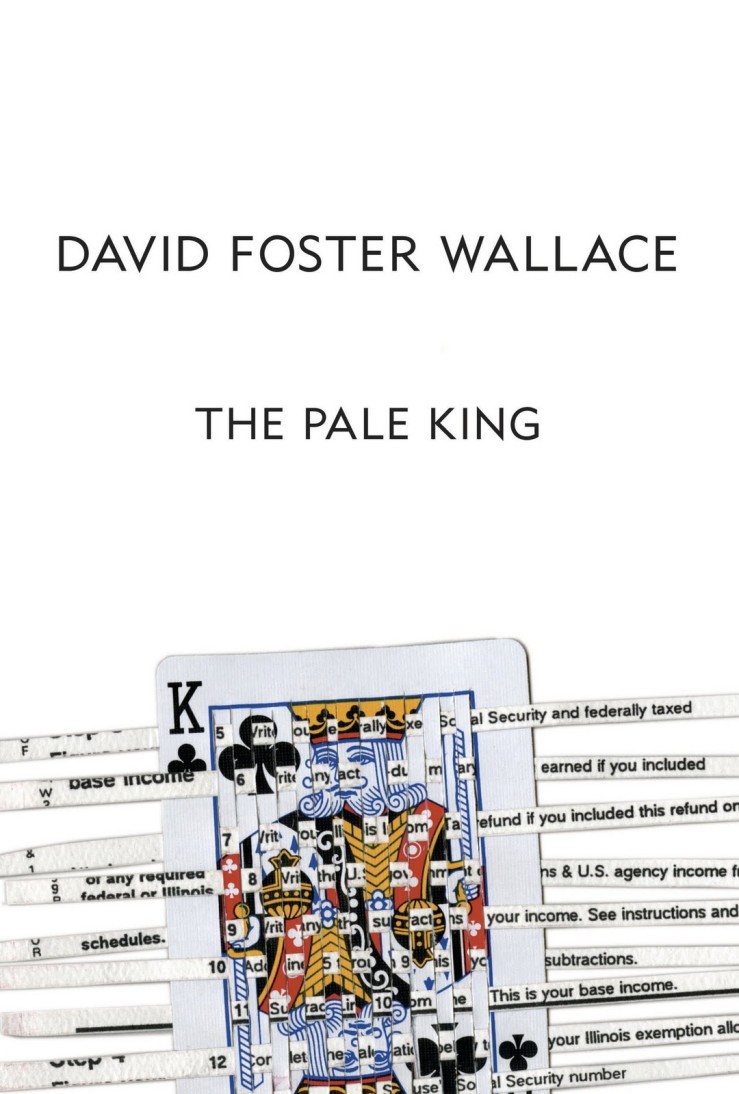
The Pale King Paperback (Book Acquired, 4.07.2012)

20120411-174813.jpg

I was happy to get a trade paperback of David Foster Wallace’s The Pale King this weekend (thanks Hachette!) for a few reasons. First, I detest hardback books — that didn’t stop me from picking up (and reviewingTPK when it debuted last year — but I know I’ll prefer this paperback for rereadings. More to the point, the paperback boasts four vignettes not published with the hardback last year, which I’m sure is in no way a cynical marketing ploy cooked up by the publishers. On those scenes:

20120411-172813.jpg

Okay, so yes, I read them. They’re short, and they don’t really add to the novel; actually, they probably take away from the Michael Pietsch’s fine editing work. Still, DFW fans will eat them up. I’ll try to reflect more later.

There’s also one of those reading group guide sections, which cracks me up. Are book clubs gonna read this book? I mean, I hope they do, but they’ll likely hate it. Here’s a question that caught my eye, mostly because I wrote a bit about §19 this summer.

20120411-174805.jpg

“It’s No Accident that Civics Isn’t Taught Anymore” — More from §19 of David Foster Wallace’s The Pale King

(Help yourself to some context (or not)).

Let’s look at some more of  §19 of David Foster Wallace’s The Pale King. Our interlocutors, all IRS agents, stuck in an elevator (methinks), direct their attention toward the decline of civics education (“‘Civics is the branch of political science that quote concerns itself with citizenship and the rights and duties of US citizens,’” we learn) in America and link this decline to the 1960s—

‘I think it’s no accident that civics isn’t taught anymore or that a young man like yourself bridles at the word duty.’

‘We’ve gotten soft, you’re saying.’

‘I’m saying that the sixties—which God love them did a lot for raising people’s consciousness in a whole lot of areas, such as racism and feminism—‘

‘Not to mention Vietnam.’

‘No, mention it, because here was a whole generation where most of them now for the first time questioned authority and said that their individual moral beliefs about the war outweighed their duty to go fight if their duly elected representatives told them to.’

‘In other words that their highest actual duty was to themselves.’

And down a bit—

‘The sixties were America’s starting to decline into decadence and selfish individualism—the Me generation.’

‘There was more decadence in the twenties than there was in the sixties though.’

‘You know what I think? I think the Constitution and Federalist Papers of this country were an incredible moral and imaginative achievement. For really the first time in a modern nation, those in power set up a system where the citizens’ power over their own government was to be a matter of substance and not mere symbolism. It was utterly priceless, and will go down in history with Athens and the Magna Carta. The fact that it was a utopia which for over two hundred years actually worked makes it beyond priceless—it’s literally a miracle. And—and I’m speaking of Jefferson, Madison, Adams, Franklin, the real church Fathers—what raised the American experiment beyond great imagination and made it very nearly work was not just these men’s intelligence but their profound moral enlightenment—their sense of civics. The fact is that they cared more about the nation and the citizens than about themselves. They could have just set America up as an oligarchy where powerful eastern industrialists and southern landowners controlled all the power and ruled with an iron hand in a glove of liberal rhetoric. Need I say Robespierre, or the Bolsheviks, or the Ayatollah? These Founding Fathers were geniuses of civic virtue. They were heroes. Most of their effort went into restraining the power of the government.’

‘Checks and balances.’

‘Power to the people.’

‘They knew the tendency of power to corrupt—’

As I said in some earlier posts about  §19, I don’t really have any great thesis to share about it: I really just want folks to read it. I think it’s a thoughtful and sometimes funny discussion that seems especially relevant against the backdrop of current American politics, which seem to be infected by a terrible case of the reactionaries, a very vocal contingent that does not seem to believe in civic duty.

Most reviewers have remarked (rightly) upon Wallace’s grand theme of boredom in The Pale King, but I don’t know how much attention has been paid to the way the book tries to measure the costs of existence (namely, death and taxes). Wallace squares boredom as both symptom and affect of a postindustrial existence, a post-democratic existence, an existence that has the leisure, or at least the means and the common vocabulary, to hash out the finnicky sinews between rights and duties—or, in turn, the leisure and means (and entertainments) to psychologically deflect or otherwise ignore those costs. His characters in The Pale King—and not just these guys stuck in the elevator, but, hey, their colloquy is especially instructive—his characters are in many ways are trying to find meaning, a sense of duty, against terrible, soul-crushing boredom, a boredom that capitalist culture fosters and with one hand and then assuages with the other, like a heroin dealer stringing along a junkie for all he’s worth. (There’s an intersection here with Infinite Jest, of course).

It seems that “civics” is a dirty word now, or even worse, a word unattached to any real concept in the American hivemind. It’s pretty much a given (and “given” in the sense of, like, “submission”) that our politicians are wholly corrupted by power, part and parcel of a corporatocracy that thrives on manufactured desire, on the promotion of “lack,” constantly feeding into the basest instincts of a populace easily motivated by xenophobia, paranoia, and the sense that a creeping dark “other” is destabilizing America’s “natural” progress to some great grand glowing telos in the sky. The great lie of the past few decades has been to perpetuate the ideal of a cost-free existence, a metaphysical out, an endless deflection of our rapid consumption. We live in a world where the leading Republican candidates for the 2012 election race are basically cartoons. We live in a world where headlines from The Onion seem more the work of prescient prescription than outright satire. We live in a world where an honest assessment of who-pays-what-taxes can only come from a comedy show.

Perhaps I’m ranting; perhaps this post is too hyperbolic. Sorry. I’ll return to Wallace’s language and that opening line: “‘I think it’s no accident that civics isn’t taught anymore or that a young man like yourself bridles at the word duty.'” Americans are being told that they have no duty to other Americans, that they should not have to have any relationship with other Americans, that, essentially, there is no civic duty to one’s country, to one’s fellow Americans—there is only a duty to one’s ruggedly individual self, only a duty to one’s bootstraps, which you must always pull up by yourself. The corporate-advertising-entertainment-industrial complex perpetuates the illusion of rugged individualism and politicians reinforce it with their empty rhetoric, blasting at any element of a public, civic corpus that isn’t part of the American war machine (which remains of course untouchable; perhaps the greatest signal of cognitive dissonance I regularly see on my commute to and from work are the cars in front of me that somehow bear anti-tax bumper stickers right next to calls to “Support Our Troops”).

Wallace perhaps rightly links the genesis of this cognitive dissonance when it comes to civic rights and civic duties to the 1960s, when the baby boomers, finding power in sheer numbers, were able to assert a generational agency unseen in this country’s history. His elevator talkers here are at the precipice of the Reagan ’80s, post-Watergate disenchantment, but also post-Carter malaise, a time when the boomers are oiled and primed for the complete ideological failure that should forever mark their generation.

There’s more rant in me, of course, but I’ll save it for more excerpts from  §19.

I Watch The Decemberists’ David Foster Wallace Video

I’ll be upfront: I don’t care for the music of The Decemberists. I’ve tried, after being told repeatedly how “deep” or “clever” or “literate” the lyrics are, and how good the music is—but it all strikes me as awfully bland stuff, like someone’s shitty take on R.E.M.

Anyway, I do very much like David Foster Wallace’s novel Infinite Jest, the “inspiration” (yes, I’ll put the word in suspicious quotation marks) behind The Decemberists’ new music video for “Calamity Song.” Here’s their singer/songwriter Colin Meloy (via NPR)—

I wrote “Calamity Song” shortly after I’d finished reading David Foster Wallace’s epic Infinite Jest. The book didn’t so much inspire the song itself, but Wallace’s irreverent and brilliant humor definitely wound its way into the thing. And I had this funny idea that a good video for the song would be a re-creation of the Enfield Tennis Academy’s round of Eschaton — basically, a global thermonuclear crisis re-created on a tennis court — that’s played about a third of the way into the book. Thankfully, after having a good many people balk at the idea, I found a kindred spirit in Michael Schur, a man with an even greater enthusiasm for Wallace’s work than my own. With much adoration and respect to this seminal, genius book, this is what we’ve come up with. I can only hope DFW would be proud.

I’m not going to conjecture whether Wallace would be proud or not. That seems like total asshole move. But, I am interested in seeing a filmed version of Eschaton, and I do like Michael Schur’s show Parks and Recreation. So I’m going to watch the video now—unmuted and everything—and then post a reaction. Here’s the vid—

Okay. Nice production values, I guess. I think that’s the band, right? I like it when bands are in their own videos and “act.” I guess they’re playing the older ETA kids who are watching the game this Interdependence Day. The singer is Pemulis, that seems clear. It snows in the Escahton episode, but it looks like only some rain here. I like the Otis P. Lord kid, but I don’t know if the other kids look right. This is weak criticism, I know. Hmmm. The song . . . well, I’m not into this song, but I guess it’s pleasant enough. It’s terribly competent. Bits of it sound like a sped up version of R.E.M.’s “Talk About the Passion.” Some of the lyrics seem to reference or play off of Infinite Jest maybe—like “Year of the Something Something”  or something.

I don’t know. What can I say here? I hope no one tries to make a movie out of Infinite Jest. It was all I could do to fast forward through most of Jim from The Office’s movie of Hideous Men.

The Pale King — David Foster Wallace

In one of the notes at the end of David Foster Wallace’s incomplete novel The Pale King, the author writes, “Plot a series of set-ups for stuff happening, but nothing actually happens.” This is a fairly precise summary of The Pale King—if you take “nothing actually happens” to mean an absence of recognizable character arcs defined through readily identifiable conflicts progressing along a linear narrative. The Pale King is not a traditional novel. Hell, it’s not even really a novel, unless you decide to really stretch your definition of what a novel is. Which is all fine and good and dandy. Infinite Jest is not a traditional novel either, but it is, I believe, clearly identifiable as a novel: it coheres; it completes; it concludes—which The Pale King does not.

You know the context of The Pale King, and if you don’t you can look it up—there’s a glut of hand-wringing and buzz and backlash out there (out there=internet) that I’ve spent the past three or four months doing my best to ignore. And while I haven’t read a review of The Pale King yet (I’ll read Tom McCarthy’ s write up in The New York Times as soon as I finish my piece), I would have to be deaf dumb blind not to have missed all the headlines, the links, the tweets, the weight people have sought to attach to this book. Anyway, I’m approaching hand-wringing here myself, which is not my aim. I want to try to review the book. But, like I said, there’s all that context. It’s unfinished. Incomplete. Posthumous.

We know the context. You know it’s incomplete, I know it’s incomplete, we know that going in. Which is why it’s a far more satisfying read, I believe, to treat The Pale King as a fragmentary piece, a novel-in-stories, a collection of themes, riffs, dialogues and monologues, vignettes, bits and pieces. It’s closer in many ways to Brief Interviews with Hideous Men or Oblivion than it is to Infinite Jest, although there are plenty of novelly-novel elements. There’s a setting: mostly a sweaty Peoria, Illinois in the mid 1980s, and although much of the novel centers around an IRS regional center there, there are also bits in Chicago, various college classrooms, suburban homes, sad motels, crowded highways, fringe communities, surveillance vans, bars, psych wards, etc. There are recurring characters, all of them IRS employees.

Perhaps a bit on those characters: Some of the best moments of the book center on the bizarre mind of Claude Sylvanshine, a fact psychic who can’t control the flow of data that surges into his mind. Sylvanshine works with his partner and sometime rival Reynolds to help lay the groundwork for the arrival of Merrill Errol Lehrl in Peoria, where Lehrl will continue to machinize the IRS or something like that. There’s Toni Ware, easily the coolest character in the book. There’s not enough Toni Ware in The Pale King. There’s Leonard Stecyk, a person so impossibly good that he drives everyone to despair. There’s Lane Dean, a Christian who may or may not be slowly losing faith. There’s Chris Fogle, who tells us basically his life story in a 100 page novella that may or may not be the center of the book (there is no center though). There’s David Wallace, who claims to be writing a memoir, who claims to be, like, the David Foster Wallace, the author, who claims that he worked for the IRS for a few years between other gigs. As if to prove he’s the real David Wallace, his sections are crammed with diverting, annoying footnotes that repeatedly interrupt any rhythm the reader (or this reader anyway) could get going. It’s difficult to summarize or even describe the relations between the characters, who are defined repeatedly not just through their own telling, but through each others’ eyes, which makes it even more difficult to unpack the plot of The Pale King.

The conflict of the book, or at least the surface conflict, the plot-level conflict, seems to be (or seems to have intended to have been) about a movement within the IRS to essentially change its mission from one of service, of doing a job that no one wants to do that nevertheless has to be done for the greater good of democracy, to a more nefarious and machine-like agency bent on generating revenue—like a corporation. Thus humanity vs. bureaucracy, religious-type calling vs. mercenary machinery, selfless duty vs. selfish will, etc. etc. etc. Chapter 19 (§19, in the book’s terms) lays out these themes beautifully in a civics lesson (the chapter is set in a stuck elevator, I think). The civics lesson has even more resonance in these times of rampant Teabaggery. Here’s a taste—-

Corporations aren’t citizens or neighbors or parents. They can’t vote or serve in combat. They don’t learn the Pledge of Allegiance. They don’t have souls. They’re revenue machines. I don’t have any problem with that. I think it’s absurd to lay moral or civic obligations on them. Their only obligations are strategic, and while they can get very complex, at root they’re not civic entities. With corporations, I have no problem with the government enforcement of statutes and regulatory policy serving a conscience function. What my problem is is the way it seems that we as individual citizens have adopted a corporate attitude. That our ultimate obligation is to ourselves. That unless it’s illegal or there are direct practical consequences for ourselves, any activity is okay.

The IRS gives Wallace a perfect backdrop to explore the tension between civic virtue and the American right to be a selfish asshole, but it’s the book’s themes of boredom and attention that have been remarked upon the most. Simply put, the theme is pervasive, perhaps overdetermined within the narrative, and at once both obvious and complex. Infinite Jest explored the consequences and existential fallout of a society conditioned to believe that it had to be entertained at all times; The Pale King seems to respond to the same existential problem in kind, only from a different angle. There’s so much of this theme of boredom and attention throughout the book that I’ll lazily go to Wallace’s end notes again, where he concisely lays it bare for us (or not for us really but probably for himself)—

It turns out that bliss—a second-by-second joy + gratitude at the gift of being alive, conscious—lies on the other side of crushing, crushing boredom. Pay close attention to the most tedious thing you can find (tax returns, televised golf), and, in waves, a boredom like you’ve never known will wash over you and just about kill you. Ride these out and it’s like stepping from black and white into color. Like water after days in the desert. Constant bliss in every atom.

Wallace finds a kind of transcendental out in the ability to concentrate attention on tasks of despair-invoking boredom. This type of attention obviously recalls the intensity of fervent, even monastic prayer (indeed, the IRS agents are often implicitly compared to monks), yet the Midwest America of The Pale King is deeply desacralized. Although Lane Dean provides a figure of religion in crisis (underexplored for the perhaps obvious reason that the book is unfinished), for the most part The Pale King  presents a post-Nietzschean world without an authorizing center. Wallace’s work then is to find some kind of metaphysical solace in a world where God seems absent at best, and he finds it in paying close attention to the tedium of life. For me, it’s The Pale King’s strange metaphysical moments that are the most intriguing (and frustrating) then. We have the aforementioned Sylvanshine, a fact psychic who can parse data, but cannot glean real meaning from it—

The fact psychic lives part-time in the world of fractious, boiling minutiae that no one knows or could be bothered to know even if they had the chance to know. The population of Brunei. The difference between mucus and sputum. How long a piece of gum has resided on the underside of the third-row fourth-from-left-seat of the Virginia Theater, Cranston, RI, but not who put it there or why. Impossible to predict what facts will intrude. Constant headaches.

In a world of information-overload, attending deeply and meaningfully to data becomes prohibitively difficult, if not impossible. Sylvanshine’s blessing/curse dramatizes the paralyzing post-20th century crisis of too much information (and therefore too many choices). The Pale King’s metaphysical elements manifest again in the ghosts Garrity and Blumquist, who kinda-sorta haunt the IRS center in Peoria; one of them shows up to explain the etymology of the word “boring” to Lane Dean. There’s a boy whose devotion to kissing every square inch of his body (clearly an impossible feat) takes on a spiritual dimension. There’s Chris Fogle, who experiences a religious-type epiphany in an accounting class. There’s also a “fierce infant” who seems to have some metaphysical powers, although I don’t know why I’m lumping him in here. Like I said, (didn’t I say?) I don’t really know how to review this book (I’ve also had a few beers at this point). The infant is one of those threads that goes nowhere, that fails to cohere, that might have a missing piece somewhere else, somewhere unwritten. A more complete picture of the transcendental bliss that prolonged attention might hold comes late in the book, in a longish piece (§46) that details a tête-à-tête between Meredith Rand, who is too-pretty, a little crazy, and ultimately both boring and alienating to almost any guy she actually talks to, and Drinion, an asexual man I take to be autistic. Drinion pays absolute, intense, true, human attention to Meredith Rand’s story of being admitted to a psychiatric hospital in her teens for cutting herself; there she meets her future husband. During their conversation, Drinion begins to levitate—via his attention, he literally transcends gravity. And yet the catch of it all is that Drinion’s autism and aesexuality somehow make it easier for him to attend others, to truly connect to this beautiful woman who simultaneously bores and alienates most of the men she bothers to speak with.

Still, Wallace posits in Drinion—and elsewhere in the book, but hey, let’s face it, this is getting pretty long for a blog review—Wallace posits some kind of answer to existential despair and boredom, an answer that goes beyond a trite commonplace like “empathy,” in that empathy is ultimately about self-identification: the answer in The Pale King seems to be selfless identification, in the most literal sense. There’s no cheat here—the narrative bits with Toni Ware especially dramatize the brutal ugliness of life, its essential Darwinian unfairness, the random cruelty that might be there. This is a book about death and taxes, and Wallace works to sanctify these costs of life, to make them count in a in a world that has largely abandoned the sacred, in a society where many people are incapable or unwilling to think empathetically about their relation to (via taxes and social institutions) other humans whom they do not personally know.

The Pale King is not as rich or funny or sad as Infinite Jest; it has nothing to match Don Gately nor does it have a Prince Hal Incandenza. But why hold that against it? It is, after all, an unfinished thing, but as incomplete as it may be, its ends not just loose but frayed, it is still a marvel of heart and intellect. Highly recommended.

Is American Psycho Profound, Artistic Nihilism or Stupid, Shallow Nihilism? — Bret Easton Ellis vs David Foster Wallace

Bret Easton Ellis’s controversial novel American Psycho turns 20 this year. The folks at Vintage were kind enough to send me a copy of the book to promote the anniversary, and despite a mounding stack of review copies, I took a few hours to re-read parts of Ellis’s third novel.

I’ve only read two Ellis books and I remember the reading of them distinctly, precisely; I remember how I picked them up and where I was and what I was doing and all that jazz. The first was Ellis’s début Less Than Zero, a slim, ugly little novel that I read in one night. I was fifteen, spending a summer with my aunt and uncle, living in my cousin’s old bedroom. Less Than Zero was part of a cache of books that included Hunter S. Thompson’s Fear and Loathing in Las Vegas, Anthony Scaduto’s Bob Dylan biography, some Hemingway and Fitzgerald novels, One Flew Over the Cuckoo’s Nest, and a Kurt Vonnegut starter kit. In short, a life changing library, and most of it went home with me in my Jansport (somewhat surreptitiously, although I’m sure if I had asked I would have received). Only I didn’t take Less Than Zero, despite reading it all in one sick night, and then reading it again in pieces over the summer. The book hurt my stomach. The drugs were not the Looney Tunes business in HST’s book—they were the symptom of a blank nihilism I simply couldn’t identify with. The scene where the kids casually watch a snuff film horrified me. And the rape scene. Well. It was the first time I read something that genuinely disturbed me in a non-child, non-Grimm’s way — in a way where I felt moral outrage from an adult-psyche-type-position (whatever that means). The book genuinely concerned me; I was afraid such people existed.

I read American Psycho in 2002. I was traveling through Thailand for a month, trading books at guest houses and shops as I went, and the only book I remember being more ubiquitous than American Psycho was Alex Garland’s The Beach (which, yes, I also read there). I had seen and quite enjoyed Mary Harron’s 2000 film adaptation of American Psycho, which had the good sense to treat the whole matter as a piece of cartoonish black comedy. In Harron’s hands, the hyperbolic exploits of Patrick Bateman are considerably less ambiguous than the book’s depiction; Harron  clearly marks the narrative violence as Bateman’s internal fantasies. Of course, one of literature’s greatest tools is ambiguity, and Ellis’s American Psycho revels in it. In a sense, this is the book’s defining nihilism: its total unwillingness to make a definitive judgment about its protagonist’s violence. Instead, American Psycho’s claims to satire rely on the implicit force of the reader’s sense of humanity and morality; like Less Than Zero before it, we have a flat narrative, an utter lack of self-reflection or internal psychology. Ellis gives us only concrete contours, cocaine, hydrochloric acid, chainsaws, and a laundry list of brand names. These are novels without interiors.

American Psycho, utterly concrete, deeply ironic, and occasionally funny, is a strange beach read, but a beach read nonetheless (although all that gristle and blood (and oh the rat!) won’t go down easy for many folks). When I read it in 2002 I found it neither shocking or enlightening, just precise and ugly and grotesque, a numbing progression of concrete descriptions of clothes and restaurants punctuated by ridiculous violence. Its one-note satire would find a better home in a short story. A short short story. I’ve spent the past few days reading through its sections again, trying to reassess it against the backdrop of my current literary estimations of Bret Easton Ellis, which I hate to admit are largely informed not only by his own acerbic personality, but also by (or perhaps more accurately against) his agon with David Foster Wallace.

BEE vs. DFW is not exactly news. Ellis (b. 1964) and Wallace (b. 1962) both published their first novels in the mid-eighties. Less Than Zero made 21-year-old Ellis a star, a likely “voice of his generation.” The Broom of the System didn’t exactly go gangbusters for Wallace, but its voluminous scope, Pynchonian silliness, and its willingness to pick up the postmodern games that Ellis and the other new minimalists seemed to reject announced a major new talent who was willing to both think and feel—to go beyond the surfaces. Indeed, Wallace’s entire project might be defined as setting himself apart from the cool, detached irony that characterizes Ellis’s ethos. In a 1993 interview with Larry McCaffery,Wallace decries fiction that devotes
“a lot of energy to creating expectations and then taking pleasure in disappointing them. You can see this clearly in something like Ellis’s American Psycho: it panders shamelessly to the audience’s sadism for a while, but by the end it’s clear that the sadism’s real object is the reader herself.” I think this is an apt criticism. American Psycho is torture porn encased in a thin veneer of social satire with no interior substance. Here’s Wallace at length—

 I think it’s a kind of black cynicism about today’s world that Ellis and certain others depend on for their readership. Look, if the contemporary condition is hopelessly shitty, insipid, materialistic, emotionally retarded, sadomasochistic, and stupid, then I (or any writer) can get away with slapping together stories with characters who are stupid, vapid, emotionally retarded, which is easy, because these sorts of characters require no development. With descriptions that are simply lists of brand-name consumer products. Where stupid people say insipid stuff to each other. If what’s always distinguished bad writing—flat characters, a narrative world that’s cliched and not recognizably human, etc.—is also a description of today’s world, then bad writing becomes an ingenious mimesis of a bad world. If readers simply believe the world is stupid and shallow and mean, then Ellis can write a mean shallow stupid novel that becomes a mordant deadpan commentary on the badness of everything. Look man, we’d probably most of us agree that these are dark times, and stupid ones, but do we need fiction that does nothing but dramatize how dark and stupid everything is? In dark times, the definition of good art would seem to be art that locates and applies CPR to those elements of what’s human and magical that still live and glow despite the times’ darkness. Really good fiction could have as dark a worldview as it wished, but it’d find a way both to depict this world and to illuminate the possibilities for being alive and human in it. You can defend Psycho as being a sort of performative digest of late-eighties social problems, but it’s no more than that.

Four years before the interview—and two years before the publication of American Psycho—Wallace mocked Ellis’s void, vacuous characters in “Girl with Curious Hair,” a story about a yuppie on LSD at a Keith Jarrett concert.  With no affective life, Sick Puppy (as his low life punk rock friends call him) feels nothing. He cannot enjoy his wealth, his position—not even his acid trip. He can’t even enjoy sex unless he can burn his partner as he’s being fellated. As Marshall Boswell points out in his study Understanding David Foster Wallace, “the story eerily forecasts . . . American Psycho . . . in a grisly and hilarious pastiche of Ellis’ preposterously benumbed prose.”

Perhaps Wallace’s greatest critique of nihilism — greatest in that it escapes the confines of Ellis and his ilk’s literary purview — is Don Gately, erstwhile hero of Infinite Jest, a recovering Demerol addict and small time thief whose painful day-to-day existence figures as the existential struggle against bleak, overwhelming nothingness. Gately is the heart and spirit of IJ, a big sad throbbing heart that, to quote Wallace out of context (from above), is the writer’s way “to depict this [dark] world and to illuminate the possibilities for being alive and human in it.”

Ellis perhaps perceives a character like Gately and his illuminating possibilities as simply too affected. Last summer, at a reading in Hackney, England, Easton offered the following—

Question: David Foster Wallace – as an American writer, what is your opinion now that he has died?

Answer: Is it too soon? It’s too soon right? Well I don’t rate him. The journalism is pedestrian, the stories scattered and full of that Midwestern faux-sentimentality, and Infinite Jest is unreadable. His life story and his battle with depression however is really quite touching . . .

Then there was this cryptic tweet a few months ago—

I’m not sure what Ellis’s tweet meant, and attendees of the Hackney reading claim that he was more considered and measured in his tone than the actual words of his response seem to entail. His end of the agon with Wallace is also rife with its own set of problems—his contemporary is dead, horribly dead, a suicide, (the kind of death that makes an essay like this one, an essay that claims to find affirmation of life in DFW and empty nihilism BEE, particularly hard to swallow, I suppose)—making it all the harder to respond. I read his “too soon” remark from the Hackney reading to be in earnest.

But Ellis’s tweets are not part of his literary corpus (even though they can be entertaining), and Wallace’s suicide is not part of his text. So, I return to those texts—

Wallace’s last effort, The Pale King, contrasts strongly with American Psycho. Wallace’s novel is fractured, heteroglossic, crammed with ideas, and at times purposefully taxing on its reader’s attention. American Psycho is concise (even if its plot is messy and episodic), imagistic, lacks even the pretense of allowing a controlling voice other than Bateman’s into the narrative, and, in its fetishistic, sexualized violence, is a work designed to lock its reader’s attention in a sensationalized vice grip. It’s id-bait par excellence, seductive and stylish. Its greatest achievement may be to fool some readers into believing that its violence is simply part and parcel of its intention of being a scathing satire. The book then relies heavily — too heavily — on an exterior morality system to weigh its flat, static characters, characters who face incredible trauma and yet never process it (or even attempt to process it). And I am not just speaking of Bateman. Consider the dry cleaner who repeatedly removes bloodstains, or the maid  who mops up brain bits without a single question. Then there are the faceless, indistinguishable alpha males who populate Bateman’s yuppie corporate world, and their requisite fiancées and mistresses, weak watery women the narrative repeatedly condemns. These characters lack meaning or depth; they are essentially probable replicants of Bateman, the implication being that psychopathic tendencies lurk everywhere, that the modern condition preempts empathy or human understanding or plain old common decency. The savvy reader is supposed to admire Ellis’s satire of capitalist vacuity, and admittedly, there are some very funny riffs (Bateman’s bits on popular music like Huey Lewis and the News and Whitney Houston, replicated in the film version, still hold up well). But I think Wallace is correct when he asserts that the real violence is ultimately inflicted on the reader. Ellis’s violence is not the same as Flannery O’Connor’s, who used the shock of murder in her stories to explore the possibility of awe, transcendence, and revelation in a desacralized world. Wallace’s The Pale King tries to sanctify the costs of life (death and taxes and the deep existential crisis these costs entail) in a world that has largely abandoned the sacred, in a society where many people are incapable or unwilling to think empathetically about their relation to (via taxes and social institutions) other humans whom they do not personally know. Ellis’s American Psycho is a cartoonish, lopsided distortion of a descralized world. Its affective power is purely externalized, generated from the reader’s moral core. It replaces feeling with violence; it replaces ideas with the illusion of ideas. Its closest claim to art is its satirical power, which is ultimately puddle-shallow (did we really need Ellis to tell us that yuppies are uncaring, shallow and materialistic?) Writers need not be morally instructive, but good books are guided by a vision. Ellis’s vision is pure, bleak nihilism, abyssal and unreflecting, asking little from its reader other than to play voyeur to murder and giving back nothing in return.

Six (More) Stoner Novels (And a Bonus Short Story)

One year ago, to celebrate 4/20, Sam Munson at the Daily Beast wrote an article praising “The Best Stoner Novels.” Not a bad list—Wonder Boys, sure, Invisible Man, a bit of a stretch, The Savage Detectives, a very big stretch, but sure, why not. Anyway, six more stoner novels (not that we advocate the smoking of the weed)—

Junkie, William Burroughs

Burroughs’s (surprisingly lucid) early novel Junkie may take its name from heroin, but it’s full of weed smoking. Lesson: weed smoking leads to heroin. And the inevitable search for yage.

Inherent Vice, Thomas Pynchon

Doc Sportello, the wonky PI at the off-center of Pynchon’s California noir, is always in the process of lighting another joint, if not burning his fingers on the edges of a roach. A fuzzy mystery with smoky corners.

Infinite Jest, David Foster Wallace

Hal Incandenza, protagonist of Wallace’s opus, spends much of his time hiding in the tunnels of Enfield Tennis Academy, feeding his bizarre marijuana addiction, which is, in many ways, more of an addiction to a secret ritual than to a substance. Hal’s hardly the only character in IJ who likes his Mary Jane; there’s a difficult section near the novel’s beginning that features a minor character preparing to go on a major weed binge. His pre-smoking anxiety works as a challenge to any reader seeking to enter the world of Infinite Jest.

The Lord of the Rings, J.R.R. Tolkien

I’m pretty sure “pipe-weed” isn’t tobacco.

Chronic City, Jonathan Lethem

I kind of hated Chronic City, a novel where characters seem to light up joints on every other page. It seems to have been written in an ambling, rambling fog, absent of any sense of immediacy, urgency, or, uh, plot. Bloodless stuff, but, again, very smoky.

Stoner, John Williams

Okay. Stoner has nothing to do with marijuana. But, hey, it’s called Stoner, right?

Bonus short story: Raymond Carver’s “Cathedral”

Carver’s classic story features a myopic narrator who comes up against his own shortcomings when he meets an old friend of his wife, a blind man who ironically sees deeper than he does. After drinking too much booze, they spark up, share a doob, and take in a documentary about European cathedrals. Great stuff.


Is Infinite Jest Just David Foster Wallace’s Way of Imposing His Phallus on the Consciousness of the World?

From David Foster Wallace’s 1997 interview with Charlie Rose. I love Rose’s response–

DFW: Feminists are always saying this. Feminists are saying white males say, “Okay, I’m going to sit down and write this enormous book and impose my phallus on the consciousness of the world.”

ROSE: And you say?

DFW: I — I — if that was going on, it was going on on a level of awareness I do not want to have access to.

ROSE: Do you still play tennis?

The Instructions — Adam Levin

Adam Levin’s début novel The Instructions is long. It’s very long. It’s too long.

Or, more to the point, it’s too long to be so mediocre.

This is not a fair criticism, especially considering that I have only read about 35.5% of the book. 8 chapters. 366 pages. I have no conclusive evidence that the next 664 pages won’t be the kind of mind-blowing read that can justify taking up over a thousand pages. Significantly though, there’s nothing in the first 366 pages that especially compels me to continue reading. I give up. I abandon it. Although reading is hardly a quantitative experience — reading and digesting a page of Melville requires more sustained concentration and energy than a page of, say, Bukowski — it stands to reason that I can read two or three novels in the time it would take finish The Instructions. And if I spend my (limited, I am a human and am going to die at some point) reading time reading three novels instead of finishing Levin’s book, it’s likely that at least one of them might be good, even great, while I’m pretty sure that The Instructions is going to continue its middling trajectory.

So what’s it about? It must have had an interesting premise for me to read 366 pages, right?

Gurion ben-Judah Maccabee is a 10 year-old seventh grader (he’s been promoted, sort of) who is forced to attend a special program called “The Cage” after being expelled from his first three schools for various violent acts. Gurion is a hyper-intelligent, budding rabbinical scholar with serious Torah-interpreting skills. He’s also pretty much the toughest kid at Aptakisic Junior High, where, despite being only ten, he kicks ass left and right (his mom is a former Israeli commando). The novel takes place over four days in 2006, as Gurion declares his love for June Watermark, meets a new friend, and begins to rally the behavioral disorder kids against The Cage’s totalitarianism.

The opening scene of the novel is an engaging piece — Gurion and two friends take turns simulating water boarding on each other during a gym class held in a pool. Then, in the locker room, a fight. Gurion loves to fight, despite his inkling — or, at least the inkling of others — that he may be the potential messiah. This obsession with Jewish (“Israelite,” Gurion would correct me) identity seems to be the main thrust of the novel. Gurion, who is the “author” of the novel (which he refers to as “scripture”) speaks authoritatively and eruditely about Torah and religious philosophy. In fact, he speaks like a fully matured scholar who has taught and studied religious philosophy for decades. One can allow this conceit of the novel: sure, Gurion is special, he can fight, he’s a genius, sure, that’s what drives the plot–but Levin wants to extend this genius, or at least rhetorical flair, to almost every other character.

The effect is by turns grating and numbing, as we are subjected to page after page of dialog that is meant to sound witty or empathetic or just plain flavorful but is more often silly or inauthentic or, at worst, too fucking precious for words. The cartoonish dialog, rife with fake slang that no middle school kids ever used, wouldn’t be so bad on its own; in fact, it seems to go hand in hand with Levin’s goal, which appears to be slapstick of some kind. Only he (or Gurion) repeatedly calls attention to the slapstick, commenting on it, even pointing out how the reader should appreciate it.

This meta-textual attention is at work at all times. In particular, it’s there in the long (oh my god are they long) descriptions of each and every action that takes place in the prose. Gurion feels the need to analyze every last little detail, to load it with preternatural significance; these lengthy passages scream for an editor. The arrangement of the text is of course meta-textual as well: it purports to be a work of Gurion’s authorship, and includes a variety of texts from his “personal file” including emails, detention records, essay assignments, and, in one glaring case of squandered potential, a psychological report. And yet in all these documents, there does not seem to be any perspective outside of Gurion’s; when Gurion’s therapist comments on his behavior we learn nothing new, nothing different — we only see a confirmation of Gurion’s highly perceptive intelligence. It is grand solipsism on the largest of scales.

Which brings me to the David Foster Wallace comparisons, which are probably what got me interested in The Instructions in the first place. Granted, The Instructions may have facile similarities to Infinite Jest, but the books differ tremendously in how the reader must engage them. IJ is pluralistic and heteroglossic; The Instructions is essentially a monologue. IJ invites the reader to play, to pursue mystery; The Instructions, despite its volume, seems to contain just one mind. And maybe that’s the problem. Reviewers have compared Gurion to Hal Incandenza — and it’s true, both are bright, troubled young men — but The Instructions seems to be lacking a Don Gately.

Looking over my comments, they seem harsher than I perhaps intended. I believe that Levin has great talent and is surely a keen intellect with stories worth sharing. More to the point, I think that there might be a good novel somewhere inside of The Instructions — only I’m pretty sure it’s much, much shorter.

The Instructions is new in hardback from McSweeney’s.

Jonathan Franzen on Underappreciated Books

Vodpod videos no longer available.

Newsweek Publishes Deleted Scenes from David Foster Wallace’s Infinite Jest

Newsweek has published a series of scenes David Foster Wallace cut from his manuscript of Infinite Jest. Fascinating for fans. (Thanks to @mattbucher for the tip). Here’s “Hal’s Essay on Ducks”–

A Plot Diagram of Infinite Jest

Alphabet Soup: I

1831s.jpg

I is for Ishmael, narrator of Herman Melville’s Moby-Dick, a story about whaling/wailing. Ishmael’s narrative is an attempt to transform his pain and loss into some kind of meaningful human connection–to try to measure the incomprehensible and to put the ineffable into words. He’s a lovable guy, something of an eccentric in his time, who makes good friends with his strange bedfellow Queequeg. Of course, the whole thing ends in disaster, a disaster that Ishmael alone bears witness to, like one of Job’s servants returning to the master.

Also, I think that the great white whale, Moby Dick, is like a symbol or something.

infinitejest.jpg

I is also for Incandenza, Hal, the would-be tennis prodigy, secret stoner, and eidetically gifted prescriptive grammarian who is–along with Don Gately (somehow unjustly skipped over in installments D and G)–the protagonist of David Foster Wallace’s mammoth novel Infinite Jest. Hal is a sensitive kid, the son of a mad scientist filmmaker/tennis academy founder, who kinda sorta haunts both the novel as well as the Enfield Tennis Academy. Writing this makes me wish for a free month (i.e. no grad school) to re-read IJ, just so that I could take another crack at why Hal comes down with the howling fantods. Plenty of theories here.

Dave Eggers on Infinite Jest

ij.jpg

Last week Little Brown published a new edition of David Foster Wallace’s Infinite Jest featuring a new introduction by Dave Eggers. You can read the whole introduction here (thanks to Bob Tomorrowland for sending me the link).

Eggers’ intro weighs in on the current “readability” debate in contemporary fiction. In his 2002 essay “Mr. Difficult,” Jonathan Franzen (author of The Corrections) attacked “difficult fiction,” focusing on writers like William Gaddis and Thomas Pynchon, whom Franzen views as “Status” writers who don’t really care about their audience. Franzen posits that “Contract” writers (like himself) take a more humanist, social approach. In his intro, Eggers avers that DFW’s work denies these classifications; the content of DFW’s work may be complex and weighty and downright philosophical, but DFW’s tone and his humor and his pathos ultimately allow for an accessible, fun read.

This blog has previously come out against Franzen’s argument: biblioklept is a fan of both the difficult and the more accessible–and the work of authors like Eggers and DFW prove that Franzen’s types are empty models. It’s too bad for Franzen that Gravity’s Rainbow and Ulysses require more work on the part of the reader than say, Stephen King or Tom Clancy. The Bible and Shakespeare and Moby-Dick and Gabriel García Márquez also require work from the reader, and no one could make a legitimate argument for removing them from the literary canon. One day, Infinite Jest will take its place in that same canon, alongside the work of Pynchon, John Barth and Don DeLillo–all authors whose work requires some effort on the part of the reader.

Eggers disscusses the effort required to read Infinite Jest, noting that it’s not a book you can simply put down and come back to a few weeks later. From my own IJ reading experience, I know this to be true: I made three attempts before finally getting into it; once I was “into” it, I was addicted, reading well past my bedtime, lugging the large object around on the Tokyo subway, reading snatches during my lunch break. IJ made me laugh loudly, it made me cry a few times; I even found myself so excited that I had to stand up during the climactic fight between Don Gately and the mysterious guys in Hawaiian shirts. When I finished the book, I immediately started re-reading it, sifting through its dense language for added meaning. And one day (month), when I have the time, I plan on reading it in its entirety again.

If you have any interest in this book, read Eggers’ foreward–he does a much better job selling this book than I could. I will say that this book is a favorite of mine, and that if you put the time and effort into it, you won’t be disappointed.