Read “Whatever He Sees, He Sees Soft,” a very short story by Julio Cortázar

“Whatever He Sees, He Sees Soft”

by

Julio Cortázar

translated by Robert Coover and Pilar Coover

I know a great softener, a fellow who, whatever he sees, he sees soft, softens it merely by seeing it, not by looking at it for he doesn’t look, he only sees, he goes around seeing things and all of them are terribly soft, which makes him happy because he doesn’t like hard things at all.

There was a time when no doubt he saw things hard, being then still able to look, for he who looks sees twice: he sees what he’s seeing and at the same time it is what he sees, or at least it could be, or would like to be, or would not like to be, all exceedingly philosophical and existential means of locating oneself and locating the world. But one day when he was about twenty years old, he began to stop looking, this fellow, because in point of fact he had very soft skin, and the last few times he’d wanted to look straight out at the world, the sight had torn his skin in two or three places, and naturally my friend said. Hey baby, this won’t do! Whereupon one morning he’d started just seeing instead, very carefully, only that, nothing but seeing-and from then on, of course, whatever he saw, he saw soft, softened it simply by seeing it, and he was happy because he couldn’t abide hard things at all.

“Trivializing vision” is what a professor from Bahía Blanca called it, a surprisingly felicitous expression coming as it did from Bahía Blanca, but my friend paid it no heed, and not only that, but when he saw the professor, he naturally saw him as remarkably soft, and so invited him home for cocktails, introduced him to his sister and aunt, the whole event transpiring in an atmosphere of great softness.

It bothers me a little, I must say, because whenever my friend sees me, I feel like I’m going completely soft, and even though I know it’s got nothing to do with me, but rather with the image of me my friend has, as the professor from Bahía Blanca would say, just the same it bothers me, because nobody likes to be seen as some kind of semolina pudding, and so get invited to the movies to watch cowboys or get talked to for hours about how lovely the carpets are in the Embassy of Madagascar.

What’s to be done with my friend? Nothing, of course, At all events, see him but never look at him: how, I ask, could we look at him without, horribly, risking utter dissolution? He who sees only must be seen only: a wise and melancholy moral which goes, I am afraid, beyond the laws of optics.
“A Continuity of Parks” — Julio Cortázar

“A Continuity of Parks”

by

Julio Cortázar

translated by Paul Blackburn


He had begun to read the novel a few days before. He had put it down because of some urgent business conferences, opened it again on his way back to the estate by train; he permitted himself a slowly growing interest in the plot, in the characterizations. That afternoon, after writing a letter giving his power of attorney and discussing a matter of joint ownership with the manager of his estate, he returned to the book in the tranquility of his study which looked out upon the park with its oaks. Sprawled in his favorite armchair, its back toward the door—even the possibility of an intrusion would have irritated him, had he thought of it—he let his left hand caress repeatedly the green velvet upholstery and set to reading the final chapters. He remembered effortlessly the names and his mental image of the characters; the novel spread its glamour over him almost at once. He tasted the almost perverse pleasure of disengaging himself line by line from the things around him, and at the same time feeling his head rest comfortably on the green velvet of the chair with its high back, sensing that the cigarettes rested within reach of his hand, that beyond the great windows the air of afternoon danced under the oak trees in the park. Word by word, caught up in the sordid dilemma of the hero and heroine, letting himself be absorbed to the point where the images settled down and took on color and movement, he was witness to the final encounter in the mountain cabin. The woman arrived first, apprehensive; now the lover came in, his face cut by the backlash of a branch. Admirably, she stanched the blood with her kisses, but he rebuffed her caresses, he had not come to perform again the ceremonies of a secret passion, protected by a world of dry leaves and furtive paths through the forest. The dagger warmed itself against his chest, and underneath liberty pounded, hidden close. A lustful, panting dialogue raced down the pages like a rivulet of snakes, and one felt it had all been decided from eternity. Even to those caresses which writhed about the lovers body, as though wishing to keep him there, to disuade him from it; they sketched abominably the frame of that other body it was necessary to destroy. Nothing had been forgotten: alibis, unforeseen hazards, possible mistakes. From this hour on, each instant had its use minutely assigned. The cold-blooded, twice-gone-over reexamination of the details was barely broken off so that a hand could caress a cheek. It was beginning to get dark.

Not looking at one another now, rigidly fixed upon the task which awaited them, they separated at the cabin door. She was to follow the trail that led north. On the path leading in the opposite direction, he turned for a moment to watch her running, her hair loosened and flying. He ran in turn, crouching among the trees and hedges until, in the yellowish fog of dusk, he could distinguish the avenue of trees which led up to the house. The dogs were not supposed to bark, they did not bark. The estate manager would not be there at this hour, and he was not there. He went up the three porch steps and entered. The woman’s words reached him over the thudding of blood in his ears, first a blue chamber, then a hall, then a carpeted stairway. At the top, two doors. No one in the first room, no one in the second. The door of the salon, and then, the knife in hand, the light from the great windows, the high back of an armchair covered in green velvet, the head of the man in the chair reading a novel.

Between parentheses | On Julio Cortázar’s “Letters from Mom”

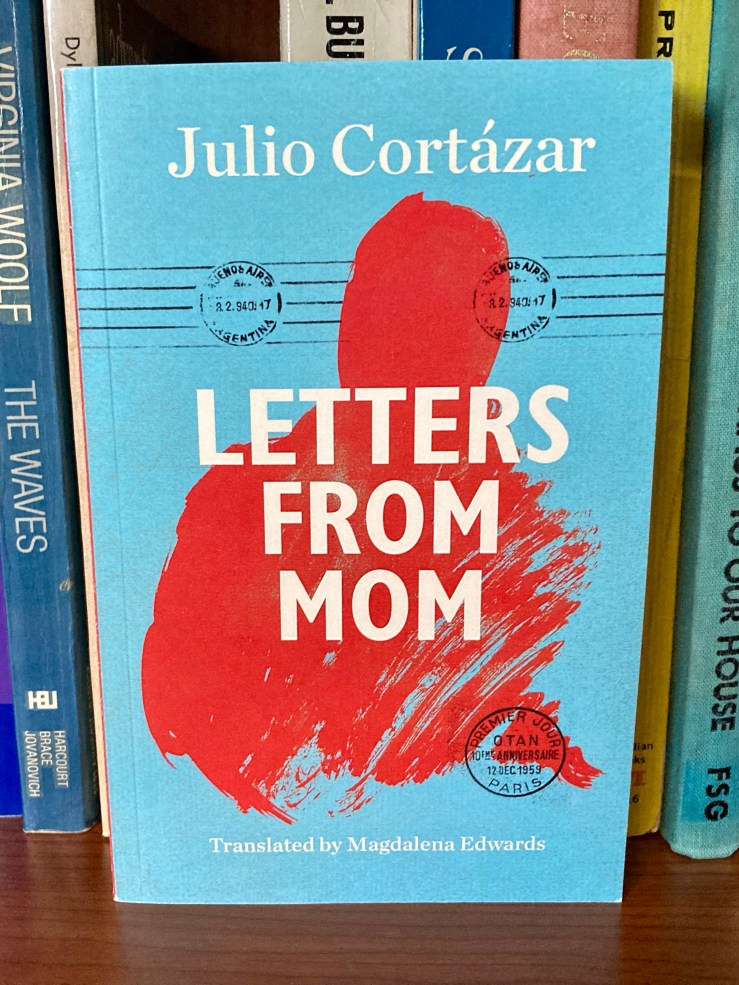
Julio Cortázar’s story “Letters from Mom” is available in English for the first time thanks to translator Magdalena Edwards and the good folks at Sublunary Editions. First published in Cortázar’s 1959 collection Las armas secretas, “Letters from Mom” centers on Luis and his wife Laura, Argentinian expatriates living in Paris, where Luis works as a designer for an advertising agency.

The story begins with Luis receiving a letter from his mother. The event underscores one of Cortázar’s main themes: writing itself. Luis’s mother’s letters arrive from Buenos Aires as “an alteration of time, a harmless little scandal within the order of things that Luis had wanted and designed and achieved” for himself. Luis’s designed “order” is a self-exile which relies on his and Laura’s refusal to speak a certain name. His mother’s latest letter evokes the name, stirring emotions that Luis has sought to repress.

Indeed, Luis’s entire life is rooted in repression. His time in Paris is “a heap of probation, the ridicule of living like a word between parentheses, divorced from the main sentence which nevertheless always supports and explains.” The simile “like a word between parentheses” (which appears in the very first paragraph of the story) teaches us to read the tale that unfolds. It’s between parentheses that we learn the emotional and psychological truth at the root of Luis’s repression. And as the story reaches its climax, Cortázar’s free indirect style paradoxically finds its freest expression within parenthetical boundaries.

Like so many self-exiles, Luis wants to escape the past. His desires again invoke similes of writing: “If the past could be torn up and thrown away like the draft of a letter or a book. But it’s always there, staining the clean copy, and I think that’s the real future.” The stain arrives again and again through his mother’s letters, which repeatedly invoke — and look, I don’t want to spoil the story, so maybe stop reading this now, hey — Continue reading “Between parentheses | On Julio Cortázar’s “Letters from Mom””

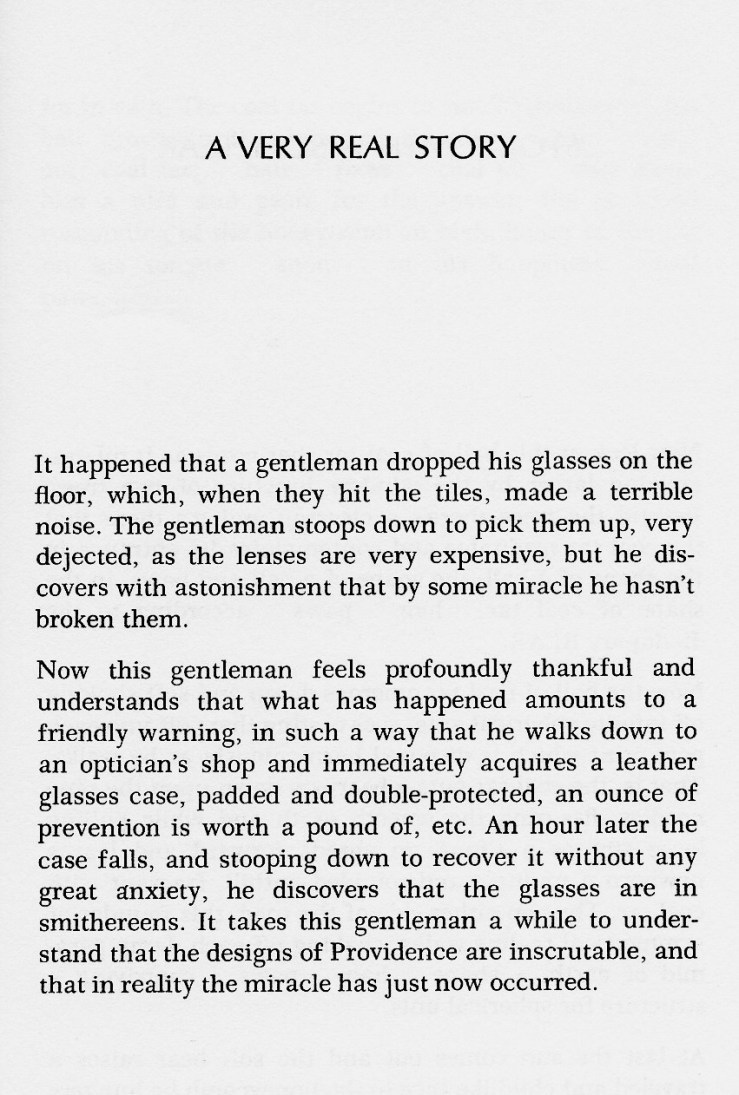
“A Very Real Story” — Julio Cortázar

2020-03-06_151902_4

(English translation by Paul Blackburn.)

“Theme for a Tapestry” — Julio Cortázar

2020-03-06_151902_5

(English translation by Paul Blackburn.)

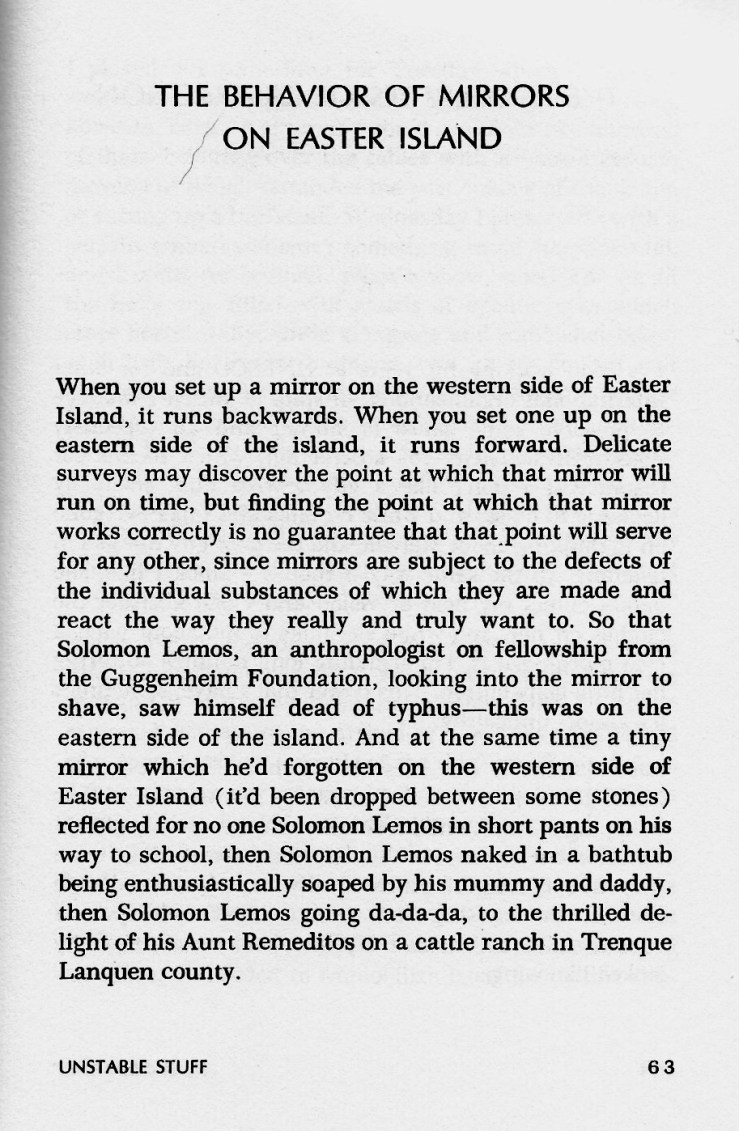
“The Behavior of Mirrors on Easter Island” — Julio Cortázar

2020-03-06_151902_3

(English translation by Paul Blackburn)

Blog about some books acquired, 13 March 2020

img_5049

After one week of abstinence I drove the mile or so to the used bookstore I go to too often and browsed.

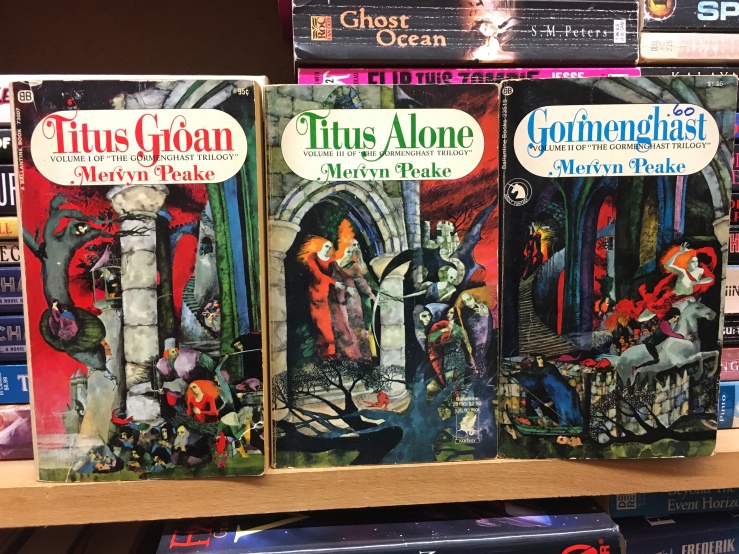
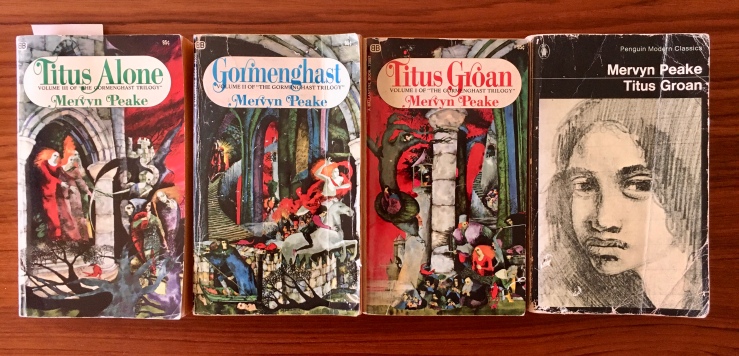
I was specifically looking for the other Gormenghast books by Mervyn Peake, the 1956 novella Boy in Darkness, and the unfinished Titus Awakes, completed by Peake’s wife Maeve after his death. I’m in the last few pages of Titus Alone, and I guess I don’t want to exit his proseworld just yet. Anyway, I went to this bookstore almost every week of February looking for Peake books with no luck after having picked up Gormenghast there on a lark a while back. I ended up buying the first and third of the Gormenghast trilogy online, because I couldn’t find them there, but today I found the complete trilogy in matching Ballantine editions. I did not find the other Gormenghast books though.

img_5048

As much as I hated to break up the triplets pictured above, I picked up the Ballantine Titus Groan and adopted it to fit my other Ballantine editions. There is a specific student I have in mind whom I think will love the Penguin edition of Titus Groan I’ll give him next week (even though my dog bit it).

img_5050

I’m obviously a sucker for covers, as any one who’s followed this blog for a while probably knows, and the Ballantine covers are better, I think—the Penguin editions of Peake’s trilogy are great, but they shy away from the bizarre nature of the narratives, tilting toward respectability.

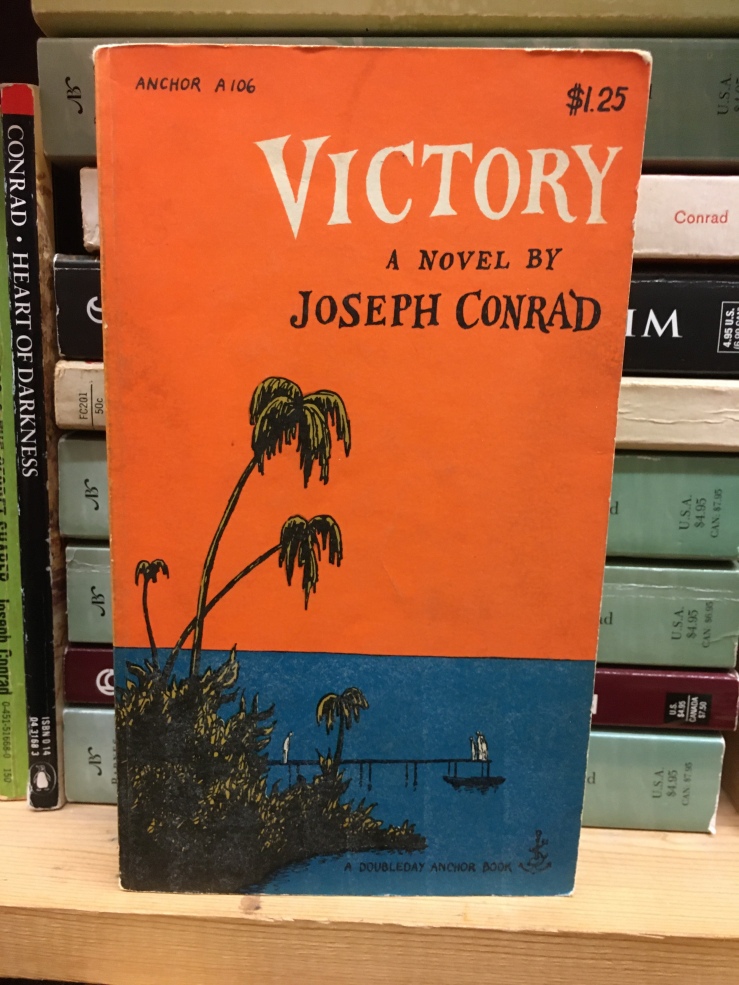
Indeed, I like browsing in large part because I like the aesthetics of books, particularly older books. I absolutely loved this Edward Gorey cover for a 1957 edition of Joseph Conrad’s Victory—but I settled for a picture. I mean, I doubt I’ll read lesser-known Conrad at this point. But I love the orange and the blue, and Gorey’s handlettering:

img_5045

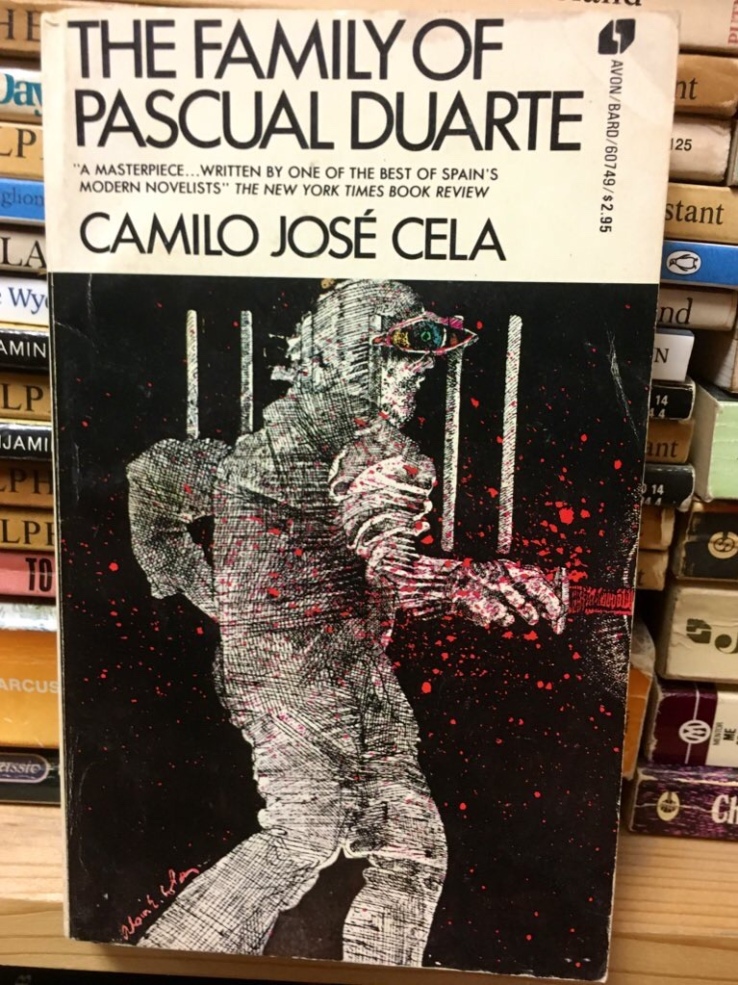
I often settle for just a snapshot of a beautiful cover, like this bizarre one for The Family of Pascual Duarte by Camilo José Cela. I didn’t pick it up a few weeks ago, but then wished I had.

img_5004

I had left it on the shelf like this, face outward. It wasn’t there today, and I wished that I had picked it up. Apparently it is brutal and was banned for a few years in its native Spain.

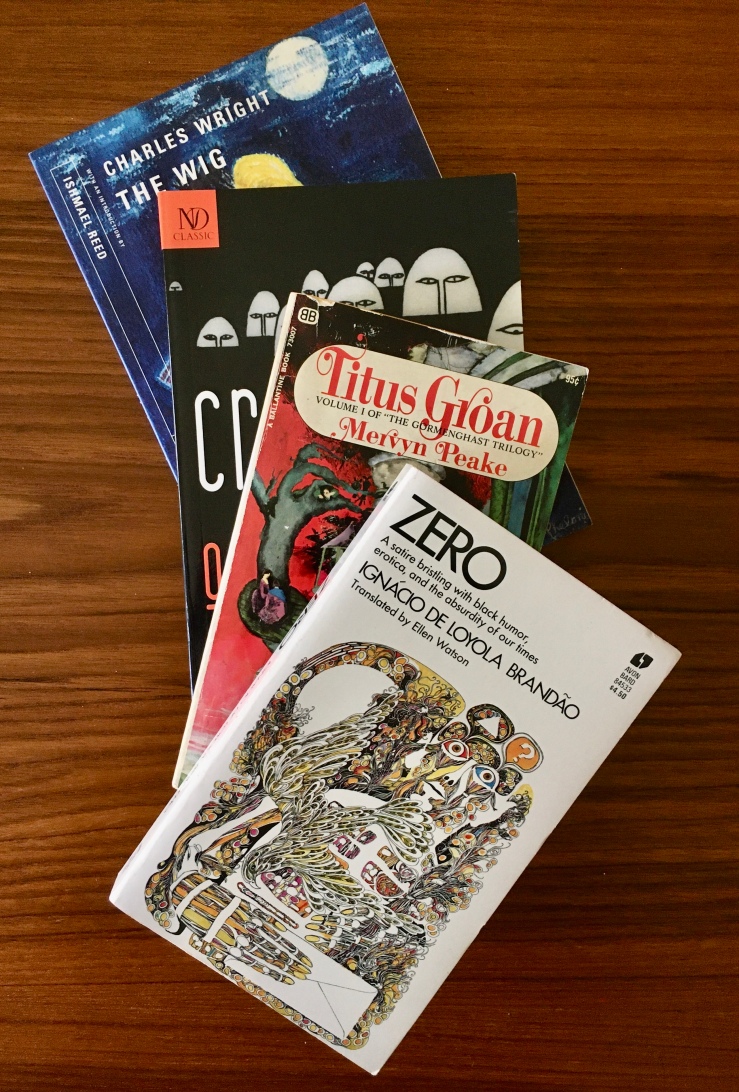
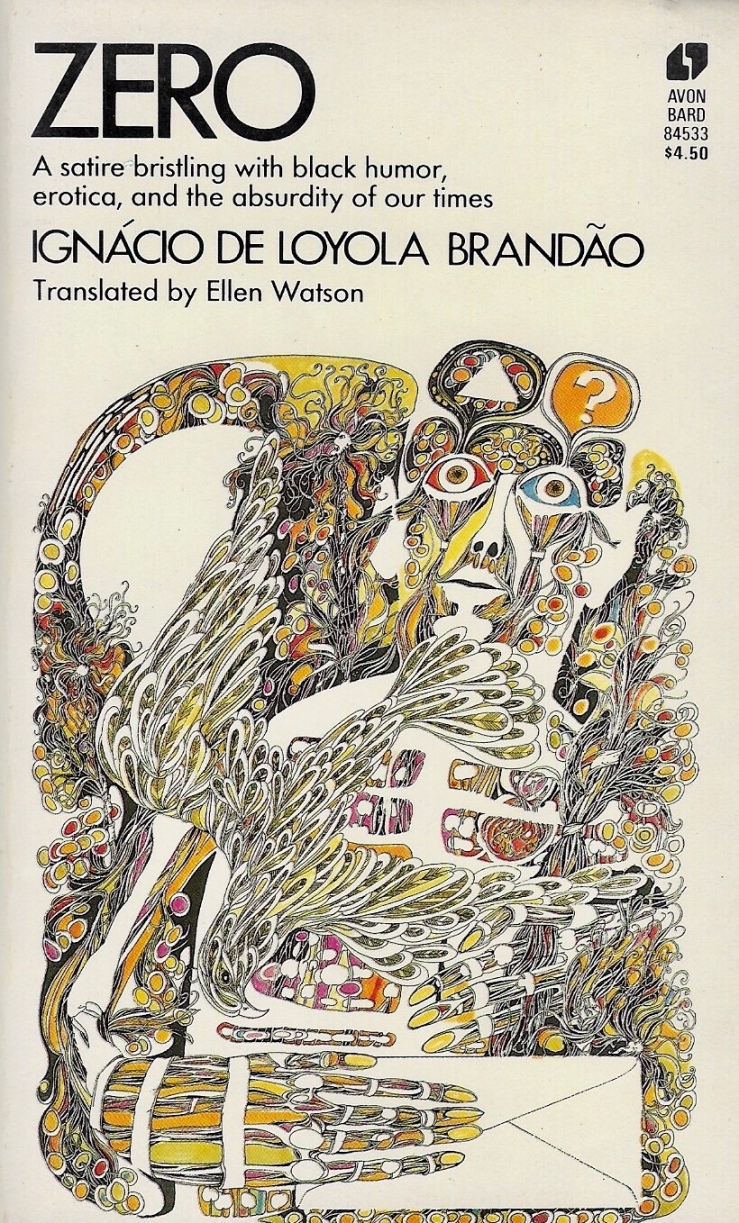
So well and anyway when I spied another Avon-Bard spine with a strange title I pulled it out, wowed at the cover, and dove in. Brazilian author Ignácio de Loyola Brandão’s Zero instantly struck a chord with me. The book is typographically all over the place, with text offset in boxes or laid out in columns. There are diagrams, enormous fonts, glypsh, citations, footnotes, etc. The book is a dystopian satire that seems to be written in its own idiom. The translation is by Ellen Watson. The wonderful cover art is uncredited (as far as I can tell).

2020-03-06_151902

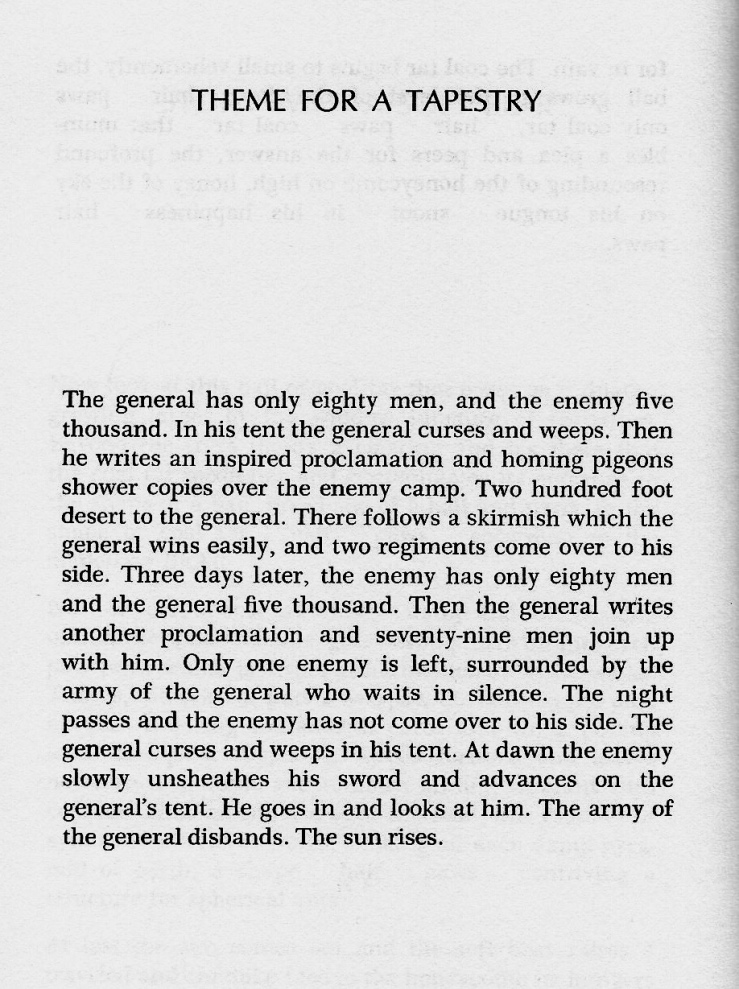
I’ve never been able to get through Julio Cortázar’s famous book Hopscotch (despite many attempts), but I liked the short stories by him that I’ve read. I’m also a sucker for anything supershort, so when I saw his collection Cronopios and Famas (translated by Paul Blackburn), I was intrigued. I love a book in slices and morsels that I can snack on for a while (I’m really digging Gary Lutz’s The Complete Gary Lutz for the same reason). Most of the stuff in here is under three pages; much of it is much shorter too, like “Theme for a Tapestry”:

2020-03-06_151902_5

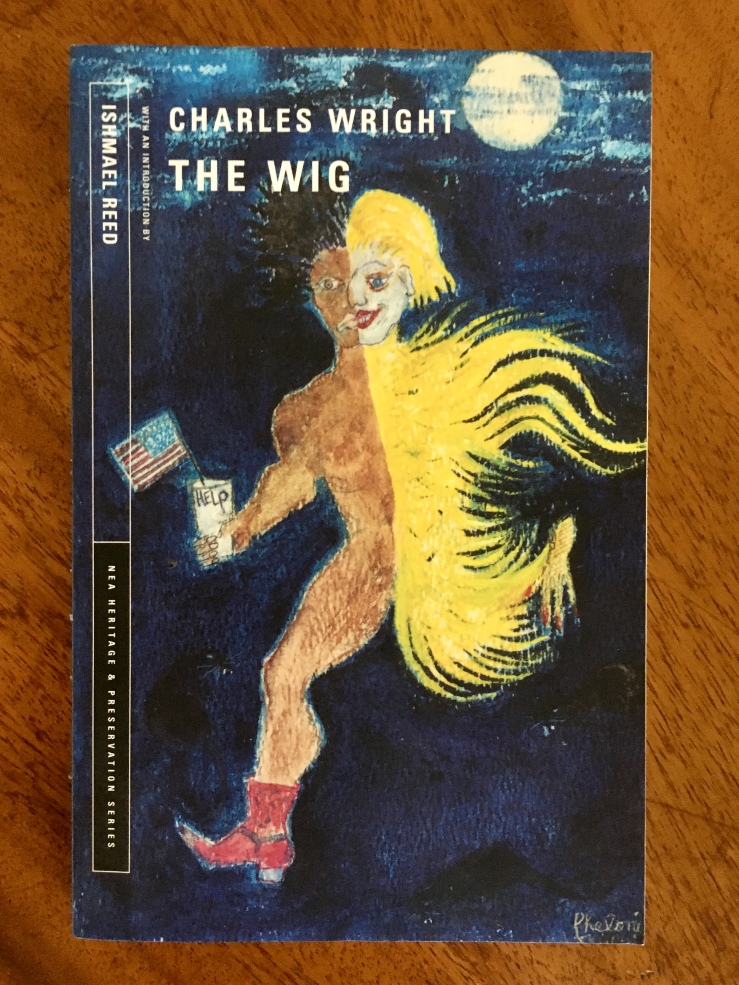
While scanning for anything by Rudolph Wurlitzer (no dice), I spied the spine of Charles Wright’s The Wig. Wright has been on my radar for a while now, mostly due to Ishmael Reed’s consistent endorsement of him (in both fiction and nonfiction alike), and when I pulled the volume to reveal its beautiful cover, I saw Reed’s name on the margin (and on the blurb on the back), and had to have it. The cover art is by Phelonise Willie; design by Scott di Giolamo:

img_5057

Julio Cortázar: For me, literature is a form of play

From his Paris Review interview, Julio Cortázar:

For me, literature is a form of play. But I’ve always added that there are two forms of play: football, for example, which is basically a game, and then games that are very profound and serious. When children play, though they’re amusing themselves, they take it very seriously. It’s important. It’s just as serious for them now as love will be ten years from now. I remember when I was little and my parents used to say, “Okay, you’ve played enough, come take a bath now.” I found that completely idiotic, because, for me, the bath was a silly matter. It had no importance whatsoever, while playing with my friends was something serious. Literature is like that—it’s a game, but it’s a game one can put one’s life into. One can do everything for that game.

David Foster Wallace on INTERPRET-ME Novels

Certain novels not only cry out for what we call “critical interpretations” but actually try to help direct them . . .  Books I tend to associate with this INTERPRET-ME phenomenon include stuff like Candide, Witold Gombrowicz’s Cosmos, Hesse’s The Glass Bead Game, Sartre’s Nausea, Camus’s The Stranger. These five are works of genius of a particular kind: they shout their genius. Mr. Markson, in Wittgenstein’s Mistress, tends rather to whisper, but his w.o.g.’s no less successful . . . Clearly the book was/is in some way “about” Wittgenstein, given the title. This is one of the ways an INTERPRET-ME fiction clues the critical reader in about what the book’s to be seen as on a tertiary level “about”: the title: Ulysses’s title, its structure as Odyssean/Telemachean map (succeeds); Goldstein’s The Mind-Body Problem (really terrible); Cortázar’s Hopscotch (succeeds exactly to the extent that one ignores the invitation to hop around in it); Burroughs’s Queer and Junkie (fail successfully (?)). 

From David Foster Wallace’s essay “The Empty Plenum: David Markson’s Wittgenstein’s Mistress,” which is collected in Both Flesh and Not.

Book Shelves #12, 3.18.2012

20120318-142208.jpg

Book shelves series #12, twelfth Sunday of 2012.

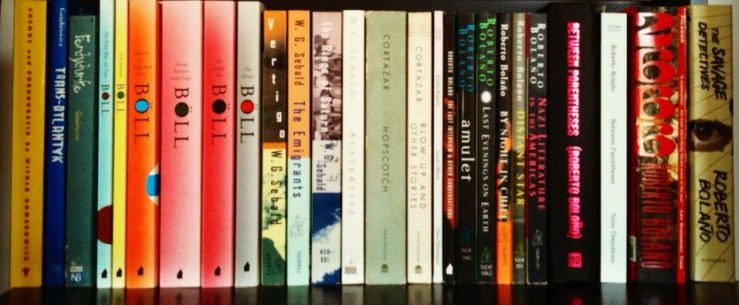
The shelf holds literature in translation: Witold Gombrowicz, Heinrich Böll, W.G. Sebald, Julio Cortázar, and Roberto Bolaño. There was a geode bookend here until Thursday, when I reorganized (finally giving the Gombrowicz a home and restoring the finished copy of Between Parentheses to its brothers). No, I never finished Hopscotch, nor much of the Böll (although I did read Irish JournalThe Train Was on Time, and The Clown); I haven’t read Ferdydurke yet either.