Dr. Samuel Johnson, Origin of a Penis Euphemism

In his forthcoming cultural history of euphemisms, Euphemania, Ralph Keyes offers the following (seemingly apocryphal) origin of the euphemism “Johnson” (for “penis,” of course) —

Johnson is the last name most often used for the male sex organ. According to one theory, this slangy euphemism originated with the name of a large railroad brake lever. Lexicographer Eric Partridge thought it was more likely an abbreviated version of Dr. Johnson, a onetime synonym for “penis” that Partridge said might be based on the assumption that ‘there was no one Dr. [Samuel] Johnson was not prepared to stand up to.’ Working under the verbal restraints of his times, Partridge said this synonym was for the ‘membrum virile.’

Roland Barthes on Alain Robbe-Grillet

From Roland Barthes’s essay Objective Literature: Alain Robbe-Grillet

Robbe-Grillet’s purpose . . . is to establish the novel on the surface: once you can set its inner nature, its “interiority,” between parentheses, then objects in space, and the circulations of men among them, are promoted to the rank of subjects. The novel becomes man’s direct experience of what surrounds him without being able to shield himself with a psychology, a metaphysic, or a psychoanalytic method in his combat with the objective world he discovers. The novel is no longer a chthonian revelation, the book of hell, but of earth–requiring that we no longer look at the world with the eyes of a confessor, of a doctor, or of God himself (all significant hypostases of the classical novelist), but with the eyes of a man walking in his city with no other horizon than the scene before him, no other power than that of his own eyes.

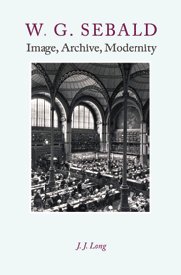
W.G. Sebald: Image, Archive, Modernity — J.J. Long

In W.G. Sebald: Image, Archive, Modernity, J.J. Long posits that the work of the late German author W.G. Sebald is best understood as the struggle for autonomous subjectivity in a world conditioned by the power structures of modernity. If the term “power structures” wasn’t a big enough tip-off, yes, Long’s analysis of Sebald is largely Foucauldian, and although he cites Foucault more than any other theorist (Freud is a distant second), the book is not a dogged attempt to make Sebald’s prose stick to Foucault’s theories. Rather, Long uses Foucault’s techniques to better understand Sebald’s works. As such, Long examines the ways that modernity affects power on the human body in Sebald’s work, tracing his protagonists’ encounters with modern institutions that exert power via archive and image.
From the outset, Long distinguishes his book-length study on Sebald from the tradition of so-called Holocaust studies, as well as some of the other foci that dominate analyses of Sebald — “trauma and memory, melancholy, photography, travel and flânerie, intertextuality and Heimat.” Long claims that these are simply “epiphenomena” of the “problem of modernity” that dominates Sebald’s work, and goes on to scrutinize Sebald’s novels like The Emigrants, Austerlitz, and The Rings of Saturn by focusing instead on the various ways that modern institutions proscribe power on the subject’s body. Long writes–

Sebald is interested in the ways in which subjectivity in modernity is formed by archival and representational systems through which various forms of disciplinary power are exercised. He is also concerned with the scope that might exist for eluding disciplinary power or reconfiguring its archival systems in order to assert a degree of subjective autonomy or evade the determinations of power/knowledge.

Long’s study of Sebald is very much a description of modernity; in particular, of modernity as a series of affects of power and discipline upon the subject (again, very Foucauldian). It’s not particularly surprising then that Long, after locating so many Sebaldian traumas in the 19th and early 20th centuries, asserts that Sebald is a modernist and not a postmodernist. He bases this claim not on the formal elements of Sebald’s prose, which he readily concedes can just as easily be read as postmodernist, but rather on the way his “texts respond to the specific historical constellation” of modernity. Long continues–
What is notable about Sebald is that the fictional worlds he constructs are not postmodern spaces of global capital, hyperspace and ever-faster cycles of production, consumption and waste (despite his narrators’ occasional visits to McDonald’s). His texts do not present unrelated present moments in time, nor do they partake of the waning of history that is frequently noted as a characteristic of the postmodern. Sebald’s spaces are those of an earlier modernity that are deeply marked by the traces of history.

If the question of whether or not a book is postmodern or modern strikes you as merely academic, that’s because it is merely academic. Long makes a solid case for Sebald-as-modernist, but the best parts of his book are really his Foucauldian analyses of Sebald’s texts. They make you want to go back and reread (or, in some cases read for the first time.) I’m inclined to believe that Sebald (along with a host of other writers) is better described as something beyond modern or postmodern, something we might not have a name for yet, but that’s fine–we need distance, time. In Long’s take, Sebald is, of course, trying to sort out the detritus of modernity–even as it’s happening to him. But I’m not sure if that makes him a modernist.

W.G. Sebald: Image, Archive, Modernity is available now from Columbia University Press.

“I Finally Got Tired of Being Angry at Roth” — What Jonathan Franzen’s Been Reading

Time profiles Jonathan Franzen this week (part of the push for his new novel Freedom, out later this month). Franzen also talks about five works that have “inspired him recently.” Here are his comments on those books–

The Charterhouse of Parma by Stendhal

Instead of sitting for years at his writing desk, pulling his hair, Stendhal served with the French diplomatic corps in his favorite country, Italy, and then came home and dictated his novel in less than eight weeks: what a great model for how to be a writer and still have some kind of life! The book is at once deeply cynical and hopelessly romantic, all about politics but also all about love, and just about impossible to put down.

The Greenlanders by Jane Smiley

There’s nothing fancy about the writing in Smiley’s masterpiece, and yet every sentence of its eight hundred pages is clean and necessary. For the two weeks it took me to read it, I didn’t want to be anywhere else but in late-medieval Greenland, following the passions and feuds and farming crises of European settlers trying to survive in the face of ecological doom. It all felt weirdly and plausibly contemporary.
Sabbath’s Theater by Philip Roth

I finally got tired of being angry at Roth for his self-indulgent excesses and weak dialogue and thin female characters and decided to open myself to his genius for invention and his heroic lack of shame. Whole chunks of Sabbath’s Theater can be safely skipped, but the great stuff is truly great: the scene in which Mickey Sabbath panhandles on the New York with a paper coffee cup, for example, or the scene in which Sabbath’s best friend catches him relaxing in the bathtub and fondling his (the friend’s) young daughter’s underpants.

The House of Mirth by Edith Wharton

Wharton’s male characters suffer from some of the deficiencies that Roth’s female characters do, but the heroine of House of Mirth, Lily Bart, is one of the great characters in American literature, a pretty and smart but impecunious New York society woman who can’t quite pull the trigger on marrying for money. Wharton’s love for Lily is equal to the cruelty that Wharton’s story relentlessly inflicts on her; and so we recognize our entire selves in her.

East of Eden by John Steinbeck

A lifelong heavy drinker with his most famous novel well behind him, Steinbeck set out to write a mythic version of his family’s American experience that would embody the whole story of our country’s lost innocence and possible redemption. There are infelicities on almost every page, and the fact that the book succeeds brilliantly anyway is a testament to the power of Steinbeck’s storytelling: to his ferocious will to make sense of his life and his country.

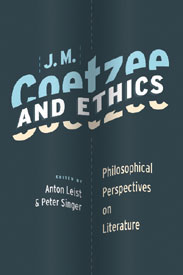
J.M. Coetzee and Ethics — Anton Lesit & Peter Singer

In their introduction to J.M. Coetzee and Ethics, editors Anton Lesit and Peter Singer make the claim that the essays in the new collection “show the folly of Plato’s idea that literature has nothing to contribute to philosophical discussion. Instead they are an invitation to a dialogue that can sharpen the issues that literature raises while making philosophy more imaginative.” Lesit and Singer briefly review the philosophical tradition, from the time of Plato’s call to banish the poets to the current wars between pragmatists and postmodernists, specifically foregrounding the case for Coetzee’s literature as a legitimate source of philosophical inquiry. They identify three specific features of his works — reflectivity, truth seeking, and an exploration of social ethics — that merit critical attention. The essays in the volume address “the psychological and moral phenomenology of personal relationships; the consequences of human suffering, evildoing, and death for human rationality and reason; and the literary methods invoked to open areas of experience beyond the abstract language of philosophers.” The editors also point out that “Unsurprisingly, the ethics of animals looms large in this collection,” a concern that might attract animal ethicists and others interested in animal-human relationships who might not immediately turn to literature for answers (or questions). On the whole, J.M. Coetzee and Ethics, while obviously a specialty volume, strives to appeal to a wider audience, eschewing much of the acadamese that plagues (and obfuscates the arguments of) so many critical volumes. Fans of Coetzee will wish to take note. J.M. Coetzee and Ethics is new in hardback from Columbia University Press.

The Thousand Autumns of Jacob de Zoet — David Mitchell

At some point, almost every character in David Mitchell’s new novel, The Thousand Autumns of Jacob de Zoet tells a story. The book teems with storytellers and their stories, overflows with compact bildungsromans, wistful jeremiads, high adventures drawn in miniature, comic escapades, bizarre folk tales, and romantic myths, all pressed into the service of the book’s larger narrative, the story of Jacob de Zoet, a Dutchman in Shogunate era Japan. In 1799, the relative starting point for this massive novel, Japan limited economic trade with Europeans to the Dutch East India Company, who, with a few rare exceptions, were not permitted to touch Japanese soil. Instead, the Dutch were confined to the man-made isle of Dejima in the bay of Nagasaki. With its rich cultural mishmash, claustrophobic isolation, and strange hybrid nature, Dejima makes a fascinating platform for Mitchell’s tale.

Most reviews of Mitchell’s new book have squared it against his earlier novels, particularly his experimental opus Cloud Atlas (The Guardian‘s review even begins by asking “Does it matter what books a novelist has written before? Should readers need to know an author’s preceding works fully to grasp the new one?”). The reason for this is plain. By and large, Thousand Autumns is a conventional historical novel, a straightforward linear narrative that combines a forbidden love triangle story with elements of high adventure. There are good guys and bad guys, Enlightened thinkers and scheming crooks, warriors and spies, and even an evil monk who may or may not have supernatural powers. Thousand Autumns (like its main setting Dejima) is richly detailed but hermetically sealed; what leaks from that seal are its myriad stories, its capacity for storytelling. This effusion of stories also marks the novel, I believe, as something more than the conventional historical novel it is purported to be. Even more interesting though is the space the novel is occupying in a current literary debate–is The Thousand Autumns of Jacob de Zoet a postmodern novel or not? The rest of my review will discuss this issue, along with James Wood’s review at The New Yorker and Dave Eggers’s review at The New York Times. The simple answer, of course, is that it doesn’t matter whether the book is postmodern or something else–it’s a very good book, I enjoyed it very much, and you probably will too. I encourage you to read Wood’s precis, which I’ve excised here, and then pick up the book. Anyone else interested in the foolish minutiae of what may or may not make a book postmodern or post-postmodern or something else may wish to continue (or not).

Here’s James Wood, using Mitchell’s oeuvre to dither over the fact that “The serious literary novel is at an interesting moment of transition” —

If postmodernism came after modernism, what comes after postmodernism? For that is where we are. “Post-postmodernism” tends toward an infinite stutter. “After postmodernism” suggests a severance that has not occurred. We might settle for “late postmodernism,” a term that suggests the peculiar statelessness of contemporary fiction, which finds itself wandering—not unhappily—between tradition and novelty, realism and anti-realism, the mass audience and the élitist critic. Thus David Mitchell can follow a “postmodern” novel with a “traditional” comic bildungsroman, and then follow that with a conventional historical novel. It is hard to know whether this statelessness is difficult freedom or easy imprisonment, but the more ambitious contemporary fiction will often blend a bewildering variety of elements and historical techniques [. . .]

Dave Eggers, however, feels no need to look for machinations beyond straightforward storytelling. He claims that Thousand Autumns retains the

[. . .] narrative tendencies [of Mitchell’s earlier works] while abandoning the structural complexities often (and often wrongly) called postmodern. This new book is a straight-up, linear, third-person historical novel, an achingly romantic story of forbidden love and something of a rescue tale — all taking place off the coast of Japan, circa 1799. Postmodern it’s not.”

There’s a certain reticence in Eggers’s review to situate Thousand Autumns against anything but itself, including even the rest of Mitchell’s works. In contrast, Wood spends the first half of his review positioning Mitchell’s postmodernism, throughout both his novels (against each other), and as the oeuvre of one author (against other authors). For Wood, Thousand Autumns, because of “its self-enclosed quality [. . .] represents an assertion of pure fictionality.” He continues, arguing that “although the book contains no literary games, it is itself a kind of long game.” Wood would like to see in Thousand Autumns‘s discrete self-containedness a kind of literary gesture, perhaps a sort of conventional historical novel (in scare quotes) that is so conventional as to efface all signs of self-awareness (and thus erase the scare quotes around the gesture). At the same time, Wood recognizes the power of storytelling in the book, asserting that this feature is what makes it a “representative late-postmodern document.” Wood continues:

In place of the grave silence that was the great theme of early postmodernism (or late modernism, if you prefer), language announcing a postwar exhaustion, its own impossibility, as in the work of Beckett or Blanchot, there is a confident profusion of narratives, an often comic abundance of story-making. Never, when reading Mitchell, does the reader worry that language may not be adequate to the task, and this seems to me both a fabulous fortune and a metaphysical deficiency.

These last sentiments are where I strongly disagree with Wood (as perhaps my lede attests)–the greatest strength of Mitchell’s work here is the fabulous fortune of its abundant storytelling. Far from being a metaphysical deficiency, the characters in Thousand Autumns, major and minor, repeatedly transcend their social, spiritual, economic, psychological, and physical confinement via storytelling. Again and again language breaks characters away from their isolation or imprisonment, gives them access to adventure and romance–to spirit. Ultimately, Wood condemns the book for this “metaphysical deficiency,” arguing that “the reader wants a kind of moral or metaphysical pressure that is absent, and that has ceded all the ground to pure storytelling.” (In Wood’s critical body, it is always “the reader,” never “this reader”). I think that the pleasure and power of pure storytelling is its own end, and perhaps it is this recognition that leads Eggers to pronounce of the book simply that “Postmodern it’s not.” And while this declaration is ultimately a more reader-friendly take on Thousand Autumns, it’s also clear to see how the experimental nature of Mitchell’s previous work calls for Wood’s need to place the novel, to situate it against a developing canon (even if Wood chooses ultimately to deny its status).

Wood is perhaps right in his assertion that the term “post-postmodernism” leads to an “infinite stutter.” Still, post-postmodernism ultimately seems more fitting to describe Thousand Autumns than Wood’s “late postmodernism.” The Thousand Autumns of Jacob de Zoet cunningly sets the spiky traps of language and then gracefully leaps over them. Like David Foster Wallace and William Vollmann–two writers who I believe mark the beginnings of post-postmodernism–Mitchell wants to transcend postmodernism’s ironic vision, and storytelling–giving his characters voices–is a means to this end. Perhaps it is Mitchell’s earnestness in conveying the power of storytelling leads Wood to conclude Thousand Autumns “a kind of fantasy [. . .] Or, rather, it is a brilliant fairy tale; and even nightingales, as a Russian proverb has it, can’t live off fairy tales.” If, finally, Thousand Autumns is not a late postmodernist historical fiction but indeed a fairy tale, then it’s worth noting that it’s a particularly enjoyable and nourishing one. Highly recommended.

James Wood on Harold Bloom

In his essay “Shakespeare in Bloom,” critic James Wood performs one of the strangest, most backhanded (and yet earnest) defenses I’ve ever read of Harold Bloom‘s aesthetic reaction to (what Bloom has called) “The School of Resentment” — deconstruction, Marxism, gender and queer theory, postcolonial theory, all that good stuff. Wood comes out strong, arguing, that in his prolific output, Bloom “has kidnapped the whole of the English literature and has been releasing his hostages, one by one, over a lifetime, on his own spirited terms.” Wood suggests that “this ceaselessness has produced some hurried, fantastical, and repetitive work,” before going on to throw around words like “garrulous” and “shallow.” Wood then takes Bloom to task over his famous (and improbable) claim that “Shakespeare invented us,” situating the claim against Bloom’s own most famous theory, the anxiety of influence. Wood says–
In truth, Bloom’s word invention is an enthusiastic Wildean necessary exaggeration. It is Bloom’s way of registering our almost religious sense that we live in Shakespeare’s shadow and that he does not simply represent human beings but brings new life, more life, into the world. . . . Bloom’s determination to honor Shakespeare’s godly primacy is a kind of secular theology.

The second section of Wood’s essay should be required reading for all English majors (or anyone serious about literary criticism). Here, Wood provides a wonderfully succinct overview of the history of literary criticism, connecting Freudian analysis and the New Critics to the various theories that Bloom would come to call the “The School of Resentment.” As we bring up the term again, we should note that we consider it a bit pejorative and utterly reactionary, and, to borrow from (and perhaps misapply) Wood, shallow. Wood points out that “Deconstruction brings a generalized suspicion to bear on language and in particular on metaphor (or ‘rhetoric’), which it suspects of hiding something–namely, its own metaphoricity.” In short, literature always metaphorizes, and thus hides, some other impulse, one always politicized. Wood continues: “Political criticism, including cultural materialism, converts Freud’s analytical suspicions into political ones. . . . The poem is read as if it were covering something up, as if it were an alibi that is rather too fluent to be entirely trusted.” It must be interrogated to reveal its secret, the secret prejudices of its age. Wood continues, after a page or two–
This is a long way around to Bloom, but it may explain the venom and desperation of his attacks. For although deconstruction did not intend to, it has produced mutant modes of reading that, when combined with leftish political guilt or ressentiment, seem to threaten the existence of literature as a discipline.

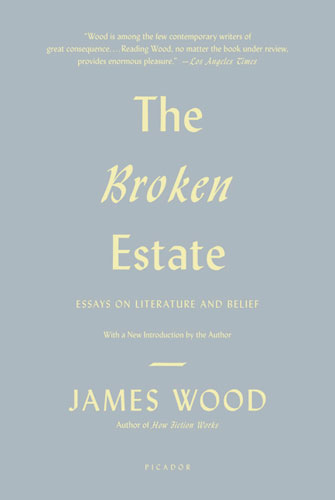
Wood espouses some common sense here uncommon in literary criticism, taking a long view that recognizes–and attempts to step outside of–the fact that it’s not all academic when it comes to how we read our books. History and politics matter, but so does our passion, our love for our books (as silly as that may sound). He defends Bloom’s work even as he calls it an overreaction. He credits deconstruction as having “produced some brilliance and many distinguished readings (no one could deny the acuities of Derrida, of Paul de Man, of Barbara Johnson).” Wood’s essay “Shakespeare in Bloom” is the kind of thing that students and aspiring critics alike should read before they feel the need to draw arms. You can read it in the second printing (the first in a decade) of Wood’s essay collection The Broken Estate, which debuts in June, 2010 from Picador.

John Updike’s Rules for Reviewing Books

From Picked-up Pieces (1975):

1. Try to understand what the author wished to do, and do not blame him for not achieving what he did not attempt.

2. Give him enough direct quotation—at least one extended passage—of the book’s prose so the review’s reader can form his own impression, can get his own taste.

3. Confirm your description of the book with quotation from the book, if only phrase-long, rather than proceeding by fuzzy precis.

4. Go easy on plot summary, and do not give away the ending. (How astounded and indignant was I, when innocent, to find reviewers blabbing, and with the sublime inaccuracy of drunken lords reporting on a peasants’ revolt, all the turns of my suspenseful and surpriseful narrative! Most ironically, the only readers who approach a book as the author intends, unpolluted by pre-knowledge of the plot, are the detested reviewers themselves. And then, years later, the blessed fool who picks the volume at random from a library shelf.)

5. If the book is judged deficient, cite a successful example along the same lines, from the author’s ouevre or elsewhere. Try to understand the failure. Sure it’s his and not yours?

To these concrete five might be added a vaguer sixth, having to do with maintaining a chemical purity in the reaction between product and appraiser. Do not accept for review a book you are predisposed to dislike, or committed by friendship to like. Do not imagine yourself a caretaker of any tradition, an enforcer of any party standards, a warrior in an idealogical battle, a corrections officer of any kind. Never, never (John Aldridge, Norman Podhoretz) try to put the author “in his place,” making him a pawn in a contest with other reviewers. Review the book, not the reputation. Submit to whatever spell, weak or strong, is being cast. Better to praise and share than blame and ban. The communion between reviewer and his public is based upon the presumption of certain possible joys in reading, and all our discriminations should curve toward that end.

The Delighted States — Adam Thirlwell

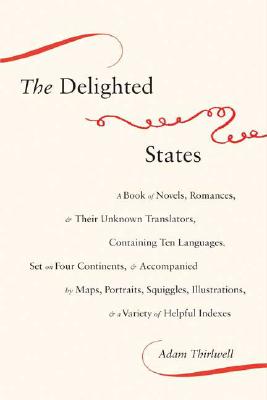
This weekend, I read and thoroughly enjoyed the first volume of Adam Thirlwell’s The Delighted States (new in a handsome trade paperback edition from Picador at the end of this month). The word “volume” seems to imply multiple, discrete editions, but really the term has more to do with Thirlwell’s sense of humor. Like an 18th century novel, The Delighted States comprises chapters, books, and volumes. That playfulness also echoes in the book’s subtitle: “A Book of Novels, Romances, & Their Unknown Translators, Containing Ten Languages, Set on Four Continents, & Accompanied by Maps, Portraits, Squiggles, Illustrations, & a Variety of Helpful Indexes.” Despite the mock-serious tone there, the subtitle is a pretty accurate description of the book. Not that Thirlwell is pompous or long-winded. Rather, he’s the rare literary critic who manages to show authority without being didactic, who balances scholarly insight with playful humor and a willingness not to answer to every little detail.
But what is it about? From Thirlwell: “This book — which I sometimes think of as a novel, an inside-out novel, with novelists as characters — is about the art of the novel. It is also, therefore, about the art of translation.” Thirlwell, a translator himself (the book flips over to his version of Vladimir Nabokov’s short story “Mademoiselle O”) uses translation (of books, of styles, of ideas) to relate a history of the rise of literary modernism. The first volume finds heroes in Gustave Flaubert and his would-be mistress, James Joyce and his French translator, Denis Diderot, Marcel Proust, and Balzac. There’s Gogol and Nabokov, Tolstoy and Borges–not to mention their characters, major and minor. It’s a lot of fun, but even better, it’s the kind of performance to which every literary critic should aspire. It makes you want to read the books you haven’t yet read and re-read the ones you already have.

Thirlwell, like any good avid reader, reads his books (and authors) in dialog with each other, and I can’t help but do the same. The hardback edition was published in 2008, but I can’t help read in Thirlwell’s work a response to David Shields’s new “manifesto” Reality Hunger. Both authors recognize that novelists attempt to represent or even re-enact “reality” in their works (despite Plato’s claim that mimesis was not the business of the poets). However, where Shields for some unclear reason nihilistically argues for the death of the novel, Thirlwell repeatedly demonstrates why a novelist’s depiction of reality is important. Thirlwell realizes that “The more a sign looks as if it’s real, the more it will have to be artificial,” citing Joyce’s interior monologues as an example. “The less artificial a sign is, the less likely it is to be convincing,” Thirlwell writes. Put another way, novels — and by proxy other narrative art forms — must use artifice to achieve reality. Like Shields, Thirlwell cites Joyce’s famous quote — “I am quite content to go down to posterity as a scissors and paste man” — but the effect is far more satisfying in The Delighted States, where it is contextualized evidence used to bolster a point, and not mere solipsistic indulgence. But maybe I’m still holding a grudge against Shields. And maybe it’s not fair to use Thirlwell’s work to rap at his (metaphorical) knuckles. Unlike the sensationalism, negativity, and gimmicks of Reality Hunger, Thirlwell’s argument for the novel is measured, patient, well-researched–and thus far less likely to cause as big a stir. In a single parenthetical aside he reveals more about his critical subjectivity than Shields is ever willing to admit in an entire book: “Good novelists (or, maybe more honestly, the novelists I like) are often not just avant-garde in terms of technique; they are also morally avant-garde as well.” It’s a good thesis on its own, but what’s really wonderfully refreshing is Thirlwell’s honesty about bias in criticism–that “Good novelists” are really “the novelists I like.” Fantastic stuff so far, and I’m itching to read more.

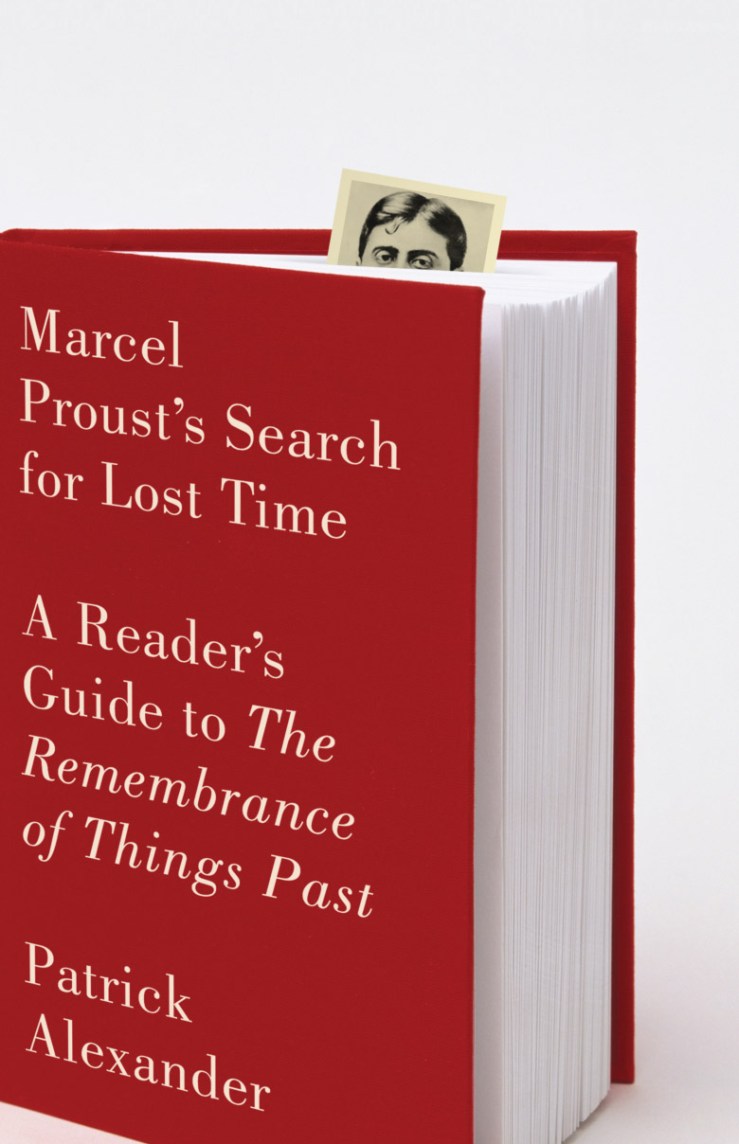
Marcel Proust’s Search for Lost Time — Patrick Alexander

Marcel Proust

In his introduction to his reader’s guide to Proust’s In Search of Lost Time, Patrick Alexander observes that “Except for those fortunate enough to spend several years confined to a hospital bed, a federal prison, or to be stranded on a desert island with their preselected library, few modern readers have the time to tackle a novel with more than three thousand pages, a million and a half words, and more than four hundred individual characters.” Alexander goes on to point out that “Proust’s novel is increasingly read only by professional academics,” a trend he describes as a “great pity.” Alexander wants you to be able to access all the philosophical insight and rich humor of Proust, and his book Marcel Proust’s Search for Lost Time makes a great starting point for doing so.

The first of the three sections that comprise Alexander’s book, “What Happens in Proust,” summarizes the seven novels that form Proust’s great work In Search of Lost Time (sometimes translated as Remembrance of Things Past). This is easily the largest section of the book. Alexander summarizes the novels, and contextualizes their themes against their historical and social milieu. Alexander’s second section, “Who’s Who in Proust,” will likely be most useful for readers trying to keep track of the many (many, many) characters in this opus. The final section, “The World of Proust,” situates Proust’s place in Paris, French history, and modern literature. As Alexander points out himself, the book will appeal to three types of readers: those who want to read Proust but are daunted, those who are currently reading Proust and wish for a guide to keep track of all the places and names, and those who wish to return to Proust.

Alexander’s project is ambitious, and guidebooks are always an iffy business of course. I found Harry Blamires’s The New Bloomsday Book, probably the most famous guide for James Joyce’s Ulysses, to be an interminable bore, whereas Joseph Campbell’s lectures on the same subject are indispensable. There’s really a fine balance to be achieved I suppose. I’m currently making my way through another big book (okay, not as big as Proust’s), William Gaddis’s The Recognitions, and so far,Steven Moore’s A Reader’s Guide to William Gaddis’s The Recognitions has proven to be a valuable resource when I need it. It manages to provide analytical insights and explications of all the many (many, many) allusions in Gaddis’s massive tome without ever being intrusive. Similarly, Alexander understands that a guide should never step on toes. His clean, lucid style is both humorous and realistic, and he’s never overly-reverential of Proust, but respectful at all times toward both his favorite author and his readers. Alexander’s real goal is not to paraphrase Proust, but, like all good critics, to try to get you to read the material. I never got past the first forty pages of Swann’s Way, the first book of Lost Time, but Alexander’s book makes me want to go back and give it another shot.

Marcel Proust’s Search for Lost Time by Patrick Alexander is available from Vintage books on September 22nd, 2009.

No Great Book Is Explicable

About the same time I was finishing up James Wood’s How Fiction Works, I was also beginning William Gaddis‘s massive tome The Recognitions. So far the book is fantastic–I’m about 180 pages in–but it’s (very, very) long and there’s a big stack of upcoming releases here that needs to be digested for review, so who knows if I’ll finish it anytime soon. Anyway, I thought this notation from William H. Gass‘s brilliant introduction does a fantastic job of speaking to both the limits of literary criticisms (like Wood’s) as well as underscoring the value of reading–and rereading:

No great book is explicable, and I shall not attempt to explain this one. An explanation–indeed, any explanation–would defile it, for reduction is precisely what a work of art opposes. Easy answers, convenient summaries, quiz questions, annotations, arrows, highlight lines, lists of its references, the numbers of its sources, echoes, and influences, an outline of its design–useful as sometimes such helps are–nevertheless seriously mislead. Guidebooks are useful, but only to what is past. Interpretation replaces the original with the lamest sort of substitute. It tames, disarms. “Okay, I get it,” we say, dusting our hands, “and that takes care of that.” “At least I understand Kafka” is a foolish and conceited remark.

Philip Guston Literally Paints Gass
Philip Guston Literally Paints William H. Gass