“The Wizard Postponed,” a short tale by Jorge Luis Borges

“The Wizard Postponed”

by

Jorge Luis Borges

Translated by Norman Thomas di Giovanni


In the city of Santiago, there was a dean who had a burning desire to learn the art of magic. Hearing that don Illán of Toledo knew more about magic than anyone else, the dean went to Toledo in search of him.

The very morning he arrived, he went straight to don Illán’s and found him reading in a room at the back of his house. Don Illán received the dean cordially and asked him to postpone telling him the object of his visit until after they had eaten. Showing his guest into pleasant quarters, don Illán said he felt very happy about the dean’s visit. After their meal, the dean told don Illán why he had come, and he begged to be taught the craft of magic. Don Illán said that he already knew that his guest was a dean, a man of good standing and of good prospects, but that were he to teach him all his knowledge, the day might come when the dean would fail to repay his services as men in high places are often wont to do. The dean swore that he would never forget Don Illán’s bounty and that he would always be at his call. Once they came to an agreement, don Illán explained that the magic arts could not be learned save in a place of deep seclusion, and, taking the dean by the hand, he led him to the next room, in whose floor there was a large iron ring. Before this, however, he told the serving maid to prepare partridges for supper but not to put them on to roast until he so ordered.

Don Illán and his guest lifted the ring and went down a well-worn, winding stairway until it seemed to the dean they had gone down so far that the bed of the Tagus must now be above them. At the foot of the staircase was a cell, and in it were a library of books and a kind of cabinet with magic instruments. They were leafing through the books, when suddenly two men appeared bearing a letter for the dean, written by the bishop, his uncle, in which the bishop informed him that he was gravely ill, and that if the dean wanted to find him alive he should not tarry. The news was very upsetting to the dean for one thing, because of his uncle’s illness; for another, because he would be forced to interrupt his studies. In the end, choosing to stay, he wrote an apology and sent it to the bishop. Three days passed, and there arrived several men in mourning bearing further letters for the dean, in which he read that the bishop had died, that a successor was being chosen, and that they hoped by the grace of God that the dean would be elected. The letters advised him to remain where he was, it seeming better that he be absent during his election.

Ten days elapsed, and two finely dressed squires came, throwing themselves down at the dean’s feet and kissing his hands and greeting him as bishop. When don Illán saw these things, he turned to the new prelate with great joy and said that he thanked the Lord that such good news should have come to his house. He then asked for the now vacant deanery for his son. The bishop answered that he had already set aside the deanery for his own brother but that he would find the son some post in the Church, and he begged that they all three leave together for Santiago.

They made their way to the city of Santiago, where they were received with honours. Six months passed, and messengers from the pope came to the bishop, offering him the archbishopric of Toulouse and leaving in his hands the naming of a successor. When don Illán heard this, he reminded the archbishop of his old promise and asked for the vacated title for his son. The archbishop told him that he had already set aside the bishopric for his own uncle, his father’s brother, but that as he had given his word to shed favour on don Illán, they should, together with the son, all leave for Toulouse. Don Illán had no recourse but to agree .The three set out for Toulouse, where they were received with honours and Masses. Two years passed, and messengers from the pope came to the archbishop, elevating him to the cardinalate and leaving in his hands the naming of a successor. When don Illán learned this, he reminded the cardinal of his old promise and asked for the vacant title for his son. The cardinal told him that he had already set aside the archbishopric for his own uncle, his mother’s brother a good old man but that if don Illán and his son were to accompany him to Rome, surely some favourable opportunity would present itself. Don Illán protested, but in the end he was forced to agree.

The three then set out for Rome, where they were received with honours, Masses, and processions. Four years elapsed, and the pope died, and our cardinal was elected to the papacy by all the other cardinals. Learning of this, don Illán kissed His Holiness’s feet, reminded him of his old promise, and asked for the vacant cardinal’s office for his son. The pope told don Illán that by now he was weary of his continued requests and that if he persisted in importuning him he would clap him in gaol, since he knew full well that don Illán was no more than a wizard and that in Toledo he
had been a teacher of the arts of magic.

Poor don Illán could only answer that he was going back to Spain, and he asked the pope for something to eat during the long sea journey. Once more the pope refused him, whereupon don Illán (whose face had changed in a strange fashion) said in an unwavering voice, ‘In that case, I shall have to eat the partridges that I ordered for tonight.’

The serving maid came forward, and don Illán ordered the partridges roasted. Immediately the pope found himself in the underground cell in Toledo, no more than dean of Santiago, and so taken aback with shame that he did not know what to say. Don Illán said that this test was sufficient, refused the dean his share of the partridges, and saw him to the door, where, taking leave of him with great courtesy, he wished him a safe journey home.

From the Libro de los enxiemplos del Conde
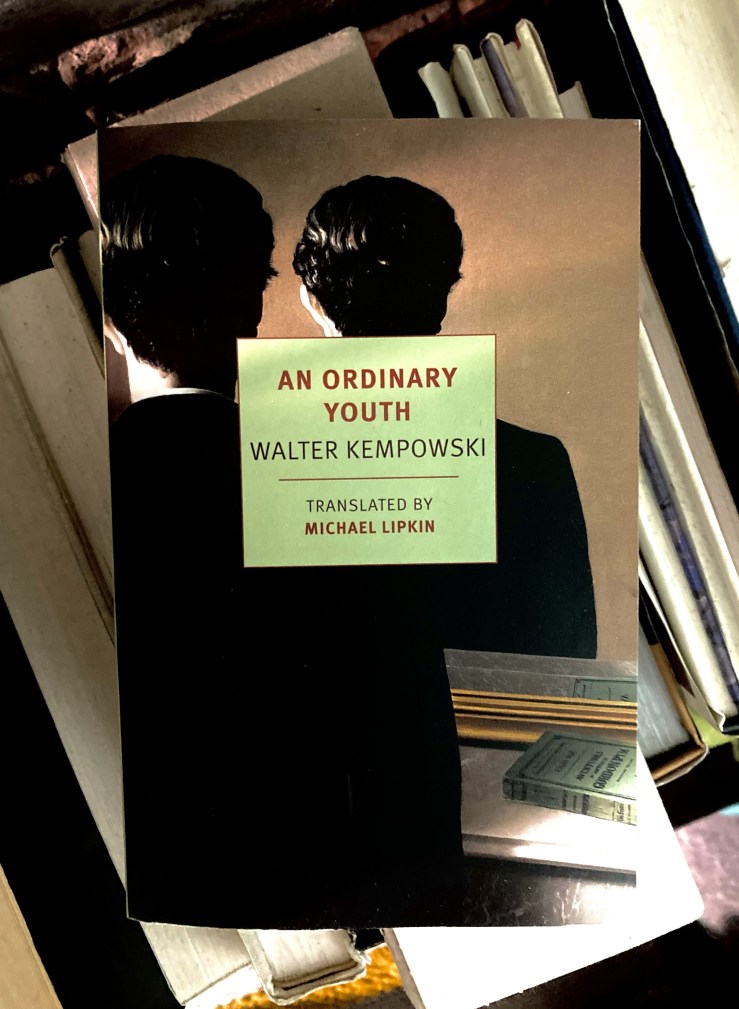
Walter Kempowski’s An Ordinary Youth (Book acquired, 2 Oct. 2023)

Walter Kempowski’s An Ordinary Youth gets its first published English translation thanks to Michael Lipkin. The book is new in print from NYRB. Their blurb—

An Ordinary Youth is a novel drawn directly from the author’s boyhood in Nazi Germany. Nine-year-old Walter’s family is moving house when the novel opens, but Walter’s main concerns are his tin soldiers and his older brother’s jazz records, his father’s fluctuating moods, and his mother’s ministrations and anxieties. While Walter is absorbed by his private life, the extraordinary accumulation of contemporary idioms that accompany his point of view—dialogue, song, literary quotations, commercials, and political slogans—tell a different story.  Through this echo chamber of voices, Kempowski shows a hugely turbulent and murderously intolerant nation racing toward disaster. An immediate bestseller when it was first published in Germany in 1971 (as Tadellöser & Wolff) and the best known of Kempowski’s novels in Germany, An Ordinary Youth is now available in English for the first time.

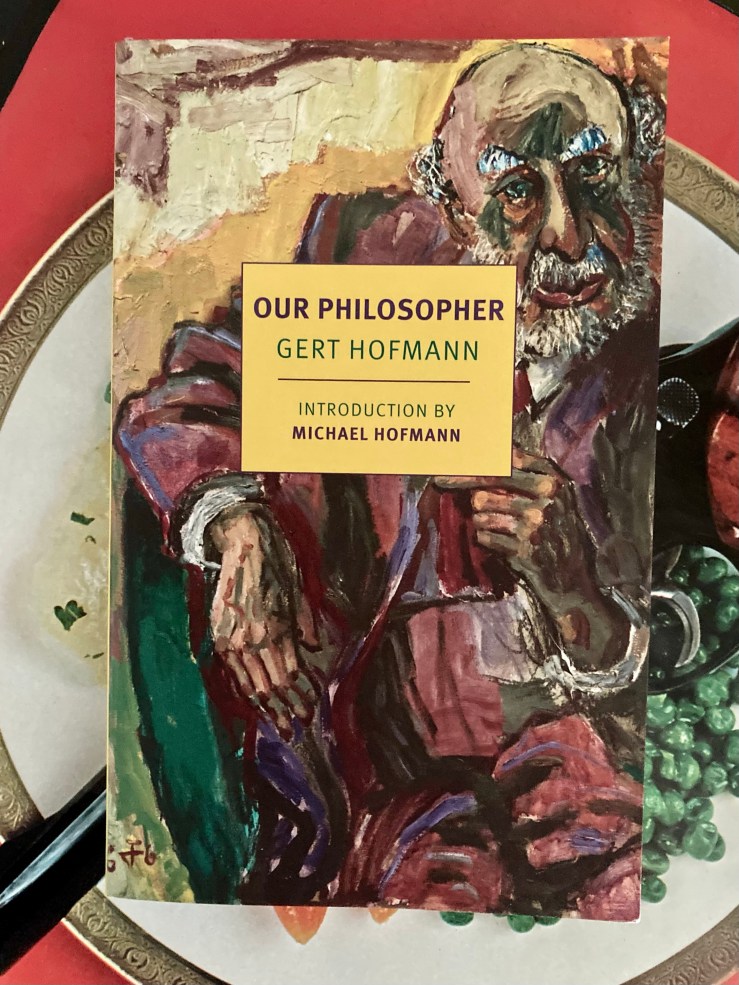
Gert Hofmann’s Our Philosopher (Book acquired, 13 Sept. 2023)

Gert Hofmann’s 1986 novel Veilchenfeld is forthcoming in the U.S. in an English translation by Eric Mace-Tessler, The new edition is from NYRB. Their back cover copy:

The time is the 1930s. Our philosopher is Herr Veilchenfeld, a renowned thinker and distinguished professor, who, after his sudden dismissal from the university, has retired to live quietly in a country town in the east of Germany. Our narrator is Hans, a clever and inquisitive boy. He relates a mix of things he witnesses himself and things he hears about from his father, the town doctor, who sees all sorts of people as he makes his rounds, even Veilchenfeld, with his troubled heart. Veilchenfeld is in decline, it’s true—he keeps ever more to himself—but the town is in ever better shape. After the defeat of the Great War and the subsequent years of poverty, things are looking up. The old, worn people are heartened to see it. The young are exhilarated. It is up to them to promote and patrol this new uplifting reality—to make it safe from the likes of Veilchenfeld, whose very existence is an affront to it. And so the doctor listens, and young Hans looks on.

And novelist Ian McEwan’s blurb:

The best novel I’ve read that describes events through the eyes of a child is little known and a minor masterpiece….Hans, the son of a small-town doctor, watches as the life of his fascinating neighbor, Professor Veilchenfeld, unravels and is then destroyed…In this learned old man, Hofmann condenses the industrialized extermination of millions…To recount it through the limited and fragmented understanding of an innocent child was an inspired authorial choice.

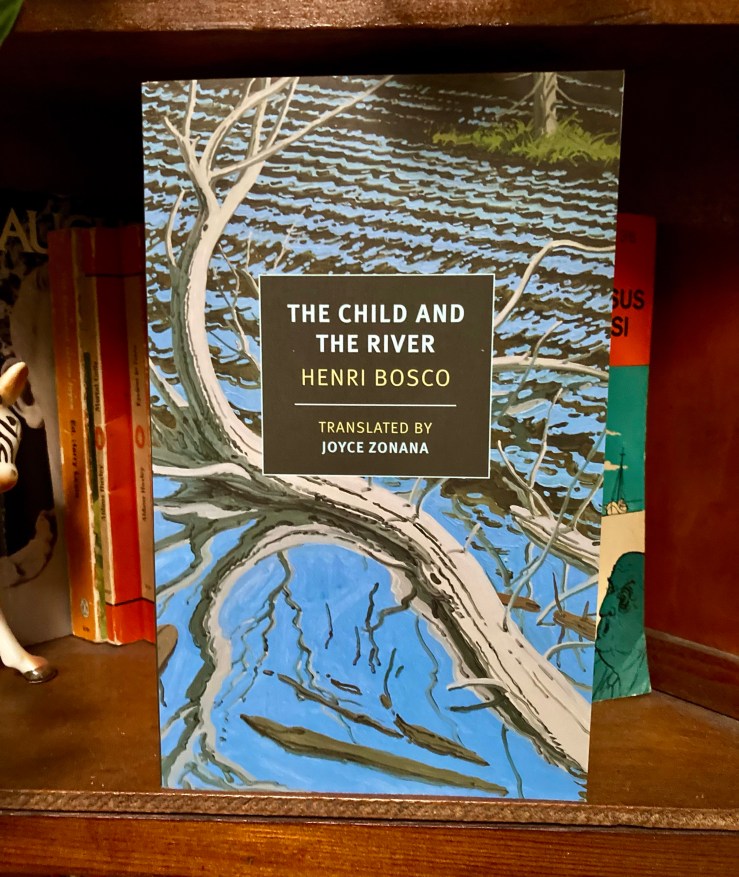
On Henri Bosco’s lovely brief novel, The Child and the River

Last week or maybe the week before last, I received in the mail a review copy of Henri Bosco’s slim 1945 novel The Child and The River. This new translation by Joyce Zonana is available now from publisher NYRB. I picked up The Child and the River this week twice: once before bed, and then again immediately upon waking the next morning, where I finished it before rising.

Set some years before either of the Big Wars, The River and the Child takes place in the countryside somewhere in the south of France (likely Bosco’s native Provence). Narrator Pascalet, now an older man, looks back on a transformational episode in his youth. He relates how as a young boy, he was free to roam the countryside wherever he pleased, excepting the river, where, according to his parents, “there are black holes where you can drown; there are snakes in the reeds and Gypsies on the banks.”

When his parents go on a trip, leaving him in the care of sweet Tante Martine, young Pascalet makes his way to the forbidden river posthaste, blaming any mischief on newly-arrived Spring:

…one fine April morning, temptation caught me unawares. It knew how to speak to me. It was a springtime temptation, one of the sweetest there is, I think, for anyone who is open to clear skies, tender leaves, and newly-blossomed flowers.

That is why I succumbed.

Pascalet’s adventure quickly goes awry, or improves in intensity, depending on how you like to think of it. He falls asleep in an old rowboat, drifts downriver, and ends up on an island inhabited by Gypsies. Hungry, he spies them from behind the brush. Near their cauldron they keep a dog and a bear—and a bound prisoner: “He was a handsome child, sturdy, taller than me and stronger, most likely a Gypsy.” The men in the group beat the young prisoner with a whip, but he endures it. Late in the night, under cover of darkness, Pascalet frees this boy, Gatzo; they then steal a boat and escape to live out a boyhood fantasy of utter freedom—for a few days, at least.

The Child and the River brims with lovely nostalgic pleasures. The boys playact their boyish fantasies, forging crude bows and arrows of reed and pretending that they might have to fend off monsters or “headhunters, cannibals.” Pascalet describes the wonderful sensation of escalating these fantasies:

Then I would feel a mock terror. I enjoyed it. Because when you scare yourself through make-believe, you know well enough that you are not in any danger, but still you are afraid. It is one of the most delicious pleasures.

And yet the boys are not merely playacting—they are surviving: fishing, foraging, strategically moving and mooring their boat to avoid detection. They make fire; they cook. In a lovely little scene, they dig a spring to enjoy fresh water:

We made a hole near a bulge in the clay. Water was seeping through. We continued to dig and fashioned a little basin. Through a breach in the clay, the water moistened a bed of sand. We flattened one side of our hole and stuck in a hollow reed. At first the reed stayed dry. We were aching with impatience, even more than for the fire. At long last, a droplet formed and grew round; for a long time, it hung, uncertain. Suddenly it fell. Another drop came, and slowly, at the tip of the green reed, the spring was born.

This passage exemplifies the simple precision of Bosco’s prose via Zonana’s clean, clear translation. The joy of The Child and the River comes from Pascalet’s gentle, limpid observations of his time on the river, which are generally free of intrusive, muddy “adult” meditations. Instead, we experience what the boys experience:

Everywhere, plants and waters, shorelines and trees, came alive at nightfall with a confused, mysterious life. A duck would flap its wings in the reeds; an owl would screech on a black poplar; a brutal badger would rummage in a bush; a weasel, gliding from branch to branch, would cause two or three leaves to tremble lightly; a roving fox would yelp in the distance.

“It is a sad animal,” Gatzo told me. “It is thinking

The adventures of Pascalet and Gatzo culminate in a strange, dreamlike encounter with “the Puppeteer of Souls.” I won’t remark on the episode at any length, only add that it provides a nearly-mystical, memorable climax to the book. I’ll also add that the novel’s last two sentences are some of the sweetest I’ve read in a while.

I loved reading The Child and the River; I loved the feeling of reading it. It took me back to books I’d loved as a child: Arthur Ransome’s Swallows and Amazons, abridged and bowdlerized versions of Moby-Dick and Huckleberry Finn, and countless Robinsades. In a letter to a friend, Bosco suggested that The Child and the River was “a novel very good, I think, for children, adolescents, and poets.” Is there a better audience?

The Child and the River is one of two Bosco books in publication now from NYRB; they released Zonana’s translation of his 1948 novel Malicroix in early March of 2020. I have it on my shelf, still unread, but not for long. I hope NYRB and Zonana will do a few more Bosco titles. Recommended.

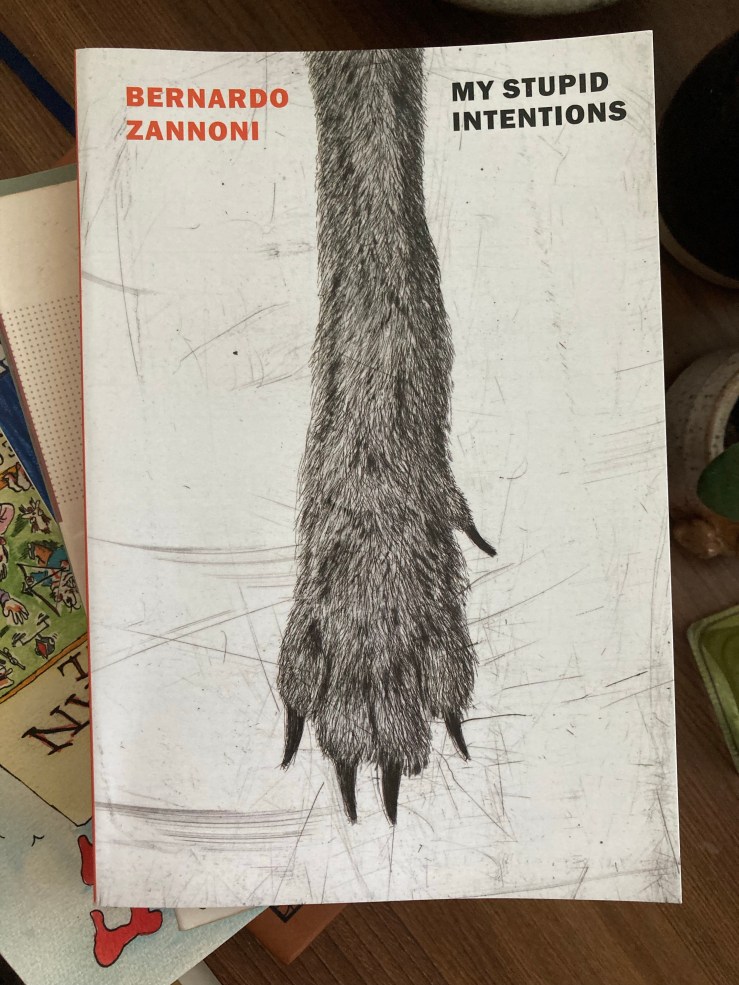
Bernardo Zannoni’s My Stupid Intentions is a brash and brilliant picaresque fable

A few pages into Bernardo Zannoni’s brash, brilliant novel My Stupid Intentions, our narrator Archy and his eldest brother Leroy have the following conversation about their youngest brother Otis:

“Are you cold?” he said.

“I’m hungry.”

“Me too. We could eat Otis. He’s small, and weak.”

Otis is small and weak, but his brothers ultimately elect to remain hungry and not consume him. A few pages later, Archy falls from a tree, leaving one leg permanently lame. He then engages in sexual intercourse with his sister Louise. And poor Otis? “I’m going to die because I’m not growing,” he declares at the family dinner. This prediction quickly proves true. Archy is then sold into the service of a writer named Solomon for the low price of one and a half chickens.

Perhaps, having put forth details in lieu of a bigger picture, I should backtrack:

My Stupid Intentions (I miei stupidi intenti) is Bernardo Zannoni’s first published novel. It won the 2022 Campiello Prize, and is now available in English thanks to translator Alex Andriesse and publisher NYRB. I enjoyed all 211 pages of it.

Archy, the narrator of My Stupid Intentions is a beech marten, a kind of mustelid similar to a weasel or ferret. My Stupid Intentions is Archy’s life story—and it is crammed with life, with nerve, joy, terror, anger, and discovery.

I mentioned some names above, mostly of Archy’s family members, but we can dispense with them now. The most important character in Archy’s life is Solomon, an old fox who has learned to read and write. Solomon’s ability to cipher makes him a market nexus for the animals of the forest, who come to him to trade in goods like chickens, eggs, and vegetables. A fiercely loyal dog named Joel protects Solomon and their enterprise (Joel claims that Solomon rescued him from a wasp’s nest when he was an infant). Crippled Archy soon finds his place in Solomon and Joel’s routine, even venturing out with Joel to collect delinquent accounts.

In time, Solomon teaches Archy to read and write. They begin with the business, keeping track of customers’ debts, but soon advance to the bible. Here, Archy learns about God and comes to despise him: “Why had he inflicted this pain upon me? Why wasn’t I a man? Hadn’t I sought him, hadn’t I been on his side?”

In knowing God, Zannoni seems to suggest, Archy and Solomon become imbued with a consciousness otherwise unavailable to animals. The curse of this consciousness is the revelation of mortality. While other animals comprehend that death exists, they do not, at least from Archy’s perspective, fully understand what death entails. Understanding his own mortality is Archy’s curse, and his agon with God weaves through the novel’s bright and dark adventures. In one of the novel’s most poignant moments, Archy, unable to provide succor to his friend Joel, offers him an illusion, a proper telos for his dog’s soul:

He went off searching for a place that didn’t exist, beyond the wrong mountains, where no three rivers parted ways. He would wander all his life, clinging to a spurious hope, the only thing that made him keep going, like a phantom. I am terrified to think he may still be out there, searching. I am terrified to think he may have realized he has been damned to a pointless existence, a life of grasping at smoke. I am terrified to think I have been crueler than God.

My Stupid Intentions is full of cruelties and heroics. There are bandits and thieves and duels. There is a strange underground club for maimed and toothless animals to huddle together. (“Even in their loneliness, their exhaustion, their absence of appetite, they did not think they were going to die, and absurdly I envied them.”) There are doctors and apprentices and violent brigands—again, Zannoni’s novel bristles with life, teems with a propulsive energy.

This energy pulses at both the sentence and paragraph level in Andriesse’s nimble translation. The book’s jacket summary describes My Stupid Intentions as a “picaresque fable,” and it indeed rockets along with picaresque energy, its sharp turns often made even sharper by an ironic quip from Archy.

As for the “fable” bit…well, any story with anthropomorphic animals might be called a “fable,” especially if there is a moral dimension highlighted. Archy’s complaint against God is direct yet ultimately ambiguous. I didn’t catch a didactic whiff from Zannoni. My Stupid Intentions is more complex than Aesop’s fables; it has more in common with the visceral reality of Richard Adam’s novel Watership Down or the zany violence of Roald Dahl’s The Fantastic Mr. Fox (especially in Anderson’s film adaptation). My Stupid Intentions also reminded me strongly of Neko Case’s nature songs, some of the essays in Joy Williams’ collection Ill Nature, Disney’s loose, picaresque 1970’s take on the legend of Robin Hood, Russell Hoban’s inimitable novel Riddley Walker, Brian Jacques’ Redwall books, and Italo Calvino’s novel The Baron in the Trees.

My Stupid Intentions is also a book about writing, a kind of self-creating document, Archy’s autobiography in action, a sort of funny animal Künstlerroman. If there were any urges on Zannoni’s part to give into postmodern cleverness here, to play with the metatextual nature of his tale, not a trace of such frippery is evident. The novel is, for all its twisting and turning and snapping, wonderfully and refreshingly straightforward. There is nothing stupid about this book. I loved it. Highly recommended.


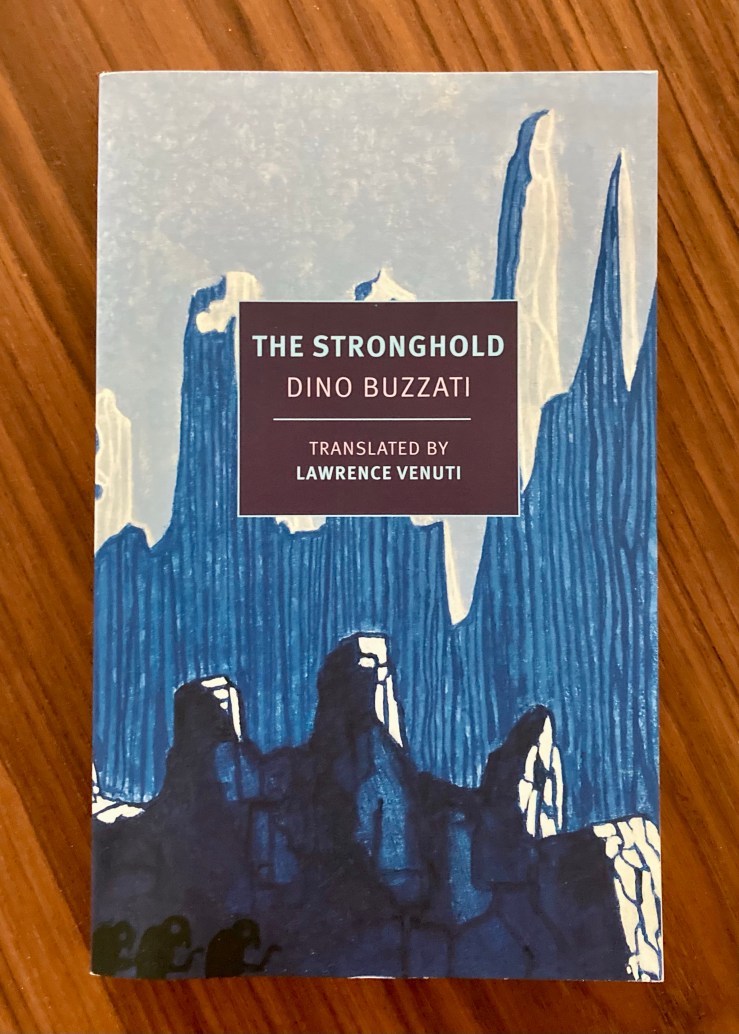
A review of The Stronghold, Dino Buzzati’s novel of deferred hope and ecstatic boredom

Dino Buzzati’s 1940 novel Il deserto dei Tartari (retitled The Stronghold in Lawrence Venuti’s new English translation) takes place in an unidentified time in an unidentified country. Our protagonist is Giovanni Drogo, freshly graduated from an unspecified military academy and ready for a thrilling life of combat and adventure at his new post, Fortezza Bastiani, a fortress at the border of the Tartar steppe. He and his fellow soldiers wait in the hope of attaining glory.

And they continue to wait.

The nebulous Tartars repeatedly fail to appear, offering only the vaguest hints of their alien existence. The soldiers of Fortezza Bastiani live a life of anxious monotony, their desires and hopes for the heroics of war flattened by the boredom of day to day life. It’s all very existentialist.

From the opening pages of The Stronghold, Buzzati conjures a strange but familiar world, usually telegraphed in brisk, unadorned prose (a style he honed in his career as a journalist). Everything is slightly off, slightly anxious. Initially, a reader might chalk the disquieting style up to our viewpoint-character Drogo’s own hesitancy as he enters into a new life as a military officer, but we soon find ourselves in an uncanny realm.

The world of the fortezza is somehow simultaneously dull and enthralling. Consider Drogo’s first glimpse of the fortress:

Fortezza Bastiani was neither imposing, with its low walls, or beautiful in any  way. Its towers and ramparts weren’t picturesque. Absolutely nothing alleviated its starkness or recalled the sweet things of life. Yet Drogo gazed at it, hypnotized, as on the previous night at the base of the gorge. And an inexplicable ardor penetrated his heart.

This “inexplicable ardor” is nevertheless ambiguous in its penetration; after learning he is nominally free to choose a different, perhaps more invigorating post, Drogo elects to transfer from the fort. However, his commanding officer suggests that he stay for four months to avoid bureaucratic problems with the higher ups. That four-month season of waiting turns into a lifetime of waiting. And then waiting some more.

Drogo and his fellow soldiers hunger for the glory of contesting the Tartars, an enemy they know utterly nothing about. Like almost every sociopolitical, cultural, and even technological detail in The Stronghold, the specific nature of the Tartar enemy is collapsed into something closer to a fairy tale or a rumor. Vague and dreamlike, the Tartars are not a geopolitical entity; they are not even an other, but rather the figment of an other, the kernel of a dream that promises action. And this dim promise keeps the soldiers waiting at the Fortezza:

From the northern desert would arrive their fortune, the occasion of their exploits, the miraculous hour that befalls everyone at least once. Because of this vague eventuality, which grew increasingly uncertain with time, grown men wasted the best part of their lives there.

The narrator, hovering in Drogo’s consciousness, imagines an interlocutor explaining to one of these soldiers that his “entire life will be the same, utterly the same, till the very last moment” — and then imagines the hypothetical soldier’s response: “Something else must come to pass, something truly worthy.” Drogo here believes he has grasped the “transparent secret” of the soldiers of the Fortezza, but also imagines himself an “uncontaminated onlooker.” But it’s too late. Drogo too has committed to waiting for something else to come to pass.

Nothing comes to pass—or nearly nothing. (One might read The Stronghold as an extended riff on Kafka’s wonderful parable “Before the Law.“) However, this is not to say though that Buzzati’s portraiture of tedium is itself tedious. The boredom he conjures is an ecstatic boredom, anxious and writhing, exploding in strange, magical moments of hallucinations and night terrors.

In one of the novel’s most extraordinary sequences, “fragile apparitions, quite like fairies” enter Drogo’s dreams, bearing away to some spectacular land Drogo’s fallen comrade who is now converted to a child dressed in a rich velvet suit. In another episode, a mysterious horse appears from the desert, sending the men into fits of hope and despair culminating in a horrific incident that underscores the absurdities of military rigor. Late in the novel, a much-older Drogo’s desire for action, for something to come to pass, tips into near-comic paranoia, as he and a younger officer fool around with a telescope to no avail.

After all this waiting in hope, The Stronghold concludes with a devastating Kafkaesque punchline which I shall not spoil here.

It will be clear to most seasoned readers that Kafka was an influence on Buzzati even without Venuti’s afterword, which details Buzzati’s admiration for the Bohemian writer. Buzzati does not ape the older master so much as evoke the same state of anxious alterity we find in texts like “The Great Wall of China” and The Castle. Stepping into The Stronghold, one is reminded of other branches of the Kafka tree, like Kazuo Ishiguro’s The Unconsoled, Kobo Abe’s The Woman in the Dunes, Alasdair Gray’s Lanark, and Albert Camus’ The Stranger, among many others.

Like many Kafkaesque works, one might be inclined to fob his own allegorical readings onto The Stronghold. In his afterword, Venuti points out that early English-language readings of Buzzati’s novel tended to interpret Il deserto dei Tartari as an anti-totalitarian tract. Il deserto dei Tartari was first translated as The Tartar Steppe by Stuart Hood in 1952, and many of its contemporary critics read the novel against the backdrop of the Cold War.

While praising the “remarkable accomplishment” of Hood’s translation, Venuti differentiates his own “historically oriented interpretation” of the novel; namely, his attempt to more emphatically underline Il deserto dei Tartari’s “latent critique” of fascism. Venuti points out that “Hood had twice rendered the generic ‘stivali’ (boots) with the politically marked term ‘jackboots,'” adding, “I tripled its use.”

Venuti also discusses at some lengths his choice to change Hood’s title. He writes that Buzzati initially wanted to title the book La fortezza, but this name was rejected by the novel’s publisher who worried it might be misunderstood by the reading public. In his attempt to further historicize his translation (and differentiate it from Hood’s), Venuti elected to remove Steppe from the title fearing it “might be taken as an anachronistic reference to the Soviet Union.” He also avoided The Fort or The Fortress as a possible titles, worried they might underscore Buzzati’s “debt to Kafka’s The Castle.” Venuti eventually settled on The Stronghold, suggesting that this title helps to emphasize the “cult of virility championed during the Fascist period” while also “conveying the sheer tenaciousness of the soldier’s heroic fantasies, as well as their inability to escape their debilitating obsession.”

I haven’t read Hood’s translation of Il deserto dei Tartari, but I appreciated Venuti’s, which, as I pointed out above, takes place in an unidentified time in an unidentified country. The novel’s eerie, fable-like quality—a quality that resists historicity—is what most engages me. Buzzati’s book captures the paradox of a modern life that valorizes the pursuit of glory (or at least happiness) while simultaneously creating a working conditions that crush the human spirit. We can find this paradox in Herman Melville’s Bartleby or Mike Judge’s Office Space; we can find it in Antonio di Benedetto’s Zama or Mike Judge’s Enlightened; we can find if in David Foster Wallace’s The Pale King or Dan Erickson’s recent show Severance. I could go on of course.

Some of these boredom narratives seek to assuage us, or make us laugh or cry—in recognition, spite, pity, despair, or hope. Some of these boredom narratives find resistance in art, or in just plain resistance. Buzzati’s novel offers something more like a warning. It is not possible to be an “uncontaminated onlooker” in one’s own life. It’s not enough to wait forever, even if we wait in hope.

The Stronghold is available now from New York Review Books.

James Grieve’s translation of Proust’s Swann’s Way (Book acquired, 19 March 2023)

This May, NYRB will publish a “new” translation of the first volume of Marcel Proust’s longassed novel In Search of Lost Time.

The translation, by James Grieve, is not actually new. It’s actually like half a century old.

The NYRB jacket copy states that “James Grieve began his career as a translator of Proust in the early 1970s, driven by his dismay at how many readers deemed In Search of Lost Time to be too difficult for them to take on. Grieve’s artful and celebrated version of Swann’s Way—only now available outside his native Australia—shows that this is hardly the case.” 

I was unfamiliar with Grieve’s translation. As I admitted on Twitter, I’m not really a Proust Guy. I read Lydia Davis’s translation of Swann’s Way a decade ago, and thought it was Okay and decided it was also Enough. Many, many people replied to my tweet that C.K. Scott Moncrieff’s translation was the way to go. Author and translator Daniel Mendelsohn told me that I’d “read the wrong translation!”  — but I’m okay with that.

Here is the I-guess famous opening line of Moncrieff’s 1922 translation:

For a long time I used to go to bed early.

Here is the Modern Library’s 1992 translation, crediting Moncrieff and Terence Kilmartin, revised by D.J. Enright:

For a long time I would go to bed early.

Here is Lydia Davis’s translation (2002) of the opening line:

For a long time, I went to bed early.

And here is James Grieve’s translation:

Time was when I always went to bed early.

There were a lot of opinions on Grieve’s rendering of this particular line floating around Twitter.

I have no dog in this race, but the voicing here strikes me as, I dunno, very, uh, colloquial? Almost like Huck Finn or something?

Proust’s original, by the way:

Longtemps, je me suis couché de bonne heure.

I muddled my way through a few years of college French, and have no real strong opinions here, but the phrase bonne heure is the most interesting to me. When I read it in French, I read it as something like, “a good hour,” or “the right time.”

Translation is about feeling and tone and vibe and mood as much it is about (the attempt for) precision, so I suppose each translator brings their own sense of the narrator’s voice to their translation, a voice that may or may not sync with what those other translators, the readers, hear in their mind’s ear.

Two from Dino Buzzati (Books acquired, last week of March 2023)

NYRB is issuing a new translation of Italian author Dino Buzzati’s 1940 novel Il deserto dei Tartari next month. In his afterword to this new edition, translator Lawrence Venuti points out that Buzzati’s original intended title, La fortezza, was rejected by the novel’s publisher Rizzoli, who expressed concerns that, with the outbreak of WW2, the title might be misunderstood by the reading public. The novel received an English translation by Stuart Hood twelve years later as The Tartar Steppe. Venuti restores Buzzati’s intended title in his new translation.

I started in on The Stronghold last night, just casually dipping into a few pages, as I try to do with all of these silly “book acquired” posts, and wound up reading the first fifty pages in one go, then picking it up again this morning. It quickly reminded me of Kafka’s The Castle and Ishiguro’s The Unconsoled—the kind of novel of endless deferrals, its alterity heightened by the concrete precision of the prose. Great stuff so far.

NYRB is also releasing an edition of Joseph Green’s translation of Buzzati’s later novel, A Love Affair. Their blurb:

Antonio Dorigi is a successful architect in Milan, nearing fifty, who has always been afraid of women. He has been a regular at an upscale brothel for years, even as he mourns the lack of close female companionship in his life.

One afternoon, the madam at the brothel introduces Tonio to “a new girl,” Laide (short for Adelaide). Tonio sees nothing especially remarkable about Laide, though it intrigues him that she dances at La Scala and also at a strip club, and yet in a very short time he becomes completely obssessed with her.

Laide draws Antonio on, confounds him, uses and humiliates him, treats him tenderly from time to time, lies to him, makes no apologies to him, and he loves her ever more. This helpless and hopeless love is what he is, he feels, even as it prevents him—we see—from ever seeing Laide for who she is. Because Who is she? is the question at the heart of Buzzati’s clear-eyed and often comic tale of infatuation.

Laide is a young woman who has never known the bourgeois prosperity Tonio takes for granted, someone in a pickle looking for a main chance. She is a storyteller and someone, too, who knows how stories tell on people and shape their desires and lives.

Is A Love Affair a love story or is it a story of anything but love? Buzzati’s novel, with its psychological subtleties, its vivid cityscapes, and its compassion, keeps the reader guessing till the end.

Márcia Barbieri’s The Whore (Book acquired, Feb. 2023)

In a long, delirious monologue driven by bile and cocaine, a prostitute named Anúncia recounts the story of her life, remembering and sometimes inhabiting the men and women who left the deepest scars on her psyche—her absent father, her mentally disturbed mother, the son she never wanted, the parade of lovers like the poet and the philosopher—all the while drawing grand conclusions about the nature of sex, life, and death from her own experiences. In a world ravaged by pollution and unceasing war, the narrator’s acid tongue condemns anyone who believes that filth and depravity have more to do with copulation than the misery inflicted by exploitation and inequality.

In acidic, relentless, and sometimes dream-like prose, Barbieri conjures a figure at once singularly human and divine, an androgynous, eternal being made of viscera and utterance. The Whore, more than anything, is an interrogation of interiority, and the ways in which the emotional and spiritual interior is not only inseparable from one’s physical form, but, in fact, strengthened by acknowledgement of the body.

Márcia Barbieri’s novel The Whore is forthcoming this spring from Sublunary Editions in translation by Adrian Minckley.

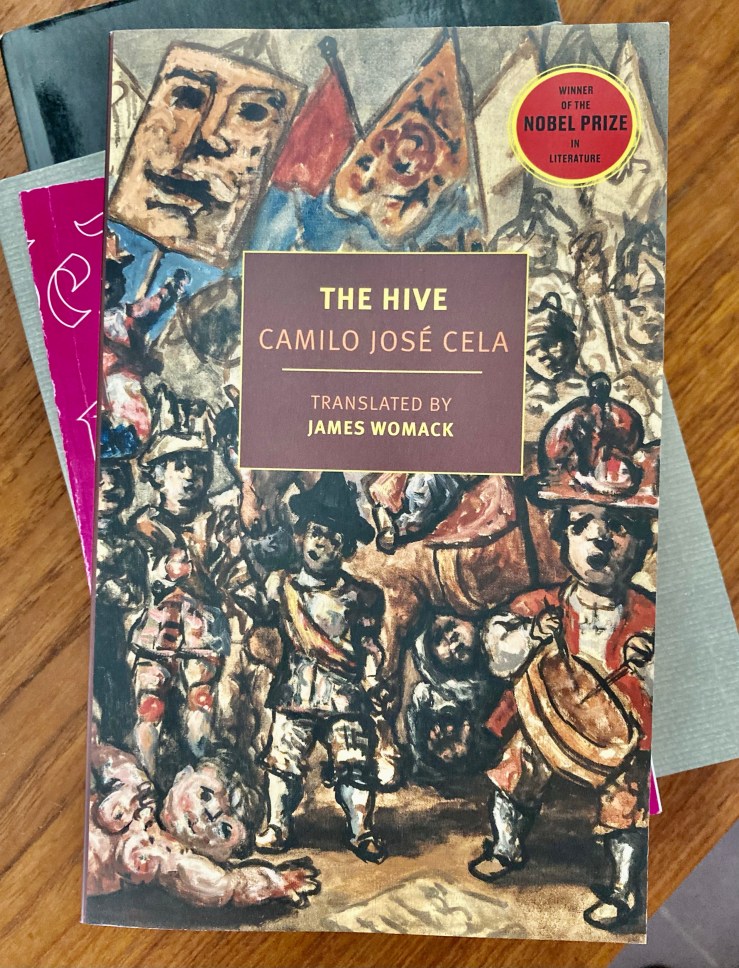
Camilo José Cela’s 1950 novel The Hive (Book acquired, 1 Feb. 2023)

Camilo José Cela’s 1950 novel The Hive is forthcoming from NYRB in translation by James Womack. NYRB’s blurb:

The translator Anthony Kerrigan compared Camilo José Cela, the 1989 winner of the Nobel Prize in Literature, to Louis-Ferdinand Céline and Curzio Malaparte—all “ferocious writers, truculent, badly spoken, even foulmouthed.” However provocative and disturbing, Cela’s novels are also flat-out dazzling, their sentences as rigorous as they are riotous, lodging like knives in the reader’s mind. Cela called himself a proponent of “uglyism,” of “nothingism.” But he has the knack, to quote another critic, Américo Castro, of deploying those “nothings and lacks” to construct beauty.

The Hive is set over the course of a few days in the Madrid of 1943, not long after the end of the Spanish Civil War, when the regime of General Francisco Franco was at its most oppressive. The book includes more than three hundred characters whose comings and goings it tracks to hypnotic effect. Scabrous, scandalous, and profane, The Hive is a virtuosic group portrait of a wounded and sick society.

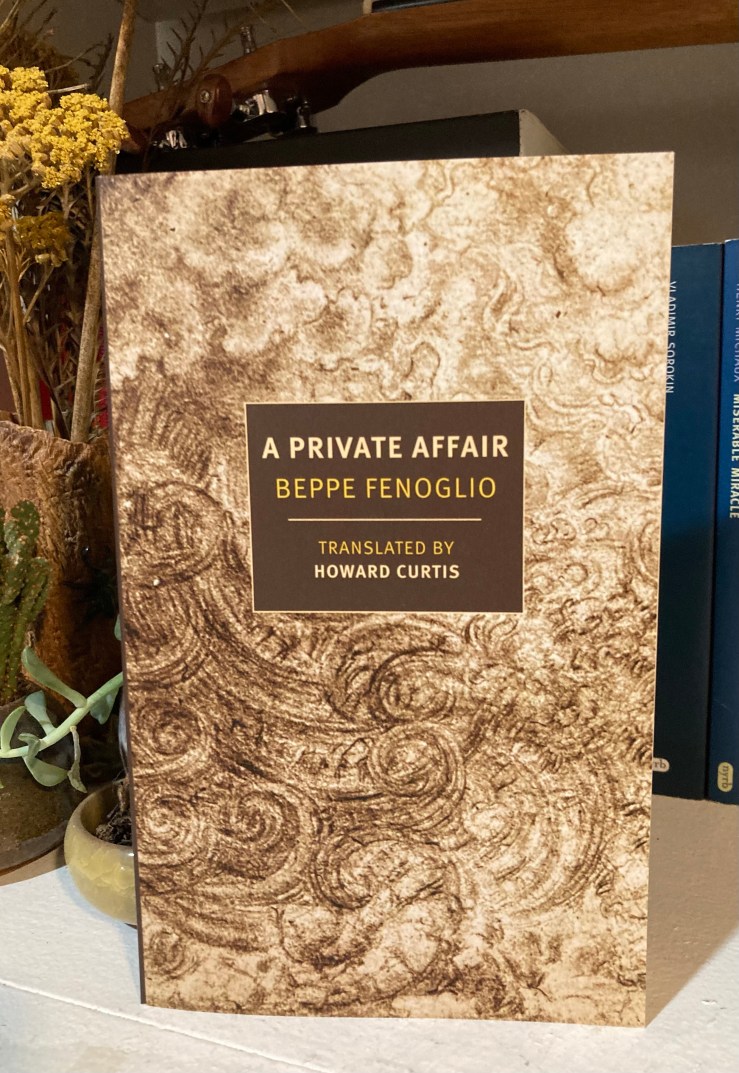
Beppe Fenoglio’s A Private Affair (Book acquired, 9 Jan. 2023)

Beppe Fenoglio’s A Private Affair is forthcoming this spring in translation by Howard Curtis from NYRB. Their blurb:

Milton—the name is a nom de guerre—is a member of a partisan band battling Italian Fascists and German forces in the chaotic last years of World War II. Before the war Milton was a student of English literature and a lover of poetry. He was in love with a girl, too, Fulvia, and from time to time she’d invite him over to her rich family’s fine house and have him read to her. Now, in the thick of war, he discovers that handsome Giorgio, his friend and fellow partisan, was sleeping with Fulvia at the time. Furious with jealousy, Milton hastens to have it out with Giorgio, but Giorgio has been captured by the Germans. A Private Affair tells the story of Milton’s mad quest—through mud and fog, rain and terror, while barely evading enemy patrols—to rescue his friend, the better to settle a grudge from a lost world of peace. Beppe Fenoglio’s masterpiece is a peerless story of the violent heart and world.

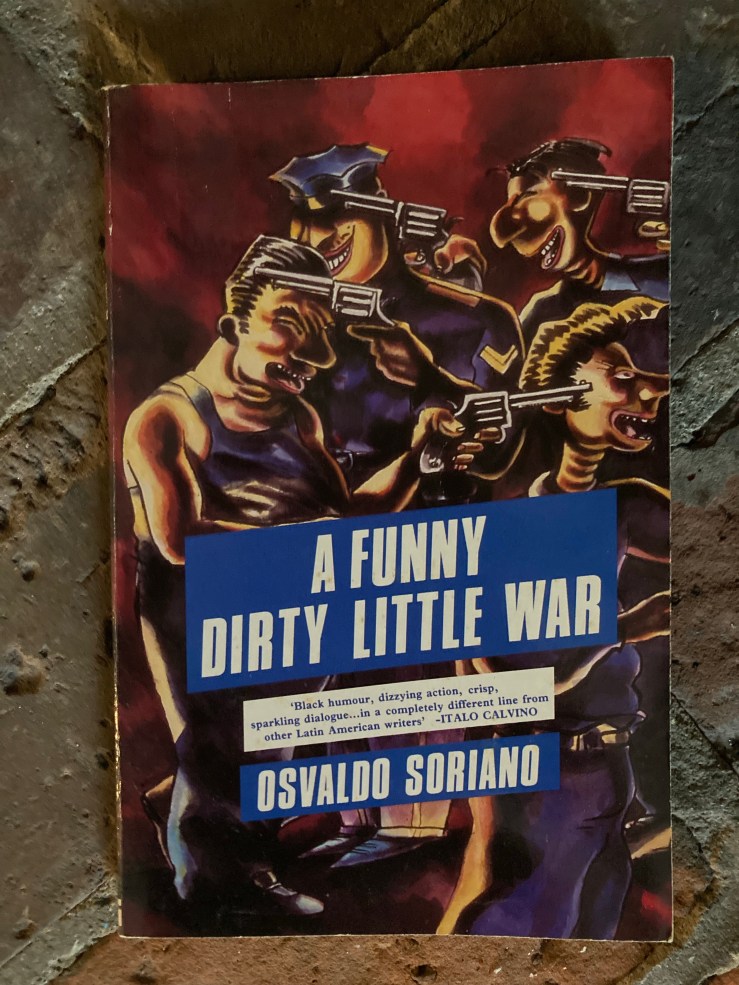
Farce, then tragedy | A few thoughts on Osvaldo Soriano’s novel A Funny Dirty Little War

I had never heard of the Argentinian author Osvaldo Soriano, but I plucked his novel A Funny Dirty Little War from the bookstore shelf because of its title. The goofy, menacingly violent cover, featuring an illustration by Oscar Zarate, intrigued me, and the Italo Calvino blurb on the back sold me on the book before I’d even opened it.

Calvino’s blurb offers a succinct summary of the novel:

A Funny Dirty Little War tells the story of a political confrontation in a small village in Argentina. Obscure differences between Peronist supporters and leaders escalate in a crescendo of violence to the final massacre.

Those “obscure differences” first evince as absurd, petty eruptions between the various characters. “You’ve got infiltrators,” the novel opens, and from there accusations accumulate and intensify.

That first accuser is the Inspector, who tells Ignacio, the city’s Council Leader, to fire a mild mannered clerk for his Marxist sympathies. Ignacio refuses, and the early part of the novel casts his as the closest thing to the protagonist. To be clear though, Soriano’s journalistic style recalls Hemingway’s brevity. His camera rarely dips into the interior lives of his characters; most of the action is conveyed in short, punchy sentences and often-terse, often-humorous dialogue. As Calvino observes, the “characters, who with each chapter evolve from the comic and grotesque to the tragic, are observed by the author with a cool, dispassionate gaze.”

The initial grotesquerie lends the novel a farcical air at the outset. Ignacio quickly deputizes an ad hoc militia to square off against the Inspector and his goon squad, and the atmosphere is one of buffoonish amateurism, best encapsulated in the drunken agricultural pilot who takes to the sky to spray DDT on his adversaries. As the violence escalates, we get farther from any ideological differences. Both sides claim to be true Peronists, yet there’s no real politics here beyond grievances exploding into vengeance.

That vengeance and violence overtakes the farcical absurdity of the novel’s first half, sweeping into brusque tragedy. “[In} the end we are left with a feeling of bitter pity,” Calvino writes, and I agree. There is a punchline at the end of the novel, but that punchline isn’t the novel’s cumulative, explosive slaughter—an explosion, an abject corpse laid out on a toilet.

Nick Caistor’s translation telegraphs Soriano’s journalistic, clipped style. At times, I wished that the dialogue might be rougher. While the men do curse at each other, there’s a veneer of gentility that at times seems out of place (at times I found myself substituting words or phrases I thought one of Bolaño’s translators might have employed). A Funny Dirty Little War could be even dirtier.

I’m not sure if Caistor or an editor or even Soriano settled on the English title A Funny Dirty Little War, which, as I mentioned above, called for my attention. Soriano’s original title is No habrá más penas ni olvido: “Pain and longing shall be no more.” This original title (from a tango by Carlos Gardel and Alfredo Le Pera that expresses a longing to return to Argentina) suggests the deeper melancholy behind the narrative’s farcical, funny contours. The novel was first published in 1978, while Soriano was living in exile in Europe after the US-supported 1976 military coup in Argentina. He returned to Buenos Aires in 1984 after the junta’s collapse. Caistor’s English translation of No habrá más penas ni olvido published two years later.

A Funny Dirty Little War will in no way explain the Dirty War to those unfamiliar with its history. The causes and effects here unfold in the most basic way (all in a neat Aristotelian unity of action, place, and time). There is no introspection, no analysis—the violence just escalates. Absurd farce hurtles into absurd tragedy. Yet for all their outlandish, grotesque contours, Soriano’s characters are ultimately sympathetic. Or at least pathetic. In any case, this short novel will reward those who don’t mind their black humor extra bitter, with a heavy dose of violence.

Konstantin Paustovsky’s The Story of a Life (Book acquired, early January 2023)

The first part of Konstantin Paustovsky’s memoir The Story of a Life is forthcoming in a new translation by Douglas Smith from NYRB. Their blurb:

In 1943, the Soviet author Konstantin Paustovsky started out on what would prove a masterwork, The Story of a Life, a grand, novelistic memoir of a life spent on the ravaged frontier of Russian history. Eventually expanding to fill six volumes, this extraordinary work of a lifetime would establish Paustovsky as one of Russia’s great writers and lead to a nomination for the Nobel Prize in Literature.

Here the first three books of Paustovsky’s epic autobiography—long unavailable in English—appear in a splendid new translation by Douglas Smith. Taking the reader from Paustovsky’s Ukrainian youth, his family struggling on the verge of collapse, through the first stirrings of writerly ambition, to his experiences working as a paramedic on the front lines of World War I and then as a journalist covering Russia’s violent spiral into revolution, this vivid and suspenseful story of coming-of-age in a time of troubles is lifted by the energy and lyricism of Paustovsky’s prose and marked throughout by his deep love of the natural world. The Story of a Life is a dazzling achievement of modern literature.

“The Unhappiness of Being a Single Man” — Franz Kafka

“The Unhappiness of Being a Single Man”

by

Franz Kafka

translation by

Alexander Starritt


It seems a terrible thing to stay single for good, to become an old man who, if he wants to spend the evening with other people, has to stand on his dignity and ask someone for an invitation; to be ill and spend weeks looking out of the corner of your bed at an empty room; always to say goodbye at the door; never to squeeze your way up the stairs beside your wife; to live in a room where the side doors lead only to other people’s apartments; to carry your dinner home in one hand; to be forced to admire children you don’t know and not to be allowed to just keep repeating, “I don’t have any”; to model your appearance and behaviour on one or two bachelors you remember from childhood.

That’s how it’s going to be, except that in reality both today and in the future you’ll actually be standing there yourself, with a body and a real head, as well as a forehead, which you can use your hand to slap.

Vladimir Sorokin’s Their Four Hearts made me physically ill. (This is praise.)

Vladimir Sorokin’s novel Their Four Hearts (in English translation by Max Lawton) made me physically ill several times. To be clear, the previous statement is a form of praise. I finished it a few weeks ago and put it on a high shelf where no one in my family might come across it.

I picked up Their Four Hearts on the strength of the first Sorokin novel I read, Telluria, and the third, Blue Lard (both also in translation by Max Lawton). The kinetic energy of those novels evoked cinema in my mind’s eye—something akin to Alejandro Jodorowsky’s surreal Holy Mountain or Luis Buñuel’s comic masterpiece L’Age d’Or—narratives that engender their own new visual grammars. In Their Four Hearts, I again found a cinematic comparison, this time in Pier Paolo Pasolini’s study of depravity and cruelty, Salò, or the 120 Days of Sodom.

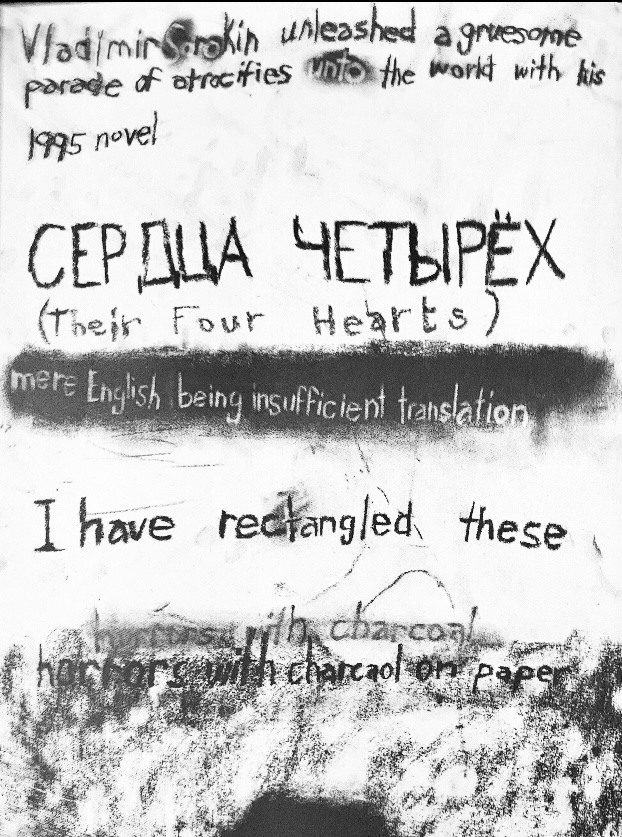
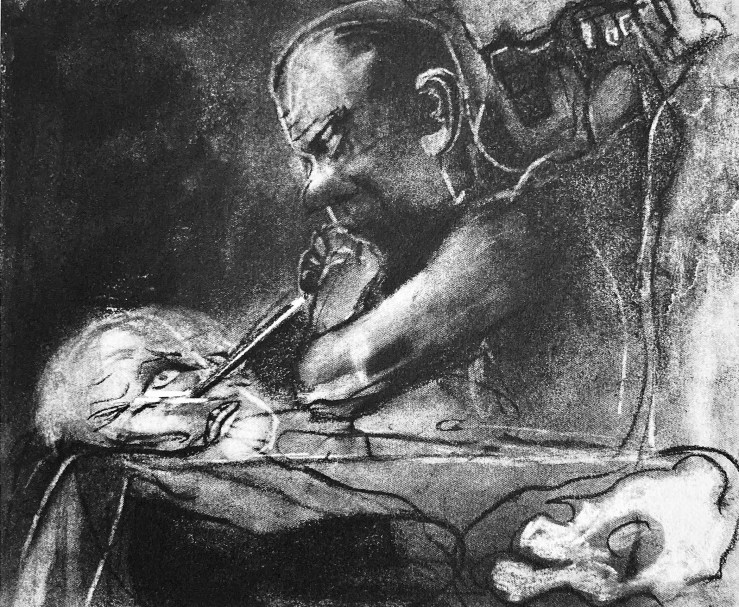
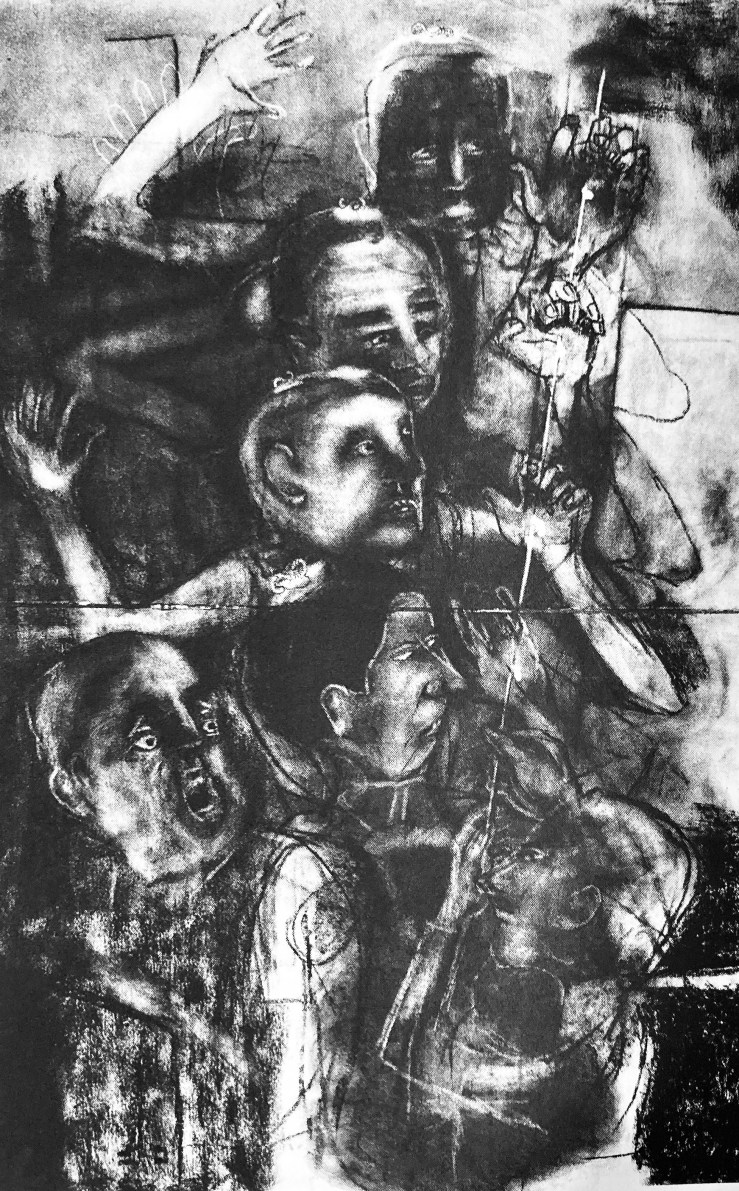
Like Salò, Sorokin’s Their Four Hearts explores seemingly every form of depravity in extreme detail. It is not for the faint of heart or stomach. (Sorokin’s potent language, in Lawton’s sharp translation, would eviscerate the cliches that precede this parenthetical aside.) Their Four Hearts is fairly short—200 pages, including over 30 pages of charcoal illustrations by Greg Klassen—but I had parcel it out over four distinct sittings. (After the second time I had to put it down because of nausea, I decided to avoid reading it close to mealtimes.)

Frontispiece for Their Four Hearts, Greg Klassen

Before I touch briefly on that depravity, it might be useful to interested readers to offer a gloss on the plot of Their Four Hearts. There is no recognizable plot. Or, rather, the plot hides behind the accumulation of violent, abject details, forever unavailable to a reader, no matter how keen a detective that reader might be. It is a cannibalizing plot, both literally and figuratively, stochastic, absurd, consuming its own horrific iterations.

But, like, what is it about?, hypothetical you might ask. In lieu of a list of depravities, let me cannibalize the back cover copy:

Their Four Hearts follows the violent and nonsensical missions carried out by a group of four characters who represent Socialist Realist archetypes: Seryozha, a naive and optimistic young boy; Olga, a dedicated female athlete; Shtaube, a wise old man; and Rebrov, a factory worker and a Stakhanovite embodying Soviet manhood. However, the degradation inflicted upon them is hardly a Socialist Realist trope. Are the acts of violence they carry out a more realistic vision of what the Soviet Union forced its “heroes” to live out? A corporealization and desacralization of self-sacrificing acts of Soviet heroism? How the Soviet Union truly looked if you were to strip away the ideological infrastructure? As we see in the long monologues Shtaube performs for his companions––some of which are scatological nonsense and some of which are accurate reproductions of Soviet language––Sorokin is interested in burrowing down to the libidinal impulses that fuel a totalitarian system and forcing the reader to take part in them in a way that isn’t entirely devoid of aesthetic pleasure.

Libidinal forces . . . totalitarian system . . . forcing the reader . . . aesthetic pleasure?

Aesthetic pleasure? Pleasure is doing a lot in that phrase, although I was admittedly alternately rapt by Their Four Hearts even while I was (quite literally) disgusted. I’ve read enough Sorokin to this point that I didn’t have to be forced into the surreal, jarring logic of the plot, finding instead deeply dark humor in it, where possible (although more often than not, horror without humor).

“Rebrov took a noose out of his pocket and put it around Alexandra Olegnova’s neck,” Greg Klassen

I have resisted turning this ostensible “review” into a catalog of the horrors Sorokin offers in Their Four Hearts. These horrors are all the more horrible for their sensory evocation set against their seemingly senseless (lack of) meaning. When the foursome, very early in the novel, drug and murder Seryozha’s parents, remove the glans from his father’s penis, and pop into the kid’s mouth to suck on, does that mean something exterior to the novel’s own aesthetics? That the quartet continues to trade the glans off, taking turns sucking on it throughout the novel—are we to plumb that for some kind of allegorical gloss? Or do we simply ride with it? Their Four Hearts confounds its readers, creating not only its own inventions of vocabulary, but its own grammar of storytelling.

Instead of my describing further the horrors of Their Four Hearts (murder, pedophilia, parricide, torture, mutilation, coprophagia, rape, cannibalism, etc. ), it might be more profitable for interested readers to inspect the illustrations by Greg Klassen I’ve included in this review. Reminiscent of George Grosz or Hans Bellmer, Klassen’s charcoals capture the tone and vibe of Their Four Hearts. They add to the text’s cinematic quality. (Publisher Dalkey Archive should have given Klassen the cover.)

“With only a few strokes, Schtaube opened up the maxillary sinus cavities in the corpse’s face,” Greg Klassen

By now you likely have a clear idea if Their Four Hearts is For You or Not For You. I found the experience of reading Sorokin’s novel paradoxically compelling and repellent. (One of the closest experiences I can compare reading it to was eating beef chitterlings at a Korean restaurant in Tokyo. The waitress brought the raw gray intestines to our table, where we grilled them ourselves over charcoal, dipping them in sauces. We ate three orders.)

“He skewered all of their hands on the first meter-long spoke,” Greg Klassen

Telluria and the forthcoming Blue Lard are much better starting places for those interested in Sorokin, but his translator Lawton suggested in an interview that,

…any new reader of Sorokin [should] immediately chase TELLURIA with THEIR FOUR HEARTS: those two combined give something like a complete picture of the master at work.

It’s a strange chaser, and it leaves a flavor unlike anything else I’ve ever tasted. Highly recommended.

From Naoji’s Moonflower Journal | From Osamu Dazai’s novel The Setting Sun

From Naoji’s Moonflower Journal

from

The Setting Sun

by

Osamu Dazai

Translated by Donald Keene


A sensation of burning to death. And excruciating though it is, I cannot pronounce even the simple words “it hurts.” Do not try to shrug off this portent of a hell unparalleled, unique in the history of man, bottomless!

Philosophy? Lies. Principles? Lies. Ideals? Lies. Order? Lies. Sincerity? Truth? Purity? All lies. They say the wisteria of Ushijima are a thousand years old, and the wisteria of Kumano date from centuries ago. I have heard that wisteria clusters at Ushijima attain a maximum length of nine feet, and those at Kumano of over five feet. My heart dances only in those clusters of wisteria blossom.

That too is somebody’s child. It is alive.

Logic, inevitably, is the love of logic. It is not the love for living human beings.

Money and women. Logic, intimidated, scampers off precipitously.

The courageous testimony of Dr. Faust that a maiden’s smile is more precious than history, philosophy, education, religion, law, politics, economics, and all the other branches of learning.

Learning is another name for vanity. It is the effort of human beings not to be human beings.

I can swear even before Goethe that I am a superbly gifted writer. Flawless construction, the proper leavening of humor, pathos to bring tears to the reader’s eyes—or else a distinguished novel, perfect of its kind, to be read aloud sonorously with the deference due it, this (shall I call it running commentary on a film?) I claim I could write were I not ashamed. There’s something fundamentally cheap about such awareness of genius. Only a madman would read a novel with deference. In that case it had best be done in formal clothes, like going to a funeral. So long as it does not seem as affected as a good work! I will write my novel clumsily, deliberately making a botch of it, just to see a smile of genuine pleasure on my friend’s face—to fall on my bottom and patter off scratching my head. Oh, to see my friend’s happy face!

What is this affection which would make me blow the toy bugle of bad prose and bad character to proclaim, “Here is the greatest fool in Japan! Compared to me, you’re all right—be of good health!”

Friend! You who relate with a smug face, “That’s his bad habit, what a pity!” You do not know that you are loved.

I wonder if there is anyone who is not depraved.

A wearisome thought.

I want money.

Unless I have it….

In my sleep, a natural death!

I have run up a debt of close to a thousand yen with the pharmacist. Today I surreptitiously introduced a clerk from the pawnshop into the house and ushered him to my room. I asked, “Is anything here valuable enough to pawn? If there is, take it away. I am in desperate need of money.”

The clerk, with scarcely a glance at the room, had the effrontery to say, “Why don’t you forget the whole idea? After all, the furniture doesn’t belong to you.”

“Very well!” I said with animation, “just take the things I have bought with my own pocket money.” But not a one of all the odds and ends I piled before him had any value as a pledge.

Item. A hand in plaster. This was the right hand of Venus. A hand like a dahlia blossom, a pure white hand, mounted on a stand. But if you looked at it carefully you could tell how this pure white, delicate hand, with whorl-less finger tips and unmarked palms, expressed, so pitifully that even the beholder was stabbed with pain, the shame intense enough to make Venus stop her breath; in the gesture was implicit the moment when Venus’ full nakedness was seen by a man, when she twisted away her body, flushed all over with the prickling warmth of her shock, the whirlwind of her shame, and the tragedy of her nudity. Unfortunately, this was only a piece of bric-à-brac. The clerk valued it at fifty sen.

Items. A large map of the suburbs of Paris. A celluloid top almost a foot in diameter. A special pen-point with which one can write letters finer than threads. All things bought by me under the impression that they were great bargains.

The clerk laughed and said, “I must be leaving now.”

“Wait!” I cried, holding him back. I finally managed to load him down with an immense stack of books for which he gave me five yen. The books on my shelves were, with a few exceptions, cheap paper-bound editions, and at that I had bought them secondhand. It was not surprising that they fetched so little.

To settle a debt of a thousand yen—five yen. That is approximately my effective strength. It is no laughing matter.

But rather than the patronizing “But being decadent is the only way to survive!” of some who criticize me, I would far prefer to be told simply to go and die. It’s straightforward. But people almost never say, “Die!” Paltry, prudent hypocrites!

Justice? That’s not where you’ll find the so-called class struggle. Humanity? Don’t be silly. I know. It is knocking down your fellow-men for the sake of your own happiness. It is a killing. What meaning has it unless there is a verdict of “Die!” It’s no use cheating.

Continue reading “From Naoji’s Moonflower Journal | From Osamu Dazai’s novel The Setting Sun”

“The Challenge” — Jorge Luis Borges

“The Challenge”

by

Jorge Luis Borges

Translated by d by Norman Thomas di Giovanni


All over the Argentine runs a story that may belong to legend or to history or (which may be just another way of saying it belongs to legend) to both things at once. Its best recorded versions are to be found in the unjustly forgotten novels about outlaws and desperadoes written in the last century by Eduardo Gutiérrez; among its oral versions, the first one I heard came from a neighborhood of Buenos Aires bounded by a penitentiary, a river, and a cemetery, and nicknamed Tierra del Fuego. The hero of this version was Juan Muraña, a wagon driver and knife fighter to whom are attributed all the stories of daring that still survive in what were once the outskirts of the city’s Northside. That first version was quite simple. A man from the Stockyards or from Barracas, knowing about Muraña’s reputation (but never having laid eyes on him), sets out all the way across town from the Southside to take him on. He picks the fight in a corner saloon, and the two move into the street to have it out. Each is wounded, but in the end Muraña slashes the other man’s face and tells him, “I’m letting you live so you’ll come back looking for me again.”

What impressed itself in my mind about the duel was that it had no ulterior motive. In conversation thereafter (my friends know this only too well), I grew fond of retelling the anecdote. Around 1927, I wrote it down, giving it the deliberately laconic title “Men Fought.” Years later, this same anecdote helped me work out a lucky story—though hardly a good one—called “Streetcorner Man.” Then, in 1950, Adolfo Bioy-Casares and I made use of it again to plot a film script that the producers turned down and that would have been called On the Outer Edge. It was about hard-bitten men like Muraña who lived on the outskirts of Buenos Aires before the turn of the century. I thought, after such extensive labors, that I had said farewell to the story of the disinterested duel. Then, this year, out in Chivilcoy, I came across a far better version. I hope this is the true one, although since fate seems to take pleasure in a thing’s happening many times over, both may very well be authentic. Two quite bad stories and a script that I still think of as good came out of the poorer first version; out of the second, which is complete and perfect, nothing can come. Without working in metaphors or details of local color, I shall tell it now as it was told to me. The story took place to the west, in the district of Chivilcoy, sometime back in the 1870’s. Continue reading ““The Challenge” — Jorge Luis Borges”