David Foster Wallace on Commercial Literature and the Dread of Reading

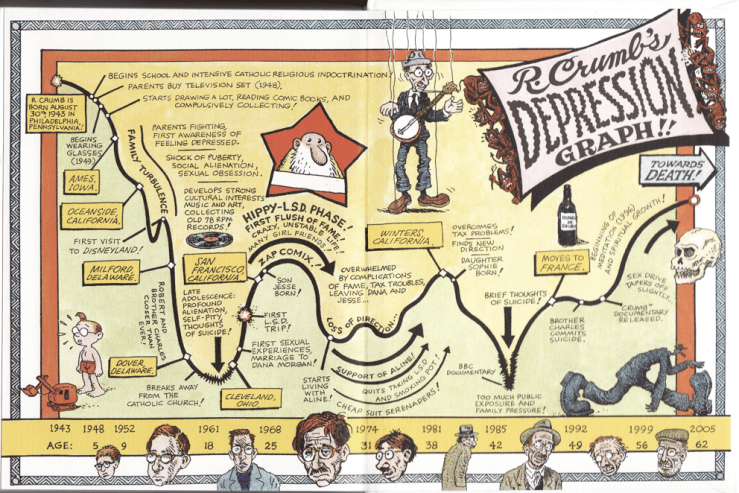
R. Crumb’s Depression Graph

Bret Easton Ellis Disses David Foster Wallace

At a in a reading in Hackney, England, two days ago, Bret Easton Ellis dissed the late great David Foster Wallace:

Question: David Foster Wallace – as an American writer, what is your opinion now that he has died?

Answer: Is it too soon? It’s too soon right? Well I don’t rate him. The journalism is pedestrian, the stories scattered and full of that Mid-Western faux-sentimentality and Infinite Jest is unreadable. His life story and his battle with depression however is really quite touching . . .

Via HTMLGIANT, via The Howling Fantods. The discussion at HTMLGIANT’s comment section is pretty great right now (see our own comment thread below for comments detailing HTMLGIANT readers who claim that BEE’s quote is misrepresented/mistranscribed), with a few commentators bringing up an interview in which DFW said the following about BEE:

I think it’s a kind of black cynicism about today’s world that Ellis and certain others depend on for their readership. Look, if the contemporary condition is hopelessly shitty, insipid, materialistic, emotionally retarded, sadomasochistic, and stupid, then I (or any writer) can get away with slapping together stories with characters who are stupid, vapid, emotionally retarded, which is easy, because these sorts of characters require no development. With descriptions that are simply lists of brand-name consumer products. Where stupid people say insipid stuff to each other. If what’s always distinguished bad writing—flat characters, a narrative world that’s cliched and not recognizably human, etc.—is also a description of today’s world, then bad writing becomes an ingenious mimesis of a bad world. If readers simply believe the world is stupid and shallow and mean, then Ellis can write a mean shallow stupid novel that becomes a mordant deadpan commentary on the badness of everything. Look man, we’d probably most of us agree that these are dark times, and stupid ones, but do we need fiction that does nothing but dramatize how dark and stupid everything is? In dark times, the definition of good art would seem to be art that locates and applies CPR to those elements of what’s human and magical that still live and glow despite the times’ darkness. Really good fiction could have as dark a worldview as it wished, but it’d find a way both to depict this world and to illuminate the possibilities for being alive and human in it. You can defend “Psycho” as being a sort of performative digest of late-eighties social problems, but it’s no more than that.

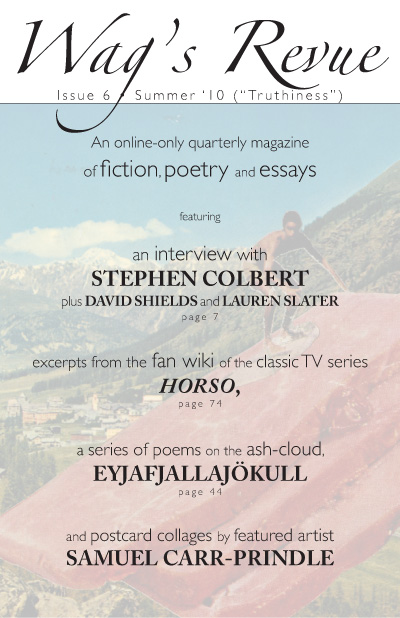
Wag’s Revue #6 Features Stephen Colbert, David Shields, and More

Issue 6 of the online literary journal Wag’s Revue is out now, and features interviews with Stephen Colbert and Reality Hunger author David Shields. They’re calling it the “Truthiness” issue, which I guess is appropriate. Here’s Colbert actually talking about Shields:

WG: Despite your professed aversion to books, you often have guests on the show from the world of literature. In fact, David Shields, who we recently interviewed, was on your show shortly after we spoke with him.

SC: Yeah, you guys should get a nice Colbert bump out of that.

WG: How do you reconcile that, though?

SC: Reconcile what? Having Shields on the show? I nailed Shields. You can go to the tape and see that. I mean, the guy’s book is the equivalent of you guys putting clips from my show on your website and calling it “The Wag-bert Report.” It’s—basically, it’s Wikipedia. A bunch of unattributed, slapped-together quotes. Mostly taken from Britannica.

“A bunch of unattributed, slapped-together quotes”–that’s about right, although it’s always a precarious position to agree with Colbert’s persona. As for the Shield’s interview, well, he manages to say a number of embarrassing things. Here he is explaining why he’s too busy to actually read the novels he’d love to see extinct:

What I find tedious are works that genuflect at the altar of narrative. What happens with so many books by supposedly intelligent writers is that the intelligence gets tamped down: ‘I’ll tell this story and the meaning will crawl through the cracks of the narrative at six crucial points.’ That’s not worth it. Part of my conversion, you could say, resulted of becoming aware of mortality. This is what I focused on in my previous book [The Thing About Life is One Day You’ll Be Dead]. This is it. This is my entire life. We are mortal beings watching the earth for a short time. I don’t have time for a 600-page novel that tells me that crime doesn’t pay.

Interviewer Sandra Allen has the intelligence to call Shields out on this. Observe:

SA: But doesn’t this dismissal also potentially dismiss art? Dismiss a reader experiencing the glorious immersion in the art that is Crime and Punishment, or for that matter Swann’s Way or Ulysses or 2666?

DS: First of all, most of the books that you mentioned were written a long time ago. I love Proust above all else pretty much. Of course if you want to read Crime and Punishment, Swann’s Way, these glacially-paced novels that have no place in a 21st century universe, you can. Even the Bolaño was written ten or so years ago. I’m trying to figure out how we’re going to write now.

Shields then blathers about how Reality Hunger, like Monet or Ulysses or Beethoven’s 5th (!) is really renewing art, claims that all of the critics who hated on Reality Hunger merely proved his point (Shields offers no support for this argument), and generally poses as a would-be revolutionary/college sophomore who just read half of Roland Barthes’s Mythologies. The interview is basically great ammunition for anyone who saw through Reality Hunger.

James Wood Summarizes David Mitchell’s The Thousand Autumns of Jacob de Zoet

I’m a few hours from the end of the audiobook version of David Mitchell’s new novel The Thousand Autumns of Jacob de Zoet. It’s fantastic stuff so far–engaging, imaginative, complex, and satisfying in its richness. Here’s a summary of the book from James Wood’s review of the book in The New Yorker, July 5, 2010:

Jacob de Zoet is a pious, pedantic, upright young clerk for the Dutch East Indies Company, newly arrived on the man-made island of Dejima, in the bay of Nagasaki. It is 1799. The Japanese, enforcing their policy of isolation, confined the Dutch to their post at Dejima, a kind of floating village connected by a bridge to the mainland, and strictly monitored them. The Dutch were effectively prohibited from entering the landmass of Japan, except for the purpose of making an annual visitation to the shogun, in Edo; religious services were banned, and books of Christian devotion were seized upon arrival. Jacob is quickly involved in two difficult narratives: as an employee of the utmost probity, he is tasked with auditing the company, and purging its corruption (various employees have been fiddling the books and stealing goods); unfortunately, the man who has bestowed that task, Unico Vorstenbosch, the chief of the Dejima trading station, is himself on the take. When Jacob confronts Vorstenbosch about his dishonesty, he is suddenly isolated, without allies.

The second struggle also isolates Jacob: he falls in love with Orito Aibagawa, an unusual Japanese woman who works as a midwife, and who has been taking medical instruction from a Dutch physician and intellectual, Dr. Marinus, long resident on Dejima. It is almost impossible for Jacob to advance his love; he is not even sure that Orito returns it, and, even if she did, how could a red-haired Dutchman and a wellborn Japanese woman form any serious bond? But, before anything might occur, Orito disappears. Her father has died, leaving large debts, and it seems that Orito’s family, in order to settle those debts, has “sold” the daughter into a kind of slavery: against her will, she is taken to a remote rural nunnery, run by a powerful and malevolent warlord, the Abbot Enomoto. Just as Jacob fought to unravel the corruptions of his company, so he now strives to unravel the corrupt potency of the Abbot Enomoto and his cultlike temple. As an English reviewer has remarked, the Abbot’s temple, where the enslaved nuns are drugged and impregnated by willing monks, is reminiscent of the world of Japanese anime.

This summary is really the best part of Wood’s review, which works overtime to find fault in what is a very good book. He spends a good deal of his review dithering over the space Mitchell occupies in the contemporary literary world–is Mitchell a postmodernist? A post-postmodernist? A late postmodernist? It’s all quite silly, and I’ll probably write about it in a later post.

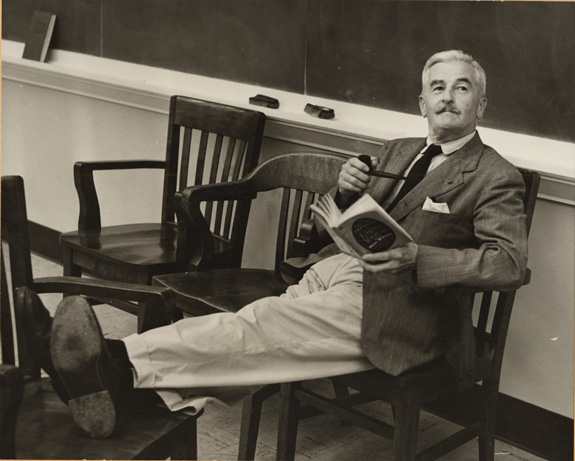
William Faulkner’s UVA Lectures Now Available Online

Faulkner at UVA, 1957

In 1957 and 1958, William Faulkner served as the first writer-in residence at the University of Virginia at Arlington. Under the direction of English Professor Stephen Railton, UVA has now put the audio archive online, making it available to the public for the first time. There are dozens of lectures here, as well as many readings from Faulkner’s essays and fiction, including a reading from The Sound and the Fury. Cool stuff. For more about Faulkner’s time at UVA, read the university’s Magazine article, “Faulkner among the ‘Snobs’.”

The AV Club Interviews China Miéville

The AV Club interviews author China Miéville about his new book, Kraken. From the interview:

Kraken is a very undisciplined book. That’s a gamble. If it doesn’t come off, it’s disastrous. But there are pleasures, I think, to a meandering lack of discipline that you can’t get the other way, and vice versa. You gain something and you lose something. My second book, Perdido Street Station, was the one that a lot of people really, really liked, and it was tremendously sort of rumbustious and ill-disciplined. I feel like I’ve been getting increasingly disciplined since then, and some readers seem to miss that kind of amiable chaos. What I wanted to do with Kraken is tap into what you’ve kindly called an eruption. I wanted to indulge that. It does have a very different feel than The City & The City. It obviously won’t work for everyone, but I always think about books like—and I don’t mean this hubristically—Gravity’s Rainbow. If Gravity’s Rainbow is anything, it’s kind of this dreamlike meander. The idea of saying to Pynchon, “You know, you need to tighten this up,” it would destroy it. Kraken was an effort to tap into that same kind of pleasurable ramble. In some ways, Kraken is more like Perdido, whereas The City & The City was a departure. It’s the kind of thing I’d like to do a lot more of. In some ways, this was getting back to what I was better known for.

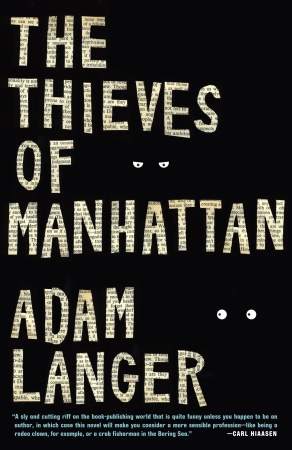
The Thieves of Manhattan — Adam Langer

The literary hoax at the heart of Adam Langer’s new novel The Thieves of Manhattan explores the line between fiction and fact, asking readers to examine what kinds of truth they demand from their books. The novel’s outset finds protagonist/narrator Ian Minot working in a coffee shop, watching his too-good-for-him girlfriend Anya begin to succeed in a literary world that repeatedly rejects his own small, simple stories. Ian writes character-driven short stories that attempt to capture the banal truths that permeate ordinary, everyday existence. Publishers aren’t interested though, telling Ian that his characters don’t seem to live on after the last page. Aggravating matters, blatant phony Blade Markham sits atop the bestseller lists despite the fact that his memoir Blade by Blade seems too preposterously fantastical to hold up to even the flimsiest exercise in fact-checking. When Anya gets a book deal and leaves Ian for Blade, Ian hits bottom and agrees to work with a former editor named Roth on a literary con. After years of getting his crime-adventure novel A Thief of Manhattan rejected–it’s not realistic enough–Roth enlists Ian to rewrite the book as his own, real memoir. Working together, Ian and Roth revise Thief until it becomes Thieves, a book that weds Ian’s sense for character depth and dialogue with Roth’s crime noir adventure plot. As galleys arrive and it becomes clear that Thieves is poised to be a major hit, it also becomes clear that not all the details of Roth and Ian’s fake memoir are so fake after all. To reveal more of the plot would spoil the twists, turns, and snares of its brisk third act, so we’ll leave summary aside by simply noting that Thieves compels reading to its final page, a reading that you’ll likely complete in one sitting once that third act begins.

Thieves is a hybrid novel, a stylistic balancing act between Ian’s character-based, realist, psychological storytelling and Roth’s adventure-mystery tales. Langer draws his audience in to identify with Ian. It’s hard not to empathize with Ian, especially through his early embarrassments in Manhattan’s literary world, a world that Langer satirizes with equal parts vitriol and love. Ian mocks the successful literati who he feels have rejected him; to him, they’re poseurs, hacks, and shallow sycophants. One of the rewards of Thieves is watching Ian transform into one of the people he would once mock, and to do so through an act of fakery, one which he repeatedly defends (to himself) as a means to artistic expression. Langer’s groundwork in developing Ian’s character pays off tremendously in the novel’s aforementioned third act, which essentially finds Ian transforming into a character in a book that he (kinda sorta) wrote himself. Here, Thieves shifts gears into full-on noir adventure, yet retains its self-referential humor through its final spiky helix. It works because we still believe in the core veracity of Ian’s character. And while plenty of literary comparisons would be apt here, the last act of Thieves reminded me most of the final act of Spike Jonze and Charlie Kaufman’s marvelous film Adaptation, a film that at once enacts and comments on its own genre status without the pitfalls of academic dithering.

The signature literary device of Thieves is a strange kind of metonymy where the names of authors, characters, and other proper-noun literary references substitute for objects or actions with which they are closely associated–at least in Ian’s lit-soaked mind. An example: “I saw us agreeing to split the apartment down the middle, putting a divider between her proust and mine. I could hear her having wild chinaski in the next room with all of her new boyfriends, madly scrawling in her notebook, furiously typing on her laptop, while I sat alone with my hand on my portnoy.” Langer takes a risk here. His narrator’s ergot could have turned out too-precious (and thus eventually irritating); instead, Ian’s litspeak becomes the fitting jargon for a crime novel. In appropriating and recontextualizing other authors’ characters and names, Ian’s jargon underscores Thieves‘s themes of the tension between fact and fiction, the writer’s role in delivering truth, and the concept of the artist as a thief.

Literary hoaxes are hardly new, but in recent years there’s been a small explosion of memoirs revealed to be part or wholly false. Langer clearly has a love for literary hoaxes old and new, and it shows in his book, particularly through his narrator’s transformation from a writer of realist fiction to a fake memoirist to a character in a book of his own making. The Thieves of Manhattan is a tightly-plotted, character-driven adventure-crime noir-mystery-hoax-con game novel pretending to be a memoir (pretending to be a novel . . .) that, despite all its fun metafictional games, never falls into the trap of navel-gazing. Langer gives us a character we can care about and puts him in the middle of a plot we want to see through to its end, but the real testament to Thieves is how much we can still care about that character after the last page. Highly recommended.

The Thieves of Manhattan is available from Spiegel & Grau. For more, read Biblioklept’s interview with Adam Langer.

Biblioklept Interviews Adam Langer about His New Book, The Thieves of Manhattan

Adam Langer’s newest novel, The Thieves of Manhattan hits bookstores across the country this week. It’s a smart, funny hybrid that blends and bends genres with startling results. Adam was kind enough to talk to Biblioklept over a series of emails about his new book, truth vs stuff that actually happened, literary hoaxes, and being mistaken for the author of The Magicians. You can read more about Adam Langer at his website, including info on his previous novels Crossing California, The Washington Story, and Ellington Boulevard, and his memoir My Father’s Bonus March. The Thieves of Manhattan is available from Spiegel & Grau.

Biblioklept: Your new novel (or novel-posing-as-memoir-posing-as-novel-posing-as-memoir . . .) The Thieves of Manhattan is about a con game, a literary hoax, and the problems of art and truth, love and theft. It’s also a send-up of the publishing industry and a clever adventure story with a noir flavor and a self-referential sense of humor. I want to talk about all of that, but let’s begin with your protagonist, Ian Minot, a barista with literary aspirations. Early in the novel, he attends a Manhattan party crammed with literary types, most of whom he thinks are poseurs and hacks. At the same time, under his bitterness, we sense that he’d love to be a part of that world. How much of Ian’s experiences correlate to your own with the publishing world? How much hyperbole is in your satire?

Adam Langer: Looking back on writing Thieves, it’s sometimes hard for me to remember exactly where the reality ends and the satirical hyperbole begins. At some point, fact and fiction fuses in my mind, which is, of course, one of the themes of the book. On the one hand, it’s totally true that, as an editor of Book Magazine, I attended many a literary wingding in which actual events described at the book took place. Yes, just as Francine Prose happily greets our hero until she realizes she has confused him with someone else, I too was happily greeted by Ms. Prose until she realized that she thought I was Lev Grossman (Argh). On the other hand, though, a majority of Ian’s experiences and Ian’s biography emerge completely from my imagination—my resumé has a lot of odd items on it, but New York barista isn’t one of them. I liken this experience of melding the actual with the fanciful to one of those live action/animation movies like Who Framed Roger Rabbit? or Mary Poppins, in which the two coexist to create another reality.

B: At the beginning of Thieves, Ian is writing “small,” realistic, character-based stories that no one wants to read. He enters into a literary con with a man named Roth to produce a big adventure story that they will sell as a memoir–as “true,” despite how improbable and fantastical it is. Thieves is in many ways an analysis on our modern obsession for true stories (and the way that “truth” can unravel). Why do people demand truth–even when it might not be what they really want from a narrative?

AL: I think we, or at least speaking for myself, I do want truth from a narrative. When I read a book or see a movie, I do want it to resonate; I want it to either connect with my viewpoints or to challenge them and make me rethink them; I don’t like when my BS-o-meter is constantly going off. But I think people often get bogged down when they confuse Truth with Stuff That Actually Happened. Tim O’Brien has an awesome essay on this topic that kind of blew my mind when I was in college. As for me, I’d much rather read a story of space aliens or baboons or Elizabeth Barrett Browning’s dog that rang true than a self-aggrandizing purportedly-true memoir or celebrity autobiography. There’s a line in Steve Toltz’s A Fraction of the Whole, which I quite liked–”If someone said to me, ‘I’ve got this great story to tell you, and every word of it is an absolute lie!’ I’d be on the edge of my seat.” That line has stuck with me. Also, more prosaically, in the publishing industry, there’s a perception that, with the decline of traditional book coverage, a good novel isn’t enough anymore, that the author needs a compelling biography as well. Ian certainly has this perception and part of his frustration is that he assumes his lack of success is directly related to his lack of an interesting autobiography. He later learns he was wrong regarding just about all of his
perceptions.

B: In his recent book Reality Hunger, David Shields makes a point similar to yours that audiences “get bogged down when they confuse Truth with Stuff That Actually Happened.” Shields also calls for the extinction of the “novelly novel” or the “novel qua novel” — he wants hybrid or “remix” novels. Thieves strikes me as such a novel, clearly in its treatment of memoir vs. novel, but also in its self-aware incorporation of genre fiction tropes from adventure stories and crime noir. Had you tried your hand at crime fiction or adventure tales before Thieves? Were there any difficulties you faced in crafting your hoax story?

AL: I haven’t read Reality Hunger, but my sense is that Shields is probably a lot more dogmatic in his views than I am. I’m not particularly interested in rendering any particular literary form “extinct,” except maybe the genre of Manifestoes That Declare Certain Literary Forms Extinct. I’m a fan of novelly novels just as I am a fan of remix novels or hybrid novels. I love writers who experiment with form and writers who hew to the “well-made-novel” and haven’t advanced past the 19th Century. Though Thieves probably does fit the definition of hybrid or remix, I don’t think that’s all I’ll be writing from now on. As for crime fiction, I’ve dabbled. In fact, the first novel I wrote after moving to New York in 2000 was a thriller of sorts set in the publishing world and concerned a research assistant to a crime novelist who becomes chief suspect once that novelist disappears. It had a lot of problems, and I haven’t taken it out of the drawer in about nine years. Although I have other crime/genre fiction ideas, I think my tastes and skills tend more towards character-based, comic social novels. But putting together the hoax plot was really a blast or a hoot or something like that. It was really incredible fun to try. Normally, when I’m writing, I read certain books to inspire me; while writing Thieves, I was religiously doing New York Times crossword puzzles.

B: Speaking of crossed-words, your narrator Ian uses a rhetorical device that will stand out to many readers: he substitutes the names of famous authors, alter-egos, and literary characters for words he associates them with–so, sex becomes “chinaski,” after Bukowski’s stand-in, a bed becomes a “proust,” a thick head of hair becomes a “chabon,” and so on. How did you come up with this idea?

AL: Well, it seemed to me that so many thrillers I’ve read are filled with jargon, whether hard-boiled patois or technical procedural details, that I thought my narrator needed his own lingo. At the same time, the lingo worked for me because it established Ian’s mindset, one completely immersed in the contemporary literary universe. Before I even started Thieves, I heard this voice that spoke in this literary slang, much of which I didn’t wind up using because I didn’t want to overdose on it. The idea of the slang is that it should be understandable in context without anyone needing to understand or even care about what is being referenced.

B: There is an “answer key,” though–a glossary at the end. Was that your idea? Or was that a publisher’s or editor’s inclusion?

AL: My idea, and I was just having fun with the glossary. I don’t like when readers can flip to the last page and see how it turns out. So, my previous books have featured glossaries, an index, and in the case of Ellington Boulevard, song lyrics.

B: Like you, I’m a big fan of literary hoaxes–so one of my favorite passages in Thieves was a detailed list of various literary forgeries and hoaxes, many of which I’d never heard of, like Li-Hung Chang or the works of Emanuel Morgan and Anne Knish. How much of Thieves was born of your interest in literary hoaxes, and how much research did you do along the way?

AL:: I’ve always been fascinated by literary hoaxes and, while editing Thieves, I was reading as many as I could including the titles you mention, as well as watching great literary hoax movies such as Orson Welles’s F For Fake and Forbidden Lies, the documentary about Norma Khouri, and some awesome YouTube footage of “Margaret B. Jones.” I was slightly disheartened to note how many literary hoaxes have been forgotten. My personal favorites are the Diary of a Young Lady of Fashion in 1764-5 by Madalen King Hall aka Cleone Knox, an incredibly fun read, and the poems of the fictional “Ern Malley,” who has some great turns of phrase no matter how nonsensical. I have no idea what “I am still the black swan of trespass on alien waters” means, but man, it sounds cool.

B: While we’re on literary hoaxes, one of my favorite things about Thieves is that both Clifford Irving and Laura Albert (aka JT LeRoy) blurb it, and then, in the plot, a hoaxer agrees to blurb Ian’s book. How did the Albert/LeRoy blurb come about?

AL: I actually take a very active part in soliciting blurbs for my books, which is partially related to control freakishness and partially related to the fact that, as an author, I much prefer hearing from other writers than from editors, publicists or agents. Clifford Irving’s was the first blurb I got for the book, and getting it was remarkably simple. I found his agent, wrote her a letter that she forwarded to him. We had a very gentlemanly correspondence. I sent him the book and he provided a very generous endorsement. As for Laura, we were introduced via a mutual friend and, after I sent her a galley of the book, we traded dozens of e-mails back and forth and had a number of hilarious, wild and profane telephone conversations. She’s a lot of fun to talk to and correspond with.

My initial idea was to have writers blurb as their alter egos or writer characters in their books—Steven King would write as Jack Torrance, Gary Shteyngart would write as Jerry Shteynfarb, Michael Chabon would write as Grady Tripp, and so on. But I was advised that this would be confusing and most readers who got the joke would think that the blurbs were fake.

B: Have you ever stolen a book?

AL: When I was about eleven, I shoplifted a copy of Arthur C. Clarke’s Fountains of Paradise from Rosen’s Drug Store on Devon Avenue a few blocks away from my house in Chicago. But I felt guilty about it, so the next day, I actually wound up sneaking it back.

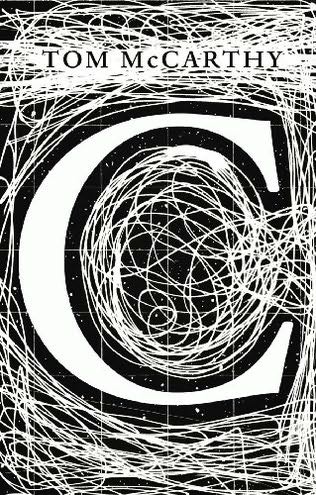
“Plugging Literature Into Other Literature” — Tom McCarthy on His New Novel, C

British Cover for C

Surplus Matters has reprinted last week’s edition of The Sunday Times interview with/profile of Tom McCarthy about his new novel C, our favorite new novel of 2010 (The Sunday Times is not free, so thank you, Surplus Matters). The author of the article, Robert Collins, situates McCarthy’s C as an indirect answer to David Shields’s argument in Reality Hunger that the successful modern novel must be a synthesis or remix. We’ve been critical of Shields’s argument, which ultimately rests on aesthetic assumptions that allow Shields to pick what texts will count in his reality canon. To put it another way, great works of literature, from Homer to Ovid to Shakespeare to Henry Miller have always been appropriating and recontextualizing the texts that came before them. McCarthy’s C doesn’t respond to Shields’s would-be manifesto; it obliterates it, following in the (counter)tradition of Joyce, Woolf, Faulkner, and William Burroughs, writers who navigated the treacherous straits of history, art, representation, and reality. C is rich and inventive, telling the life story of Serge Carrefax in the early part of the 20th century. We follow Serge through his strange youth, where he experiments with wireless technology, to the skies of WWI, where he maps the terrain below him; we follow him through his drug-soaked twenties in the ’20s and eventually to the tombs of Egypt. C isn’t a response to the demands of a marketplace that increasingly demands gimmicky concepts and reality-soaked memoirs; instead, to use McCarthy’s term, C plugs into the reservoir of literature that precedes it. From the article:

If McCarthy — as [Zadie] Smith has suggested — presents a radically fresh prospect for the future of the novel, it is probably, paradoxically, because he has instinctively ignored contemporary literature almost completely. He would argue, in fact, that it is only by immersing oneself in all that has gone before that any contemporary novelist has even the faintest chance of coming up with something new. “I don’t think most writers, most commercial middlebrow writers, are doing that,” he says. “I think they’ve become too aligned with mainstream media culture and its underlying aesthetic of ‘self-expression’. I see what I’m doing as simply plugging literature into other literature. For me, that’s what literature’s always done. If Shakespeare finds a good speech in an older version of Macbeth or Pliny, he just rips it and mixes it. It’s like DJing.”

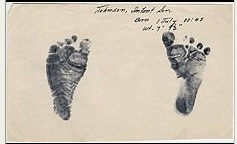
UT’s Harry Ransom Center Acquires Denis Johnson’s Baby Footprints (and Other Archival Material)

The Harry Ransom Center has acquired novelist Denis Johnson’s baby footprints (along with other archival material, including manuscripts, annotations, and other personal material). Read more here. Read our reviews of Johnson’s books Tree of Smoke, Jesus’ Son, and Nobody Move.

Yeah Yeah YA — New Novels from Laurence Gonzales and Simon Rich

Once upon a time, young people who were lucky enough to have the leisure to read what they wanted gravitated toward texts like Little Women, The Adventures of Tom Sawyer, and Great Expectations. These books weren’t necessarily written for or marketed to teenagers, but they found (and continue to find) a hungry audience in adolescents. The rise of the modern publishing industry saw a way to feed these voracious young readers, and Young Adult–YA–has since solidified into its own genre, complete with its own set of conventions and tropes, found in fantasies, romances, adventures, and sci-fi novels alike. YA tends to enlarge themes that predominate literature as a whole–alienation, isolation, shame, transformation, and (of course) identity. The best YA literature speaks to adolescent fear, channels it into thought experiments and fantasies that help teens to cope with their changing identities. However, YA, like any genre, puts a writer at risk of being ghettoized, of having her own work thrown in with a good many bad books. In recent years, established writers like Sherman Alexie and Nick Hornby have purposefully written YA books and worked to have their books marketed as such, but perhaps many writers don’t want to be pigeonholed into a genre by having their books directed squarely at teens.

I was thinking about this problem today when I read Michiko Kakutani’s somewhat negative review of Laurence Gonzales’s new novel Lucy in the The New York Times. I received a review copy of Lucy back in March and breezed through it in a few afternoons. It’s an enjoyable read with a preposterous plot that somehow doesn’t come across as a gimmick. The eponymous Lucy, you see, is a genetic experiment, a humanzee born of a bonobo and raised in the middle of the jungle by a (not so) mad scientist named Stone until the age of 14, when insurgents murder her erstwhile dad/creator. Lucy is summarily adopted by another scientist, Jenny Lowe, who takes her to Americaland where she learns to be a normal teen. That is, until her super-chimp powers are revealed to the good American people, who come after her, mob-persecution style. Kakutani insists on reading Gonzales’s work as a Frankenstein story, and picks at it for not explaining its science as well as Michael Crichton’s Jurassic Park. What Kakutani is failing to see is that the novel is not really about scientific hubris–it’s about how hard it is to be a teenager; specifically, it’s about how hard it is to be a teenage girl with a teenage girl body. Kakutani, apparently mistaking books for gravy, also takes Lucy to task for being “lumpy.” If Lucy lacks the finesse, explication, or subtlety that Kakutani would like it to have, then perhaps that is because she misunderstands its audience (to be fair though, Kakutani seems to frequently forget that not all books should be written to her taste).
Again at The New York Times, Tom DeHaven made a similar, if less boorish mistake, earlier this summer in his review of Simon Rich’s début novel Elliot Allagash. Here’s his lede:

If I were in the eighth grade, I’m pretty sure I’d love Simon Rich’s first novel, “Elliot Allagash.” I might even press it on my friends. (“It’s about this 13-year-old evil genius who does whatever he wants because he’s, like, a billionaire. And it’s funny. And short.”) But since more than 45 years have passed since I took up space in a middle school, I simply like it, very much — while wishing this flippant little parable about the puerility of greed had a deeper, sharper bite.

DeHaven wishes Rich’s book had a “deeper, sharper bite” — like Kakutani’s quibble with Gonzales, he wants the kind of acuity that ultimately is not best suited for the eighth and ninth grade boys who will love this book, who will press it on their friends. In my own review of Elliot Allagash, I wrote: “I don’t think that Elliot Allagash is being promoted directly as a Young Adult novel, but it will have a ready audience in the same smart crowd who dig funny, bright novels like C.D. Payne’s Youth in Revolt and Sherman Alexie’s The Absolutely True Diary of a Part-Time Indian .” But even though Elliot Allagash and Lucy aren’t being promoted by their respective publishers Random House and Knopf as YA, that doesn’t mean that they don’t have a potential audience of young adults–and it seems impossible to me that seasoned critics like Kakutani and DeHaven could be ignorant of that. Older readers might enjoy Lucy or Elliot Allagash but young readers might love them; critics shouldn’t condescend authors for not overreaching. A pretentious book is a sin and neither of these books is pretentious.

“—the bitter lapse into everyday life—the hideous dropping off of the veil” — Or, We Return from Vacation

After five five fun-filled (mostly) sun-soaked days on Florida’s glorious Gulf Coast, Biblioklept returns from July 4th reveries. I found time to finish Adam Langer’s The Thieves of Manhattan–full review forthcoming, but now, I’m still in a lazy-loungy mood: so, links and vids and so forth–

First, I ripped my title from Edgar Allan Poe’s “The Fall of the House of Usher,” which you obviously knew of course, gentle reader, because of course you’ve read it, but maybe you haven’t seen Jan Svankmajer’s 1981 film adaptation. Creepy stop motion that completely dispenses with actors. Ignore the subtitles.

Another great little film I saw this weekend is Oliver Laric’s Versions (2010), an essay that playfully updates Walter Benjamin’s “The Work of Art in the Age of Mechanical Reproduction.” Watch Versions. A choice line–perhaps appropriated?–from Laric’s essay: “There is more work in interpreting interpretations than in interpreting things and more books about books than any other subject.”

Still on film: watched John Huston’s 1956 adaptation of Moby-Dick on a lazy post-July 4th demi-hangover. Melville’s novel is unfilmable, really, but Huston’s effort isn’t half bad, although the tone of “high adventure” and the downright jaunty soundtrack hardly fit the grisly images of whale killing that permeate the work. The climax doesn’t really read as big as it should either. Key scene: Orson Welles delivers Father Mapple’s sermon–

Finally, I listened to a good chunk of the audiobook of David Mitchell’s new novel The Thousand Autumns of Jacob de Zoet. Good stuff so far (great stuff, really), and a full review forthcoming, but for now, here’s Dave Eggers’s review.

Jan Swafford Explains Why E-books Won’t Replace Real Books

Musicologist Jan Swafford’s article “Why E-books Will Never Replace Real Books” at Slate makes a good case for why we’ll still want printed books in the age of the iPad and Kindle (not that I needed convincing). From the article:

So real books and e-books will coexist. That has happened time and again with other new technologies that were prophesied to kill off old ones. Autos didn’t wipe out horses. Movies didn’t finish theater. TV didn’t destroy movies. E-books won’t destroy paper and ink. The Internet and e-books may set back print media for a while, and they may claim a larger audience in the end. But a lot of people who care about reading will want the feel, the smell, the warmth, the deeper intellectual, emotional, and spiritual involvement of print.

HTMLGIANT Interviews Lee Rourke about His New Novel, The Canal

At HTMLGIANT, Catherine Lacey interviews Lee Rourke about boredom, the writing process, dialogue, foxes, and his new novel The Canal. Read our review of The Canal here. From the interview:

Your narrator speaks a lot about his philosophy on boredom. How much of this do you share with him?

Well, I would have to say quite a lot. I mean, I truly believe – as Bertrand Russell did before me – that if we truly embraced boredom there would be less violence in the world. When I say truly embrace boredom I mean that we should make an effort not to fight it – we especially shouldn’t do something just to stop us from feeling bored (this just leads to the type of passive nihilism the philosopher Simon Critchley warns us about). I think we should just accept it and naturally feel bored and ultimately do nothing. Fighting boredom only leads to friction, which can cause myriad things, including the type of violence that haunts my novel. But I know this is a losing battle. It is a losing battle because boredom reveals to us the nothingness that makes up our lives: the gaping void of our existence, its meaninglessness and finiteness. Obviously this gaping void scares the shit out of us. And it is because of this intrinsic fear that we mostly fail.

In Brief — Adam Langer, William H. Gass, David Foster Wallace, and Frank Meeink

I have terrible writer’s block. It’s not that I have nothing to say, it’s just that I can’t seem to say it. Or that I write sentences like the previous one and shudder at their awkward clunky artless awfulness. But I’m gonna press through it, write through it, and share a few thoughts on what I’ve read this week–

First up: Adam Langer’s new novel, The Thieves of Manhattan, a send-up of the publishing industry that sets its targets directly on the current swath of (faked) memoirs that have done gangbusters for publishers in the past few years. Ian Minot is a broke-assed barista one fuck-up away from an overdue firing, who moves from the Midwest to make it as a writer in the big city. Only he’s not doing so well–in contrast to his gorgeous Romanian girlfriend Anya whose literary star is on the rise. For Minot though, this isn’t the worst–that would be the rampant success of über-poseur Blade Markham, a wanna-be gangsta whose memoir Blade on Blade is a blatant fabrication (albeit a fabrication that no one but savvy schlemiel Minot seems to notice (or, at the least, be bothered by)).  I read the first fifty-odd pages of the Thieves in one sitting–a good sign to be sure. Langer’s Minot’s voice is familiar territory, the boy who loves to mock the literati he would love to be a part of. In one of the signal moves of his patois, the names of famous authors (and characters) regularly replace common nouns–a bed becomes a proust, a full head of hair is a chabon, sex is chinaski and so on. Minot seems to be headed to running his own grift soon with the help of a man he appropriately calls the Confident Man–should be good stuff. Full review forthcoming. The Thieves of Manhattan is available July 13, 2010 from Spiegel & Grau.
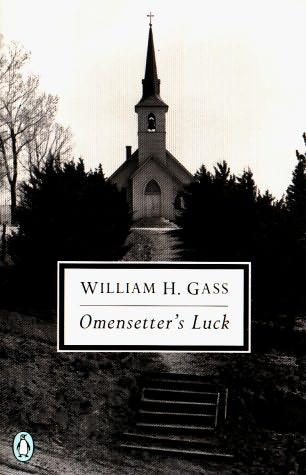
I’ve also been reading William H. Gass’s first novel, Omensetter’s Luck. It’s weird, wonderful, Faulknerish in its loose (but somehow layered and constructed) stream of consciousness. Omensetter’s Luck comprises three sections, each progressively longer; I finished the second one today, and so far the novel seems to dance around a description or accounting of its namesake, Brackett Omensetter who carts his family into the small sleepy town of Gilean, Ohio, and immediately perplexes the townsfolk with his amazing luck. As Frederic Morton put it in his contemporary 1966 New York Times review, “It quickly becomes apparent that as other people have green thumbs, [Omensetter] has a green soul. The cosmos and he live in mysterious congruity.” There’s much to commend and unpack in Gass’s writing here, but the pleasure of his musical rhythm are enough for me now (in my writer’s block, I retreat to aesthetic criticism [shudders]). Besides, do I really have to recommend this novel when David Foster Wallace already did so in his semi-famous list “Five Direly Underappreciated U.S. Novels > 1960”? No, I don’t, that’s right. Here’s Wallace on Omensetter’s Luck: “Gass’ first novel, and his least avant-gardeish, and his best. Basically a religious book. Very sad. Contains the immortal line ‘The body of Our Saviour shat but Our Saviour shat not.’ Bleak but gorgeous, like light through ice.”
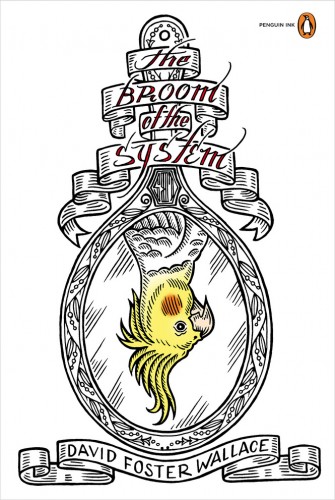
Speaking of Wallace and début novels, Richard Rayner at The Los Angeles Times has reviewed Wallace’s first book The Broom of the System, which is being republished at the end of this month with a cool new cover by tattoo artist Duke Riley. A considered, well-written review, one which prompted me to dig out (okay, bad verb phrase choice; no unearthing involved, my Wallace volumes are neatly aligned together on a shelf in my living room) my copy of Broom. I remember reading a friend’s copy in the burning humidity of a Gainesville summer, in ’98 or ’99, reading the book in long chunks. I tried to read it again after I finishing Infinite Jest but it seemed kinda sorta goofy (albeit purposely, Pynchonesquely goofy). Anyway, Rayner’s review makes a strong case for a re-reading.

And, speaking of Wallace (again), or at least using him as a crutch–I’ve almost finished Autobiography of a Recovering Skinhead by Frank Meeink (“as told to” Jody M. Roy; they’ve sort of got the whole Malcolm X/Alex Haley thing going on there). So, yeah, why the Wallace segue? How to justify it? Well, reading Meeink’s story, the true story of an abused, battered Philadelphia kid who falls into the American neo-Nazi movement and its attendant violent crime and terrorism, who goes to prison and finds redemption and human connection and a new purpose for the nihilistic void of his life, who falls into alcoholism and drug addiction only to be redeemed again–reading Meeink’s story, even knowing its veracity (demonstrable to a point that would satisfy even Langer’s Ian Minot)–I couldn’t help but read his strong, immediate, gritty, and utterly real voice as something not unlike one of the creations in David Foster Wallace’s Brief Interviews with Hideous Men. It’s not just Meeink’s hideousness, his violence, or the grace that he works toward–all constituents of DFW’s collection–it’s that voice, the realness of the volume, surely the book’s greatest asset. Recovering Skinhead is an engrossing read, fascinating in the same way that an infected wound prompts our attention, our paradoxical compulsion and repulsion, but most of all it’s an exhilarating and exhausting performance of voice, of Meeink’s unrelenting, authentic telling of a tale, a telling that any novelist would thrill to channel. Only Meeink’s voice isn’t a novel creation: it’s real. Autobiography of a Recovering Skinhead is available now from Hawthorne Books.

Pop Damage Interviews James Grauerholz, Executor of William Burroughs’s Literary Estate

Pop Damage interviews James Grauerholz, executor of William Burroughs’s literary estate. From the interview:

SF: William’s magickal experimentation, the aspects of recording what he called “Danger Sounds” and replaying them in proximity to his target, or using collage to hit a specific target has become the stuff of legend. Some attribute the closing of one particular establishment to William’s hexes. Is there another specific instance which you can recall that is as dramatic and apparently self-evident?

JG: Nope, not really. You are likely referring to the Moka Bar in London, where William said he received snide, snotty service and lousy, weak tea — and his tape-recorders-and-cameras mock-surveillance routine, back and forth on the sidewalk of Frith Street, and how the Moka Bar failed and was shuttered not too long after that.

Forgive me please, but my cast of mind leads me to suspect the Moka Bar, if it really did sell lousy tea with terrible service, might have been headed out of business, with or without the sound-text-tape-film sidewalk-pacing routine…

As with William’s long-ago theory that, because he had never known a NYC junky ever to get a seasonal cold, it was likely that Junk provided a protective covering to the cells (or else, maybe Junk kept the cells well-exercised and in-shape with a constant cycle of shrinking to kick, swelling back up in re-addiction, kicking, hooked again, etc.) — I pointed out that, because a junky with a good supply on hand rarely leaves his apartment to mingle on the sidewalk with other people (which would expose him to more airborne rhinovirus particles), maybe the apparent immunity was more the result of limited exposure to current pathogens…