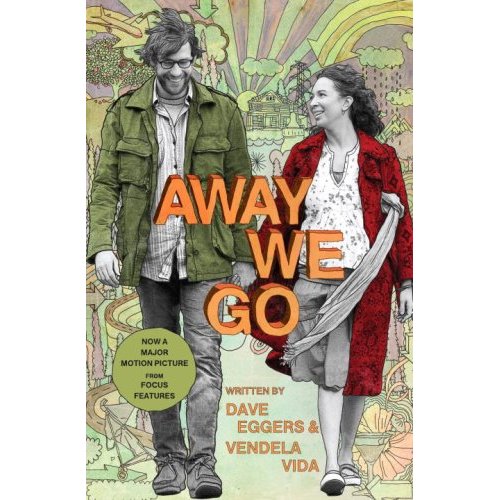
Away We Go — Dave Eggers and Vendela Vida

away

Away We Go is the story of Verona and Burt, an unmarried couple in their early thirties expecting a child. After discovering that the child’s only living grandparents will be moving to Belgium, Verona and Burt realize that there’s nothing anchoring them in Colorado. The pair set out on a cross country journey in their boxy old Volvo, meeting up with old friends and family in an attempt to find the right place to start their new family.

“We’ve attempted to make this readable to a non-screenwriting population, from whose ranks we’ve recently come,” write Dave Eggers and Vendela Vida in their introduction to their screenplay for Away We Go. Released last week in conjunction with the film, the screenplay, with its vivid cover and prestige trade format, seems to physically back up Eggers’s and Vida’s wish–they’re hoping that you’d want to, y’know, actually read it, like, a book, and not just watch Sam Mendes‘s filmed version. There’s that hopeful, informative introduction, for starters, and they really do make good on their claim of readability; stage directions and location shifts are clear but never overbearing, allowing the reader to engage the characters in his or her own imagination. The book also includes scenes (apparently) cut from the movie–should I mention now that I haven’t seen the movie?–as well as an alternate “admittedly radical Bush-era ending.” Still, it is a screenplay–not a novel, not a play, but a text intended for a movie, a movie out there getting reviewed now, a movie with physical entities playing the key roles. “Verona and Burt were written with Maya Rudolph and John Krasniski in mind,” Eggers and Vida state in their introduction, and, between this admission and press for the movie, its almost impossible to read the script without imagining these actors’ mannerisms and tics. Not that that’s a bad thing, it just limits any nuance in (and in between) the lines, and again brings up the question of why one might want to own this book.

The answer for many readers, of course, will simply be Eggers, a modern literary luminary. For the record, we’re a huge fan of Dave Eggers, even when his writing isn’t the best. Eggers is perhaps the most visible of a whole crop of post-David Foster Wallace writers (for lack of a better term), a linchpin of a (non-)movement whose literary house McSweeney’s, and its attendant magazines, Timothy McSweeney’s Quarterly Concern, The Believer, and the video journal Wholphin frequently feature some of the best writing and art out there today. His 2000 memoir A Heartbreaking Work of Staggering Genius might be a bit overrated, but it’s also one of the first post-DFW books to grapple with irony and earnestness in a moving discourse. Besides all of that, Eggers is the founder of 826 National, a nonprofit organization that tutors kids in writing and reading across the country. In short, Eggers is all about making reading and writing fun and cool and demystified for lots and lots of people, and because of that, he’s a hero of ours. Of course, he has his haters; there are many who claim that McSweeney’s is form without substance, all show, fancy design without good writing. This is a pretty silly argument, because all you have to do is sit down with an issue of McSweeney’s or The Believer and actually, y’know read it to realize that 99% of the writing is fantastic. Better yet, check out one of the books they’ve published, like Chris Adrian‘s The Children’s Hospital. Eggers’s haters generally don’t have a lucid argument because what they hate is an attitude, a vibe, a feeling. I’ll readily admit that I’m hip to what they’re describing, and something of that backlash has come out in reviews of the film–especially New York Times critic A.O. Scott’s overly-analytical takedown of Away We Go. There’s a preciousness, a smug quirkiness, an awareness that people simply do not have discussions in the manner that Verona and Burt do, and this puts people off. Of their fictional parents-to-be, Eggers and Vida–who were pregnant with their own child October when they wrote the screenplay–write: “When we conceived them, we thought of a couple who was as different from ourselves as we could muster.” People who read into things deeply might find it hard to believe that Verona and Burt are anything but stand-ins for Vida and Eggers, and that couples casual resistance to the extreme drama of having a child is, honestly, a bit offputting. (If you really want to see some visceral Eggers-hating/Eggers-defending, check out the comments on this recent A.V. Club interview with the pair).

But back to the screenplay, which I suppose was the occasion for this writing. I enjoyed it. It was funny. At times there was an irking quirk to the characters, a certain shallowness that doesn’t do justice to the intensity of pregnancy. I read it in two short sittings–less time than the film would take to watch, I suppose. It also made me want to watch the film, rather than putting me off. Eggers completists might want to add the screenplay for Away We Go to their collections; newbies interested in his work should check out his novel What Is the What, Eggers’s remarkable novelization of the life story of Valentino Achak Deng, one of the “lost boys” of Sudan.

Away We Go is now available in trade paperback from Vintage.
Movie Trailer for Hillcoat’s Adaptation of McCarthy’s The Road

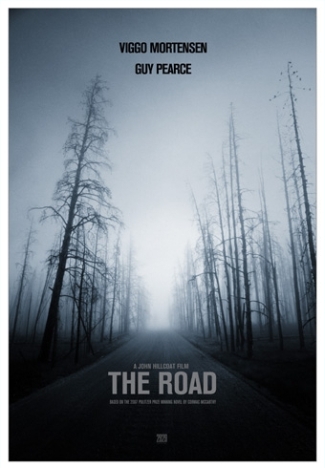
Australian director John Hillcoat’s movie adaptation of Cormac McCarthy‘s bleak and beautiful novel The Road finally has a proper trailer as well as (another) release date, October 16th, 2009. Here’s the trailer:

I weighed in on the possible merits (and possible demerits) of a film adaptation of The Road way back in October of last year, back when the movie was planned for a Thanksgiving release (what better time than Turkey Day to watch a story with baby cannibalism?)

The trailer makes the movie look kinda “big”–explosions, way more people than I remember being in the novel, and what appears to be a heavily expanded role for the wife, played by Cherlize Theron. Still. I wanna see this. At the same time, the trailer seems to scream “Go read the book, now!” And you should. It’s great.

“The Jungle Is Obscene” — Werner Herzog’s Visceral Nature Writing

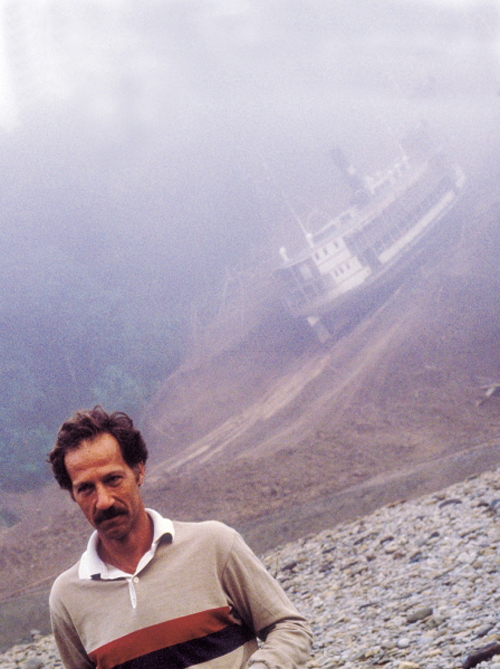
wernerherzogfitz

This month’s issue of Harper’s features a fantastic collection of diary entries by German film director Werner Herzog. These entries are excerpted from the forthcoming book Conquest of the Useless: Reflections from the Making of Fitzcarraldo. Released in 1982, Fitzcarraldo tells the story of a would-be rubber magnate who attempts to haul a steamship over a small mountain in Peru so that he can access an area rich in rubber trees. The infamous Klaus Kinski plays Fitzcarraldo, a European who pushes his crew to the breaking point in this mad quest; the semi-fictional plot was doubled in the real-life production disasters that plagued the movie. Fitzcarraldo dramatizes one of the oldest narrative conflicts, man vs. nature, in an earnest yet completely unromantic way. Fitzcarraldo, the opera-lover who brings ice to the natives, shatters any romantic illusions one might have about the power and majesty of nature in his mad schemes. This theme repeats throughout Herzog’s work, from the conquistador opus Aguirre, the Wrath of God to his outstanding 2005 documentary Grizzly Man. Again and again, Herzog’s films ironize, disrupt, or otherwise show the folly of romanticizing nature. His diary entries from Conquest of the Useless lay these sentiments bare in ways both bleakly poetic and terribly funny.

Take this entry from December 8, 1980: “The jungle is obscene. Everything about it is sinful, for which reason the sin does not stand out as sin.” Here, Herzog provides a succinct antithesis to Rousseau’s concept of the “noble savage.” Herzog’s view of man—de-politicized, that is—seems more Hobbesian, actually. In an entry from April 6, 1981, he writes:

“This morning I woke up to terror such as I have never experienced before: I was entirely stripped of feeling. Everything was gone; it was as if I had lost something that had been entrusted to me the previous evening, something I was supposed to take special care of overnight. I was in the position of someone who has been assigned to guard an entire sleeping army, but suddenly finds himself mysteriously blinded, deaf, and effaced. Everything was gone. I was completely empty, without pain, without longing, without love, without warmth and friendship, without anger, without hate. Nothing, nothing was there anymore, and I was left like a suit of armor with no knight inside. It took a long time before I even felt alarmed.”

Nature seems to nullify Herzog, to void any essential humanity he might have had. His repetition of “Nothing, nothing was there anymore” reminds me of King Lear’s famous lines “Never, never, never, never, never.” Although Lear is weeping over the body of his kind daughter Cordelia, the psychology of these lines surely reflect his own terrible experiences, his own nullified identity of homelessness on the wild heath.

For Herzog, nature is a war, nature will eat you. “Moss grows on lianas, and in the knobby places where the moss is thicker, a leafy plant like a slender hare’s ear grows out of the moss: a parasite on a parasite on a parasite,” he observes. If Herzog is melancholy or mordant in these grim reckonings, he’s also very, very funny. Take this hilarious June 4th entry concerning a giant albino turkey that’s been terrorizing the set:

“The camp is silent with resignation; only the turkey is making a racket. It attacked me, overestimating its own strength, and I quickly grabbed its neck, which squirmed and tried to swallow, slapped him left-right with the casual elegance of the arrogant cavaliers I had seen in French Three Musketeers films who go on to prettily cross swords, and then let the vain albino go. His feelings hurt, he trotted away, wiggling his rump but with his wings still spread in conceited display.”

And yet one senses that Herzog’s humor is a defense against the absurdity of nature, one that derives from an acute awareness that humanity is at once of and apart from nature, and at that by its own definition, its own choice. In a June 2nd entry featuring his nemesis the albino turkey, Herzog details an incident that highlights the essential ugliness of a Darwinian world:

“Our kitchen crew slaughtered our last four ducks. While they were still alive, Julian plucked their neck feathers, before chopping off their heads on the execution block. The white turkey, that vain creature, the survivor of so many roast chickens and ducks transformed into soup, came over to inspect, gobbling and displaying, and used his ugly feet to push one of the beheaded ducks, as it lay there on the ground bleeding and flapping its wings, into what he thought was a proper position and making gurgling sounds while his bluish-red wattles swelled, he mounted the dying duck and copulated with it.”

There we go. We get it all, all the order of nature. Food, sex, death, the whole deal, laid out keenly and with grim humor, neatly compacted into a single, grotesque episode. If these excerpts are any indication of the rest of the book’s trajectory, Conquest of the Useless promises to transcend standard making-of fare. Indeed, Herzog’s book seems nothing less than a profound meditation on the intersection of man, nature, terror, and mortality.

Conquest of the Useless: Reflections on the Making of Fitzcarraldo is available June 30th from HarperCollins.

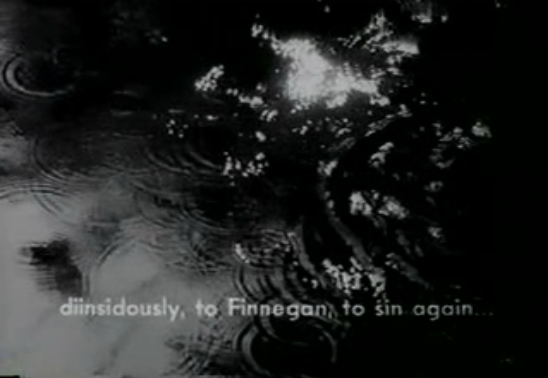
Passages From James Joyce’s Finnegans Wake — Mary Ellen Bute

finnegan

In the mid-sixties, Mary Ellen Bute made a surreal little film that kinda sorta illustrates James Joyce’s most inscrutable novel, Finnegans Wake. Watch the whole thing at UbuWeb Film. And you were going to celebrate St. Patrick’s Day by simply getting stinking drunk…for shame…for shame!

Coraline

coraline-poster

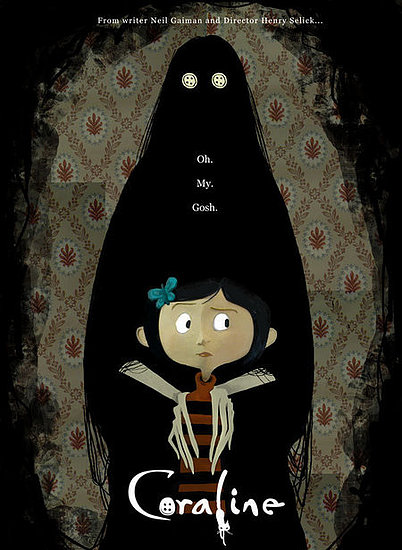
Even if Coraline didn’t have an engaging plot, well-developed characters an audience can really care about, and an especially singular sense of setting, rhythm, and movement, it would still be worth seeing in the theater for its astounding 3D visuals. Director Henry Selick (The Nightmare Before Christmas), working from Neil Gaiman‘s short novel of the same name, has created an endearing, imaginative, and often disturbing fairytale in meticulous stop-motion animation, dramatically enhanced in 3D. Selick doesn’t rest simply on the film’s amazing optical effects; rather, Coraline‘s plot and characterization are seamlessly, often dreamily (or nightmarishly) crafted through those marvelous visuals. Even when a scene veers into outright spectacle, it is always purposeful, cohesive, and forwards the logic of the plot, the story of young Coraline and her strange adventures in an alternate universe.

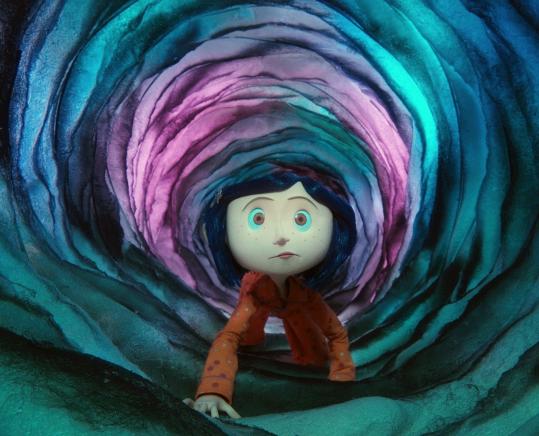
Bored and largely ignored by her parents who have just moved her to a country boarding house, Coraline discovers a tunnel to a world that doubles her own, replete with an “other mother” who cooks all sorts of delicious foods and loves to play games, and an “other father” who dotes on his little girl. This alternate universe also contains more glamorous versions of the boarding house’s other tenants, a circus performer who works with musical mice, and two aging actresses with a predilection for salt water taffy. The alternate world becomes a site of spectacle and wonder for Coraline, as well as the setting for some pretty mind-bending 3D set-pieces for the audience–however, like all fairy tales, Coraline always toes the line between fantasy and nightmare, joy and shocking horror. Savvy audience members will pick up on a sinister thread underlying the early scenes with Coraline’s “other mother,” a creepiness artfully balanced with the notion that this woman represents Coraline’s wish-fulfillment to be loved, adored, and entertained at all times. The reality of this fantasy world soon becomes painfully apparent to Coraline, who must go on a hero’s quest–in her own home–to save her “real” parents.

coraline

Coraline thrills at all the right moments, and at times is downright scary (although the seven year old behind me seemed unafraid; he just kept saying “Awesome!” every five minutes). The plot is rich with allusions to Alice and Wonderland and the Brothers Grimm fairy tales, and, in keeping with these sources, Coraline often exposes its dark side with little or no buffer. From frightening birthing tropes to threats of infanticidal cannibalism, Coraline always purchases its spectacular fantasy with reminders of grim, almost cruel reality. One scene in particular lays this cost literally bare; the aging actresses perform a high-wire trapeze act half-naked, their clumsy, inept bodies overexposed to every kind of peril–including the potential mockery of the audience. In an act of fantastic wish-fulfillment, the old women strip their fat, wrinkled bodies away like the husks of fruit; they emerge young women, their impossible rejuvenation the climax of a fantasy involving an intricate clash of sexuality and death. And yet Coraline repeatedly makes clear the costs of these fantasies, working its way toward a satisfying conclusion that doesn’t attempt to gloss over the erosion, corrosion, and mundane deathliness of life, but rather reconciles how a person might live happily in the “real world.” Very highly recommended.

The Best and Worst Movies of 2008

THE WORST

The Dark Knight

darkknight2

We liked the first act of Nolan’s second Batman movie very much. In fact, nothing in the whole movie could top the robbery scene at the beginning. Yes, we loved Heath Ledger’s Joker. He wasn’t in it enough. But we were getting pretty bored by the end of the second act, and by the time it became clear that Two Face would be a villain in this Batman film and not the next sequel, well, we were downright exhausted. The clunky editing, clumsy fight scenes (you really couldn’t see anything in the film), and convoluted plot turns didn’t help a film where the hero endorses the Bush administration’s methods (torture; spying on its citizens). And don’t even get us started on Bale’s silly “Batman voice.” Worst of all was all the praise this film garnered, as if everyone had been primed to love it and had no other choice. The Dark Knight is a crushing fascist vision; that its true hero is the Joker will be lost on all.

Hancock

An interesting premise and a funny opening scene quickly devolve into an incoherent mythology and a superhero story absent of any real villain. We usually like our films short, but Hancock felt thin at under 90 minutes. What was cut?

Speed Racer

Speed Racer, a psychedelic cartoon blur of flat characters and unfun nonsense should be the nail in the Wachowski’s brother-sized coffin. We’re beginning to think that The Matrix was just a matter of the right William Gibson rip-off at the right time (right time here = right technology). Ugh.

Indiana Jones and the Kingdom of the Crystal Skull

You saw that South Park episode, “The China Probrem,” right? Where Spielberg and Lucas literally rape Indy? That’s about right…

The Happening

the-happening

Shyamalan owes us the ninety minutes he stole from us. We suggest he show up at Biblioklept World Headquarters (shamefaced, of course) prepared to work–there’s always some caulking and mowing and painting that needs doing. On second thought, we’re sure he’d figure out a way to fuck up even the simplest chore. Possibly the worst movie we’ve ever seen.

THE BEST

Iron Man

iron-man-downey-gauntlet

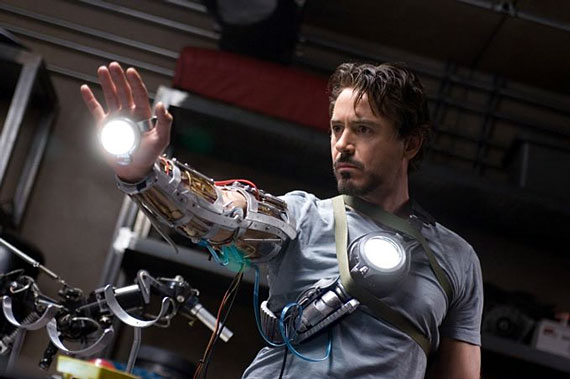
Where The Dark Knight plumbed the worst aspects of human nature, Iron Man gave us a hero with a truly redemptive arc, and did so in a way both moving and humorous. Iron Man also looked great, and featured the best origin story of any of the big superhero movies of the past decade. In fact, we’re calling it: Iron Man is the best superhero movie of the decade.


Be Kind Rewind

We laughed, we cried, we wrote a review.

Burn After Reading

Coming after No Country for Old Men, the Coen brothers’ shaggy dog comedy felt light and even superfluous at times. Still, elements of the story stuck with us long after the viewing, and, as usual, the Coen’s get great performances out of their cast.

In Bruges

in-bruges1

We don’t want to give away too many details from In Bruges, but it’s worth pointing out that the trailers and ads totally missed–or misrepresented–the tone of the movie. In Bruges is funny, but it’s hardly a buddy film–at it’s core it’s a sad, even philosophical, reflection on loss and guilt. Great stuff.

Pineapple Express

Enough has been written at this point on Judd Apatow’s crew and the successes they’ve had in recent years that we don’t need to comment, except to point out that we loved Freaks and Geeks when it originally aired and it’s great to see what all these kids have done since then. Seth Rogen is hilarious, but James Franco steals the show here as a dope dealing loser who just needs a friend. Great action scenes too. Forgetting Sarah Marshall, also featuring Apatow cohorts, was pretty good too, of course.

Wall-E

wall-e-4

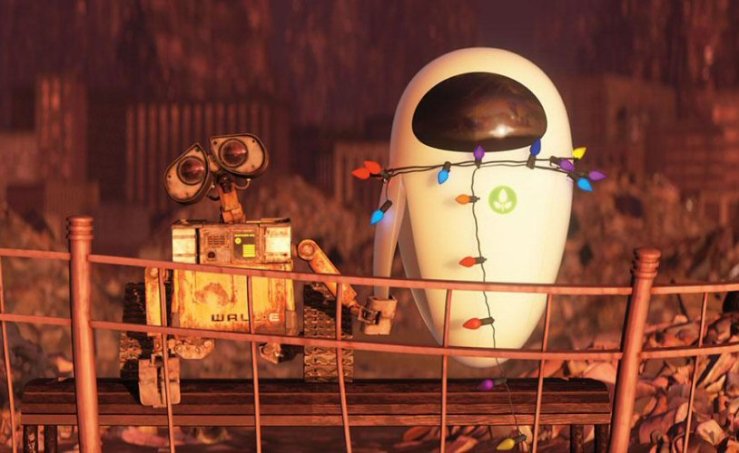
Who knew a post-apocalyptic film criticizing consumerist culture and our ever-increasing loss of connection to both the natural world and our own bodies would be so good? We loved, loved, loved Wall-E. Best film of 2008.

Films we still haven’t seen but in which we have interest: Rachel Getting Married, Synecdoche, New York, Hamlet 2, Hellboy 2, The Wrestler, Quantum of Solace, Let the Right One In.

The Only Earthly Certainty Is Oblivion

Check out this odd, possibly disturbing clip from the obscure 1986 claymation masterpiece, The Adventures of Mark Twain. Bizarre, fun stuff.

Road Movie

“Having your book turned into a movie is like seeing your oxen turned into bouillon cubes” — John LeCarre

Movies rarely compare favorably to the books from which they are adapted and almost never surpass them. Still, film adaptations of books can be fantastic if handled by the right director–take Mexican director Alfonso Cuarón for example, whose brilliant films Children of Men and Harry Potter and the Prisoner of Azkaban (adaptations of books by P.D James and J.K. Rowling, respectively) convey richly imagined, engrossing worlds. Cuarón’s films join a small stable of adaptations that live up to–if not surpass–the books on which they are based. Most great film adaptations turn good genre fiction into great art. However, great literature doesn’t usually fare so well. Geniuses like Kubrick and Coppola have reconfigured airport reading like Stephen King’s The Shining and Mario Puzo’s The Godfather into cinematic masterpieces, but has anyone ever done justice to Melville or Hemingway or Hawthorne or Fitzgerald (of the four attempts at translating Gatsby to the screen, the 1974 Coppola-produced effort is arguably the best, but consider how short it falls of capturing Fitzgerald’s vision)? Which brings up the question: just how good, bad, or indifferent will the upcoming movie adaptation of Cormac McCarhy’s Pulitzer Prize winner The Road be? We thought we’d navigate the pros and cons here.

What The Road film adaptation has going for it:

The director: Australian director John Hillcoat’s 2005 feature film debut The Proposition captured the bloody violence and moral ambiguity of a world alienated from civilization. We loved the movie, and not enough people have seen it. The tone Hillcoat achieved in The Proposition seems well matched to McCarthy’s grim vision.

The producer: Nick Wechsler’s list of films includes Sex, Lies, and Videotape, The Player, Requiem for a Dream, 25th Hour, and Drugstore Cowboy–so it seems like he knows how to sit back and let a filmmaker create art without trying to, you know, have a massive Hollywood hit.

The leading man: Viggo Mortensen as the father seems like a great choice. Mortensen brought depth to the role he’s most famous for–Aragorn in The Lord of the Rings trilogy–something of a feat when you consider most of his screen time was devoted to scowling, brooding, or chopping up orcs. He was fantastic in the films he did with David Cronenberg, A History of Violence and Eastern Promises (his bathhouse fight scene is unbelievable). Mortensen’s a published author who started his own publishing house, Perceval Press, so he probably understands the literary gravity of The Road.

The story: Anyone who’s read The Road knows that it’s a sad and moving and strangely beautiful take on one of the most hackneyed devices of science fiction: the post-apocalyptic wasteland.

No Country for Old Men: The Coen brothers did a great job with No Country for Old Men.

Potential problem spots for The Road film adaptation:

The cast: We don’t know much about twelve year old Kodi Smit-McPhee who plays the son, but we do know that that is a major role. Let’s hope Kodi is more Jodie, less Jake Lloyd or (shiver) Dakota Fanning. However, Viggo’s had pretty positive things to say about him. Ringers Robert Duvall and Guy Pearce are also in there, but there aren’t too many other speaking parts in the book besides the father and the son, so it’s hard to predict what they’ll be doing–hopefully Hillcoat hasn’t fiddled with the story too much. Charlize Theron is also in the movie. The wife character showed up in a few dreamy flashbacks, but was more of a shadow than a fleshed out character; again, hopefully Hillcoat hasn’t chosen to expand the role to appease a wider demographic.

The story: Some of the best moments of The Road consist of the father’s inner monologues on memory and loss and very few directors can pull off a voice-over successfully (Terrence Malick is the only one who comes to mind right now). Of course, this problem of language is always the problem of movie adaptation.

All the Pretty Horses: Billy Bob Thornton’s leaden 2000 adaptation of the first of McCarthy’s “border trilogy” is pretty boring. I’ll admit that I’ve never finished the book, despite three attempts [ed. note: I finished the “border trilogy” in spring of ’09. Books are far, far, far superior to the film].

No Country for Old Men: Even though the Coens did a great job with No Country for Old Men, the book was still better than the movie–and No Country is, in some ways, McCarthy’s take on a genre novel, the crime procedural. In this sense, the Coens made a smart move, but they still couldn’t convey the depth and meaning of the book–again, much of it delivered via Sheriff Ed Tom Bell’s inner monologues. Although The Road may appear to have genre fiction elements–namely, the tropes of post-apocalyptic sci-fi–to describe it as such would be a severe limitation, as would be to film it in such a manner.

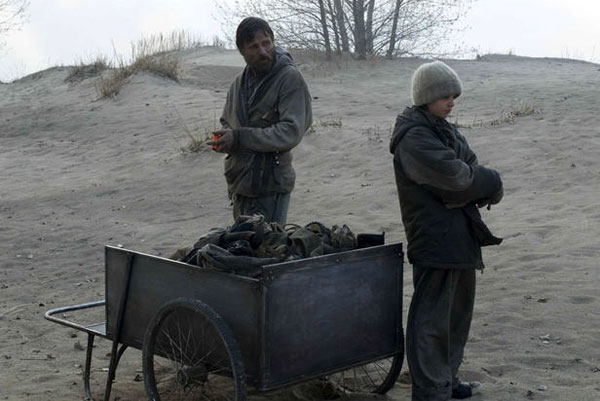
The advance stills: Sure, they’re grim and bleak, but are they grim and bleak enough?

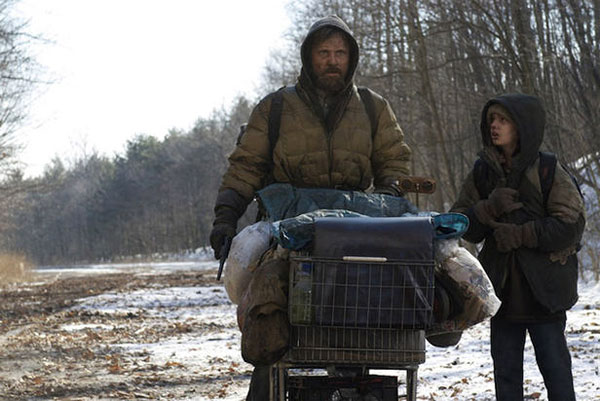
Also, why the stylized cart? If you’ve read the novel, you know what I mean–the cart needs to be a grocery store cart, homeless style! Hang on–

–that’s better! (NB: images link to a gallery of advance images)

Does it seem worth seeing in the theater?

Yes. We’ll be carrying the fire on or around November 26th (and just in time for Thanksgiving!)

AFI’s Stupid Lists: No Love for Horror

The wankers at the American Film Institute just released their lists of top ten films by “genre” (full lists after the jump). Everyone loves to quibble with lists, and there’s plenty weird with theirs. First off, “Animation” is a medium, not a genre. That’s like calling comic books a genre, or TV a genre. But whatever. Also, Shrek on anyone’s top ten is always a bad sign–still, they give Blue Velvet its due and give Groundhog Day some props). What I thought was really odd was that AFI finds room to recognize a “Sports” genre (and on that end, are Raging Bull and Caddyshack really sports movies?), and even a “Courtroom Drama” genre, but doesn’t make a list of the great horror films. Why?

Here’s our list of the great American horror films. We’re sure we’re forgetting a bunch. This blog has been a slapdash affair lately.

1. Night of the Living Dead (the original)

2. Psycho (clearly, not Van Sant’s remake)

3. Alien

4. The Shining

5. Dawn of the Dead (the original)

6. Rosemary’s Baby

7. Re-animator

8. The Thing (John Carpenter)

9. Evil Dead 2

10. Texas Chainsaw Massacre (the original)

Continue reading “AFI’s Stupid Lists: No Love for Horror”

Be Kind Rewind

Sweet and silly, Be Kind Rewind, Michel Gondry’s fourth film (fifth if you count his 2005 documentary, Block Party) recounts the adventures of Mike (Mos Def) and his pal Jerry (Jack Black) as they recreate films from memory. When Mr. Fletcher, owner of the Be Kind Rewind video store, goes away for a week to a Fats Waller convention, he leaves Mike in charge of the store. Unfortunately, after a bizarre accident, Jerry becomes magnetized and consequently demagnetizes the store’s entire collection of VHS tapes (no DVDs here, folks). When number-one customer Miss Falewicz (Mia Farrow) asks for Ghostbusters, the pair are forced to create their own version from memory (along with help from local laundress Alma (Melonie Diaz)). Miss Falewicz’s nephew and his friends see the bizarre results and must have more, hence the birth of “sweding“–the process of remaking film favorites. The neighborhood citizens go crazy for the sweded films, clamoring for their own favorites to be made. By the end of the film, the entire neighborhood has moved beyond copying other people’s movies. Instead, they make their own film, the (kinda invented) biography of Fats Waller.

Be Kind Rewind is full of goofy fun laughs, and despite its lighthearted tone it never half-asses–or overplays–handling its dominant themes of creativity and community. Jack Black never overdoes it as Jerry, the zany paranoiac, and Mos Def is fantastic as the slightly anxious, slightly slow Mike (his version of Chris Tucker during the sweding of Rush Hour 2 is worth the price of admission alone). Danny Glover plays Mr. Fletcher poignantly, and the character comes to serve as a kind of elegiac totem for the death of highly-specialized local video shops with knowledgeable, cinephile-employees. Be Kind Rewind is a funny, giving film, and never self-indulgent; it moves the viewer without a trace of schmalz. Plus, it never drags. Highly recommended.

Be Kind Rewind is out on DVD today.

Five Great Recent Comedies, All Underappreciated, All Worth Watching

Perhaps no comedy best exemplifies “the little film that could” syndrome as does Mike Judge’s Office Space. Although Office Space died in the theaters, this movie about three fed up cubicle drones quickly regained a second life as a cult film classic before eventually becoming a quotable cultural touchstone on par with Caddyshack. Judge’s next film Idiocracy followed the same pattern, and while it’s not likely to ever hold the same prestige as Office Space, movies like Super Troopers and Wet Hot American Summer continue to show us that a film can die at the box office but have a second life as a cult favorite. We present to you five future classic comedies, all underappreciated, all worth watching.

1. Beerfest (2006)

Drunken Lizard’s Beerfest details the experiences of two brothers and their friends who travel to Germany to enter an underground beer-drinking competition in order to restore both familial and patriotic glory. Despite the silly premise, the movie is nonetheless an epic adventure story that dutifully moves through each phase of Joseph Campbell’s hero’s journey. It’s also, of course, very, very funny.

2. Hot Rod (2007)

Hot Rod was in the theaters for about five minutes last year and was unfairly criticized for being derivative of every other sports spoof ever made. Sure, Andy Samberg was following a model that anyone who’s ever seen a Will Ferrell comedy will be familiar with, but it’s the small touches, the strange little nuances that make the delicious dumbness of Rod Kimble’s sorry attempts at dare-devilry so funny. Ian McShane (Deadwood‘s Swedgin) is fantastic as the malevolent stepfather and Chris Parnell is too fucking funny in his bit part.

3. I Think I Love My Wife (2007)

Everyone knows that Chris Rock is hilarious, so why did no one go see I Think I Love My Wife? Well, it could be that the story of an African-American executive who feels constricted by his upper-middle class lifestyle, kids, wife, etc. and daydreams of having sex with lots and lots of other women simply couldn’t find it’s niche; I Think I Love My Wife is a cult film with no cult. In an interview with the AV Club last year, co-writer Louis CK says that he warned director/writer/star that the film would be a mistake to make. I think he’s wrong. Although the film is very much a monoglossic, one-voice escapade–this is Rock’s tale, of course–that voice is funny and insightful, and often says things that most married men are apt to feel on a daily basis (but not me, honey!)

4. Crank (2006)

Crank should be taught in film classes. In the most wonderfully stupid plot imaginable, professional assassin Jason Statham (who’s made a career out of these kinds of roles, it seems) is injected with a lethal poison. Here’s the twist: if his heart rate drops too low, he’ll die! For the next 90 minutes, he engages in every kind of adrenaline-jumping escapade imaginable including drinking lots of Red Bull, snorting mounds of cocaine, driving really, really fast, and, uh, fighting all the time. Lots and lots of fighting. In one memorable scene, Statham publicly schtups his annoying girlfriend while a busload of Japanese tourists cheers him on. Why this film didn’t win an Oscar, I’ll never understand.

5. Southland Tales (2006)

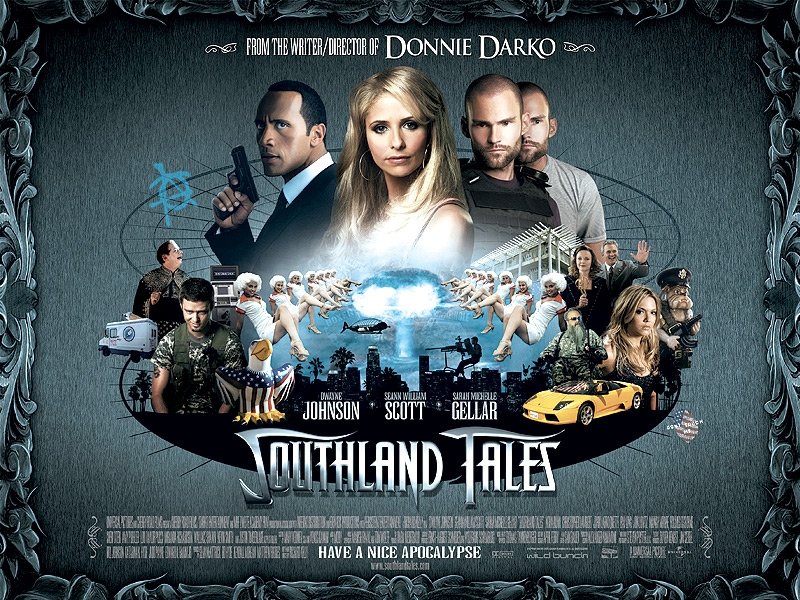
I’ve already reviewed Southland Tales but it belongs on this list. For all its many, many faults, Richard Kelly’s sprawling opus is a weird, sardonic mess of smart satire and goonish toilet humor, the kind of movie that seems to be mocking both itself as well as its audience at every turn. Not everyone will get this movie, but there are some of you out there who will love it even as it bewilders you.

Days of Heaven–Terrence Malick

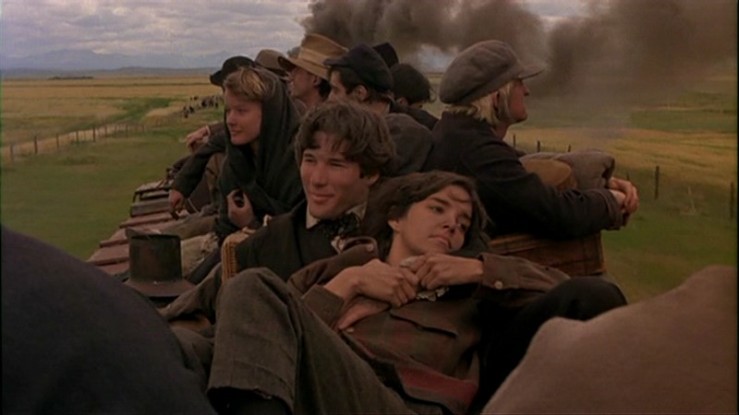
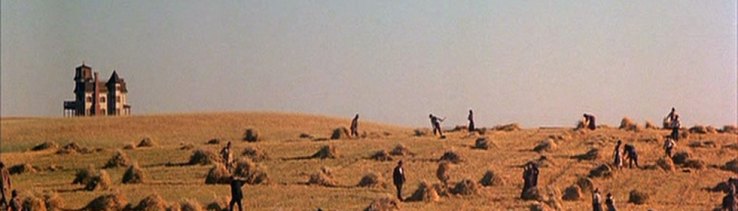
At a scant 93 minutes, Terrence Malick’s Days of Heaven is a paradoxically epic film, condensing the strange joy and bitter disappointments of four lives into something beautiful and marvelous. Days of Heaven is the story of three itinerant workers, Bill (Richard Gere), his girlfriend/common law wife Abby (Brooke Adams) and her younger sister Linda (a young Linda Manz, who is amazing in the role. She would go on to star in Out of the Blue and, uh, Gummo). Bill and Abby pretend that they are brother and sister because, as Linda (whose rambling introspection approximates narration) puts it, “people will talk.” The trio flees from Chicago after Bill kills a man, and soon find a job harvesting wheat in Texas for a rich farmer (Sam Shepard). The farmer, diagnosed with a terminal illness, falls in love with Abby. Bill encourages her to marry the farmer; he hopes that the rich man will die soon and that they will inherit his wealth. Jealousy, shame, confusion, and rage follow.

Days of Heaven seems much longer than its running time, and I mean this in a good way. Like Malick’s other films (Badlands, The Thin Red Line, The New World) it is not the seemingly improvised dialog that propels the narrative. Instead, Malick lets the story unfold in an impressionistic layering of images. Linda provides a voice over that occasionally gives a key insight to the desires of her sister/mother, brother/father, or even the farmer, but she’s just as likely to declare that she’d love to become a “mud doctor” and learn about the science of soil. And while the film has a strong and complex human, emotional core, like Malick’s other movies, it is very much a nature film, brimming with gorgeous shots of the farm, wild antelope, fowl, and other beasts. Malick’s lush shots make the Texas panhandle seem exotic, and Ennio Morricone’s masterful score is never obtrusive. This is a perfect film, and it’s a little sad to me that two whole decades passed between its release and The New World–but I suppose perfection and prolificness are not necessarily concomitant states. Let’s hope that Malick’s upcoming film, Tree of Life doesn’t take another twenty years to hit theaters. Highly recommended.

Southland Tales

Movies, Richard Kelly, Southland Tales, Confusion

OK. So. I’ve now aborted several attempts at properly reviewing Southland Tales so I figure I’ll just go for it. This might be a hack job; possibly one of the worst blogs I’ve ever written. In the spirit of Richard Kelly’s something-opus, I’ll do it anyway.

How much you love or hate (or are completely perplexed by) Southland Tales will rest on a number of factors:

How do you feel about overly-ambitious movies that sprawl in multiple directions? Are you OK with key plot lines not reaching resolution? Do you mind cartoonish violence and sophomoric humor mixed with biting satire? What about giant toilets? How would you feel about Dwayne “The Rock” Johnson relentlessly mugging for about 150 minutes? Would it bother you if thematic plot points hung on lines from poems by T.S. Eliot, Robert Frost, and lyrics from, uh, Perry Ferrell? Would you think that that was pretentious (or just plain dumb, perhaps)? Do you love to see ex-Saturday Night Live members in seemingly incongruous roles? What about watching a movie made a couple of years ago that intended to satirize the (then) near future, only the movie had major troubles getting distributed so when it finally got a national release the future it was satirizing was, like, now? How much did you love Donnie Darko (that won’t make a difference, actually…)? Can’t get enough Sarah Michelle Gellar? Are you OK with watching a movie that, like the original Star Wars trilogy, begins at part IV? How do you feel about Justin Timberlake? What about a “tell-don’t-show” voiceover courtesy of said JT? What about a soundtrack by Moby? SUVs humping? Are these fair questions? Is it fair to frame a movie review in a series of questions? No? Really?

OK. So. Now. How about this:

Philip K. Dick, crime noir, Neo-Marxism, Apocalypse Now, Natural Born Killers, David Lynch, Repo Man, comic books, Strange Days, Wim Wenders, psychotropic paranoia, Terry Gilliam, MAD magazine, epic confusion, Spring Break apocalypse, the Revelation to John, Disneyworld on acid, strange loops, Stanley Kubrick, bogus quantum theory, Los Angeles, nightmare comedy soap opera…

No? Just listing a bunch of references doesn’t qualify as decent critical appraisal? How about this, then:

–or this–

Wow. I was probably better off just not reviewing the damn thing. I want to see it again, like six or seven times, before deciding if I hate it or love it (my wife hated the parts that she didn’t sleep through, by the by. But she sleeps through about 75% of the movies we watch). Actually, after it was over, I immediately watched the whole last half hour again. Maybe you should just go here and read a bunch of real reviews of this movie. Or, better yet, just see it.

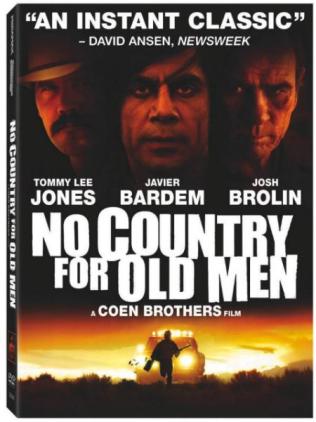
No Country for Old Men Reconsidered

nocountryboxart.jpg

On my Superlatives list at the end of last year, I awarded No Country for Old Men “Most Disappointing Film of 2007.” Here’s what I wrote:

Although it was by no means bad, I was disappointed in the Coen’s adaptation of Cormac McCarthy’s No Country for Old Men. It was a good movie–Javier Badem was fantastic, great pacing and tone–but still it didn’t blow me away like, say, Fargo or Blood Simple or Miller’s Crossing did. Ditto Werner Herzog’s Rescue Dawn. Chalk it up to hyperbolic expectations, I guess. Maybe I need to watch these films again on DVD and reconsider.

Ok. So. I went back and watched No Country on DVD this weekend. One of my criteria for a great film is that it has to be great without the transfixing power of a huge screen and roaring sound system. The Lord of the Rings movies, for example, suffer greatly on TV; the epic magnitude is diminished, and you realize just how much the movies relied on the the modern movie screen. I still like them though. I just don’t think they work too well on small screens (god forbid you watch them on a phone). So how does No Country hold up?

I don’t think it fairs any worse, but I still have to argue that this movie is incredibly overrated. I’d read the book (listened to the audiobook, actually) before I’d seen the film the first time, and watching it again I was doubly-prepared for the film’s decidedly non-Hollywood ending (and non-Hollywood climax, to boot).

Oh, by the way, a few SPOILERS ARE COMING UP. Fair warning, right?

Ok. When I initially saw the film, many of the people of the audience were disappointed and angered at the end of the movie, including my mom’s cousin, a man in his sixties from South Carolina. My uncle zoned out at the end, during Tommy Lee Jones’s last speech. When the movie ended and we walked out of the theater, he asked me to explain what happened. He’d missed the end. Three young men overheard, came up, and started asking me questions– “Did that guy [Llewellyn Moss] die?” etc. My mom’s cousin summed up the way a lot of people probably felt about the end of this movie– “I didn’t like it that the bad guy got away and the good guy died. Why didn’t the Sheriff go get him?” That the film is deeply dissatisfying to our collective sense of justice is kind of a thematic point, and that’s not what bothers me about No Country–although I understand why it would bother many audience members.

chigurh.jpg

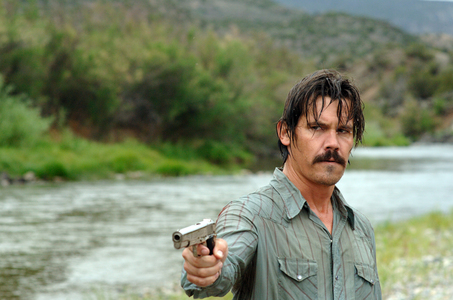
The film omits the two scenes we ache to see–the initial massacre that sets events in motion, and the death of Llewellyn Moss. We barely get to identify Llewellyn’s body, in fact. The substitutions for these elisions all involve Anton Chigurh, who pretty much steals the show. His murder of a deputy at the beginning of the film enacts a sacrificial slaughter, a substitution for the greater violence of the drug massacre that we don’t witness. He murders Carson Wells, a silly and ultimately trivial character whose sense of self-importance is quickly put under erasure. Finally, he kills Carla Jean Moss, before becoming the victim of a random violent car accident. An accident–not a just punishment for the atrocities he’s committed. Despite the severe accident, Chigurh is able to get up and walk away; presumably, he will continue to wreak havoc. Before Chigurh leaves the screen he turns two boys against each other. They squabble over a bloodied piece of money, recapitulating the larger theme of the movie–an echo of Fargo–that greed is destructive. The message is not overstated, but plain nonetheless. So what’s wrong with this film? Nothing, really. It’s just not as good–and certainly not as profound–as everyone makes it out to be.

In the book, the third act rests mostly on the “old men”–Tommy Lee Jones’s Sheriff Ed Tom Bell, a fellow sheriff, and Ellis, Ed Tom’s uncle. The film omits much of the book here, including a scene where Ed Tom visits another “old man”–Llewellyn’s father. The film also omits a key story from Ed Tom’s past, an act of cowardice in war. The Coens were right to leave much of this stuff out–there are too many monologues from Ed Tom as it is. Still, the titular point of the book becomes eclipsed, subsumed into Chigurh’s violence. Chigurh is a “new man,” part of what Ed Tom perceives as a new direction in our country–a violent and impersonal world he doesn’t belong in. Ed Tom fails to realize that the country was founded and maintained in many ways via impersonal violence, despite the fact that his own past–as well as the past of his family–is entrenched in this violence. His real problem is with the lack of clear, absolute morality, pure right and wrong, good and evil, an attitude best summed up with his assertion that once people quit saying “Ma’am and Sir,” everything else goes to hell. He brushes off Ellis when the old man tells him that the country has always been violent and difficult. The movie ends the same as the novel, with Ed Tom relating two dreams he had about his father.

large_0288_2326.jpg

The film ultimately fails to relate the depth of the novel, opting instead for a competent depiction of the surface tensions at work. The Coens accurately captures the “men doing stuff” aspect of McCormac’s writing without getting to any of the meaning behind it all. And that’s fine. The movie’s fine. It’s just not as great as everyone is pretending it is. Perhaps we’re all just so happy that the Coens have stepped up from their previous lightweight projects–The Ladykillers and Intolerable Cruelty–that we feel the need to fawn all over No Country. Or maybe I’m wrong–maybe this is a profound thriller, a truly excellent movie; maybe this is the Coens’ masterpiece. But I think not.

A Diddy in the Sun

I teach four sections of 11th grade AP English Language and Composition; I’m really hard on these kids. I also teach one section of 10th graders. I see these kids dark and early every morning, and I’m not very hard on them. It’s impossible to be, really. They–and I–are still sort of asleep. So, even though the FCAT is but a week away, when one assertive young lady in the class thought to tape record the new TV movie version of A Raisin in the Sun and bring it in, I agreed to let them watch it. After all, we’d read the play in class back in November, and watched the entire 1989 filmed stage production starring Danny Glover, as well as parts of the 1961 version starring Danny Glover.

glover.jpg

I’ve been using Lorraine Hansberry’s play in the classroom for years, with great success, I might add–the themes of race, economics, integration, assimilation, acculturation, generational change, and women’s rights continue to be as vital and thought-provoking as when the play was first produced a half-century ago. Which is why the early aughties revival starring Sean “Puff Daddy P-Diddy, No, Just Diddy (Diddy Dumb Diddy Do)” Combs seemed like a great idea. It was met with good reviews and ran to 88 performances. I know this play inside and out, and was excited to see a new version of it.

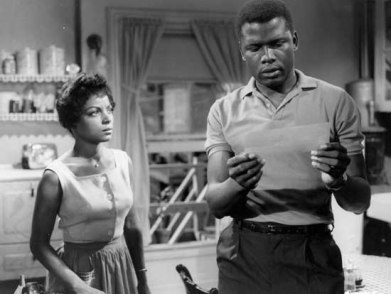
It was awful. Just plain awful. I can only hope that most of the people who saw it last week had some previous exposure. The depth of inter-generational conflict of Hansberry’s original text is drained of all energy and force, leaving only a weak trace of sappy melodrama. Both Poitier and Glover carried their versions, exploring the role of Walter Lee, a man whose dreams and ambitions are outmatched by the limited station thrust upon him. Walter Lee, properly, must be a man-child animal, lean and angry, a volcano ready to explode in rage and desperation. Walter Lee’s transformation into an adult man is painful; it almost undoes his family, metonymized neatly in the abortion his wife plans to have. Diddy, however, turns in one of the laziest one-note performances I’ve ever seen. He relies on every hackneyed trope of melodrama as a substitution for really emoting his part. In short, it’s impossible to believe that he’s Walter Lee. He’s just Diddy casually pretending to be Walter Lee. And the producers and director seem to know this. Whereas Walter Lee at least punctuates each scene of ARITS–and usually is at the forefront of catalytic action–the 2008 version reduces the scope of Diddy’s screen time, even omitting the famous “flaming spear” scene (my students were appalled at this elision–they determined that Diddy wouldn’t want to appear foolish). Furthermore, every single scene with Puffy Daddy (yes, I kept track) relies on the most saccharine of music to make sure the audience knows how to feel.


diddy.jpg

It’s left then to a chubbyish Phylicia Rashad to carry the movie, and while she’s a great actress, her Mama Younger is far too keenly self-aware. She’s simply not Hansberry’s Mama; instead, she’s Rashad’s late aughties update on what Rashad thinks a strong black woman should be. The original Mama’s ideology is defined (perhaps even limited) by the Great Migration; ARITS is largely the story of this mentality clashing with the artistic, educational, and economic aspirations inherent in the Civil Rights movement. Rashad’s Mama is never confused or even especially distraught over this changing ideology, and even some of the original lines that show her distress are cut. It just doesn’t work.

Maybe I gripe too much–my kids enjoyed it on the whole, but conceded that it wasn’t nearly as good as Glover’s take. I have to admit that I liked John “Uncle Jessie” Stamos as Mr. Lindner. He brought a silly unself-conscious humor to the role that exposed the inherent conflict of the original character: a guy whose actions are incredibly racist who can at no point recognize this racism because it’s so indelibly entrenched within him.

Still, if you’ve never seen the play before, I recommend going to the Danny Glover version, or at least the Poitier “classic.” Our inaugural post was about A Raisin in the Sun.

poitier.jpg

What I Liked About that Zodiac Movie

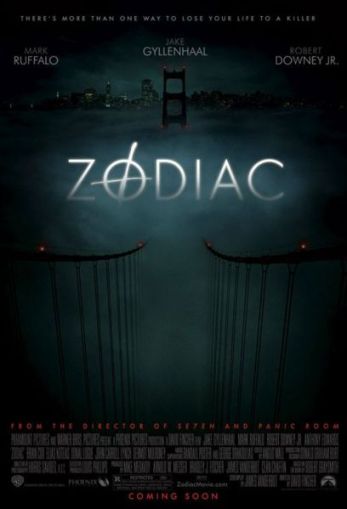
This weekend, I watched and thoroughly enjoyed David Fincher’s Zodiac, a film I initially had no interest in seeing, but nonetheless dutifully queued up when it wound up on numerous critics’ year-end top ten lists. When Zodiac came out last year, I prejudicially–and wrongly–assumed that the film, the tale of the infamous Zodiac killer who menaced California in the late sixties and early seventies, would be a moody character study, all ominous texture, smoggy chase scenes, and desperate anger à la Fincher’s 1995 thriller, Se7en (that movie where Gwyneth Paltrow’s head gets chopped off), or even worse, Fincher’s awful 1997 effort The Game. Most Hollywood suspense films–Fincher’s included–propel themselves on chase sequences, meaningless yelling, and overstated light and music queues that seem to scream “this is the part where you feel tense.” Zodiac, however, eschews all of these often vacuous tropes in favor of simply telling a story.

zodiacfincher.jpg

In today’s issue of Slate, Elbert Ventura points out in his write-up of the director’s cut DVD of Zodiac that the film is “a cop epic without a single shootout, a serial-killer flick in which all the blood is shed in the first act, and a taut procedural in which the case is never solved. In fact, it’s one of the most unsatisfying thrillers you’ll ever see—which is precisely how Fincher intended it.” Ventura’s review is fantastic, and I highly recommend reading it. He discusses the underlying politics of Zodiac, arguing that the film champions due process over vigilante “justice,” an important position to reaffirm in an age of Jack Bauerisms and actual debates over what constitutes torture.

What I really enjoyed about the film wasn’t so much its sense of values (something I honestly only realized after Ventura’s review), but the fact that the story was told without the intrusions of the personal lives of the principals involved as some kind of dramatic back story. Too often, Hollywood feels the need to muddy a perfectly good story with an unnecessary secondary plot about the personal conflict that the dramatic action in the main plot creates for its protagonists. Zodiac seems to understand that the obsessive hunt for the Zodiac killer is a source of personal conflict for the characters. To be sure, wives are annoyed with husbands, family duties are overlooked, and characters have substance abuse problems. However, Fincher is never tempted to exploit these “issues” for dramatic fodder. Instead, what might’ve served as a dramatic back drop in a standard Hollywood movie becomes little more than a character tic.

zodiac.jpg

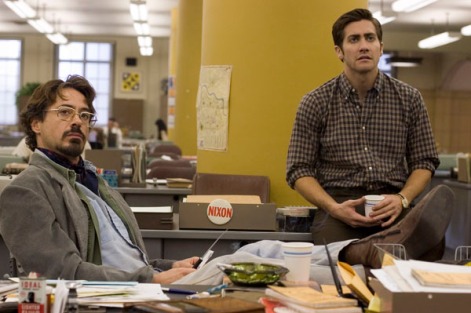
This is not to say that the film is not character-driven. Zodiac is anchored by stellar performances by that guy from Donnie Darko, that guy from Less Than Zero, and that guy from Eternal Sunshine of the Spotless Mind, and also features great supporting parts from that chick from Gummo, that guy from Revenge of the Nerds, and that guy who was in everything. Hell, even that guy from Mr. Show has a bit part.

Too bad that Zodiac was a flop. There should be more Hollywood thrillers like this, films unafraid to simply tell a great story, even if that story doesn’t have gunslinging heroes or damsels in distress, even if the bad guy gets away. Check it out on DVD.

zodiacbuttonnote.gif

How to Watch Transformers on DVD (If You Must)

autobot.jpg

1. Rent or queue up Michael Bay’s 2007 “live action” version of Transformers (NOTE: this “How to” addresses the 2007 version of Transformers, not the superior 1986 animated version).

2. Put the DVD in the DVD player.

3. Go directly to the chapter selection menu.

4. Select chapter 18.

5. Begin watching the movie. Disregard the clunky, superfluous plot that’s been leading up to this over the past hour and forty minutes. It doesn’t matter if you don’t know what’s going on. You’ve gotten to the part of the movie that you want to see–giant robots fighting giant robots. Additionally, don’t worry about who the characters are. You can figure it out pretty easily, if you like–they’re all types (stereo- or arche-). Alternately, don’t even worry about who the characters are.

6. Enjoy the mayhem and violence and spectacle of Transformers.

7. Now, as a form of penance, watch a movie by Akira Kurosawa, Peter Greenaway, Nic Roeg, Werner Herzog, Pedro Almodovar,  David Lynch, or any other director worth a damn.