December 1st.–I saw a dandelion in bloom near the lake.
Nathaniel Hawthorne’s journal entry for December 1st, 1850. From Passages from the American Note-Books.
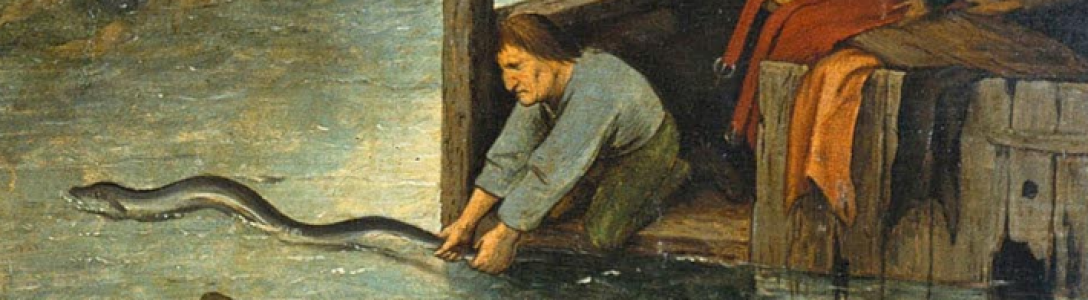
December 1st.–I saw a dandelion in bloom near the lake.
Nathaniel Hawthorne’s journal entry for December 1st, 1850. From Passages from the American Note-Books.

Maggie Umber calls the nine pieces collected in Chrysanthemum Under the Waves “comics,” so I will call them comics too. The term “comics” has long encompassed a wide range of visual storytelling techniques, resisting attempts to confine it to rigid structures, and Chrysanthemum Under the Waves shows the form’s expansive potential, blending horror, surrealism, and poetic fragmentation to tap into the alienation, paranoia, and repression that lurks under the surface of everyday life.
The stories here resist conventional narrative logic, which will likely confound any reader expecting something traditional. Umber eschews the common building blocks of the medium: there are no speech bubbles, no thought balloons, no panels stacking up into a coherent sequence. In fact, the few pages that use multiple panels feel like an anomaly. Most of the work in Chrysanthemum is confined to single, expansive images. Yet, these full-page spreads do not recall the bombastic splash pages of Jack Kirby or other Golden Age comics. Instead, they underscore the inherent incompleteness of storytelling. No artwork, no story, can ever present a full picture of reality—there are always gaps, always gutters. And in these gaps, dread and unease fester.

Umber’s comics aren’t so much about exploring the fragmentation of storytelling; rather, they showcase it as an aesthetic choice. It’s a choice that generates a palpable tension, a constant refusal to return to any resolution. There is no resolving tonic chord here. The uncanny permeates these pages—not in the sense of something foreign intruding upon the familiar, but as if the familiar itself has been subtly warped. Maybe this horror is “real,” maybe it’s not—but what is certain is its presence. The world Umber paints is one of perpetual strangeness, captured in black-and-white, shaded with grays. Pen and ink, printmaking, and watercolor all blur together in a form that makes us feel the unease before we can even articulate it.
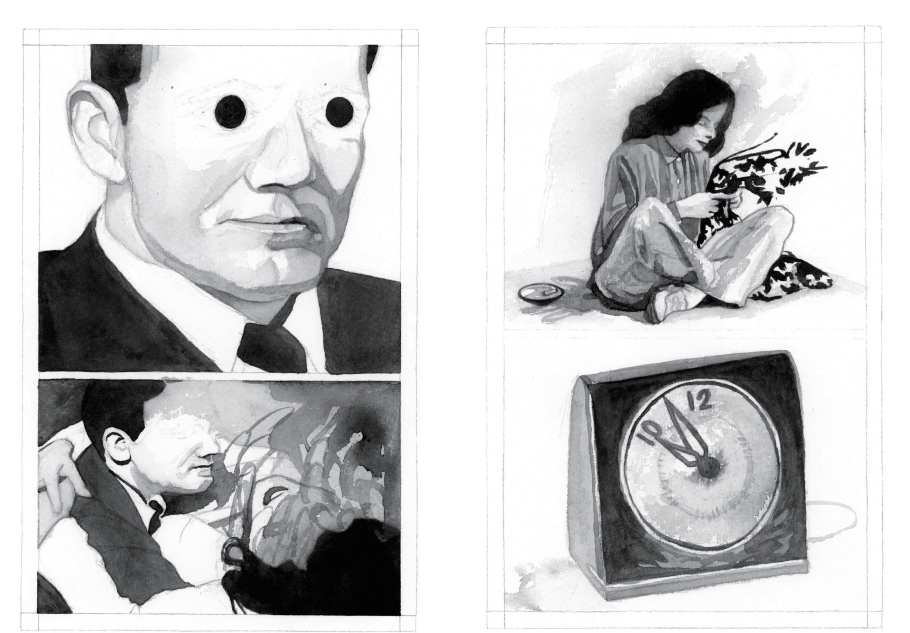
And while Umber’s work is refreshing in its uniqueness, it is by no means sui generis, but rather part of a clear tradition. As Umber notes in her introduction, Chrysanthemum started as a one-off “adaptation” of Shirley Jackson’s 1949 story “The Tooth.” If you have read “The Tooth” (and if you haven’t, do yourself a favor and resolve that problem) — if you have read “The Tooth,” you will likely recognize the uncanny unease that permeates Chrysanthemum. In her intro, Umber identifies James Harris as the agent of this unease: “James Harris snuck up on me when I was distracted by other things.” James Harris is a strange character who wanders in and out of not only “The Tooth,” but several of the other stories in Jackson’s The Lottery. Indeed, the original subtitle of The Lottery was not and Other Stories, but rather The Adventures of James Harris. This is the James Harris of the 17th century ballad “The Daemon Lover”; he is also the oblique star of Chrysanthemum Under the Waves. Look and you will find him in each of Umber’s tales, sliding like a shadow in and out of panels and gaps.
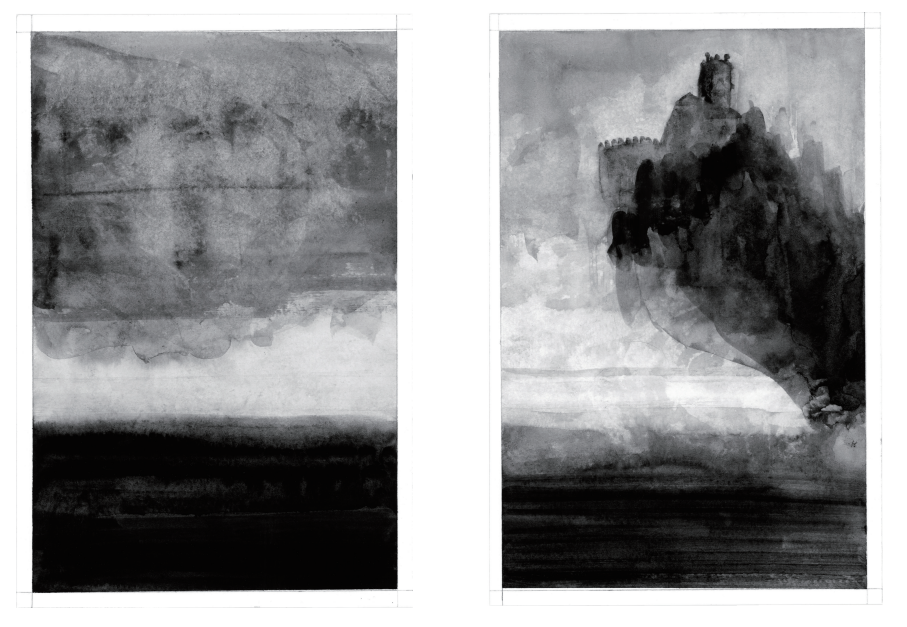
You will find so much more there as well–there are direct allusions to Goya’s Caprichos and Black Paintings, as well as nods to Toulouse-Lautrec and Sylvia Plath. There’s also a strong echo of Jackson’s American Gothic precursors and successors: Nathaniel Hawthorne, Edgar Allan Poe, Emily Dickinson, David Lynch, Kathy Acker — and, far less famously, Jason Schwartz. Chrysanthemum Under the Waves most reminded me of Schwartz’s prose-poem John the Posthumous, so much so that I read it again to confirm my notion.
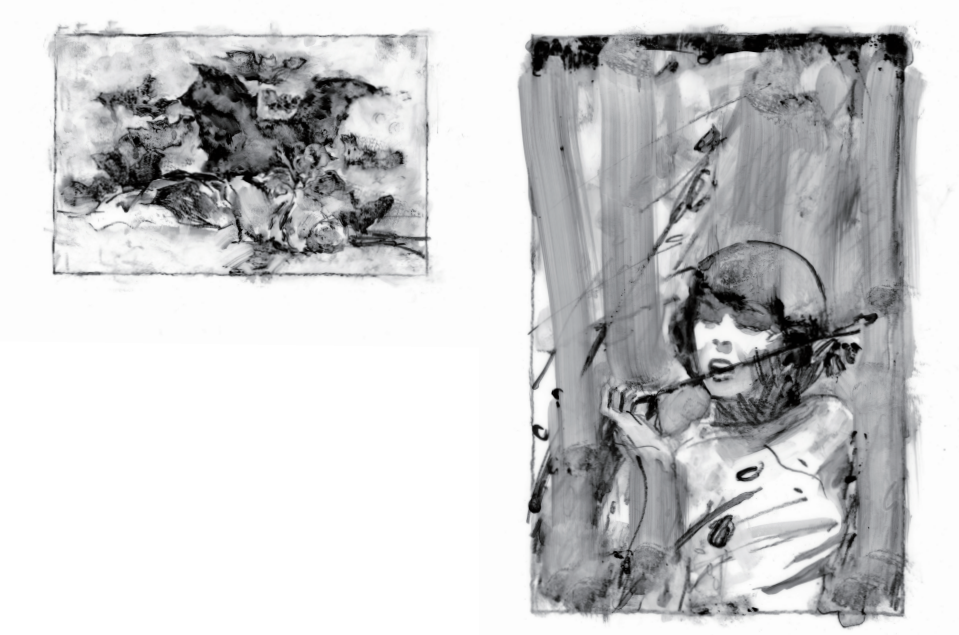
I’ve failed to remark so far on the apparent plots of the tales here. I found myself arrested by the ominous vibes in my first readings, and I still could not pin down a summary. At the same time, I feel that Umber clearly knows “what’s happening” in her stories, even if she keeps that information in the gaps and margins, out of the panel, but still, maybe, hidden in the pictures. The lead story, “Those Fucking Eyes,” is a collision of horror and beauty, twisting the artist’s gaze into something self-possessed and austere. “Rine” plays with fragmentation and distortion while evoking a ghostly presence. We get a gentleman caller, a broken bridge, a bouquet of flowers that flickers between reality and illusion. “Intoxicated” takes on a Gothic Toulouse-Lautrec aesthetic, unraveling into surreal rage and rejection. “The Devil Is a Hell of a Dancer” retells the “James Harris” ballad; it’s the first time written language infiltrates one of the stories.
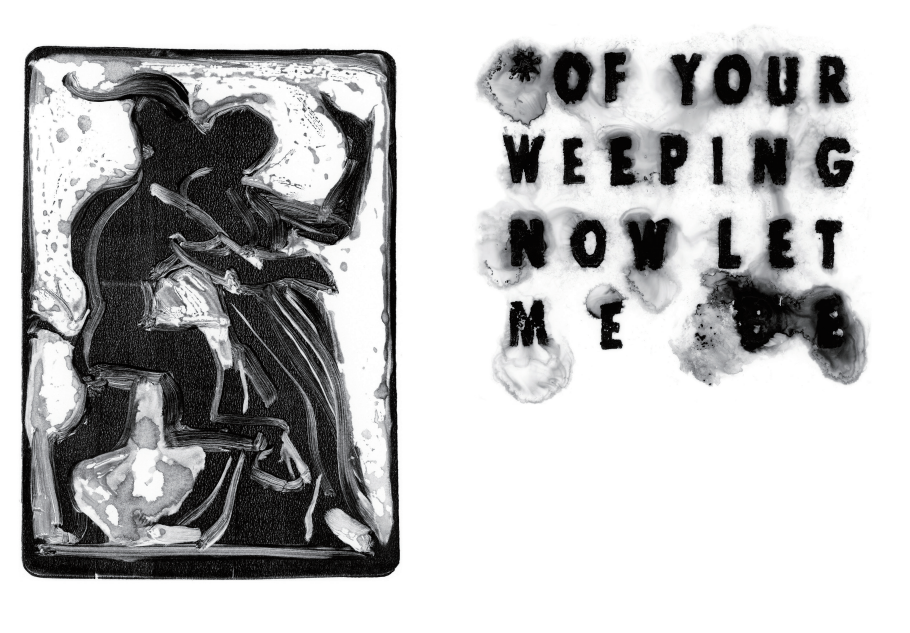 The title track, “Chrysanthemum” is a surreal noir fantasia punctured by a cup of coffee, with daemon lover James Harris hovering menacingly in the background. It seems to reinterpret Shirley Jackson as does the aforementioned “The Tooth” — itself a revision of Charlotte Perkins Gilman’s suffocating 1892 classic, “The Yellow Wall-Paper.” The shortest comic, “There Is Water” unfolds like a koan, enigmatic and meditative. Standout “The Witch” returns to Goya but also channels the American Gothic vein. The piece might be a nightmare one of Hawthorne’s characters endures. There are clouds, castles, dreams, doors, flickering horror. Is that a witch burning? And do the flames morph into a glimpse of Goya’s Saturn, only to resolve into the shadowed face of a woman? Shadows and erasures pulse through the imagery. It is both the strongest and longest piece in the collection. The book ends with “The Rock,” another riff on the the ballad “James Harris.” It’s a fitting end, conclusive but elusive. What remains rattles: unsettled, open, and always strange.
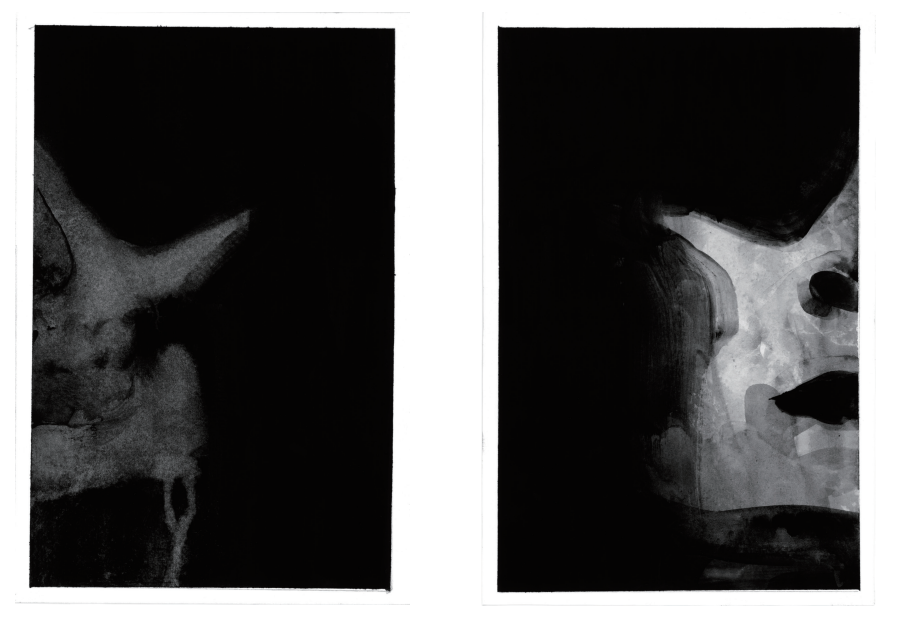
Chrysanthemum Under the Waves is a haunting, layered work that defies easy categorization. Umber’s pieces blend literary, artistic, and Gothic influences into a unique vision that expands the possibilities her chosen medium’s conventions. With its distinctive style and careful attention to space and detail, Chrysanthemum Under the Waves is a compelling read. Highly recommended.
“The Christmas Banquet”
by
Nathaniel Hawthorne
In a certain old gentleman’s last will and testament there appeared a bequest, which, as his final thought and deed, was singularly in keeping with a long life of melancholy eccentricity. He devised a considerable sum for establishing a fund, the interest of which was to be expended, annually forever, in preparing a Christmas Banquet for ten of the most miserable persons that could be found. It seemed not to be the testator’s purpose to make these half a score of sad hearts merry, but to provide that the stern or fierce expression of human discontent should not be drowned, even for that one holy and joyful day, amid the acclamations of festal gratitude which all Christendom sends up. And he desired, likewise, to perpetuate his own remonstrance against the earthly course of Providence, and his sad and sour dissent from those systems of religion or philosophy which either find sunshine in the world or draw it down from heaven.
The task of inviting the guests, or of selecting among such as might advance their claims to partake of this dismal hospitality, was confided to the two trustees or stewards of the fund. These gentlemen, like their deceased friend, were sombre humorists, who made it their principal occupation to number the sable threads in the web of human life, and drop all the golden ones out of the reckoning. They performed their present office with integrity and judgment. The aspect of the assembled company, on the day of the first festival, might not, it is true, have satisfied every beholder that these were especially the individuals, chosen forth from all the world, whose griefs were worthy to stand as indicators of the mass of human suffering. Yet, after due consideration, it could not be disputed that here was a variety of hopeless discomfort, which, if it sometimes arose from causes apparently inadequate, was thereby only the shrewder imputation against the nature and mechanism of life. Continue reading ““The Christmas Banquet” — Nathaniel Hawthorne”
In the final third of Nathaniel Hawthorne’s 1852 novel The Blithedale Romance, the narrator, having departed the titular would-be utopian farm, enjoys some city time in a hotel. He takes a voyeuristic pleasure in watching people from his window, and elects to deepen the pleasure by ordering a drink: “Just about this time a waiter entered my room. The truth was, I had rung the bell and ordered a sherry-cobbler.” The explanatory end note for my Penguin Classics copy of Blithedale gives the following recipe: “A drink made with sherry, lemon juice, sugar, and cracked ice.” I decided to make a few.
A brief internet search resulted in dozens and dozens of recipes, all more or less the same iteration: long glass, crushed ice, sherry, simple syrup, citrus (oranges cited most frequently), fresh berries if you have ’em, and a straw. The straw is the kicker here. Here is a passage from Charles Dickens’ 1844 novel Life and Adventures of Martin Chuzzlewit that shows the titular hero’s delight with his first sherry cobbler (note Chuzzlewit’s ecstasy when he gets “the reed” to his lips):
‘I wish you would pull off my boots for me,’ said Martin, dropping into one of the chairs ‘I am quite knocked up—dead beat, Mark.’
‘You won’t say that to-morrow morning, sir,’ returned Mr Tapley; ‘nor even to-night, sir, when you’ve made a trial of this.’ With which he produced a very large tumbler, piled up to the brim with little blocks of clear transparent ice, through which one or two thin slices of lemon, and a golden liquid of delicious appearance, appealed from the still depths below, to the loving eye of the spectator.
‘What do you call this?’ said Martin.
But Mr Tapley made no answer; merely plunging a reed into the mixture—which caused a pleasant commotion among the pieces of ice—and signifying by an expressive gesture that it was to be pumped up through that agency by the enraptured drinker.
Martin took the glass with an astonished look; applied his lips to the reed; and cast up his eyes once in ecstasy. He paused no more until the goblet was drained to the last drop.
‘There, sir!’ said Mark, taking it from him with a triumphant face; ‘if ever you should happen to be dead beat again, when I ain’t in the way, all you’ve got to do is to ask the nearest man to go and fetch a cobbler.’
‘To go and fetch a cobbler?’ repeated Martin.
‘This wonderful invention, sir,’ said Mark, tenderly patting the empty glass, ‘is called a cobbler. Sherry cobbler when you name it long; cobbler, when you name it short. Now you’re equal to having your boots took off, and are, in every particular worth mentioning, another man.’
Anyway. Where was I? Oh, yeah—so I looked around for recipes. David Wondrich’s 2007 cocktail history Imbibe! gives a helpful baseline recipe by citing Jerry Thomas’s 1862 classic, How to Mix Drinks. From Thomas’s book:

Thomas doesn’t mention muddling the oranges, although pretty much every online recipe I read called for muddling.
So reader, I muddled.
Here is my variation on the sherry cobbler (or Sherry Cobbler, or sherry-cobbler). In the loose spirit of the cocktail, I made ours entirely of ingredients I already had at the house. These were for each cocktail:
–4 oz of sherry
–1/2 oz of simple syrup
–1/2 oz of maraschino syrup
–1 oz of sparkling water
–1 clementine (muddled)
–sprigs of mint
–blueberries
–crushed ice

The maraschino syrup was an afterthought after I’d mixed the cocktail and was about to pour it over ice—I wanted to get a pop of color at the bottom of the glass. The mint and blueberries were from our garden. The pic above is lousy; sorry—not sure why I didn’t move the dishcloth and maybe photograph the cocktails like, uh, not in front of my wife’s kombucha hotels.
So how was it? Pretty refreshing. My wife enjoyed it more than I did, although I’m not a huge cocktail guy. (I think it’s pretty hard, for example, to improve upon neat scotch , although I do like bourbon straight up in the hotter months).
I’ve always been fascinated by literary recipes, so I’m a bit surprised the sherry cobbler has evaded my attention until now, despite its having shown up in various novels I’ve read (including Nicholson Baker’s House of Holes, as Troy Patterson pointed out in a remarkably thorough literary history of the cocktail at Slate years ago). I’m not sure I’d go out of my way to make a sherry cobbler again (not that I went out of my way to make these ones), but the basic cobbler recipe’s spirit is very close to my approach to making cocktails at home anyway—use what you have. In fact, the major difference between the sherry cobblers I made yesterday and the kind of cocktail I’d normally cobble together for my wife on a Saturday afternoon is the sherry—I’d usually use rum or maybe vodka. Anyway, the whole thing was fun, which is like, the point of cocktails.
[Ed. note–Biblioklept first published this post in 2018. Happy Thanksgiving!]
Hawthorne is a writer
Writers create what they do out of their own frightful agony and blood and mushed-up guts and horrible mixed-up insides. The more they are in touch with their insides the better they create. If you like a writer’s books read his books, the books aren’t pure suffering; if you want to publish/help the writer, do it business-like, but don’t get into the writer’s personal life thinking if you like the books you’ll like the writer. A writer’s personal life is horrible and lonely. Writers are queer so keep away from them. I live in pain, but one day, Hawthorne said, I’m going to be happy I’m going to be so happy even if I’m not alive anymore. There’s going to be a world where the imagination is created by joy not suffering, a man and a woman can love each other again they can kiss and fuck again (a woman’s going to come along and make this world for me even though I’m not alive anymore).
From Kathy Acker’s novel Blood and Guts in High School.
BODDY: In In Memoriam you speak of Faulkner as “the American writer.” What is it about Faulkner that makes him “the American”?
ACKER: First of all, there weren’t any novelists around then who weren’t just realists. The way I see it is that it starts off with Hawthorne and Melville—you have Cooper on one side, the realist telling fairy tales (realism has always looked like fairy tales, even Dickens). For me, the American novel starts off with Hawthorne, Melville, Poe—and it’s not a novel, it’s a reaction to the novel, it’s a romance. The novel, as Roland Barthes would say, is deeply about bourgeois life. Hawthorne and Melville and Poe are revolutionaries in lots of ways. So you have the novel in America starting off being radical, not being real. Just in literary terms, the fight is against realism. Moby Dick is not a realist novel, and Pierre just makes fun of the whole idea—it’s the first genre-fuck novel. But then you don’t really have the tradition continuing. You go through a lot of radical writing that is mainly poetry. And nobody is that interesting until Faulkner, who just shines. He does something interesting—he does a novel that is both realist and radical. He keeps narrative, and yet it’s absolutely radical. What I take to be radical is that interest in America in something called guts—a heart. What does Poe say? That if you wrote the truth of the heart you’d set the whole world on fire. It’s like fuck you, the rules, that’s what you do. That’s what Faulkner did.
From a 1997 interview with Kathy Acker, conducted by Kasia Boddy.
Thursday, November 24th.–This is Thanksgiving Day, a good old festival, and we have kept it with our hearts, and, besides, have made good cheer upon our turkey and pudding, and pies and custards, although none sat at our board but our two selves. There was a new and livelier sense, I think, that we have at last found a home, and that a new family has been gathered since the last Thanksgiving Day. There have been many bright, cold days latterly,–so cold that it has required a pretty rapid pace to keep one’s self warm a-walking. Day before yesterday I saw a party of boys skating on a pond of water that has overflowed a neighboring meadow. Running water has not yet frozen. Vegetation has quite come to a stand, except in a few sheltered spots. In a deep ditch we found a tall plant of the freshest and healthiest green, which looked as if it must have grown within the last few weeks. We wander among the wood-paths, which are very pleasant in the sunshine of the afternoons, the trees looking rich and warm,–such of them, I mean, as have retained their russet leaves; and where the leaves are strewn along the paths, or heaped plentifully in some hollow of the hills, the effect is not without a charm. To-day the morning rose with rain, which has since changed to snow and sleet; and now the landscape is as dreary as can well be imagined,–white, with the brownness of the soil and withered grass everywhere peeping out. The swollen river, of a leaden hue, drags itself sullenly along; and this may be termed the first winter’s day.
 The First Thanksgiving, 1973 by Warrington Colescott (1921 – 2018)


A grave and dark-clad company!” quoth Goodman Brown. In truth, they were such. Among them, quivering to-and-fro, between gloom and splendor, appeared faces that would be seen, next day, at the council-board of the province, and others which, Sabbath after Sabbath, looked devoutly heavenward, and benignantly over the crowded pews, from the holiest pulpits in the land. Some affirm, that the lady of the governor was there. At least, there were high dames well known to her, and wives of honored husbands, and widows, a great multitude, and ancient maidens, all of excellent repute, and fair young girls, who trembled lest their mothers should espy them. Either the sudden gleams of light, flashing over the obscure field, bedazzled Goodman Brown, or he recognized a score of the church-members of Salem village, famous for their especial sanctity. Good old Deacon Gookin had arrived, and waited at the skirts of that venerable saint, his reverend pastor. But, irreverently consorting with these grave, reputable, and pious people, these elders of the church, these chaste dames and dewy virgins, there were men of dissolute lives and women of spotted fame, wretches given over to all mean and filthy vice, and suspected even of horrid crimes. It was strange to see, that the good shrank not from the wicked, nor were the sinners abashed by the saints. Scattered, also, among their pale-faced enemies, were the Indian priests, or powows, who had often scared their native forest with more hideous incantations than any known to English witchcraft.–From “Young Goodman Brown,” Nathaniel Hawthorne (1835)

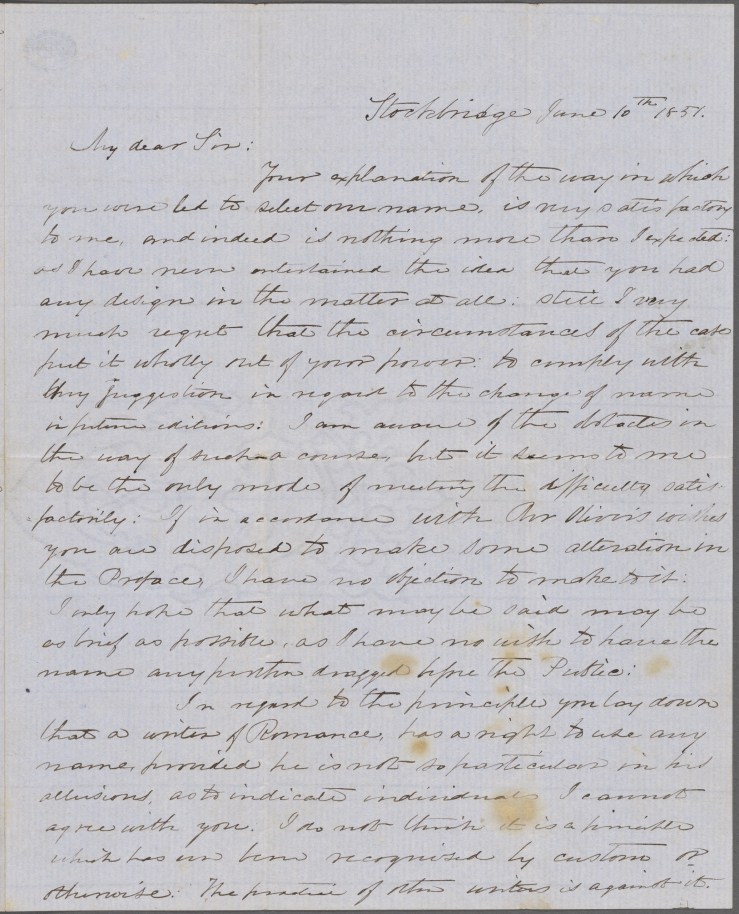
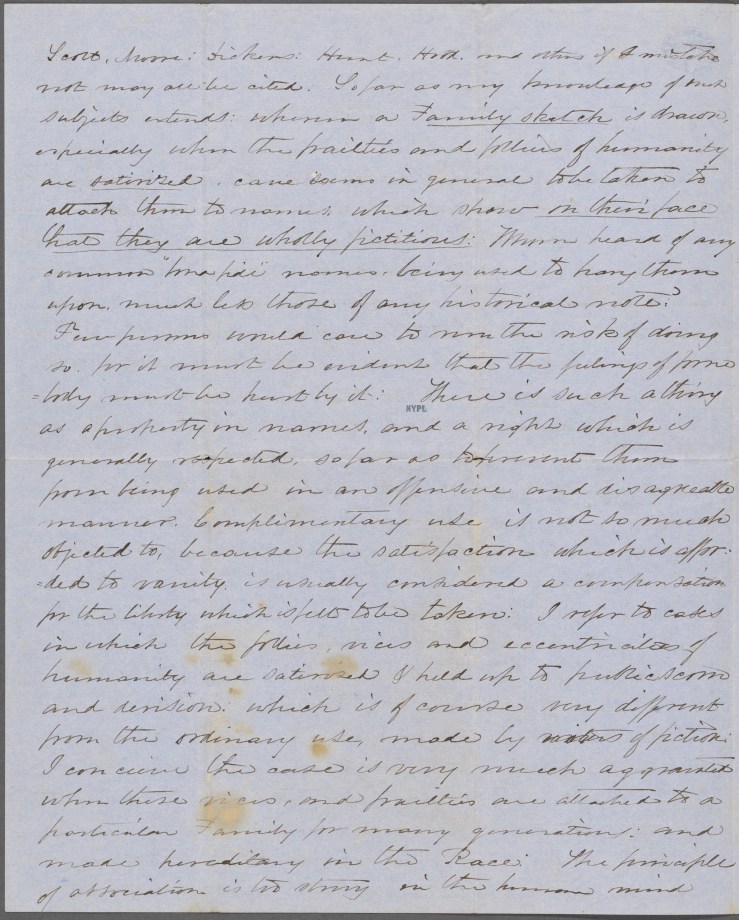
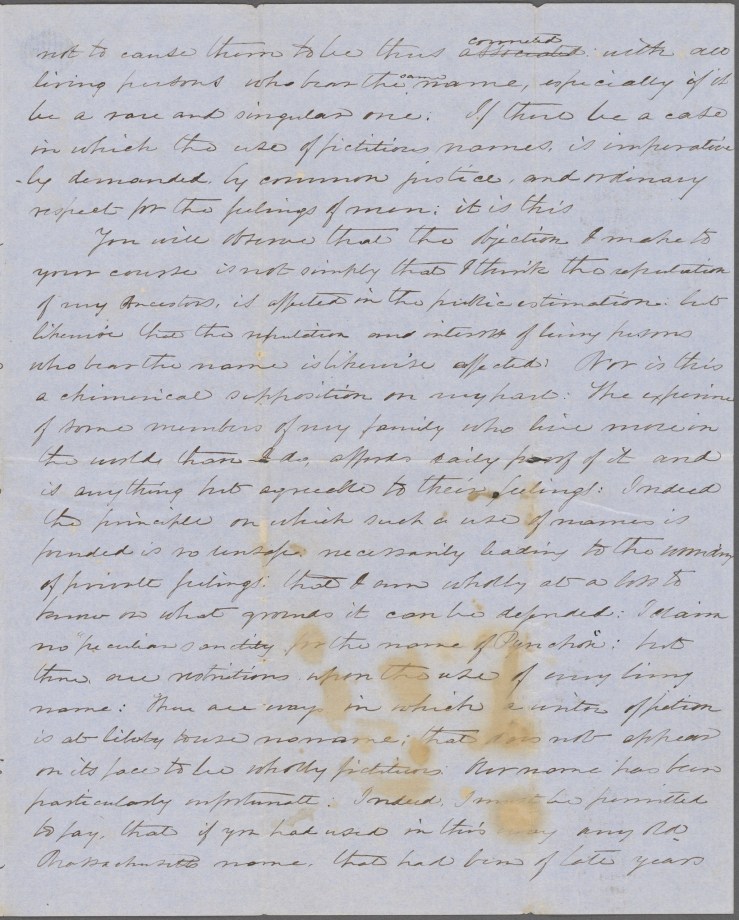
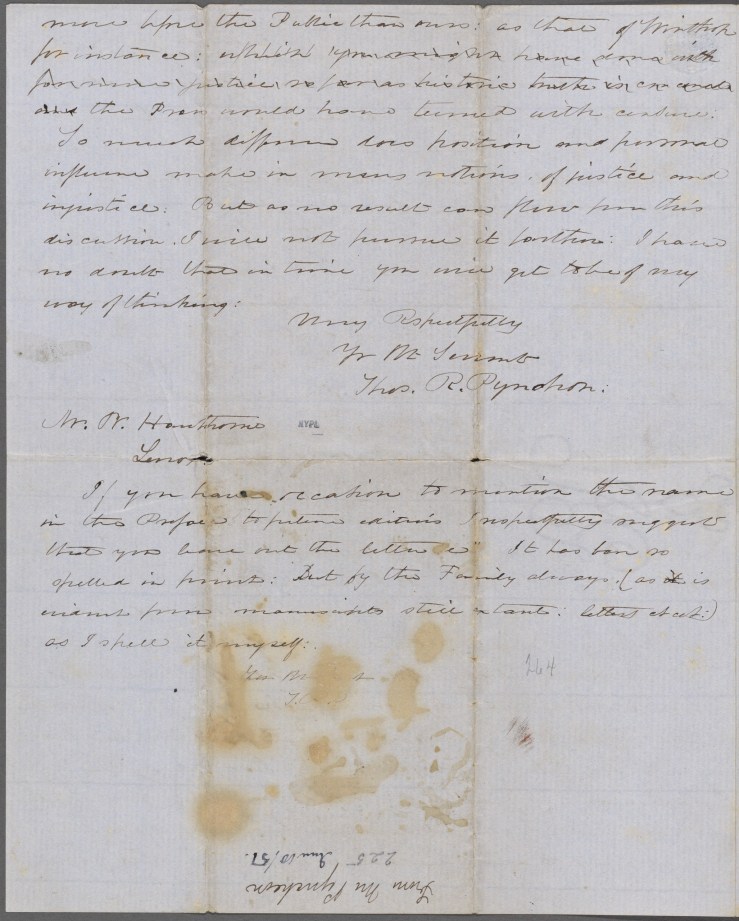
Thomas Ruggles Pynchon (the great-granduncle of American novelist Thomas Ruggles Pynchon) writes to the American novelist Nathaniel Hawthorne. From the New York Public Library Digital Collections.
Via Pynchon supersite Vheissu:
Nathaniel Hawthorne publishes The House of the Seven Gables. Rev. Thomas Ruggles Pynchon (1823-1904) writes the author a letter, complaining about the ‘abuse’ of the ‘Pyncheon’ name. This rev. Thomas Ruggles Pynchon will become the ninth president of Trinity College in Hartford, Conn, where he teaches science and religion. In 1881 he publishes an Introduction to Chemical Physics. His brother William is the great-grandfather of author Thomas Pynchon.
The First Thanksgiving, 1973 by Warrington Colescott (1921 – 2018)
A grave and dark-clad company!” quoth Goodman Brown. In truth, they were such. Among them, quivering to-and-fro, between gloom and splendor, appeared faces that would be seen, next day, at the council-board of the province, and others which, Sabbath after Sabbath, looked devoutly heavenward, and benignantly over the crowded pews, from the holiest pulpits in the land. Some affirm, that the lady of the governor was there. At least, there were high dames well known to her, and wives of honored husbands, and widows, a great multitude, and ancient maidens, all of excellent repute, and fair young girls, who trembled lest their mothers should espy them. Either the sudden gleams of light, flashing over the obscure field, bedazzled Goodman Brown, or he recognized a score of the church-members of Salem village, famous for their especial sanctity. Good old Deacon Gookin had arrived, and waited at the skirts of that venerable saint, his reverend pastor. But, irreverently consorting with these grave, reputable, and pious people, these elders of the church, these chaste dames and dewy virgins, there were men of dissolute lives and women of spotted fame, wretches given over to all mean and filthy vice, and suspected even of horrid crimes. It was strange to see, that the good shrank not from the wicked, nor were the sinners abashed by the saints. Scattered, also, among their pale-faced enemies, were the Indian priests, or powows, who had often scared their native forest with more hideous incantations than any known to English witchcraft.–From “Young Goodman Brown,” Nathaniel Hawthorne (1835)
August 24th.–I left home at five o’clock this morning to catch some fish for breakfast. I shook our summer apple-tree, and ate the golden apple which fell from it. Methinks these early apples, which come as a golden promise before the treasures of autumnal fruit, are almost more delicious than anything that comes afterwards. We have but one such tree in our orchard; but it supplies us with a daily abundance, and probably will do so for at least a week to come. Meantime other trees begin to cast their ripening windfalls upon the grass; and when I taste them, and perceive their mellowed flavor and blackening seeds, I feel somewhat overwhelmed with the impending bounties of Providence. I suppose Adam, in Paradise, did not like to see his fruits decaying on the ground, after he had watched them through the sunny days of the world’s first summer. However, insects, at the worst, will hold a festival upon them, so that they will not be thrown away, in the great scheme of Nature. Moreover, I have one advantage over the primeval Adam, inasmuch as there is a chance of disposing of my superfluous fruits among people who inhabit no Paradise of their own.
Passing a little way down along the river-side, I threw in my line, and soon drew out one of the smallest possible of fishes. It seemed to be a pretty good morning for the angler,–an autumnal coolness in the air, a clear sky, but with a fog across the lowlands and on the surface of the river, which a gentle breeze sometimes condensed into wreaths. At first, I could barely discern the opposite shore of the river; but, as the sun arose, the vapors gradually dispersed, till only a warm, smoky tint was left along the water’s surface. The farm-houses across the river made their appearance out of the dusky cloud; the voices of boys were heard, shouting to the cattle as they drove them to the pastures; a man whetted his scythe, and set to work in a neighboring meadow. Meantime, I continued to stand on the oozy margin of the stream, beguiling the little fish; and though the scaly inhabitants of our river partake somewhat of the character of their native element, and are but sluggish biters, still I contrived to pull out not far from two dozen. They were all bream, a broad, flat, almost circular fish, shaped a good deal like a flounder, but swimming on their edges, instead of on their sides. As far as mere pleasure is concerned, it is hardly worth while to fish in our river, it is so much like angling in a mud-puddle; and one does not attach the idea of freshness and purity to the fishes, as we do to those which inhabit swift, transparent streams, or haunt the shores of the great briny deep. Standing on the weedy margin, and throwing the line over the elder-bushes that dip into the water, it seems as if we could catch nothing but frogs and mud-turtles, or reptiles akin to them. And even when a fish of reputable aspect is drawn out, one feels a shyness about touching him. As to our river, its character was admirably expressed last night by some one who said “it was too lazy to keep itself clean.” I might write pages and pages, and only obscure the impression which this brief sentence conveys. Nevertheless, we made bold to eat some of my fish for breakfast, and found them very savory; and the rest shall meet with due entertainment at dinner, together with some shell-beans, green corn, and cucumbers from our garden; so this day’s food comes directly and entirely from beneficent Nature, without the intervention of any third person between her and us.
Nathaniel Hawthorne’s journal entry, 24 August 1842. From American Note-Books.
July 20th.–A drive yesterday afternoon to a pond in the vicinity of Augusta, about nine miles off, to fish for white perch. Remarkables: the steering of the boat through the crooked, labyrinthine brook, into the open pond,–the man who acted as pilot,–his talking with B—- about politics, the bank, the iron money of “a king who came to reign, in Greece, over a city called Sparta,”–his advice to B—- to come amongst the laborers on the mill-dam, because it stimulated them “to see a man grinning amongst them.” The man took hearty tugs at a bottle of good Scotch whiskey, and became pretty merry. The fish caught were the yellow perch, which are not esteemed for eating; the white perch, a beautiful, silvery, round-backed fish, which bites eagerly, runs about with the line while being pulled up, makes good sport for the angler, and an admirable dish; a great chub; and three horned pouts, which swallow the hook into their lowest entrails. Several dozen fish were taken in an hour or two, and then we returned to the shop where we had left our horse and wagon, the pilot very eccentric behind us. It was a small, dingy shop, dimly lighted by a single inch of candle, faintly disclosing various boxes, barrels standing on end, articles hanging from the ceiling; the proprietor at the counter, whereon appear gin and brandy, respectively contained in a tin pint-measure and an earthenware jug, with two or three tumblers beside them, out of which nearly all the party drank; some coming up to the counter frankly, others lingering in the background, waiting to be pressed, two paying for their own liquor and withdrawing. B—- treated them twice round. The pilot, after drinking his brandy, gave a history of our fishing expedition, and how many and how large fish we caught. B—- making acquaintances and renewing them, and gaining great credit for liberality and free-heartedness,–two or three boys looking on and listening to the talk,–the shopkeeper smiling behind his counter, with the tarnished tin scales beside him,–the inch of candle burning down almost to extinction. So we got into our wagon, with the fish, and drove to Robinson’s tavern, almost five miles off, where we supped and passed the night In the bar-room was a fat old countryman on a journey, and a quack doctor of the vicinity, and an Englishman with a peculiar accent. Seeing B—-‘s jointed and brass-mounted fishing-pole, he took it for a theodolite, and supposed that we had been on a surveying expedition. At supper, which consisted of bread, butter, cheese, cake, doughnuts and gooseberry-pie, we were waited upon by a tall, very tall woman, young and maiden-looking, yet with a strongly outlined and determined face. Afterwards we found her to be the wife of mine host. She poured out our tea, came in when we rang the table-bell to refill our cups, and again retired. While at supper, the fat old traveller was ushered through the room into a contiguous bedroom. My own chamber, apparently the best in the house, had its walls ornamented with a small, gilt-framed, foot-square looking-glass, with a hair-brush hanging beneath it; a record of the deaths of the family written on a black tomb, in an engraving, where a father, mother, and child were represented in a graveyard, weeping over said tomb; the mourners dressed in black, country-cut clothes; the engraving executed in Vermont. There was also a wood engraving of the Declaration of Independence, with fac-similes of the autographs; a portrait of the Empress Josephine, and another of Spring. In the two closets of this chamber were mine hostess’s cloak, best bonnet, and go-to-meeting apparel. There was a good bed, in which I slept tolerably well, and, rising betimes, ate breakfast, consisting of some of our own fish, and then started for Augusta. The fat old traveller had gone off with the harness of our wagon, which the hostler had put on to his horse by mistake. The tavern-keeper gave us his own harness, and started in pursuit of the old man, who was probably aware of the exchange, and well satisfied with it.
Our drive to Augusta, six or seven miles, was very pleasant, a heavy rain having fallen during the night, and laid the oppressive dust of the day before. The road lay parallel with the Kennebec, of which we occasionally had near glimpses. The country swells back from the river in hills and ridges, without any interval of level ground; and there were frequent woods, filling up the valleys or crowning the summits. The land is good, the farms look neat, and the houses comfortable. The latter are generally but of one story, but with large barns; and it was a good sign, that, while we saw no houses unfinished nor out of repair, one man at least had found it expedient to make an addition to his dwelling. At the distance of more than two miles, we had a view of white Augusta, with its steeples, and the State-House, at the farther end of the town. Observable matters along the road were the stage,–all the dust of yesterday brushed off, and no new dust contracted,–full of passengers, inside and out; among them some gentlemanly people and pretty girls, all looking fresh and unsullied, rosy, cheerful, and curious as to the face of the country, the faces of passing travellers, and the incidents of their journey; not yet damped, in the morning sunshine, by long miles of jolting over rough and hilly roads,–to compare this with their appearance at midday, and as they drive into Bangor at dusk; two women dashing along in a wagon, and with a child, rattling pretty speedily down hill;–people looking at us from the open doors and windows;–the children staring from the wayside;–the mowers stopping, for a moment, the sway of their scythes;–the matron of a family, indistinctly seen at some distance within the house her head and shoulders appearing through the window, drawing her handkerchief over her bosom, which had been uncovered to give the baby its breakfast,–the said baby, or its immediate predecessor, sitting at the door, turning round to creep away on all fours;–a man building a flat-bottomed boat by the roadside: he talked with B—- about the Boundary question, and swore fervently in favor of driving the British “into hell’s kitchen” by main force.
Colonel B—-, the engineer of the mill-dam, is now here, after about a fortnight’s absence. He is a plain country squire, with a good figure, but with rather a heavy brow; a rough complexion; a gait stiff, and a general rigidity of manner, something like that of a schoolmaster. He originated in a country town, and is a self-educated man. As he walked down the gravel-path to-day, after dinner, he took up a scythe, which one of the mowers had left on the sward, and began to mow, with quite a scientific swing. On the coming of the mower, he laid it down, perhaps a little ashamed of his amusement. I was interested in this; to see a man, after twenty-five years of scientific occupation, thus trying whether his arms retained their strength and skill for the labors of his youth,–mindful of the day when he wore striped trousers, and toiled in his shirt-sleeves,–and now tasting again, for pastime, this drudgery beneath a fervid sun. He stood awhile, looking at the workmen, and then went to oversee the laborers at the mill-dam.
Nathaniel Hawthorne’s journal entry, 20 July 1837. From American Note-Books.
May 16th.–It has been an easterly rain yesterday and to-day, with occasional lightings up, and then a heavy downfall of the gloom again.
Scenes out of the rear windows,–the glistening roof of the opposite houses; the chimneys, now and then choked with their own smoke, which a blast drives down their throats. The church-spire has a mist about it. Once this morning a solitary dove came and alighted on the peak of an attic window, and looked down into the areas, remaining in this position a considerable time. Now it has taken a flight, and alighted on the roof of this house, directly over the window at which I sit, so that I can look up and see its head and beak, and the tips of its claws. The roofs of the low out-houses are black with moisture; the gutters are full of water, and there is a little puddle where there is a place for it in the hollow of a board. On the grass-plot are strewn the fallen blossoms of the cherry-tree, and over the scene broods a parallelogram of sombre sky. Thus it will be all day as it was yesterday; and, in the evening, one window after another will be lighted up in the drawing-rooms. Through the white curtains may be seen the gleam of an astral-lamp, like a fixed star. In the basement rooms, the work of the kitchen going forward; in the upper chambers, here and there a light.
In a bar-room, a large, oval basin let into the counter, with a brass tube rising from the centre, out of which gushes continually a miniature fountain, and descends in a soft, gentle, never-ceasing rain into the basin, where swim a company of gold-fishes. Some of them gleam brightly in their golden armor; others have a dull white aspect, going through some process of transformation. One would think that the atmosphere, continually filled with tobacco-smoke, might impregnate the water unpleasantly for the scaly people; but then it is continually flowing away and being renewed. And what if some toper should be seized with the freak of emptying his glass of gin or brandy into the basin,–would the fishes die or merely get jolly?
I saw, for a wonder, a man pretty drunk at Parker’s the other evening,–a well-dressed man, of not ungentlemanly aspect. He talked loudly and foolishly, but in good phrases, with a great flow of language, and he was no otherwise impertinent than in addressing his talk to strangers. Finally, after sitting a long time staring steadfastly across the room in silence, he arose, and staggered away as best he might, only showing his very drunken state when he attempted to walk.
Old acquaintances,–a gentleman whom I knew ten years ago, brisk, active, vigorous, with a kind of fire of physical well-being and cheerful spirits glowing through him. Now, after a course, I presume, of rather free living, pale, thin, oldish, with a grave and care or pain worn brow,–yet still lively and cheerful in his accost, though with something invincibly saddened in his tones. Another, formerly commander of a revenue vessel,–a man of splendid epaulets and very aristocratic equipment and demeanor; now out of service and without position, and changed into a brandy-burnt and rowdyish sort of personage. He seemed as if he might still be a gentleman if he would; but his manners show a desperate state of mind by their familiarity, recklessness, the lack of any hedge of reserve about himself, while still he is evidently a man of the world, accustomed to good society. He has latterly, I think, been in the Russian service, and would very probably turn pirate on fair occasion.
Nathaniel Hawthorne’s journal entry, 16 May 1850. From American Note-Books.
April 11th.–I meditated accordingly, but without any very wonderful result. Then at eight o’clock bothered myself till after nine with this eternal tale of Tieck. The forenoon was spent in scribbling; but at eleven o’clock my thoughts ceased to flow,–indeed, their current has been woefully interrupted all along,–so I threw down my pen, and set out on the daily journey to the village. Horrible walking! I wasted the customary hour at the Athenæum, and returned home, if home it may now be called. Till dinner-time I labored on Tieck’s tale, and resumed that agreeable employment after the banquet.
Just when I was on the point of choking with a huge German word, Molly announced Mr. Thoreau. He wished to take a row in the boat, for the last time, perhaps, before he leaves Concord. So we emptied the water out of her, and set forth on our voyage. She leaks, but not more than she did in the autumn. We rowed to the foot of the hill which borders the North Branch, and there landed, and climbed the moist and snowy hill-side for the sake of the prospect. Looking down the river, it might well have been mistaken for an arm of the sea, so broad is now its swollen tide; and I could have fancied that, beyond one other headland, the mighty ocean would outspread itself before the eye. On our return we boarded a large cake of ice, which was floating down the river, and were borne by it directly to our own landing-place, with the boat towing behind.
Parting with Mr. Thoreau, I spent half an hour in chopping wood, when Molly informed me that Mr. Emerson wished to see me. He had brought a letter of Ellery Channing, written in a style of very pleasant humor. This being read and discussed, together with a few other matters, he took his leave, since which I have been attending to my journalizing duty; and thus this record is brought down to the present moment.
Nathaniel Hawthorne’s journal entry, 11 April 1843. From American Note-Books.
February 11th.–I have been measuring coal all day, on board of a black little British schooner, in a dismal dock at the north end of the city. Most of the time I paced the deck to keep myself warm; for the wind (northeast, I believe) blew up through the dock, as if it had been the pipe of a pair of bellows. The vessel lying deep between two wharves, there was no more delightful prospect, on the right hand and on the left, than the posts and timbers, half immersed in the water, and covered with ice, which the rising and falling of successive tides had left upon them, so that they looked like immense icicles. Across the water,however, not more than half a mile off, appeared the Bunker Hill Monument; and, what interested me considerably more, a church-steeple, with the dial of a clock upon it, whereby I was enabled to measure the march of the weary hours. Sometimes I descended into the dirty little cabin of the schooner, and warmed myself by a red-hot stove, among biscuit-barrels, pots and kettles, sea-chests, and innumerable lumber of all sorts,–my olfactories, meanwhile, being greatly refreshed by the odor of a pipe, which the captain, or some one of his crew, was smoking. But at last came the sunset, with delicate clouds, and a purple light upon the islands; and I blessed it, because it was the signal of my release.
Nathaniel Hawthorne’s journal entry for February 11th, 1840. From Passages from the American Note-Books.
December 13th.—Chill, frosty weather; such an atmosphere as forebodes snow in New England, and there has been a little here. Yet I saw a barefooted young woman yesterday. The feet of these poor creatures have exactly the red complexion of their hands, acquired by constant exposure to the cold air.
At the ferry-room, this morning, was a small, thin, anxious-looking woman, with a bundle, seeming in rather poor circumstances, but decently dressed, and eying other women, I thought, with an expression of slight ill-will and distrust; also, an elderly, stout, gray-haired woman, of respectable aspect, and two young lady-like persons, quite pretty, one of whom was reading a shilling volume of James’s “Arabella Stuart.” They talked to one another with that up-and-down intonation which English ladies practise, and which strikes an unaccustomed ear as rather affected, especially in women of size and mass. It is very different from an American lady’s mode of talking: there is the difference between color and no color; the tone variegates it. One of these young ladies spoke to me, making some remark about the weather,—the first instance I have met with of a gentlewoman’s speaking to an unintroduced gentleman. Besides these, a middle-aged man of the lower class, and also a gentleman’s out-door servant, clad in a drab great-coat, corduroy breeches, and drab cloth gaiters buttoned from the knee to the ankle. He complained to the other man of the cold weather; said that a glass of whiskey, every half-hour, would keep a man comfortable; and, accidentally hitting his coarse foot against one of the young lady’s feet, said, “Beg pardon, ma’am,”—which she acknowledged with a slight movement of the head. Somehow or other, different classes seem to encounter one another in an easier manner than with us; the shock is less palpable. I suppose the reason is that the distinctions are real, and therefore need not be continually asserted.
Nervous and excitable persons need to talk a great deal, by way of letting off their steam.
On board the Rock Ferry steamer, a gentleman coming into the cabin, a voice addresses him from a dark corner, “How do you do, sir?”—”Speak again!” says the gentleman. No answer from the dark corner; and the gentleman repeats, “Speak again!” The speaker now comes out of the dark corner, and sits down in a place where he can be seen. “Ah!” cries the gentleman, “very well, I thank you. How do you do? I did not recognize your voice.” Observable, the English caution, shown in the gentleman’s not vouchsafing to say, “Very well, thank you!” till he knew his man.
What was the after life of the young man, whom Jesus, looking on, “loved,” and bade him sell all that he had, and give to the poor, and take up his cross and follow him? Something very deep and beautiful might be made out of this.
Nathaniel Hawthorne’s journal entry for December 13th, 1853. From Passages from the English Note-Books.
December 1st.–I saw a dandelion in bloom near the lake.
Nathaniel Hawthorne’s journal entry for December 1st, 1850. From Passages from the American Note-Books.
 Biblioklept