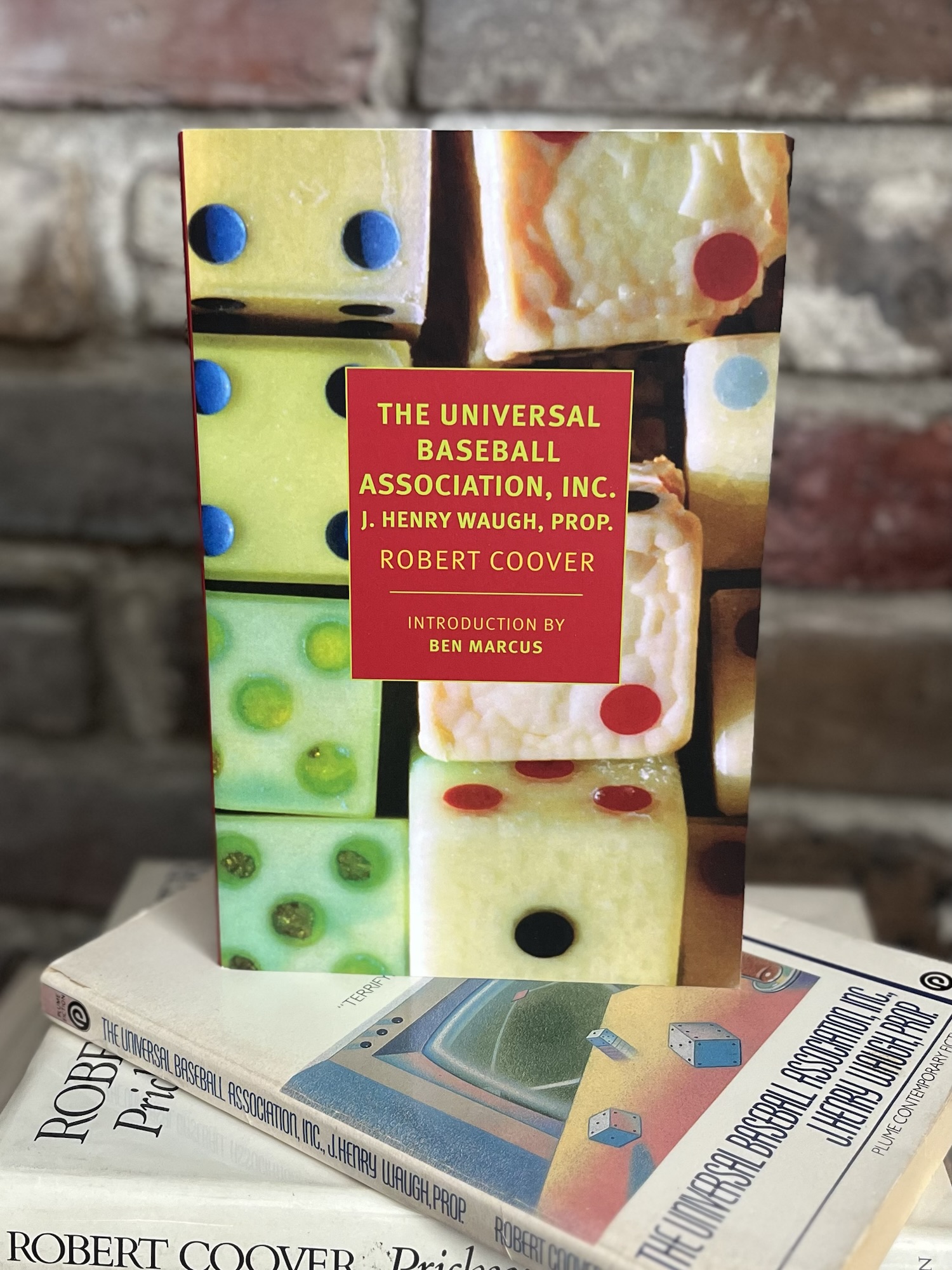
Notes on Thomas Pynchon’s novel Shadow Ticket


I posted these notes on Thomas Pynchon’s 2025 novel Shadow Ticket on Biblioklept in October and November of 2025. They appear here in basically the same form.


Let’s start with the epigraph:

“Supernatural, perhaps. Baloney…perhaps not.”

Bela Lugosi,
in The Black Cat (1934) Continue reading “Notes on Thomas Pynchon’s novel Shadow Ticket”

Sunsets to chase | Notes on Ch. 39, the last chapter of Thomas Pynchon’s Shadow Ticket

Notes on Chapters 1-7 | Glows in the dark.

Notes on Chapters 8-14 | Halloween all the time.

Notes on Chapters 15-18 | Ghostly crawl.

Notes on Chapters 19-20 | The needs of cold capitalist reality and those of adjoining ghost worlds come into rude contact.

Notes on Chapters 21-23 | Phantom gearbox.

Notes on Chapters 24-26 | Idiots get respect out here, they’re believed to be in touch with invisible forces.

Notes on Chapters 27-29 | We’re in for some dark ages, kid.

Notes on Chapters 30-32 | Some occult switchwork.

Notes on Chapters 33-34 | The dead ride fast.

Notes on Chapters 35-36 | Ghost city.

Notes on Chapters 37-38 | Our racket happens to be exile.


The last chapter of Shadow Ticket has three movements: one for Bruno, the novel’s erstwhile villain; one for Hicks, its anti-hero finding his way to becoming a hero; and one for Hicks’s young protege Skeet, who’s been sidelined Stateside and not present in the novel’s second, European half.

We begin the finale on the phantom submarine the Vampire Squid, “Somewhere out beyond the western edge of the Old World.” Shadow Ticket will end with the promise of a new edge of the New World.

Bruno Airmont, one-time dairy gangster, believes he’s headed home. The sub encounters a bizarre behemoth, “a statue hundreds of meters high, of a masked woman draped in military gear less ceremonial than suited to action in the field [wearing] an openwork visor of some darkly corroded metal protecting, some say hiding, her identity.” The full description of this statue is beautiful and strange, and culminates with the melancholic note that her visage recalls “somebody we knew once a long time ago.” 

“Statue of Liberty,” guesses Bruno, which, okay. I mean, that’s a reasonable guess I guess.

The image Pynchon conjures of a surreal, armed Lady Liberty recalls the opening of Franz Kafka’s unfinished first novel Amerika, which begins with its hero entering the New York Harbor and encountering “the Statue of Liberty, which he had been observing for some time, as if in a sudden burst of sunlight. The arm with the sword now reached aloft, and about her figure blew the free winds” (trans. Mark Harman).

In the Pynchonverse, “It’s the U.S. but not exactly the one you left. There’s exile and there’s exile” for Bruno: “There is no Statue of Liberty, Bruno, no such thing, not where you’re going.”

Bruno’s episode–and the Vampire Squid’s—ends with a Dickinson dash: “Whatever counter-domain of exile this is they have wandered into, they will be headed not back into any sunrise but west, toward a frontier as yet only suspected, as the days sweep over them—”

The Vampire Squid is another bilocated ghost ship, like the Stupendica on which Hicks voyaged to Europe. In Against the Day, the Stupendica splits into two ships — its shadow double the Emperor Maximilian is off to war. Recall that the Vampire Squid is a reformed U-boat, set out on a “new career of nonbelligerence.” Shadow Ticket might be cynical about redemption, but it also posits second chances — even if those chances take the quester into unknown counter-domains of exile.


Ch. 39’s second movement is a scant few lines. Hicks, exiled to Europe, panics a bit and realizes “that what he thought mattered to him is now foreclosed.” Terike pulls up on her bike, teaches him the Hungarian phrase csókolj meg, and our boy is on another adventure, another romance. It’s a nice conclusion for Hicks — who, it’s worth noting, has not committed a single act of violence in the novel.


The real conclusion of Shadow Ticket is epistolary, a letter to “Hicksie” from his old pal Skeet Wheeler. Skeet’s “On the hop,” staying clear of “Paddy wagons, dogcatcher nets, arrest warrants, the works,” lamenting that there are “Not so many places to hide as there were.” Here again is a theme of Shadow Ticket: there’s only freedom on foot, on the run, on the hop. To escape the net, Skeet plans to head West with Zinnia, the gal who gave him a glow-in-the-dark watch back in Chapter 1: “There’s supposed to be plenty of work out on the Coast.” That would be the West Coast of course.

Skeet offers a wrap-up of the Wisconsin cast of Shadow Ticket, including Against the Day’s hero Lew Basnight, who agrees to give Skeet and “Zin the fare out to California.” Basnight advises the young couple in a mode that’s not so much benediction as it is ominous prophecy, warning of “forks in the road, close shaves, mistakes he wished he didn’t make.”

Basnight warns Skeet of California’s American promises: “Eternal youth, big Hollywood playpen, whatsoever—but someday they’ll lose that innocence. They’ll find out.”

“Maybe they’ll keep finding new ways to be innocent,” rejoins Skeet, to which Basnight replies: “Better if somebody tells you now—innocent and not guilty ain’t always the same.”

Skeet concedes he’s not sure what that riddle means, but figures he’ll solve it in time; for now, he writes to Hicks, it’s “Time to put them street kiddie days behind me.” Time to grow up, or at least to make a motion towards it.

The novel ends with Skeet en route to California via the Santa Fe Chief: “Right now, we’ve got a couple of sunsets to chase.” Like the crew of the Vampire Squid, Skeet and Zin are headed “not back into any sunrise but west, toward a frontier as yet only suspected.” 

And while Pynchon’s conclusion follows a signal trope of US American literature — namely the promise of a new start Out West — I think there’s more here than the urge that Huck expresses at the end of Adventures of Huckleberry Finn, when he promises to “light out for the Territory ahead of the rest” to avoid the “sivilizin'” domesticity represented by Aunt Sally. Skeet’s Westward movement isn’t pure escapism or the fantasy of Manifest Destiny. It isn’t a rejection of domestic responsibility in lieu of a new frontier but rather a utopian dream of “finding new ways to be innocent,” even as he puts those “kiddie days behind.”

Lew Basnight, veteran of Against the Day‘s fantasia/nightmare of nineteenth-century history, provides a tempering wisdom to cool Skeet’s American Dream: “innocent and not guilty ain’t always the same.” Perhaps, like the narrator back in Ch. 35 documenting Hicks and Daphne’s last encounter, Basnight understands that the characters in Shadow Ticket are floating “in the last minutes of a break that will seem so wonderful and peaceable and carefree” before the horrors of WWII. Again, Shadow Ticket is a dance number, a chronological breeze floating between Pynchon’s titans Against the Day and Gravity’s Rainbow.

For me, the ending is sweet and then bittersweet and then bitter and then sweet again. We know Hicks will likely never see Skeet again — but he might. We know that this is probably Pynchon’s last novel — but maybe it isn’t.

And we know that Zoyd Wheeler is the hero of Pynchon’s California novel Vineland, and we know that Skeet’s last name is Wheeler. My presumption is that Skeet and Zinnia are Zoyd’s parents, and I presume it because I like to think that the Pynchonverse, although large and containing multitudes (and bilocations of every stripe) is somehow cozily discrete.

I should probably distill my thoughts on Shadow Ticket into a compact, “proper” review, but I’ve sat with the novel now for two months, reading it twice, and really, really enjoying it. I never expected to get another Pynchon novel; it’s a gift. I loved its goofy Gothicism; I loved its noir-as-red-herring-genre-swap conceit; I loved even its worst puns (even “sofa so good”). I loved that Pynchon loves these characters, even the ones he might not have had the time or energy to fully flesh out — this is a book that, breezy as it reads, feels like a denser, thicker affair. And even if he gives us doom on the horizon in the impending horrors of genocide and atomic death, Pynchon ends with the hopeful image of two kids chasing sunsets. Great stuff.

Our racket happens to be exile | Notes on Thomas Pynchon’s Shadow Ticket, Ch. 37-38

Notes on Chapters 1-7 | Glows in the dark.

Notes on Chapters 8-14 | Halloween all the time.

Notes on Chapters 15-18 | Ghostly crawl.

Notes on Chapters 19-20 | The needs of cold capitalist reality and those of adjoining ghost worlds come into rude contact.

Notes on Chapters 21-23 | Phantom gearbox.

Notes on Chapters 24-26 | Idiots get respect out here, they’re believed to be in touch with invisible forces.

Notes on Chapters 27-29 | We’re in for some dark ages, kid.

Notes on Chapters 30-32 | Some occult switchwork.

Notes on Chapters 33-34 | The dead ride fast.

Notes on Chapters 35-36 | Ghost city.


Illustration of Vampyroteuthis infernalis from Deutschen Tiefsee-Expedition, 1898-1899 by Carl Chun

Chapter 37: Shadow Ticket continues its wrap-up. Hicks punches another old ticket, not-exactly-solving the mystery of missing Stuffy Keegan (who disappeared way back in Ch. 8 on a U-13 submarine — a submarine that not everyone can see — into the icy depths of Lake Michigan.)

Hicks meets Stuffy at “the old Whitehead factory, where the torpedo as we have come to know it was invented.” The Whitehead Torpedo Works, based in Fiume/Rijeka  invented and developed the self-propelled torpedo in the 1860s. After WWI the company (under different subsidiary names) manufactured motorcycles and then hand grenades — bikes and pineapples, in the parlance of Shadow Ticket. There are a lot of bombs and biwheels in this novel.

The Whitehead Torpedo Works is another of Shadow Ticket’s Gothic spots, “fallen into ruin [and] said to be haunted by the ghosts of submarines long dismantled.” The phantom submarine that Stuffy crews is supernatural, natch, and a totem of the bigger thesis that Pynchon underlines throughout his latest novel: It’s never too late to redeem yourself. A war machine might repurpose itself, friendly ghost, into a rescue ship (or at minimum, a do-no-harm ship).

Whitehead torpedo’s illustrated profile, 1898

Stuffy introduces Hicks to the submarine’s skipper, Ernst Hauffnitz a veteran of the Great War responsible for “no casualty count that I know of, idiot’s luck no doubt.” The idiot, the fool, is blessed in Pynchon’s oeuvre, and in Shadow Ticket especially. And the idiot-who-does-no-harm is especially blessed. Let’s consider Hicks’s past as a strikebreaker, which we learn about back in Ch. 4, in a pivotal encounter when the big gorilla goes to whack a  “truculent little Bolshevik” with a “lead-filled beavertail sap” that would’ve surely killed the poor fella. Hicks’s blackjack disappears — “asported,” in the novel’s paranormal lingo. It sets him on a non-violent path (whether he sees or chooses this path or not).

For skipper Ernst Hauffnitz, doubts about the merits of war — by which I think we should say, doubts about using technology and innovation in the service of violence and undue death — began when “Max Valentiner torpedoed and sank SS Persia in the Mediterranean, killing 343 civilians in direct violation of Chancellery orders to spare passengers and rescue survivors.”

Those doubts increased when post-WWI orders to bring his submarine “to be broken up pursuant to Article 122 of the Trianon dictate led Captain Hauffnitz to suicidal feelings — but he converts that despair into hope, and sets out on a “new career of nonbelligerence.”

That new do-no-harm career includes helping out the Al Capone of Cheez, Bruno Airmont, “Who is about to be taken, as we speak, off on an undersea voyage of uncertain extent.” The International Cheese Syndicate — InChSyn — is after Bruno who’s taken off with their cash and their secrets. The submariners, now in “the search and rescue line” aim to see that “Mr. Airmont is safely relocated where he can neither commit nor incur further harm.”

Captain Hauffnitz continues: “You might consider us an encapsulated volume of pre-Fascist space-time, forever on the move, a patch of Fiume as it once was, immune to time, surviving all these years in the deep refuge of the sea…” On the move is the move of Shadow Ticket, one of its grand themes summed up by Stuffy Keegan back in Ch. 20: “as long as you can stay on the run, that’s the only time you’re really free.”

The episode concludes with reference to theValdivia Expedition of 1898–99, which brought up into the daylight a pitch-black critter known as the Vampire Squid, by whose name, these days, the U-13 has since come to be known.” More Gothic tinges!


We transition to the parting farewells of Bruno and Daphne; Daphne’s secured her father’s passage with a mariner named Drago. Papa Bruno gives his “li’l midnight pumpkin” a parting gift — “Better than money…It’s information” on the machinations of the InChSyn. Their last moments end with Bruno looking down at his watch, a “Rolex Oyster Perpetual he does not seem to recognize, as if thanks to the psychical ambience he’s been in all evening it has just apported onto his wrist.” 

It’s an odd reference, Bruno’s phantom Rolex, but it also fits with the novel’s theme of time as well as the motif of timepieces. Way back in Ch. 1, Skeet Wheeler shows off his new watch to Hicks: “Hamilton, glows in the dark too.” We’ll get a reference to that timepiece in the last paragraphs of the novel.


Bruno doesn’t make it too far on Drago’s escape boat before Hauffnitz’s crew intervenes. He’s on their sub in no time, wondering if he’s imprisoned in his “not uncomfortable cabin” — “Is this the brig I’m in, he wonders. No, submarines don’t have brigs, they are brigs.”

Stuffy starts to explain the situation to Bruno; the Cheez Gangster at first believes that the crew of the Vampire Squid intend to turn him over to the InChSyn. But as we saw earlier in the chapter, their goal is to add to a world of do no harm. 

Stuffy tries to hip Bruno to his new life: “See, there’s a difference between the Al Capone of Cheese and the AC of C in Exile. One sooner or later gets the paving-material overcoat. The other goes where he’ll do no harm. Our racket happens to be exile.”

“Milk belonging to John Albrecht is poured out on Sept. 16, 1933, by insurgent members of the Pure Milk Association seeking to force higher prices.” Chicago Tribune.

The chapter ends with Stuffy hipping Bruno to the 1933 Wisconsin milk strikes:

Seems revolution has broken out in the U.S., beginning in Wisconsin as a strike over the price per hundredweight that dairy farmers were demanding for milk, spreading across the region and soon the nation. Milk shipments hijacked and dumped at trackside, trees felled across roadways and set aflame to stop motor delivery, all-night sentinels, crossroads pickets, roundups, ambushes, bayonet charges, gunfire, casualties military and civilian.

It’s easy to dismiss Pynchon’s evocation of American zaniness as goofy, silly, unserious — but that would require (the very easy threshold of) not actually really reading Pynchon, a writer whose works stand clearly on the side of organized labor as well as on the peace-anarchy dimension of do no harm. The notion of “milk strikes” and a gangster cheese magnate might seem wacky, but Pynchon’s narrator points us towards the wallet, the stomach, the soul. There’s something comforting in the idea of Midwestern dairy workers going hard as a motherfucker and taking collective action to resist exploitation a century ago.

“Men lay out obstacles for milk delivery trucks along the Wisconsin-Illinois state line at Route 41 during the milk strike in January 1934. More than 18,000 farmers were demanding a fair price for their milk.” Chicago Tribune.

Chapter 38: Who should Hicks run into on the Korzo but one-time mob-enforcer Dippy Chazz Foditto, recently deported from the USA but nevertheless “just signed on to a scheme hatched and run by U.S. ruling-class elements who are betting that the island of Sicily will be a strategic factor in the next war.” Dippy will help to establish “a local anti-Fascist guerrilla force, trained, armed, and ready to roll.” Again, we’re ramping up to WW2. Dippy Chazz brings news from the West: Hicks’s old flame April is now married to the head crimeboss Milwaukee, and pregnant to boot. Hicks is exiled: “Take the tip, is all, it’s over for you in M’waukee, Hicks, Chicago too.”

The chapter ends on a sad note, with Hicks, “in the dawn hours of the first day of a post-American life…dials a number without thinking much about it till later, when he remembers it’s a TRIangle exchange number in Chicago, same as Al Capone’s mother has.” We can recall from Ch. 4 that Hicks’s mother Grace abandoned him to run away with an elephant trainer. He has a conversation with a person — his mother? Capone’s? just a person? — that ends with the sad image of trying to find “just a glimpse of something blowing away into the night, something it’s already too late to chase in this windbeaten emptiness taking possession of his heart…”


Ghost city | Notes on Thomas Pynchon’s Shadow Ticket, Ch. 35-36

Notes on Chapters 1-7 | Glows in the dark.

Notes on Chapters 8-14 | Halloween all the time.

Notes on Chapters 15-18 | Ghostly crawl.

Notes on Chapters 19-20 | The needs of cold capitalist reality and those of adjoining ghost worlds come into rude contact.

Notes on Chapters 21-23 | Phantom gearbox.

Notes on Chapters 24-26 | Idiots get respect out here, they’re believed to be in touch with invisible forces.

Notes on Chapters 27-29 | We’re in for some dark ages, kid.

Notes on Chapters 30-32 | Some occult switchwork.

Notes on Chapters 33-34 | The dead ride fast.


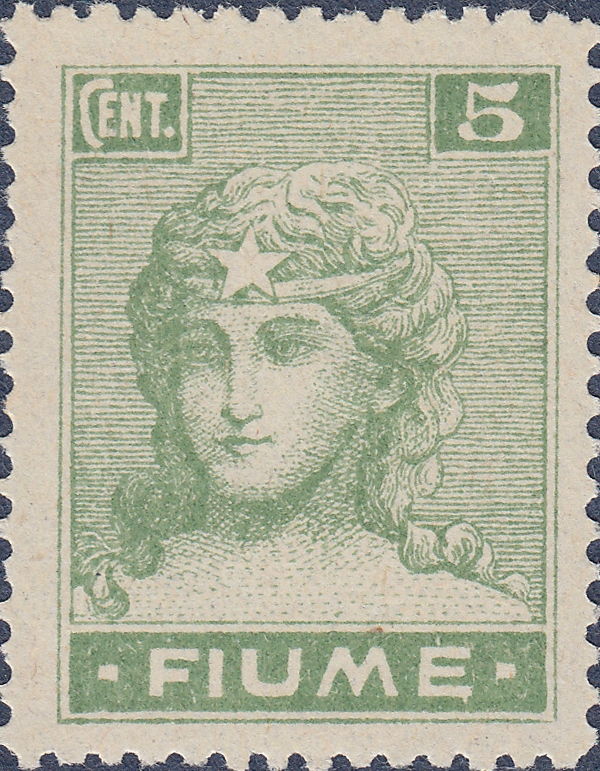
Chapter 35 commences in “Fiume…a tattered ghost city with a sordid history of secret treaties and sellouts, edging its way through what the Fascist Italian regime calls Year Ten, continuing to collapse in on itself, unlikely to be redeemed.” 

There’s a lot there, as in most of Shadow Ticket’s sentences. The Italian fascist poet Gabriele D’Annunzio marched on Fiume in 1919, claiming it post-WWI in defiance of its “Free City” status. Like the Esperanto that runs through Shadow Ticket, utopian ideals won’t last long.

The spectral language invoking an unredeemed ghost city is a theme Pynchon explored throughout Gravity’s Rainbow, the first section of which, in particular, details a preterite, apocalyptic London. I think what’s notable here is again the sense of a pretender’s “utopian intellectualism” — the fascist force’s Anno X — which tries to stabilize a dehumanizing pursuit of power within the context of the humanities. It’s a ghost town, bound for collapse, bad for the soul.

The narrator notes that Fiume was once “a major port of embarkation for the New World, bright and bustling.” What’s more utopian than a capital-en-capital double-you New World? Shadow Ticket is all about movement, particularly west-east movement, with the bilocated east-west corollary (coreality?) built in. Indeed, Pynchon will end the novel a la Huckleberry Finn with Hicks’ protege Skeet Wheeler following Huck’s move to “light out for the Territory.” But I’m jumping ahead. The bigger Thing to note here, I think is that the New World is not so new anymore. Frontiers are going to be stranger, more combustible, going forward.

I’ve focused too much on setting: Our man in Fiume is Daphne Airmont, hunting Papa Cheez. She picks up a pair of Morčić, “earrings representing a black Moor’s head in a fancy white turban,” as well as a new tune, “Daleko m’ê moj Split,” (“My Split Is Far Away from Me” — here, a reference to the singer’s hometown).

A few nights later Daphne is singing this tune “at a sympathetic room in a roadhouse on the Yugoslavian side of the line, where neighborhood musicians like to get together, tonight a C-melody sax, banjo-uke, trombone, piano, an underlying beat from snare brushes and woodblock” — I let the sentence ride out because just because (lots of ukes in Shadow Ticket, yet not a single snood). In the middle of the song, Daphne’s “joined out of somewhere by a clarinet, all too immediately recognizable as who else but Hop Wingdale.” Before the erstwhile couple retreats to more private environs to catch up, Hop “reaches for a highball glass, where he’s been keeping a couple of reeds soaking in slivovitz, drinks what’s there, pours in more.” I agree with Daphne (That’s disgusting!”), but maybe the Drunk Pynchon blog will disagree if they ever get around to “clarinet reeds soaked in slivovitz.”

I can’t help myself: Here’s Pynchon’s mise en scène one-sentence-paragraph for the Daphne-Hop intimate reunion, in which she will find out that he’s actually a spy:

“A busy echoing interior comfortably dim with all-night cigarette and kitchen smoke, young runners who never fall asleep in and out bringing seafood fresh from the Adriatic, a continuous wind outside, down from the high limestone, a theremin of uneasiness, sliding around a narrow band of notes, in which it’s said you may come to hear repeated melodies, themes and variations, which is when you know you’re going bughouse, with only a very short period of grace to try and escape before it no longer matters.”

Pynchon is an underrated prose stylist. The rhythm here might not work for all folks, but it sings to me. There’s obviously a bustling noir quality to the cramped kitchen scene, which Pynchon drapes in mystical paranoia: the Adriatic wind (and “wind” by the by, is a byword in Against the Day, a physical yet invisible force) — the Adriatic wind becomes “a theremin of uneasiness,” a phrase that recalls “the Sombrero of Uneasiness” that makes “a chill creep across Hicks’s scalp” back in Ch. 10, back in Wisconsin, back at the Nazi bowling alley. (There was also a nod to the theremin back in Ch. 24, at the Club Hypotenuse.) The last little bit of the paragraph is a parable for paranoids perhaps — when we “hear repeated melodies, themes and variations,” we know we’re “going bughouse.”

There’s a bit of business at the end of the Daphne-Hop episode that again points to Shadow Ticket’s underinflated bagginess — I’ve pointed out in these riffs that this is a much bigger novel in my imagination, a fat wedge between between Against the Day and Gravity’s Rainbow. The narrator mentions that Daphne’s supposed-one-time-not-really-fiance “G. Rodney Flaunch has recently published How to Lose a Million and a Half and Bounce Back Smiling,” opening a potential skewering of the kind of self-helpery bullshit that grifters continue to grift on as we breathe, this very minute. It’s a blip of a bit, reminding us that Daphne is far from home (as “Daleko m’ê moj Split” has already underscored), and if it’s underdeveloped, well, William Gaddis took Carnegie to task in The Recognitions (and elsewhere).

The wrapping-things-up-too-quickly motif continues as Hicks and Daphne reunite. Daphne’s headed back home; Hicks is not. She lets him off “that Chippewa hook”; no more life debt for Hicks. Our hero asks her to convey a message to April Randazzo, who is not mentioned by name, but rather alluded to as a “grown woman, married, family to raise” — the kiddie stuff is done. It’s time to grow up. The narrator infuses their stilted, terse parting with a flood of emotion:

“What one of them should have been saying was ‘We’re in the last minutes of a break that will seem so wonderful and peaceable and carefree. If anybody’s around to remember. Still trying to keep on with it before it gets too dark…'”

The break is of course the moments between the two big wars, situated as the break between Modernity and what comes after — the atom bomb and all that.

Pynchon’s narrator then domesticates the issue in his hypothetical dialogue: “Stay, or go. Two fates beginning to diverge—back to the U.S., marry, raise a family, assemble a life you can persuade yourself is free from fear, as meanwhile, over here, the other outcome continues to unfold, to roll in dark as the end of time.” Here again is the novel’s theme of bilocation, of imagining two lives; shadow/form.

It gets darker of course, as the Second World War deserves: “Those you could have saved, could’ve shifted at least somehow onto a safer stretch of track, are one by one robbed, beaten, killed, seized and taken away into the nameless, the unrecoverable.” Hicks won’t go back east, back home to the New World. Can he rise to this challenge? Can he divert some souls to a safer stretch of track and earn a crumb of redemption?


Chapter 36 is a mess.

It is a mess because it attempts to tie up loose ends; that is the wrong metaphor, tie up loose ends — in any case a cavalcade of featured players, guest stars, and even extras show up here (in Fiume, natch), to reconfigure in new teams for the coming war. We get Hicks and Terike and Ace Lomax and Porfirio del Vasto and Zoltán von Kiss and Egon Praediger (“nose merrily aglow,” the fucking cokehead).

Anyway, they’re all in Fiume, convening at Bruno Airmont’s villa, which “dates from just after the War, when d’Annunzio’s republic was young and Fiume had a reputation as a party town, fun-seekers converging from all over, whoopee of many persuasions, wide-open to nudists, vegetarians, coke snorters, tricksters, pirates and runners of contraband, orgy-goers, fighters of after-dark hand-grenade duels, astounders of the bourgeoisie…” Pynchon twins this list with new revelers at the villa, now a scene for “night owls, freeloaders, accidental walk-ins, practitioners of esoteric arts, fearers of the dark, compulsive socializers, secret police, jewel thieves, firefly girls, drug dealers, cigarette-factory workers, tobacco smugglers…” Old boy loves lists! (What is a “firefly girl”?)

The noisy, buzzing chapter ends with Hop Wingdale offering Ace Lomax (along with “that Czechoslovakian robot” Zdeněk) a job “Escorting Jews to safety, one at a time or in truckloads.” Ace was once hired muscle — like Hicks, who started his “career” as a strikebreaker. But in Shadow Ticket we see the possibility for his changing sides. Redemption is possible. As the psychic Zoltán von Kiss suggests in  Ch. 22: “even the most hopelessly ill-imagined lamp deserves to belong somewhere, to have been awaited, to enact some return, to stand watch on some table, in some corner, as a place-keeper, a marker, a promise of redemption.” 

This novel believes in the promise of redemption.


The dead ride fast | Notes on Thomas Pynchon’s Shadow Ticket, Ch. 33-34

Notes on Chapters 1-7 | Glows in the dark.

Notes on Chapters 8-14 | Halloween all the time.

Notes on Chapters 15-18 | Ghostly crawl.

Notes on Chapters 19-20 | The needs of cold capitalist reality and those of adjoining ghost worlds come into rude contact.

Notes on Chapters 21-23 | Phantom gearbox.

Notes on Chapters 24-26 | Idiots get respect out here, they’re believed to be in touch with invisible forces.

Notes on Chapters 27-29 | We’re in for some dark ages, kid.

Notes on Chapters 30-32 | Some occult switchwork


Chapter 33 is the big-budget action sequence of Shadow Ticket, in which the “pocket-size golem Zdeněk” and musician/secret agent Hop Wingdale rescue Ace Lomax from the clutches of the fascist Vladboys in their “Hungaro-Croatian terrorist training camp, located right on the borderline.” (Notably–significantly–Hicks is missing from the rescue team.)

The narrator informs us that the camp is “flexibly all-purpose Fascist, quivering in readiness to be deployed anywhere…briefly innocent as Fascism in its ‘springtime of beauty,’ as the old anthem goes, before it descended into paperwork and brutality…” We tend to think, rightly, that fascism is a rejection of progressive values, but it’s worth remembering that much of what we now think of as Modernism was wrapped up in proto-fascist idealizations of energy and action — consider Filippo Tommaso Marinetti’s Manifesto of Futurism f’r’instance…

The camp where Ace is being held prisoner is a hotbed of action:

“Fascist adventurers have journeyed here from all over, Austrians sporting blue cornflowers and black grouse feathers, secret police, anti-Red goon squads, revolutionary cells, convicts escaped from internal exile and not sure where they are right now or what language they’re supposed to be speaking, colonial stooges in civvies in from as far afield as Indo-China and South America, irredentist aristos from the old Hungarian kingdom adrift in nostalgia, Polish freelancers working on spec for all of the above.” 

I love the force of the sentence. For such a breezy novel, Shadow Ticket is dense. We might take it as a sketch of a much larger, thicker, denser novel.

Well so and anyway–

The deal is that Hop’s band shows up to play this fascist gig; he’s informed that they, the fascist paramilitary Vladboys, “are pretending to invade Fiume, which any number of potential clients want back.” The garrulous entertainment liaison who meets with the band opines that such an invasion would be “all over in a day or two. Anasa supo.”

That last phrase, anasa supo, is Esperanto for duck soup, an American idiom referring to a task easily accomplished. Duck Soup is also of course the title of the 1933 Marx Brothers that centers (oh-so-anarchically) around the tiny nation of Freedonia–a bilocation of Fiume? Here’s a bit of bilocation from Duck Soup:

Hop and his band will play their swing tunes in “ruined limestone amphitheater, once dedicated to bloodletting presented as amusement, back when the Fifth Macedonian Legion were busy here invading and occupying.

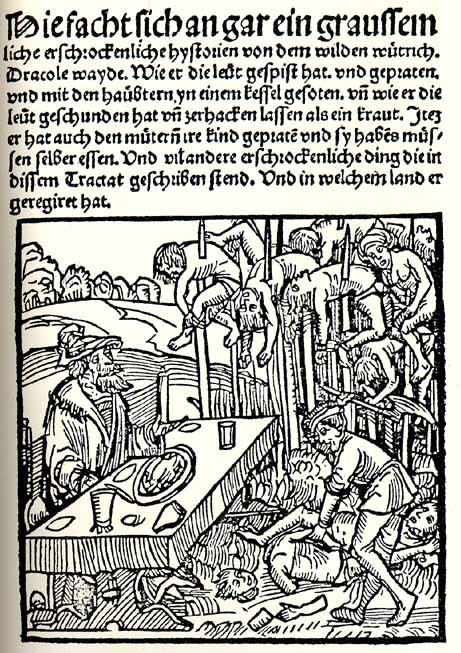
The entertainment menu is “A Gay Evening with Vlad Ţepeş,” with riffs including “Vlad’s Vegetarian Chef”…(“Turnip loaf again, remind me to have the chef impaled”) and “Vlad at the Office” (the Count laments that they never call him “Vlad the Spending Reducer.”)

1499 German woodcut depicting Vlad the Impaler dining among his victims: “Here begins a gruesome and terrible history of the wild tyrant, Dracole Wayde. How he had people impaled, roasted, and boiled in a kettle with their heads. How he had people flayed and their skin salted like cabbage. He also had mothers’ children roasted, and they had to eat them themselves.”

Is this “Vlad Ţepeş” just a performer playing a character in the evening’s festivities, vamping on a riff–or is it, like, the Vlad Ţepeş, son of Vlad Dracul, Voivode of Wallachia, born half a century before the events of Shadow Ticket — like, Dracula man Vlad? A few paragraphs later, we are briefly introduced to the thug guarding Ace, “Csongor…a sort common in these parts, an apprentice vampire doomed never to develop past journeyman.” On one hand, the language here, and the general supernatural bent of Shadow Ticket suggests that these are like real (as in mythological) vampires — but the novel’s themes of bilocation also hedge the bet: vampire here could be a metaphor; the Vlad Ţepeş could be merely an actor playing a part.

Pynchon renders the scene in the kind of sexualized language we’d expect from vampire stories: “Vladboys have been building up, sending them out after prey each time in a more dangerous state of arousal. Trivial disputes are apt at any moment to erupt into violence. Local women go more and more in fear of their safety, cover their hair, stay in groups. The weirdly erotic charge accumulates, until vrrrooom! here’s the Vladboys out on another massive prowl…”

The prowl, as we’ve already learned, scores “Ace…an understandably welcome catch, with the Flathead an unexpected bonus, which the boys keep insisting is a Jewish motorcycle.” (The idiot vladboys reasoning? “Harley. David…Son, this is son of David, no?”)

Standing guard over their “welcome catch,” journeyman vampire Csongor takes interest in Ace’s tattoo: “’Die Todten reiten schnell,’ the Vladboy reads from the Gothic lettering there. ‘Something about the dead ride fast.'”

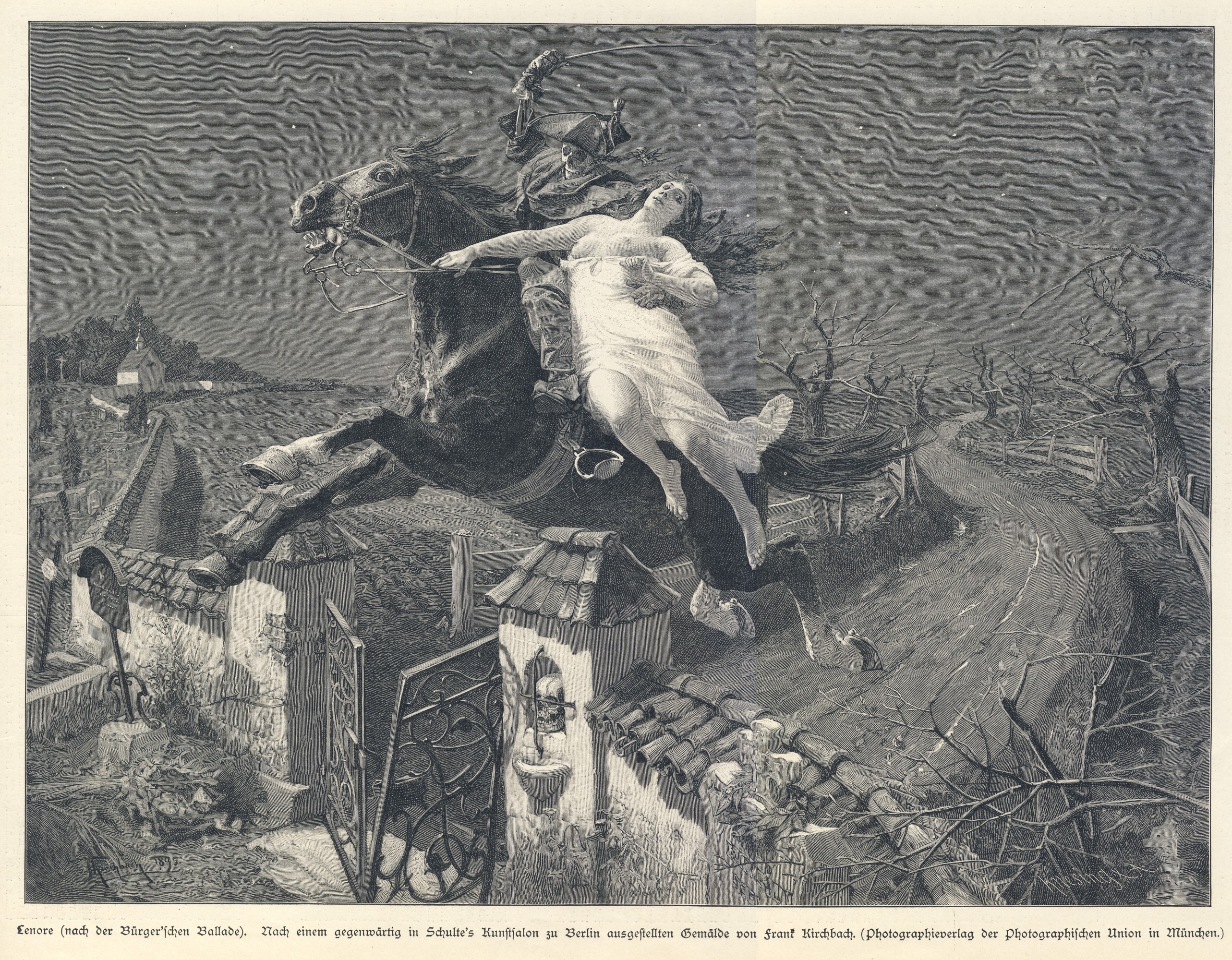
The phrase “Denn die Todten reiten schnell” appears in the opening chapter of Bram Stoker’s Dracula, a phrase recorded in Harker’s journal, which he identifies as the “line from [Gottfried August] Bürger’s ‘Lenore.'”

Illustration for Lenore, 1896 by Frank Kirchbach (1859-1912); engraving by Theodore Knesing (1840-1925).

Csongor wants to know if the dead actually do ride fast. Ace’s answer is philosophical: “Over there, among the dead, time has no meaning anymore, so to get distance per hour you’d have to divide by zero, which even if it was legal would still give you infinite speed.”

But before he can really explain his riff on death-speed paradox though, Ace’s rescuers arrive: “the pocket-size golem Zdeněk [and] Hop Wingdale.” Our mini-golem is a cyborg: “Zdeněk’s left arm turns out to be a modified ZB-26 Czech light machine gun, with the magazine built into his shoulder.” He likens it to “one of many earthly variants of Azrael, the Angel of Death” — yet still spares Csongor.

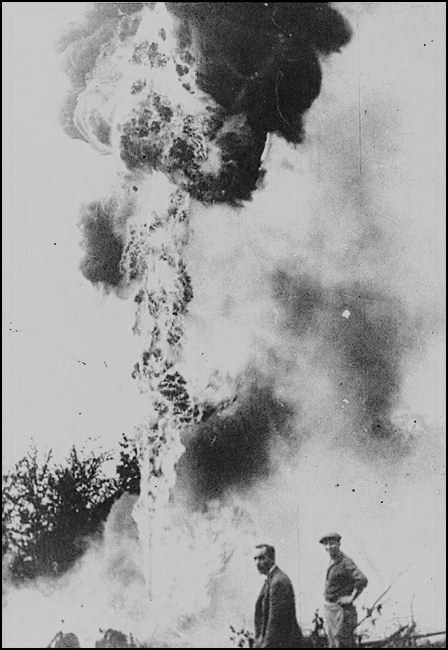
The chapter ends with our heroic trio escaping the fascist camp, fleeing their captors with the aid of a “pocket-size model” of a “a Bangalore torpedo” that Zdeněk has improvised from “a few sticks of dynamite thoughtfully borrowed last week in Transylvania off of a freelance firefighting crew passing through en route to a Romanian oil-well fire everybody could see from fifty miles away.”

The massive fire Pynchon’s narrator refers to here is, with most everything in Shadow Ticket, an historical event. The “torch of Moreni” burned for almost two and a half years, from September 1929 to November 1932.

The Moreni oil-well fire.

Chapter 34 opens with a sentence that lays out the situation for us: “Daphne looking for Hop has blundered out into a territory she thought she knew, which in fact the political situation has changed to something unrecognizable and poisonous.”

The Weimar days are over; “Hamburg, once the Swing Kid metropol” is now a Nazi hotbed, where “Blues licks have largely given way to major triads.” Conformity reigns; difference is punished. Daphne finds this out the hard way when she “wanders into a beer garden [Hop’s band] the Klezmopolitans once played at, formerly named the Midnight Mouse after a poem by Christian Morgenstern, now converted to a Sturmlokal” — she’s stumbled into a Nazi bar, and immediately finds herself imperiled by the not-so-subtle sexual predations of fascist goons (“Looking for me, Schätzchen?”)

But before our “Cheez Princess…become[s] fondue” she’s by Glow Tripforth del Vasto in her autogyro-cum-deus-ex-machina. They alight to a tavern; on the way Glow complains that because gyros “are forgiving ships…there’s the danger [of] The idiot appealromance on the cheap.” Modern convenience will puncture Gothic adventures of flight. Any idiot can fly.

Glow, headed to “some kind of anarchist sainthood” in Spain, drops Daphne in Fiume, but first delivers another one of several hey-we’re-about-to-be-in-some-bigger-mess-than-we-thought-we-were-going-to-be-in proclamations: “Whatever it is that’s just about to happen, once it’s over we’ll say, oh well, it’s history, should have seen it coming, and right now it’s all I can do to get on with my life.”

Glow adds, “I don’t care to know more than I need to about the mysteries of time…You’re expecting spiritual wisdom from little G. T. del V.? you’ll be waiting a long time, sucker.” 

The dead might ride fast–but they’re still dead.

Some occult switchwork | Notes on Thomas Pynchon’s Shadow Ticket, Ch. 30-32

Notes on Chapters 1-7 | Glows in the dark.

Notes on Chapters 8-14 | Halloween all the time.

Notes on Chapters 15-18 | Ghostly crawl.

Notes on Chapters 19-20 | The needs of cold capitalist reality and those of adjoining ghost worlds come into rude contact.

Notes on Chapters 21-23 | Phantom gearbox.

Notes on Chapters 24-26 | Idiots get respect out here, they’re believed to be in touch with invisible forces.

Notes on Chapters 27-29 | We’re in for some dark ages, kid.


Chapter 30 opens in “The Vienna branch of MI3b, daytime, a modest-size office decorated with a movie poster of Lilian Harvey waltzing with Willy Fritsch in Der Kongreß tanzt and an ancient map of the Hapsburg Dual Monarchy.

Der Kongreß tanzt (The Congress Dances) is a 1931 UFA production set in Vienna, 1815 — if you want to go down the rabbit hole, maybe start with this contemporary New York Times review of the film. The Congress Dances was Weimar UFA’s tentpole shot at competing with Hollywood; later the production company would be subsumed by the Nazis. A current throughout Pynchon’s works has been something like, resist the military-industrial-entertainment complex. It’s worth noting the emphasis on dancing here, a motif in Shadow Ticket. Is dancing a form of transcendent resistance? Or is it a narcotizing agent?

The Habsburg Dual Monarchy, formed in 1867 after the Austro-Prussian War, joined two distinct nations under one emperor — a kind of bilocation — leaving ethnic and nationalist tensions unresolved. These divisions weakened the empire, contributing to the instability that helped spark World War I and, after its collapse, left a fragmented Central Europe whose resentments helped set the stage for World War II.

We are in that stage-setting right now, in that fragmented, fragmenting Central Europe, in the office of British Military Intelligence Section 3 where secret agent couple Alf and Pip Quarrender have been called before “Station chief Arvo Thorp.” Thorp informs the Quarrenders that their asset Vassily Midoff is “seeking to join a motorcycle rally in progress at the moment” — the Trans-Trianon 2000 Tour of Hungary Unredeemed that everyone’s set out on — and “that someone must be sent round” to cut off that loose end posthaste. The Quarrenders are upset — “But he was ours, Thorp…Our bloke” — but orders are orders. They do question the rationale of the orders though, wondering if it was simply “too much effort to keep all [Vassily’s] allegiances straight.” Here we have a neat little summary of how some readers may feel sussing motives and plot points from Shadow Ticket. 

Codebreaker Alf gets something proximal to an “answer” when he intercepts an encrypted message floating around various intelligence agencies: Vassily “has apparently been promoted to deputy operations officer of an unacknowledged narkomat, a Blavatskian brotherhood of psychical masters and adepts located someplace out in the wild Far East.” Pynchon further underlines Shadow Ticket’s haunted themes, bringing up Stalin’s “chief crypto genius Gleb Bokii [who] is also running a secret lab specializing in the paranormal.” 

But Alf can’t fully crack the code (natch), receiving “only glimpses behind a cloak of dark intention at something on a scale far beyond trivialities of known politics or history, which one fears if ever correctly deciphered will yield a secret so grave, so countersacramental, that more than one government will go to any lengths to obtain and with luck to suppress it.” In a chilly series of sentences, Alf, pushed by “some invisible power,” continues chipping at the encryption against his better judgment. But the encryption is, well, cryptic, even as it portends a future yet to come (including the ominous not that Stalin, “threatened by supernatural forces [would] probably go after Jews first.”

Alf concludes that Vassily “may have gone mad, he may in fact have crossed a line forbidden or invisible to the likes of us, thrown by some occult switchwork over onto an alternate branch line of history.” The “alternative branch line” again evokes the novel’s themes of bilocation (which I’ve tried to enumerate in previous riffs).

(The bigger Pynchonian bilocation is frequently visible/invisible, in the spiritualist-materialist sense — which perhaps finds a moral corollary in convenient/inconvenient.)

So well and anyway–the Quarrenders track down the Russian Trans-Trianon caravan and locate Vassily, but he manages to escape on a Rio-bound zeppelin painted like a watermelon, to their relief.

Graf Zeppelin over Guanabara Bay, in Rio de Janeiro, Brazil, 25 May 1930

“Hicks, Slide, and Zdeněk come rolling into a parts depot deep in the Transylvanian forest,” at the beginning of Chapter 31. (Slide is an American journalist; Zdeněk is a non-gigantic golem, if you need help keeping track.) They are on the Trans-Trianon 2000 motorcycle route, presumably tracking Hop Wingdale. Or Daphne Airmont. Or Bruno Airmont. Or…?

Here in “actual Transylvania, the vampire motherland itself,” the trio drives through hairpin turns frequented by vengeful spirits, passages cursed by some local shaman, marsh life you wouldn’t want swarming around you after dark…And the bats of course.” According to Zdeněk these vampire bats are the Unbreathing, who go about their business in a silence not even broken by pulsebeats.”

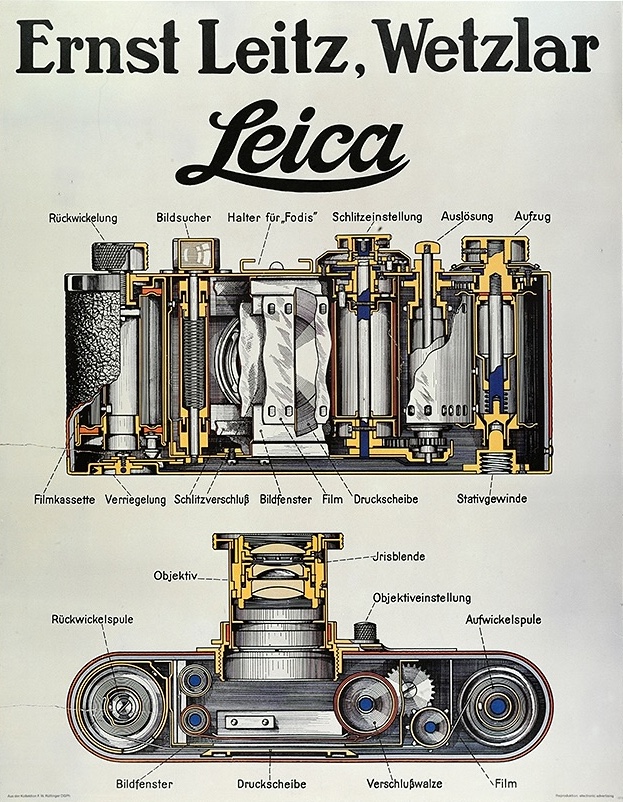
Slide’s brought along his Leica camera to “cover the supernatural angle,”  but the pictures all end up blank: “a vampire’s allergy to silver, an ambivalence as to light itself…” I’ve foregrounded Shadow Ticket’s Gothic motifs and impulses throughout my notes. I don’t really know what I could add to, like, golems and vampires in Transylvania.

A diagram of the internal mechanisms of a Leica I camera

Noting that the Trans-Trianon 2000 motorcycle route allows for “impulses disallowed in normal society” to be acted upon, the narration then gives over to one of my favorite little bits in Shadow Ticket, a self-contained episode of spontaneous pig rescue.” The pig in question is “a Mangalica, a popular breed in Hungary at the moment, curly-coated as a sheep, black upper half, blonde lower. And that face! One of the more lovable pig faces, surrounded by ringlets and curls.”

Mangalica piggy looking cute

Pynchon’s porcophilia is well-documented, with pigs showing favorably throughout his work–particularly in Mason & Dixon and in Gravity’s Rainbow, where Tyrone Slothrop takes on the role (and costume) of Plechazunga, the Pig-Hero, and then later wanders through the Zone with a sweet pig as his companion-guide, while the narrator sings:

“A pig is a jolly companion,
Boar, sow, barrow, or gilt–
A pig is a pal, who’ll boost your morale,
Though mountains may topple and tilt.”

Back to Hicks: wandering the compound one day hears a piano in the distance, recognizes the tune as ‘Star of the County Down,’ a longtime favorite of Irish drinkers he’s known.” It turns out that none other than Pip Quarrender is singing and playing the song — which she identifies as “Dives and Lazarus,” a traditional English folk song that that adapts a riff from the Gospel of Luke. Pips notes that it’s “technically it’s a Christmas carol, though uncomfortable for the average churchgoer given its rather keen element of class hostility.” We have here another bilocation, a song with two separate but real co-existing lives. (Throw in a little class warfare, too.)

Hicks then runs into Terike, who’s concerned that Ace Lomax is missing, on the run from she-knows-not-what (it’s Bruno). The chapter ends with “Zdeněk the golem [locating] Hop Wingdale en route to a Croatian guerrilla training camp near the Hungarian border.” He decides to go check it out.


We’re back to Hop Wingdale and his band in Chapter 32 begins with their tricked-out road-Pullman ominously “moving deeper into Vladboys terrain.” We learn that the “band find themselves growing less enthusiastic about the Trans-Trianon 2000 Tour of Hungary Unredeemed [as] Loose cocaine isn’t always practical on these beat-up roadbeds.” The musicians settle on enormous pills of “cocaine and morphine, known as a speedball.” 

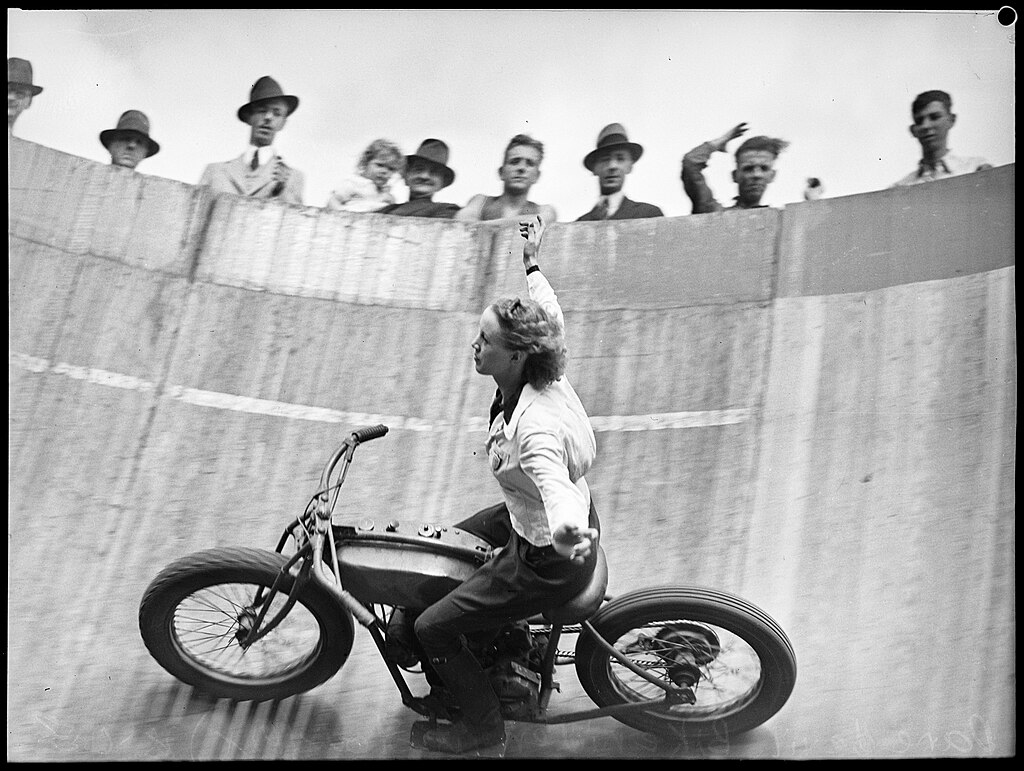
The band pulls in to a “towering wooden cylinder set in a clearing, filled with the snarling of low-displacement bike engines.” Their gig is at a Wall of Death motor cycle stunt show.

Motorcyclist Clara Lee riding the ‘Wall of Death’, Sydney Easter Show, 1938

Pynchon invokes the image of a wall of death late in Gravity’s Rainbow: “somewhere, out beyond the Channel, a barrier difficult as the wall of Death to a novice medium, Leftenant Slothrop, corrupted, given up on, creeps over the face of the Zone.” The metaphor here of course is the wall between the living and the dead.

It turns out that Ace Lomax has been stunt riding on the Wall of Death for tips. Prompted by the band, he sings a Western tune: “Things were so jake, at the O.K. Corral— / Till those Earps and Clantons came along—.” The fantasy here is of an unspoiled West which eventually succumbs to the violence of competing agencies.

Ace recognizes Hop and congratulates his being “still vertical.” He proceeds to tell the musician that Bruno Airmont had tried to get Ace to assassinate Hop, but he decided that wasn’t his gig and hit the road: “By nightfall he’s in Bratislava and slipping unnoticed in among a convoy of Trans-Trianon machinery.” In their discussion about the Wall of Death, Hop brings up motordrome physics: “Somebody said it’s safe long as you keep moving fast enough, something about centrifugal force.” We get here a repetition of one of Shadow Ticket’s major themes, neatly summed up by Stuffy Keegan back in Ch. 20: as long as you can stay on the run, that’s the only time you’re really free.” 

Ace then hits the road. He fails to check in back at the Trans-Trianon base camp, causing Terike’s cryptic road-adventuress face…to drift into disarray. She decides to light out looking for him.

The chapter ends with the narrator telling us that it turns “out that in some walled-in maze of a mountain town Ace has missed a turn…and ends up running on fumes.” He’s pursued by not only wolves but also the fascist Vladboys, “who also run this terrain in packs.” The fascist gang are on what I take to be dirt bikes, faster than Ace’s Harley. The last line, “Ace finds himself in the hands of the Vladboys,” sets up a nice opportunity for a big dramatic climactic rescue scene.


Idiots get respect out here, they’re believed to be in touch with invisible forces | Notes on Thomas Pynchon’s Shadow Ticket, Ch. 24-26

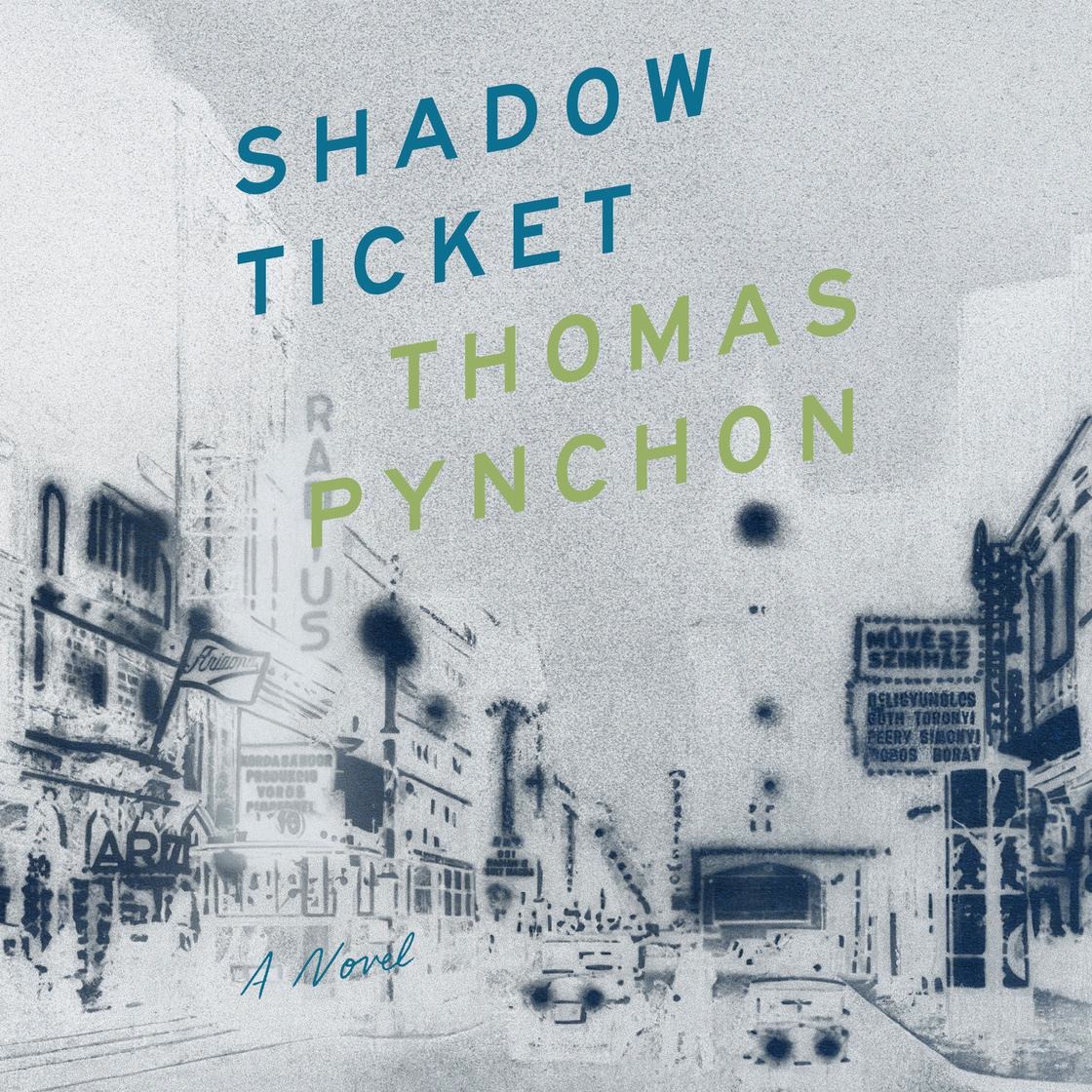
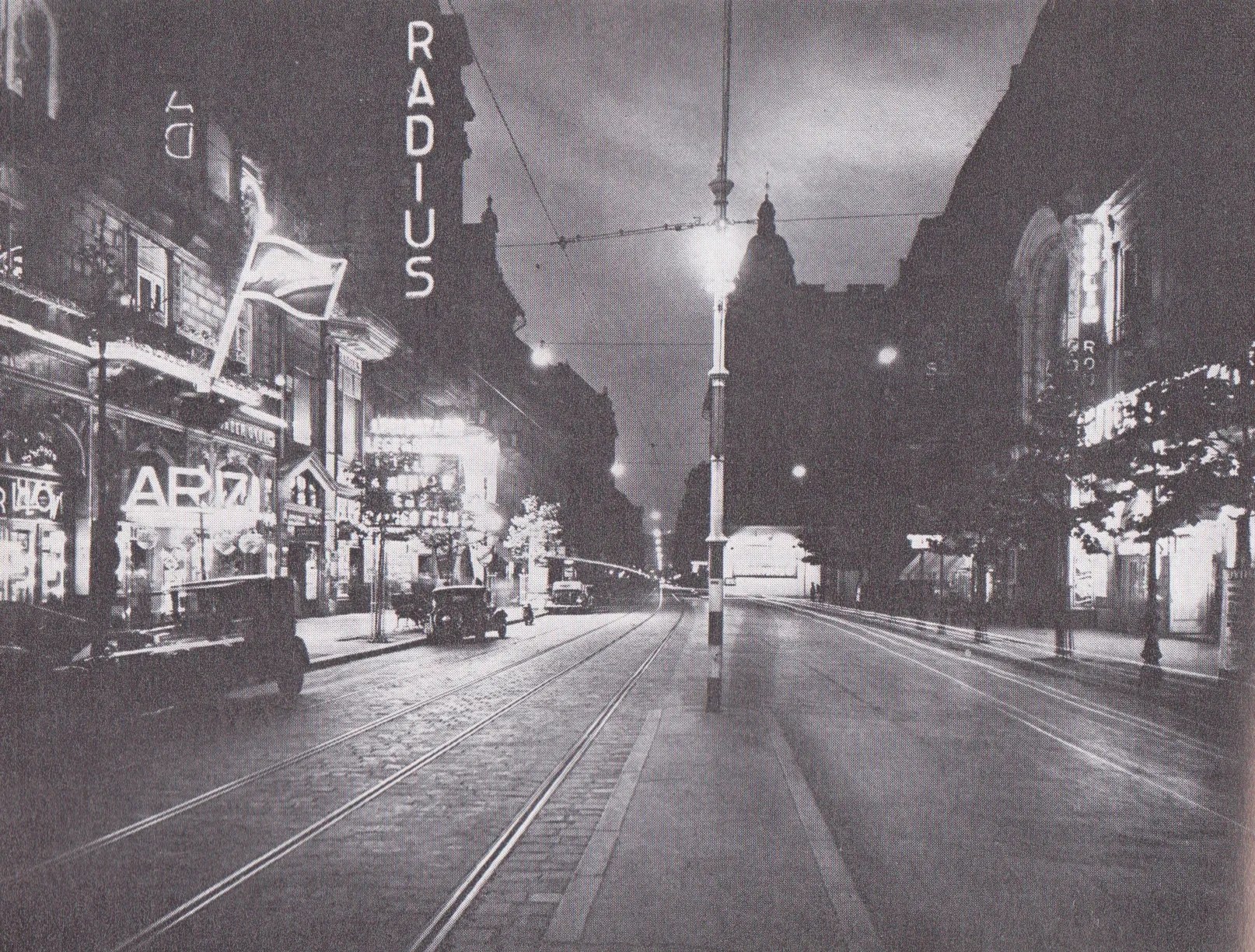
Nagymező Street, the Radius Film Theater (Radius Filmszínház)

Notes on Chapters 1-7 | Glows in the dark.

Notes on Chapters 8-14 | Halloween all the time.

Notes on Chapters 15-18 | Ghostly crawl.

Notes on Chapters 19-20 | The needs of cold capitalist reality and those of adjoining ghost worlds come into rude contact.

Notes on Chapters 21-23 | Phantom gearbox.


Chapter 24: Another fairly long chapter for Shadow Ticket. I’ve been over-summarizing in these notes, and maybe I’ll keep over-summarizing — at this point doing these notes has been my second reading of Shadow Ticket. I would say though, that we’ve reached a point well beyond the novel’s quick change glamour, its bilocative split — or its bait n’ switch, if you feel that way. The novel initially presents as a hardboiled noir send-up in the dark American Heartland only to pivot (or bilocate, to misapporpriate a term from Against the Day) to Central Europe where there’s preparation for a war on (moron). Hero Hicks fades, just a little, in the background; a larger cast steps up.

But Hicks is still the heart of Ch. 24, which begins at Egon Praediger’s office in Budapest, where the ICPC detective is snorting soup spoonfuls of cocaine while ranting about his inability to catch Bruno Airmont. Egon fears he’s wasting his talent “not on an evil genius but on an evil moron, dangerous not for his intellect, what there may be of it, but for the power that his ill-deserved wealth allows him to exert, which his admirers pretend is will, though it never amounts to more than the stubbornness of a child.” Oh man–wonder if that sounds like any evil moron of recent vintage? Egon would rather face off against a worthy villain, a “Dr. Mabuse or Fu Manchu,” references again underlining Shadow Ticket’s lurid pop Goth bona fides.

Hicks then runs into Terike, “just emerging from her latest run-in with the authorities over her motorcycle, a 500 cc Guzzi Sport 15″ — which more on this transport later. On the way to the bike, Hicks finds that he has somehow percolated through Terike, who has performed some kind of metaphysical quick change. He apports, I guess.

1937 Moto Guzzi GTS 500 with matching sidecar

For Terike, the Guzzista “is a metaphysical critter. We know, the way you’d say a cowboy knows, that there’s a fierce living soul here that we have to deal with.” As we should expect now in Ole Central Europe, this bike is spooky, and Terike is a superhero on it: “she can go straight up the sides of walls, pass through walls, ride upside down on the overheads, cross moving water, jump ditches, barricades, urban chasms one rooftop to the next, office-building corridors to native-quarter alleyways quicker than a wink.”

Hicks rides along in the sidecar. (A bit later we’ll see a charming pig, a spirit animal, really, riding sidecar–perhaps there’s a link between Hicks and Pynchon’s other pigmen, like Seaman Bodine or Tyrone Slothrop (or the unfortunate Major Marvy.) Their mission: deliver a batch of experimental vacuum tubes “specially designed for the theremin” to Club Hypotenuse,” a “cheerfully neon-lit” venue featuring a rotating dance floor and “not just one soloist on theremin but a half dozen, each expensively gowned tomato with more or less identical platinum bobs, waving their hands at these units and pulling music out of some deep invisibility, swooping one note to the next, hitting each one with pitch as perfect, Terike assures him, as the instrument’s reigning queen, Clara Rockmore. The joint effect of these six virtuoso cuties all going at once in close harmony is strangely symphonic.”

(Forgive me if I let the quote linger too long, the image is just too lovely.)

At Club Hypotenuse we get a bit of background on Terike, her rejection of her bourgeoisie upbringing, and recent Hungarian political struggles, before meeting yet another character, freelance foreign correspondent Slide Gearheart (he uses the alias “Judge Crater” at the bar. We last heard the name back in Ch. 18, but Crater, icon of the disappearing act, will pop up again). Slide lets Hicks in on a lead he has to cheese heiress Daphne Airmont’s whereabouts; he also gives our P.I. some advice about (not) fitting in to Hungary: “…best stick to English and there’s a chance they’ll take you for an idiot and leave you alone. It might help if you could also pretend now and then to hear voices they don’t. Idiots get respect out here, they’re believed to be in touch with invisible forces.” 

But Slide’s bigger note for Hicks is a soft warning to prepare him for the reality that you can never really go home.


Chapter 25: “Things pick up a day or two later when Slide reports that Daphne has been sighted at the Tropikus nightclub, in Nagymező utca, the Broadway of Budapest.” (This is I suppose the inspiration for the use of the photograph of Nagymező Street used on the cover of the first edition of Shadow Ticket.)

Daphne sings a song and then she and Hicks dance together.

So–I have really neglected Shadow Ticket as a song and dance routine. I think if you’ve read Pynchon you’d expect it; it’s a bit more prevalent here, the singing and dancing, in Shadow Ticket I mean, then in some of the other novels, but it’s certainly what you’d expect. The songs probably deserve their own whole blog or something to deal with (which I will never do); the dancing — well the dancing — I think something I should’ve highlighted much earlier is that Hicks is a really good dancer. Like fucking excellent. He’s a magician who goes into “one of those hoofer’s trances” in the previous chapter while dancing with Terike to the theremin orchestra. That notation — of the trance state — is given for various characters in Shadow Ticket who achieve a kind of short-term perfection outside the physical realm. (It’s the drummer Pancho Caramba (and like, Pynchon, c’mon man, that’s too much, name wise) — it’s the drummer Pancho Caramba in Ch. 25 who goes “into this kind of trance” at his drum kit, enchanting his audience.)

Most of the chapter is the dance and the dance-within-the-dance between Hicks and Daphne. There are Gothic-tinged allusions to their past in Wisconsin–his saving her from the “North Shore Zombie Two-Step” of forced psychiatric hospitalization, incurring a “Chippewa hoodoo” debt as her caretaker in perpetual.

We also start to get Daphne’s backstory with Hop Wingdale, the jazz clarinetist she left home for. She’s followed Hop and his band the Klezmopolitans around Europe, but is worried that the ill-fated lovers “need to relocate before it’s all Storm Trooper chorales and three-note harmony.” Daphne again underlines Shadow Ticket’s departure point — a big ugly change is gonna come. Hop is (rightfully) worried about Papa “Bruno’s invisible hand…” though. Awkwardly enough,” he tells Daphne, “it turns out more of your life than you think is being run on the Q.T. by none other” but her pops.

The phrase “on the Q.T.” — meaning quiet (or “on the quiet tip,” as I thought way back as a teen encountering it) — shows up a few times in Shadow Ticket. It’s phonetically doubled in the word cutie, which shows up more than a few times in Shadow Ticket.


Chapter 26: Another longish section by Shadow Ticket standards, and less breezy than the novel as a whole.

There’s a lot of Daphne-Hicks and Daphne-Hop stuff here — more bilocations, maybe? — in any case, our boy Hicks gets himself more wrapped up than he intended to. After Daphne urges him to help hunt down Hop, who’s kinda sorta left her, he reminds himself of his mantra “No More Matrimonials! Ever!”

By the end of the chapter our American idiot is wondering if “wouldn’t it be a nice turnaround to bring some couple back together again, put the matrimony back in ‘matrimonial’ for a change, instead of divorce lawyers into speedsters and limousines.” Here, I couldn’t help but think of Paul Thomas Anderson’s film revision to Pynchon’s novel Inherent Vice; PTA ties a neater bow on the narrative by letting its lead P.I. Doc Sportello restore the marriage of musician Coy Harlingen.

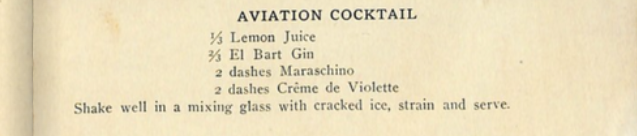
Anyway, we get Daphne and Hop’s origin story: “Talk about meeting cute. You’d think she’d have known better by then. It was in Chicago a few years back, still deep in her teen playgirl phase.” General gunplay shatters Daphne’s double aviation cocktail. She’s smitten with his woodwind serenades.

1917 recipe for aviation cocktail.

This chapter is chocked full of motifs and mottoes we’d expect from Shadow Ticket in particular at this point and Pynchon in general: invisibility, inconvenience, Judge Crater, “Who killed vaudeville?,” etc. It’s also pretty horny, with Hicks and Daphne finally consummating their meet cute from years gone by. Sorry if I’m breezing through.

I’m more interested in a specific exchange.

Carl Jung’s house in Kusnacht, Switzerland: VOCATUS ATQUE NON VOCATUS DEUS ADERIT —  “Called or not called, the god will be there.”

Daphne hips Hicks to something she saw “once, in one of these mental fix-it shops I kept getting sent to, up on the office wall was a motto of Carl Jung—Vocatus atque non vocatus deus aderit. I said what’s this my Latin’s a little rusty, he sez that’s called or not called, the god will come.”

The end of Ch. 23, at least in my guess, seemed to obliquely reference Jung’s Answer to Job, with the narrator suggesting that a trinity can only truly operate as a whole in the form of a stealth quatro — it’s phantom fourth piece balancing out the visible trio in the foreground. The reference to Jung here is not oblique but direct and maybe I will do something more direct with it down the line.

Of course the thing that comes to save Daphne isn’t “the god” but that Big Gorilla Hicks. He notes that, “Your old pals from the rez think it’s spoze to be a critter” who shows up to save the day. In a moment of vulnerability that I take to be sincere, Daphne asks Hicks if he didn’t think that she might actually be insane and should be returned to the hospital and not set free. His reply is a repetition of one of the novel’s several theses: “You were on the run, that was enough.”

Phantom gearbox | Notes on Thomas Pynchon’s Shadow Ticket, Ch. 21-23

Notes on Chapters 1-7 | Glows in the dark.

Notes on Chapters 8-14 | Halloween all the time.

Notes on Chapters 15-18 | Ghostly crawl.

Notes on Chapters 19-20 | The needs of cold capitalist reality and those of adjoining ghost worlds come into rude contact.


Chapter 21:

We move from trans-Atlantic passage to Central Europe pretty quickly. Hicks’s spy handlers Alf and Pip (and like at this point I don’t think he fully realizes Alf and Pip are his handlers on whatever shadow ticket he’s picked up) — Hicks’s spy handlers Alf and Pip leave Hicks on the train while they depart into Belgrade, Kingdom of Serbs, Croats, and Slovenes.

In the Quarrenders’ place emerges Egon Praediger, claiming to be of ICPC — the International Criminal Police Commission (not the Insane Clown Posse Crew), progenitor of Interpol (not the dour 2000s band, but the ICPO). Egon produces “a jarful of cocaine crystals” and grinds up some fat lines — “a routine known around Chicago as ‘hitching up the reindeer,'” the narrator informs us. While ingesting the coke, Egon eventually discloses the shadow ticket Hicks is working: “as you pursue the elusive Miss Airmont, we keep the shadow on you day and night, hoping that Bruno at a moment of diminished attention will make some fateful lunge.” (In another nod to Shadow Ticket’s Gothic motif, the narrator tells us that Egon pronounces the name Bruno Airmont “the way Dracula pronounces the name Van Helsing”).

It turns out that the Al Capone of cheese is the ICPC’s “most sought-after public enemy,” wanted for “criminal activities including murder, tax evasion in a number of countries, [and] Cheese Fraud.” For the terrible crime of counterfeiting cheese, “the International Cheese Syndicate,” or “InChSyn,” want to lock up Bruno. In a cocaine thrall, Egon riffs a bit at the sinister implications behind the scenes: “Cheese Fraud being a metaphor of course, a screen, a front for something more geopolitical, some grand face-off between the cheese-based or colonialist powers, basically northwest Europe, and the vast teeming cheeselessness of Asia.” Egon’s ranting here echoes the academic discussions of cheese back at the Airmont compound in Ch. 13, when discussion turns to breaking into the Asian markets: “How the heck do we create a market for dairy products in Japan short of invading and occupying the country outright? Taking away their tea or sake or whatever it is they drink and forcing them to drink milk like normal human beings?”

(Going back to Ch. 13 to find these lines, I realized that I’d neglected to include a Gothic reference in my riff on that chapter, where cheese is described as “a strange new form of life that was deliberately invented, like Doctor Frankenstein”).

Egon’s coked-up rant culminates in another of Shadow Ticket’s prophetic warnings of the Next Big War to Come. A glistening, entranced Egon declares:

“This is the ball bearing on which everything since 1919 has gone pivoting, this year is when it all begins to come apart. Europe trembles, not only with fear but with desire. Desire for what has almost arrived, deepening over us, a long erotic buildup before the shuddering instant of clarity, a violent collapse of civil order which will spread from a radiant point in or near Vienna, rapidly and without limit in every direction, and so across the continents, trackless forests and unvisited lakes, plaintext suburbs and cryptic native quarters, battlefields historic and potential, prairie drifted over the horizon with enough edible prey to solve the Meat Question forever…”

To repeat a claim I made in my last riff: Shadow Ticket is a bridge novel between two of Pynchon’s masterpieces, Against the Day and Gravity’s Rainbow.

And, to repeat another claim I’ve been making throughout these notes, as Hicks moves eastward, Shadow Ticket’s supernatural elements come closer to the foreground. He’s en route to Budapest, where, according to Egon, there “carouses a psychical Mardi Gras in every shade of the supernatural no matter how lurid.We learn that “Budapest just at the moment is the metropolis and beating heart of asport/apport activities, where objects precious and ordinary, exquisite and kitsch, big and small, have been mysteriously vanishing on the order of dozens per day.” The “asport/apport” motif was first announced back in Ch. 4, via ex-vaudeville psychic Thessalie Wayward. Whereas folks back in Wisconsin were far more skeptical about — or at least reticent to openly speak about — the spooky stuff, Central Europe doesn’t try to deny it.

The chapter ends with Egon giving Hicks a present: a brand new type of pistol called the “Walther PPK.” 


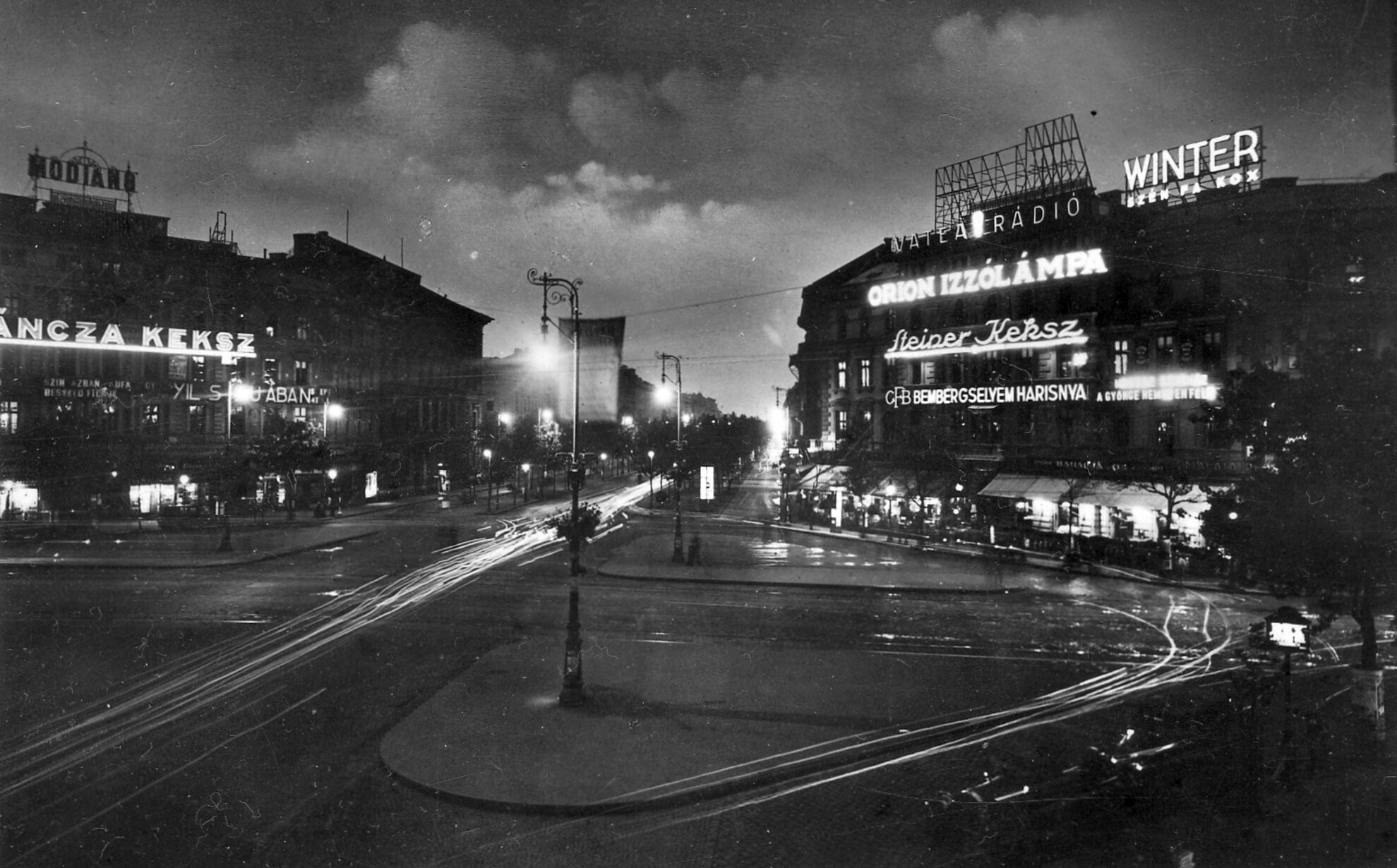
A photograph of the Oktagon, circa 1930

Chapter 22 begins in the Oktogon, a major intersection in Pest. Here, Hicks (and the readers) meet two new characters: Zoltán von Kiss, “once an echt working apportist, lately more of a psychic celebrity detective,” and motorcycle courier Terike who downplays her role as Zoltán’s “Glamorous Assistant.” Hicks is intrigued by Terike, and when she departs with “Szia!” — Hungarian for hello/goodbye, he responds with a “Hope so.” The pun is low hanging fruit but our boy Pynchon loves to eat from that tree.

Zoltán, or “Zoli,” as he prefers to be called has a mission for Hicks. But before getting into that (and a demonstration of his psychic and telekinetic powers), he distinguishes metaphysical Central Europe from concrete America:

“You are a practical people, Americans, everyone is either some kind of inventor or at least a gifted repairman. I myself have grown to rely too much on the passionate mindlessness which creeps over me just as an apport is about to arrive or depart. I am painfully aware of how much more exposure I need to the secular, material world.”

The phrase “passionate mindlessness” recalls Mindless Pleasures — a working title Pynchon used for what would become Gravity’s Rainbow.

mindless-pleasures

But onto that mission: Hicks will assist in the recovery and return of “the crown jewel of tasteless lamps… known in underworld Esperanto as La Lampo Plej Malbongusto.” (Zoli’s ever-inflating description of the lamp’s tastelessness is pure Pynchon.) Again, we get an echo of the Airmont compound back in Ch. 13, where Hicks stumbled into “an excessive number of electric lamps… Some are unusual-looking, to say the least, and few if any in what you’d consider good taste.” 

While the tasteless-lamp bit is, on the surface very goofy, it nevertheless highlights the novel’s concern with what can be seen and what remains unseen; with what casts a shadow, and with what is immaterial. Zolti posits the lamp’s recovery in language that approaches a holy restoration: “even the most hopelessly ill-imagined lamp deserves to belong somewhere, to have been awaited, to enact some return, to stand watch on some table, in some corner, as a place-keeper, a marker, a promise of redemption.” I think the notion here is beautiful answer to a rhetorical question posed in the opening nightmare of Gravity’s Rainbow: “Each has been hearing a voice, one he thought was talking only to him, say,You didn’t really believe you’d be saved. Come, we all know who we are by now. No one was ever going to take the trouble to save you…‘ Pynchon is for the preterite; even the ugliest light-bearer is poised for redemption.

Hicks and Zoli eventually make their way to “a neighborhood of warehouses, corner taverns, cafés and hashish bars, metallic shadows, sounds of mostly invisible train traffic” and into speakeasyish spot “turbulent with kleptos conferring in Esperanto, featuring a lot of words ending in u (‘Volitive mood,’ comments Zoltán, ‘used for yearnings, regrets, if-onlys…’)” (When I was young my mother had a friend who was a member of an Esperanto society. The notion of an invented language fascinated me; I also recognized, even as a child, that it was a doomed project. I love that Pynchon includes a few nods to L. L. Zamenhof’s utopian linguistic project, and highlights the “yearning” behind the invented grammar.) After some funny business by a vaudevillian magic act trio called Drei Im Weggla (secret agents themselves, we’re assured parenthetically) and a nonviolent showdown with “Bruno Airmont’s deputy Ace Lomax,” Hicks fulfills his mission with Zoli.


Chapter 23 sees Hicks reunite with the Quarrenders. Pips has performed a quick change glamour, to Hicks’s admiration. She tells him it’s, All part of the craft, give whoever’s watching something blonde and shiny to fix their attention, then should one need to disappear, simply get rid of it and fade into the mobility.” Like Terike and the other sleight-of-hand artists of Shadow Ticket, Pips understands the value of posing as the “Glamorous Assistant.” Later in this chapter we’ll meet another spy, Vassily Midoff, of whom we’re told “Impressions of what he looks like also vary widely. Not that he’s invisible, exactly, people see him all the time, but they don’t remember that they saw him.”

Alf soon (literally) materializes and complains of an exhausting morning at the “Crossword Suicide Café.” Alf then goes on to detail how “an unemployed waiter named Antal Gyula steps in to what was then known as the Emke Café,” committed suicide, and left a “farewell note in the form of a crossword puzzle he designed himself, whose solution will reveal the reasons he did the deed, along with the names of other people involved.” The puzzle remained unsolved, a “crypto bonanza potentially and yet just as easily somebody’s idea of a practical joke.” The note is zany and sinister, silly and sad, utterly Pynchonian but also, like, totally real.

1937 Böhmerland 603cc Langtouren

The chapter ends with the “nightclub apport trio Schnucki, Dieter, and Heinz, seated one behind another on a Böhmerland Long Touring motorcycle, ten and a half foot wheelbase, red and yellow paint job, riding patrol…” The spectacle upsets Vassily Midoff, who senses a fourth “invisible rider” at the motorcycle’s stern. He hits the high road, “spooked…back into invisibility,” the narrator noting that “for a trinity to be effective, and not just a set which happens to contain three members, there must be a fourth element, silent, withheld. A fourth rider, say, working a phantom gearbox…” 

Perhaps the invisible fourth rider alludes to Carl Jung’s Answer to Job, which argues for a unified, reconciled quaternity, and not a trinity; a symbolic totality that acknowledges the shadow (ticket?) suppressed by the idealized triad. In Jung’s schema, the fourth element completes the cycle by restoring what has been excluded, granting wholeness rather than perfection. The phantom rider becomes an embodiment of that hidden completion, an invisible force that trails behind the spectacle of the three visible figures, suggesting that beneath their exuberant surface rides the unacknowledged presence that makes the whole thing work. (Or perhaps threatens to undo it.)

The needs of cold capitalist reality and those of adjoining ghost worlds come into rude contact | Notes on Thomas Pynchon’s Shadow Ticket, Ch. 19-20

Notes on Chapters 1-7 | Glows in the dark.

Notes on Chapters 8-14 | Halloween all the time.

Notes on Chapters 15-18 | Ghostly crawl.


Chapter 19:

Last time we checked on hero Hicks McTaggart, our P.I. was in NYC, unwillingly sent there by his intelligence agency, U-Ops. A “a needle full of something in the chloral hydrate family” sends Hicks out on the Atlantic, on the “ocean liner Stupendica. The Stupendica is presumably the same ship, or a version of the ship, from Pynchon’s opus Against the Day. In the “Bilocations” section, the Stupendica bifurcates (or  doubles?), engendering a second ship, the Emperor Maximilian, which departs on its own timeline to other bellicose adventures.

Aboard this particularStupendica, Shanghaied Hicks revives to a “seagoing-type tomato” named “Glow Tripforth del Vasto…here on assignment for Hep Debutante magazine, sending in a series of articles on how to be a Jazz Age adventuress on a Depression budget.”

Glow’s name immediately recalls Shadow Ticket’s motif of “glow in the dark” images and monster movie irradiation. The name “Glow Tripforth” (she married into the del Vasto name) also echoes “Geli Tripping,” the beautiful young witch who takes up with Tyrone Slothrop in Gravity’s Rainbow.

Indeed, much in seafaring Chapter 19 seems to echo some of Gravity’s Rainbow’s nautical (and casino) episodes. The Stupendica isn’t the Anubis of GR, but, with its “grinning stewards, uniformed juveniles years corrupted, American sorority girls, [and] exiled royalty” it offers another version of Pynchon’s ship of foolish fun.

And just as Pynchon delighted in Gravity’s Rainbow giving his totem Slothrop costume changes, so too does Hicks get a new suit, a garish “‘Midnight aubergine and electric kumquat…not perhaps as understated a look as one might wish.’ Though in fact, as the Gumshoe’s Manual points out, quite useful if you want eyewitnesses to be focused more on the suit than the mug happens to be in it.” Glamour, as in magic, is a recurring theme in Shadow Ticket, and this theme only intensifies as Hicks heads east to Ole Europe, where we meet more characters who disguise themselves via peacocking distractions.

Pynchon renders the Stupendica as a drunken anarchic playground where “different classes of passenger all … shuffle together” fueled by “Champagne Cocktails, Sidecars, French 75s, Jack Roses, and Ward Eights [that] flow without interruption.” Lotta spirits on this ship!

In this carnivalesque atmosphere, Hicks is approached by Alf and Philippa Quarrender; he claims to be a retired Lt. Commander in the British Royal Navy, but Hicks, brighter than these spies (yeah, spoiler) realize, detects “an air of international monkey business, maybe even some kind of espionage racket, hard at work” in the story they’re selling. The Quarrenders test Hicks a bit on his susceptibility to fascist/Nazi tendencies, and in one of the novel’s least subtle gags, Alf feigns shock to learn from Hicks that U.S. political operatives have ties to the mob in America: “But Al Capone, I say— Republicans and gangsters? How can such things be?” (Pynchon’s stand-in “Hicks blinks once, maybe twice” at this reaction.)

The chapter ends with some more monkey business with people who may not be what they seem, sweet Glow and her “ex- or possibly current husband, Porfirio del Vasto,” an autogyro dealer who may or may not have a murderous streak and who may or may not be a jewel thief. But he does share with Hicks that the word on the street is that folks believe Hicks is “an American gangster, being deported to somewhere in Eastern Europe. Traveling in the custody of Lieutenant-Commander and Mrs. Quarrender, of the British Intelligence, currently under contract to forces unnamed.”


Chapter 20:

So Hicks confronts the Quarrenders: “Seems Alf and Pips have been out on a worldwide scouting expedition to find recruits for the Secret Intelligence” and have likely picked up a “number of code breakers [who] have recently found themselves at loose ends after the Black Chamber was shut down, on Halloween of 1929, just after the stock market crashed.”

There’s a lot I could riff on here — the reference to cryptoanalytics; the will to mill meaning from chaos, finding the visible in the invisible; the rise of national intelligence agencies — but it’s really Pynchon’s reference to Halloween I most want to foreground here. Shadow Ticket is a stealth Gothic novel. Or not really a Gothic novel, per se, but maybe a novel about Gothicism in relation to technology, or, more specifically, communication technology — ways of knowing, ways of sending, ways of communicating. Pynchon chooses to highlight a Gothic aesthetic in the lines above, pinning them to the economic-political historicity of the U.S. at the end of the 1920s. This Gothicism intensifies over the next few chapters, as our hero P.I. heads East into Old Europe. Is Hicks a U.S. Modern? A hayseed hick? Something else?

Either way, the sophisticated, aristocratic Quarrenders do condescend to Hicks’s midwestern naivete. Our P.I. hopes aloud that things will get back to “normal” soon, to which Pips replies: “Things will never go back to the way they were, it’ll all just keep getting more, what the Chinese call, ‘interesting.’” Alf is even more frank: “Take up shooting.” Later in the chapter, Alf delivers one of several theses dispersed in Shadow Ticket:

“It’s a strange time we’re in just now…one of those queer little passageways behind the scenery, where popes make arrangements with Fascists and the needs of cold capitalist reality and those of adjoining ghost worlds come into rude contact…many have been quick to blame it on the War, on the insupportable weight of so many dead, so many wrongs still unresolved.'”

The next war is coming.

Again, I want to situate Shadow Ticket as a bridge novel between two of Pynchon’s masterpieces. Read it after Against the Day and before Gravity’s Rainbow. (Or read it however you like.)

Alf’s concern with “so many wrongs still unresolved” finds psychical manifestation on the decadent Stupendica, where “Passageways long after hours clamor with what sounds like an immense unsleeping crowd, not to be explained away by corridor acoustics or the unceasing friction of the sea.” It’s a ghost ship, baby: “‘Not too many of them exactly visible,’ Alf speculates, ‘yet still wandering the ship at will, in and out of spaces both authorized and forbidden.'” Alf suggests these spirits haunt from “a hope no longer quite sure and certain that injustices would be addressed and all come right in the end.”

The seagoing chapters of Shadow Ticket continue to echo Gravity’s Rainbow; prompted by Alf’s ghost talk, Hicks remembers “séances and so forth going on all the time” at a “spiritualist camp” he visited in summers at his “mother’s side of the family…Hicks and his friends used to hang around…hoping to see ghosts or other supernatural visitors.” The immediate recall here is to the séance scene early in Gravity’s Rainbow, but the bigger pull is to Pynchon’s overall concern with how we know what we know and how we don’t know what we don’t know — a concern that can fit neatly into a term like “paranoia,” but also manifests in attention to the paranormal or supernatural or the metaphysical.

Or, in terms Pynchon repeats in his novels, the visible and the invisible—what glows in the dark? Consider the epigraph to Shadow Ticket (from Bela Lugosi’s character in The Black Cat): “Supernatural, perhaps. Baloney…perhaps not.” Now compare it to the epigraph Pynchon gives for Against the Day (attributed to Thelonious Monk: “It’s always night, or we wouldn’t need light.” And then, far messier in its layered levels of irony, Pynchon’s epigraph to Gravity’s Rainbow, from Nazi-to-NASA rocketmensch Wernher von Braun: “Nature does not know extinction; all it knows is transformation. Everything science has taught me, and continues to teach me, strengthens my belief in the continuity of our spiritual existence after death.” But how can you know?

Pip is skeptical of all of Alf’s intuitions — “a sighting of uncertain luminosity, or a wordless voice that might be more than wind strumming the guy wires of the radio masts,” for example. The skepticism is doubled in the crew and passengers of the Stupendica, some of whom give over to “paranoid suspicions the liner is being tracked by a mysterious submarine.” Like Alf’s ghosts, “Some see it, some don’t.” 

Hicks doesn’t ever see the submarine — presumably the same U-13 he didn’t see back in Chapter 8, when it picked up Stuffy Keegan. Hicks does, however, communicate with Stuffy, or someone claiming to be Stuffy (“Don’t sound like you”) over the radio. Throughout the novel, different characters warn Hicks about a variety of wonderful dangers: bombs and guns and dames and gangsters and an impending world war — but Stuffy gives the gumshoe a warning that he feels in his flat feet:

“‘…back in Milwaukee, freedom, nobody thought much about it, we just figured hey, a free country ain’t it and left it at that. But—’ this being about the point Hicks begins to feel warning signs from his feet—’the real thing, what if that’s only when they’re comin after you for somethin? But they haven’t caught you yet. So for a while, as long as you can stay on the run, that’s the only time you’re really free?'”

Is that freedom though?

Ghostly crawl | Notes on Thomas Pynchon’s Shadow Ticket, Ch. 15-18

Notes on Chapters 1-7 | Glows in the dark.

Notes on Chapters 8-14 | Halloween all the time.


Chapter 15 opens proximal to Xmas time, presumably 1931, still–although it’d take a reread for me to pin down the timeline better. Hicks is in the grip of mild paranoia, feeling like he’s the target of some unknown They. The feeling is a haunting: “light as delusional bugs, the ghostly crawl of professional finger-eye coordination, somewhere above and in the distance, tightening in on whatever is centered in its crosshairs, which at the moment happens to be Hicks’s head.” 

Christmas bugs?!

Hicks’s paranoia is well-placed. He’s “handed a parcel wrapped in festive red-and-green paper whose design features Xmas trees, reindeer, candy canes, so forth. Ribbon tied in a big bow. Something to do with Christmas” by miscreants claiming to be “Santa’s elves.”

Skeptical Hicks denies the supernatural, natch, despite the “ghostly crawl” that’s come over his aspect this haunted season. The so-called elves protest that they are cousins of Billie the Brownie, an historical mainstay of Milawaukee’s Schuster’s Department Store Christmas spectacles.

(I’ve tried not to overload these riffs with too many of Pynchon’s Milwaukee/Milwaukee-proximal references–like, I couldn’t leave Les Paul out when I riffed on Ch. 8, but I didn’t include his reference in the same chapter to Árpád Élő, the Hungarian-American physicist who taught at Marquette in Milwaukee for four decades, during which time he developed the Elo chess rating. Anyway, the point is — for a breezy novel, Shadow Ticket is still pretty dense. Pynchon enjoys fat in the right proportion.)

Anyway, addressing Hicks as “Schultz,” the elves deliver an Xmas package and evaporate into thin air. Then who appears? “Damn if it ain’t the same sawed-off Bolshevik striker Hicks didn’t manage to kill that fateful night not so long ago,” who we learned of back in Ch. 4 (recall Hicks felt some kind of metaphysical interjection prevented his striking down the protester). He warns Hicks to dispose of the package posthaste, insinuating it’s a time bomb.

Hicks steps into Wisebroad’s Shoes in order to use their, yes, X-ray machine. The narrator informs us that, “One of many interesting facts about Milwaukee is that along with the Harley-Davidson motorcycle and the QWERTY typewriter keyboard layout, it’s also the birthplace of the shoe-store X-ray machine.” I have to admit I thought at first that the ridiculousness of such an apparatus struck me as a goofy Pynchonian invention. But shoe-fitting fluoroscopes were like a totally real twentieth-century thing.  (One of the shoe clerks attests that he prefers Brannock devices as X-rays “don’t pick up fat, and fat’s the key, see.”)

The X-ray riff here ties into Shadow Ticket’s themes of mad science, glow-in-the-dark wonders, and strange rays, like those Dr. Swampscott Vobe was said to experiment on his psychiatric patients (Ch. 14) or the irradiated “Radio-Cheez” that helped establish the Airmont cheese fortune (Ch. 13).

Instead of a bomb in the package, Hicks and the shoe clerks see something closer to a face when they peer into the fluoroscope’s lens. The scene is another moment of anxious dread, horror even, woven into the comic zaniness:

“Despite a certain blurriness, Hicks realizes it is inescapably a face, not unchanging and lifeless, like you’d get from a severed head for example, but instead gazing back with its eyes wide open and holding a gleam of recognition, a face he’s supposed to know but doesn’t, or at least can’t name. Mouth about to open and tell him something he should’ve known before this. The window he never wanted to have to look through, the bar he used to know enough not to set foot inside of.”

Hicks disposes of the package in Lake Michigan, where it explodes.

Later, Hicks, haunted and depressed, finds some solace in April. But they both know he won’t keep the girl, even as he dreams of them as partners on the move, “teamed up against each day and its troubles.”

The chapter ends with Hicks trying to pick up the thread of why those elves delivered the bomb to him, and why they called him Schulz. Uncle Lefty isn’t really much help. Hick checks in with the anarchist bombsmith Michele “Kelly” Stecchino, a character who could fit in neatly in Against the Day. Kelly suggests that “an explosion, not always but sometimes, is actually somebody with something to say. Like, a voice, with a message we aren’t receiving so much as overhearing.” He then advises Hicks to get out of town, suggesting a trip to Italy. Hicks protests that Italy’s, “Fascist dictatorship, Professore,” and anarchist Kelly needles him back, asking “What makes you private dicks any different?…Study your history, gabadost, you started off, mosta yiz, breakin up strikes, didn’t ya, same as Mussolini’s boys.” Again, one of the major conflicts in Shadow Ticket is Hicks realizing which side of history he wishes to be on. Hicks then checks in at the Nazi bolwing alley, New Nuremberg Lanes with his old associate Ooly, who thinks that the bomb “don’t feel local. Somethin’s on the way around here, bigger than a gang war.” That would be a World War. Finally, Hicks checks in with Lew Basnight (who was in Against the Day); Lew tells him that what he’s “after is an Overlooked Negative.” Is that something an X-ray could catch? Hicks tells Lew that he was “always what I was hoping to be someday” — and I don’t think he meant it as mere flattery.


Chapter 16 sees the action move out from Milwaukee (much to Hicks’s chagrin). His employer seems to agree with everyone else that he should get out of town for his own health and safety, and the agency sends him to New York (Hicks picks up on the fact that his travel stipend is decidedly a one way sum).

April’s gangster beau Don Peppino sends one of his enforcers along too to suggest he hits the bricks. (The goon tries to hip Hicks to how one might take a “grape so harsh and bitter you’d never make wine from it alone—but when you blend it with other grapes, sometimes only a couple percent, suddenly a miracle” — but Hicks protests that he’s “Only a beer drinker.” The scene is a sweet repetition of sorts of Mason and Dixon’s discussion of grape people and grain people in Mason & Dixon.)

Hicks then goes through some goodbyes with April. I realized that one of my favorite bits in Shadow Ticket is that April always addresses Hicks with a different, sweet-but-pejorative nickname — “Chuckles,” “damned ox,” “Fathead,” “Einsteins” (plural), and my favorite, “ten-minute egg.” They depart in a sweet noir phantasia at Union Station.


Chapter 17 is a relatively short chapter (especially given the sprawl of Chapter 15, which, let me say, I’m sorry that I went on so long about it — part of what I’m trying to do is reread the book by writing about it and tie some themes, motifs, etc. together — I know it went on long. But it was a long chapter, chock full of Important Stuff) — sorry, Chapter 17 is a relatively short ditty, with Hicks’s train moving east through “Depression Pittsburgh, a ghost city” and then entering deeper into the night run, having left behind and below what neon still shone, the Hoovervilles, the ghost-city light, hobo gatherings around trackside trash fires, stray auto headlights gliding briefly alongside the tracks, some fractional moonlight through the windows plus a few dim electric lamps in the observation car, deserted at this hour except for Hicks.” Reviewers and critics will rightly point out that Shadow Ticket is a detective noir; it’s possible to overlook the Gothic horror underpinnings of that genre though. Pynchon often foregrounds this Gothicism, as in the lovely description above. 

Solitary in the observation car, Hicks is approached by “a Pullman porter, whose name, as he’s quick to point out, isn’t George but McKinley.” The reference here is to George Gibbs, a nineteenth century naturalist who, in the parlance of Twain, lit out for the Territory to study, among other things, indigenous languages in the Pacific Northwest.

Our Pullman porter “McKinley Gibbs turns out to be running a sideline in race records; after riffing on politics with Hicks, he slips a few records out for our PI to peruse, including “Blind Blake, ‘Police Dog Blues.’”

We are then told that “McKinley brings it over to the club-car Victrola, puts it on. Before bar three Hicks is about to topple into a romantic nostalgia episode. ‘I’ve heard this. Not on a record, not in a club, but…'”

Presumably the referent for the “it” McKinley possesses is “Police Dog Blues” — but the “romantic nostalgia episode” reveals a different song. The vocalist? “It’s April. Natch.” We get another of Pynchon’s songs, including another of April’s nicknames for Hicks — “dimwit of my dreams” (rhymes with “strange as it seems”). But Hicks’s “romantic nostalgia episode” (American Gothic, I say) is pure reverie. He awakes — no record, no McKinley. Did either ever exist?


Chapter 18: Hicks makes it to New York and does a “courtesy drop-by at the New York branch of U-Ops, which he finds slightly west of Broadway beneath a neon sign featuring a pair of eyeballs electrically switching back and forth between bloodshot vein-crazed and lens-blank pop-bottle green.” The lurid eyeball image mixes nineteenth-century Gothicism with twentieth-century pop. Connie McSpool, on the U-Ops desk, ribs Hicks: “You just missed Judge Crater, he was in here looking for you.” Joseph Force Crater was a New York Supreme Court justice who infamously disappeared and, for a decade or two, was known as America’s “missingest” person. (Maybe surpassed, at the end of the twentieth century, by Jimmy Hoffa.) Shadow Ticket–and Pynchon’s oeuvre in general–features many characters “pulling a Crater.”

Chapter 18 concludes with Hicks overwhelmed, in true Pynchonian fashion, by a shadowy (tickety?) They. There’s “something weirdly off about Gould Fisk Fidelity and Trust,” the “bank” he finds himself at, getting an unexpected ticket to Europe and two-weeks pay. The reference here is to Black Friday, 1869, where big money boys Jay Gould and Jim Fisk tried to hijack the gold market in a Gilded Age financial thriller. Another fragment, maybe, from Against the Day.

The chapter ends with Hicks at “Club Afterbeat up in Harlem,” complaining to Connie McSpool that someone “wants me 86’d clear out of the U.S.A.” 

We’ll get to that ejection soon.


Halloween all year long | Notes on Thomas Pynchon’s Shadow Ticket, Ch. 8-14

Notes on Chapters 1-7 here.

I’m quite a bit further into the novel than where I’m going to have to leave off in these notes, but there will not be any so-called spoilers/discussion of material past Chapter 14

My general take on Shadow Ticket though: This is probably Pynchon’s most accessible novel. It’s fun, funny, and breezy, but it also kinda sorta bridges Against the Day to Gravity’s Rainbow — and not just in a timeline sense, but also thematically.


Chapter 8:

Hicks’s protege Skeet brings Hicks down to the “clubhouse” under the Holton Street Viaduct. Pynchon continues to develop the glow-in-the dark horror film motif, describing, “Cobwebs of purple light from radio tubes with imperfect vacuums inside…A dozen speakers going at once…Pieces of electrical gear blinking and chirping at each other, like a lab in a movie belonging to a scientist not entirely in his right mind.” 

The mad scientist monitoring all these wild signals is pretty harmless though. It’s “a kid named Drover in a set of earphones.” Drover shows off the amplified ukulele he’s crafted: “Kid out in Waukesha showed me…You want the real Tom Swift, it’s this Lester kid, calls himself Red, playing hillbilly guitar up and down Bluemound Road for nickels and dimes, drive-ins, roadhouse parking lots, gets to where he needs to be heard over the traffic, so he figured this out.”

This Lester aka Rhubarb Red is, of course, Les Paul, whose artistic and technological contributions and innovations to 20th-century popular music cannot be overstated. I think his licks sound fresh today.

Pynchon has long been concerned with the intersection of art and technology; of how a signal can cut through noise.

Skeet has brought Hicks to the “clubhouse” under the viaduct to connect with Stuffy Keegan, whose REO Speed Wagon was exploded by unknown entities in Shadow Ticket’s opening chapter. Things get very, very Pynchonian here—a U-13 submarine is prowling the depths of Lake Michigan, apparently there to pick up Stuffy. Hicks is in disbelief. Drover has a hard time picking up a human voice from the sub, and declares that, “everybody must be down below at the bowling alley.” Hicks is even more incredulous: “Bowling alley on a submarine, Drover?”  — setting up an execrable/wonderful Pynchonian joke that pivots on a Jules Verne novel’s title.

The episode ends with Stuffy disappearing somewhere, although Hicks is loath to believe he left on a submarine. Chapter 8 concludes with a less-skeptical Skeet pointing out that Stuffy “Kept saying things like ‘Maybe I’m a ghost now and I’m haunting you,’” again underscoring the novel’s horror-film motif.


Chapter 9 might be summarized by its opening line: “Skeet shows up at the office next day with an out-of-town tomato who causes a certain commotion.” 

This fair lady is one “Fancy Vivid” (geez Thomas); no one in the detective agency can quite believe that she wants to hire them to find disappeared Stuffy, whom she loves dearly. She’s hip to the submarine thing too: He ever say anything to you about a submarine? …Kept wanting to know if I’d ever been on one, if I’d like to go for a ride on one. At first I thought it was some kind of sex talk.”

Like the previous chapter, this one ends with a Gothic note. Hicks goes into a reverie while looking through old files, dreams he’s “in Chicago, or something calling itself that, up North Clark, across the suicides’ bridge, deep in that part of the North Side known as The Shadows.” In this space that is “haunted to saturation by the unquiet spirits of hanged men and women, white, Negro, and American Indian,” he encounters too the spirit of Stuffy who pleads for his help. “Only a dream,” Hicks tells himself.


Chapter 10:

When we first met Hicks’s Uncle Lefty back in Ch. 4, he espoused his sympathies for Adolf Hitler; in Ch. 10, after a casserole dinner, he takes his nephew to a Nazi bar, the New Nuremberg LanesHicks, as yet unaware of the bar’s fascist sympathies, nevertheless picks up on the weird vibes:

“All normal as club soda, yet somehow…too normal, yes something is making a chill creep across Hicks’s scalp, the Sombrero of Uneasiness, as it’s known in the racket. Something here is off. A bowling alley is supposed to be an oasis of beer and sociability, busy with cheerful keglers, popcorn by the bucketful, crosscurrents of flirtation, now and then somebody actually doing some bowling. But this crowd here, no, these customers are only pretending to bowl…”

These people are all American Nazis.

Hicks runs into Ooly Schaufl (“Going by Ulrich these days”), an old associate from his strike-breaking day. The scene underlines a theme developing in the novel: Hicks slowly starting to realize which side of the line he belongs on. The reunion is broken up by the Feds though — prohisdry agents, in the novel’s parlance.

Hicks makes his escape. At the next casserole night, Uncle Lefty gives Hicks the plot-moving-forward tip that Pynchon has frequently deployed thus far in Shadow Ticket, telling him to check out the under-radar as-yet-unopened FBI office in Milwaukee.


Chapter 11 begins with more Gothic intentions; Hicks approaches local the local FBI headquarters, which appears something closer to a haunted house:

“On days of low winter light the federal courthouse can take on a sinister look, a setting for a story best not told at bedtime, the jagged profile of an evil castle against pale light reflected off the Lake, bell tower, archways, gargoyles, haunted shadows, Halloween all year long.”

In Shadow Ticket, the goofy Gothicism of glaring gargoyles butts up against the realer, deeper horror of encroaching fascism abroad and a burgeoning police state at home — and worse, the twisting, bundling of these forces. Hicks gets twisted into it; the feds want him to be their agent too.


Chapter 12 begins with Hicks’s boss Boynt going full tilt paranoid, Pynchonian style:

“The federals who had you in are likely just a front, OK? It’s the outfit that’s behind them, a nationwide syndicate of financial tycoons, all organized in constant touch against the forces of evil, namely everything to the left of Herbert Hoover. Worried about the next election, worried this latest Roosevelt if he gets in might decide to step out on his own, and even if he does revert to type after all, it might not be in time to stop the Red apocalypse that’s got them spooked out of what they think of as their wits.”

The outfit, the syndicate–Boynt ties the forces of right-wing capitalism to outright fascist gangsterism. He redirects his detective’s attention to the cheese heiress case, and the pair take off to the Airmont’s lawyers’ office. There, Hicks is asked if he’s “aware of the American Indian belief, referenced in depositions filed on Miss Airmont’s behalf, that once you save somebody’s life, you’re responsible for them in perpetuity?” (This routine gets brought up again and again.)


Chapter 13:

Hicks heads out to the Airmont mansion to do some recon on missing heiress Daphne. There, he picks up on chatter about “the recent Bruno Airmont Dairy Metaphysics Symposium held annually at the Department of Cheese Studies at the UW branch in Sheboygan, this year featuring the deep and perennial question, ‘Does cheese, considered as a living entity, also possess consciousness?'” 

The philosophical riffing gives way to a brief overview of the Airmont cheese fortune, which was built in  no small part upon the brief success of a product called “Radio-Cheez…designed to stay fresh forever, in or out of the icebox, thanks to a secret, indeed obsessionally proprietary, radioactive ingredient.” 

1921 magazine advertisement for Undark, a product of the Radium Luminous Material Corporation

The narrator reminds us that this was “radium’s grand hour of popularity, when it’s still medical wisdom to seek as many ways as possible to introduce radiation into the human body—radioactive mineral water, patent radium elixirs and aphrodisiacs, radium suppositories,” before bringing up the “Radium Girls” of “nearby Ottawa, Illinois [who] were employed in painting numbers on glow-in-the-dark clock dials, licking their brushes every so often to keep them finely pointed.”

The sad story of the Radium Girls has been well documented. It is another case of real-life horror in Shadow Ticket butting up against Pynchon’s zanier play-acting theatrical horrors. The Radium Girls’ case eventually led to expanded labor protections in the United States, making them ideal Pynchonian heroes.

Cheese conspiracies develop in this chapter; we learn that “The year 1930 happened to be the 1776 of the cheese business.” Bruno Airmont, the “Al Capone of Cheese” befriends the Al Capone (“And what is it you’re the Al Capone of again?”).

At the Airmont compound we also meet G. Rodney Flaunch, “a onetime male flapper” and fiancé to departed Daphne and mom, Mrs. Vivacia Airmont.


And in Chapter 14 we finally get the backstory of Hicks and Daphne’s meet-cute. Daphne’s in disguise and on the run from “Winnetka Shores Psychopathic, a ritzy banana plantation in the neighborhood, overseen by a Dr. Swampscott Vobe, M.D. Known for a susceptibility to anything newfangled, Dr. Vobe has somehow gotten it into his head that the patients at WSP are all available to him as lab material to try out his therapy ideas on, free of charge. Drugs, electricity, rays. Dr. Vobe is specially interested in rays.”

More mad scientist Halloween-all-the-time shit. They escape via rumrunner–the boat, not the drink–and Hicks drops the heiress at an Ojibwe reservation (she claims it was her finishing school). There are more horror notes — references to werewolves and windigos — and again the note that if you save a person’s life you are forever responsible for it:

“And if I say thanks but no thanks, what happens, I get an arrow through my head?”

“You don’t have to be all that way about it either, white man.”


I’ve left out noting all the drinks in Shadow Ticket thus far — I leave that task for Drunk Pynchon! — but I have to bring up two from this chapter. The first is Hicks’s Old Log Cabin Presbyterian, which sounds fucking delicious. The second is Dippy Chazz’s Wisconsin Old Fashioned: “Korbel brandy, 7UP lithiated lemon soda, and, sharing the toothpick with a cherry, a pickled Brussels sprout.” Initially, I thought this had to be a Pynchonian invention — but it’s not. From Toby Cecchini’s case study of the cocktail in The New York Times:

 It’s more a family of drinks, revolving around a central theme. There are four main ways to order it: sweet, with 7 Up; sour (which is not), with sour mix or Squirt; “press” with half 7 Up and half seltzer; or seltzer only. There are regional garnish customizations using pickled vegetables — including mushrooms, asparagus, cucumbers, tomatoes, brussels sprouts and olives — that seem counterintuitive until you taste the salty, vinegar tang playing off of the spice of the bitters and the sweet thrum of the brandy. By God, our great-grandparents were on to something.

Glows in the dark | Notes on Thomas Pynchon’s Shadow Ticket, Ch. 1-7

Let’s start with the epigraph:

“Supernatural, perhaps. Baloney…perhaps not.”

Bela Lugosi,
in The Black Cat (1934)

Dr. Vitus Werdegast, Bela Lugosi’s character in The Black Cat, gives this line to mystery novelist Peter Alison (portrayed by David Manners). Here is the scene:

Pynchon is not the first to sample this line.

The epigraph for Shadow Ticket highlights a concern with the metaphysical that Pynchon has shown throughout his novels. The epigraph encapsulates this concern, ties it to the talkies, the American Gothic tradition, and wedges in a slice of absurd (and drily-delivered) humor early on.


Chapter 1; the novel’s first line:

“When trouble comes to town, it usually takes the North Shore Line.”

Shadow Ticket is set, thus far and for the most part, in Milwaukee Wisconsin in early 1931. For about half a century, The Chicago North Shore and Milwaukee Railroad ran from Chicago to Milwaukee, roughly a long the coast of Lake Michigan. It ceased operations in early 1963.

(Even went through Kenosha, kid.)

The opening paragraphs introduce us to Shadow Ticket’s hero Hicks McTaggart and establish a snappy, hardboiled style reminiscent of films of the thirties and forties (or films of the Coen Brothers that pay homage to those films).


“Everybody is looking at everybody else like they’re all in on something. Beyond familiarity or indifference, some deep mischief is at work.”

These lines append the postprandial scene of a noontime explosion. We get paranoia and a whiff of the supernatural — that “deep mischief…at work.”


“Pineapples come and pineapples go,” declares Hicks’s boss Boynt Crosstown, dismissing the explosion. (Perhaps the name Boynt Crosstown evokes “Burnt Cross Town”?)

Pineapples, slang for grenades specifically or explosives more generally, pops up repeatedly early on in Shadow Ticket.


“…local multimillionaire Bruno Airmont, known throughout the dairy industry as the Al Capone of Cheese in Exile…this one’s more about his daughter Daphne…Seems your old romance has just run off with a clarinet player in a swing band.”

Daphne Airmont, Runaway Cheese Heiress: an early MacGuffin or possible red herring to look out for. One of many, many of Pynchon’s female characters on the run.

Detail from Apollo and Daphne by Pollaiuolo, c. 1470–1480

(Parenthetically, I suppose, because it’s of such minor note, but there’s a mention of one “Zbig Dubinsky” — surely, Shirley, a minor character? — but the name seems to echo the Coens’ film The Big Lebowski.)


“Getting sentimental, kid, better watch ’at, once.”

A warning from Hicks to his protege Skeet Wheeler, a “flyweight juvenile in a porkpie hat.” We’ll see more of Skeet’s apparent sentimentality when he pockets a ball bearing from an exploded REO Speed Wagon. The line would be a throwaway for me, except that it is the first instance of the word kid in the novel. We see it pop up frequently in several forms, including kidding and kiddies. In Ch. 1, Skeet refers to his snub nose service .32″ pistol as a “Kids’ Special.” We learn that Skeet is tapped into the kid underworld—drifters, truants, and guttersnipes, newsboys at every corner and streetcar stop—who in turn have antennas of their own out.” The system of littler kids reporting to bigger kids, etc., reports Skeet to bigger kid Hicks, is “like Mussolini.” (Hitler will show up soon.)


“‘…New watch, I see.’

‘Hamilton, glows in the dark too.'”

The first of (by my count) four specific references to things that glow in the dark. I’ll remark on them in turn, but the other three are Hicks’s hair gel (Ch. 3), a jello salad served at the Velocity Lunch diner (Ch. 5), and a pair of novelty vampire fangs (Ch. 7).

In Pynchon’s books, and in particular in Against the Day and Mason & Dixon, there is a concern with the invisible world, which might be taken as the metaphysical world, or, the supernatural-but-not-baloney world. Perhaps these novelties that glow in the dark point in that direction?


Chapter 2 begins at the crime scene, the scene of an exploded bootlegger’s hoochwagon (the aforementioned REO Speed Wagon).

The “kid” motif develops with references to “Federal kiddies that nobody’s ever heard of,” “Chicago Latin kids, and “German storm kiddies. A page or two later soda jerk Hoagie Hivnak (of a certain “adenoidal brashness”) laments that his Ideal Pharmacy “was no place for kids, the words ‘soda fountain’ would send mothers all over town into fits, worse than ‘opium den.'” No more coke in the sodas for the “Leapers and sleigh riders” to enjoy.

Hoagie moves the plot forward, telling Hicks to “Track down Bruno Airmont wherever he’s got to.”

Chapter 3: We meet Hicks’s special lady, April Randazzo. She’s a femme fatale, folks, a singer-dancer making the late night speakeasy scene. Hicks and April seem like a suave match, but we learn that she has a fetish for married men: “A gold-accented ring finger has the same effect on April as a jigging spoon on a Lake trout, especially when kept on while kidding around, good as a framed copy of a marriage license hanging up on a love-nest wall.” 

Note the kidding around there; perhaps Pynchon teases kidness as the illusion of a romanticized time of faux-innocence, an idealized (and ironized) notion of primeval purity. “Any town but this one / Couldn’t we be kids again” croons April in “what’s gotten to be her trademark ballad, backed by a minor-key semi-Cuban arrangement for accordion, saxes, banjo-uke, melancholically muted trumpet.”


Oh and before I forget, our glow-in-the dark fetish for this episode is delivered from Hicks’s “hip flask from which he pours not hooch but some slow green liquid, rubs it between his hands, runs both hands through his hair as an intensely herbal aroma fills the room…” (21). Hicks attests that his hair jelly “Lasts for days, glows in the dark” (21).


(Parenthetically–we get our first two Pynchon songs in this chapter, one from Hicks and one from April (as cited above.) The chapter ends with Hicks getting nudged again, this time to visit his Uncle Lefty, a retired cop.)


Chapter 4 starts at Uncle Lefty and Aunt Peony’s house. They, sorta, raised Hicks; like his protege Skeet (and every other hero), Hicks is an orphan.

Uncle Lefty has prepared a special “Surprise Casserole [in which] Hicks can detect sport peppers, canned pineapple, almost-familiar pork parts marinated in Uncle Lefty’s private cure, based on wildcat beer from a glazed-crock studio just across the Viaduct.” Here, a pineapple is a pineapple. But it can still be part of a surprise.


Uncle Lefty’s name is a bit ironic. He opines: “Der Führer,” gently, “is der future, Hicks. Just the other day the Journal calls him ‘that intelligent young German Fascist.’ ”

Aunt Peony is more sympathetic. We learn that her words have taken on an edge as her marriage advanced, “as if some maidenly spirit, searching and pious, has set out on a trip Peony has no plans herself to make, toward a destiny quietly lifted away from her when she wasn’t looking.” Unlike Daphne (and April?), Peony failed to make her escape in good time.


We learn of Hicks’s fresh-out-of-school job as a strikebreaker. This job would generally make him on the wrong side in Pynchonian terms, but the novel extends some heartstrings his way, pulling him over to the light. Hicks, it seems, would not turn a Pinkerton villain the likes of which Pynchon castigated in Against the Day. His road to Damascus moment happens when his “lead-filled beavertail sap” disappears before he can decimate a striking “truculent little Bolshevik.” The metaphysics of this disappearing object has a profound effect on our hero.


A bit later in the chapter, Boynt offers a through-a-glass-darkly description of Milwaukee, Cream City USA, evoking, “Hitler kiddies, Sicilian mob, secret hallways and exit tunnels, smoke too thick to see through, half a dozen different languages, any lowlife thinks they can turn a nickel always after you for somethin, there’s your wholesome Cream City, kid, mental hygiene paradise but underneath running off of a heartbeat crazy as hell, that’s if it had a heart which it don’t.” 

There’s the invisible world, but it might sometimes glow in the dark.


Chapter 4 segues into Chapter 5; Uncle Lefty tells Hicks to talk to ex-vaudeville mentalist Thessalie Wayward. They meet at Velocity Lunch, a cafe where “Today’s Special [is] a vivid green salad centerpiece the size and shape of a human brain, molded in lime Jell-O, versions of which have actually been observed to glow.” Hicks is hoping to learn more about the metaphysical disappearance of his beavertail sap–what divine hand intervened to prevent his killing another person?

Thessalie teaches him about ass and app: “Asported. When something disappears suddenly off to someplace else, in the business that’s called an asport. Coming in at you the other way, appearing out of nowhere, that’s an ‘apport.’ Happens in séances a lot, kind of side effect. Ass and app, as we say.”

After some speculation on this “unnamed force,” Thessalie sends Hicks out again, this time to “Talk to Lew.”


That Lew, as we see in Chapter 6, is none other than Lew Basnight, one of the many heroes of Pynchon’s opus Against the Day (which, so far, Shadow Ticket feels very much akin to). Lew’s chapter is beautiful, short and sweet, a kind of elegy for Western phantasia. He was already late to the Manifest Destiny goldrush: “Didn’t even get out there till late in life, after years of dancin the Pinkertonian around what only a couple of old-timers were still callin the Wild West anymore. Hell, I’m ready to go back…”

Pynchon then extends Lew’s fantasy of returning to a mythical Old West via “lucid dreaming… flown in from strange suburban distances, past radio antennas and skyscrapers, down the gloomy city canyons, skimming echo to echo, banking into the Dearborn station, flown invisible, ticketless, right onto the Santa Fe Chief. And away. Away, so easy…” An escape from the Modern world. Invisible, ticketless–that’s the fantasy.


Lew’s episode ends with a warning to Hicks not to become “another one of these metaphysical detectives, out looking for Revelation.”


In Chapter 7, Hicks takes his (his?) gal April to Chicago to see Dracula. April’s smitten by Bela Lugosi, and “Soon she is sending away to Johnson Smith down in Racine for a set of Glow-in-the-Dark Vampire Choppers, 35¢ postpaid.”

A paragraph later our hero is getting some bad news about his (his..?) gal April and one Don Peppino Infernacci. “April Randazzo is in fact the promised bride of evil,” we learn; Infernacci (good golly that name, Pynchon, chill) is “lord of the underworld.” 

Infernacci could be Hades, but April doesn’t strike me as a Persephone. But we’ll see.

Detail from Proserpine, 1882 by Rossetti

It still believes in night | A review of Antoine Volodine’s post-exotic novel Mevlido’s Dreams

Antoine Volodine’s 2007 novel Mevlido’s Dreams is a bleak, dystopian noir novel set several centuries in the future in the ruined city-state of Oulang-Oulane. Here, weary revolutionary Mevlido lives in a decaying ghetto called Henhouse Four, an eerie quarter inhabited by indigents, junkies, and other remnants of failed uprisings who must contend with the giant mutated birds who terrorize the borough.

Once a soldier of the revolution, Mevlido now serves as a policeman, yet he may also be a double or even triple agent, a sleeper sent through time from a kind of liminal afterlife, a bardo between death and rebirth. The novel drifts between waking and dream states, war memories and spectral futures, as Mevlido’s fragmented consciousness becomes a vessel for Volodine’s haunting post-exotic vision of history, language, and apocalypse.

About halfway through the novel, Mevlido’s bardo boss offers a handy summary of the apocalypse:

They’ve become an inexplicable species. They are just getting out of multiple wars of extermination, but a new conflict is already in sight. The population has decreased by a hundredfold, even more. Entire continents are currently uninhabitable. Those who have survived remain socially organized, but they no longer believe in themselves, or in society. They’ve inherited political systems to which they’ve lost the keys; for them ideology is a prayer devoid of meaning. The ruling classes have become criminalized, the poor obey them. Both classes act as if they were already dead. And as if, on top of that, they don’t even care. … Something in them has changed. You’d think that they no longer have the ability to differentiate between life, dreams, and death.

Our hero will be reborn into this turmoil, his consciousness a roiling mess of anxious irreality. “Even if I’m dreaming, I’m in reality,” he concludes at one point, as if to anchor himself in his mission. What that mission is, exactly, is never fully clear to Mevlido or the reader. Or perhaps the mission is very clear; as translator Gina M. Stamm puts it in her introduction, the plot of Mevlido’s Dreams “has the elements of a fairly classic tragic romance: man and woman are in love, the world prevents their being together, man descends into tragic circumstances.” This motif repeats in dreamlike iterations in the novel; Mevlido drifts through a post-exotic wasteland following orders no one remembers giving, haunted by his dead wife Verena Becker, whose presence threads through his days like a recurring dream or a flickering film reel.

We come to learn that Verena Becker died cruelly, murdered by the “child soldiers” who were pressed in to service by agents of the exploitative upper class. In Mevlido’s present time (or, more specifically one of Mevlido’s present times), the child soldiers are now “ex-child soldiers,” reviled refugees who hide under new identities, hoping to avoid the vengeance of people like Mevlido. The vengeance is not aimed just at these foot soldiers though; one of the novel’s heroes, Sonia Wolguelane, plots the assassination of the upper-echelon genociders who, now absolved of their war crimes, continue to rule the city-state with their one-time political foes. Here is Volodine’s description of one of the men Wolguelane assassinates:

Toni Müller, forty-nine years old, delegate to the Office of Fuel, policy officer during the final project of pacification of the remaining zones, initiator of the so-called controlled genocide practice, threatened with legal action after the disappearance of the Wongres, the Spanish, and the Myrzes, sued for not having been able to provide an explanation for the mysterious annihilation of the inhabitants of the Philippines. Amnestied. Director of the petroleum trusts in the remaining zones, billionaire, numerous books of economics published in his name, numerous honorific titles. During his last self-criticism, he admitted having constantly hidden from the masses the fact that he didn’t share the household chores with his wife.

While the apocalyptic stakes here are swollen to hyperbolic levels, Volodine’s critique of how the ruling class wields power nevertheless applies neatly to our own 21st-century blues. Henry Kissinger, for example, died fat and happy. I’m reminded too here of Thomas Pynchon’s critique of power, particularly in Gravity’s Rainbow, where the narrator laments that the Nazi war criminal Weissmann will not be punished but rather elevated, set to sit “among the successful academics, the Presidential advisers, the token intellectuals who sit on boards of directors. He is almost certainly there. Look high, not low.” Look low for the preterite heroes of Mevlido’s Dreams though. They are the “faded zombies, probably candidates for another hallucinatory expedition, left-behinds who imagine they will be able to leave again.”

I am making the novel sound too grim. It is rich, and much of that richness comes from a bureaucratic, deadpan humor, the laughter of exhausted ideologues trapped in their own paperwork. But what happens to faith in any ideology when it is sundered from observable reality? Consider this exchange, in which a lost Mevlido tries to communicate with a band of men who fail to recognize him as a human being:

“Incredible,” says one of the normal ones, “it’s still talking.”

“And what is it talking about?” asks the red cap.

“About the night,” says the fat one.

“It’s talking about the night?” the bare-chested one asks, surprised.

“Yes, it must still believe in night,” says one of the normal ones.

“Incredible,” says the other normal one, “it still believes in night.”

And beneath the satire, there’s love. Volodine writes love as a metaphysical condition, a persistence that outlasts ideology, memory, and even death. The tenderness between Mevlido and Verena gives the novel its pulse. It’s the one human rhythm left in a mechanical world. Stamm’s translation conveys this rhythm in clipped, moody sentences, wounded and precise.

Like Volodine’s 2014 novel Radiant Terminus, Mevlido’s Dreams operates in the twilight between horror and tenderness. But Mevlido’s Dreams is quieter, more interior—a story of a single man’s dissolution told in flickering vignettes. It reads like the afterimage of a life projected on a cracked wall.

That light, dim and trembling, is what Volodine and Stamm preserve. Mevlido’s Dreams reads not like a film script but like a film itself: shadowy scenes unfolding in silence, broken by bursts of deadpan dialogue and ghostly humor. You can see the ash swirling, hear the echo of curses in an alley haunted by mutant birds.

Oulang-Oulane feels shot through a grim lens, intense, ugly, beautiful, like something from Tarkovsky’s Stalker or a Béla Tarr film, with scenes of desolation punctuated by tenderness. Volodine isn’t cinematic because he borrows film tropes, but because he composes through atmosphere and rhythm. His sentences drift like a camera through fog and memory.

That line above—“it still believes in night”—could be the novel’s credo. Dreaming isn’t retreat; it’s resistance. Writing, too. Mevlido’s Dreams works as both a political fable and a séance for the lost, a way of keeping consciousness flickering in the dark. Highly recommended.


A review of Rebecca Gransden’s novella Figures Crossing the Field towards the Group

In Rebecca Gransden’s novella Figures Crossing the Field Towards the Group, an unidentified blight spreads from the south of England, driving refugees northward. Our hero, a girl named Flo, walks north through this ruined England on a quest to find her lost twin brother. In her strange journey, Flo encounters scattered figures who spill fragmented stories in broken voices. This England is barren, etiolated, and foul. Gransden conjures this apocalyptic barrenness in oblique and elliptical language. Most of the narration in Figures Crossing the Field Towards the Group slips out in clipped single-syllable beats, as if the world itself has been pared down to bone. The book’s end-times aren’t explosions or spectacle but the exhausted rhythms of a world already gone, the voice itself a survivor stumbling forward, blunt and breathless. What remains is not plot so much as the scraping of words against ruin.

And yet, within that scraped-down ruin, Gransden finds a strange fullness: stark fields and broken voices bloom with uncanny images, fleeting surges of feeling, flashes of lyric intensity that make the blasted landscape thrum with life even as it crumbles. Consider this passage, in which our hero Flo encounters a band of freed apes:

Howls eke out through branch and twig, and bods slink down the fell trunks, climb in shift shads on the broke build roof, a mess of swol leaves and wet spikes. Lab apes crawl and tick, their mugs stretch flesh, their heads bolt. Freed by the flee, and left to lone, their house fell in and they, shy and of wound nerve, did peek to the wood, and then run out and claim the trees. They stay near to where they know, fear keeps them so. One ape chomps on a bat, its legs kick as it dies. Most of the lab apes have one eye, a square patch of bald skin, a rash and some scabs.

Figures propels forward with a loose, picaresque energy, its moody, elliptical atmosphere stretched across an almost shapeless structure. It’s best not to look for causality here; things just happen. This isn’t post-apocalyptic fiction. The apocalypse is underway. And Gransden’s language drifts on the fumes of that apocalypse. I often found myself reading lines aloud, even repeatedly, in gnarly little loops: “Town rats puff with nits in their ruffs” is a simultaneously abject and beautiful image. Or consider this lovely little passage:

A shock of white moth wings sings from the shrubs, makes Flo step back and near fall. White flies round her like a snow storm, and moth dust fills the small grove. A film forms on dark leaves and the air smells of old nests. Moths brush her,just close to push a soft stroke on her face. Small round white moths, small white moth round.

The monosyllabic narrative style that dominates Figures may challenge or, more frankly, irritate some readers. I found it hypnotic. Gransden’s characters are not bound to single syllables though. When Flo talks to someone she encounters (an insane royalist, say, or a man sacrificing his body as food to tiny furry beasts), they speak in normal, multi-syllabic dialogue. More fascinating is a solitary chapter that divides the novella in halves. “Public Information Dreams” reads almost like its own Ballardian short story. Told in a clinical, detached style, the chapter gives an incomplete picture of observations made from afar on two children, Kid P and Kid Q. A taste:

Observer: 35

Day: 163

10:37:45 am — Kid Q exits property by back door (3b) and moves to end of garden. Weather is bright sunshine, occasional cloud shadows. No occlusion. Kid Q walks back and forth between end of garden and house, carrying objects. Objects observed to be recording equipment as previously noted (ID476). Kid Q collects the objects together on an empty patch of lawn behind the garden shed. The patch of lawn is square and is mostly unseen from the house. It ends at an overgrown fence, approx. 6ft tall that marks the perimeter boundary of the property’s rear. Beyond the rear fence are fields but the garden is not visible from this location due to the density of the foliage (full description and photographs of the layout of the property and garden are included in additional notes, at this time in the process of compilation). Kid Q assembles the recording equipment. Video camera on tripod is situated in the corner behind the shed and arranged to point across the lawn square diagonally, taking in as much of the space as possible.

10:52:13 am — Kid P exits house by the open back door (3b). Observed to have a listless demeanour. Kid P joins Kid Q. Kid Q and Kid P engage in long conversation (see transcript).

Are Kid Q and Kid P Flo and her brother? If you care, this book probably isn’t for you.

Too, Gransden refuses to settle Flo’s quest—or the apocalypse itself—into any final meaning. The ruined England she describes is not a backdrop but a language, one that stutters, doubles back, and opens fissures rather than closing them. Flo walks north, chasing the shadow of her brother, but whether she finds him, or whether there is anything left to find, hardly matters. What matters is the walking, the scraping of words across ruin, the pulse of strange life inside the waste. Figures Crossing the Field Towards the Group dwells in that space where endings blur into continuations, where survival is indistinguishable from loss, and where language itself flickers like the last light left to see by. Strange, gnarly, alive–great stuff.

A put-upon frogman with too little oxygen vs. his angry father in Markus Werner’s novel The Frog in the Throat

The hero of Markus Werner’s 1985 novel The Frog in the Throat is Franz Thalmann, a disgraced, divorced, defrocked clergyman, who lives ashamed and diminished, yet nevertheless resilient in a philosophical recalculation of his life. There’s a major complication to Franz’s reevaluation though: the memory (or ghost?) of his stern father Klement turns up as a literal (or is it just metaphorical?) frog in his throat. Klement presents as a tragicomic, pestering apparition who ventriloquizes his son—and the novel—with rural grumbles. He milks cows, rants against modernity, and accuses Franz of having betrayed the world he was born into. In Michael Hofmann’s translation, Werner’s prose is crisp, dryly mortified and quietly savage: intimate cruelty turned into a dark, pinprick comedy about guilt, family, and the stubbornness of provincial life.

The voices of son and father drive The Frog in the Throat. These voices collide in bursts that never find harmony. There are ten punchy chapters: Thalmann the Younger takes the odd chapters; Daddy Klement narrates the even ones. Franz’s chapters are philosophical, discursive, and given to a choppy, aphoristic rhythm. (Franz does, however, declare at one point, “Well. I’m not a philosopher, am I. I’m a put-upon frogman with too little oxygen.) Klement’s sections are denser and earthier, but, for all their ravings and rantings, somehow easier to digest. The voices prickle and stick, evoking that ancient tale, a failure to communicate. This is not a duet, not a dialogue.

Franz, helming the novel’s odd chapters, takes the lead. Here’s childhood, adolescence, nascent adulthood, distilled into fragments:

Obedience. Belief. Suffering. Instructions followed. Expectations fulfilled. Said yes and please and thank you and three bags full, sir. Controlled stray impulses. Cleaned teeth, ditto ears. Swilled elderberry syrup. Studied the Good Book. Knew mastery and eventually self-mastery. Did what was dinned into me, and eventually started doing some dinning of my own. Shoveled snow. Madonnified women. Got in shape. Fiddled. Suffered. Was afraid. Could barely stand Father’s glower. Rarely laughed. Prayed. Fed swine. Visited libraries. Mucked out the cowshed. Dogmas, apologias, ethics. Kissed Helen. Struggled for purity. Homiletics, catechesis, liturgy. Forswore eggs. Was afraid. Was good. Marriage. Ministry.

Franz betrays Helen not in a torrid tryst or a meaningful long-term affair with an extramarital soulmate. It’s a one-off, an almost comically ordinary lapse. It’s not a fling; it’s a thing that happens—and yet it detonates his life, initiating an existential crisis in Franz-as-preacher:

Once it’s been understood that our existential crisis is first and foremost a crisis of our senses, then in spite of metaphysical obfuscations we can see the therapy: The extension and promotion of sensuality. An expansion of the realm of the senses. Humanity will only have a future if we are successful in establishing a new Age of Tulips. The individual sets aside his gloom as soon as he feels his body is a house of joy. A precondition for this is moral enfeeblement, because morality has seen its role for thousands of years as an impediment to French kisses. To put it briefly: Traditional morality impedes sensuality.

Franz’s desire for sensuality is undercut by an intellectual airiness, a quippiness of the spirit. Our man is full of aphorisms:

Castrate the fathers, gag the mothers.

and

I say again, gladly: Happiness is remote.

and

Cleared out the attic, threw all the rubbish away. My concern: The head empty of rubbish and without level crossing attendant will produce badness.

and

Humor, though. Almost eludes description. Strangely adorable bastard child of love and wistfulness.

You can throw a small dart in this short book and find a nice line from Franz. (I plucked most of these from very early in the novel, before too much of the (non)plot develops.)

But back to our Franz’s claim that “Traditional morality impedes sensuality” and thus human joy requires “moral enfeeblement” — a problem for a one-time theologian.

In contrast, Franz’s father Klement expresses an earthy sensuality in each of his chapters; he milks his cows and reflects on their udders, their calfing, their literal breeding. His bovine reflections drift into memories of his family, sketching out the often painful history of his children. We also come to see that, like his son, Klement is an outsider. He doesn’t quite fit in at the local pub. The other patrons can’t comprehend his contempt for the modern world.

Some of the finest moments in The Frog in the Throat happen when Franz wanders into a theme that Klement, grumbling from the cowshed, will half-pick up on in the next chapter—less a conversation than a comic game of misheard telephone. These echoes and prefigurations create a thematic tone, however discordant. Take for instance middle-aged Franz, feeling as if he’ll never really mature:

I’ll be fifty soon and I wonder what being grown-up will feel like. Was I grown-up when I turned twenty-two? For a bet, then, I ate a coffee cup. No problem. My stomach was equal to the challenge. Today, I poke at my sauerkraut. An un-grown-up way of behaving, only confirming one’s suspicion that being grown-up, like everything else, is a passing condition.

And a chapter later, Klement confirms Franz’s intuition:

People remain a mystery, you can read a hundred books and you’ll be no closer to understanding them, that’s my view, and when I was younger, I always used to think: When I’m older, I’ll work it out. You see, when you’re young, you see old fellows with white hair, and you think: They may be old and knackered, but they have experience of life, they’re not floundering like us, and maybe they have wisdom. And suddenly you’re old and gray yourself, and you realize that’s all you are, old and gray and just as clueless as you ever were, and so I say: No one’s got the secret. I often think we should view everything from above, we should look down on the world from way up high, and who knows what we would see, what connections, what never-guessed bridges and linkages, or then again maybe not. What a tangled mess, what a confused jumble, I don’t know.

Perhaps the two preceding passages might give a prospective reader the incorrect impression that The Frog in the Throat is a dour novel; it is not. It is often quite funny and quite moving. It’s easy to identify with Franz’s groping questions, and as the book progresses, we come to see under Klement’s anger a wounded pathos. Perhaps the father’s name is not ultimately ironic; perhaps there is a mercy in his haunting his son. Maybe Franz sees the past with new eyes (or, rather ears) through his father’s visitation. But I’m inclined to agree with translator Michael Hofmann in his introduction, when he suggests that “reconciliation is out of the question, but equally there is no possibility of not laughing.”

Synthesis between father and son was never the goal of this novel, let alone a metaphysical coherence. Rather, Werner seems to express his own literary ambitions most directly near the end of the novel, when his antihero Franz declares his admiration for novels that

…are subversive, making clear that their authors, in writing them, did so to avoid doing something far worse…the books that crackle subtly, the semi-house-trained powder kegs of books, the incautious, unconsidered, and if you like erroneous ones…

I’m not sure that The Frog in the Throat is a powder keg, but it does crackle subtly.

I have perhaps overshared Werner’s prose in this review. The truth is I just really loved the way his sentences stack up. And I must again applaud translator Michael Hofmann’s work here; his new  translation of Alfred Döblin’s 1929 novel Berlin Alexanderplatz was one of my favorite reads in recent memory. So I’ll share one last stack of sentences, again from a Franz section. It’s a passage I dogeared, perhaps thinking it exemplary of the novel’s sharp pacing and shifts between pathos and dark humor:

In the morning I’m miserable, at night I’m scared, and during the day I am at pains not to attract attention, putting one foot in front of the other, forming sentences, combing my hair, leaving tips for the waitstaff and buying five tomatoes and answering the telephone in my best and brightest voice, reading this and that in the newspaper, not killing myself, showering regularly. And I give advice to people and listen to them and feel moved by their confidence in me. I sit around, I drink, I brood, I pat myself down for flaws and find many and each evening I say: Starting tomorrow I’m going to get a grip on myself.

—but really it’s that last clause there hanging from the colon that I most connect to. For tomorrow, I too will get a grip on myself.

Highly recommended.


Birthday stacks | Not really a blog about Biblioklept turning nineteen

A few weekends ago we did the take-your-kid-to-college thing, made the ninety-minute SW drive to Gainesville, FL to move our daughter into her first place on her own. She’s living in the same apartment complex her mom lived in, only under a different name. (The apartment complex has a different name. Not my daughter or wife — although I guess my wife has something of a different name, having taken my own last name up as hers.) There was some nostalgia, some weird feelings, etc. But mostly excitement, followed by backache, muscle ache, and an intense week of schlepping even more stuff around my house, cleaning, painting, refinishing, etc. as we repurposed our daughter’s room into an office and my wife’s old office into a studio space for our son.

This process displaced many many books. The house was already littered with stacks, with at least two established semi-permanent piles of incoming volumes and TBRs and etc., but somehow all the furniture relocation led to an entire bookcase heading south and west of Biblioklept World Headquarters. I culled what I could and vowed to get to the rest later. And here we are.


I started this blog on 9 Sept. 2006, nineteen years ago today. I don’t think I would have remembered this connection, even though I’ve blogged about Biblioklept’s birthday several times before, if I hadn’t heard the local sportscaster on his local morning-commute sports show give a shoutout to his wife, whose birthday is today. I thought, Oh, that’s Biblioklept’s birthday too.


(The local sportscaster’s wife is his second wife, or maybe third, I’m not really sure. But he used to be married, way back in the gay nineties, to the news anchor. They were our little big town’s version of a celebrity couple, maybe. (I remember I took a date to Barnes & Nobles and then the Chili’s by the Barnes & Noble — these places are long gone — and I saw the sportscaster and his anchor wife bickering in the Chili’s parking lot before I ate fajitas or whatever.) The sportscaster’s news anchor wife had an affair with the weatherman, a bold blond surfer specimen who frequently wore suspenders on air. This affair was something of an open secret, and I think some of the people involved were fired, or shuffled to different networks. It’s like the most low rent version of prime Fleetwood Mac you could imagine.

Anyway, the anchor and the weatherman are still married. He still does the weather and she’s the mayor of the city now. Her ex covers local sports on TV, the web, and the radio. I listen to his show in the mornings as a diversion from reality. It’s not very good, but it’s better than the complacent centrism of NPR. I haven’t been able to listen to music on morning drives in decades (I would have to pull the vehicle over and weep); I cannot follow audiobooks or even podcasts in the mornings; I take the inane meaningless chatter for aural breakfast. Today was the sportscaster’s current wife’s birthday. And Biblioklept’s.)


So well and anyway, I thought, I should do some kind of birthday post for the blog. So again, here we are. (Or maybe you have wisely left by this point.)


How about those promised stacks, those totem poles that keep getting moved from room to room? Here’s one:

What these books have in common is that some of them used to be in a bookcase that is now in Gainesville and I don’t know where to put them. All the B.S. Johnson books came from a B.S. Johnson jag I went on a few years ago, and they ended up tucked away — can’t stick them on the shelf of American postmodernists, right? And Christie Malry’s Own Double-Entry? What an amazing novel? How have I not reread it. I got the Tim Tebow and Werner Herzog books for Christmas and I read them both. José Donoso’s The Obscene Bird of Night is maybe my richest reading experience of the past year.


Here’s another picture of a stack of books:

I got another copy of Woolf’s Mrs Dalloway a few weeks ago, which I think led to me pulling out some Woolfs (Wolves?); everything else here seems random, chaotic, emblematic maybe of my self-disgust—what am I doing with all these books? Of course I want to own a hardback first of Angela Carter’s Wise Children, even if I can’t find a proper home for it, right? And why wouldn’t I snap up every Alasdair Gray novel I come across? I think all these Evan Dara books were stacked up in the same missing bookcase that the B.S. Johnson books were stacked in; now they are loose, reminding me of the novelist’s diminishing career. Do I really need to hold on to Permanent Earthquake? The novel is terrible and the book itself is a cheaply-bound print-on-demand thing. It makes me feel sad. The Lost Scrapbook is amazing.


I was 27 when I started this blog.


What am I even doing here?


The Gordon Lish books were almost certainly smashed up against the B.S. Johnson and Evan Dara books — I think I wasn’t sure where to shelf them. I have been very mad at Gordon Lish for a few years now for reasons I promised not to divulge but which basically have to do with his being a flaming asshole. I finished Markus Werner’s novel The Frog in the Throat a week ago and the ending made me tear up. It’s a novel about aging and failure and fear; it’s very, very funny. The late great David Berman once said that Robert Stone’s Dog Soldiers was his favorite novel. I loved it and I suppose I’ll refuse to read another Robert Stone novel. (Why?)


For some years, David Berman kept Biblioklept on the blog roll of his blog Menthol Mountains. That’s like the proudest I’ve ever been of anything that ever happened on this blog. I miss him.


Last stack — not really the last stack, there are at least three others, but I’m getting tired of this, in several senses:

John Keene’s collection/semi-novel Counternarratives is one of the best things I’ve read in forever. He refracts history through these layered polyphonic fictions that pull truth from the margins. My favorite piece in the collection reads like a riff on Melville’s Benito Cereno. I read Leonora Carrington’s novel The Stone Door, realized I misread it, then read it again. I have about four tabs open attempting to properly review it, but alas! I don’t know. I keep failing to find a grip into Di Benedetto’s The Suicides; maybe it’ll take soon. I started reading Antoine Volodine’s Mevlido’s Dreams around 12:30am this morning. It’s much funnier so far than I would have imagined. I’d mislaid the novel maybe a year ago; it was in a pile in the back of a bookcase that is now south and west of here.


I don’t have a way out of this post. I’ll do this blog at least one more year. Odysseus did twenty years, right? That’s a ridiculous stupid fucking sentence, the previous one.


This summer has been the weirdest one of my life, but it’s over now, right?

Paul Kirchner’s metaphysical trip continues in The Bus 3

Paul Kirchner’s surreal comic strip The Bus is a looping, deadpan fugue of modern alienation and mechanical ritual, where a lone Commuter drifts through absurd, Escher-like permutations of transit life.

The Commuter’s foil and ferry is the titular bus (which Kirchner himself described as “demonic” in a 2015 essay in The Boston Globe); his Charon (and, really, partner) is the bus’s Driver. Each Bus strip is a double-decker one-pager rendered in precise black ink; most strips are wordless and consist of six or eight panels. Kirchner uses these constraints to conjure metaphysical gags that upend the banality of everyday existence. The previous two sentences that attempt to describe Kirchner’s formal techniques are a poor substitute for an example — so here is an example:

The strip above is the first entry in Kirchner’s new collection, The Bus 3. This strip neatly ushers us into The Bus’s charms. Old partners Commuter and Driver reunite; the bus subtly transforms into a theater; the Commuter turns to witness the loop start anew. Is there an exit? And would the Commuter want to escape the loop?

The second strip reaffirms Kirchner’s commitment to the Commuter’s eternal return. Our hapless hero is a kind of chthonic demigod, simultaneously plastic and immutable, wholly absurd:

The Bus’s first route was between 1978 and 1985 in the pages of Heavy Metal magazine. French publisher Tanibis Editions republished this original run in 2012. In 2015, they published The Bus 2, a sequel of new material. In my review, I wrote that “The Bus 2, like its predecessor, is a remarkably and perhaps unexpectedly human strip.” The same is true for The Bus 3. Kirchner’s strips demonstrate that the absurdity of the modern condition, for all its dulling machinations, reaffirms humanity and the imaginative, artistic vision as a site of surreal resistance.

I kept The Bus 3 out on my coffee table the entire summer. I tried not to gobble up all the strips right away, but rather to read one or two a day, each page a small treat against the absurdity of the day. As I reached the end of the volume a week ago, I found myself strangely moved by the last three strips. Kirchner’s Möbius strips always send the Commuter back to his starting position. These last three pull the same move, but with a difference. In the first of the final three, the Commuter dies (waiting on the Driver, natch) and his spirit ascends. In eight speechless panels, Kirchner retells Kafka’s parable “Before the Law.”

The penultimate strip, a gag on Macy’s Thanksgiving Day Parade balloons literally deflates the bus. The crowd has left, but the Commuter remains, stoic, waiting. And the last proper strip shows a techno-utopian future with a splendid flying bus — but our Commuter refuses to board. His neck stooped, he wanders to the outskirts of town to find the apocalyptic wreckage of his beloved broken down bus. It’s a lovely moment.

Has Kirchner retired his Commuter? Perhaps. The last page of the book shows our hero somehow looking bemused in a folding lawn chair, a cold one in his hand. He sits in front of the bus, now converted to an immobile home, scene of domestic bliss, maybe, everything tranquil and normal (just ignore the fish).

Is it really the end of service? If so, The Bus 3 offers a sweet send off for its hero. But I’ll hold out hope for one more ride. Great stuff.