Study for Ophelia — John Everett Millais

Tom McCarthy on William Burroughs’s Verbal Remix Software

A passage from Tom McCarthy’s essay “Transmission and the Individual Remix:”

It might be inferred, from what I’ve said, that any old remix will do. Not so: there are good and bad ones. Tristan Tzara cutting Shakespeare sonnets up and pulling their words from hats is an exercise in randomizing. William Burroughs and Brion Gysin mixing poems in with sliced-up pages of The New York Times is quite another matter: it is assiduous composition—composition understood in all its secondary nature: as reading, tracing, reconfiguring. Using the same technique, Gysin comes up with a few clumsy permutations along the lines of “Rub the Word Right Out . . . Word Right Rub the Out” and so on—whereas Burroughs generates such gorgeous sequences as:

Visit of memories. Only your dance and your voice house. On the suburban air improbable desertions . . . all harmonic pine for strife.

or

The great skies are open. Supreme bugle burning flesh children to mist.

Why does Burroughs conjure so much more richness from the same source material? Because (unlike the painter Gysin, whose skill lies primarily in the domain of images), he has uploaded the right verbal remix software. He has read and memorized his Dante, his Shakespeare, his Eliot—to such an extent that his activity as a composer consists of giving himself over to their cadences and echoes, their pulses, codas, loops, the better that these may work their way, through him, The New York Times and any other body thrown into the mix, into an audibility that, booming and echoing in the here-and-now, transforms all the mix’s elements, and time itself.

This is what all good writers are doing, and always have been.

Five Favorite Fictional Fathers

Literature seems to have an ambivalence toward fatherhood that’s too complex to address in a simple blog post–so I won’t even try. But before I riff on a few of my favorite fathers from a few of my favorite books, I think it’s worth pointing out how rare biological fathers of depth and complexity are in literature. That’s a huge general statement, I’m sure, and I welcome counterexamples, of course, but it seems like relationships between fathers and their children are somehow usually deferred, deflected, or represented in a shallow fashion. Perhaps it’s because we like our heroes to be orphans (whether it’s Moses or Harry Potter, Oliver Twist or Peter Parker) that literature tends to eschew biological fathers in favor of father figures (think of Leopold Bloom supplanting Stephen Dedalus in Ulysses, or Merlin taking over Uther Pendragon‘s paternal duties in the Arthur legends). At other times, the father is simply not present in the same narrative as his son or daughter (think of Telemachus and brave Odysseus, or Holden Caulfield wandering New York free from fatherly guidance). What I’ve tried to do below is provide examples of father-child relationships drawn with psychological and thematic depth; or, to put it another way, here are some fathers who actually have relationships with their kids.

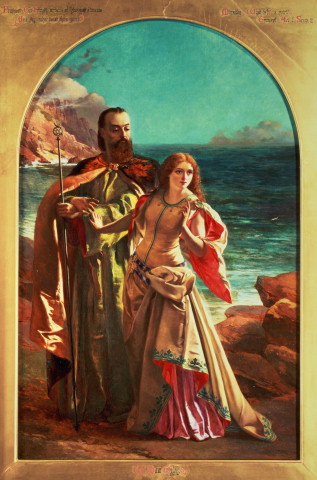
Prospero and Miranda--William Maw Egley
Prospero and Miranda–William Maw Egley

1. Prospero, The Tempest (William Shakespeare)

Prospero has always seemed to me the shining flipside to King Lear’s dark coin, a powerful sorcerer who reverses his exile and is gracious even in his revenge. Where Lear is destroyed by his scheming daughters (and his inability to connect to truehearted Cordelia), Prospero, a single dad, protects his Miranda and even secures her a worthy suitor. Postcolonial studies aside, The Tempest is fun stuff.

2. Abraham Ebdus, The Fortress of Solitude, (Jonathan Lethem)

Like Prospero, Abraham Ebdus is a single father raising his child (his son Dylan) in an isolated, alienating place (not a desert island, but 1970’s Brooklyn). After Dylan’s mother abandons the family, the pair’s relationship begins to strain; Lethem captures this process in all its awkward pain with a poignancy that never even verges on schlock. The novel’s redemptive arc is ultimately figured in the reconciliation between father and son in a beautiful ending that Lethem, the reader, and the characters all earn.

3. Jack Gladney, White Noise (Don DeLillo)

While Jack Gladney is an intellectual academic, an expert in the unlikely field of “Hitler studies” (and something of a fraud, to boot), he’s also a pretty normal dad. Casual reviewers of White Noise tend to overlook the sublime banality of domesticity represented in DeLillo’s signature novel: Gladney is an excellent father to his many kids and step-kids, and DeLillo draws their relationships with a realism that belies–and perhaps helps to create–the novel’s satirical bent.

4. Oscar Amalfitano, 2666 (Roberto Bolaño)

Sure, philosophy professor Amalfitano is a bit mentally unhinged (okay, more than a bit), but what sane citizen of Santa Teresa wouldn’t go crazy, what with all the horrific unsolved murders? After his wife leaves him and their young daughter, Amalfitano takes them to the strange, alienating land of Northern Mexico (shades of Prospero’s island?) Bolaño portrays Amalfitano’s descent into paranoia (and perhaps madness) from a number of angles (he and his daughter show up in three of 2666‘s three sections), and as the novel progresses, the reader slowly begins to grasp the enormity of the evil that Amalfitano is confronting (or, more realistically, is unable to confront directly), and the extreme yet vague danger his daughter is encountering. Only a writer of Bolaño’s tremendous gift could make such a chilling episode simultaneously nerve-wracking, philosophical, and strangely hilarious.

5. The father, The Road (Cormac McCarthy)

What happens when Prospero’s desert island is just one big desert? If there is a deeper expression of the empathy and bonding between a child and parent, I have not read it. In The Road, McCarthy dramatizes fatherhood in apocalyptic terms, positing the necessity of such a relationship in hard, concrete, life and death terms. When the father tells his son “You are the best guy” I pretty much break down. When I first read The Road, I had just become a father myself (my child was only a few days old when I finished it), yet I was still critical of McCarthy’s ending, which affords a second chance for the son. It seemed to me at the time–as it does now–that the logic McCarthy establishes in his novel is utterly infanticidal, that the boy must die, but I understand now why McCarthy would have him live–why McCarthy has to let him live. Someone has to carry the fire.


Hooped Pots, Sneak-cup, and Other Drinking Customs in Shakespeare

Drinking Customs.

Shakespeare has given several allusions to the old customs associated with drinking, which have always varied in different countries. At the present day many of the drinking customs still observed are very curious, especially those kept up at the universities and inns-of-court. Alms-drink was a phrase in use, says Warburton, among good fellows, to signify that liquor of another’s share which his companion drank to ease him. So, in “Antony and Cleopatra” (ii. 7) one of the servants says of Lepidus: “They have made him drink alms-drink.”

By-drinkings.This was a phrase for drinkings between meals, and is used by the Hostess in “1 Henry IV.” (iii. 3), who says to Falstaff: “You owe money here besides, Sir John, for your diet, and by-drinkings.”

Hooped Pots.In olden times drinking-pots were made with hoops, so that, when two or more drank from the same tankard, no one should drink more than his share. There were generally three hoops to the pots: hence, in “2 Henry VI.” (iv. 2), Cade says: “The three-hooped pot shall have ten hoops.” In Nash’s “Pierce Pennilesse” we read: “I believe hoopes on quart pots were invented that every man should take his hoope, and no more.” The phrases “to do a man right” and “to do him reason” were, in years gone by, the common expressions in pledging healths; he who drank a bumper expected that a bumper should be drunk to his toast. To this practice alludes the scrap of a song which Silence sings in “2 Henry IV.” (v. 3): “Do me right, And dub me knight: Samingo.” He who drank, too, a bumper on his knee to the health of his mistress was dubbed a knight for the evening. The word Samingo is either a corruption of, or an intended blunder for, San Domingo, but why this saint should be the patron of topers is uncertain.

Rouse.According to Gifford, [972] a rouse was a large glass in which a health was given, the drinking of which, by the rest of the company, formed a carouse. Hamlet (i. 4) says: “The king doth wake to-night, and takes his rouse.” The word occurs again in the following act (1), where Polonius uses the phrase “o’ertook in’s rouse;” and in the sense of a bumper, or glass of liquor, in “Othello” (ii. 3), “they have given me a rouse already.”

Sheer Ale. This term, which is used in the “Taming of the Shrew” (Induction, sc. 2), by Sly—“Ask Marian Hacket, the fat ale-wife of Wincot, if she know me not: if she say I am not fourteen pence on the score for sheer ale”—according to some expositors, means “ale alone, nothing but ale,” rather than “unmixed ale.”

Sneak-cup. This phrase, which is used by Falstaff in “1 Henry IV.” (iii. 3)—“the prince is a Jack, a sneak-cup”—was used to denote one who balked his glass.

From Thomas Firminger Thiselton-Dyer’s indispensable volume Folk-lore of Shakespeare.

“Quite an Original” — Herman Melville on Hamlet, Don Quixote, and Satan

This is Chapter XLIV of Herman Melville’s The Confidence Man:

“Quite an original:” A phrase, we fancy, rather oftener used by the young, or the unlearned, or the untraveled, than by the old, or the well-read, or the man who has made the grand tour. Certainly, the sense of originality exists at its highest in an infant, and probably at its lowest in him who has completed the circle of the sciences.

As for original characters in fiction, a grateful reader will, on meeting with one, keep the anniversary of that day. True, we sometimes hear of an author who, at one creation, produces some two or three score such characters; it may be possible. But they can hardly be original in the sense that Hamlet is, or Don Quixote, or Milton’s Satan. That is to say, they are not, in a thorough sense, original at all. They are novel, or singular, or striking, or captivating, or all four at once.
More likely, they are what are called odd characters; but for that, are no more original, than what is called an odd genius, in his way, is. But, if original, whence came they? Or where did the novelist pick them up?

Where does any novelist pick up any character? For the most part, in town, to be sure. Every great town is a kind of man-show, where the novelist goes for his stock, just as the agriculturist goes to the cattle-show for his. But in the one fair, new species of quadrupeds are hardly more rare, than in the other are new species of characters—that is, original ones. Their rarity may still the more appear from this, that, while characters, merely singular, imply but singular forms so to speak, original ones, truly so, imply original instincts.

In short, a due conception of what is to be held for this sort of personage in fiction would make him almost as much of a prodigy there, as in real history is a new law-giver, a revolutionizing philosopher, or the founder of a new religion.

In nearly all the original characters, loosely accounted such in works of invention, there is discernible something prevailingly local, or of the age; which circumstance, of itself, would seem to invalidate the claim, judged by the principles here suggested.

Furthermore, if we consider, what is popularly held to entitle characters in fiction to being deemed original, is but something personal—confined to itself. The character sheds not its characteristic on its surroundings, whereas, the original character, essentially such, is like a revolving Drummond light, raying away from itself all round it—everything is lit by it, everything starts up to it (mark how it is with Hamlet), so that, in certain minds, there follows upon the adequate conception of such a character, an effect, in its way, akin to that which in Genesis attends upon the beginning of things.

For much the same reason that there is but one planet to one orbit, so can there be but one such original character to one work of invention. Two would conflict to chaos. In this view, to say that there are more than one to a book, is good presumption there is none at all. But for new, singular, striking, odd, eccentric, and all sorts of entertaining and instructive characters, a good fiction may be full of them. To produce such characters, an author, beside other things, must have seen much, and seen through much: to produce but one original character, he must have had much luck.

There would seem but one point in common between this sort of phenomenon in fiction and all other sorts: it cannot be born in the author’s imagination—it being as true in literature as in zoology, that all life is from the egg.

In the endeavor to show, if possible, the impropriety of the phrase, Quite an Original, as applied by the barber’s friends, we have, at unawares, been led into a dissertation bordering upon the prosy, perhaps upon the smoky. If so, the best use the smoke can be turned to, will be, by retiring under cover of it, in good trim as may be, to the story.

“Effect of Quantity” (Nietzsche on Shakespeare)

162. Effect of Quantity. —The greatest paradox in the history of poetic art lies in this: that in all that constitutes the greatness of the old poets a man may be a barbarian, faulty and deformed from top to toe, and still remain the greatest of poets. This is the case with Shakespeare, who, as compared with Sophocles, is like a mine of immeasurable wealth in gold, lead, and rubble, whereas Sophocles is not merely gold, but gold in its noblest form, one that almost makes us forget the money-value of the metal. But quantity in its highest intensity has the same effect as quality. That is a good thing for Shakespeare.

From Human, All Too Human, Part II by Friedrich Nietzsche.

“I Felt an Irresistible Repulsion and Tedium” — Tolstoy Disses Shakespeare

From the beginning of Leo Tolsoy’s attack on William  ShakespeareA Critical Essay on Shakespeare:

I remember the astonishment I felt when I first read Shakespeare. I expected to receive a powerful esthetic pleasure, but having read, one after the other, works regarded as his best: “King Lear,” “Romeo and Juliet,” “Hamlet” and “Macbeth,” not only did I feel no delight, but I felt an irresistible repulsion and tedium, and doubted as to whether I was senseless in feeling works regarded as the summit of perfection by the whole of the civilized world to be trivial and positively bad, or whether the significance which this civilized world attributes to the works of Shakespeare was itself senseless. My consternation was increased by the fact that I always keenly felt the beauties of poetry in every form; then why should artistic works recognized by the whole world as those of a genius,—the works of Shakespeare,—not only fail to please me, but be disagreeable to me?

For a long time I could not believe in myself, and during fifty years, in order to test myself, I several times recommenced reading Shakespeare in every possible form, in Russian, in English, in German and in Schlegel’s translation, as I was advised. Several times I read the dramas and the comedies and historical plays, and I invariably underwent the same feelings: repulsion, weariness, and bewilderment. At the present time, before writing this preface, being desirous once more to test myself, I have, as an old man of seventy-five, again read the whole of Shakespeare, including the historical plays, the “Henrys,” “Troilus and Cressida,” the “Tempest,” “Cymbeline,” and I have felt, with even greater force, the same feelings,—this time, however, not of bewilderment, but of firm, indubitable conviction that the unquestionable glory of a great genius which Shakespeare enjoys, and which compels writers of our time to imitate him and readers and spectators to discover in him non-existent merits,—thereby distorting their esthetic and ethical understanding,—is a great evil, as is every untruth.

Tolstoy spends most of the rest of the (long) essay showing why he believes King Lear a terrible piece of literature. His rubric is of course terribly subjective, aesthetic, and perhaps ultimately rooted in his own literary mission of realism and social reform—but what I find most remarkable is that, despite all his claims to have read and reread Shakespeare (in English, Russian and German!) he never mentions actually watching a performance of the play.

I read Tolstoy’s gripes last night and felt the need (why?!) to reply, but found this morning that George Orwell already did so. From  Orwell’s rebuttal to Tolstoy, “Lear, Tolstoy and the Fool“:

Artistic theories such as Tolstoy’s are quite worthless, because they not only start out with arbitrary assumptions, but depend on vague terms (‘sincere’, ‘important’ and so forth) which can be interpreted in any way one chooses. Properly speaking one cannot answer Tolstoy’s attack. The interesting question is: why did he make it? But it should be noticed in passing that he uses many weak or dishonest arguments. Some of them are worth pointing out, not because they invalidate his main charge but because they are, so to speak, evidence of malice. . . .

There is no argument by which one can defend a poem. It defends itself by surviving, or it is indefensible. And if this test is valid, I think the verdict in Shakespeare’s case must be “not guilty”. Like every other writer, Shakespeare will be forgotten sooner or later, but it is unlikely that a heavier indictment will ever be brought against him. Tolstoy was perhaps the most admired literary man of his age, and he was certainly not its least able pamphleteer. He turned all his powers of denunciation against Shakespeare, like all the guns of a battleship roaring simultaneously. And with what result? Forty years later Shakespeare is still there completely unaffected, and of the attempt to demolish him nothing remains except the yellowing pages of a pamphlet which hardly anyone has read, and which would be forgotten altogether if Tolstoy had not also been the author of WAR AND PEACE and ANNA KARENINA.

“How few of the tales we listen to can lay any claim to originality!”

How many brothers, sisters, uncles, aunts, and cousins of all degrees a little story has! And how few of the tales we listen to can lay any claim to originality! There is scarcely a story which I hear which I cannot connect with some family of myths, and whose pedigree I cannot ascertain with more or less precision.

Shakespeare drew the plots of his plays from Boccaccio or Straparola; but these Italians did not invent the tales they lent to the English dramatist. King Lear does not originate with Geofry of Monmouth, but comes from early Indian stores of fable, whence also are derived the Merchant of Venice and the pound of flesh, ay, and the very incident of the three caskets. But who would credit it, were it not proved by conclusive facts, that Johnny Sands is the inheritance of the whole Aryan family of nations, and that Peeping Tom of Coventry peeped in India and on the Tartar steppes ages before Lady Godiva was born?

If you listen to Traviata at the opera, you have set before you a tale which has lasted for centuries, and which was perhaps born in India. If you read in classic fable of Orpheus charming woods and meadows, beasts and birds, with his magic lyre, you remember to have seen the same fable related in the Kalewala of the Finnish Wainomainen, and in the Kaleopoeg of the Esthonian Kalewa. If you take up English history, and read of William the Conqueror slipping as he landed on British soil, and kissing the earth, saying he had come to greet and claim his own, you remember that the same story is told of Napoleon in Egypt, of King Olaf Harold’s son in Norway, and in classic history of Junius Brutus on his return from the oracle . . .

From Sabine Baring-Gould’s indispensable work Curious Myths of the Middle Ages (1866).

Easter in Shakespeare

From Thomas Firminger Thiselton-Dyer’s indispensable volume Folk-lore in Shakespeare:

Easter. According to a popular superstition, it is considered unlucky to omit wearing new clothes on Easter Day, to which Shakespeare no doubt alludes in “Romeo and Juliet” (iii. 1), when he makes Mercutio ask Benvolio whether he did “not fall out with a tailor for wearing his new doublet before Easter.” In East Yorkshire, on Easter Eve, young folks go to the nearest market-town to buy some new article of dress or personal adornment to wear for the first time on Easter Day, as otherwise they believe that birds—notably rooks or “crakes”—will spoil their clothes. In “Poor Robin’s Almanac” we are told: “At Easter let your clothes be new, Or else be sure you will it rue.” Some think that the custom of “clacking” at Easter—which is not quite obsolete in some counties—is incidentally alluded to in “Measure for Measure” (iii. 2) by Lucio: “his use was, to put a ducat in her clack-dish.” [649] The clack or clap dish was a wooden dish with a movable cover, formerly carried by beggars, which they clacked and clattered to show that it was empty. In this they received the alms. Lepers and other paupers deemed infectious originally used it, that the sound might give warning not to approach too near, and alms be given without touching the person. A popular name for Easter Monday was Black Monday, so called, says Stow, because “in the 34th of Edward III. (1360), the 14th of April, and the morrow after Easter Day, King Edward, with his host, lay before the city of Paris; which day was full dark of mist and hail, and so bitter cold, that many men died on their horses’ backs with the cold. Wherefore unto this day it hath been call’d the Blacke Monday.” Thus, in the “Merchant of Venice” (ii. 5), Launcelot says, “it was not for nothing that my nose fell a-bleeding on Black Monday last at six o’clock i’ the morning.”

Paul Robeson Talks About Othello

Hamlet and His Father’s Ghost — Henry Fuseli

“Of the Foure Elementes Where They Shoulde Sone Be Founde” (A Tale from The Old-English Jest Book)

A tale of the four elements from The Old-English Jest Book, a volume supposedly owned and used by William Shakespeare:

In the old world when all thyng could speke, the iiii elementys mette to geder for many thynges whych they had to do, because they must meddell alway one wyth a nother, and had communicacion to gyder of dyuers maters; and by cause they coulde not conclude all theyr maters at that season, they appoyntyd to breke communicacion for that tyme and to mete agayne another tyme. Therfore eche one of them shewed to other where theyr most abydyng was and where theyr felows shoulde fynde them, yf nede shuld requyre; and fyrste the erthe sayde: bretherne, ye knowe well as for me I am permanent alway and not remouable; therfore ye may be sure to haue me alway whan ye lyste. The wather sayde: yf ye lyst to seke me, ye shall be sure to haue me under a toft of grene rushes or elles in a womans eye. The wynde sayde: yf ye lyst to speke wyth me, ye shall be sure to haue me among aspyn leuys or els in a womans tong. Then quod the fyre: yf any of you lyst to seke me, ye shall euer be sure to fynd me in a flynt stone er elles in a womans harte.

By thys tale ye may lerne as well the properte of the iiii elementys as the properteis of a woman.

“They Told Me I Was Everything” — Orson Welles Plays King Lear

“Speaking of Beards” — Facial Hair in Shakespeare

From Thomas Firminger Thiselton-Dyer’s Folk-lore of Shakespeare (1883):

In speaking of beards, it may be noted that formerly they gave rise to various customs. Thus, in Shakespeare’s day, dyeing beards was a fashionable custom, and so Bottom, in “A Midsummer-Night’s Dream” (i. 2), is perplexed as to what beard he should wear when acting before the duke. He says: “I will discharge it in either your straw-colour beard, your orange-tawny beard, your purple-in-grain beard, or your French-crown-colour beard, your perfect yellow.” [915] To mutilate a beard in any way was considered an irreparable outrage, a practice to which Hamlet refers (ii. 2): “Who calls me villain? breaks my pate across? Plucks off my beard, and blows it in my face?”

And in “King Lear” (iii. 7), Gloster exclaims: “By the kind gods, ’tis most ignobly done To pluck me by the beard.” Stroking the beard before a person spoke was preparatory to favor. Hence in “Troilus and Cressida” (i. 3), Ulysses, when describing how Achilles asks Patroclus to imitate certain of their chiefs, represents him as saying: “‘Now play me Nestor; hem, and stroke thy beard, As he, being drest to some oration.’” Again, the phrase “to beard” meant to oppose face to face in a hostile manner. Thus, in “1 Henry IV.” (iv. 1), Douglas declares: “No man so potent breathes upon the ground, But I will beard him.” And in “1 Henry VI.” (i. 3), the Bishop of Winchester says to Gloster: “Do what thou dar’st; I’ll beard thee to thy face.” It seems also to have been customary to swear by the beard, an allusion to which is made by Touchstone in “As You Like It” (i. 2): “stroke your chins, and swear by your beards that I am a knave.” We may also compare what Nestor says in “Troilus and Cressida” (iv. 5): “By this white beard, I’d fight with thee to-morrow.” Our ancestors paid great attention to the shape of their beards, certain cuts being appropriated to certain professions and ranks. In “Henry V.” (iii. 6), Gower speaks of “a beard of the general’s cut.” As Mr. Staunton remarks, “Not the least odd among the fantastic fashions of our forefathers was the custom of distinguishing certain professions and classes by the cut of the beard; thus we hear, interalia, of the bishop’s beard, the judge’s beard, the soldier’s beard, the citizen’s beard, and even the clown’s beard.” Randle Holme tells us, “The broad or cathedral beard [is] so-called because bishops or gown-men of the church anciently did wear such beards.” By the military man, the cut adopted was known as the stiletto or spade. The beard of the citizen was usually worn round, as Mrs. Quickly describes it in “Merry Wives of Windsor” (i. 4), “like a glover’s paring-knife.” The clown’s beard was left bushy or untrimmed. Malone quotes from an old ballad entitled “Le Prince d’ Amour,” 1660: “Next the clown doth out-rush With the beard of the bush.”

“Honor Pricks Me On” — Falstaff’s Catechism (Orson Welles in Chimes at Midnight)

“A Book of Utopias” (Prospero’s Books)

Seven More Horror Stories Masquerading in Other Genres

We often identify genre simply by its conventions and tropes, and, when October rolls round and we want scary stories, we look for vampires and haunted houses and psycho killers and such. And while there’s plenty of great stuff that adheres to the standard conventions of horror (Lovecraft and Poe come immediately to mind) let’s not overlook novels that offer horror just as keen as any genre exercise. Hence: Seven horror stories masquerading in other genres (and see our first post for more):

Oedipus Rex — Sophocles

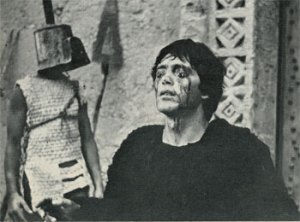
Sure, Aristotle tells us that tragedy, by its very nature, must involve pity and terror, two emotions fundamental to horror as well. But the Oedipus story is so fundamental to our culture and its narratives that we easily overlook the plain fact that it is a horror story. Oedipus Rex begins with the attempted infanticide of the hero, including the brutal pinning of his feet, from which his name derives. Spared, Oedipus must endure the horrific uncertainty that he is not his parents’ natural son, a problem compounded when he learns from the Delphic oracle that he is predestined to kill his father and mate with his mother. You know what unfolds: a murder on the high road, a monster with riddles, a curse of famine, a horrible revelation, a suicide, and a bloody blinding.

Julius Caesar — William Shakespeare

History is its own horror show; Julius Caesar might be about the Roman Empire or the price of a republic, but it’s also very much a tale of paranoia, murder, and ghosts. Poor wavering Brutus recapitulates the crime of Oedipus when he stabs father-figure Brutus. The conspirators bathe their hands in Caesar’s blood, hoping to signal rebirth and shared responsibility, but the marking gestures are ultimately ambiguous. Great Caesar’s ghost will return, suicides will abound (Portia swallowing hot coals is particularly gruesome), and war will ravage the Republic.

“A Good Man Is Hard to Find” — Flannery O’Connor

This one may be a bit of a cheat, because I’m sure plenty of folks have the good sense to see “A Good Man Is Hard to Find” as the horror story it is. Still, O’Connor’s short masterpiece too often gets pushed into the “Southern Gothic” or even “Southern Grotesque” mini-genre, one which belies the story’s intense powers of horror. The intensity of “A Good Man” comes largely from its crystalline reality; half a century after its publication, the Misfit still has the power to shock readers (notice too that the Misfit’s first crime was again Oedipal—he was jailed for patricide). Here’s O’Connor on her story:

Our age not only does not have a very sharp eye for the almost imperceptible intrusions of grace, it no longer has much feeling for the nature of the violence which precede and follow them.  The devil’s greatest wile, Baudelaire has said, is to convince us that he does not exist.
I suppose the reasons for the use of so much violence in modern fiction will differ with each writer who uses it, but in my own stories I have found that violence is strangely capable of returning my characters to reality and preparing them to accept their moment of grace.  Their heads are so hard that almost nothing else will do the work.  This idea, that reality is something to which we must be returned at considered cost, is one which is seldom understood by the casual reader . . .

The Kindly Ones — Jonathan Littell

Keeping our Oedipal theme alive is Littell’s enormous novel The Kindly Ones, a horror story masquerading as a historical epic. The Kindly Ones, taking its name from the Greek tragedy, is about an SS officer who carries out probably every taboo one can think of during WWII, including incest, patricide, fantasies of coprophilia and cannibalism, and child murder. Oh, and mass murder. Lots and lots of mass murder. In my review, I argued that, “This is a novel that might as well take place in the asshole,” and I stick by that.

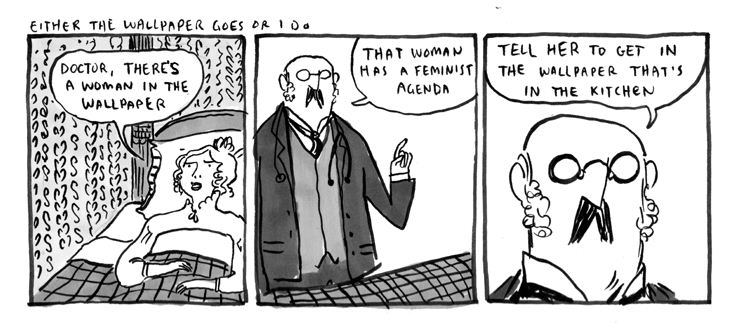
Kate Beaton's Take on "The Yellow Wallpaper"

“The Yellow Wallpaper” — Charlotte Perkins Gilman 

“The Yellow Wallpaper” has become a central text in feminist criticism for good reason. The story, told in first person POV, is a sad, scary descent into madness. And while it’s easy to point toward postpartum depression as the culprit, the story deserves a much more considered analysis, one which addresses the literal and metaphorical constraints placed upon the female body—a body that literary traditions have often tried to keep lying down (consider Sleeping Beauty, for example).

Steps — Jerzy Kosinski

Steps is an odd duck even for this list, because I’m not even sure if it’s ever been identified within a genre by any large group of readers. From my review:

At a remove, Steps is probably about a Polish man’s difficulties under the harsh Soviet regime at home played against his experiences as a new immigrant to the United States and its bizarre codes of capitalism. But this summary is pale against the sinister light of Kosinski’s prose. Consider the vignette at the top of the review, which begins with an autophagous octopus and ends with a transvestite. In the world of Steps, these are not wacky or even grotesque details, trotted out for ironic bemusement; no, they’re grim bits of sadness and horror. At the outset of another vignette, a man is pinned down while his girlfriend is gang-raped. In time he begins to resent her, and then to treat her as an object–literally–forcing other objects upon her. The vignette ends at a drunken party with the girlfriend carried away by a half dozen party guests who will likely ravage her. The narrator simply leaves. Another scene illuminates the mind of an architect who designed concentration camps. “Rats have to be removed,” one speaker says to another. “Rats aren’t murdered–we get rid of them; or, to use a better word, they are eliminated; this act of elimination is empty of all meaning. There’s no ritual in it, no symbolism. That’s why in the concentration camps my friend designed, the victim never remained individuals; they became as identical as rats. They existed only to be killed.” In another vignette, a man discovers a woman locked in a metal cage inside a barn. He alerts the authorities, but only after a sinister thought — “It occurred to me that we were alone in the barn and that she was totally defenseless. . . . I thought there was something very tempting in this situation, where one could become completely oneself with another human being.” But the woman in the cage is insane; she can’t acknowledge the absolute identification that the narrator desires. These scenes of violence, control, power, and alienation repeat throughout Steps, all underpinned by the narrator’s extreme wish to connect and communicate with another. Even when he’s asphyxiating butterflies or throwing bottles at an old man, he wishes for some attainment of beauty, some conjunction of human understanding–even if its coded in fear and pain.

“The Shawl” — Cynthia Ozick

Ozick’s short story “The Shawl” is a study in desperation and fear, and while any hack can milk horror from a concentration camp setting and a sick child, Ozick’s psychological study of a mother and her children skewers any hope of a simple sympathetic reading. At its core, “The Shawl” is about the dramatic Darwinism that underpins our fragile bodies, a Darwinism that can, under the right circumstances, remove our humanity. I never want to read “The Shawl” again.