Bruno Jasieński’s The Legs of Izolda Morgan (Book Acquired, 5.01.2014)

20140516-102034.jpg

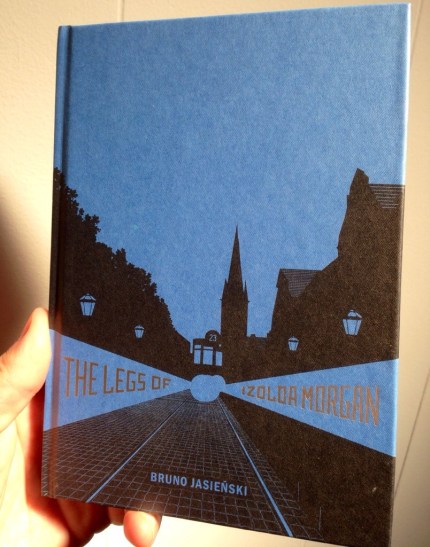
The recent publication of Bruno Jasieński’s The Legs of Izolda Morgan offers another strong argument that Twisted Spoon Press is publishing some of the most fascinating—and most beautiful—books available today. Clothbound and handsomely printed, Izolda Morgan collects several of Jasieński’s futurist manifestos, an essay, stories, and satires.

20140516-093921.jpg

Publisher’s blurb:

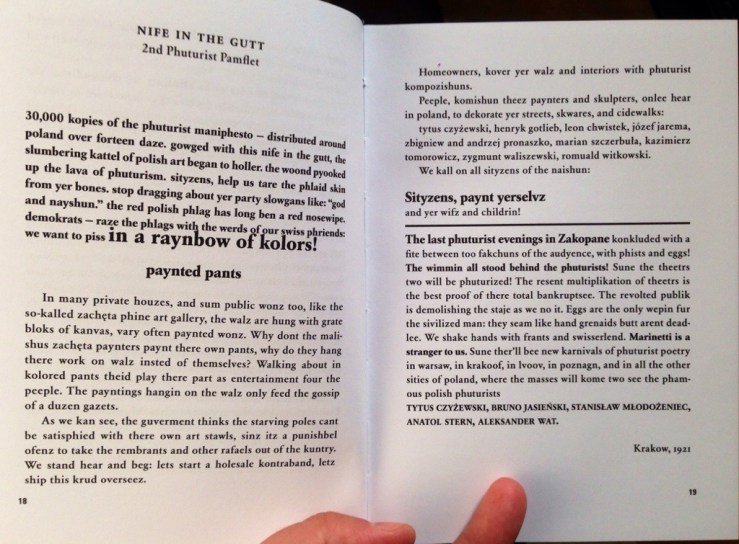
Considered the enfant terrible of the Polish avant-garde, lauded by critics and scorned by the public, Bruno Jasieński suddenly declared the end of Futurism in Poland soon after his short “novel” The Legs of Izolda Morgan appeared in 1923. An extraordinary example of Futurist prose, this fantastic tale cautions against the machine supplanting the human while the human body is disaggregated into fetishized constituent parts. As central to Jasieński’s oeuvre, the text is situated here between two seminal manifestoes and the important essay “Polish Futurism,” which signaled the movement’s end in the context of its confused reception in Poland, the towering influence of Mayakovsky, and what set it apart from the futurisms of Italy and Russia. The condensed story “Keys” displays Jasieński’s turn toward satire to lambaste the hypocrisies pervasive in powerful institutions, and this is further developed in the two longer grotesques from his time in the Soviet Union in the 1930s. Translated into English from the Russian for the first time, these two late stories expose the nefarious absurdity of racial persecution and warmongering and the lengths social and political structures will go to underpin them.


A manifesto:

20140516-102256.jpg

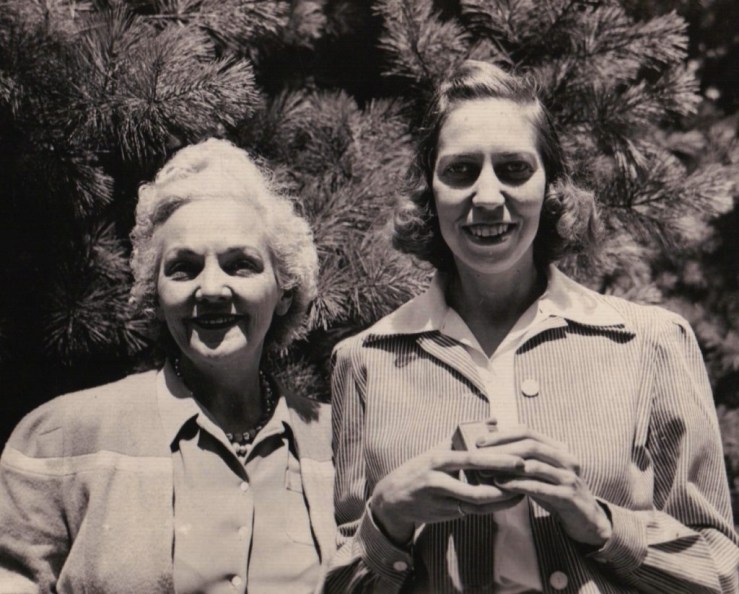
Katherine Anne Porter and Eudora Welty at Yaddo in 1941

Katherine-Anne-Porter-and-Eudora

RIP Gabriel García Márquez

RIP Gabriel García Márquez, 1927-2014

Gabo the Giant is dead.

Long live the Giant.

“The Anarchist: His Dog” — Susan Glaspell

“The Anarchist: His Dog”

by Susan Glaspell

Stubby had a route, and that was how he happened to get a dog. For the benefit of those who have never carried papers it should be thrown in that having a route means getting up just when there is really some fun in sleeping, lining up at the Leader office—maybe having a scrap with the fellow who says you took his place in the line—getting your papers all damp from the press and starting for the outskirts of the city. Then you double up the paper in the way that will cause all possible difficulty in undoubling and hurl it with what force you have against the front door. It is good to have a route, for you at least earn your salt, so your father can’t say that any more. If he does, you know it isn’t so.

When you have a route, you whistle. All the fellows whistle. They may not feel like it, but it is the custom—as could be sworn to by many sleepy citizens. And as time goes on you succeed in acquiring the easy manner of a brigand.

Stubby was little and everything about him seemed sawed off just a second too soon,—his nose, his fingers, and most of all, his hair. His head was a faithful replica of a chestnut burr. His hair did not lie down and take things easy. It stood up—and out!—gentle ladies couldn’t possibly have let their hands sink into it—as we are told they do—for the hands just wouldn’t sink. They’d have to float.

And alas, gentle ladies didn’t particularly want their hands to sink into it. There was not that about Stubby’s short person to cause the hands of gentle ladies to move instinctively to his head. Stubby bristled. That is, he appeared to bristle. Inwardly, Stubby yearned, though he would have swung into his very best brigand manner on the spot were you to suggest so offensive a thing. Just to look at Stubby you’d never in a thousand years guess what a funny feeling he had sometimes when he got to the top of the hill where his route began and could see a long way down the river and the town curled in on the other side. Sometimes when the morning sun was shining through a mist—making things awful queer—some of the mist got into Stubby’s squinty little eyes. After the mist behaved that way he always whistled so rakishly and threw his papers with such abandonment that people turned over in their beds and muttered things about having that little heathen of a paper boy shot. Continue reading ““The Anarchist: His Dog” — Susan Glaspell”

Writers may be classified as meteors, planets and fixed stars (Schopenhauer)

Writers may be classified as meteors, planets and fixed stars. A meteor makes a striking effect for a moment. You look up and cry There! and it is gone for ever. Planets and wandering stars last a much longer time. They often outshine the fixed stars and are confounded with them by the inexperienced; but this only because they are near. It is not long before they must yield their place; nay, the light they give is reflected only, and the sphere of their influence is confined to their own orbit—their contemporaries. Their path is one of change and movement, and with the circuit of a few years their tale is told. Fixed stars are the only ones that are constant; their position in the firmament is secure; they shine with a light of their own; their effect to-day is the same as it was yesterday, because, having no parallax, their appearance does not alter with a difference in our standpoint. They belong not to one system, one nation only, but to the universe. And just because they are so very far away, it is usually many years before their light is visible to the inhabitants of this earth.

From The Art of Literature by Arthur Schopenhauer.


“White Rabbits” — Leonora Carrington

rabbit

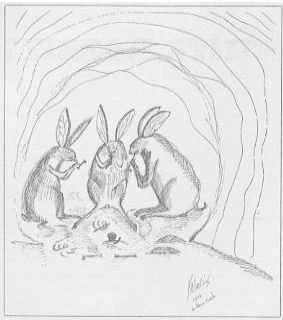
“White Rabbits”

by Leonora Carrington

THE TIME has come that I must tell the events which began in 40 Pest St. The houses which were reddish-black looked as if they had survived mysteriously from the fire of London. The house in front of my window, covered with an occasional wisp of creeper, was as blank and empty looking as any plague-ridden residence subsequently licked by flames and saliv’d with smoke. This is not the way that I had imagined New York.

It was so hot that I got palpitations when I ventured out into the streets—so I sat and considered the house opposite and occasionally bathed my sweating face.

The light was never very strong in Pest Street. There was always a reminiscence of smoke which made visibility troubled and hazy—still it was possible to study the house opposite carefully, even precisely; besides my eyes have always been excellent.

I spent several days watching for some sort of movement opposite but there was none and I finally took to undressing quite freely before my open window and doing breathing exercises optimistically in the thick Pest Street air. This must have blackened my lungs as dark as the houses. One afternoon I washed my hair and sat out on the diminuitive stone crescent which served as a balcony to dry it. I hung my head between my knees ¡and watched a blue-bottle suck the dry corpse of a spider between my feet. I looked up through my lank hair and saw something black in the sky, ominously quiet for an airplane. Parting my hair I was in time to see a large raven alight on the balcony of the house opposite. It sat on the balustrade and seemed to peer into the empty window, then poked its head under its wing apparently searching for lice. A few minutes later I was not unduly surprised to see the double windows open and and admit a woman onto the balcony—she carried a large dish full of bones which she emptied onto the floor. With a short appreciative squawk, the raven hopped down and picked about amongst its unpleasant repast.

The woman, who had hemp-long black hair, wiped out the dish, using her hair for this purpose.

Then she looked straight at me and smiled in a friendly fashion. I smiled back and waved a towel. This seemed to encourage her for she tossed her head coquettishly and gave me a very elegant salute after the fashion of a queen.

“Do you happen to have any bad meat over there that you don’t need?” she called.

“Any what?” I called back, wondering if my ears had deceived me.

“Any stinking meat? Decomposed flesh … meat?”

“Not at the moment,” I replied, wondering if she was trying to be funny.

“Won’t you have any towards the end of the week? If so, I would be very grateful if you would bring it over.”

Then she stepped back into the empty window and disappeared. The raven flew away. Continue reading ““White Rabbits” — Leonora Carrington”

Portrait of Heinrich von Kleist — Andre Masson

Your Favorite Author as a Cute Little Doll

 Debbie Ritter makes and sells charming dolls of writers (and artists and actors and characters).

RIP Amiri Baraka

RIP Amiri Baraka, 1934-2014

Jack London’s Dystopian Short Story, “A Curious Fragment”

“A Curious Fragment” by Jack London

[The capitalist, or industrial oligarch, Roger Vanderwater, mentioned in the narrative, has been identified as the ninth in the line of the Vanderwaters that controlled for hundreds of years the cotton factories of the South. This Roger Vanderwater flourished in the last decades of the twenty- sixth century after Christ, which was the fifth century of the terrible industrial oligarchy that was reared upon the ruins of the early Republic. From internal evidences we are convinced that the narrative which follows was not reduced to writing till the twenty- ninth century. Not only was it unlawful to write or print such matter during that period, but the working-class was so illiterate that only in rare instances were its members able to read and write. This was the dark reign of the overman, in whose speech the great mass of the people were characterized as the “herd animals.” All literacy was frowned upon and stamped out. From the statute-books of the times may be instanced that black law that made it a capital offence for any man, no matter of what class, to teach even the alphabet to a member of the working-class. Such stringent limitation of education to the ruling class was necessary if that class was to continue to rule. One result of the foregoing was the development of the professional story-tellers. These story-tellers were paid by the oligarchy, and the tales they told were legendary, mythical, romantic, and harmless. But the spirit of freedom never quite died out, and agitators, under the guise of story-tellers, preached revolt to the slave class. That the following tale was banned by the oligarchs we have proof from the records of the criminal police court of Ashbury, wherein, on January 27, 2734, one John Tourney, found guilty of telling the tale in a boozing-ken of labourers, was sentenced to five years’ penal servitude in the borax mines of the Arizona Desert.—EDITOR’S NOTE.]

Listen, my brothers, and I will tell you a tale of an arm. It was the arm of Tom Dixon, and Tom Dixon was a weaver of the first class in a factory of that hell-hound and master, Roger Vanderwater. This factory was called “Hell’s Bottom”… by the slaves who toiled in it, and I guess they ought to know; and it was situated in Kingsbury, at the other end of the town from Vanderwater’s summer palace. You do not know where Kingsbury is? There are many things, my brothers, that you do not know, and it is sad. It is because you do not know that you are slaves. When I have told you this tale, I should like to form a class among you for the learning of written and printed speech. Our masters read and write and possess many books, and it is because of that that they are our masters, and live in palaces, and do not work. When the toilers learn to read and write—all of them—they will grow strong; then they will use their strength to break their bonds, and there will be no more masters and no more slaves.

Kingsbury, my brothers, is in the old State of Alabama. For three hundred years the Vanderwaters have owned Kingsbury and its slave pens and factories, and slave pens and factories in many other places and States. You have heard of the Vanderwaters—who has not?—but let me tell you things you do not know about them. The first Vanderwater was a slave, even as you and I. Have you got that? He was a slave, and that was over three hundred years ago. His father was a machinist in the slave pen of Alexander Burrell, and his mother was a washerwoman in the same slave pen. There is no doubt about this. I am telling you truth. It is history. It is printed, every word of it, in the history books of our masters, which you cannot read because your masters will not permit you to learn to read. You can understand why they will not permit you to learn to read, when there are such things in the books. They know, and they are very wise. If you did read such things, you might be wanting in respect to your masters, which would be a dangerous thing… to your masters. But I know, for I can read, and I am telling you what I have read with my own eyes in the history books of our masters. Continue reading “Jack London’s Dystopian Short Story, “A Curious Fragment””

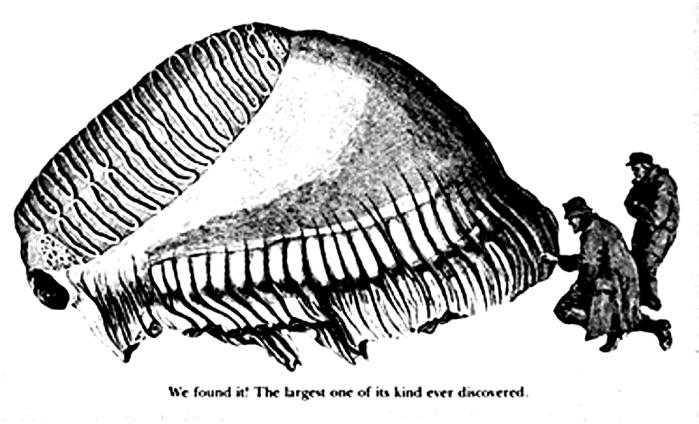
We found it! (Donald Barthelme)

barthelme1

Portrait of Félix Fénéon — Paul Signac

New Gordon Lish

There’s a new Gordon Lish rant in this month’s issue of Harper’s. The selection, titled “The Boys on the Block,” is collected in the forthcoming Goings: In Thirteen Sittings, out early next year from O/R Books.

First paragraph:

There was a game we played. Maybe it wasn’t a game in and of itself. Is a ball a game? A ball is not a game. But you can make a game with it, can’t you? What can’t you make a game with or of? You just have to decide you’re going to do it, is all. Or not even make up your mind and go ahead and decide as such. All you have to do is take the thing and start doing something with it and then say to a boy on the block, Can you do this? and then you show the boy that you can, and then the next thing is that that particular boy has to see if he can do it too or even if he can’t, well, I ask you, is there or is there not already enough of a game going from just that much of it already? Or even better, let’s say he can’t do it, the boy, that particular boy, then even better, even better that he can’t, except who can say, maybe before you know it you’re the boy who’s sorry you started the whole thing in the first place, because maybe the boy we’re talking about, maybe he can go ahead and do it better than you can do it, and then you wish you had never even taken the reins and started the game and could instead of any of that just stop playing it, but you can’t stop playing it, because every time that particular boy on the block comes around he’s got the thing you need for the game with him and he says to you, Hey look, can you do this, can you, can you? even if all you have to do is do it as many times as he can, or do it a little farther than he can, or do it faster than he can, or, you know, more times, or do it some other way different like that.


The Complete Short Stories of J.G. Ballard (Sixth Riff: 1963-1964)

jgb_complete_ss40031

PREVIOUSLY:

Introductions + stories 1956-1959

Stories of 1960

Stories of 1961

Stories of 1962

“The Subliminal Man,” Black Friday, and Consumerism

IN THIS RIFF:

“The Reptile Enclosure” (1963)

“A Question of Re-Entry” (1963)

“The Time Tombs” (1963)

“Now Wakes the Sea” (1963)

“The Venus Hunters” (1963)

“End-Game” (1963)

“Minus One” (1963)

“The Sudden Afternoon” (1963)

“The Screen Game” (1963)

“Time of Passage” (1964)

“Prisoner of the Coral Deep” (1964)

“The Lost Leonardo” (1964)

“The Terminal Beach” (1964)

“The Illuminated Man” (1964)

“The Delta at Sunset” (1964)

“The Drowned Giant” (1964)

“The Gioconda of the Twilight Noon” (1964)

“The Volcano Dances” (1964)

1.”The Reptile Enclosure” (1963) / “A Question of Re-Entry” (1963) / “The Time Tombs” (1963) / “Now Wakes the Sea” (1963) / “The Venus Hunters” (1963) / “Minus One” (1963) / “Prisoner of the Coral Deep” (1964) / “The Illuminated Man” (1964) / “The Delta at Sunset” (1964) / “The Gioconda of the Twilight Noon” /”The Volcano Dances” (1964)

There are 98 stories in The Complete Short Stories of J.G. Ballard. That’s a lot of stories. Maybe too many. Too many for me to write about in full, anyway. I’ve lumped these stories together because they are somewhat unremarkable: Ballard does his Ballardian thing way better elsewhere. Several of these stories feel like sketches (or leftovers) from Ballard’s early novels like The Drowned WorldThe Burning World, and The Crystal World. Themes of time, memory, art, and nature abound here, usually glommed on to simple adventure narratives or sci-fi pulp treadthroughs. Jungles, watches, crystals, structures, beaches. Misanthropy, paranoia, nagging wives, misunderstood heroes. Man apart from nature, but beholden to nature. Etc. The worst moments of these stories—and we can find these moments all through early Ballard, to be fair—suffer from a bad case of White Man’s Burden doubled up with a shot of misogyny. I’ve written it before in these posts, but the most disappointing aspect of early Ballard is our would-be futurist’s inability to transcend the patriarchal ideology of the post-war era. So now let’s move to the good stuff.

2. “End-Game” (1963)

I first read “End-Game” when I was sixteen or seventeen, and it’s always stuck with me. It’s the story of a former “party member” who’s been imprisoned under nebulous circumstances—only his prison isn’t that bad—a nice little villa, comfortable, with books and a chess set. He even has a housekeeper. Unfortunately, the housekeeper is also his executioner, and the date and method of the execution is forever withheld from him:

This ironic inversion of the classical Kafkaesque situation, by which, instead of admitting his guilt to a non–existent crime, he was forced to connive in a farce maintaining his innocence of offences he knew full well he had committed, was preserved in his present situation at the execution villa.

The psychological basis was more obscure but in some way far more threatening, the executioner beckoning his victim towards him with a beguiling smile, reassuring him that all was forgiven. Here he played upon, not those unconscious feelings of anxiety and guilt, but that innate conviction of individual survival, that obsessive preoccupation with personal immortality which is merely a disguised form of the universal fear of the image of one’s own death. It was this assurance that all was well, and the absence of any charges of guilt or responsibility, which had made so orderly the queues into the gas chambers.

Ballard directly invokes Kafka, whose tale “Before the Law” comes to mind here (not to mention The Trial and The Castle); “End-Game” also feels like Ballard’s take on 1984. It’s a great little tale, and I think it helps to prove that Ballard is at his best when he sticks to a confined, limited cast and setting. Much of the force of “End-Game” comes from Ballard pitting his prisoner/protagonist against the protagonist’s mental conception of his guard/executioner. Part of my ideal collection, The Essential Short Stories of J.G. Ballard.

3. “The Sudden Afternoon” (1963) / “Time of Passage” (1964)

In “The Sudden Afternoon” and “Time of Passage,” Ballard explores how time and place—context, I suppose—constitute identity. The former story is a tale of metempsychosis with a troubling take on Indian spirituality, wherein a doctor—an Indian, of course—transplants his psyche and his wife’s psyche into the bodies of another couple (his wife is dying of a terminal disease). Ballard’s own wife died a year after the story was first published (I’m reminded of Poe here, whose wife Virginia died after the publication of “The Raven”). “The Sudden Afternoon” isn’t very good, but structurally we see Ballard beginning to employ something approaching the cut-ups/fragments he’ll move to in the next decade.

“Time of Passage” is essentially a rewrite of F. Scott Fitzgerald’s “The Curious Case of Benjamin Button.” It’s also basically a rewrite of Ballard’s own 1961 tale “Mr. F Is Mr. F” — only this time, Ballard dispenses with abject-horror-for-maternal-body in lieu of a fable-like exploration of what a life in reverse might actually look like. A lovely story. Stick it in The Essentials.

4. “The Screen Game” (1963)

Another Vermilion Sands story. More insanity. Another femme fatale. An attempt at the story of Orpheus, perhaps. I would have lumped it in with the stories in point 1, but I wanted to clarify: The Vermilion Sands stories are the worst.
15. “The Lost Leonardo” (1964)

This is an excellent little detective tale with mystical-magic undertones. I’m a sucker for any story of art theft, too. We all know Dan Brown ripped off Umberto Eco, but maybe Eco ripped off Ballard? Who cares. Lovely stuff. Ballard is excellent at the detective story; Poe is one of his clearest predecessors, but like Poe, he’s more famous for other stuff. Too bad. Let’s call it Essential.

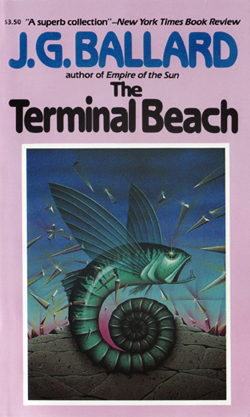
6. “The Terminal Beach” (1964)

1964’s “The Terminal Beach” is such a big break through for Ballard in terms of formal elements and structuring that it probably deserves its own post, but I’ll jab at it here anyway. Up until now, Ballard’s stories have been notable almost entirely for their ideas—his prose has improved some, but ultimately, the pulp fiction he’s writing for magazine publication constrains him to a pedestrian rhetoric that simply can’t match how far out his concepts are. With “The Terminal Beach,” Ballard finally approaches a narrative structure—fractured, polyglossic, shifting through interiors to exteriors, breaking through different forms—that can match the themes of his tale. The story–clearly an Essential—points to the finest of Ballard’s future work. You can read it here in two parts, but here’s a taste that I think stands alone as a microfiction:

The Fly

(A small fly, which Traven presumes has followed him into the fissure, now buzzes about the corpse’s face. Guiltily, Traven leans forward to kill it, then reflects that perhaps this minuscule sentry has been the corpse’s faithful companion, in return fed on the rich liqueurs and distillations of its pores. Carefully, to avoid injuring the fly, he encourages it to alight on his wrist.)

DR YASUDA: Thank you, Traven. In my position, you understand

TRAVEN: Of course, Doctor. I’m sorry I tried to kill it – these ingrained habits, you know, they’re not easy to shrug off. Your sister’s children in Osaka in ’44, the exigencies of war, I hate to plead them. Most known motives are so despicable, one searches the unknown in the hope that YASUDA: Please, Traven, do not be embarrassed. The fly is lucky to retain its identity for so long. ‘That son you mourn, not to mention my own two nieces and nephew, did they not die each day? Every parent in the world grieves for the lost sons and daughters of their earlier childhoods.

TRAVEN: You’re very tolerant, Doctor. I wouldn’t dare – YASUDA: Not at all, Traven. I make no apologies for you. Each of us is little more than the meagre residue of the infinite unrealized possibilities of our lives. But your son, and my nephew, are fixed in our minds forever, their identities as certain as the stars.

TRAVEN: (not entirely convinced) That may be so, Doctor, but it leads to a dangerous conclusion in the case of this island. For instance, the blocks – YASUDA: They are precisely what I refer to, Traven. Here among the blocks you at last find an image of yourself free of the hazards of time and space. This islandis an ontological Garden of Eden, why seek to expel yourself into a world of quantal flux?

TRAVEN: Excuse me (The fly has flown back to the corpse’s face and sits in one of the dried-up orbits, giving the good doctor an expression of quizzical beadiness. Reaching forward, Traven entices it on to his palm. He examines it carefully) Well, yes, these bunkers may be ontological objects, but whether this is the ontological fly is doubtful. It’s true that on this island it’s the only fly, which is the next best thing

YASUDA: You can’t accept the plurality of the universe – ask yourself why, Traven. Why should this obsess you? It seems to me that you are hunting for the white leviathan, zero. The beach is a dangerous zone. Avoid it. Have a proper humility, pursue a philosophy of acceptance.

TRAVEN: Then may I ask why you came here, Doctor?

YASUDA: To feed this fly. ‘What greater love – ?’

TRAVEN: (Still puzzling) It doesn’t really solve my problem. The blocks, you see

YASUDA: Very well, if you must have it that way

TRAVEN: But, Doctor

YASUDA: (Peremptorily) Kill that fly!

TRAVEN: That’s not an end, or a beginning.

(Hopelessly, he kills the fly. Exhausted, he falls asleep beside the corpse.)

7. “The Drowned Giant” (1964)

Another Essential, this puzzling fable readily recalls Gabriel García Márquez’s story “A Very Old Man with Enormous Wings.” Ballard rarely handles archetypes so directly as he does here. Even if the story’s theme seems almost too-plain—we lose the miracle, we cast down the old gods, we deny the sublime, etc.—its construction and telling are wonderfully achieved.

The lower jaw, typically, found its way to the museum of natural history. The remainder of the skull has disappeared, but is probably still lurking in the waste grounds or private gardens of the city – quite recently, while sailing down the river, I noticed two ribs of the giant forming a decorative arch in a waterside garden, possibly confused with the jaw–bones of a whale. A large square of tanned and tattooed skin, the size of an indian blanket, forms a backcloth to the dolls and masks in a novelty shop near the amusement park, and I have no doubt that elsewhere in the city, in the hotels or golf clubs, the mummified nose or ears of the giant hang from the wall above a fireplace. As for the immense pizzle, this ends its days in the freak museum of a circus which travels up and down the north–west. This monumental apparatus, stunning in its proportions and sometime potency, occupies a complete booth to itself. The irony is that it is wrongly identified as that of a whale, and indeed most people, even those who first saw him cast up on the shore after the storm, now remember the giant, if at all, as a large sea beast.

8. On the horizon:

Ballard plays with fragmentation again in “The Beach Murders” and “The Assassination of John Fitzgerald Kennedy Considered as a Downhill Motor Race” — and we finally get to his stories of the late sixties.

RIP Doris Lessing

doris_lessing

RIP Doris Lessing, 1919-2013.

Thomas Bernhard’s Reger on the Purpose of Art

Art is the most sublime and the most revolting thing simultaneously, he said. But we must make ourselves believe that there is high art and the highest art, he said, otherwise we should despair. Even though we know that all art ends in gaucherie and in ludicrousness and in the refuse of history, like everything else, we must, with downright self-assurance, believe in high and in the highest art, he said. We realize what it is, a bungled, failed art, but we need not always hold this realization before us, because in that case we should inevitably perish, he said.

The O. Henry Prize Stories 2013 (Book Acquired, Sometime Last Week)

20130914-084712.jpg

Here are the table of contents for the 2013 O. Henry Prize Stories:

Your Duck Is My Duck, by DEBORAH EISENBERG
Sugarcane, by DEREK PALACIO
The Summer People, by KELLY LINK
Leaving Maverley, by ALICE MUNRO
White Carnations, by POLLY ROSENWAIKE
Sail, by TASH AW
Anecdotes, by ANN BEATTIE
Lay My Head, by L. ANNETTE BINDER
He Knew, by DONALD ANTRIM
The Visitor, by ASAKO SERIZAWA
Where Do You Go? by SAMAR FARAH FITZGERALD
Aphrodisiac, by RUTH PRAWER JHABVALA
Two Opinions, by JOAN SILBER
They Find the Drowned, by MELINDA MOUSTAKIS
The Mexican, by GEORGE MCCORMICK
Tiger, by NALINI JONES
Pérou, by LILY TUCK
Sinkhole, by JAMIE QUATRO
The History of Girls, by AYŞE PAPATYA BUCAK
The Particles, by ANDREA BARRETT

My favorite thing about the list is that I’ve only heard of a handful of the writers here. Read the introduction here.