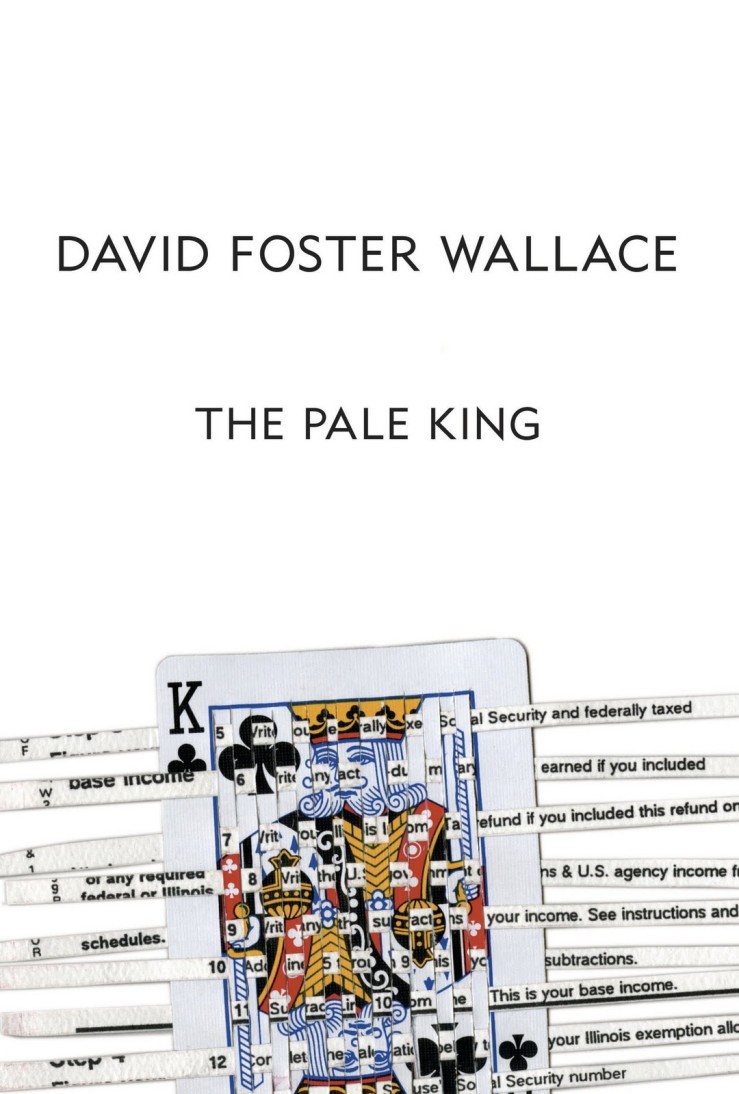
The Pale King — David Foster Wallace

In one of the notes at the end of David Foster Wallace’s incomplete novel The Pale King, the author writes, “Plot a series of set-ups for stuff happening, but nothing actually happens.” This is a fairly precise summary of The Pale King—if you take “nothing actually happens” to mean an absence of recognizable character arcs defined through readily identifiable conflicts progressing along a linear narrative. The Pale King is not a traditional novel. Hell, it’s not even really a novel, unless you decide to really stretch your definition of what a novel is. Which is all fine and good and dandy. Infinite Jest is not a traditional novel either, but it is, I believe, clearly identifiable as a novel: it coheres; it completes; it concludes—which The Pale King does not.

You know the context of The Pale King, and if you don’t you can look it up—there’s a glut of hand-wringing and buzz and backlash out there (out there=internet) that I’ve spent the past three or four months doing my best to ignore. And while I haven’t read a review of The Pale King yet (I’ll read Tom McCarthy’ s write up in The New York Times as soon as I finish my piece), I would have to be deaf dumb blind not to have missed all the headlines, the links, the tweets, the weight people have sought to attach to this book. Anyway, I’m approaching hand-wringing here myself, which is not my aim. I want to try to review the book. But, like I said, there’s all that context. It’s unfinished. Incomplete. Posthumous.

We know the context. You know it’s incomplete, I know it’s incomplete, we know that going in. Which is why it’s a far more satisfying read, I believe, to treat The Pale King as a fragmentary piece, a novel-in-stories, a collection of themes, riffs, dialogues and monologues, vignettes, bits and pieces. It’s closer in many ways to Brief Interviews with Hideous Men or Oblivion than it is to Infinite Jest, although there are plenty of novelly-novel elements. There’s a setting: mostly a sweaty Peoria, Illinois in the mid 1980s, and although much of the novel centers around an IRS regional center there, there are also bits in Chicago, various college classrooms, suburban homes, sad motels, crowded highways, fringe communities, surveillance vans, bars, psych wards, etc. There are recurring characters, all of them IRS employees.

Perhaps a bit on those characters: Some of the best moments of the book center on the bizarre mind of Claude Sylvanshine, a fact psychic who can’t control the flow of data that surges into his mind. Sylvanshine works with his partner and sometime rival Reynolds to help lay the groundwork for the arrival of Merrill Errol Lehrl in Peoria, where Lehrl will continue to machinize the IRS or something like that. There’s Toni Ware, easily the coolest character in the book. There’s not enough Toni Ware in The Pale King. There’s Leonard Stecyk, a person so impossibly good that he drives everyone to despair. There’s Lane Dean, a Christian who may or may not be slowly losing faith. There’s Chris Fogle, who tells us basically his life story in a 100 page novella that may or may not be the center of the book (there is no center though). There’s David Wallace, who claims to be writing a memoir, who claims to be, like, the David Foster Wallace, the author, who claims that he worked for the IRS for a few years between other gigs. As if to prove he’s the real David Wallace, his sections are crammed with diverting, annoying footnotes that repeatedly interrupt any rhythm the reader (or this reader anyway) could get going. It’s difficult to summarize or even describe the relations between the characters, who are defined repeatedly not just through their own telling, but through each others’ eyes, which makes it even more difficult to unpack the plot of The Pale King.

The conflict of the book, or at least the surface conflict, the plot-level conflict, seems to be (or seems to have intended to have been) about a movement within the IRS to essentially change its mission from one of service, of doing a job that no one wants to do that nevertheless has to be done for the greater good of democracy, to a more nefarious and machine-like agency bent on generating revenue—like a corporation. Thus humanity vs. bureaucracy, religious-type calling vs. mercenary machinery, selfless duty vs. selfish will, etc. etc. etc. Chapter 19 (§19, in the book’s terms) lays out these themes beautifully in a civics lesson (the chapter is set in a stuck elevator, I think). The civics lesson has even more resonance in these times of rampant Teabaggery. Here’s a taste—-

Corporations aren’t citizens or neighbors or parents. They can’t vote or serve in combat. They don’t learn the Pledge of Allegiance. They don’t have souls. They’re revenue machines. I don’t have any problem with that. I think it’s absurd to lay moral or civic obligations on them. Their only obligations are strategic, and while they can get very complex, at root they’re not civic entities. With corporations, I have no problem with the government enforcement of statutes and regulatory policy serving a conscience function. What my problem is is the way it seems that we as individual citizens have adopted a corporate attitude. That our ultimate obligation is to ourselves. That unless it’s illegal or there are direct practical consequences for ourselves, any activity is okay.

The IRS gives Wallace a perfect backdrop to explore the tension between civic virtue and the American right to be a selfish asshole, but it’s the book’s themes of boredom and attention that have been remarked upon the most. Simply put, the theme is pervasive, perhaps overdetermined within the narrative, and at once both obvious and complex. Infinite Jest explored the consequences and existential fallout of a society conditioned to believe that it had to be entertained at all times; The Pale King seems to respond to the same existential problem in kind, only from a different angle. There’s so much of this theme of boredom and attention throughout the book that I’ll lazily go to Wallace’s end notes again, where he concisely lays it bare for us (or not for us really but probably for himself)—

It turns out that bliss—a second-by-second joy + gratitude at the gift of being alive, conscious—lies on the other side of crushing, crushing boredom. Pay close attention to the most tedious thing you can find (tax returns, televised golf), and, in waves, a boredom like you’ve never known will wash over you and just about kill you. Ride these out and it’s like stepping from black and white into color. Like water after days in the desert. Constant bliss in every atom.

Wallace finds a kind of transcendental out in the ability to concentrate attention on tasks of despair-invoking boredom. This type of attention obviously recalls the intensity of fervent, even monastic prayer (indeed, the IRS agents are often implicitly compared to monks), yet the Midwest America of The Pale King is deeply desacralized. Although Lane Dean provides a figure of religion in crisis (underexplored for the perhaps obvious reason that the book is unfinished), for the most part The Pale King  presents a post-Nietzschean world without an authorizing center. Wallace’s work then is to find some kind of metaphysical solace in a world where God seems absent at best, and he finds it in paying close attention to the tedium of life. For me, it’s The Pale King’s strange metaphysical moments that are the most intriguing (and frustrating) then. We have the aforementioned Sylvanshine, a fact psychic who can parse data, but cannot glean real meaning from it—

The fact psychic lives part-time in the world of fractious, boiling minutiae that no one knows or could be bothered to know even if they had the chance to know. The population of Brunei. The difference between mucus and sputum. How long a piece of gum has resided on the underside of the third-row fourth-from-left-seat of the Virginia Theater, Cranston, RI, but not who put it there or why. Impossible to predict what facts will intrude. Constant headaches.

In a world of information-overload, attending deeply and meaningfully to data becomes prohibitively difficult, if not impossible. Sylvanshine’s blessing/curse dramatizes the paralyzing post-20th century crisis of too much information (and therefore too many choices). The Pale King’s metaphysical elements manifest again in the ghosts Garrity and Blumquist, who kinda-sorta haunt the IRS center in Peoria; one of them shows up to explain the etymology of the word “boring” to Lane Dean. There’s a boy whose devotion to kissing every square inch of his body (clearly an impossible feat) takes on a spiritual dimension. There’s Chris Fogle, who experiences a religious-type epiphany in an accounting class. There’s also a “fierce infant” who seems to have some metaphysical powers, although I don’t know why I’m lumping him in here. Like I said, (didn’t I say?) I don’t really know how to review this book (I’ve also had a few beers at this point). The infant is one of those threads that goes nowhere, that fails to cohere, that might have a missing piece somewhere else, somewhere unwritten. A more complete picture of the transcendental bliss that prolonged attention might hold comes late in the book, in a longish piece (§46) that details a tête-à-tête between Meredith Rand, who is too-pretty, a little crazy, and ultimately both boring and alienating to almost any guy she actually talks to, and Drinion, an asexual man I take to be autistic. Drinion pays absolute, intense, true, human attention to Meredith Rand’s story of being admitted to a psychiatric hospital in her teens for cutting herself; there she meets her future husband. During their conversation, Drinion begins to levitate—via his attention, he literally transcends gravity. And yet the catch of it all is that Drinion’s autism and aesexuality somehow make it easier for him to attend others, to truly connect to this beautiful woman who simultaneously bores and alienates most of the men she bothers to speak with.

Still, Wallace posits in Drinion—and elsewhere in the book, but hey, let’s face it, this is getting pretty long for a blog review—Wallace posits some kind of answer to existential despair and boredom, an answer that goes beyond a trite commonplace like “empathy,” in that empathy is ultimately about self-identification: the answer in The Pale King seems to be selfless identification, in the most literal sense. There’s no cheat here—the narrative bits with Toni Ware especially dramatize the brutal ugliness of life, its essential Darwinian unfairness, the random cruelty that might be there. This is a book about death and taxes, and Wallace works to sanctify these costs of life, to make them count in a in a world that has largely abandoned the sacred, in a society where many people are incapable or unwilling to think empathetically about their relation to (via taxes and social institutions) other humans whom they do not personally know.

The Pale King is not as rich or funny or sad as Infinite Jest; it has nothing to match Don Gately nor does it have a Prince Hal Incandenza. But why hold that against it? It is, after all, an unfinished thing, but as incomplete as it may be, its ends not just loose but frayed, it is still a marvel of heart and intellect. Highly recommended.

The Red Sea — Anselm Kiefer

The Pale King’s Opening Lines Vs. Hadji Murad’s Opening Lines

Putting together a review of David Foster Wallace’s The Pale King right now, I realize I have no place to put , nor anything intelligent or even thoughtful to say, about an observation I made about its opening lines (you know, that sentence you halfway paid attention to on some dude’s tumblr), which seem to echo the opening of Leo Tolstoy’s Hadji Murad, which said observation I only observed because I read the books at the same time, and in fact read the opening chapters on the same day. Anyway.

First lines of The Pale King

Past the flannel plains and blacktop graphs and skylines of canted rust, and past the tobacco-​brown river overhung with weeping trees and coins of sunlight through them on the water downriver, to the place beyond the windbreak, where untilled fields simmer shrilly in the a.m. heat: shattercane, lamb’s‑quarter, cutgrass, sawbrier, nutgrass, jimsonweed, wild mint, dandelion, foxtail, muscadine, spinecabbage, goldenrod, creeping charlie, butter-​print, nightshade, ragweed, wild oat, vetch, butcher grass, invaginate volunteer beans, all heads gently nodding in a morning breeze like a mother’s soft hand on your cheek.

First lines of Hadji Murad—-

I was returning home by the fields. It was midsummer, the hay harvest was over and they were just beginning to reap the rye. At that season of the year there is a delightful variety of flowers —red, white, and pink scented tufty clover; milk-white ox-eye daisies with their bright yellow centers and pleasant spicy smell; yellow honey-scented rape blossoms; tall campanulas with white and lilac bells, tulip-shaped; creeping vetch; yellow, red, and pink scabious; faintly scented, neatly arranged purple plaintains with blossoms slightly tinged with pink; cornflowers, the newly opened blossoms bright blue in the sunshine but growing paler and redder towards evening or when growing old; and delicate almond-scented dodder flowers that withered quickly.

I’m not suggesting that Wallace is consciously following Tolstoy here, although the structures of the openings are remarkably similar, and in each case, the flora imagery is ultimately ironized by the narrative that follows.

Eat the Document — Bob Dylan’s Rambling 1966 Tour Film

“The List Is the Origin of Culture” — Umberto Eco

From a 2009 interview with Der Spiegel

Umberto Eco: The list is the origin of culture. It’s part of the history of art and literature. What does culture want? To make infinity comprehensible. It also wants to create order — not always, but often. And how, as a human being, does one face infinity? How does one attempt to grasp the incomprehensible? Through lists, through catalogs, through collections in museums and through encyclopedias and dictionaries. There is an allure to enumerating how many women Don Giovanni slept with: It was 2,063, at least according to Mozart’s librettist, Lorenzo da Ponte. We also have completely practical lists — the shopping list, the will, the menu — that are also cultural achievements in their own right.

SPIEGEL: Should the cultured person be understood as a custodian looking to impose order on places where chaos prevails?

Eco: The list doesn’t destroy culture; it creates it. Wherever you look in cultural history, you will find lists. In fact, there is a dizzying array: lists of saints, armies and medicinal plants, or of treasures and book titles. Think of the nature collections of the 16th century. My novels, by the way, are full of lists.

SPIEGEL: Accountants make lists, but you also find them in the works of Homer, James Joyce and Thomas Mann.

Eco: Yes. But they, of course, aren’t accountants. In “Ulysses,” James Joyce describes how his protagonist, Leopold Bloom, opens his drawers and all the things he finds in them. I see this as a literary list, and it says a lot about Bloom. Or take Homer, for example. In the “Iliad,” he tries to convey an impression of the size of the Greek army. At first he uses similes: “As when some great forest fire is raging upon a mountain top and its light is seen afar, even so, as they marched, the gleam of their armour flashed up into the firmament of heaven.” But he isn’t satisfied. He cannot find the right metaphor, and so he begs the muses to help him. Then he hits upon the idea of naming many, many generals and their ships.

SPIEGEL: But, in doing so, doesn’t he stray from poetry?

Eco: At first, we think that a list is primitive and typical of very early cultures, which had no exact concept of the universe and were therefore limited to listing the characteristics they could name. But, in cultural history, the list has prevailed over and over again. It is by no means merely an expression of primitive cultures. A very clear image of the universe existed in the Middle Ages, and there were lists. A new worldview based on astronomy predominated in the Renaissance and the Baroque era. And there were lists. And the list is certainly prevalent in the postmodern age. It has an irresistible magic.

“I’m a Writer You Monsters!”

John Turturro on Miller’s Crossing and Barton Fink

Great interview with John Turturro at the AV Club today—it’s part of their Random Roles feature, where an actor (usually a character actor) discusses his or her films. Here’s Turturro talking about some of the films he’s made with the Coen brothers

JT: I’ve known [the Coens] a long time. I’ve known them from the mid-’80s, because I’m friends with Fran [McDormand]. That’s how I know them. I’ve worked with them on four movies, and they were my executive producers for and really helped me edit Romance And Cigarettes. They’re really good friends—and so is someone like Spike [Lee]. It’s a pleasure in this business when you work with someone more than once. It’s nice, because everybody knows each other.

The Coens are like a mom-and-pop operation. They write it, they edit it, they do the whole thing. They’re involved in everything. It’s very low stress, working with them. There’s almost no stress. If I could make a movie with them every couple of years I would, just because of the pleasure of it.

AVC: How did you finally come to work with them on Miller’s Crossing?

JT: They’d seen me do a lot of plays, and so they said they were going to write a part for me. Then they wrote two parts for me in a row! [Laughs.] Those are big things. When someone writes something for you, you really want to return the favor. So I put a lot of work into it, and tried to give them a little surprise back. Actually I’m going to be directing these three one-act plays on Broadway soon, and Ethan is one of the writers. Woody Allen is one and Elaine May is one and Ethan is one. So I’m working with him again. This is, I guess, the sixth time we’ve worked together.

AVC: The big “look into your heart” scene in the woods. How many takes was that?

JT: I don’t remember how many takes. I just know it was 13 degrees, that’s all. It was really cold. You know, it was a long time ago. It was a hard scene. Sometimes you think about movies, and you say, “Well, I want to try to do something that’s not exactly in a movie.” If you’ve ever been in a very dangerous situation, you know that people will do all kinds of things to keep themselves alive. It was very well-written, but you want to imagine what it’s really like to be in that kind of situation. It depends on what you’re willing to do, and in real life you would do a lot of different things. I tried to capture a little bit of that. I had a couple close encounters throughout my life before that, and you store that stuff in the back of your mind. It’s how you do it, but it’s what they choose and how they put it together too. But that was my goal when I did that, was to do something that was almost a little difficult to watch, because people aren’t trying to be heroic at those moments.

AVC: When you first came across that scene in the screenplay, was it obvious to you that it would be so central and important to the movie? They even used it for the poster.

JT: I guess maybe, but not completely. I kind of knew it was important, and they kept telling me it was. But you don’t want to put too much pressure on yourself, because then it’s like going to bed with somebody the first time or something. You’re like, “Oh God, I got to be great.” [Laughs.] You just don’t want to put too much pressure on yourself. I just thought about it in the context of the story, that’s it. Because you can overthink something, too. It all felt really good when they did it, but it was hard to do.

Barton Fink (1991)—“Barton Fink”
AVC: Since the Coens were writing Barton Fink while they were still struggling through Miller’s Crossing, were you guys discussing that during the shoot?

JT: No. They said at the end—the guy, [executive producer] Ben Barenholtz, said there was this other movie. The way he talked, it sounded like Bart And Fink. I thought it was Bart And Fink. I was like, Bart And Fink? I don’t know about that.” And I didn’t completely get it when I first read it. Their scripts you have to read a bunch of times. And now I guess people can read them easier—someof their scripts—because they know their sensibility. But their sensibility can be quite different, depending on the movie that they’re linked to.

AVC: Did you really go to secretarial school just to study typing for Barton Fink?

JT: Yeah, I did. It was in Brooklyn Heights. It was with electric typewriters; they didn’t have computers. But then I had to use the old manual typewriter, which I loved. They get stuck, but I really love the sound of it, and the whole visceral experience. I wrote a lot of things on that typewriter during the shoot, a lot of ideas for other things.

AVC: Didn’t you write Romance And Cigarettes on it?

JT: I wrote the title of it and some ideas. A couple of scenes. But then I kind of sat on it. I put it in this box for 10 years. So yeah, it was “A Film by Barton Fink.” [Laughs.]

AVC: Your character talks a lot about creating “a new living theater of, about, and for the common man,” which is relevant to the sort of stories you seem to tell in a lot of your own work. But in the film, it seems like that whole idea is being mocked as pretentious. 

JT: [Laughs.] Yeah. Well, there’s guys who are outside of that and who talk about it, and there are guys who are inside of it. I did Mac right after that, which was really, for me, inside. And Fink is more from the outside. Plenty of writers have taken those stances—especially in the ’30s, because people came out of immigration, and there was a lot of Socialism. People were really liberal. There were anarchists. There was a Communist Party in this country. There was also a Nazi party that people don’t really talk about. So there were a lot of these things going on, and you kind of have to go back years to understand this thing. It was in the Group Theatre, and people like Arthur Miller obviously had that in his plays. Sometimes it could become a little bit pretentious, and other times not. But everything’s connected in different ways.

AVC: My favorite scene—honestly, maybe my favorite scene in a movie ever—is just a simple dialogue between you and Tony Shalhoub.

JT: Which one?

AVC: “Throw it hard.”

JT: “Throw it hard, Fink!” [Laughs.] Yeah, there were some great actors in that movie, and I got to work with all of them. It was just a treat. There was just wonderful writing in it too. Even though it was a strange movie and stuff like that, when I see the movie now, I really appreciate it. I’m like, “Wow, that was really good.” When I first saw it, it’s hard, because you’re in it. But it’s a good movie, so thank you. It’s a really well-crafted film. It was a treat to make that film, and to work with every one of those actors. Judy Davis is just fabulous.

“Style and Content Must Match” — William Gaddis on Voice and Risk in His Novels

From a brief  1982 interview with William Gaddis

Q: The pervasive and distinctive authorial voice of The Recognitions gives way in J R to a self-effacing voice that seems to serve only functional purposes. Also in J R there is an increased dependence on dialogue. For verisimilitude in Lolita, Nabokov “travelled in school buses to listen to the talk of schoolgirls.” Did you take any special measures to hear and note the speech patterns of any of the wide variety of people who speak in “J R”?

William Gaddis: Style and content must match, must be complementary, accounting in part for a difference between the two books, though the lack of a conventional narrative style had already jarred a good many readers of The Recognitions when it appeared, as its hapless reviews show. J R was started as a story which quickly proved unsatisfactory, inspired- here’s the legitimate gossip—-by the postwar desecration of the Long Island village of Massapequa where my family had had property since around 1910, take a look at it now and you’ll see all the book’s worst hopes realized. In approaching J R as a novel, I was at pains to remove the author’s presence from the start as must be obvious. This was partly by way of what I mentioned earlier, obliging the thing to stand on own, take its own chances. But it was also by way of setting up a problem, a risk, in order to sustain my own interest, especially since the largely uninterrupted dialogue raised the further risk of presenting a convincing sense of real time without the conventional chapter breaks, white spaces, such narrative intrusions as “A week later . . .” How some of the writers I come across get through their books without dying of boredom is beyond me. As for what you call speech patterns, one is always listening and has got an ear or hasn’t, and without one, unless perhaps in dealing with an unfamiliar language and culture, no amount of your special measures like riding around on school buses will get you out of the swamp.

Ten Thousand Years Older — Werner Herzog

The Goodbye Place — Richard Kelly

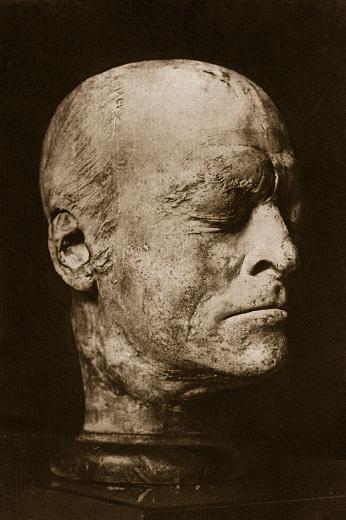
William Blake’s Death Mask

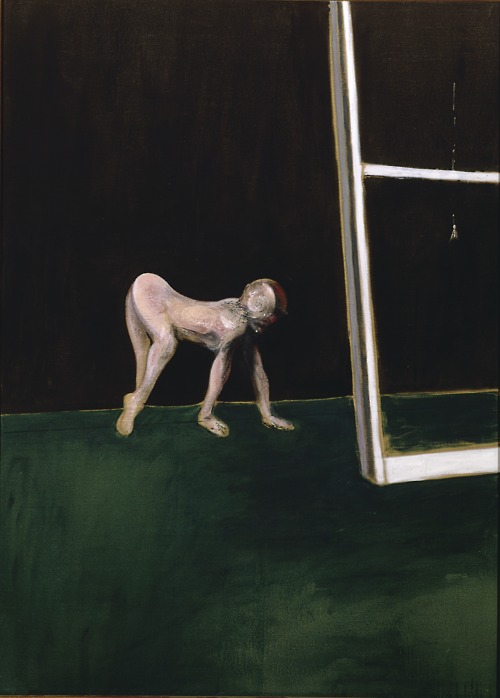
Paralytic Child Walking on All Fours (from Muybridge) — Francis Bacon

“Finnegans Wake: What It’s All About” — Anthony Burgess

Read Anthony Burgess’s essay on James Joyce’s Finnegans Wake. From said essay—

In his dream HCE, as we shall now call him, tries to make the whole of history swallow up his guilt for him. His initials are made to stand for the generality of sinful man, and they are expanded into slogans like “Here Comes Everybody” and “Haveth Childers Everywhere”. After all, sexual guilt presupposes a certain creative, or procreative, vitality, and a fall only comes to those who are capable of an erection. The unquenchable vitality appears in “our Human Conger Eel” (despite the “down, wantons, down” of the eel-pie-maker in King Lear); the erector of great structures is seen in “Howth Castle and Environs”. From the point of view of the ultimate dreamer of the dream, though (the author himself), “HCE” has a structural task to perform. As a chemical formula (H2CE3) or as a genuine vocable (“hec” or “ech” or even “Hecech”) it holds the dream down to its hero, is sewn to it like a mono­gram-HCE: his dream. But HCE has, so deep is his sleep, sunk to a level of dreaming in which he has become a collective being rehearsing the collective guilt of man. Man falls, man rises so that he can fall again; the sequence of falling and rising goes on till doomsday. The record of this, expressed in the lives of great men, in the systems they make and unmake and remake, is what we call history.

RIP Peter Falk

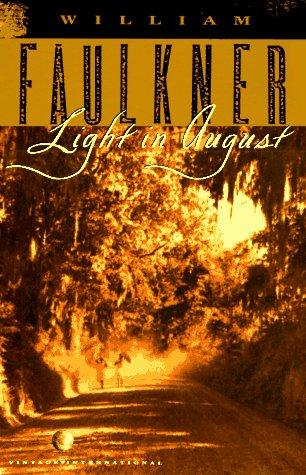
Light in August — William Faulkner

I can’t unpack William Faulkner’s novel Light in August here. There’s too much in it. It’s too thick. Faulkner piles on his sentences in a gelatinous mass, smearing words on top of words into a deep swamp of meaning, motif, and symbol. The novel is archaeological, a deep dig into the South’s abject wounds. It is the most Faulkneresque Faulkner novel I have read, a heady strange brew that tries to suss out racism, misogyny, fear of paternity, the scars of the plantation system, the fallout of the Civil War, the cold comfort of religion, and so much more. Like any good modern text, you could say it’s about a quest for identity, and how the quester must come into conflict with the codes and terms of the dominant social order to find that solid identity. But in Faulkner there is no stable identity, and Light in August dramatizes this problem, even as it points to a possible inherent payoff.

A book review should give some sense of what happens in the book, but as in much of Faulkner’s work, explaining “what happens” in a Light in August would spoil the puzzle, the synthesis, the game, the shock of it all. But some outlines should suffice. The novel is set in the Jim Crow South, mostly in Jefferson, seat of Yoknapatawpha County, the Faulknerverse. It opens with Lena Grove walking “all the way from Alabama” into Mississippi; she’s in her third trimester of pregnancy and still has no ring on her finger, a sign that every Southerner knows how to read. Lena is looking for the father’s child, Lucas Burch; she hears tell that a Burch might work at the planing mill. It’s not Burch though, but Byron Bunch, who falls for Lena right away, plays Joseph to her Mary. Meanwhile, Lucas Burch is around—only the rascal’s taken up the false name Joe Brown. He’s also taken up with the novel’s tragic anti-hero, Joe Christmas, helping that strange man bootleg whiskey out of old servant quarters adjoining a decaying plantation house. Joe Christmas, an abandoned orphan, may have black blood in him. In Jim Crow Mississippi this makes him black, even worse than black—an unknown, unknowable something. Christmas (is there a more overdetermined name in fiction?) is accused of killing the woman who lives the old plantation house, a woman the community of Jefferson shunned for her family’s abolitionist, carpetbaggin’ past, yet now the community must exact the only kind of justice suitable for a black man accused of killing a white woman in Mississippi in the 1920s. JC, always estranged, must now keep on the run to avoid being lynched.

In any other novel, the two protagonists would have to meet, but Faulkner never allows a scene between Christmas and Lena. Yet they are undeniably tied together: somehow he is both the metaphysical father of her child and the child itself, Faulkner’s answer to the inescapable violent fatalism that curses the South. There is no exit from the wounded past, but there might be new possibilities, and we might find them in Lena’s baby. Lena provides a feminine antidote to Christmas’s abject fear of women, his utterly Faulknerian despair of genitalia and menstruation; at the same time, Christmas becomes the sacrificial lamb for the South’s sins, the totem whose ritualistic dismemberment will at once reaffirm the dominant social patriarchal order of the plantation system at the very same time it reveals that system’s deep hypocrisy and radical instability.

In Light in August, Faulkner shows us a world where social codes are rigid, inflexible, immutable, unspoken, and bear absolutely no relation to the concrete reality of the phenomenal, external world they pretend to govern. It’s the primal sin of the plantation system, which paradoxically separated and joined blacks and whites; which said that miscegenation was abomination yet created the optimal circumstances for racial mixing; which proscribed the very concept of a multiracial family while enforcing the Darwinian circumstances that would necessitate such a collective. It is a world where nothing fits together, nothing connects, yet Faulkner finds a place for his misfits, although he must find it by mixing up the system.

Here’s Lena talking to Hightower, the defrocked minister and ersatz medicine man (I will not even begin to discuss Hightower). Lena’s concern is over Christmas’s grandmother, who through a bizarre series of events is present at the baby’s birth—-

“She keeps on talking about—–She is mixed up someway. And sometimes I get mixed up too, listening, having to . . . . . . .” Her eyes, her words, grope, fumble.

“Mixed up?”

“She keeps on talking about him like his pa was that—–that one in jail, that Mr Christmas. She keeps on, and the I get mixed up and it’s like sometimes I can’t——like I am mixed up too and I think that his pa is that Mr—–Mr Christmas too—–” She watches him; it is as though she makes a tremendous effort of some kind. “But I know that aint so. I know that’s foolish. It’s because she keeps on saying it and saying it, and maybe I ain’t strong good yet, and I get mixed up too. But I am afraid . . . . . . .”

“Of what?”

“I don’t like to get mixed up. And I am afraid she might get me mixed up, like they say how you might cross your eyes and then you can’t uncross . . . . . . .”

But the eyes and the I’s (both are ways of seeing, of course) do get crossed in Light. Faulkner mixes up the system, crosses the wires as a way out of the ugly circuit, even as he paradoxically reconfirms the circuit’s contours. This is not a writer who flinches from history and all its despair, even as he tries to find a metaphysical answer outside of religious doctrine and conventional morality.

I feel like I’ve made, at best, some very broad, superficial scratches into the surface of a very dense, thick book; even worse, I’ve barely provided even a hint of Faulkner’s astounding prose. Mea culpa. I’ll take a second, more specific shot at Light in August in an upcoming post. For now: Very highly recommended.

Bill Murray Reads Billy Collins’s Poem “Forgetfulness”

(More).

Anthony Burgess Laments the Loss of History

In 1972, Burgess could already see the loss of historical perspective that was happening in institutionalized education. I suppose he would consider 2011 a nightmare that no one is even attempting to wake up from. Also, is there anything like this on TV today? Seriously—is conservatism simply the opposite of intellectualism at this point? Could you imagine a leading conservative pundit having a literary author like Burgess on his or her show to actually, like, talk about history (or anything else for that matter)?
(See also).