“The Christmas Banquet,” a tale from Nathaniel Hawthorne (from Mosses from an Old Manse; it might be, like, an allegory or something):
“I HAVE HERE attempted,” said Roderick, unfolding a few sheets of manuscript, as he sat with Rosina and the sculptor in the summer-house–“I have attempted to seize hold of a personage who glides past me, occasionally, in my walk through life. My former sad experience, as you know, has gifted me with some degree of insight into the gloomy mysteries of the human heart, through which I have wandered like one astray in a dark cavern, with his torch fast flickering to extinction. But this man–this class of men–is a hopeless puzzle.”
“Well, but propound him,” said the sculptor. “Let us have an idea of him, to begin with.”
“Why, indeed,” replied Roderick, “he is such a being as I could conceive you to carve out of marble, and some yet unrealized perfection of human science to endow with an exquisite mockery of intellect; but still there lacks the last inestimable touch of a divine Creator. He looks like a man, and, perchance, like a better specimen of man than you ordinarily meet. You might esteem him wise–he is capable of cultivation and refinement, and has at least an external conscience–but the demands that spirit makes upon spirit, are precisely those to which he cannot respond. When, at last, you come close to him, you find him chill and unsubstantial–a mere vapor.”
Hey, didn’t we just accuse Mark Twain of dissing Santa? Dude had a heart, of course. Here’s a letter he ghost wrote for St. Nick to his beloved daughter Susie:
Palace of St. Nicholas
In the Moon
Christmas Morning
MY DEAR SUSIE CLEMENS:
I have received and read all the letters which you and your little sister have written me by the hand of your mother and your nurses; I have also read those which you little people have written me with your own hands–for although you did not use any characters that are in grown peoples’ alphabet, you used the characters that all children in all lands on earth and in the twinkling stars use; and as all my subjects in the moon are children and use no character but that, you will easily understand that I can read your and your baby sister’s jagged and fantastic marks without any trouble at all. But I had trouble with those letters which you dictated through your mother and the nurses, for I am a foreigner and cannot read English writing well. You will find that I made no mistakes about the things which you and the baby ordered in your own letters–I went down your chimney at midnight when you were asleep and delivered them all myself–and kissed both of you, too, because you are good children, well trained, nice mannered, and about the most obedient little people I ever saw. But in the letter which you dictated there were some words which I could not make out for certain, and one or two small orders which I could not fill because we ran out of stock. Our last lot of kitchen furniture for dolls has just gone to a very poor little child in the North Star away up, in the cold country above the Big Dipper. Your mama can show you that star and you will say: “Little Snow Flake,” (for that is the child’s name) “I’m glad you got that furniture, for you need it more than I.” That is, you must write that, with your own hand, and Snow Flake will write you an answer. If you only spoke it she wouldn’t hear you. Make your letter light and thin, for the distance is great and the postage very heavy.
There was a word or two in your mama’s letter which I couldn’t be certain of. I took it to be “a trunk full of doll’s clothes.” Is that it? I will call at your kitchen door about nine o’clock this morning to inquire. But I must not see anybody and I must not speak to anybody but you. When the kitchen doorbell rings, George must be blindfolded and sent to open the door. Then he must go back to the dining room or the china closet and take the cook with him. You must tell George he must walk on tiptoe and not speak–otherwise he will die someday. Then you must go up to the nursery and stand on a chair or the nurse’s bed and put your car to the speaking tube that leads down to the kitchen and when I whistle through it you must speak in the tube and say, “Welcome, Santa Claus!” Then I will ask whether it was a trunk you ordered or not. If you say it was, I shall ask you what color you want the trunk to be. Your mama will help you to name a nice color and then you must tell me every single thing in detail which you want the trunk to contain. Then when I say “Good-by and a merry Christmas to my little Susie Clemens,” you must say “Good-by, good old Santa Claus, I thank you very much and please tell that little Snow Flake I will look at her star tonight and she must look down here–I will be right in the west bay window; and every fine night I will look at her star and say, ‘I know somebody up there and like her, too.’ ” Then you must go down into the library and make George close all the doors that open into the main hall, and everybody must keep still for a little while. I will go to the moon and get those things and in a few minutes I will come down the chimney that belongs to the fireplace that is in the hall–if it is a trunk you want–because I couldn’t get such a thing as a trunk down the nursery chimney, you know.
People may talk if they want, until they hear my footsteps in the hall. Then you tell them to keep quiet a little while till I go back up the chimney. Maybe you will not hear my footsteps at all–so you may go now and then and peep through the dining-room doors, and by and by you will see that thing which you want, right under the piano in the drawing room-for I shall put it there. If I should leave any snow in the hall, you must tell George to sweep it into the fireplace, for I haven’t time to do such things. George must not use a broom, but a rag–else he will die someday. You must watch George and not let him run into danger. If my boot should leave a stain on the marble, George must not holystone it away. Leave it there always in memory of my visit; and whenever you look at it or show it to anybody you must let it remind you to be a good little girl. Whenever you are naughty and somebody points to that mark which your good old Santa Claus’s boot made on the marble, what will you say, little sweetheart?
Good-by for a few minutes, till I come down to the world and ring the kitchen doorbell.
Your loving SANTA CLAUS
Whom people sometimes call “The Man in the Moon”
In Chapter 31 of his travel piece A Tramp Abroad, Mark Twain wonders (in typical cynical fashion) why dear ole Saint Nick, who abandoned his kids, should deserve a loving reputation:
Presently we passed the place where a man of better odor was born. This was the children’s friend, Santa Claus, or St. Nicholas. There are some unaccountable reputations in the world. This saint’s is an instance. He has ranked for ages as the peculiar friend of children, yet it appears he was not much of a friend to his own. He had ten of them, and when fifty years old he left them, and sought out as dismal a refuge from the world as possible, and became a hermit in order that he might reflect upon pious themes without being disturbed by the joyous and other noises from the nursery, doubtless.
Judging by Pilate and St. Nicholas, there exists no rule for the construction of hermits; they seem made out of all kinds of material. But Pilate attended to the matter of expiating his sin while he was alive, whereas St. Nicholas will probably have to go on climbing down sooty chimneys, Christmas eve, forever, and conferring kindness on other people’s children, to make up for deserting his own. His bones are kept in a church in a village (Sachseln) which we visited, and are naturally held in great reverence. His portrait is common in the farmhouses of the region, but is believed by many to be but an indifferent likeness. During his hermit life, according to legend, he partook of the bread and wine of the communion once a month, but all the rest of the month he fasted.
1. If I had anything resembling a decent thesis about Michel Houellebecq’s 1998 novel The Elementary Particles, I’d try to write a proper review; but I don’t have anything approaching a thesis about it, so I’ll just riff a bit.
2. Re: item 1: there are just too many “big ideas” to hash out without a second reading. The book tackles social and cultural evolution, taking a hard aim at what the boomers hath wrought: it attacks the concepts of the free market, free love, and even free will.
3. The themes of The Elementary Particles: sex and death.
4. Les Particules élémentairesis the original French title. The book was sold with the title Atomised in its British publication. The Elementary Particles is the “American” title; it’s fine, I suppose, but Atomised strikes me as more fitting. Both titles allude to the book’s plot, which involves molecular biology as well as the “metaphysical mutations” that happen over human history. But the American title seems too positive—it connotes imagery of building blocks, of growth, of possibility. Atomised conjures disintegration, which is more in tune with the novel’s tone.
5. Frank Wynne translates.
6. Is it silly to say that I find the novel very French? I think this is a silly comment, one that says more about me than the book.
7. Still, I find the book very French.
8. The Elementary Particles isn’t a “novelly novel.” Don’t read this book if you are interested in plot arc, character development, or emotional uplift. Catharsis? Validation of the existential human drama? Not gonna happen here.
9. This isn’t a book for everyone. This is probably not a book for most people, in fact.
10. I loved it though. It was funny and mean and shocking. Bristly, brisk, engaging. Most of all, I was fascinated by Houellebecq’s intelligence.
11. It is possible that many readers will be annoyed or aggravated at Houellebecq’s artless ventriloquizing of his characters, who often deliver long, occasionally polemical, speeches on any number of subjects, including the Huxleys (Aldous and his brother Julian), problems with the French education system, the merits and tragedies of anonymous sex, the emotional cost of a culture mediated by advertising and consumerist desire, the terrors of post-boomer moral fallout (ritualized slayings and the like) . . .
12. Things that The Elementary Particles reminds me of:
Louis-Ferdinand Céline
William Burroughs
Albert Camus
The Marquis de Sade
Aldous Huxley
J.G. Ballard
Neuromancer
Pornography
Wikipedia
Flat narrative voice-overs in films both foreign and domestic
Nietzsche
Peter Greenaway’s film A Zed and Two Noughts
The late twentieth century
13. What do the two half-brothers of The Elementary Particles crave? Motherly love.
14. Sensationalism that repels more than it titillates in The Elementary Particles: group sex, voyeurism, exhibitionism, ritualistic Satanic murder.
15. A weak shot at plot summary: Michel and Bruno are half-brothers. Their mother, a selfish hippie (there can be no other kind in Houellebecq’s world), abandons them to be raised by different family members. Bruno, more or less forgotten by his father, is brutalized in boarding school. Michel, raised by his paternal grandmother, becomes emotionally isolated and withdrawn. He grows up to become a brilliant molecular biologist whose work on DNA mapping leads to a new type of cow (later he does something that changes the course of humanity forever, but hey, no spoilers). Michel cannot make human connection and finds no interest in sex. Bruno, in contrast, spends his life in arrested development, lusting after young girls like a sex-crazed maniac (which he kinda sorta technically is, I suppose). Both men reconnect with each other, connect with meaningful women, and some other stuff happens too.
16. Look, the plot isn’t really that important in The Elementary Particles. It’s an idea novel. A novel of ideas. [Shudders].
17. A lot of people hated this book; that is, they hated the ideas in this book and the presentation of those ideas.
18. Here’s Michiko Kakutani in The New York Times:
The reader of the newly translated English version can only conclude that controversy — over the book’s right-wing politics and willfully pornographic passages — accounts for the novel’s high profile. As a piece of writing, ”The Elementary Particles” feels like a bad, self-conscious pastiche of Camus, Foucault and Bret Easton Ellis. And as a philosophical tract, it evinces a fiercely nihilistic, anti-humanistic vision built upon gross generalizations and ridiculously phony logic. It is a deeply repugnant read.
19. I generally disagree with Kakutani, who is often disingenuous or lazy as a critic. I think that she completely misreads the novel.
20. I find it reassuring that Houellebecq offends Kakutani.
21. Kakutani loved Gary Shteyngart’s awful dystopian sex and death and aging novel Super Sad True Love Story; I super hated it! While reading Houellebecq’s novel, I occasionally thought about Shteyngart’s book, which I think seems not just watery and weak next to The Elementary Particles, but cowardly.
22. Is The Elementary Particles sci-fi? Maybe. Sort of. Not really.
23. Is it dystopian? I think that it posits the globalized, post-boomer world as a dystopia, as a place obsessed with aging and image, as a world of enslaved people who falsely extol their own freedom. But it works its way toward a positive vision of life.
24. Is it utopian then? No, not really. I mean, this positive vision of life doesn’t include human beings.
25. The ending of the book is a philosophical dodge, the kind of misanthropy that too easily dismisses the entirety of history, philosophy, religion, and even basic biological impulses.
26. Maybe the ending is ironic. So much of the book is blackly bleakly ironic, that, hey, yeah, it’s possible the ending is ironic.
The following passage from Michel Houellebecq’s novel The Elementary Particles is part of a dialog between half brothers Michel and Bruno. Otherwise, context unimportant:
When Bruno arrived at about nine o’clock, he had already had a couple of drinks and was eager to talk philosophy. “I’ve always been struck by how accurate Huxley was in Brave New World,” he began before he’d even sat down. “It’s phenomenal when you think he wrote it in 1932. Everything that’s happened since simply brings Western society closer to the social model he described. Control of reproduction is more precise and eventually will be completely disassociated from sex altogether, and procreation will take place in tightly guarded laboratories where perfect genetic conditions are ensured. Once that happens, any sense of family, of father-son bonds, will disappear. Pharmaceutical companies will break down the distinction between youth and old age. In Huxley’s world, a sixty-year-old man is as healthy as a man of twenty, looks as young and has the same desires. When we get to the point that life can’t be prolonged any further, we’ll be killed off by voluntary euthanasia; quick, discreet, emotionless. The society Huxley describes in Brave New World is happy; tragedy and extremes of human emotion have disappeared. Sexual liberation is total—nothing stands in the way of instant gratification. Oh, there are little moments of depression, of sadness or doubt, but they’re easily dealt with using advances in anti-depressants and tranquilizers. ‘Once cubic centimeter cures ten gloomy sentiments.’ This is exactly the sort of world we’re trying to create, the world we want to live in.
“Oh, I know, I know,” Bruno went on, waving his hand as if to dismiss an objection Michel had not voiced. “Everyone says Brave New World is supposed to be a totalitarian nightmare, a vicious indictment of society, but that’s hypocritical bullshit. Brave New World is our idea of heaven: genetic manipulation, sexual liberation, the war against aging, the leisure society. This is precisely the world that we have tried—and so far failed—to create.”
From Ralph Ellison’s Invisible Man, a shocking, weird, gross, Christmasy reference near the end of the book. The context is that, in 1950s America, Sibyl, a white woman, wants the narrator, a black man, to fulfill her rape fantasy. Page 522 of my edition–
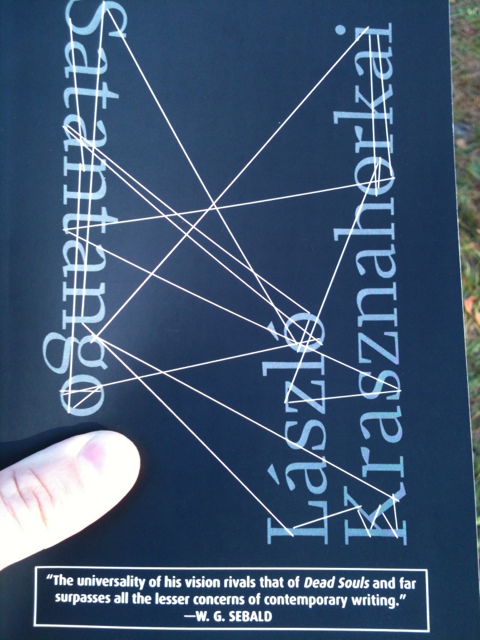
Damn. Check this out. László Krasznahorkai’s novel Satantango, the title of which does not apparently include diacritical marks in its new (first published!) English translation.
Publisher New Direction’s description:
Already famous as the inspiration for the filmmaker Béla Tarr’s six-hour masterpiece, Satantango is proof, as the spellbinding, bleak, and hauntingly beautiful book has it, that “the devil has all the good times.” The story of Satantango, spread over a couple of days of endless rain, focuses on the dozen remaining inhabitants of an unnamed isolated hamlet: failures stuck in the middle of nowhere. Schemes, crimes, infidelities, hopes of escape, and above all trust and its constant betrayal are Krasznahorkai’s meat. “At the center of Satantango,” George Szirtes has said, “is the eponymous drunken dance, referred to here sometimes as a tango and sometimes as a csardas. It takes place at the local inn where everyone is drunk. . . . Their world is rough and ready, lost somewhere between the comic and tragic, in one small insignificant corner of the cosmos. Theirs is the dance of death.” “You know,” Mrs. Schmidt, a pivotal character, tipsily confides, “dance is my one weakness.”
New Directions has a fantastic record when it comes to lit in translation, and Satantango has been long anticipated by English-reading audiences, due in large part to Béla Tarr’s movie (which is more like seven and a half hours, which I meant to watch this summer but couldn’t because I want to watch it with no interruptions, but I have kids and a wife, so, hey).
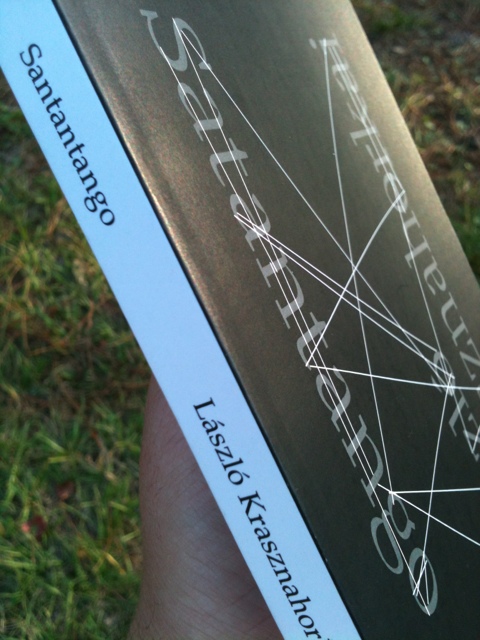
I got into it a bit last night, and, I don’t know if it’s just the advance reader copy I got or what, but there are no paragraph breaks, which is a grueling rhetorical technique, a big dare to readers, really (see also: W.G. Sebald’s Austerlitz (note: Sebald blurbs Satantango)). The advance reader copy also has a delightful typo on the spine, one that makes the book sound like, I dunno, if Santana made a tango record. Or maybe Santa n’ Tango for ever (Cash will no doubt be jealous). More to come.
Cormac McCarthy’s seminal anti-Western Blood Meridian isn’t exactly known for visions of peace on earth and good will to man. Still, there’s a strange scene in the book’s final third that subtly recalls (and somehow inverts) the Christmas story. The scene takes place at the end of Chapter 15. The kid, erstwhile protagonist of Blood Meridian, has just reunited with the rampaging Glanton gang after getting lost in the desert and, in a vision-quest of sorts, has witnessed “a lone tree burning on the desert” (a scene I have argued is the novel’s moral core).
Glanton’s marauders, tired and hungry, find temporary refuge from the winter cold in the town of Santa Cruz where they are fed by Mexicans and then permitted to stay the night in a barn. McCarthy offers a date at the beginning of the chapter — December 5th — and it’s reasonable to assume, based on the narrative action, that the night the gang spends in the manger is probably Christmas Eve. Here is the scene, which picks up as the gang — “they” — are led into the manger by a boy–
The shed held a mare with a suckling colt and the boy would would have put her out but they called to him to leave her. They carried straw from a stall and pitched it down and he held the lamp for them while they spread their bedding. The barn smelled of clay and straw and manure and in the soiled yellow light of the lamp their breath rolled smoking through the cold. When they had arranged their blankets the boy lowered the lamp and stepped into the yard and pulled the door shut behind, leaving them in profound and absolute darkness.
No one moved. In that cold stable the shutting of the door may have evoked in some hearts other hostels and not of their choosing. The mare sniffed uneasily and the young colt stepped about. Then one by one they began to divest themselves of their outer clothes, the hide slickers and raw wool serapes and vests, and one by one they propagated about themselves a great crackling of sparks and each man was seen to wear a shroud of palest fire. Their arms aloft pulling at their clothes were luminous and each obscure soul was enveloped in audible shapes of light as if it had always been so. The mare at the far end of the stable snorted and shied at this luminosity in beings so endarkened and the little horse turned and hid his face in the web of his dam’s flank.
The “shroud of palest fire” made of sparks is a strange image that seems almost supernatural upon first reading. The phenomena that McCarthy is describing is simply visible static electricity, which is not uncommon in a cold, dry atmosphere–particularly if one is removing wool clothing. Still, the imagery invests the men with a kind of profound, bizarre significance that is not easily explainable. It is almost as if these savage men, naked in the dark, are forced to wear something of their soul on the outside. Tellingly, this spectacle upsets both the mare and her colt, substitutions for Mary and Christ child, which makes sense. After all, these brutes are not wise men.
[Ed. note — Yes, this post is recycled (regifted?) from last year].
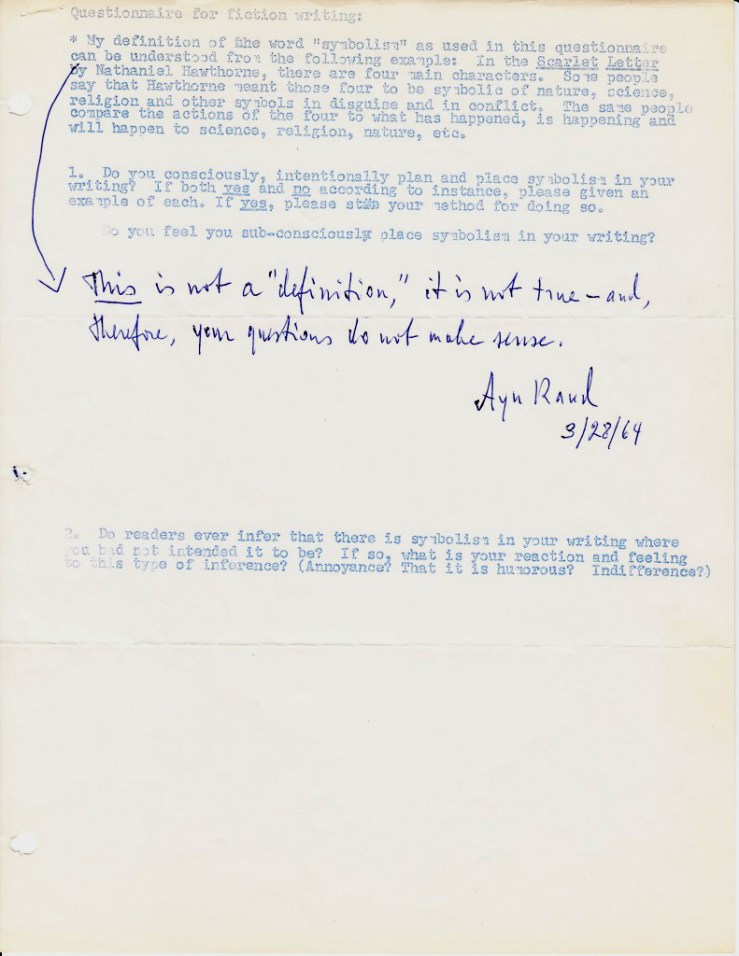
In 1963, a sixteen-year-old San Diego high school student named Bruce McAllister sent a four-question mimeographed survey to 150 well-known authors of literary, commercial, and science fiction. Did they consciously plant symbols in their work? he asked. Who noticed symbols appearing from their subconscious, and who saw them arrive in their text, unbidden, created in the minds of their readers? When this happened, did the authors mind?
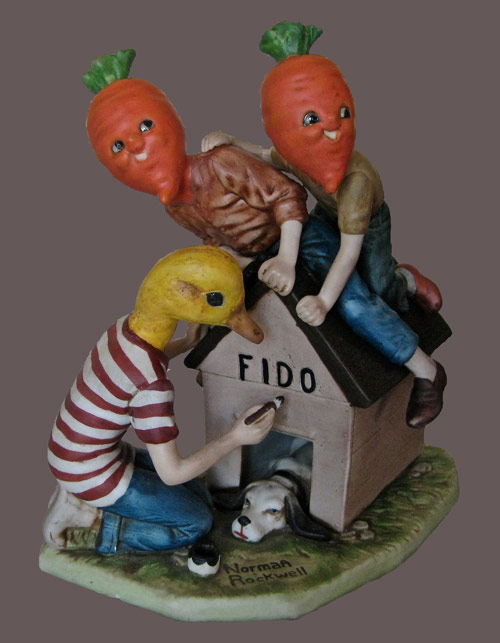
Duck and Carrots Putting the Final Touches on a Doghouse -- Click Mort
Click Mort makes surreal, charming, disarming sculptures that synthesize pre-existing figures into strange new forms. Largely self-taught, Click works out of his home in his native L.A., where he lovingly decapitates and recapitates antique statuettes. Click’s sculptures were featured in a solo exhibit earlier this year in L.A.’s La Luz de Jesus gallery and are currently on display at the Webb Gallery in Waxahachie, Texas. Click was kind enough to talk to me in detail about his work over a series of emails around Thanksgiving. Check out Click’s website to see more of his fantastical stuff.
Biblioklept: I love your sculptures. They’re disconcerting and surreal but also charming. They’re bizarre and clever, but not whimsical. Can you tell us about how you make them?
Click Mort: Thanks. I’m especially happy to hear them described as “not whimsical.” As for how they’re made, I should probably backtrack a bit since the porcelain pieces I’m doing now weren’t the actual starting point. The first things I tried recapitating were resin figurines from the 99 Cent Store: cute kid couples strolling hand-in-hand, adorable angel-tots, etc.. They were pleasantly awful on their own merits, but when I saw some particularly crappy plastic barnyard animals in the toy section that were roughly the same scale, the gears started turning. Those first head-swaps were pretty crude: I’d just hack off both heads mid-neck with a jeweler’s saw, attach the non-native head with some sculpting resin, and paint over the seam. Voila … Angel-tot with a pig’s head (or angel-pig with a tot’s body, depending on how you look at things).
After a few years of working with cheap resin figures, I kind of burnt out on them. My technique had developed to the point where the swaps were reasonably undetectable, but the available subject matter — tots, tots, and … tots — had gotten monotonous. Also, the figures gave off a really horrible smell when sawed; I strongly suspected they were made of something creepy like melamine. At that point, I decided to try doing the same thing with porcelain figures.
Right … so now I can answer your actual question. Once a suitable head and body match have been found (and describing that process would add a few more paragraphs to an already inhumanely long and dull answer) the first job is to remove all the unwanted material. A jeweler’s saw — or any cutting implement whose description doesn’t include the words “diamond-edged” — won’t even mar the finish on porcelain. I use a high-speed Dremel with some sort of diamond-dust edged cutting tool attachment. Assuming we’re talking about a human body getting an animal head, everything from the collar up has to go on the body figure. This includes hair, headgear, ribbons, or whatever connecting the head and body. If any of these drape over a collar or lapel, those parts have to go too. For the heads, the amount that gets hacked off depends on the animal. On a quadruped, because of the different angle the spine intersects the skull relative to a biped, almost everything behind the ears and under the jawline has to be removed and then re-sculpted after the head has been attached to the body.
This slideshow requires JavaScript.
In order to get a really good bond between the head and body, I fill the upper torso with sculpting resin and sink an aluminum rod into it. A length of rod is left protruding up, and the head—which also gets stuffed with resin—is then positioned on it. After that, all the missing areas have to be sculpted back on. Finally, whatever painting is needed to cover the recreated areas and blend them into the original parts gets done.
And however tedious that was to read, the actual process is several thousand times more so.
Biblioklept: I liked reading about the process, but I suppose when we do something all the time, it seems tedious to us. Your process fascinates me, because the images of your figures don’t show any “seams” — your figures look like little mass produced statues from an alternate dimension. There’s a surreal synthesis at play in your work, not just in the actual combination of, say, a dog’s head on human body, but also in the tone of the work. Your pieces strike me as both creepy and tender at the same time. I’m curious how you know if a piece “works” — when are you satisfied with your figures?
CM: That mass-produced quality is something I really try not to lose when putting together the figures. There’s something inherently familiar and low-key about mass-produced objects, and I like the idea of art that doesn’t scream for attention but just sort of sits there mumbling to itself. The down side to this is it sometimes works against the figures getting noticed at all. In the few gallery shows they’ve been in, it seemed a lot of people never looked at them from closer than a few feet away. Maybe they thought someone had just lined up a bunch of old lady tschotske crap as some sort of conceptual piece.
As for the figures working as much on a tonal as objective level, yeah, that’s becoming more and more the case. Or at least my intention. On the early pieces, I was getting figures that I thought were awful to begin with and simply trying to change the nature of their awfulness. Over the course of hundreds of hours on eBay looking for working materials, I started noticing how great some of these cheap figurines were in their own right, particularly the stuff made in Japan in the fifties and sixties. At that point, I really started paying less attention to what kind of head would seem funniest on a piece and focusing more on how the shape and expression of the new head would fit into what was already a wonderful figure. It became more about trying to maintain the geometry of the whole thing while shifting the mood.
“Creepy and tender” is as good a description as I’ve heard. I guess the tenderness is a product of my real affection for the original figures showing through. And while I don’t consider the finished pieces particularly creepy, a lot of people have described them that way. As near as I can figure, it’s because the heads I like to use almost always have sort of neutral expressions, and that lack of expression is unsettling to us on some fundamental level.
And to a great degree, when a piece “works” is determined almost as soon as I have the original figure in hand. The only finished pieces I’ve been unhappy with are ones where as soon as I unpackaged a figure bought online, I hated it but followed through with a head-swap anyway rather than just eat the cost of the figure. Usually though, if I like the original piece, I’m going to be happy with the finished figure. It might be a week or a year for the right head to show up, but I’ll know when it does. And from there, it’s only a matter of taking the time (and typically, this is something like ten to twenty hours) to bring the two together.
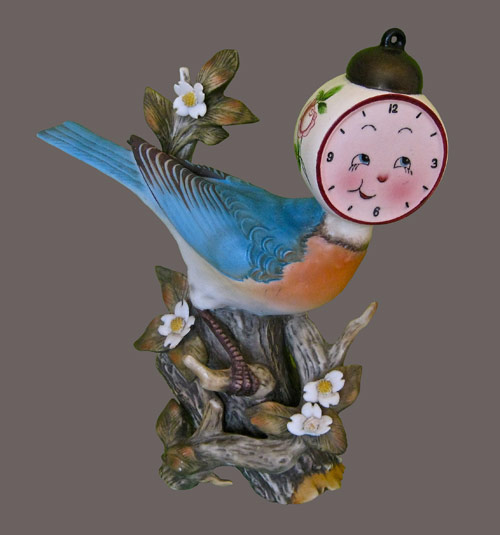
Clock Headed Harpy -- Click Mort
Biblioklept: There’s a clear appreciation or even adoration of kitsch in your work, but there’s also this level to it where you’re literally grafting two tchotchkes to each other in a way that transcends kitsch (I don’t know if that description is clear or valid). What I like about your work is that it doesn’t rely solely on an ironic aesthetic shared by both artist and audience, but that’s nevertheless part of the experience. What is it about the awful that attracts us?
CM: I wouldn’t describe my composite pieces as transcending their components, but that’s probably an extension of my regard for the original, unaltered figures. I mean, obviously I don’t think they’re sacrosanct or whatever or I wouldn’t be doing what I’m doing. Still, if there were only one — rather than thousands — of a given figure, I’d absolutely leave it alone. The same holds true for figures I think are already so wonderfully bizarre that anything I could possibly do to them would only diminish their oddity.
I guess I consider what I do as just condensing what I like about these things: taking the most expressive elements of each and putting that all in one figure in a way that enhances (but doesn’t necessarily transcend) what was already going on to some degree in the original.
It’s really hard to say what perceptions I share with whatever audience my work has. Originally, the only place that would carry them was a little boutique retail store, and now the figures have gotten into a couple of gallery group shows. In both instances, I almost never know who’s bought them, so there’s no opportunity for any sort of dialogue. For me, there’s no irony whatsoever at work in these things, but I’m pretty much literal to the point of dullness and don’t really see them as operating on any level other than the apparent. All I’m trying to do is get objectively incongruent elements and make them visually and aesthetically congruent.
But that’s just my take on them. I can be a didactic goon about a lot of stuff, but it would really be pointless to try and dictate what anyone else is or isn’t seeing in these pieces. And while there’s a definite attraction to awfulness, I don’t perceive these figures as awful. Alien, yeah. Absolutely. Which is pretty funny, given that they were originally produced as innocuous home garni and now something like a Norman Rockwell figurine is about as familiar as one of those lumpy Paleolithic Venus figures.
Biblioklept: A few of your pieces reference authors (Didion, Hemingway), but it’s not necessarily a recurring theme. How did these authors find their way into your titles? What do you enjoy reading?
CM: Titling the pieces is probably my least favorite part of the process. Usually, I just slap on whatever gibberish pops into my head and that’s that. The two figures you’ve posted are the only ones with literary references and, oddly enough, refer to one author who knocks me out and one I think is flat-out terrible (and I don’t think Didion is terrible).
As for what I read, it’s sort of a weird grab bag of stuff. Rather than trying to categorize my likes, I just grabbed the pile currently on the nightstand. Here’s what was there:
Wicked Bugs: The Louse That Conquered Napoleon’s Army & Other Diabolical Insects
Dada and Surrealism: A Very Short Introduction
Zippy Goes to School (The titular Zippy is a chimp, not the better-known pinhead.)
Guns, Germs, and Steel: The Fates of Human Societies (Keep trying to read this but invariably drop it in favor of something like Zippy Goes to School)
Tank Warfare: A History of Tanks in Battle
Monsters Are Attacking Tokyo: The Incredible World of Japanese Fantasy Films
And there’s other stuff I like and have been reading and rereading for decades: Saki and Flannery O’Connor are two particular faves.
Portrait of the Artist with the Easter Bunny, 2011
Biblioklept: You’ve mentioned that you don’t have an art school background. I’ll concede up front that this is one of those questions that interviewers aren’t supposed to ask, but I’d really like to know—what artists move you?
CM: Not to flip the interview, but why aren’t you supposed to ask stuff like that? It seems like a reasonable question.
Besides lacking an art school background, I’ve got a pretty skimpy art foreground. I’ve just never paid all that much attention to visual art. There are a few artists who for whatever reason caught my attention like Mark Ryden, Basil Wolverton, and Norman Saunders, but that’s about it. Oh, and Norman Rockwell, whose paintings are as wonderful as the figures inspired by them aren’t. And oddly enough, I seem much more moved by sounds than sights. It’s probably just a matter of how my neuro-wiring is laid out.
Biblioklept: I don’t know where I got the idea that you weren’t supposed to ask the interviewee questions like “What artists do you like?” or “What books do you read?” — maybe my high school journalism teacher? Not sure. I guess it just seems lazy on my part. But the questions are asked in good faith, I think.
You bring up music—I know you played guitar for The Cramps in the early eighties—do you have any musical projects underway now?
CM: Nope. While I still spend a fair amount of time banging on guitars, the interest and/or enthusiasm for any sort of group effort just isn’t there. I mean, I guess I could go the digital recording route, but rock and roll — and that’s all I really care about — has always been a real immediate, physical kind of thing to me. Anything other than playing with a clutch of similarly-minded goofballs just seems kinda clinical.
Biblioklept: What are you working on now? What projects do you have on the horizon?
CM: I’ve attached pictures of the figures currently in progress. This seemed kinder than subjecting your readers to the equivalent two thousand words.
As for events outside the “studio” (which is my apartment’s kitchen and breakfast nook), about a dozen pieces will be in a show opening December 4 at the Webb Gallery in Waxahachie, Texas. Also, La Luz de Jesus here in L.A. will have a clutch of them on hand through December. And my website will have an ongoing influx — and hopefully, outflux — of new figures.
Biblioklept: Have you ever stolen a book?
CM: Not recently, but yeah, I’ve lifted a volume or two. For a big stretch of my adult life I was a junky, and like most junkies had a terrifically flexible — and convenient — sense of morality. I used to steal books from used bookstores under the theory they were already used, so if I read them and then took them back, no one was really out anything.
And I usually did return them, but as often as not it was to sell the store their own book.
When I finally cleaned up, I felt like a crumb for having done this. All the same, I wasn’t about to risk some hothead filing charges if I told them I was sorry about what I’d done and wanted to settle up. Instead, I just went back to the various stores involved and, over time, bought all the books I’d sold them and those just read and returned. To me that seemed to square things, but this could be just more convenient moral reckoning. Beats me.




 Biblioklept