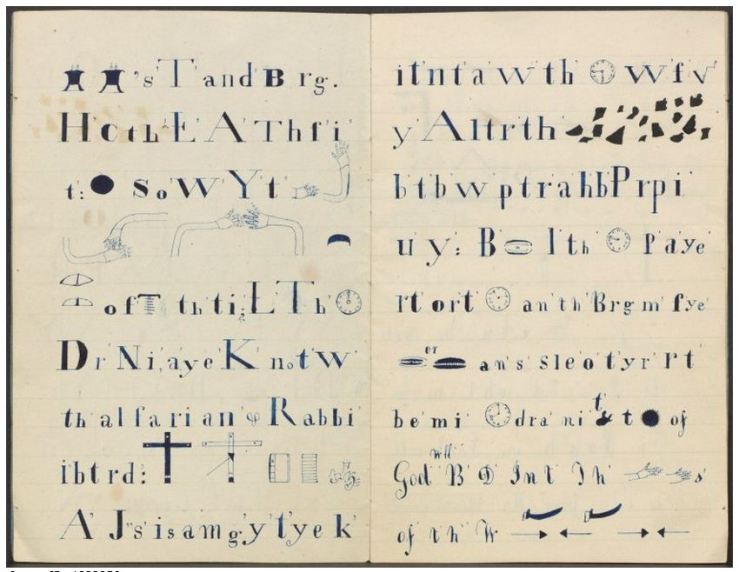
Spirit Message, 1843

(About).

Farmer Sitting at the Fireside and Reading — Vincent van Gogh

Book Shelves #21, 5.20.2012

20120520-111437.jpg

Book shelves series #21, twenty-first Sunday of 2012: William T. Vollmann and David Foster Wallace

Sorry about the glare in the photo above. As I seem to attest weekly, photography is hard. Photographing books is hard. Lighting issues, glare etc. Anyway, this shelf is half Vollmann, half DFW. I’ve written so extensively about these guys on the site that I won’t bother linking to anything here. A few months ago, Gaddis’s JR and The Recognitions was hanging out here, but then I put Expelled and Imperial on the shelf, bought Everything and More, and also picked up some more Gaddis, and, well, anyway, had to move him up with Joyce, where he seems to belong. The paperback of The Pale King is a review copy; it has additional stuff. Maybe I should part with the hardback. It seems ridiculous to have them both.

The copy of Girl with Curious Hair is extremely important to me, as silly as that sounds. It was one of the first books I ever “reviewed” on this blog, back when I still focused almost entirely on books I’d stolen or books I’d never returned to. From that review:

Scott Martin was kind enough to loan me this book. Did he know that it would forever change the way I read? It was the first semester of my freshman year in college, and I was slowly reaching beyond stuff like Henry Miller, Wm Burroughs and Franz Kafka. David Foster Wallace’s short story collection Girl With Curious Hair introduced me to a whole new world of writing. Reading DFW is like having a very witty friend tell you a moving and funny story over a few beers. He’s hilarious, thought-provoking, and not nearly as hard to read as people seem to think.

I leave the bookmark I’ve been using in almost every book I read. When I pulled Girl from the shelf, I found a Polaroid of my cat:

20120520-112636.jpg

He’s just a kitten here. His name is Remy. He no longer lives with us, but he’s still around. We moved a year ago from a bungalow set above the ground (i.e. with cat crawl space) to a ranch on a block (i.e. no crawl space). He didn’t want to move because he was having this romance with a stray my daughter named Pearly. I eventually trapped him and moved him to the new place, but I foolishly forgot he’d have no place to run and hide while getting acclimated. He ran away. A few months later I found him down the street. He looked happy and came up and talked to us. He followed us back to the new place and we gave him some people food treats. Then he left again. We seem him every now and then. He’s gotten surprisingly fat and seems to like the new people he’s taken up with. They have two boys, a little older than my kids. Sometimes I miss my cat.

Charles Bukowski Talks About Coping with Depression

“The House That Twain Built” (Mark Twain Sketch)

(Via/about).

A Brief History of Artist John Baldessari, Narrated by Tom Waits

Survival Story (Fragment from Roberto Bolaño’s 2666)

A small story from Roberto Bolaño’s 2666. Context not important:

Instead of ghosts, now the passengers in front of him were talking about a person they called Bobby. This Bobby lived in Jackson Tree, Michigan, and had a cabin on Lake Huron. One time this Bobby had gone out in a boat and capsized. He managed to cling to a log that was floating nearby and waited for morning. But as night went on, the water kept getting colder and Bobby was freezing and started to lose his strength. He felt weaker and weaker, and even though he did his best to tie himself to the log with his belt, he couldn’t no matter how hard he tried. It may sound easy, but in real life it’s hard to tie your own body to a floating log. So he gave up hope, turned his thoughts to his loved ones (here they mentioned someone called Jig, which might have been the name of a friend or a dog or a pet frog he had), and clung to the branch as tightly as he could. Then he saw a light in the sky. He thought it was a helicopter coming to find him, which was foolish, and he started to shout. But then it occurred to him that helicopters clatter and the light he saw wasn’t clattering. A few seconds later he realized it was an airplane. A great big plane about to crash right where he was floating, clinging to that log. Suddenly all his tiredness vanished. He saw the plane pass just overhead. It was in flames. Maybe a thousand feet from where he was, the plane plunged into the lake. He heard two explosions, possibly more. He felt the urge to get closer to the site of the disaster and that’s what he did, very slowly, because it was hard to steer the log. The plane had split in half and only one part was still floating. Before Bobby got there he watched it sinking slowly down into the waters of the lake, which had gone dark again. A little while later the rescue helicopters arrived. The only person they found was Bobby and they felt cheated when he told them he hadn’t been on the plane, that he’d capsized his boat when he was fishing. Still, he was famous for a while, said the person telling the story.

“And does he still live in Jackson Tree?” asked the other man.

“No, I think he lives in Colorado now,” was the response.

Then they started to talk about sports. The man next to Fate finished his water and belched discreetly, covering his mouth with his hand.

“Lies,” he said softly.

“What?” asked Fate.

“Lies, lies,” said the man.

Right, said Fate, and he turned away and stared out the window at the clouds that looked like cathedrals or maybe just little toy churches abandoned in a labyrinthine marble quarry one hundred times bigger than the Grand Canyon.

Albrecht of Brandenburg as St. Jerome in His Study — Lucas Cranach the Elder

William Gaddis’s Self-Portrait

Bill Murray Plays FDR (Hyde Park on the Hudson Trailer)

Lot and His Daughters — Joachim Wtewae

David Foster Wallace Defines The Word Despair

From David Foster Wallace’s essay “A Supposedly Fun Thing I’ll Never Do Again,” collected in the book of the same name:

The word’s overused and banalified now, despair, but it’s a serious word, and I’m using it seriously. For me it denotes a simple admixture—a weird yearning for death combined with a crushing sense of my own smallness and futility that presents as a fear of death. It’s maybe close to what people call dread or angst. But it’s not these things, quite. It’s more like wanting to die in order to escape the unbearable feeling of becoming aware that I’m small and weak and selfish and going without any doubt at all to die. It’s wanting to jump overboard.


Swift Cat — Ellen June

(More/via).

Anne Sexton Reads “Wanting to Die”

John Steinbeck: “I have never been a title man”

I have never been a title man. I don’t give a damn what it is called. I would call it [East of Eden] Valley to the Sea, which is a quotation from absolutely nothing but has two great words and a direction. What do you think of that? And I’m not going to think about it anymore.

From John Steinbeck’s 1969 interview in The Paris Review.

Young Girl Reading — Federico Zandomeneghi

Ralph Ellison: “I recognize no dichotomy between art and protest”

INTERVIEWER

Then you consider your novel a purely literary work as opposed to one in the tradition of social protest.

ELLISON

Now, mind, I recognize no dichotomy between art and protest. Dostoyevsky’s Notes from Underground is, among other things, a protest against the limitations of nineteenth-century rationalism; Don Quixote, Man’s Fate, Oedipus Rex, The Trial—all these embody protest, even against the limitation of human life itself. If social protest is antithetical to art, what then shall we make of Goya, Dickens, and Twain?

From his 1955 Paris Review interview.