Maurice Sendak: “Herman Melville is a god”

Herman Melville is a god. … I cherish what he did. He was a genius. Wrote Moby-Dick. Wrote Pierre. Wrote The Confidence-Man, wrote Billy Budd. … Oh, yes — look at him. … Scares the bejesus out of people and makes them hate him. Because he’s so good. Claggart has him killed in that book. Claggart has his eye on that boy. He will not tolerate such goodness, such blondeness, such blue eye. Goodness is scary. It’s like you want to knock it. You want to hit it.

Maurice Sendak from his 2004 interview with Bill Moyers.

Sendak also references Melville’s idea that artists must “take a dive” into the deep in this beautiful short film:

Paul Alexis Reading a Manuscript to Emile Zola — Paul Cezanne

“Don’t Fence Me In” — David Byrne

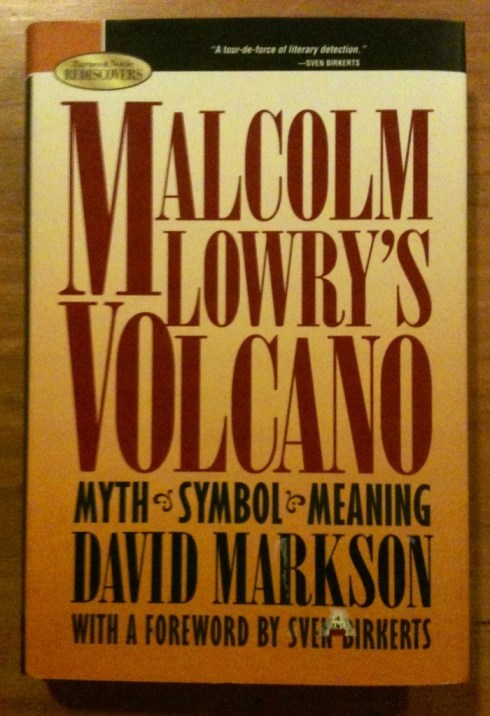
David Markson’s Malcolm Lowry Study (Book Acquired, 6.05.2012)

20120607-133715.jpg

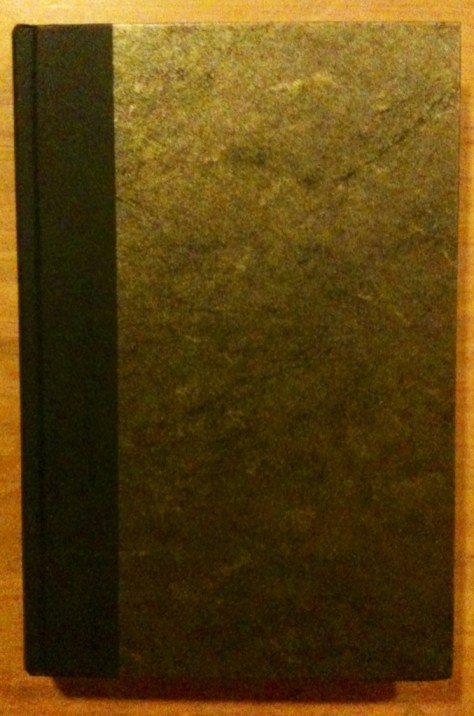
Yet another Markson book with a hideous cover. The cover for Markson’s study of Lowry’s Under the Volcano is truly terrible though: it looks like a fucking diet book or something. Great work, Barnes & Noble! Obviously I’ll shed the dust jacket; here’s what’s underneath:

20120607-133722.jpg

Much better. Anyway, what really counts is what’s inside, of course. I could probably have used this last year when I was reading Under the Volcano, but I feel I handled it okay. I’m more interested in Markson, and even more interested in Markson’s relationship with Lowry, chronicled in a brief chapter in the back that I’ve already read and will report on in more detail in the future.

Nathaniel Hawthorne on Herman Melville: “He can neither believe, nor be comfortable in his unbelief”

Melville, as he always does, began to reason of Providence and futurity, and of everything that lies beyond human ken, and informed me that he “pretty much made up his mind to be annihilated”; but still he does not seem to rest in that anticipation; and, I think, will never rest until he gets hold of a definite belief.

It is strange how he persists — and has persisted ever since I knew him, and probably long before — in wandering to-and-fro over these deserts, as dismal and monotonous as the sand hills amid which we were sitting. He can neither believe, nor be comfortable in his unbelief; and he is too honest and courageous not to try to do one or the other.

If he were a religious man, he would be one of the most truly religious and reverential; he has a very high and noble nature, and better worth immortality than most of us.

From Nathaniel Hawthorne’s journal entry for November 20, 1856; I encountered the quote in Charles Olson’s study of Melville, Call Me Ishmael.


Leo Tolstoy Reading — lya Repin

“Lazuli” — Beach House

“Birthday” (Live in ’89) — The Sugarcubes

Ben Marcus on David Markson’s Reader’s Block

 . . . when, for example, David Markson, an expository novelist who fired the starting gun for fictions of information and proved that pure exposition can be alarmingly moving, who purposefully tells instead of shows, is dismissed in The New York Times for failing to provide a story in his novelReader’s Block, no discussion follows about why, exactly, fiction must have one (at 150 words in the book review, how could any discussion follow?). Nor do we learn what a story might have looked like in such an exquisitely felt book that, to summarize, catalogs the various ways historical figures have hated whole races of people and/or died by their own hands. (Yes, you should read this book.)

Markson should have presumably, under the fiction-must-have-a-story criteria, zeroed in on one of his hundreds of characters and gone deep, doing that good old-time psychological work, the person-making stuff, dramatizing how such an interesting fellow had gone on to hate Jews and/or kill himself. Markson should have used more words like “then.” He should have sequenced. He seems to have forgotten that literature is supposedly a time-based art.

Markson’s amnesia is one of the happy accidents of the last decade of fiction writing. By eschewing a fetishistic, conventional interest in character, or a dutiful allegiance to moment creation, to occurrence itself, Markson accomplishes what a story, slogging through time and obedient to momentum, arguably could not: a commanding, obsessive portrait of single behaviors throughout history, a catalog of atrocity that overwhelms through relentless example. In truth, it’s a novel that can be read as an essay, but unlike most essays, it’s lyrically shrewd, poetry in the form of history, and it’s brave enough to provide creepy, gaping holes where we normally might encounter context (the burden of the conventional essayist).

From Ben Marcus’s essay “The Genre Artist,” published in a 2003 issue of The Believer.

Kurt Vonnegut Interview (Video/1991)

Portrait of a Reading Man — Hans Memling

Books Acquired, Sometime in the Past Two Weeks

20120606-120050.jpg

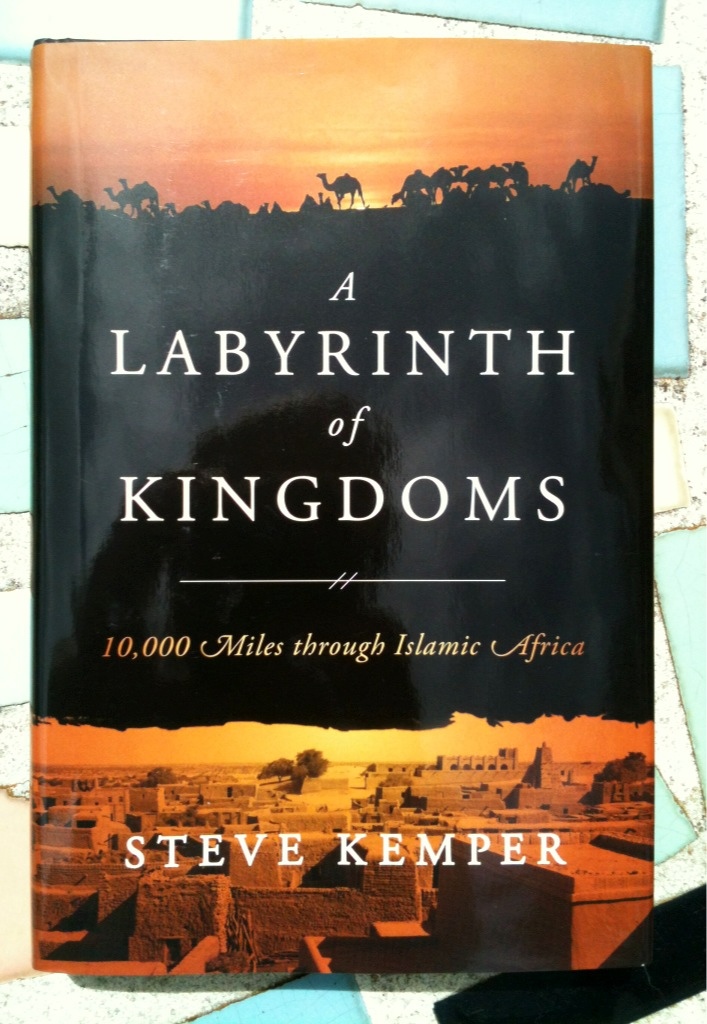
Steve Kemper’s Labyrinth of Kingdom looks pretty cool. Here’s publisher Norton’s write up:

In 1849 Heinrich Barth joined a small British expedition into unexplored regions of Islamic North and Central Africa. One by one his companions died, but he carried on alone, eventually reaching the fabled city of gold, Timbuktu. His five-and-a-half-year, 10,000-mile adventure ranks among the greatest journeys in the annals of exploration, and his discoveries are considered indispensable by modern scholars of Africa.

Yet because of shifting politics, European preconceptions about Africa, and his own thorny personality, Barth has been almost forgotten. The general public has never heard of him, his epic journey, or his still-pertinent observations about Africa and Islam; and his monumental five-volume Travels and Discoveries in North and Central Africa is rare even in libraries. Though he made his journey for the British government, he has never had a biography in English. Barth and his achievements have fallen through a crack in history.
20120606-120043.jpg

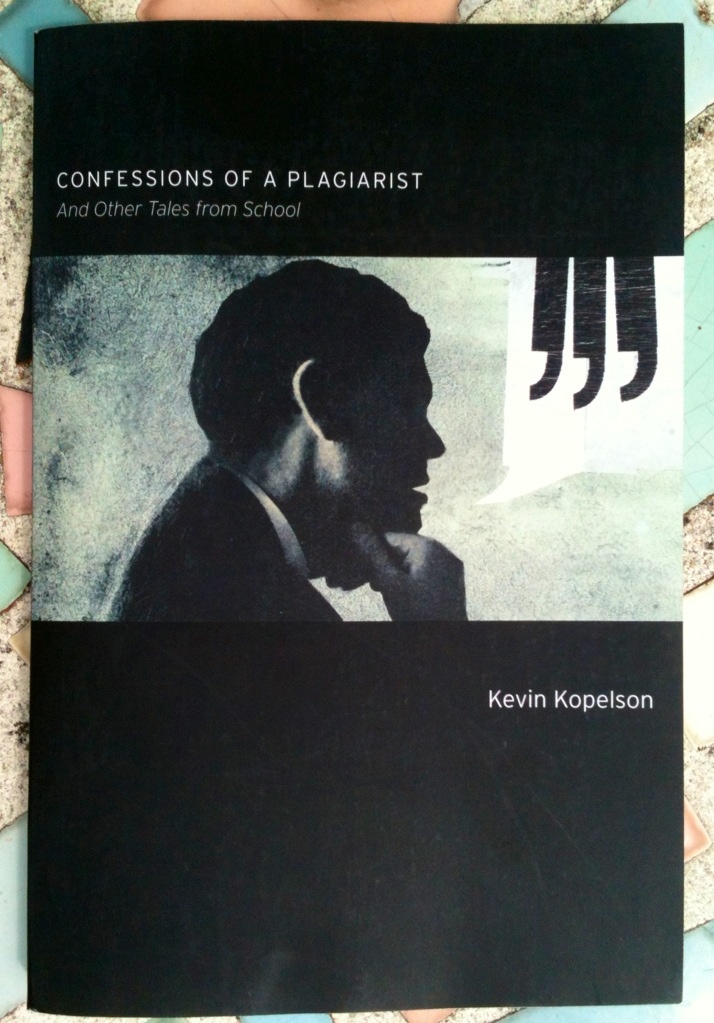
Kevin Kopelson’s Confessions of a Plagiaristnot really sure what to make of this one. Publisher Counterpath’s blurb:

In college, Kevin Kopelson passed off a paper by his older brother Robert as his own. In graduate school, he plagiarized nearly an entire article from a respected scholar, and then later, having met her and been asked if he would send something for her to read, sent that essay he had plagiarized from her work. This is not to mention the many instances in which he quoted others extensively, not passing their work off as his own, but substituting it for his own words when his words were what were called for. Until recently, such plagiarisms and thefts had been his most shameful secret, shared only with a trusted few. But then Kopelson—now an English professor and the author of a number of respected books, most recently 2007’s Sedaris—wrote an essay entitled “My Cortez,” which was published in the London Review of Books in 2008. It was a satirical literary confession, an exploration of Kopelson’s personal and professional life via his various acts of plagiarism. From that jumping off point and exploring also his other vices, Confessions of a Plagiarist is the compelling and clever retelling (not to mention renovation) of Kopelson’s life, one transgression at a time.


Ray Bradbury Interview on the TV Show Day at Night

Telling the Truth — Ray Bradbury Talks About His Life and His Writing

RIP Ray Bradbury

RIP Ray Bradbury, 1920-2012.

Thanks for helping teach me how to read.

Here’s Bradbury sharing some writing advice:

See Astra Taylor’s Documentary Examined Life, Featuring Judith Butler, Peter Singer, and Cornel West

Woman Reading — Henri Matisse