Portrait of George Sand — Eugene Delacroix

A Rambling Riff on the Age of the Amateur, Book Review Ethics, and Adam Johnson’s The Orphan Master’s Son

1.There’s been a lot of hubbub (at least in my particular echo chamber) the past few weeks about book reviews and the ethics of book reviews:

Too nice?

Too mean?

Just fine?

What about straight-up buying a book review?

And what about when authors get involved, via social media, in calling out reviewers?

2. A sloppy synthesis of what I’ve linked to above might be:

The traditional position of the serious book critic is perhaps being undermined via social media in the hands of well-meaning amateurs.

3. I’m not sure that I exactly agree with the statement above.

4. Still, we live in the Age of the Amateur.

(Saturday Night Live parodied this phenomena in a sketch called “You Can Do Anything!” that hits nail on head).

5. (SNL also unintentionally documented what happens when an amateur is given a forum beyond her untested abilities).

6. I suppose I could spend a few paragraphs parsing the delicate distinctions between literary criticism and book reviews and awarding fucking stars on Amazon or Goodreads, but I think you, gentle reader, probably get all that already.

7. (I consider myself an amateur book reviewer with an interest in but no pretension to literary criticism. I don’t intend to write about myself, but I do feel like I should clarify this).

8. (I know I just said that I don’t intend to write about myself, but again, perhaps germane:

I don’t read a lot of book reviews, especially contemporary book reviews. I mean, I hardly ever read contemporary book reviews. If I’m planning to review the work, a contemporary review may poison any pretense of objectivity I have.

With the occasional new major release, it’s almost impossible not to get a fix on some critical consensus—and I always scan of course.

I usually read a handful of reviews of a book I’m reading after I’ve drafted a review.

And I read lots of old reviews. Lots.

Again, maybe germane to all of this).

9.  But I’m riffing out all over the place. Let me get to the point. Let’s return to the second part of Point 2:

The traditional position of the serious book critic is perhaps being undermined via social media in the hands of well-meaning amateurs.

Is this true? I don’t know, exactly. A few points to consider:

Literary criticism has existed via two more-or-less stable forms for about a century now: Academic scholarship and popular media.

Academic scholarship tends to be highly-specialized and literally inaccessible for most people. I think academic scholarship and research about literature is important and I don’t want to knock it all—but most of it simply isn’t exposed to, let alone absorbed by, a reading public.

Popular media—magazines and newspapers—is clearly in a transitional phase. A lot of this boils down to the dissemination of new technologies, the advent of the so-called “citizen journalist,” and the oligarchization of mass media. Journalism, as taught in journalism school, prescribed a set of methods and ethics that seem frankly quaint when set against the internet and 24hr cable networks. How book reviews fit—if they fit at all—into the emerging paradigm of popular media is hard to say.

10. Obviously, one model for how book reviews/lit crit fits into the emerging paradigm of popular media  is Goodreads, which I really don’t know much about to be honest. Another is Amazon, which has so many problems I don’t even begin to know how to start. Both of these sites use star ratings though, which has always struck me as probably the worst critical model available.

11. (I got an email recently about Riffle, a new service “powered by the Facebook social graph and loaded with expert curated recommendations.” I mean, how’s that for a shudder down the metaphorical spine?)

12. (Re: Point 11—What is it with this term “curator”? Is it synonymous with: “I produce no original content”?)

13. So, to return to the pretense that I have a point:

I’ve written about 300 reviews on this site. Most for books, some movie reviews, and a few other things as well (uh, malt liquor). I didn’t really know what I was doing in the beginning—I mean, I wasn’t even intending to review books. I was just writing about books I’d pilfered, pinched. Stolen. (The name of the site was its mission statement).  At some point I started making critical judgments, trying to, you know, recommend books that I loved to people who I hoped would love them also.

And at some point I came across John Updike’s rules for reviewing books.

I’m not an Updike fan—wasn’t then, amn’t now—but his rules resonated with me, and I made a point of reading his criticism, which is generally excellent.

In short, I’ve tried to follow his rules.

14. (To clarify: A simple thesis for this whole riff: I think book reviewers need to follow some kind of aesthetic, ethical rubric, one that accounts for subjectivity in an objective way—and I think Updike’s list is great).

15. Updike’s first rule is his best:

Try to understand what the author wished to do, and do not blame him for not achieving what he did not attempt.

This one seems fairly straightforward, but is abused all the time, whether it’s Kakutani at the NYT pretending YA is not YA, or a reviewer at Book Kvetch lamenting that a metaphor-laced experimental novel isn’t a science textbook.

(I might have abused Updike’s first rule myself, but I’m not going to ransack the archives for self-incrimination).

16. Updike’s first rule is so graceful because it allows for a sliding scale of sorts, a range of possibilities beyond the critic’s own highly-subjective taste.

Put another way, it’s very easy to say, “I loved it” or “I hated it,” but Updike’s first rule places the onus of critical imagination on the reviewer. The responsible reviewer has to understand his or her audience (or at least has to try to understand his or her audience).

17. The subjective can’t be removed from reviews of course—nor should it be. I think the balancing act here might be described as taste.

18. I’ve occasionally broken some of Updike’s rules, especially when I super hated a book (usually #s 2 &3–didn’t bother to cite text—actually, I’ve done this repeatedly),

19. Sometimes a book confuses my approach to criticism.

20. Hence, Adam Johnson’s novel The Orphan Master’s Son, which I reviewed in hardback a few months ago, and which is now available in trade paperback, and which I will use now as some sort of loose illustration for whatever point there is in this ramble:

20120724-194425.jpg

21. (Okay. So, normally I photograph reader copies (and other books I obtain) and run a little blurb—usually the publisher’s copy or another review—and I was gonna do this with The Orphan Master’s trade paperback (citing my own review in this case), but the post lingered, thoughts accrued around it as I glommed onto all the ideas reverberating around my little echo chamber re: this whole riff. I bring this up in the recognition that a post purporting to address in some way the ethics of book reviewing should point out that the publisher in question (e.g. this blog, e.g. me) regularly posts what amounts to a kind of advertisement for forthcoming books).

22. So why The Orphan Master’s Son?

I use it as example (barring info re: Point 21 for a moment) of a book that didn’t do what I wanted the book to do.

Here’s the end of my review:

 Toward the end of The Orphan Master’s Son, I began imagining how the novel might read as a work divorced from historical or political reality, as its own dystopian blend—what would The Orphan Master’s Son be stripped of all its North Korean baggage? (This is a ridiculous question, of course, but it is the question I asked myself). I think it would be a much better book, one that would allow Johnson more breathing room to play with the big issues that he’s ultimately addressing here—what it means to tell a story, what it means to create, what it means to love a person who can not just change, but also disappear. These are the issues that Johnson tackles with aplomb; what’s missing though, I think, is a genuine take on what it means to be a North Korean in search of identity.

I think my review of The Orphan Master’s Son was/is fair, but it didn’t—couldn’t—exactly capture how I felt about the book: a mix of disappointment and admiration.

23. To be clear, I took pains to clarify that I thought highly of Johnson’s prose and that I thought most readers would really dig his book.

I gave it, I suppose, a mixed review, which is almost like giving it a negative review.

24. But I didn’t give it a mixed review to be nice—I tempered my criticisms with the knowledge that any attack I made on The Orphan Master’s Son was really a way of defining my own aesthetic tastes. Let me cite Updike’s fifth rule:

 If the book is judged deficient, cite a successful example along the same lines, from the author’s ouevre or elsewhere. Try to understand the failure. Sure it’s his and not yours?

Ultimately, my problem with The Orphan Master’s Son boils down to me wanting Johnson to have written a different book. I feel like I have plenty of reasonable reasony reasons for wanting a different book—first and foremost Johnson’s prowess as proser and storyteller—but that’s no way to review a book. From my review:

I should probably clarify that I think many people will enjoy this novel and find it very moving and that the faults I found in its second half likely have more to do with my taste as a reader than they do Johnson’s skill as a writer, which skill,  again I’ve tried to demonstrate is accomplished.

25. Let me end here in repetition (and, perhaps, here in the safety of these parentheses point to how riffing in a rambling wine-soaked list somehow frees me from actually coherently writing about any of the things I promised to—or maybe it doesn’t—which is of course its own ethical ball of worms) by restating a basic answer to some of the basic problems of amateurism:

Book reviewers need to follow some kind of aesthetic, ethical rubric, one that accounts for subjectivity in an objective way.
Werner Herzog Talks About John Waters: “He’s the Boldest of the Bold of Filmmakers”

The Reading — Edouard Manet

Storm — Yves Tanguy

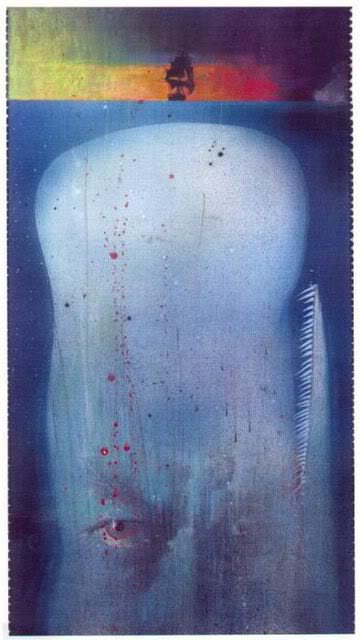
Moby-Dick Illustration — Bill Sienkiewicz

“He Burned Away Like a Comet” — Werner Herzog on Klaus Kinski

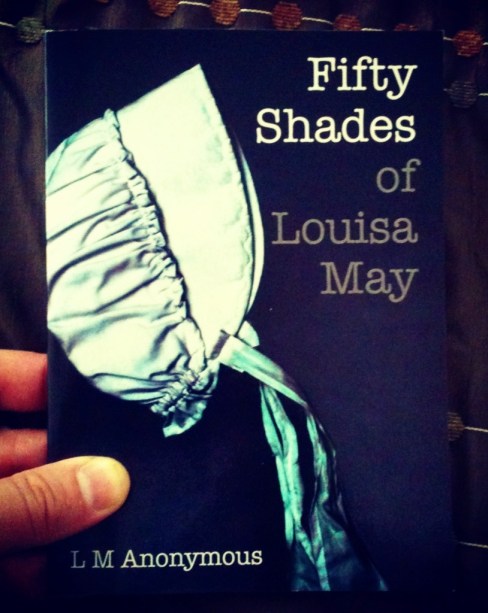
Fifty Shades of Louisa May: A Loving Biography Masquerading as a Smutty Novelty Book

20120818-173921.jpg

Fifty Shades of Louisa May by L.M. Anonymous, is , to all appearances, the kind of cheeky send-up that E.L James’s Fifty Shades of Grey hardly deserves. Satire has the strange, paradoxical power to somehow dignify its target after all, or at least point out how the thing being satirized is, you know, worth actually talking about. However, Louisa May has no proximity to Fifty Shades of Grey, other than the window dressing of its cover and its title, both of which exist somewhere on the thin line between clever and crass. Sure, Louisa May has its share of sex scenes (most are more ridiculous than erotic), but this slim little book is, at its core, really a loving biography of novelist Louisa May Alcott.

The conceit is that Alcott, dipping into her secret vice of a midnight bottle of Madeira, decides to a pen a memoir (that she intends to burn) of her “carnal episodes, some amusing, others touching, but all rife with the sighs and heavings of Love’s labours.” (How the “X-rated woodcuts” that accompany each chapter made their way into the book remains unclear; I suspect that they follow the tradition established in the mashup Pride and Prejudice and Zombies). Organized roughly around Alcott’s difficult life with her transcendentalist parents and their transcendentalist friends, each chapter of Louisa May culminates in an erotic episode, albeit one that our heroine usually witnesses as voyeur and not participant. These episodes tend to involve other transcendentalist figures. In one inspired vignette, Louisa May sneaks out of her house to follow Herman Melville to the Old Manse, where she watches him watch Sophia and Nathaniel Hawthorne get it on:

I heard a small groan from Mr. Melville’s beech tree and saw that his own garments now circled his ankles and he was busily engaged in the art of Onan, his slitted eyes on his mentor, beard shivering with concentration. I looked away quickly—even in my youth I knew that such solitary activity must remain unwitnessed.

The Hawthornes let out a quivering scream, Nathaniel’s voice as high pitched as his wife’s as he rose from his chair to finish the work that his wife had begun. Thus spent, Sophia lay back in his arms. The ever-fastidious Mr. Hawthorne reached out with one hand to set to reordering his manuscript pages.

Mr. Melville let out a low hoot and sent a frothy fusillade across the yard to strike the windowglass with a furious splash.

“Look, my Dove, it appears to be raining,” Sophia said.

The episode is obviously more comical than erotic, its style—indeed the style of the entire book—a strange mashup of Alcott’s own rhythms and the diction of Victorian smut. There’s something joyously silly in the way L.M. Anonymous throws together various transcendentalists into would-be erotic interludes; when our heroine describes Fruitlands founder Charles Lane jacking off by moonlight, the whole thing feels like a big dirty in-joke for those of us who love this period of American history and literature. And sure, the jokes can be very crude—here’s Henry David Thoreau, nature lover:

20120818-173927.jpg

L.M. Anonymous (“a well-known writer who prefers the cloak of anonymity to the vulgar embrace of rude fame,” according to the back of the book) seems to know his/her history (and attending rhetorical styles) fairly well. I’d have to guess that the author is, if not an Alcott scholar, then at least a passionate enthusiast—because what stands out most about Fifty Shades of Louisa May isn’t the smut but the internal conflicts of our narrator Louisa May.

In Anonymous’s imagination, Alcott is an embittered soul who has never forgiven her father for his foolishness, nor gotten over the fact that she’s the sole source of income for the Alcotts. She badmouths her books as unserious trash, bemoaning that she could do more:

Too often I have found myself diminished by the company of Famous Men to praise them. Had I been but relieved of the burden of supporting the entire legions of Alcotts with my earnings, I could have written novels and poems to equal their best—of that I am most confident. Instead of greatness, I lingered at the Trough of Rubbish too long, achieving only a shining of tin, not the glimmering of gold. But it is too late for me to be concerned with such matters. Time sorts out all writers, revealing each for what they truly were. I only hope that I shall be remembered as much for what I did not achieve as for what I did.

There’s so much tenderness here: Anonymous’s love and respect for his/her subject is plain. The author also seems to write through the book, through the narrator in this passage, as if acknowledging, in some metatextual move, the book’s own novelty status, pointing out that the book, a shaky Grey cash-in, is in some way a part of the Trough of Rubbish, but also that there’s more here too.

I read Fifty Shades of Louisa May in one short sitting, and found it at times amusing, if not especially erotic. I was prepared to to write it off as a silly novelty book—which perhaps it is—but there’s also a real love—and understanding—for Louisa May Alcott that comes through here. Who is it for? I’m not really sure. I’m going to guess that Fifty Shades of Grey fans will be disappointed, and fans of Little Women and its sequels will find their beloved tome trashed by Alcott herself (or at least her character). The book might work best as a primer to the American Renaissance, although I’m not sure which professor would be brash enough to stick this on her syllabus. My hope would be that Grey fans might find in Louisa May an inroad into better writers; at minimum though, they’ll at least be exposed to prose far superior to E.L. James’s trough of rubbish.

Fifty Shades of Louisa May is new in trade paperback from OR Books.

The Missal — John William Waterhouse

Black Orpheus (Full Film)

Book Shelves #35, 8.27.2012


20120826-135649.jpg

Book shelves series #35, thirty-fifth Sunday of 2012

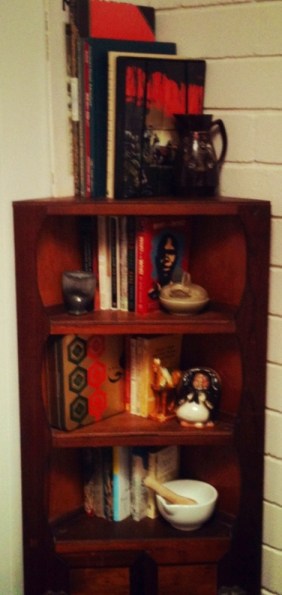
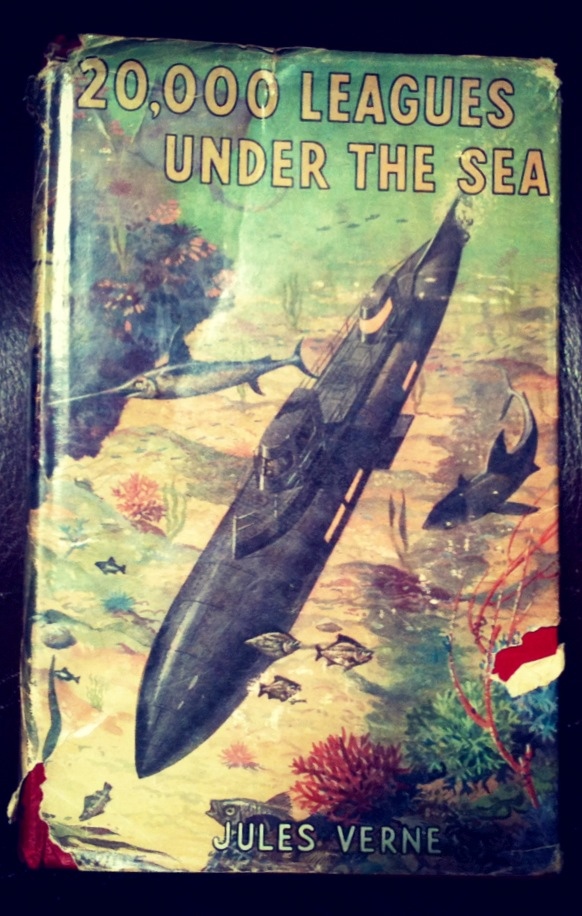
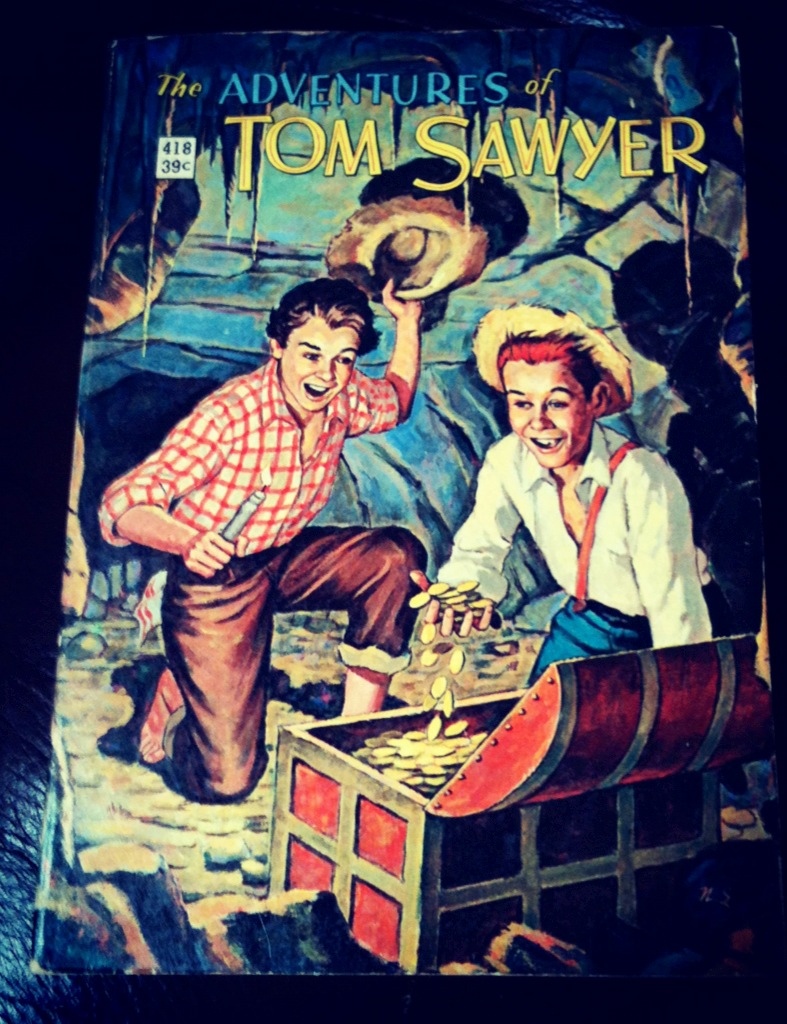
Corner case in the family room. Today’s shelf:

20120826-135655.jpg

The depth makes getting the shadow off the shot almost impossible without using additional lighting.

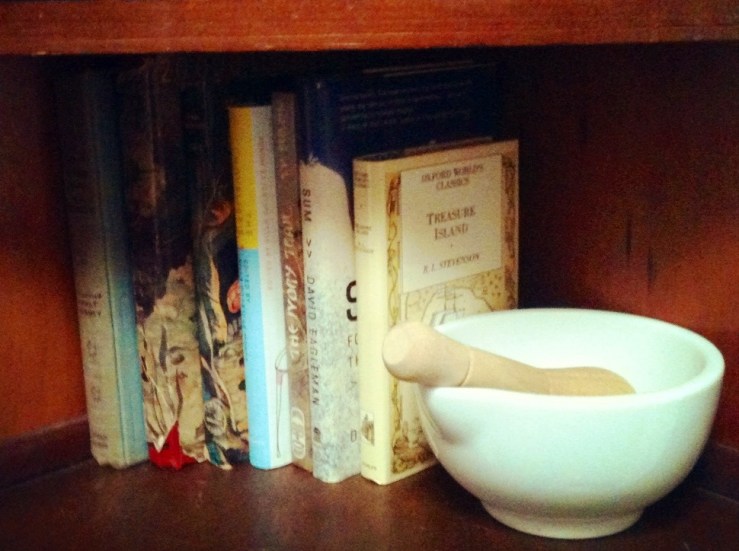
Note the use of mortar and pestle as bookend, a genteel move that screams respectability.

Volumes on this shelf include:

20120826-135702.jpg

And:

20120826-135710.jpg


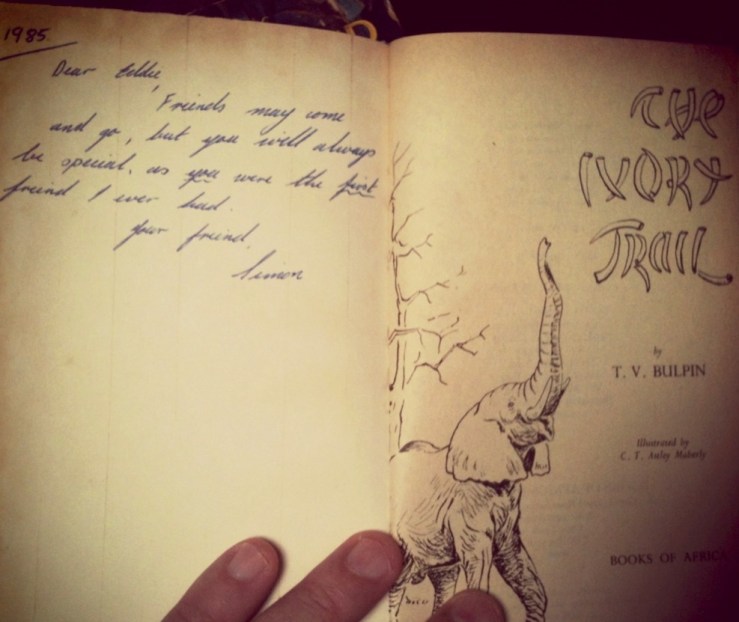
As well as The Ivory Trail, inscribed by my the mother of one of best friends of early childhood (and attributed to him):

20120826-135716.jpg


Moby-Dick Illustration — Tony Millionaire

“The Yellow Paint” — Robert Louis Stevenson


“The Yellow Paint,” a short fable by Robert Louis Stevenson—

In a certain city there lived a physician who sold yellow paint. This was of so singular a virtue that whoso was bedaubed with it from head to heel was set free from the dangers of life, and the bondage of sin, and the fear of death for ever. So the physician said in his prospectus; and so said all the citizens in the city; and there was nothing more urgent in men’s hearts than to be properly painted themselves, and nothing they took more delight in than to see others painted. There was in the same city a young man of a very good family but of a somewhat reckless life, who had reached the age of manhood, and would have nothing to say to the paint: “Tomorrow was soon enough,” said he; and when the morrow came he would still put it off. She might have continued to do until his death; only, he had a friend of about his own age and much of his own manners; and this youth, taking a walk in the public street, with not one fleck of paint upon his body, was suddenly run down by a water-cart and cut off in the heyday of his nakedness. This shook the other to the soul; so that I never beheld a man more earnest to be painted; and on the very same evening, in the presence of all his family, to appropriate music, and himself weeping aloud, he received three complete coats and a touch of varnish on the top. The physician (who was himself affected even to tears) protested he had never done a job so thorough.

Some two months afterwards, the young man was carried on a stretcher to the physician’s house.

“What is the meaning of this?” he cried, as soon as the door was opened. “I was to be set free from all the dangers of life; and here have I been run down by that self-same water-cart, and my leg is broken.”

“Dear me!” said the physician. “This is very sad. But I perceive I must explain to you the action of my paint. A broken bone is a mighty small affair at the worst of it; and it belongs to a class of accident to which my paint is quite inapplicable. Sin, my dear young friend, sin is the sole calamity that a wise man should apprehend; it is against sin that I have fitted you out; and when you come to be tempted, you will give me news of my paint.”

     “Oh!” said the young man, “I did not understand that, and it seems rather disappointing. But I have no doubt all is for the best; and in the meanwhile, I shall be obliged to you if you will set my leg.”

“That is none of my business,” said the physician; “but if your bearers will carry you round the corner to the surgeon’s, I feel sure he will afford relief.”

Some three years later, the young man came running to the physician’s house in a great perturbation. “What is the meaning of this?” he cried. “Here was I to be set free from the bondage of sin; and I have just committed forgery, arson and murder.”

“Dear me,” said the physician. “This is very serious. Off with your clothes at once.” And as soon as the young man had stripped, he examined him from head to foot. “No,” he cried with great relief, “there is not a flake broken. Cheer up, my young friend, your paint is as good as new.”

“Good God!” cried the young man, “and what then can be the use of it?”

“Why,” said the physician, “I perceive I must explain to you the nature of the action of my paint. It does not exactly prevent sin; it extenuates instead the painful consequences. It is not so much for this world, as for the next; it is not against life; in short, it is against death that I have fitted you out. And when you come to die, you will give me news of my paint.”

“Oh!” cried the young man, “I had not understood that, and it seems a little disappointing. But there is no doubt all is for the best: and in the meanwhile, I shall be obliged if you will help me to undo the evil I have brought on innocent persons.”

     “That is none of my business,” said the physician; “but if you will go round the corner to the police office, I feel sure it will afford you relief to give yourself up.”

Six weeks later, the physician was called to the town gaol.

“What is the meaning of this?” cried the young man. “Here am I literally crusted with your paint; and I have broken my leg, and committed all the crimes in the calendar, and must be hanged tomorrow; and am in the meanwhile in a fear so extreme that I lack words to picture it.”

“Dear me,” said the physician. “This is really amazing. Well, well; perhaps, if you had not been painted, you would have been more frightened still.”


The Bath — Alfred Stevens

Man on the Moon — Norman Rockwell

RIP Neil Armstrong, 1930-2012

The Compleat Beatles (Full 1982 Documentary)

In the Jungle, Florida — Winslow Homer