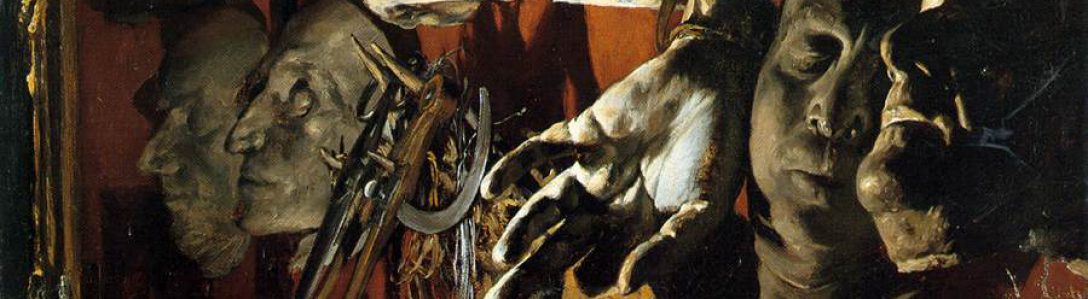
Greed — Pieter Bruegel the Elder

“Half Man/Half Mole” — Chris Knox

Book Shelves #29, 7.15.2012

20120715-103934.jpg

Book shelves series #29, twenty-ninth Sunday of 2012

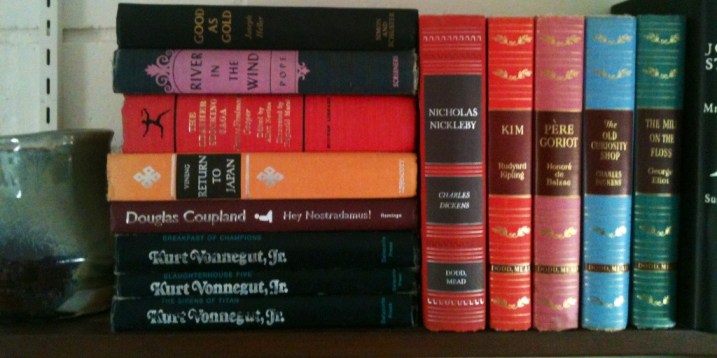
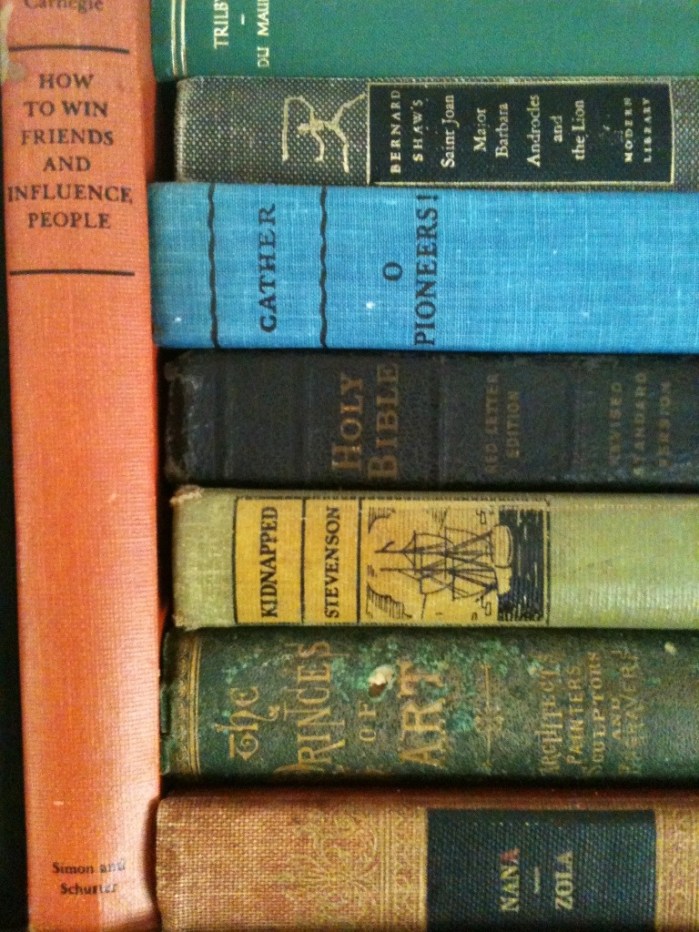
Lots of hardbacks on this long, long shelf. The Vonneguts above were particularly important to me when I was young. They were my father’s. I read them surreptitiously for years and then outright appropriated them at some point. The matching Dodd, Mead hardbacks were rescued from a school I worked at for years. My wife made the vase that serves as a bookend. The copy of Jonathan Strange and Mr. Norrell that doesn’t quite fit in the frame remains unread.

20120715-103943.jpg

The BFG: a classic. I reviewed Wabi Sabi. Next to the Crumb:

20120715-111742.jpg

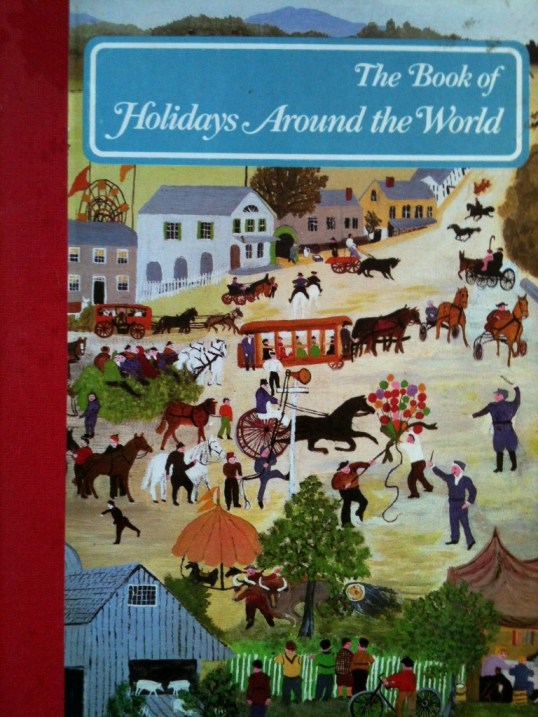
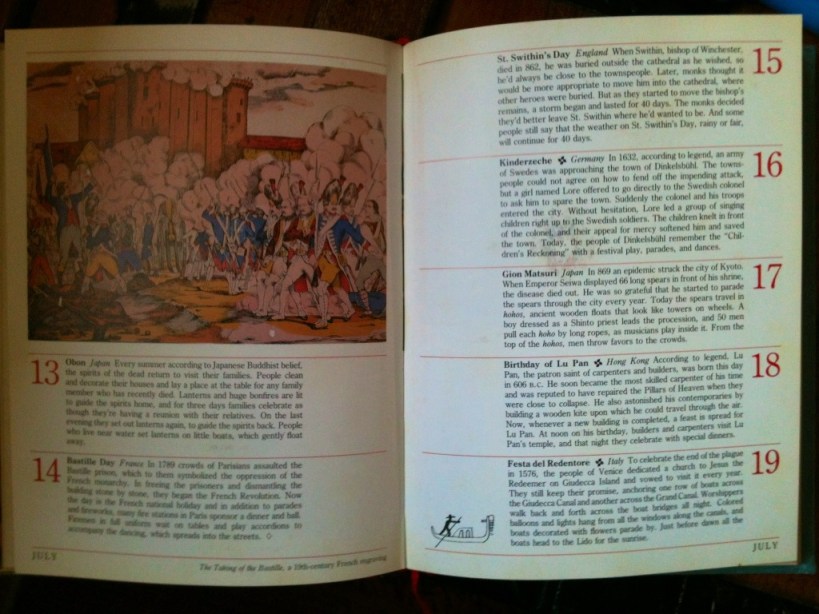
I found Holidays in a box of free books in a library lobby. Love it. Here’s this week’s schedule of holidays:

20120715-111749.jpg

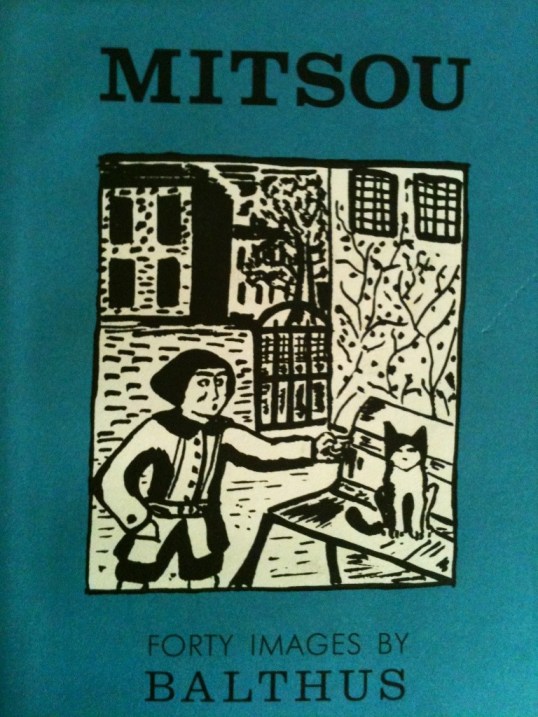
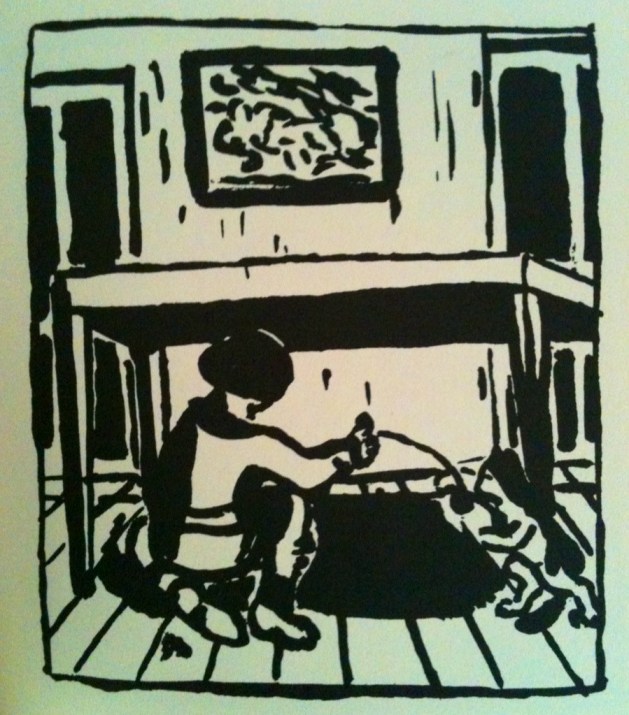
One of my favorite books ever is Mitsou, a book that Balthus did when he was like 10 or 12 or something:

20120715-104032.jpg

It’s about a young boy who gets a cat and loves the cat and then loses the cat. It’s heartbreaking. Image:

20120715-104040.jpg

And next to this one:

20120715-104015.jpg

Shelf’s end:

20120715-112719.jpg

List of Lapsus Calami from Roberto Bolaño’s Novel 2666

A funny section from late in Roberto Bolaño’s novel 2666; lapsus calami is Latin for “slip of the pen,” indicating a mistake or miswriting (although, as the characters discuss later, some of these examples may be purposeful):

. . . . and then they started to talk about lapsus calami, many of them collected in a book published long ago in Paris and fittingly titled Le Musee des erreurs, as well as others selected by Max Sengen, hunter of errata. And one thing led to another and it wasn’t long before the copy editors got out a book (which wasn’t the French Museum of Errors or Sengen’s text), whose title Archimboldi couldn’t see, and began to read aloud a selection of cultured pearls:

“Poor Marie! Whenever she hears the sound of an approaching horse, she is certain that it is I.” Vie de Ranee, Chateaubriand.

“The crew of the ship swallowed up by the waves consisted of twenty-five men, who left hundreds of widows consigned to misery.” Les Cages flottantes, Gaston Leroux.

“With God’s help, the sun will shine again on Poland.” The Deluge, Sienkiewicz.

” ‘Let’s go!’ said Peter, looking for his hat to dry his tears.” LourdesZola.

“The duke appeared followed by his entourage, which preceded him.” Letters from My Mill, Alphonse Daudet.

“With his hands clasped behind his back, Henri strolled about the garden, reading his friend’s novel.” Le Cataclysme, Rosny.

“With one eye he read, with the other he wrote.” On the Banks of the Rhine, Auback.

“Silently the corpse awaited the autopsy.” Luck’s Favorite, Octave Feuillet.

“William couldn’t imagine the heart served for anything other than breathing.” Death, Argibachev.

“This sword of honor is the most beautiful day of my life.” Honneur d’artiste, Octave Feuillet.

“I can hardly see anymore, said the poor blind woman.” Beatrix, Balzac.

“After they cut off his head, they buried him alive.” The Death of Mongomer, Henri Zvedan.

“His hand was as cold as a snake’s.” Ponson du Terrail. And here there was no indication of the source of the lapsus calami.

The following unattributed quotes from Max Sengen’s collection were particularly notable:

“The corpse stared reproachfully at those gathered around him.”

“What can a man do who’s been killed by a lethal bullet?”

“Near the city there were roaming whole packs of solitary bears.”

“Unfortunately, the wedding was delayed fifteen days, during which time the bride fled with the captain and gave birth to eight children.”

“Three- or four-day excursions were a daily occurrence.”

And then came the commentary.
A Man Seated at a Table Covered with Books — Rembrandt

Bluebird — Albrecht Dürer

The World Within: C.G. Jung In His Own Words (1990 Documentary with Archival Footage)

Italo Calvino’s List of Reasons Why We Should Read the Classics

From Italo Calvino’s The Uses of Literature

  1. The classics are the books of which we usually hear people say, “I am rereading . . . ” and never “I am reading . . . “
  2. We use the words “classics” for books that are treasured by those who have read and loved them; but they are treasured no less by those who have the luck to read them for the first time in the best conditions to enjoy them
  3. The classics are books that exert a peculiar influence, both when they refuse to be eradicated from the mind and when they conceal themselves in the folds of memory, camouflaging themselves as the collective or individual unconscious.
  4. Every rereading of a classic is as much a voyage of discovery as the first reading.
  5. Every reading of a classic is in fact a rereading.
  6. A classic is a book that has never finished saying what it has to say.
  7. The classics are the books that come down to us bearing the traces of readings previous to ours, and bringing in their wake the traces they themselves have left on the culture or cultures they have passed through (or, more simply, on language and customs).
  8. A classic does not necessarily teach us anything we did not know before. In a classic we sometimes discover something we have always known (or thought we knew), but without knowing that this author said it first, or at least is associated with it in a special way. And this, too, is a surprise that gives much pleasure, such as we always gain from the discovery of an origin, a relationship, an affinity.
  9. The classics are books which, upon reading, we find even fresher, more unexpected, and more marvelous than we had thought from hearing about them.
  10. We use the word “classic” of a book that takes the form of an equivalent to the universe, on a level with the ancient talismans. With this definition we are approaching the idea of the “total book,” as Mallarmé conceived of it.
  11. Your classic author is the one you cannot feel indifferent to, who helps you to define yourself in relation to him, even in dispute with him.
  12. A classic is a book that comes before other classics; but anyone who has read the others first, and then reads this one, instantly recognizes its place in the family tree.
  13. A classic is something that tends to relegate the concerns of the moment to the status of background noise, but at the same time this background noise is something we cannot do without.
  14. A classic is something that persists as a background noise even when the most incompatible momentary concerns are in control of the situation.


Piles of Books — Hercules Seghers

Allegory with Wolf and Eagle — Leonardo da Vinci

John Searle Talks About Wittgenstein (BBC, 1987)


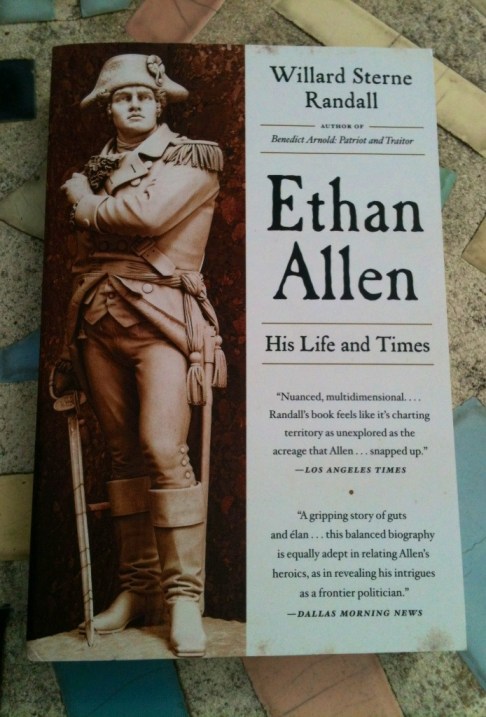
Ethan Allen (Book Acquired, Some Time Over the July 4th Holiday)

20120711-100435.jpg

Willard Sterne Randall’s biography of OG Green Mountain Boy Ethan Allen—pretty good stuff—is new in trade paperback. We’ll be running an interview with Randall about the book sometime next week. From publisher Norton’s blurb:

While Ethan Allen, a canonical hero of the American Revolution, has always been defined by his daring, predawn attack on the British-controlled Fort Ticonderoga, Willard Sterne Randall, the author ofBenedict Arnold, now challenges our conventional understanding of this largely unexamined Founding Father. Widening the scope of his inquiry beyond the Revolutionary War, Randall traces Allen’s beginning back to his modest origins in Connecticut, where he was born in 1738. Largely self-educated, emerging from a relatively impoverished background, Allen demonstrated his deeply rebellious nature early on through his attraction to Deism, his dramatic defense of smallpox vaccinations, and his early support of separation of church and state.

Chronicling Allen’s upward struggle from precocious, if not unruly, adolescent to commander of the largest American paramilitary force on the eve of the Revolution, Randall unlocks a trove of new source material, particularly evident in his gripping portrait of Allen as a British prisoner-of-war. While the biography reacquaints readers with the familiar details of Allen’s life—his capture during the aborted American invasion of Canada, his philosophical works that influenced Thomas Paine, his seminal role in gaining Vermont statehood, his stirring funeral in 1789—Randall documents that so much of what we know of Allen is mere myth, historical folklore that people have handed down, as if Allen were Paul Bunyan.

As Randall reveals, Ethan Allen, a so-called Robin Hood in the eyes of his dispossessed Green Mountain settlers, aggrandized, and unabashedly so, the holdings of his own family, a fact that is glossed over in previous accounts, embellishing his own best-selling prisoner-of-war narrative as well. He emerges not only as a public-spirited leader but as a self-interested individual, often no less rapacious than his archenemies, the New York land barons of the Hudson and Mohawk Valleys.

St. Jerome — Albrecht Durer

Calvino/Voltaire/Klee/Candide

Italo Calvino on one of my favorite books, Voltaire’s Candide (these are the first few paragraphs of the essay “Candide, or Concerning Narrative Rapidity,” from Calvino’s indispensable collection Why Read the Classics?):

Geometric characters, animated by a flickering mobility, stretch and twist in a saraband of precision and lightness: that was how Paul Klee illustrated Voltaire’s Candide in 1911, giving visual – and almost musical – form to the energetic brio which this book continues to communicate to today’s readers, above and beyond its thick network of references to its own epoch and culture.

What most delights us today in Candide is not the ‘conte philosophique’, nor its satire, nor the gradual emergence of a morality and vision of the world: instead it is its rhythm. With rapidity and lightness, a succession of mishaps, punishments and massacres races over the page, leaps from chapter to chapter, and ramifies and multiplies without evoking in the reader’s emotions anything other than a feeling of an exhilarating and primitive vitality. In the bare three pages of Chapter 8 Cunégonde recounts how having had her father, mother and brother hacked to pieces by invaders, she is then raped and disembowelled, then cured and reduced to living as a washerwoman, bartered and sold in Holland and Portugal, torn between two different protectors of different faiths on alternate days, and in this condition happens to witness the auto da fé whose victims are Pangloss and Candide himself whom she then rejoins. Even less than two pages of Chapter 9 are enough for Candide to find himself with two corpses at his feet and for Cunégonde to be able to exclaim: ‘How did you who were born so mild ever manage to kill in the space of two minutes a Jew and a prelate?’ And when the old woman has to explain why she has only one buttock, she starts by telling the story of her life from the moment when as the thirteen-year-old daughter of a Pope, she had experienced in the space of three months poverty, enslavement, and almost daily rape, before having to endure famine and war and nearly dying of the plague in Algiers: and all this before she can get to her tale of the siege of Azov and of the unusual nutrition that the starving Janissaries discover in female buttocks . . . well, here things are rather more leisurely, two whole chapters are required, something like six and a half pages.

The great discovery of Voltaire the humorist is a technique that will become one of the most reliable gags in comic films: the piling up of disaster on disaster at relentless speed. There are also the sudden increases in rhythm which carry the sense of the absurd almost to the point of paroxysm: as when the series of misfortunes already swiftly narrated in the detailed account is then repeated in a breakneck-speed summary. What Voltaire projects in his lightning-speed photograms is really a worldwide cinema, a kind of ‘around the world in eighty pages’, which takes Candide from his native Westphalia to Holland, Portugal, South America, France, England, Venice and Turkey, and this tour then splits in turn into supplementary whirlwind world tours by fellow protagonists, male and especially female, who are easy prey for pirates and slavers operating between Gibraltar and the Bosphorus. A huge cinema of contemporary world events most of all: villages wiped out in the Seven Years’ War between the Prussians and the French (the ‘Bulgars’ and the ‘Abars’), the Lisbon earthquake of 1755, the auto da fés organised by the Inquisition, the Jesuits of Paraguay who reject Spanish and Portuguese rule, the legendary gold of the Incas, and the odd snapshot of Protestantism in Holland, of the spread of syphilis, Mediterranean and Adantic piracy, internecine wars in Morocco, the exploitation of black slaves in Guyana, but always leaving a certain space for literary news, allusions to Parisian high life, interviews with the many dethroned kings of the time, who all gather at the Venice carnival.

“Genius of Love” — Tom Tom Club

Summer in the City — Edward Hopper

George Carlin Riffs on the Self-Esteem Movement (NSFW)