Speaking for Trees — Cat Power

Woman Reading — Camille Corot

“This Never Happened” — A Clip from Malick’s Badlands

Wind Fallen Trees (1880) — Ivan Shishkin

I Audit Hilary Mantel’s Bring Up the Bodies (Part 2 — In Which I Make Some Game of Thrones Comparisons and Share a Van Gogh Sketch)

1. For context/overview/summary/brief review, read part one.

2. I’m about three-quarters of the way through Bring Up the Bodies, and have thoroughly enjoyed it so far. Rich and detailed, full of ideas and keen perceptions. Mantel posits protagonist Thomas Cromwell as one of the first English Renaissance figures—pre-Elizabeth, pre-Shakespeare. The big payoff of this reading is to see the machinations of a character whose grand task is to make the rest of the world’s ideals (and illusions of those ideals) fit with his own emerging plans for a more egalitarian and democratic world. This isn’t to say that Cromwell is always a nice guy—he can’t be, he has to keep spoiled King Henry happy—but he’s generally sympathetic.

3. Mantel’s Cromwell recalls to me Tyrion Lannister, my favorite character of George R. R. Martin’s A Song of Ice and Fire epic (I enjoyed the first three books very much). In his role as Hand of the King (chronicled this season on the HBO adaptation Game of Thrones), Tyrion faces the thankless task of protecting the people (common and royal) of King’s Landing through a difficult time. Like Cromwell, Tyrion is seriously misunderstood and even hated; he does great good for the “small folk,” yet they will never understand or credit him with these efforts.

Tyrion is also extremely shrewd and cynical, yet also honorable—just like Cromwell. Both characters must play the game of thrones (a game, Martin’s characters remind us and Cromwell equally understands, that you either win or die), but they do not play solely for their own gain. Sure, Cromwell is making boatloads of money from his gig as Henry’s chief minister, but he ultimately has the good of his family and the good of the English people at heart. He and Tyrion want the best for average, common people, and these characters’ humble origins have ensured that they actually understand the needs and wants of average, common people.

4. Why am I belaboring a Game of Thrones comparison? I don’t know. It’s just what’s running through my head as I audit the Bring Up the Bodies audiobook. I guess I think a lot of Martin fans would dig Bring Up the Bodies (and vice versa). Mantel and Martin both do an excellent job at showing the plotting and the scheming, the crafty intrigue that underwrites politics. Both writers have a keen ear for sharp, ironic dialogue, and both writers know not to tip their hands too much to the reader, instead letting the reader puzzle out the shady circumstances for himself.

5. Perhaps off track: Here’s a sketch by Vincent van Gogh of Austin Friars, where Cromwell lived:

6. The thread of language that links Mantel and Martin in my reading is undoubtedly their sources: I am sure that when my ears perk to certain shared phrases (terms of heraldry, descriptions of a plague, “bedwarmer”), what’s really happening is that I’m reading through them, reading their origin texts.

7. Martin handles female perspectives in a patriarchal world with savage aplomb. His women transcend their limited circumstances (as well as the stock conventions that can beleaguer genre fiction). Mantel provides her own subtle critique of patriarchy in Bring Up the Bodies without tripping on historical reality. There’s a remarkable moment when one character—I don’t recall exactly who, but probably a member of Henry’s Privy Council—questions why God didn’t make women’s bellies transparent so that the important matters of succession, inheritance, and paternity might be made, well, clear to all. And while Anne Boleyn is hardly a sympathetic character in Bodies, keep in mind that we’re limited to Cromwell’s perspective. In Wolf Hall, Cromwell showed great concern for Thomas More’s wife and daughters, who were punished for (perceived) crimes that they had no possible agency in abetting. In Bodies, Cromwell shares similar concern for Jane Parker (among other women), wife of George Boleyn (Anne’s brother). Of course, Jane is going to help seal the case against Anne Boleyn for—

8. —brother/sister incest.

9.  And yes, bro-sis incest may be lurid (lurid enough, I’ll admit, to get its own tidy spot on this list)—but it’s to Mantel’s credit that she never exploits the lurid attraction of historical reality (see: Showtime’s The Tudors); she doesn’t have to. That’s not Cromwell’s bag and it’s not necessary anyway. (Here is an obligatory sentence pointing out that one of the major plot points of Game of Thrones rests on brother-sister incest: One of the major plot points of Game of Thrones rests on brother-sister incest ).

10. I’ll end by sticking to Bring Up the Bodies but obliquely suggesting that everything I say about Mantel’s book could apply to Martin’s books, but I’m not going to belabor this post through example (we can chat in the comments section, should you care to, gentle reader). Here’s that ending:

11. Some of my favorite passages in Bring Up the Bodies have to do with Thomas Cromwell’s imaginative capacity,which Mantel channels with fierce brilliance. Cromwell taps into his past in order to shape the present into the future he envisions (an episode with an aging Portuguese knight is especially entertaining). In a few wonderful scenes (perhaps coming to fruition at game’s end?) he imagines a dinner he’ll host with all the courtiers he’s pushing around like pawns; the way he imagines their interactions at table helps him to determine his course of action (or inaction). But the most chilly episodes of imaginative capacity involve Cromwell’s own understanding that his unnatural death is probably a foregone conclusion. He’s too perspicacious to not see that eventually his favor with Henry can only eventually fail. But that’s for the future—for Mantel’s last book in this trilogy, I’m sure, The Mirror and the Light.

Great Bather Reading — Pablo Picasso

Book Shelves #26, 6.24.2012

20120624-143352.jpg

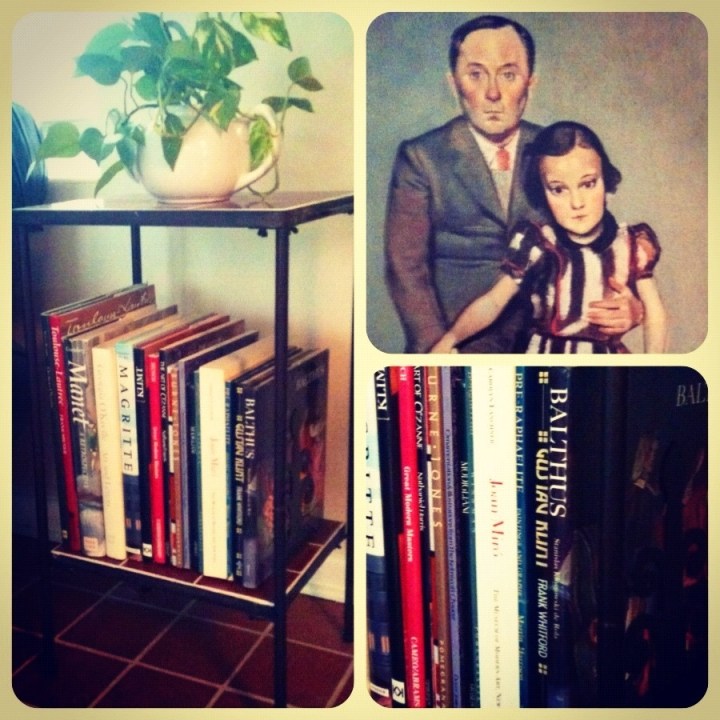
Book shelves series #26, twenty-sixth Sunday of 2012: Some old art books.

This little shelf sits next to a solitary couch in a den/fireplace room that abuts the eat-in kitchen. The shelf is mostly to hold the occasional drink if feet are propped on the coffee table. There are old art books in here, dating back to high school and college, when my wife and I (separately, of course, in those days) still bought lots and lots of art books, before the internet made accessibility to images so ubiquitous. As such, the shelf holds books that reflected our tastes of fifteen, sixteen, seventeen years ago: Lots of Pre-Raphaelite and Romantic stuff (hers) and lots of surrealist/modernist/cubist stuff (mine). Anyway. These rarely get dug out these days. If I want to check out Burne-Jones I usually visit an online gallery.

The portrait of Joan Miro and his daughter in the upper right corner is by the painter who called himself Balthus. I love the painting. It’s deeply creepy but also tender.

The Evil Thief — Albrecht Dürer

Flower Shell — Max Ernst

Apostle Islands/Another Country (Books Acquired, Some Time Last Week)

20120624-101945.jpg

Tommy Zurhellen’s Apostle Islands is forthcoming from indie Atticus. Their write up:

It’s not easy for a messiah to grow up in the Badlands of North Dakota. And it’s even harder for him to share his message when radical ideas and so-called “miracles” are the surest way to get the FBI breathing down your neck. The sequel to Nazareth, North DakotaApostle Islandsfollows Sam Davidson and his group of roughneck followers as they save wedding receptions, cure cancer patients, and boost a flagging fishing season, all while breaking bread and laws and making peace and enemies.

On a mission to change one botched up world, Sam knows he will one day be called to make the ultimate sacrifice, and indeed he sees the writing on the shores of Lake Superior when one of his inner circle betrays him. A playful and delightfully irreverent take on the New Testament, Apostle Islands reveals what it takes to shake up the status quo while paying the price to save the ones you love.

20120624-101953.jpg

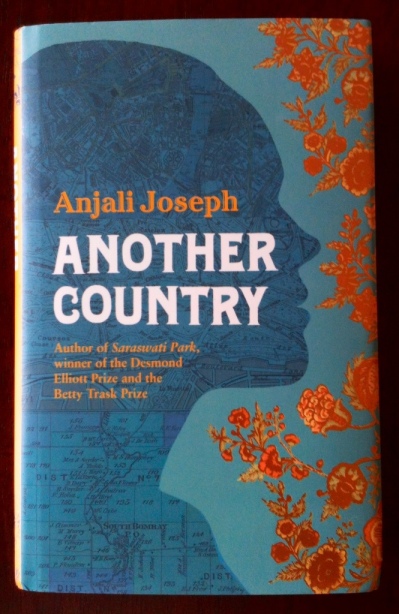
Anjali Josephs’s Another Country also has a map on its cover. This one got a bit of a scathing review in The Guardian last week; the first few pages seem well written though. Blurb:

Paris, London, Bombay: three cities form a backdrop to a journey through Leela’s twenties at the dawn of the new millennium, as she learns to negotiate the world, work, relationships and sex, and find some measure of authenticity. Sharp, funny, and melancholy, Another Country brings a cool eye to friendship, love, and the idea of belonging in its movements through old and new worlds. As with her debut, Saraswati Park (2010), which won the Desmond Elliott Prize, the Betty Trask Prize and India’s Vodafone Crossword Prize, Anjali Joseph’s beautiful, clear writing captures exactly both emotions and surroundings.

Woman Reading (1960) — Pablo Picasso

Boy Cutting Grass with a Sickle — Vincent van Gogh

“I Zimbra” (Live, 1980) — Talking Heads

The Age of Miracles (Book Acquired, 6.08.2012)

20120622-180358.jpg

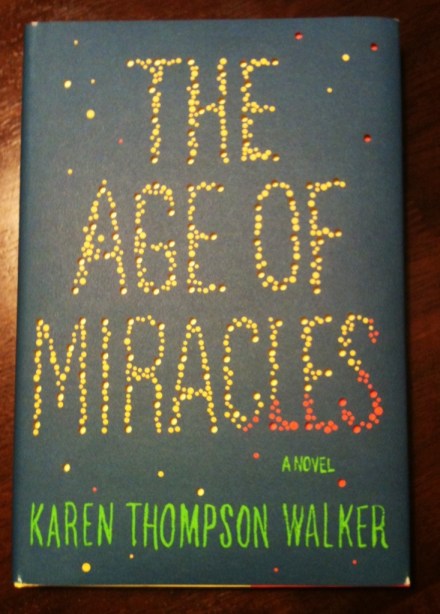
The design folks at Random House has been killing it lately with good hardback designs that integrate dust jackets in handsome ways. Check out what’s under the jacket for The Age of Miracles 

20120622-180407.jpg

I know I should write about what’s in the book, but, jeez, I hate dust jackets so much, so when the designers do something cool or innovative, it’s worth remarking on.

So, what’s in Karen Thompson Walker’s (much buzzed about) debut? Here’s the pub’s copy:

On a seemingly ordinary Saturday in a California suburb, Julia and her family awake to discover, along with the rest of the world, that the rotation of the earth has suddenly begun to slow. The days and nights grow longer and longer, gravity is affected, the environment is thrown into disarray. Yet as she struggles to navigate an ever-shifting landscape, Julia is also coping with the normal disasters of everyday life—the fissures in her parents’ marriage, the loss of old friends, the hopeful anguish of first love, the bizarre behavior of her grandfather who, convinced of a government conspiracy, spends his days obsessively cataloging his possessions. As Julia adjusts to the new normal, the slowing inexorably continues.

Walker’s book has been compared to The Lovely Bones by the publishers (Kakutani compares it favorably as well in her gushy review) as well as Margaret Atwood. I dunno. First 20 pages were not for me. It’s likely the book’s not for me.

Clarice Lispector/Malcolm Braly (Books Acquired 6.22.2012)

20120622-184839.jpg

It’s a sickness. Should I explain that the bookstore is like 1.1 miles from my house? And that it holds somewhere between one and two million books? (No exaggeration). That it’s like three or four buildings  cobbled together in snaking passages, all said passages lined by books? It’s also like .2 miles from the grocery store I/we usually shop at. Which I had to go by to get mozzarella. For make your own pizza night. But of course, I had to stop off and browse. (Is it weird I set the timer on my iPhone? Gave myself 17 minutes?).

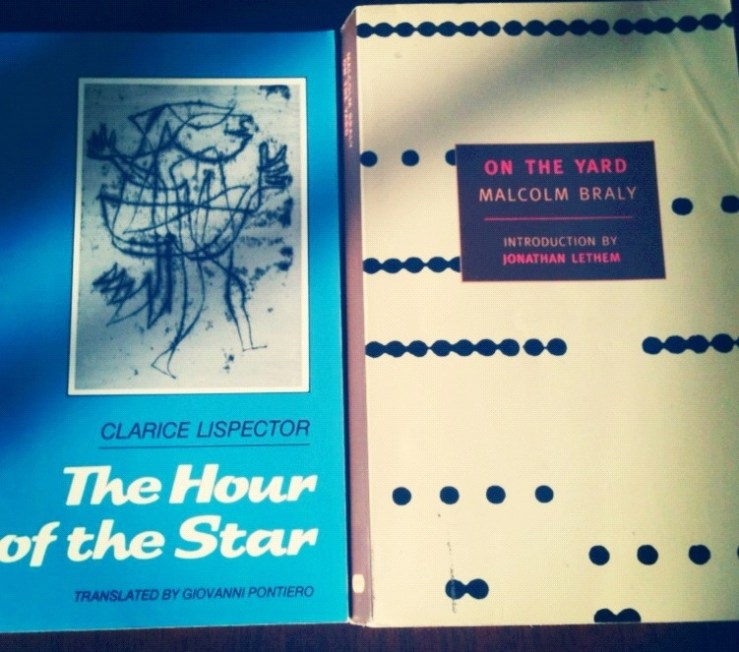
Anyway. Picked up these two.

The Lispector comes via recommendation of Scott Esposito, although this New Directions edition is not the latest translation, but, I dunno. It’s short. The Braly, well, I’d never heard of it, honestly, but it’s an NYRB edition, and the spines of those books always standout, and Lethem introduces it, and even though I haven’t liked Lethem’s last few books, well, he’s still a tastemaker par excellence, and Kurt Vonnegut blurbs it on the back, calling it, “Surely the great American prison novel.” And I just finished “The Part About the Crimes” in 2666 (yet again, more on that to come) and maybe a prison novel seems especially intriguing.

St. Jerome Reading — Giovanni Bellini

I Audit Hilary Mantel’s Bring Up the Bodies (Part 1)

The good people at Macmillan Audio were kind enough to send me a copy of the unabridged audiobook of Hilary Mantel’s Bring Up the Bodies, the highly anticipated sequel to her 2009 Booker prize winner, Wolf Hall. (I loved Wolf Hall, by the way). I’ll be writing about Bring Up the Bodies in brief installments as I audit the book, instead of waiting to complete the whole thing before reviewing (as I usually do) because a) it’s hard to dogear passages from an mp3 and b) the book is pretty damn long (about 24hrs) and c) I’ve yet to read a review of the book that might color my own perceptions.

Bring Up the Bodies—now seems as good a time as any to point out that, hey, that’s just a great title—Bring Up the Bodies picks up right where Wolf Hall left off. Just as that first book throws its audience into the deep end, with one of the more bewildering openings in recent memory, so too does Bring Up the Bodies begin abruptly in media res. Please forgive me if I begin in the middle of things as well—to be clear, it’s not a good idea to jump into Bodies until you’ve read Wolf Hall. And Wolf Hall is worth your time.

It’s 1535 and our protagonist Thomas Cromwell is 50 and starting to feel his age (he laments at one point that he no longer remembers any of the snippets of Welsh he once knew; he can no longer play tennis). His prince, King Henry VIII, is also quickly aging, his body turning to the fat lump that we tend to picture him as these days. An expanding tummy is the least of Henry’s worries, however—and Henry’s worries are Cromwell’s worries. The major plot arc will likely be Henry’s plans to oust his newish bride Anne Boleyn, a repetition of sorts from Wolf Hall, where Henry and Cromwell (mostly Cromwell) worked to annul Henry’s marriage to Queen Katherine. Obviously though, we can’t accuse Mantel of a lack of imagination in crafting her plots. She’s working from history of course, and what’s most amazing about both Wolf Hall and Bring Up the Bodies is how Mantel invigorates that history. Who knew the hoary Tudor saga needed a retelling?

It works here of course because Cromwell is such a fascinating character. Mantel anchors her impeccable free indirect style in Cromwell’s mind, and she channels his intense intellect with sharp grace.  Here’s a remarkable passage that somehow summarizes (broadly, of course) much of Wolf Hall and showcases Mantel’s ability to move her prose seamlessly from exterior to interior,  from how others might see Cromwell to how he might understand himself:

Thomas Cromwell is now about fifty years old. He has a labourer’s body, stocky, useful, running to fat. He has black hair, greying now, and because of his pale impermeable skin, which seems designed to resist rain as well as sun, people sneer that his father was an Irishman, though really he was a brewer and a blacksmith at Putney, a shearsman too, a man with a finger in every pie, a scrapper and brawler, a drunk and a bully, a man often hauled before the justices for punching someone, for cheating someone. How the son of such a man has achieved his present eminence is a question all Europe asks. Some say he came up with the Boleyns, the queen’s family. Some say it was wholly through the late Cardinal Wolsey, his patron; Cromwell was in his confidence and made money for him and knew his secrets. Others say he haunts the company of sorcerers. He was out of the realm from boyhood, a hired soldier, a wool trader, a banker. No one knows where he has been and who he has met, and he is in no hurry to tell them. He never spares himself in the king’s service, he knows his worth and merits and makes sure of his reward: offices, perquisites and title deeds, manor houses and farms. He has a way of getting his way, he has a method; he will charm a man or bribe him, coax him or threaten him, he will explain to a man where his true interests lie, and he will introduce that same man to aspects of himself he didn’t know existed. Every day Master Secretary deals with grandees who, if they could, would destroy him with one vindictive swipe, as if he were a fly. Knowing this, he is distinguished by his courtesy, his calmness and his indefatigable attention to England’s business. He is not in the habit of explaining himself. He is not in the habit of discussing his successes. But whenever good fortune has called on him, he has been there, planted on the threshold, ready to fling open the door to her timid scratch on the wood.

Of course, good fortune is not without its headaches, and Bring Up the Bodies quickly establishes the daily grind of being the king’s chief minister. Cromwell has to worry about the uncertain finances of the kingdom; the plots of the Catholic Church; the ever-present threat of Katherine’s nephew, Charles V, Holy Roman Emperor; Cromwell also has to worry about scheming at court and gossip in the towns. And yet he keeps a level head, even as he appeals to his memories of the late Cardinal Wolsey, who hangs like an ironic ghost over the early chapters of Bring Up the Bodies. (I’m hoping Wolsey’s ghost will continue to haunt the book). It’s when Cromwell turns his sharp mind to a critique of the cleric class (he’d turn out all the abbeys and seize their coffers), or to a flat rebuttal of the concept of confession (“God doesn’t require an intermediary”), or even when he sniffs at Machiavelli as too conservative that we see in Cromwell the advent of modernity.

A quick word on the audio production—it’s great stuff. Reader Simon Vance delivers the tale in a dry, clear cadence that perfectly suits Mantel’s prose. Vance knows when to lean into the ironic inflections that sometimes color Cromwell’s dialogue (both interior dialogue and speech with others), and he employs a range that easily differentiates the other voices that pop up in the narrative without losing a consistent tone. As I’ve stated on this blog many times, a good reader makes all the difference, and Vance is a good reader. More to come.