“The Masters of Cubism” — César Vallejo

“The Masters of Cubism” by César Vallejo (translated by Jason Weiss) is part of a forthcoming collection Selected Writings by César Vallejo, edited by Joseph Mulligan. You can read more selections translated by Weiss at Itineraries of a Hummingbird.

The Masters of Cubism
The Pythagoras of Painting

The greatest contemporary painter is a Spaniard from Málaga:  Picasso.  Next to Picasso and embracing a no less powerful artistic personality is another Spaniard from Madrid:  Juan Gris.  In Paris, the fame of both, at least among the elites of the vanguard, has helped in large part to impose the new painting which under the name of Cubism offers now figures so towering as Braque, Derain, Matisse, Marcoussis, whose works are being celebrated far and wide, that they can almost be considered classics already.  I’ve just now finished reading an article by Sabord where he tells of his surprise on seeing how the cubist revolutionaries are starting to enjoy a popular and absolute consecration, as if they weren’t such revolutionaries.  Every show of decorative models from Parisian shops is currently dominated by the motifs and drawings of Braque, Matisse, Gris, and naturally, Picasso himself.  Generally, starting with the International Exposition of Decorative Arts in 1925, cubism has invaded the world of commerce to a resounding degree.  Cubism has spread to furniture design, luxury goods, architecture, posters, the theater, etc.  The famous and dazzling concert hall the Salle Pleyel has the most old-school polygons.  The ads for the Cook Agency on locomotives haul along entire squads of geometry from les fauves.  People get all caught up trying to locate the characters from Doctor Caligari among the truncated pyramids and the loony bin’s lack of perspective, etc, etc.  The year 1923 marks the apex of Muscovite influence on decorative art in Paris.  Upon this Russian prevalence of taste and heights followed the cubist prevalence of taste and depth, which has now reached its greatest scope.   Okay, fine.  To this irradiation of a new art, profoundly human and, above all, of its time, Picasso and Gris have contributed with ideas and works of the highest order.  An overly patriotic Spaniard might claim that the current cubist prevalence in the Paris fashion industry is in the end a Spanish triumph, since cubism has Picasso and Gris for leaders.

But that’s not why one could think that cubism, on getting around and put within reach of commercial taste, is on the threshold of passing into the domain of the vulgar, that is, by that road it’s on the point of going up in smoke and disappearing, due to the superficiality and coarseness of its trajectory.  The spread of cubism proves only that there breathes a broadly human content, a universal vitality.  This spread is, at the same time, natural and logical.  The great esthetic currents of history have had equal luck and the same consecration.  The works of Picasso and his friends, like the marvels of the Renaissance, will pass into the category of celebrities, not for having descended to the majority of people but rather for having educated those people to the point of making them ascend toward the works and for enclosing there a cosmic rhythm.  We must not forget that there is celebrity and celebrity.  One thing is Paul de Kock and another is Victor Hugo.

Among the first creators of cubism, Gris has toiled away heroically.  Hero against the recalcitrant public and hero against many sectarians of the school itself.  Since his first paintings, Gris has shown a rigorous, mathematical sense of art, against the reigning celestinesque metaphysics.  Gris paints in numbers.  His canvases are real top-grade creations, brilliantly resolved.  Beside other cubists more or less wavering from capitulation or disbelief, Gris preaches and carries out, from the dawn of the new esthetic, around 1908, an intransigent, red, vertical belief.  Nothing of Bergsonism nor of empirical rationalism.  Gris preaches and carries out a conscientious and scientific knowledge of painting.  He wants the painter to know conscientiously what he is painting and to avail himself of a wise technique and vigilant practice, by which he may properly make use of his natural gifts.  His work, in this way, is made of precision, of pure certainty, of Goethean infallibility.  Without sinking in any narrow scholasticism.  Gris always adjusts himself, like the sainted hermit Popes, to the severe and apostolic numbers.  Because of that, the critics have called him the Pythagoras of painting and proclaimed him the initiator of what could be called “pure painting,” like the “pure poetry” of abbé Brémond.  Such appreciations spring up of their own from the serene contemplation of his work, where he strictly practiced the doctrine upheld, shortly before his death, in his conference at the Sorbonne.

Gris has been perhaps the most rebellious painter in Paris.  He was not the sort of artist who compromises out of hunger, or love of fame, or out of “lousy doubts,” as Apollinaire would say.  Gris is always Gris, against aces and queens, even against time and against himself.  And through this rigorous spirit of artistic austerity and through the scientific possession of his creative forces, without unconfessable fog or elaborate and complicit mysteries, Juan Gris will remain the most representative painter of our time.

[Variedades 1069.  Lima, 25 August 1928.]
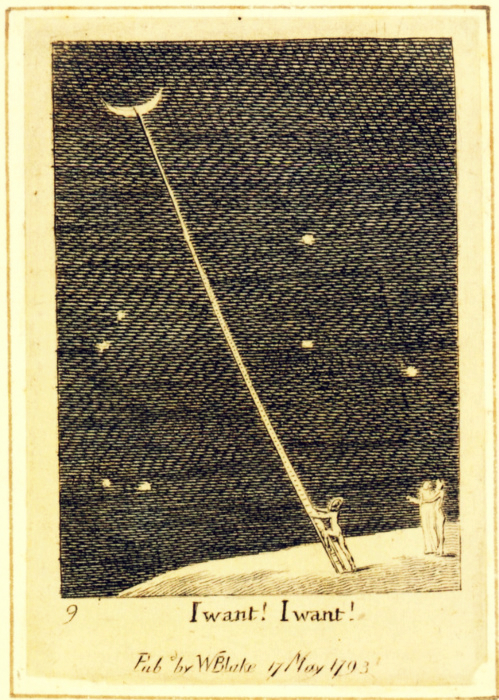
I want! I want! — William Blake

I want blake

Yoko Ogawa’s Revenge Is an Elegant Collection of Creepy Intertextual Tales

revenge

In Yoko Ogawa’s new collection Revenge, eleven stories of fascinating morbidity intertwine at oblique angles. Tale extends into tale: characters, settings, and images float intertextually from chapter to chapter, layering and reticulating themes of death, crime, consumption, and creation. (And revenge, of course. Let’s not forget revenge). Not quite a story cycle or a novel-in-tales, Revenge’s sum is nevertheless greater than its parts. It’s a brisk, engaging read, and as I worked my way to the final story, I already anticipated returning to the beginning to pull at the motifs threading through the book.

The book’s dominant motifs of death and food arrive in the first tale, “Afternoon Bakery,” where a mother tries to buy strawberry shortcakes for her dead son’s birthday—only the baker is too busy bawling to attend to sales. We learn why this baker is crying in “Fruit Juice,” the second story, a tale that ends inexplicably with an abandoned post office full of kiwi fruit. The third story, “Old Mrs.  J” (one of Revenge’s stand-outs) perhaps answers where those kiwis came from. More importantly, “Old Mrs. J,” with its writer-protagonist, elegantly introduces the thematic textual instability of the collection. There’s a  haunting suspicion here that the characters who glide from one tale to the next aren’t necessarily the silent extras they seem to be on the surface. Our characters, background and fore, are doppelgängers, ghost writers, phantoms.

The penultimate tale “Tomatoes and the Full Moon” lays the ghosting bare. Its protagonist is a magazine writer, whose “articles” really amount to little more than advertising. Staying at a seaside resort, he’s pestered by an old woman, one of the many witches who haunt Revenge. The old woman claims to be a novelist, and points out one of her books in the resort’s library:

Later, in my room, I read ‘Afternoon at the Bakery.’ It was about a woman who goes to buy a birthday cake for her dead son. That was the whole story. I should have gone back to my article, but I read her novel through twice, finishing for the second time at 3:00 a.m. The prose was unremarkable, as were the plot an characters, but there was an icy current running under her words, and I found myself wanting to plunge into it again and again.

The final line is perhaps a description of Revenge’s haunting intertextual program—although to be clear, Ogawa’s plot and characters are hardly “unremarkable,” and her prose, in Stephen Snyder’s English translation, is lucid and descriptive. It’s the “icy current running under her words” that makes Ogawa’s tales stick so disconcertingly in the reader’s psychic gullet. And if her prose is at times “unremarkable,” it’s all in the service of creating a unifying tone. All eleven tales are narrated in first-person, and each narrator is bound to the limits of his or her own language.

These limitations of language bump up against the odd, the spectacular, the alien, as in “Sewing for the Heart”:

She had explained that she was born with her heart outside of her chest—as difficult as that might be to imagine.

The line is wonderful in its mundane trajectory: Our narrator, an artisan bagmaker, witnesses this woman who lives with her heart outside her chest and concedes that such a thing might be “difficult . . . to imagine”! There’s something terribly paltry in this, but it’s also purposeful and controlled: Here we find the real in magical realism.

But this bagmaker can imagine, as we see in an extraordinary passage that moves from the phenomenological world of sight and sound and into the realm of our narrator’s strange desires:

She began to sing, but I could not make out the words. It must have been a love song, to judge from the slightly pained expression on her face, and the way she tightly gripped the microphone. I noticed a flash of white skin on her neck. As she reached the climax of the song, her eyes half closed and her shoulders thrown back, a shudder passed through her body. She moved her arm across her chest to cradle her heart, as though consoling it, afraid it might burst. I wondered what would happen if I held her tight in my arms, in a lovers’ embrace, melting into one another, bone on bone . . . her heart would be crushed. The membrane would split, the veins tear free, the heart itself explode into bits of flesh, and then my desire would contain hers—it was all so painful and yet so utterly beautiful to imagine.

Painful and utterly beautiful: Another description of Revenge.

Sometimes the matter-of-fact tone of the stories accounts for marvelous little eruptions of humor, as in “The Last Hour of the Bengal Tiger”:

At fifteen, I took an overdose of sleeping pills. I must have had a good reason for wanting to kill myself, but I’ve forgotten what it was. Perhaps I was just fed up with everything. At any rate, I slept for eighteen hours straight, and when I woke up I was completely refreshed. My body felt so empty and purified that I wondered whether I had, in fact, died. But no one in my family even seemed to have noticed that I had attempted suicide.

The scene is simultaneously devastating and hilarious, an evocation of abyssal depression coupled with mordant irony. The scene also underscores the dramatic uncertainty that underpins so many of the tales, where the possibility that the narrator is in fact a ghost or merely a character in someone else’s story is always in play.

There’s no postmodern gimmickry on display here though. Ogawa weaves her tales together with organic ease, her control both powerful and graceful. Her narrators contradict each other; we’re offered perspectives, glimpses, shades and slivers of meaning. A version of events recounted differently several stories later seems no more true than an earlier version, but each new detail adds to the elegant tangle. Like David Lynch and Roberto Bolaño, Ogawa traffics in beautiful, venomous, bizarre dread. Like those artists, she offers a discrete world we sense is complete and unified, even as our access to it is broken and discontinuous. And like Angela Carter, Ogawa channels the icy current seething below the surface of our darkest fairy tales, those stories that, with their sundry murders and crimes, haunt readers decades after first readings.

What I like most about Revenge is its refusal to relieve the reader. The book can be grisly at times, but Ogawa rarely goes for the lurid image. Instead, the real horror (and pleasure) of Revenge is the anxiety it produces in the reader, who becomes implicated in the crimes cataloged in the text. Witness to first-person narratives that often omit key clues, the reader plays detective—or perhaps accomplice. Recommended.

Revenge is new in handsome trade paperback from Picador; Picador also released Ogawa’s novel Hotel Iris in 2010.

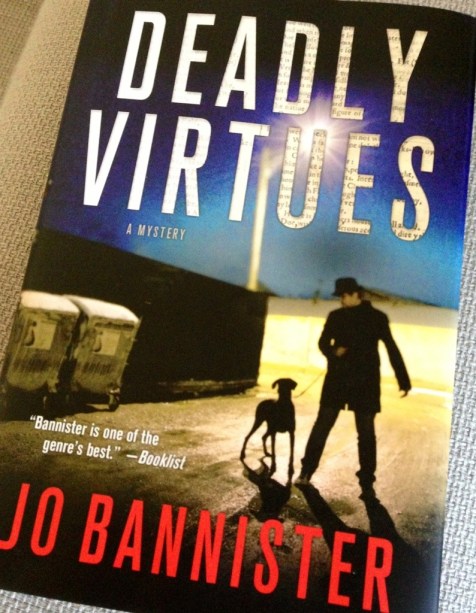
Deadly Virtues (Book Acquired, 3.01.2013)

20130302-105908.jpg

Deadly Virtues, a new mystery from Jo Bannister. Publishers Weekly review:

Stubborn morality and acid-tinged whimsy drive this superior stand-alone from British author Bannister (Liars All and eight other Brodie Farrell mysteries). Recovering mental patient Gabriel Ash looks pathetic and vulnerable as he rambles through the town of Norbold while talking to his dog. One day, at the local police station, where he’s recovering from a beating, Gabriel receives a cryptic message from a man who’s then killed by a crazed prisoner. Gabriel forces himself back into contact with normal humanity because he feels he ought to do something about the crime. Rookie policewoman Hazel Best is also dissatisfied with the official explanation of the tragedy. And so the three—the traumatized beating victim, the idealistic young cop, and the dog—begin sniffing under the pristine surface of the virtually crime-free town. They have no idea how dangerous good intentions can be. Bannister’s plotting is neat and her characterization smooth, with just enough irony to keep people from seeming ostentatiously noble


“Thrawn Janet” — Robert Louis Stevenson

“Thrawn Janet” by Robert Louis Stevenson

The Reverend Murdoch Soulis was long minister of the moorland parish of Balweary, in the vale of Dule. A severe, bleak-faced old man, dreadful to his hearers, he dwelt in the last years of his life, without relative or servant or any human company, in the small and lonely manse under the Hanging Shaw. In spite of the iron composure of his features, his eye was wild, scared, and uncertain; and when he dwelt, in private admonitions, on the future of the impenitent, it seemed as if his eye pierced through the storms of time to the terrors of eternity. Many young persons, coming to prepare themselves against the season of the holy communion, were dreadfully affected by his talk. He had a sermon on I Pet. V. 8, “The devil as a roaring lion,” on the Sunday after every 17th of August, and he was accustomed to surpass himself upon that text both by the appalling nature of the matter and the terror of his bearing in the pulpit. The children were frightened into fits, and the old looked more than usually oracular, and were, all that day, full of those hints that Hamlet deprecated. The manse itself, where it stood by the water of Dule among some thick trees, with the Shaw overhanging it on the one side, and on the other many cold, moorish hilltops rising toward the sky, had begun, at a very early period of Mr. Soulis’s ministry, to be avoided in the dusk hours by all who valued themselves upon their prudence; and guidmen sitting at the clachan alehouse shook their heads together at the thought of passing late by that uncanny neighbourhood. There was one spot, to be more particular, which was regarded with especial awe. The manse stood between the highroad and the water of Dule, with a gable to each; its bank was toward the kirktown of Balweary, nearly half a mile away; in front of it, a bare garden, hedged with thorn, occupied the land between the river and the road. The house was two stories high, with two large rooms on each. It opened not directly on the garden, but on a causewayed path, or passage, giving on the road on the one hand, and closed on the other by the tall willows and elders that bordered on the stream. And it was this strip of causeway that enjoyed among the young parishioners of Balweary so infamous a reputation. The minister walked there often after dark, sometimes groaning aloud in the instancy of his unspoken prayers; and when he was from home, and the manse door was locked, the more daring school-boys ventured, with beating hearts, to “follow my leader” across that legendary spot.

This atmosphere of terror, surrounding, as it did, a man of God of spotless character and orthodoxy, was a common cause of wonder and subject of inquiry among the few strangers who were led by chance or business into that unknown, outlying country. But many even of the people of the parish were ignorant of the strange events which had marked the first year of Mr. Soulis’s ministrations; and among those who were better informed, some were naturally reticent, and others shy of that particular topic. Now and again, only, one of the older folk would warm into courage over his third tumbler, and recount the cause of the minister’s strange looks and solitary life. Continue reading ““Thrawn Janet” — Robert Louis Stevenson”

Woman Reading — Max Weber

woman-reading